
Remote: In February 2020, approximately 5.7% of US workers worked from home on any given day. By April 2020, that figure had reached 62%.
Six years later, we are living in the long hangover of that forced experiment - and the numbers tell a story that is messier, more contested, and more interesting than either the 'remote work revolution' enthusiasts or the 'back to the office' mandate crowd would prefer to acknowledge.
The simple truth in 2026 is that hybrid work won. Not fully remote, not fully in-office, but a negotiated middle ground that varies by industry, seniority, job function, and employer - and that continues to be relitigated almost daily in boardrooms, HR strategy sessions, and awkward all-hands meetings.
The Stanford Institute for Economic Policy Research estimates that 28% of full-time US workers work remotely in some capacity, split roughly between 13% fully remote and 15% hybrid.
That is a enormous structural change from the pre-pandemic baseline, but it is also a significant retreat from the 2021 peak.
What the data reveals, when examined carefully, is a picture of profound economic and social consequences that are still playing out: commercial real estate valued at hundreds of billions of dollars has been effectively stranded, worker preferences and employer imperatives are in genuine conflict, productivity research has produced results that neither side can unambiguously claim, and the geography of the knowledge economy is being redrawn.
Here is what the most recent, well-sourced data shows.
"We have run the largest involuntary experiment in the history of workplace research. The results are not simple and they do not uniformly favor either remote-work advocates or office-mandate advocates. What they show is that context is everything." - Nicholas Bloom, Stanford Institute for Economic Policy Research, 2025
Key Definitions
Fully Remote: An employee who works entirely from a non-employer location - typically home - with no regular requirement to attend an office. Fully remote workers may be 'remote-first' (employer designed for remote) or 'remote-tolerated' (employer grudgingly permits it).
Hybrid Work: An arrangement where employees split working time between a home or remote location and an employer-designated office. Hybrid schedules vary from '1 day per week in-office' to '4 days per week in-office'; there is no industry standard for what constitutes 'hybrid.'
Return-to-Office (RTO) Mandate: An employer directive requiring employees to be physically present in an office for a minimum number of days per week. Major RTO mandates since 2022 have come from Amazon, Apple, Google, Goldman Sachs, JPMorgan Chase, and dozens of other large employers.
Location-Based Pay: A compensation policy in which employee salaries are adjusted based on the cost of living in their physical location, rather than the employer's headquarters location. Applied most aggressively in tech and finance.
Proximity Bias: A documented tendency for managers to rate in-office employees more favorably for promotions, raises, and stretch assignments - independent of actual performance - due to increased visibility and informal interaction.
The Global Distribution of Remote Work
Remote work is far from a uniform global phenomenon. It is concentrated in knowledge-economy sectors - technology, finance, consulting, media, law, and education - and in countries with high rates of computer-based work and strong broadband infrastructure.
In the United States, 28% of full-time workers work remotely in some capacity, per Stanford SIEPR's ongoing tracking survey.[1]
In the United Kingdom, the Office for National Statistics reports that 40% of employed adults worked from home at least some days in 2025, reflecting Britain's high concentration of financial and professional services employment.[12]
Australia's hybrid adoption rate is estimated at 38%, Canada's at 33%.
European rates vary considerably. The Netherlands leads European remote work adoption at approximately 53% of workers working from home at least occasionally, according to Eurofound.[11] The UK, Sweden, and Denmark follow at approximately 40-45%.
Germany and France lag at 28% and 26% respectively, reflecting stronger cultural and regulatory norms around in-person work. Southern and Eastern European countries show lower remote work rates, often below 20%.
In Asia, the picture is more complex. Japan's hybrid adoption rate has grown to approximately 22%, driven by government pressure on large corporations to modernize working practices. Singapore, despite its small geography (eliminating commuting as a major hardship), has an estimated 35% hybrid rate among knowledge workers.
China's post-COVID return to office was faster and more complete than in Western markets, with most large employers requiring full in-office attendance from early 2023 onward.
Across developing economies, remote work remains a small-minority phenomenon. In India, remote work is concentrated in the outsourcing and technology sector, where approximately 18% of workers work hybrid or fully remote. In Brazil, approximately 12% of formal workers work remotely.
Hybrid vs. Fully Remote: The Shift Since 2021
The trajectory since the 2021 peak is unambiguous: fully remote work has declined as a share of the workforce, while hybrid arrangements have grown.
In May 2021, approximately 23% of US workers were fully remote and 9% were hybrid, per BLS/SIEPR data. By Q4 2025, those figures had roughly inverted: 13% fully remote and 15% hybrid. The total share of workers with any remote work has declined from approximately 32% at peak to 28% currently.
This shift reflects both employer RTO mandates and a more nuanced understanding of what workers actually want. Many workers who described their preferred work arrangement as 'fully remote' in 2021 - when the alternative was full-time office work - expressed preference for hybrid arrangements when presented with the actual option.
The trend toward hybrid has been most pronounced in finance, consulting, and professional services. Goldman Sachs, JPMorgan, and most major Wall Street firms have successfully returned their workforces to predominantly in-office schedules, with hybrid flexibility reserved for senior employees.
Law firms and consulting practices have largely followed. Technology companies have been more varied: some, like Apple, Google, and Microsoft, have implemented 3-day-per-week in-office requirements; others, like Shopify, Gitlab, and Automattic, have maintained fully remote-first cultures.
Among fully remote employers, Atlassian's 2025 annual workforce report showed no reduction in employee retention or performance ratings compared to pre-pandemic norms, and represents one of the most carefully documented large-scale examples of fully remote knowledge work functioning effectively at scale.
Productivity: What the Research Actually Shows
The productivity debate around remote work is one of the most contested empirical questions in applied economics and organizational behavior. It is also one of the most frequently misrepresented by advocates on both sides.
Stanford economist Nicholas Bloom's 2022 study - the most cited research in this space - found that call center workers randomly assigned to work from home for 9 months were approximately 13% more productive than control-group office workers, and showed lower attrition.[8]
A follow-up study in 2023 on hybrid arrangements (3 days in-office, 2 days remote) found hybrid workers were approximately 4% more productive on individual tasks and 18% more likely to stay at the company.
However, a 2024 paper by economists Jose Maria Barrero, Nicholas Bloom, and Steven Davis found that fully remote work reduced individual productivity by approximately 10% in roles requiring significant collaboration, mentorship, or knowledge transfer.[9]
The performance penalty was sharpest for younger workers and new hires, who showed significantly lower rates of learning and career advancement in fully remote settings.
Microsoft's 2025 Work Trend Index, drawing on usage data from over 300,000 workers across its corporate customers, found that employees with schedule flexibility rated their personal productivity 20% higher than those with no flexibility.[4]
Critically, Microsoft also found that flexible employees showed higher scores on 'thriving' - a composite of engagement, energy, and meaning at work - a metric correlated with longer-term retention and innovation output.
A 2025 NBER working paper by economists at the University of Chicago found that return-to-office mandates at Fortune 500 companies were associated with a statistically significant increase in senior employee attrition - approximately a 14% increase in departures by workers with the most tenure and the highest outside employment options.
The paper's authors concluded that RTO mandates were effective at reducing headcount for employers looking to downsize, but counterproductive for those seeking to retain top talent.
The honest summary of the productivity literature in 2026 is this: hybrid work (2-3 days in office) produces outcomes roughly equivalent to or slightly better than full-time office work for most knowledge workers in established roles.
Fully remote work shows productivity gains for experienced workers in individual-contributor roles, and productivity costs for roles requiring collaboration and for workers early in their careers.
Salary and Compensation
The financial calculus of remote work for individual employees is more complicated in 2026 than in 2021, when geographic arbitrage - taking a San Francisco salary while living in Nashville - seemed like an unambiguous win.
Payscale's 2025 Compensation Best Practices Report found that remote workers received smaller average merit raises (3.1%) than in-office workers (3.8%) in 2024.[6] The gap was largest in industries where RTO mandates had been most aggressively enforced - finance (+1.1 percentage points difference) and professional services (+0.9 points).
Location-based pay adjustments have become standard practice at many major employers. Meta, Google, Microsoft, and Stripe all have documented policies reducing salaries for employees who relocate to lower-cost markets. The reductions range from 5% to 25% depending on the market differential.
Stripe's publicly documented pay policy, for example, offered a one-time $20,000 payment to remote employees willing to relocate to a major office hub - and salary reductions for those who chose to relocate to cheaper markets instead.
For workers who can access high-paying employers in major markets while living in lower-cost areas - and whose employers do not apply location-based pay - the financial benefit of remote work remains substantial.
A software engineer earning $180,000 in San Francisco but living in Columbus, Ohio effectively gains the equivalent of a significant raise through cost-of-living differences alone, even before accounting for avoided commuting costs (estimated by AAA at $3,600-$12,000 annually for car commuters).
Commercial Real Estate Impact
No sector has felt the structural impact of remote work more acutely than commercial real estate. Office vacancy rates tell the story plainly.
CBRE's US Office Market Report for Q3 2025 placed the national average office vacancy rate at 19.8%, the highest since at least 1993.[5] San Francisco's central business district vacancy exceeded 36% - a stunning figure for a market that was among the tightest in the world in 2018.
Washington DC exceeded 22%, Chicago 23.4%, and New York City 22.8%.
The market is bifurcating sharply. Class A buildings - modern, well-amenitized, located in accessible areas - show significantly lower vacancy rates than older Class B and Class C stock.
Many older office buildings in major US cities are functionally stranded assets: too expensive to operate, too inflexible to convert to residential use without massive capital investment, and insufficiently attractive to fill with tenants even at deep discounts.
Jones Lang LaSalle estimates that between $500 billion and $1.2 trillion of US office real estate value has been effectively impaired by structural demand reduction.[7]
European office markets have been somewhat more resilient - partly because hybrid work penetration is lower and partly because European office buildings tend to be newer and better-configured for modern occupancy patterns. London, Paris, and Amsterdam office vacancy rates are all below 12%.
Office-to-residential conversion has emerged as a policy priority in multiple US cities. New York City, San Francisco, Washington DC, and Chicago have all offered tax incentives or regulatory relief for conversions.
However, structural constraints - the deep floor plates of typical modern office buildings admit insufficient natural light for residential use without major renovation - make conversion far more expensive than building new residential from scratch.
Worker Preferences and the Return-to-Office Conflict
Gallup's 2025 State of the Global Workplace report captured the depth of the tension between employer mandates and worker preferences.[3] Among hybrid workers, 64% said they would actively look for a new job if required to return to full in-office work. Among fully remote workers, 71% said the same.
These are not idle threats. LinkedIn's 2025 Workforce Insights data found that job postings explicitly advertising remote or hybrid work received 2.4x more applications than equivalent roles requiring full in-office work.[10]
The 'remote premium' in job market competition is one of the most robust findings in 2025 labor market data.
Yet worker preferences are not monolithic. Approximately 23% of workers in Gallup's survey preferred full in-office work, citing professional identity, social connection, separation of home and work life, and access to equipment and resources.
Among new graduates and workers in their first 5 years of careers, the preference for at least 3 days in-office is notably higher than the workforce average - consistent with the research showing greater learning and career advancement benefits from in-person presence for early-career workers.
Company culture, individual manager relationships, and commute distance are all stronger predictors of in-office preference than demographic factors alone.
Workers with commutes under 30 minutes show significantly higher rates of in-office preference than those commuting over an hour each way - a finding so intuitive it barely requires documentation, but so often ignored in RTO mandate design that it bears repeating.
Industry-by-Industry Breakdown
| Industry | Remote or Hybrid Share (2025) | Primary Work Mode |
|---|---|---|
| Technology | 58% | Hybrid (3 days in-office common) |
| Finance and insurance | 41% | Hybrid |
| Professional and business services | 38% | Hybrid |
| Education | 24% | Mixed |
| Healthcare and social assistance | 14% | Mostly in-person |
| Retail, hospitality, construction | <10% | In-person |
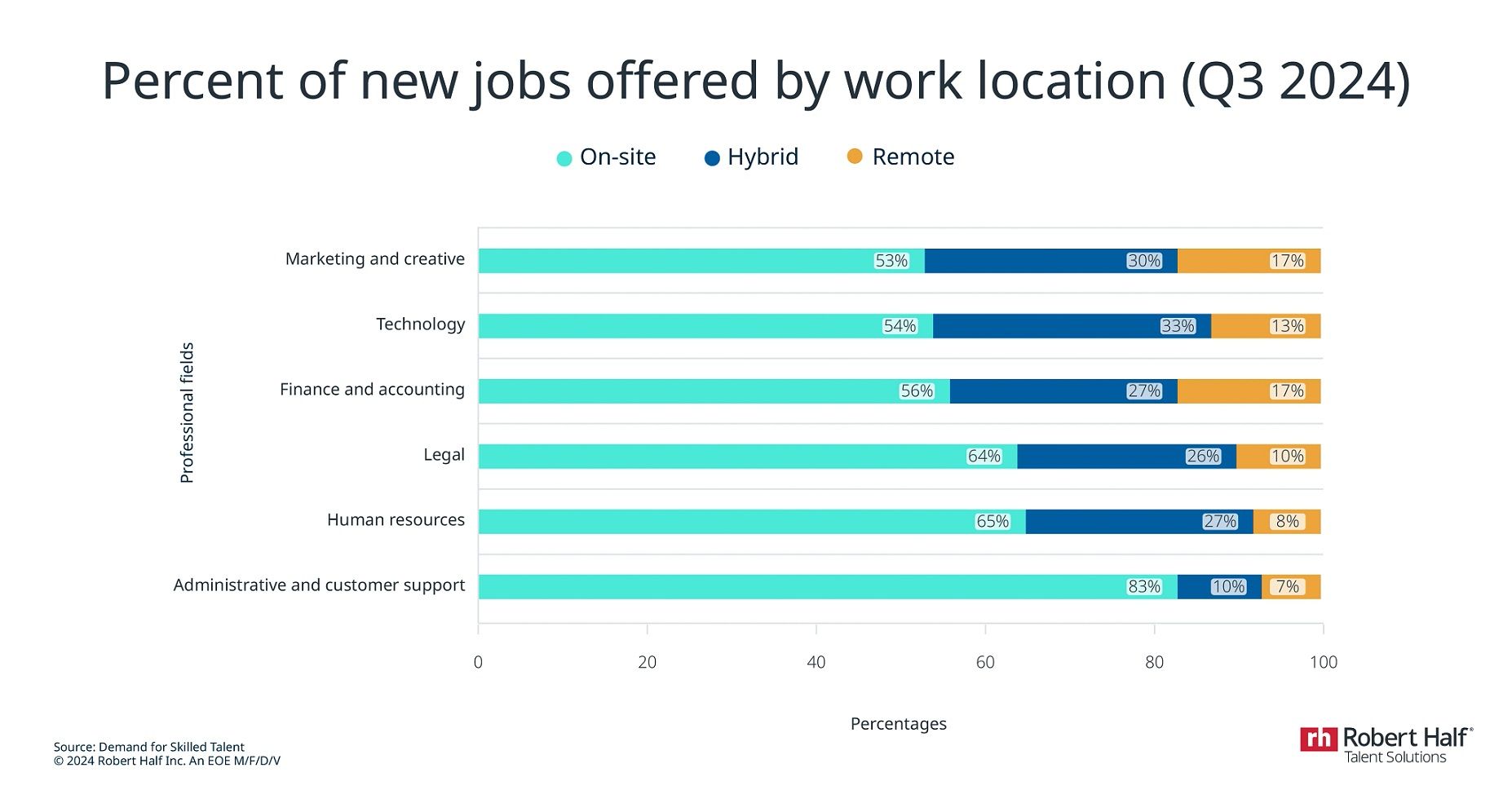
Industry variation in remote work adoption is extreme. Technology remains the most remote-work-permissive sector: approximately 58% of US tech workers work hybrid or fully remote, per the Bureau of Labor Statistics 2025 occupation survey.[2] Finance and insurance follow at 41%.
Professional and business services at 38%. Education at 24%. Healthcare and social assistance at 14%. Retail, hospitality, transportation, construction, and manufacturing are all below 10% - reflecting the physical-presence nature of those jobs.
Within technology, there are notable company-level divisions. Fully remote-first companies like Gitlab (which has operated with zero offices for most of its existence), Automattic (the company behind WordPress.com), and Zapier continue to demonstrate that large, complex software companies can operate without central offices.
Their voluntary attrition rates compare favorably to in-office peers. Conversely, Apple has been among the most aggressive RTO mandate enforcers in tech - requiring 3 days per week in-office as of 2022 and maintaining that standard - and has not seen the significant talent exodus that some predicted.
Government employment has largely returned to in-person. The US federal government, a major employer of white-collar workers, has seen agency-by-agency variation, though the broad direction since 2023 has been toward expanded in-office requirements. State and local governments vary widely.
Practical Implications
For workers, the data suggests that hybrid arrangements offer the best of both worlds when designed thoughtfully - and that fighting for hybrid rather than fully remote may be the more defensible long-term position in most organizations.
Early-career workers in particular should weigh the learning and visibility benefits of in-person time against the convenience of remote work.
For employers, the most consistent finding in the research is that flexibility - not necessarily any particular arrangement - is the strongest predictor of worker satisfaction and retention.
Rigid RTO mandates issued without employee input show the highest associated attrition, while hybrid arrangements with genuine schedule flexibility show the best retention outcomes.
For policymakers and urban planners, the commercial real estate data demands serious attention. Office vacancy rates at 20%+ in major city centers represent a structural problem that market forces alone will not solve on any reasonable timeline.
Conversion subsidies, zoning reform, and infrastructure investment in affected districts are all active policy questions in multiple US and European cities.
Sources & Further Reading
- Stanford Institute for Economic Policy Research / Bloom, N. (2025). Working From Home Around the Globe: 2025 Report. wfhresearch.com.
- Bureau of Labor Statistics. (2025). American Time Use Survey 2025. bls.gov.
- Gallup. (2025). State of the Global Workplace 2025 Report. gallup.com.
- Microsoft. (2025). Work Trend Index 2025: Annual Report. microsoft.com.
- CBRE. (2025). US Office Market Statistics Q3 2025. cbre.com.
- Payscale. (2025). Compensation Best Practices Report 2025. payscale.com.
- Jones Lang LaSalle. (2025). Global Real Estate Perspective 2025. jll.com.
- Bloom, N., Han, R., & Liang, J. (2023). How Hybrid Working From Home Works Out. National Bureau of Economic Research Working Paper 30292.
- Barrero, J.M., Bloom, N., & Davis, S.J. (2024). The Evolution of Working From Home. Journal of Economic Perspectives.
- LinkedIn. (2025). Global Talent Trends 2025. linkedin.com.
- Eurofound. (2025). Telework and ICT-Based Mobile Work: Flexible Working in the Digital Age. eurofound.europa.eu.
- Office for National Statistics UK. (2025). Homeworking in the UK Labour Market 2025. ons.gov.uk.