
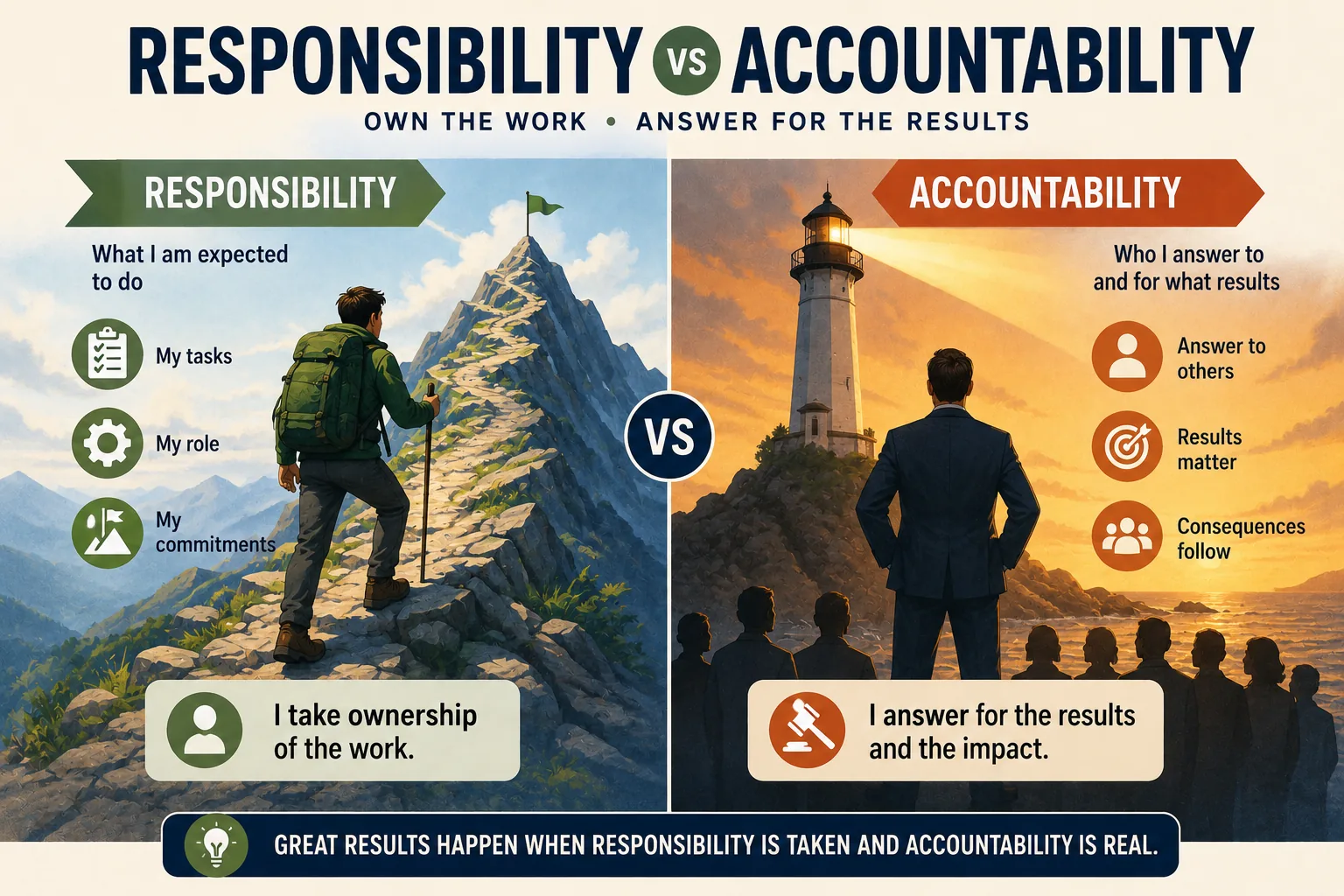
Responsibility: These two words are routinely treated as synonyms. They're not. Understanding the difference is fundamental to organizational clarity, effective governance, and avoiding dysfunction that looks like leadership but produces blame-shifting and paralysis.
Table of Contents
- The Core Distinction
- Why This Confusion Matters
- Responsibility: Duty to Execute
- Accountability: Answerability for Outcomes
- The RACI Framework
- When Responsibility and Accountability Align
- When They Diverge
- The Delegation Problem
- Organizational Dysfunction Patterns
- Building Clarity Systems
- Case Studies
- Practical Application
- References
The Core Distinction
Responsibility is about doing; accountability is about owning. Many people can share responsibility for different parts of a task, but accountability for the outcome rests with one person. Confusing the two produces organizations where everyone was responsible and no one was accountable.
Accountability is commonly defined as the obligation to account for and answer for the execution of one's responsibilities.
At its simplest:
| Dimension | Responsibility | Accountability |
|---|---|---|
| Core Meaning | Duty to complete tasks | Answerability for outcomes |
| Nature | Task-oriented | Results-oriented |
| Scope | Can be shared across many people | Typically singular per outcome |
| Focus | Execution | Ownership |
| Question Answered | "Who does the work?" | "Who owns the result?" |
| Delegation | Can be fully delegated | Cannot be fully delegated |
| Multiplicity | Many people can be responsible for parts | One person accountable for whole |
The fundamental difference:Responsibility is about doing. Accountability is about owning.
You can be responsible for writing code, conducting research, managing a budget, or coordinating a team. These are activities-duties you carry out.
You are accountable when you must answer for whether the code works, whether the research produces valid conclusions, whether the budget delivers value, whether the team achieves its mission. Accountability is about facing the consequences-good or bad-of the outcome.
Why This Confusion Matters
The High Cost of Ambiguity
When organizations conflate these terms, predictable dysfunction emerges:
1. Diffused Ownership: No one truly owns outcomes. Everyone is "responsible," which often means no one is accountable.
2. Blame Shifting: When failures occur, people point to others: "I did my part; they didn't do theirs."
3. Poor Decision Rights: Unclear who has authority to make calls when tradeoffs arise.
4. Learning Failures: Without clear accountability, organizations can't identify decision-makers to learn from success or failure.
5. Coordination Breakdown: Multiple "responsible" parties with no single owner produces conflict, duplication, and gaps.
The Illusion of Shared Accountability
Organizations often declare "we're all accountable for this outcome." This sounds egalitarian and team-oriented. In practice, it means no one is accountable.
Consider a product launch that fails. If the entire team is "accountable," who answers for it? The engineers say marketing didn't position it. Marketing says the product wasn't ready. Product says leadership set unrealistic timelines.
Leadership says the team didn't execute. Everyone has a story. No one owns the outcome.
Accountability must be singular. You can have many responsible parties contributing to an outcome, but one person must be unambiguously answerable for whether it succeeds or fails.
As Patrick Lencioni writes in The Five Dysfunctions of a Team, "Without accountability, even the most talented teams will fall short of their potential because they protect individuals at the expense of team results."[1]
Responsibility: Duty to Execute
What Responsibility Means
Responsibility is the obligation to perform tasks or duties. It's about execution-the work that must be done.
| Characteristic | Description |
|---|---|
| Task-Focused | Defined by activities, not outcomes |
| Distributable | Can be shared across multiple people |
| Delegatable | Can be fully handed off to others |
| Role-Based | Often tied to job descriptions |
| Measurable by Effort | Did you do what you were supposed to do? |
Examples of responsibility:
- A software engineer is responsible for writing clean, tested code
- A researcher is responsible for conducting experiments according to protocol
- A project manager is responsible for updating the project plan
- A sales rep is responsible for making customer calls
- A CFO is responsible for preparing financial reports
Notice these are all activities-things people do. They can be done well or poorly, but the focus is on execution.
The Limits of Responsibility
Responsibility alone doesn't create ownership. You can fulfill your responsibilities perfectly and still produce failure:
- Engineers write excellent code for a product no one wants
- Researchers execute flawless studies that ask the wrong questions
- Project managers maintain pristine schedules for initiatives that deliver no value
- Sales reps make hundreds of calls using terrible scripts
- CFOs produce accurate reports that obscure critical risks
Being responsible doesn't mean owning the outcome. It means doing your part.
Accountability: Answerability for Outcomes
What Accountability Means
Accountability is the obligation to answer for outcomes and consequences. It's about ownership-being answerable for whether something succeeds or fails, regardless of who does the work.
Political scientist Margaret Bovens defines it precisely: "Accountability is a relationship between an actor and a forum, in which the actor has an obligation to explain and to justify his or her conduct, the forum can pose questions and pass judgement, and the actor may face consequences."[9]
| Characteristic | Description |
|---|---|
| Outcome-Focused | Defined by results, not activities |
| Singular | One person answerable per outcome |
| Non-Delegatable | Can delegate tasks but remain accountable |
| Authority-Linked | Must have decision rights to be accountable |
| Measurable by Results | Did the desired outcome happen? |
Examples of accountability:
- A product manager is accountable for whether the product meets market needs
- A research director is accountable for whether studies produce valid, actionable insights
- A project leader is accountable for whether the initiative delivers business value
- A sales director is accountable for revenue targets
- A CFO is accountable for financial health and regulatory compliance
Notice these are all outcomes-results that someone must own. The accountable person may not personally do all the work, but they must answer for whether it succeeds.
The Weight of Accountability
Accountability carries consequences:
If the outcome succeeds: The accountable person earns credit, recognition, advancement, or rewards.
If the outcome fails: The accountable person faces criticism, loss of trust, career damage, or removal.
This asymmetry-both upside and downside-is what makes accountability real. If there are no consequences for failure, accountability is performative.
The Authority Requirement
You cannot be accountable without authority. If you must answer for an outcome but lack the power to make decisions that affect it, you have responsibility without authority-a recipe for dysfunction.
The accountable person must have:
- Decision rights: Authority to make calls when tradeoffs arise
- Resource control: Ability to allocate budget, people, or time
- Veto power: Ability to stop actions that undermine the outcome
- Visibility: Access to information needed to assess progress
Without these, "accountability" becomes blame assignment without empowerment.
The RACI Framework
The most widely used tool for clarifying roles is the RACI matrix, which distinguishes four types of involvement:
| Role | Meaning | Description |
|---|---|---|
| R - Responsible | Does the work | People who execute tasks; can be multiple per task |
| A - Accountable | Owns the outcome | Person who must answer for results; only one per task |
| C - Consulted | Provides input | Experts whose opinions inform decisions; two-way communication |
| I - Informed | Kept updated | Stakeholders who need to know progress; one-way communication |
RACI Example: Product Launch
| Task | Product Manager | Engineering | Marketing | Sales | Finance | CEO |
|---|---|---|---|---|---|---|
| Define product requirements | A | C | C | C | I | I |
| Build product | C | A (Tech Lead) | I | I | I | I |
| Create launch plan | C | I | A | C | I | I |
| Execute launch campaign | I | I | R | R | I | I |
| Achieve revenue target | I | I | C | A | C | I |
| Overall product success | A | R | R | R | C | C |
Key principles:
- One A per row: Only one person accountable for each outcome
- Multiple Rs allowed: Many can be responsible for execution
- Cs provide input: Consulted parties have expertise that informs decisions
- Is stay informed: Informed parties need awareness but not input
- A doesn't always equal R: The accountable person often doesn't do the work
Common RACI Mistakes
| Mistake | Why It's Problematic | Fix |
|---|---|---|
| Multiple As | Diffuses accountability; no one truly owns outcome | Designate one A; others become C or R |
| No A | No ownership; unclear who decides | Assign exactly one A |
| A without authority | Person blamed but can't control outcome | Grant decision rights or reassign A |
| Too many Cs | Slows decisions; consensus paralysis | Limit to essential expertise |
| R without resources | Tasks assigned without support | Provide budget, time, or people |
When Responsibility and Accountability Align
For individual contributors working on discrete tasks, responsibility and accountability often align. You're both doing the work (responsible) and owning the outcome (accountable).
Individual Alignment Examples
| Context | Person | Responsibility | Accountability |
|---|---|---|---|
| Freelance designer | Solo contractor | Design the website | Deliver a working, attractive site |
| Doctoral student | PhD candidate | Conduct research | Produce a defensible dissertation |
| Solo entrepreneur | Founder | Build product, sell, support | Company success or failure |
| Individual seller | Account executive | Make sales calls | Hit quota |
Why alignment works here: The person doing the work also owns the outcome. There's no separation between execution and ownership.
The Clarity Benefit
When one person is both responsible and accountable:
- Decision-making is fast: No need to coordinate
- Ownership is clear: Success or failure is unambiguous
- Learning is direct: Feedback loops are tight
- Motivation is high: Direct connection between effort and outcome
This is why small teams and startups often move faster than large organizations-fewer layers between responsibility and accountability.
When They Diverge
In organizations with division of labor, responsibility and accountability routinely diverge. This isn't inherently bad-it enables scale and specialization-but it requires systems to maintain clarity.
Organizational Divergence Examples
| Context | Accountable Person | Responsible Parties |
|---|---|---|
| Product launch | Product Manager | Engineers, designers, marketers, sales reps |
| Financial audit | CFO | Accounting team, external auditors, legal counsel |
| Software release | Engineering Manager | Developers, QA engineers, DevOps, security team |
| Marketing campaign | CMO | Copywriters, designers, media buyers, analysts |
| Hospital patient care | Attending Physician | Nurses, residents, specialists, pharmacists |
Why divergence happens: Complex outcomes require specialized work from many people. One person must own the result, but many contribute to achieving it.
Managing the Divergence
When accountability and responsibility separate, organizations need:
1. Clear Decision Rights: The accountable person must have authority to make calls: "We're launching on this date." "This feature is out of scope." "We're reallocating budget here."
2. Coordination Mechanisms: Responsible parties need ways to synchronize: stand-ups, shared dashboards, clear interfaces.
3. Escalation Paths: When responsible parties conflict or miss commitments, the accountable person must be able to intervene.
4. Feedback Loops: The accountable person needs visibility into execution: metrics, updates, early warnings.
5. Consequence Systems: Both the accountable owner and responsible contributors must face outcomes-positive or negative-of results.
The Delegation Problem
The Accountability Paradox
You can delegate responsibility, but you cannot delegate accountability.
When a leader assigns tasks to their team, they're delegating responsibility (the duty to execute). But the leader remains accountable for the outcome-they must still answer for whether it succeeds or fails.
This is why "I delegated it" is never an acceptable excuse for failure in leadership. As is commonly argued in management literature, a manager who believes delegation absolves them of accountability has misunderstood managerial work: you can share the load, but not the answerability.
Three Delegation Scenarios
| Scenario | What's Delegated | What Remains |
|---|---|---|
| Task delegation | Responsibility for specific activities | Accountability for outcome; oversight duty |
| Authority delegation | Decision rights within boundaries | Accountability for decisions made; boundary enforcement |
| Outcome delegation | Both responsibility and accountability (with authority) | Accountability for choosing the right person; systems-level ownership |
Example: Project failure
- A VP assigns a project to a director
- The director fails to deliver
- The VP is still accountable-they chose the director, set expectations, provided resources, monitored progress
- "I delegated it" doesn't absolve the VP; it explains the mechanism of failure
Why Leaders Remain Accountable
Leaders are accountable for:
- Selection: Choosing capable people
- Clarity: Setting clear expectations
- Resources: Providing what's needed to succeed
- Oversight: Monitoring progress and intervening when needed
- Systems: Building structures that enable success
- Judgment: Knowing when to intervene vs. when to trust
Delegation transfers execution, not ownership.
Organizational Dysfunction Patterns
When responsibility and accountability are confused or poorly defined, predictable patterns emerge:
Pattern 1: Diffusion ("Everyone is accountable")
Symptom: No one person owns outcomes; "shared accountability" for results.
Consequence:
- When things fail, everyone has an excuse
- No one can be held answerable
- Decision-making by committee; slow and risk-averse
- Blame-shifting becomes the dominant behavior
Real-world example: Cross-functional initiatives where multiple VPs are "co-accountable" for success. When it fails, each points to constraints the others created.
As Brene Brown has noted, blame is "simply the discharging of discomfort and pain."
Pattern 2: Responsibility Without Authority
Symptom: People assigned tasks but lack power to make decisions that affect outcomes.
Consequence:
- "Accountable" in name only-can't control what they're answerable for
- Constant escalation to get permission
- Frustration and learned helplessness
- Good people leave
Real-world example: Project managers "accountable" for timelines but with no authority over resource allocation or scope changes.
Pattern 3: Accountability Without Consequences
Symptom: People designated "accountable" but face no real downside for failure.
Consequence:
- Accountability becomes performative-a label, not reality
- No skin in the game produces poor decisions
- Systems drift toward mediocrity
- Culture of excuses rather than ownership
Real-world example: Executives "accountable" for strategy who remain in role after repeated failures because they're well-connected or untouchable.
The resulting culture normalizes mediocrity: when leadership escapes consequences, everyone else adjusts their expectations downward.
Pattern 4: Responsibility Gaps
Symptom: Critical tasks have no one assigned to execute them.
Consequence:
- Work falls through cracks
- Reactive firefighting rather than proactive execution
- Unclear who should step in
Real-world example: Customer support issue routing where no team owns a particular class of problems.
Pattern 5: Too Many Layers
Symptom: Multiple levels between those doing work and those owning outcomes.
Consequence:
- Slow information flow
- Distorted understanding of reality
- Decision-makers disconnected from execution
- "Telephone game" dysfunction
Real-world example: Corporate hierarchies where frontline realities don't reach executives who are accountable for strategy.
Building Clarity Systems
Effective organizations build systems to maintain clarity about who's responsible, who's accountable, and how they relate.
Principle 1: One Accountable Owner Per Outcome
Rule: Every outcome must have exactly one person who is unambiguously answerable for whether it succeeds or fails.
How to implement:
- Use RACI or similar framework
- Make accountability explicit in job descriptions
- Link compensation and evaluation to outcomes owned
- Publicly designate owners for strategic initiatives
Principle 2: Authority Matches Accountability
Rule: Anyone accountable for an outcome must have decision rights and resource control commensurate with that accountability.
How to implement:
- Grant budget authority to those accountable for results[14]
- Give veto power over actions that undermine outcomes
- Ensure access to necessary information
- Remove blockages to decision-making
Principle 3: Clear Interfaces Between Responsible Parties
Rule: When multiple people are responsible for pieces of an outcome, define how they coordinate.
How to implement:
- Document handoffs: "Engineering delivers to QA on Thursdays"
- Create shared dashboards for visibility
- Establish regular synchronization (stand-ups, weekly reviews)
- Define escalation paths for conflicts
Principle 4: Feedback Loops from Execution to Ownership
Rule: Accountable owners need real-time visibility into execution by responsible parties.
How to implement:
- Metrics dashboards showing progress
- Regular status updates (written or verbal)
- Early warning systems for risks
- Direct access to frontline information (not just summaries)
Principle 5: Consequences for Outcomes
Rule: Accountability requires both upside and downside tied to results.
How to implement:
- Link compensation to outcomes (bonuses, equity, profit-sharing)
- Make success and failure visible (public recognition or accountability)
- Tie career progression to track record
- Remove people from accountability roles after repeated failures
Principle 6: Responsible Parties Have What They Need
Rule: People responsible for tasks must have resources, clarity, and support to execute.
How to implement:
- Provide adequate budget, tools, and time
- Ensure clear expectations and priorities
- Remove blockers and distractions
- Support skill development
Case Studies
Case Study 1: NASA and Challenger (Accountability Failure)
Context: The 1986 Challenger disaster killed seven astronauts when O-rings failed during launch.
Responsibility: Engineers at Thiokol (the contractor) were responsible for certifying the O-rings were safe. They recommended delaying the launch due to cold weather concerns.
Accountability: NASA managers were accountable for the launch decision. They overruled the engineers and proceeded.
Dysfunction: The people accountable for the outcome (managers) were not the people with technical expertise (engineers). The accountable party ignored the responsible party's warnings.
Outcome: Catastrophic failure. The Rogers Commission found the decision-making process flawed-accountability was diffused across multiple layers, and the accountable managers lacked technical grounding to make informed decisions.[5]
Lesson: Accountability without expertise, and decision-making disconnected from responsibility, produces disaster.
Case Study 2: Amazon's "Single-Threaded Owner" Model (Accountability Success)
Context: Amazon assigns a "single-threaded owner" (STO) to major initiatives-one person accountable for success.
Responsibility: The STO doesn't do all the work. They coordinate engineering, design, marketing, operations-many responsible parties.
Accountability: The STO owns the outcome. If it fails, they answer for it. If it succeeds, they get credit.
Clarity: Everyone knows who owns what. Decision rights are clear. Escalations go to the STO. Metrics are tied to the owner.
Outcome: Faster decision-making, clearer ownership, better learning from failure.
Lesson: Singular accountability with distributed responsibility enables scale without diffusion.
Case Study 3: Wells Fargo Fake Accounts (Accountability Without Consequences)
Context: Thousands of employees created fake accounts to meet sales quotas. Over 5,000 employees were fired. Senior executives, including the CEO, claimed they didn't know.
Responsibility: Branch-level employees and managers were executing the scheme.
Accountability: Senior executives were accountable for the culture, systems, and outcomes of the retail banking division. They set the quotas, designed the incentives, and monitored performance.
Dysfunction: The accountable executives faced minimal consequences initially. The CEO eventually resigned but with a massive severance. The people "responsible" (frontline workers) were fired, while the accountable leaders who created the incentive structure were protected.
Outcome: Massive reputational damage, regulatory fines, loss of trust. Congress and regulators demanded accountability from the top.
Lesson: Accountability is hollow if the accountable party doesn't face consequences proportional to the harm.
Practical Application
For Individuals: Clarifying Your Role
| Question | Purpose |
|---|---|
| Am I responsible, accountable, or both? | Understand what's expected |
| If accountable, do I have authority? | Ensure you can control the outcome |
| If responsible, who is accountable? | Know who owns the result |
| What decisions can I make alone? | Clarify decision rights |
| Where must I consult or inform others? | Avoid surprises or conflicts |
| What are the success criteria? | Know how you'll be judged |
| What happens if I succeed or fail? | Understand consequences |
For Leaders: Assigning Roles
| Action | Why It Matters |
|---|---|
| Designate one accountable owner per outcome | Avoid diffusion |
| Grant authority commensurate with accountability | Enable ownership |
| Clarify who's responsible for execution | Ensure work gets done |
| Document decision rights | Prevent conflicts |
| Establish feedback loops | Keep accountable owners informed |
| Tie consequences to results | Make accountability real |
| Review and adjust | Fix breakdowns quickly |
For Teams: Maintaining Clarity
| Practice | Benefit |
|---|---|
| Use RACI for key initiatives | Explicit role clarity |
| Review roles when things go wrong | Identify breakdowns |
| Update RACI when team changes | Prevent gaps |
| Escalate ambiguity immediately | Don't let confusion fester |
| Celebrate clear ownership | Reinforce culture |
The Philosophical Dimension
Responsibility as Moral Duty
In ethics, responsibility often refers to moral duty-obligations we have regardless of whether we're assigned them. You have a responsibility not to harm others, to tell the truth, to help those in distress (in some ethical frameworks).
This is different from organizational responsibility, which is contractual and role-based.
Accountability as Answerability
Accountability in governance and ethics means being answerable to others-explaining and justifying your actions and decisions.
This requires:
- Transparency: Others can see what you did
- Standards: Clear criteria for judgment
- Consequences: Outcomes matter
Without these, "accountability" is rhetoric, not reality.
The Tension
Organizations work best when:
- Responsibility is distributed (many do the work)
- Accountability is concentrated (one owns the outcome)
But morally, this can feel unfair: "Why should I be accountable for others' failures?"
The answer: Because you had the authority and chose the team, set the strategy, designed the systems, and allocated the resources. Leadership means owning not just your actions but the outcomes your decisions produce.
Conclusion
Responsibility is about doing. Accountability is about owning.
Responsibility can be shared. Accountability must be singular.
Responsibility is task-focused. Accountability is outcome-focused.
You can delegate responsibility. You cannot delegate accountability.
When organizations confuse these terms, dysfunction follows: blame-shifting, unclear ownership, slow decisions, and failure to learn.
When they clarify them-one accountable owner per outcome, authority matching accountability, clear interfaces for responsible parties-they enable speed, learning, and real ownership.
The distinction matters because outcomes matter. Someone must own them. That someone is accountable.
Research Evidence: What Accountability Structures Predict About Performance
The academic literature on accountability and responsibility has moved from descriptive frameworks to empirical studies that identify which accountability structures produce better outcomes across organizational types. Several research programs have produced findings that challenge common assumptions.
Tetlock's research on accountability, summarized in his 1999 paper "Accountability Theory: Mixing Properties of Human Agents with Properties of Social Systems" (Annual Review of Psychology), established a crucial distinction between accountability that improves decision quality and accountability that merely increases decision defensibility.
When decision-makers know in advance what their audience values and must account for their decisions to that audience, accountability pressure increases cognitive effort and reduces some biases-a positive effect.
But when decision-makers are uncertain about their audience's values, or when the audience's values are themselves biased, accountability pressure produces "preemptive self-criticism" and conformism rather than improved reasoning.
The practical implication: accountability systems that specify clear, known standards for evaluation produce better decisions than accountability systems that create uncertainty about what criterion will be applied.
Research by Brian Hall and Kevin Murphy, published in the Journal of Economic Perspectives (2003), examined the accountability function of executive compensation design.
They found that CEO compensation packages that loaded heavily on restricted stock (requiring executives to hold the stock for multi-year periods) produced significantly different strategic behavior than packages loaded with stock options.
Restricted stock created genuine accountability for long-term outcomes-executives couldn't cash out before consequences materialized.
Options created accountability primarily for short-term stock price performance, incentivizing investments with high option value (high variance bets) over investments that steadily built firm value.
The study demonstrates that responsibility and accountability are separable even at the highest organizational levels: CEOs could be responsible for making strategic decisions while being accountable (via compensation structure) for only a fraction of the consequences those decisions produced.
A natural experiment from the healthcare sector provides evidence on accountability's effects in high-stakes decisions.
Researchers studying outcomes in surgical teams (Edmondson, Bohmer, and Pisano, 2001, Administrative Science Quarterly) found that teams with clear accountability structures-where the attending surgeon was unambiguously accountable for patient outcomes and had the authority to manage team processes accordingly-adapted to new surgical techniques (minimally invasive cardiac surgery) significantly faster and with better patient outcomes than teams with ambiguous accountability.
Teams where accountability was diffused across multiple senior surgeons showed slower learning curves and worse initial outcomes, even when controlling for baseline surgical skill.
The mechanism was that clear accountability created clear decision rights, which enabled faster real-time problem-solving when the team encountered the inevitable complications of a new technique.
The contrast between the UK's Grenfell Tower fire (2017) and subsequent regulatory response illustrates accountability failure at a systems level. The fire killed 72 people in a social housing tower block in London.
The subsequent public inquiry, chaired by Sir Martin Moore-Bick, found a cascade of accountability failures: the building's management organization (KCTMO) was responsible for maintenance but not clearly accountable for safety outcomes; the local council was accountable for housing policy but had delegated operational responsibility to KCTMO without maintaining oversight; the regulatory system for building safety had multiple agencies with overlapping jurisdictions but no single entity clearly accountable for ensuring the system worked as a whole.
Each organization could point to another's responsibility for the specific failures.
The Hackitt Review (2018), which followed the inquiry, proposed a restructured regulatory system with a new national Building Safety Regulator explicitly accountable for system-level outcomes-directly applying the lesson that accountability must be singular and cannot be distributed across multiple parties without losing its functional properties.
The Jeff Bezos "Two-Pizza Teams" and Single-Threaded Ownership: Evidence from Amazon's Organizational Experiment
Amazon's organizational design principles represent one of the most deliberately documented experiments in accountability structure in the corporate world.
Jeff Bezos's shareholder letters, collected and published in Invent and Wander (2021), articulate a theory of organizational accountability that directly addresses the responsibility-accountability distinction and provides a large-scale natural experiment in its implementation.
Bezos introduced the "two-pizza teams" principle-that teams should be small enough to be fed by two pizzas-as a structural response to the accountability diffusion he observed in larger organizational units.
His diagnosis: as teams grew, individual accountability for outcomes weakened because no single person could maintain clear ownership of the team's work.
The two-pizza constraint was not primarily about communication efficiency (the commonly cited rationale) but about preserving clear accountability: if a team is small enough, it is impossible to hide accountability in organizational complexity.
The "single-threaded leader" (STL) or "single-threaded owner" (STO) principle, introduced in Bezos's 2010 letter, went further: for any significant initiative, one person must be accountable for its success and must have no other significant responsibilities.
The "single-threaded" metaphor captures the accountability principle precisely: the leader's attention and authority are not divided across multiple initiatives, so there is no organizational cover when things go wrong.
Bezos described the principle explicitly: "We need to remove the word 'shared' from our vocabulary. Shared ownership means no ownership."
Amazon's growth from approximately 33,700 employees in 2010 to over 1.5 million by 2022 provides a scale test of the principle's durability.
The organizational structure created by the STL principle-sometimes called the "service-oriented architecture" at the organizational level-enabled Amazon to maintain relatively fast decision-making and clear accountability despite scale that normally degrades both.
Research by Harvard Business School professor David Garvin, who studied Amazon's organizational practices in 2013, found that the STL structure produced measurably faster product development cycles and higher rates of shipping new products relative to development investment than comparable technology companies with more conventional organizational structures.
The accountability structure also shapes how Amazon handles failure. Bezos's letters describe a consistent practice of distinguishing between "Type 1" decisions (irreversible, high-stakes, requiring senior accountability and deliberate process) and "Type 2" decisions (reversible, lower-stakes, which should be delegated to the STL without escalation).
The distinction is a formal acknowledgment that accountability should scale with irreversibility: decisions that cannot be undone if wrong require clear senior accountability, while reversible decisions should not consume senior accountability capacity that is better directed toward irreversible choices.
The limitation of the Amazon model is also instructive. The STL principle creates clear accountability but does not resolve all responsibility-accountability tensions.
Amazon's treatment of warehouse workers-subject to intense performance monitoring, high injury rates, and algorithmic management that makes human supervisory judgment secondary-reflects a different accountability calculus: STLs are accountable for throughput metrics and are given tools and authority to optimize those metrics, but responsibility for worker welfare is distributed across HR, safety teams, and regulatory compliance functions without a clear STL equivalent.
The measurable outcome-Amazon's workplace injury rates have consistently exceeded industry averages, documented in multiple Bureau of Labor Statistics reports-illustrates that accountability structures produce what they measure and incentivize, and leave unmeasured or unaccountable dimensions systemically underweighted.
About This Series: This article is part of a larger exploration of decision-making, governance, and organizational clarity. For related concepts, see Ethical Decision-Making Explained, Corporate Governance Explained, How Values Shape Decisions, and RACI Matrix Implementation.
Sources & Further Reading
Lencioni, P. (2002). The Five Dysfunctions of a Team: A Leadership Fable. Jossey-Bass.
Explores how lack of accountability undermines teams.Katzenbach, J. R., & Smith, D. K. (1993). The Wisdom of Teams: Creating the High-Performance Organization. Harvard Business Review Press.
Discusses role clarity and accountability in high-performing teams.Jacobs, R. W. (1997). Real-Time Strategic Change. Berrett-Koehler.
Examines ownership and accountability in organizational change.Smith, D., & Alexander, R. (1999). Fumbling the Future: How Xerox Invented, Then Ignored, the First Personal Computer. iUniverse.
Case study of accountability failures in innovation.Rogers Commission Report (1986). Report of the Presidential Commission on the Space Shuttle Challenger Accident.
Detailed analysis of accountability breakdowns in the Challenger disaster.Vaughan, D. (1996). The Challenger Launch Decision: Risky Technology, Culture, and Deviance at NASA. University of Chicago Press.
Explores how organizational culture diffused accountability.Bezos, J. (2016). Amazon Shareholder Letters. Amazon.
Describes single-threaded ownership model.U.S. House Committee on Financial Services (2016). Holding Wall Street and Washington Accountable: Examining Wells Fargo's Opening of Unauthorized Customer Accounts. Hearing.
Investigation into accountability failures at Wells Fargo.Bovens, M. (2007). "Analysing and Assessing Accountability: A Conceptual Framework." European Law Journal, 13(4), 447-468.
Theoretical framework for understanding accountability.Dubnick, M. J. (2003). "Accountability and Ethics: Reconsidering the Relationships." International Journal of Organization Theory & Behavior, 6(3), 405-441.
Explores the relationship between accountability, responsibility, and ethics.Gray, B., & Larson, G. S. (2018). "When Accountability Knocks, Will Anyone Answer?" In The Oxford Handbook of Organizational Paradox. Oxford University Press.
Examines paradoxes of accountability in organizations.Stone, D., & Heen, S. (2014). Thanks for the Feedback: The Science and Art of Receiving Feedback Well. Viking.
Discusses responsibility for outcomes and accepting feedback.Mulgan, R. (2000). "'Accountability': An EverExpanding Concept?" Public Administration, 78(3), 555-573.
Traces the evolution and expanding use of "accountability" in governance.Grant, R. W., & Keohane, R. O. (2005). "Accountability and Abuses of Power in World Politics." American Political Science Review, 99(1), 29-43.
Discusses accountability mechanisms in governance.Schillemans, T. (2016). "Calibrating Public Sector Accountability: Translating Experimental Findings to Public Sector Accountability." Public Management Review, 18(9), 1400-1420.
Evidence-based approaches to accountability systems.