
Democracy: April 6, 2010. That's the morning Viktor Orban's Fidesz party won a supermajority in the Hungarian parliament, 68% of seats on just 53% of the popular vote, a gap made possible by an electoral system that translated plurality advantage straight into legislative dominance.
With that supermajority in hand, Fidesz moved. They rewrote Hungary's constitution. Packed the Constitutional Court with loyalists. Restructured the electoral system to make future supermajorities more likely. Systematically bought or pressured the major media outlets into compliance.
By 2020, Freedom House had reclassified Hungary. Not a democracy anymore. A "hybrid regime," the first EU member state to fall out of the democratic category. Here's the unsettling part: none of the steps Fidesz took were illegal, under laws it was simultaneously rewriting.
Orban never staged a coup. He won an election, then used the tools available to any democratic winner to systematically dismantle the constraints on his own power.
Hungary is the sharpest example of what political scientists now call "democratic backsliding," the erosion of democratic norms and institutions not through violence or military intervention, but through the patient, legalistic exercise of power by leaders who arrived in office legitimately.
This is the central finding running through political science research on democratic decline: we're living through a period defined not by dramatic coups, but by slow strangulation.
Steven Levitsky and Daniel Ziblatt's "How Democracies Die" (2018), built on comparative historical research and case studies of contemporary backsliding, named the pattern directly. Elected leaders undermine democratic constraints step by step. Each step individually defensible. The collective process visible only in retrospect.[1]
Freedom House's annual "Freedom in the World" report has documented seventeen consecutive years of net global decline in political rights and civil liberties, as of its 2023 edition.[10]
The Varieties of Democracy, or V-Dem, Institute at the University of Gothenburg runs a data series covering nearly all countries back to 1900. What they're finding now, Anna Luhrmann and Staffan Lindberg (2019) called it a "third wave of autocratization," is gradual democratic erosion affecting roughly a quarter of the world's population. The most people hit by autocratization since the peak of the Cold War.[11]
Is this an existential crisis for liberal democracy, or a manageable correction from the optimistic highs of the 1990s? That part's genuinely contested. What's no longer contested: the direction of travel, over the past fifteen to twenty years, has been consistently wrong.
"How does a democracy die? In countries like Venezuela, Turkey, and Hungary, the threat has come not from generals and soldiers but from elected governments themselves. Democratic backsliding today begins at the ballot box." - Steven Levitsky and Daniel Ziblatt, How Democracies Die (2018)
| Region | 2006 Democracy Score | 2023 Democracy Score | Trend |
|---|---|---|---|
| Western Europe | High (stable) | High (some erosion in Hungary/Poland) | Stable with exceptions |
| Eastern Europe | Rising | Mixed (Hungary backsliding) | Diverging |
| Latin America | Mixed | Mixed (Brazil recovery; Venezuela decline) | Unstable |
| Sub-Saharan Africa | Low-medium | Low-medium (coups in Sahel) | Stagnant/declining |
| Asia-Pacific | Mixed | Mixed (India declining; Taiwan/South Korea stable) | Diverging |
| Middle East/North Africa | Low | Low (Arab Spring reversed) | Persistently low |
Key Definitions
A handful of terms keep showing up in this discussion, and they're worth pinning down before going further. Start with democratic backsliding: the gradual, incremental erosion of democratic norms, institutional constraints, and civil liberties by elected governments. Usually through legal means, without any formal military intervention or suspension of elections.
The broader process behind that is autocratization, a political regime moving away from democracy toward authoritarianism. The V-Dem Institute draws a useful line here between "autocratization," a gradual process, and "democratic breakdown," a sudden collapse. Most contemporary cases, they note, are gradual.[2]
Electoral authoritarianism describes something more specific: a system that keeps the formal appearance of competitive elections while systematically tilting the playing field, through control of media, manipulation of electoral rules, selective prosecution of opponents, intimidation.
Two norms matter a lot in this literature. Mutual toleration is Steven Levitsky and Daniel Ziblatt's term for democratic opponents treating each other as legitimate rivals, not existential enemies whose success would be catastrophic. When that norm erodes, it's an early warning sign of democratic stress.
Institutional forbearance is the companion norm: political actors choosing not to use every legal power available to them at maximum extent, preserving informal constraints on behavior. The convention against court-packing that historically held in the US, despite no constitutional prohibition against it, is the textbook example.
Populism is a political logic, analyzed extensively by Cas Mudde and Cristobal Kaltwasser, that pits a unified "virtuous people" against a corrupt "elite," with the populist leader claiming exclusive authority to speak for the people. It's compatible with both left and right politics. But it tends to treat institutional constraints as obstacles standing between the people and their will.
And liberal democracy, the system combining competitive elections with protection of civil liberties, minority rights, rule of law, and institutional constraints on executive power. That combination isn't inevitable, either. Electoral competition can exist without liberal protections, that's electoral authoritarianism. Liberal protections can coexist with limited suffrage too, as in historical oligarchic liberalism.
The Data: What the Indices Show
Measuring democracy is technically complex and politically contentious at once. Different indices operationalize democracy differently, weight components differently, produce somewhat different country rankings. They converge on one thing, though: the overall picture of recent decline.
Freedom House has produced annual assessments of political rights and civil liberties since 1973. Its methodology scores countries on a 1-7 scale for both political rights and civil liberties, combining them into a status of "Free," "Partly Free," or "Not Free."
Here's what the 2023 report found: only 43% of the world's population lives in countries rated "Free." That's the lowest share in the report's history. Down from 46% in 2005.
Forty countries declined in scores in 2022. Only nineteen improved. Seventeen consecutive years of net decline, the longest sustained backsliding trend the organization has ever recorded.
The V-Dem Institute's Varieties of Democracy dataset took fifteen years to build, developed by Luhrmann, Staffan I. Lindberg, and hundreds of country specialists. It's the most comprehensive democracy dataset that exists.
Over 400 indicators, organized into five core principles: electoral, liberal, participatory, deliberative, egalitarian democracy.
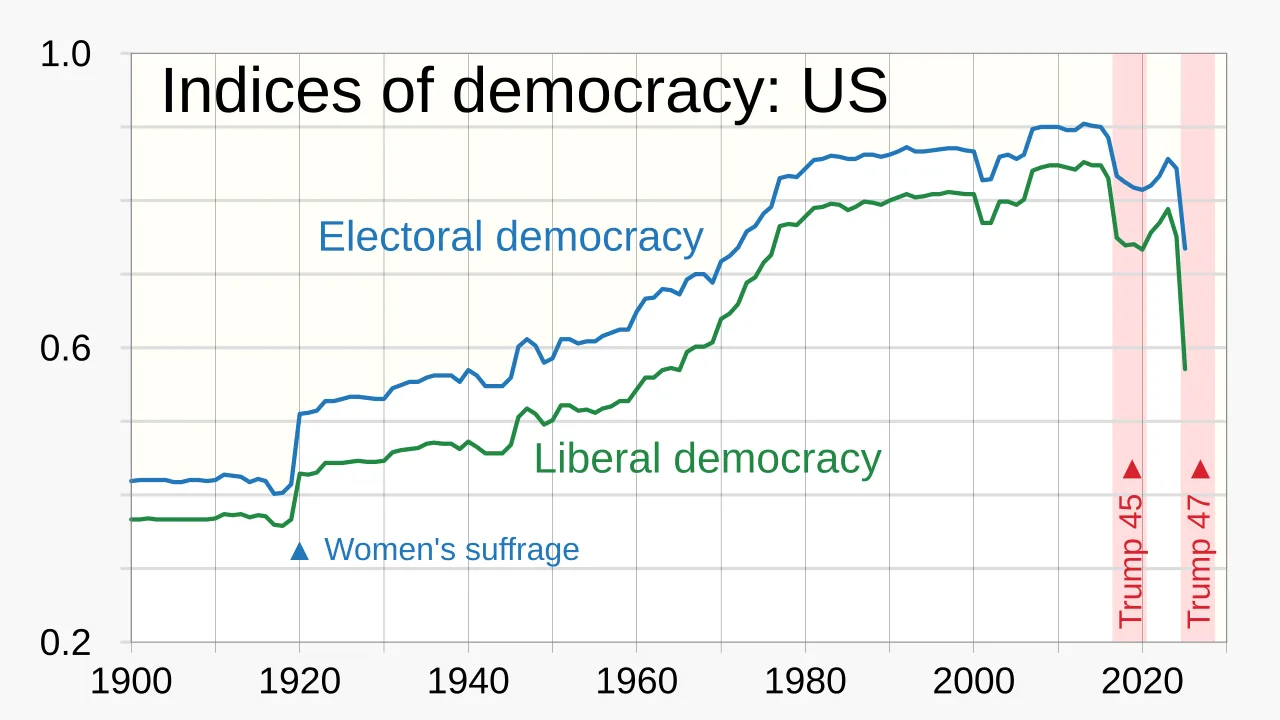
The V-Dem Liberal Democracy Index shows sharp declines in Hungary, Turkey, India, Brazil under Bolsonaro, the Philippines under Duterte. Even the US shows measurable decline on some sub-indices during 2017-2021.
What makes the index useful is its granularity. Researchers can pin down exactly which dimensions of democracy are deteriorating in a given country. Often executive constraints and media freedom erode first.
The Economist Intelligence Unit's Democracy Index tells a similar story. In its 2022 edition, only 24 countries qualified as "full democracies," home to just 8.0% of the world's population. 59 were "flawed democracies." 36 were "hybrid regimes." 57 were "authoritarian regimes."
Larry Diamond at Stanford coined the term "democratic recession" in his influential 2015 article in the Journal of Democracy. His argument runs two ways. Part of the recession reflects the fragility of third-wave democracies, the ones established after 1989, often without the institutional depth older democracies had built up over time.
And part of it reflects something newer: effective authoritarian learning. Autocrats studying each other, figuring out how to consolidate power while keeping up a democratic facade.[3]
How Democracies Actually Die: The Erosion Pattern
A coup. Tanks in the streets. A suspended constitution. That's the dramatic version of democratic collapse, and it was the dominant mode of democratic failure through most of the twentieth century.
Most of the breakdowns in the middle decades of that century were coups. Since the end of the Cold War, though, the dominant mode has shifted entirely.
Levitsky and Ziblatt identify two key "guardrails" that have historically protected democracy in practice, separate from anything written into formal constitutional design.
The first is mutual toleration: the norm that political opponents treat each other as legitimate rivals, not existential enemies who have to be defeated by any means necessary.
Here's where it breaks down. Once opponents get characterized as criminals, foreign agents, traitors, threats to the nation's existence, rather than legitimate competitors for power, the informal constraint against using every available legal and institutional tool to neutralize them just dissolves.
The second guardrail is institutional forbearance: political actors choosing not to use every power technically available to them, which preserves the informal constraints no constitution can fully specify.
A governing party can, legally, pack courts. Exploit procedural rules to block opponents. Maximize the electoral advantage of redistricting. Use prosecutorial authority selectively. But conventions against doing any of that, if widely respected, constrain behavior more effectively than a formal prohibition would, precisely because they don't need enforcement.
These norms erode in a way that's individually justifiable at every step, but collectively corrosive.
Anna Grzymala-Busse at Stanford has studied exactly this kind of institutional erosion across post-communist Europe. Governing parties gradually hollow out public institutions, civil service, courts, regulatory agencies, by replacing career officials with political loyalists, rewriting procurement rules to favor party-connected businesses, directing state resources toward political supporters.[12]
Each individual step has a plausible justification dressed up in the language of reform and efficiency. The collective effect is turning public institutions into partisan instruments.
The Hungary Case Study
Hungary is the most complete transformation of an EU democracy into what Orban himself calls an "illiberal democracy." Fidesz won its supermajority in 2010, and from there the playbook unfolded fast.
Start with the courts. The Constitutional Court got expanded from eleven to fifteen members, which handed Fidesz four immediate loyalist appointments in one move. Then the retirement age for justices dropped, which conveniently pushed out the experienced holdovers. Electoral districts got redrawn too, carved up to heavily favor Fidesz geographically.
The pattern kept going outside the courts. The Electoral Commission picked up Fidesz-appointed members. Fidesz allies went and bought up major media outlets. Public broadcasting turned into something closer to a party mouthpiece than a news service. Independent outlets that stayed critical faced harassment and regulatory action, and even major companies felt unofficial pressure not to advertise in them.
Academic freedom took a hit next, through legislation aimed squarely at the Central European University, eventually forced to move its US-accredited programs out to Vienna entirely. Civil society organizations ran into funding restrictions and public stigmatization on top of that.
And the judiciary itself got restructured, through a brand-new administrative court system staffed with Fidesz loyalists, built specifically to handle cases involving the government.
Here's what all that machinery produced by the 2022 elections: Fidesz won 54% of votes but took 68% of seats. Orban's critics point to that gap as proof the playing field has tilted so thoroughly that fair competition isn't really possible there anymore.[9]
The EU has launched infringement proceedings against Hungary on rule of law grounds, and frozen real structural funding over it. None of that has loosened Fidesz's grip on Hungarian institutions one bit.
The Role of Populism
Populism, the political logic that pits a unified, virtuous "people" against a corrupt "elite," with the populist leader claiming to be their authentic voice, has become the single most common vehicle for contemporary democratic erosion.
Cas Mudde at the University of Georgia and Cristobal Kaltwasser at the Catholic University of Chile have done the most rigorous academic work on populism as a political phenomenon.
Mudde defines populism as a "thin-centered ideology." It provides a basic moral frame, pure people versus corrupt elite[6], but needs to attach itself to something else, nationalism, socialism, Christian democracy, to actually flesh out policy content.
That thinness matters. It's what makes populism ideologically flexible. Left populism (Hugo Chavez, Bernie Sanders, Jean-Luc Melenchon) and right populism (Viktor Orban, Donald Trump, Jair Bolsonaro, Marine Le Pen) share the same people-versus-elite frame. They just differ on which elite gets targeted and which people get valorized.
Here's what both sides share, though: a challenge to intermediary institutions. Parties, courts, media, expert bureaucracies, all treated as obstacles standing between the people's will and the leader who embodies it.
That's exactly where populism creates real democratic risk. Courts that constrain executive action aren't guardians of rule of law in the populist frame. They're elites blocking the will of the people.
Independent media isn't a democratic check either. It's part of the corrupt elite, lying to the public. Delegitimize constraint this way, and you've created the political permission for exactly the kind of institutional erosion Levitsky and Ziblatt document.
Pippa Norris at Harvard has argued, using comparative survey data, that economic insecurity and perceived status decline drive most populist voting.
Her "cultural backlash" thesis, developed with Ronald Inglehart in "Cultural Backlash" (2019), holds that authoritarian-populist parties draw disproportionate support from older, less educated, non-urban voters. People who've experienced both economic decline and cultural marginalization as social liberal values became dominant among educated urban elites.[7]
Thomas Ferguson's investment theory of politics adds a structural piece to this: populist movements often get bankrolled by specific business elites, oil, coal, real estate, finance, whose interests line up neatly with weakening regulatory and labor institutions.
India, Turkey, and Brazil: Three Case Studies
Beyond Hungary, three large democracies show different variants of the same backsliding pattern.
India under Narendra Modi and the BJP has shown consistent decline on V-Dem's liberal democracy and civil liberties measures since 2014. Freedom House downgraded India from "Free" to "Partly Free" in 2021.
Pull apart the specific concerns and a pattern emerges. Start with the Citizenship Amendment Act of 2019, which creates a pathway to citizenship based on religion, in ways critics argue are structurally discriminatory. Then there's the Foreign Contribution Regulation Act, restricting civil society organizations directly.
Media has consolidated in the meantime, marginalizing critical outlets. Sedition and anti-terrorism laws have gotten used against journalists and activists. And on top of all that, Jammu and Kashmir's special status got revoked outright.
India's scale makes this trajectory especially consequential. It's the world's most populous democracy, long held up as proof that democracy can function in diverse, poor societies.
The BJP disputes calling any of this anti-democratic. Their position: these are legitimate security and development policies, nothing more.
Turkey's transformation under Erdogan has gone further. The AKP won its first election in 2002 on a platform of EU-aligned democratic reform.
By the mid-2010s, that had changed completely. A failed coup in 2016 gave Erdogan the pretext for sweeping purges of the military, judiciary, civil service. Turkey had moved clearly into hybrid regime territory by then.
The V-Dem Liberal Democracy Index shows a steep decline starting around 2013. Press freedom indices now rank Turkey among the most restrictive environments for journalism anywhere in the world.
Brazil under Jair Bolsonaro (2019-2022) tells a different kind of story: attempted backsliding that ultimately failed. Picture the textbook playbook Bolsonaro ran. Delegitimize electoral institutions before the vote even happens. Refuse to commit to accepting the results. Set the stage for a contested outcome no matter what the count says.
He lost to Luiz Inacio Lula da Silva in October 2022. His supporters stormed the Brazilian Congress, Supreme Court, and presidential palace in January 2023, an event that closely echoes the January 6, 2021 Capitol assault in the US.
But Brazilian democratic institutions held. The military didn't back an attempt to overturn the election. Courts functioned. Lula was inaugurated. The Brazilian case shows both how vulnerable democracies are to elected authoritarian leaders, and how much institutional and elite consensus matters in actually resisting backsliding.
Youth, Polarisation, and Democratic Support
Yascha Mounk and Roberto Stefan Foa's 2016 paper "The Danger of Deconsolidation" in the Journal of Democracy reported something alarming: declining support for democracy among younger cohorts across Western countries, drawing on World Values Survey data from 1994-2014.[4]
Younger Americans, they found, were substantially less likely than older cohorts to consider living in a democracy "essential." More open to non-democratic alternatives too, including military rule. The paper generated real attention. And real pushback.
Erik Voeten at Georgetown, Pippa Norris, and others pushed back directly, arguing Mounk and Foa's findings were sensitive to measurement choices and question wording. Alternative analyses, they said, showed high and stable support for democracy as a concept among young people in Western countries.
One piece of the original finding has held up better, though: declining confidence in democratic institutions specifically. Surveys consistently show younger voters trusting parliaments, parties, electoral processes less. But that mostly reflects frustration with democratic performance. Not a preference for authoritarian alternatives.
Milan Svolik's experimental research turns up something more troubling. He embedded descriptions of candidates with norm-violating behaviors, calling opponents criminals, calling for restrictions on media, claiming authority to ignore court rulings, into hypothetical candidate profiles, then asked respondents whether they'd still vote for their preferred party's candidate anyway.[5]
Americans, he found, significantly discounted anti-democratic behavior when it came from their own party. Especially when partisan polarization was already running high.
In the most polarized settings, roughly two-thirds of voters prioritized partisan policy preferences over actually enforcing democratic norms. That points to something important: polarization isn't just a symptom of democratic stress. It's a mechanism that makes democratic erosion politically feasible in the first place.
What Can Be Done: The Research on Democratic Resilience
Political science research on democratic survival and recovery offers a few genuinely useful insights.
Start with Erica Chenoweth and Maria Stephan's "Why Civil Resistance Works" (2011). They found something striking: non-violent civil resistance campaigns have historically run about twice as successful as violent resistance at achieving political change. Campaigns that sustain participation from roughly 3.5% of the population, picture a sea of ordinary people, not armed fighters, filling a city square week after week, have never once failed to achieve their objectives.[8]
For democratic resistance, that's cautiously encouraging. Sustained mass non-violent mobilization actually works against authoritarian consolidation.
Arend Lijphart looked at a different lever entirely: institutional design. His comparative research on consensus democracy, proportional representation, coalition governments, federal arrangements, strong minority rights protections, suggests these choices genuinely affect democratic resilience. Consensus-based systems tend toward greater stability.
Here's the catch, though: institutional design is path-dependent. Hard to change once it's set in place. The US majoritarian system has deep structural roots that make proportional reform politically impractical, almost regardless of its merits on paper.
Steven Levitsky and Lucan Way took a third angle, looking at international ties. Their research on competitive authoritarianism ("Competitive Authoritarianism," 2010) finds that linkage to democratic powers, economic integration with established democracies, institutional ties to them, significantly improves democratic prospects in transitional countries.
The EU's role in constraining backsliding among candidate and member countries has historically been substantial. Limited, Hungary shows that clearly. But substantial nonetheless.
Real cases of democratic reversal after backsliding are instructive, if limited in number. Poland's 2023 elections rank among the most significant recent examples, bringing a pro-democratic coalition to power after eight years of Law and Justice rule.
What happened next is the real lesson here. The new coalition walked into office and found courts, electoral commissions, and public media all packed with loyalists who simply refused to recognize its authority. That's the asymmetry sitting at the heart of all this: democratic erosion moves fast, achievable through purely legal means.
Democratic restoration moves slow, forced to either win cooperation from loyalist appointees or pick constitutional fights that themselves risk looking anti-democratic.
The American Question
The United States sits oddly inside the global democratic decline narrative. A long-established democracy with deep institutional roots. One that still showed measurable deterioration on multiple democratic indices during 2017-2021, and has lived through unprecedented levels of political polarization and institutional stress.
Levitsky and Ziblatt spend a substantial portion of "How Democracies Die" on the American case. Their argument: the US survived the twentieth century partly because partisan guardrails, mutual toleration and institutional forbearance, held up even during periods of intense political conflict.
They trace the erosion of those norms back to the 1990s, starting with Newt Gingrich's congressional strategy, accelerating through the 2000s and 2010s, and culminating in what they call unprecedented norm violations during the Trump presidency.
The January 6 Capitol assault was a democratic stress test with no real precedent in American history.
Political scientists still actively argue about whether American democratic institutions came out of 2016-2021 stronger or weaker. What's clear is that the institutions held in 2020-2021. Courts rejected post-election challenges. State officials certified accurate results. The military stayed out of it entirely.
Would the same hold under different conditions, with different people in key positions? That's a question whose answer depends on contingent factors political science simply can't resolve in advance.
The political polarization Svolik's research identifies as the central mechanism of democratic vulnerability is, by most measures, more intense in the US right now than at any point since the Civil War. And it's not some temporary aberration that resolves on its own. It's a structural feature of the electoral system itself: geographic sorting, primary system incentives, a fragmented media ecosystem.
Perspectives on the Democratic Recession
Not every analyst agrees democracy is in deep trouble. Steven Pinker and others argue the current decline follows an extraordinary expansion that was never likely to last forever, and that the underlying forces supporting democracy, economic development, education, urbanization, remain genuinely powerful.
On that reading, what's happening now is regression toward a mean. Not a secular collapse.
Lucan Way at the University of Toronto argues the "democratic recession" framing overstates the threat. His point: most countries registering decline were competitive authoritarian regimes to begin with, not established democracies, and the established democracies of the OECD remain stable.
That's technically correct. But it may understate how much partial backsliding inside established democracies, the US, Hungary, actually matters, and what global authoritarian momentum means for democratic norms internationally over the longer run.
Here's what the research most robustly supports: democratic institutions don't protect themselves automatically. They depend on active defense, from citizens, from civil society, from opposition parties, and crucially from elite actors inside governing coalitions who choose to prioritize institutional preservation over short-term advantage.
Every historical case of successful democratic defense shares one thing in common. Enough people, in enough positions, chose the institution over the party.
Inequality feeds directly into this story too, it's a major driver of the polarization and populism discussed throughout this piece; Why Inequality Is Growing digs into that connection. Disinformation and AI are reshaping democratic discourse in ways that compound the same pressures, covered in What Will AI Do to Society.
And for the deeper philosophical grounding behind all of this, What Is Political Philosophy is worth a look.
Sources & Further Reading
- Levitsky, Steven and Daniel Ziblatt. How Democracies Die. Crown, 2018.
- Lührmann, Anna and Staffan I. Lindberg. "A Third Wave of Autocratization Is Here: What Is New About It?" Democratization 26(7): 1095-1113, 2019. DOI: 10.1080/13510347.2019.1582029
- Diamond, Larry. "Facing Up to the Democratic Recession." Journal of Democracy 26(1): 141-155, 2015.
- Mounk, Yascha and Roberto Stefan Foa. "The Danger of Deconsolidation: The Democratic Disconnect." Journal of Democracy 27(3): 5-17, 2016.
- Svolik, Milan W. "Polarization versus Democracy." Journal of Democracy 30(3): 20-32, 2019.
- Mudde, Cas and Cristobal Rovira Kaltwasser. Populism: A Very Short Introduction. Oxford University Press, 2017.
- Norris, Pippa and Ronald Inglehart. Cultural Backlash: Trump, Brexit, and Authoritarian Populism. Cambridge University Press, 2019.
- Chenoweth, Erica and Maria J. Stephan. Why Civil Resistance Works: The Strategic Logic of Nonviolent Conflict. Columbia University Press, 2011.
- Levitsky, Steven and Lucan A. Way. Competitive Authoritarianism: Hybrid Regimes After the Cold War. Cambridge University Press, 2010.
- Freedom House. Freedom in the World 2023: Marking 50 Years in the Struggle for Democracy. Freedom House, 2023. View source
- V-Dem Institute. Democracy Report 2023: Defiance in the Face of Autocratization. University of Gothenburg, 2023. View source
- Grzymala-Busse, Anna. "How Populists Govern: State Capture and Democratic Backsliding in Hungary and Poland." Comparative Politics 54(1): 17-40, 2021.