
Virtue, rather than wealth, reputation, health, or other external conditions, is the sole genuine good in Stoic ethics. Understanding Stoicism begins with its distinction between what lies within one's control, especially judgments and responses, and what does not. Its practical disciplines cultivate wisdom, courage, temperance, and justice through examining impressions, accepting circumstance, and acting according to reason and shared human community.
Marcus Aurelius ruled an empire of fifty million people. He fought two major frontier wars - the Marcomannic Wars along the Danube - that stretched across more than a decade. He governed during the Antonine Plague (165-180 CE), a pandemic that killed between five and ten million people and that Marcus was powerless to stop.
By any measure of external achievement, he was among the most powerful individuals who ever lived. And yet, the private notebook discovered after his death - never intended for anyone else's eyes - is filled with self-criticism.
There are instructions to himself to be more patient. Reminders to stop caring what other people think. Exhortations to get up in the morning and do the work, even when he did not feel like it. He described himself, repeatedly, as a student, not a master.
The notebook is the Meditations. It is now one of the most widely read philosophical texts in the world, and it is Stoic philosophy in action - not described, but practiced.
The gap between the man's external circumstances (supreme power, universal fame, historical legacy) and his internal posture (constant self-examination, radical humility, daily effort to think more clearly) is the essence of what Stoicism is about.
Not detachment from the world, not indifference, not cold impassivity, but the rigorous, disciplined cultivation of wisdom, courage, temperance, and justice under the actual conditions of human life.
Stoicism is two things at once: a comprehensive philosophical system with a physics, a logic, and an ethics, and a practical program for how to live a day. The philosophy is ancient.
Its applications are as immediate as how you respond to criticism, how you face illness, how you think about death, and whether you can hold on to your values when everything around you argues against them.
Understanding Stoicism means understanding both its theoretical structure and its practical exercises - because in the Stoic tradition, philosophy was not a set of claims to be debated but a way of life to be practiced.
"Men are disturbed not by things, but by their opinions about things." - Epictetus, Enchiridion (c.[2] 135 CE)
| Stoic School | Period | Key Figures |
|---|---|---|
| Early Stoa (Athens) | 300-200 BCE | Zeno of Citium (founder), Cleanthes, Chrysippus |
| Middle Stoa | 200-100 BCE | Panaetius, Posidonius; Stoicism enters Rome |
| Late Stoa (Roman) | 1-200 CE | Seneca, Epictetus, Marcus Aurelius |
| Modern revival | 20th-21st century | Cognitive behavioral therapy draws on Stoic ideas |
Key Definitions
Stoicism: A philosophical school founded by Zeno of Citium around 300 BCE in Athens, holding that virtue is the only genuine good, that external circumstances are morally indifferent, and that the good life consists in living in accordance with reason and nature.
Logos: The rational principle that the Stoics held to pervade and organize the entire universe; simultaneously reason, word, divine intelligence, and natural law. Humans, as rational beings, share in logos and are part of a single rational community.
Hegemonikon: The "ruling part" of the soul - the rational faculty that receives impressions, deliberates, and issues commands. The central instrument of Stoic self-governance.
Preferred indifferents (proegmena): Things that are not genuinely good or bad (health, wealth, reputation, even life itself) but are nonetheless rationally preferable to their opposites. The Stoics avoided both ascetic rejection of the world and attachment to external goods.
Virtue (arete): For the Stoics, the only genuine good - the excellent exercise of reason in all domains of life. Virtue makes a person good; nothing else can.
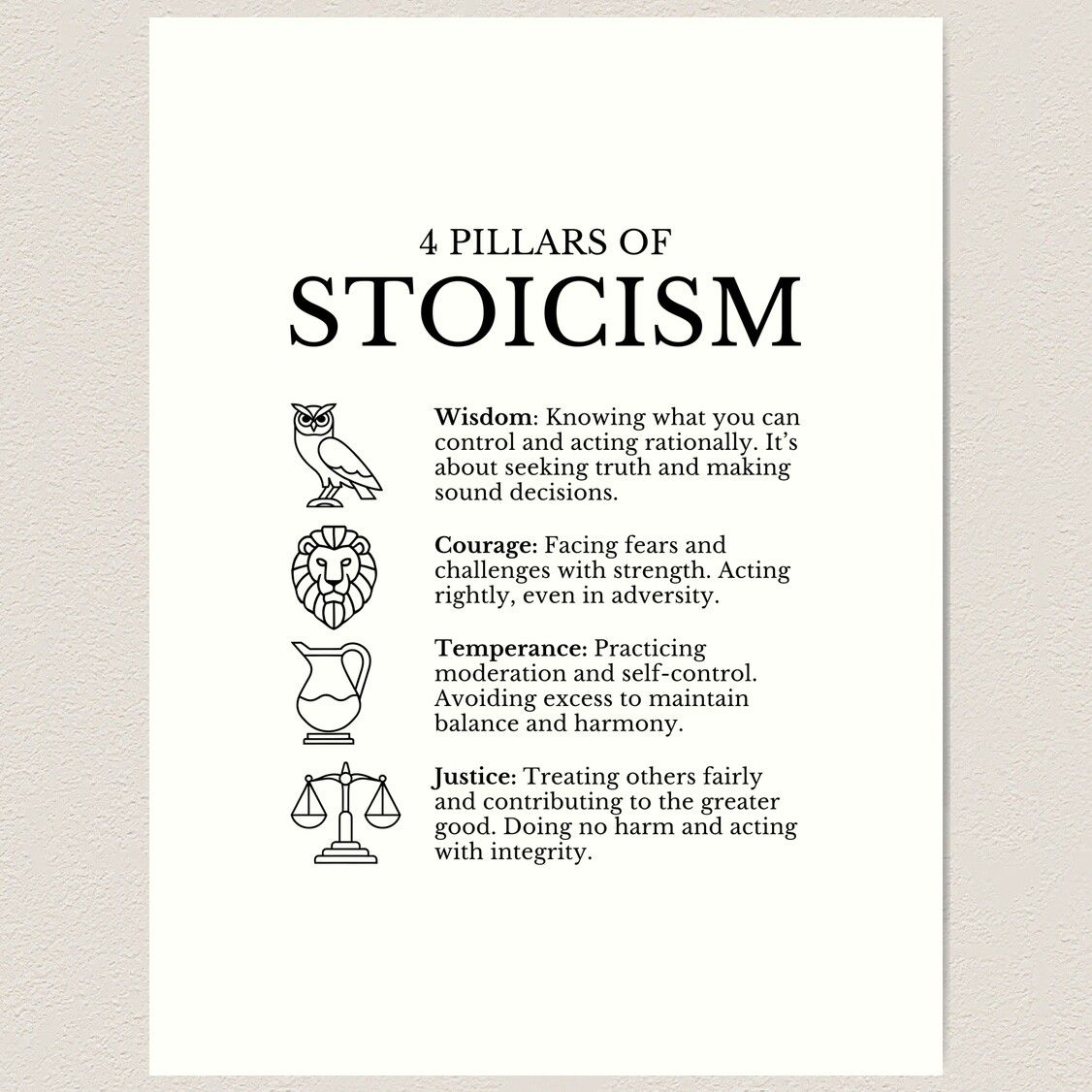
Four cardinal virtues: Wisdom (knowledge of what is genuinely good, bad, and indifferent), courage (proper response to danger and difficulty), temperance (restraint over appetites and impulses), justice (giving each person their due).
Dichotomy of control: Epictetus's foundational distinction between what is "up to us" (our beliefs, desires, and responses) and what is not (our body, reputation, property, and external events).
Cosmopolitanism: The Stoic doctrine that all rational beings - regardless of nationality, class, or ethnicity - are members of a single world community (cosmopolis) by virtue of sharing in logos.
Amor fati: Love of fate. The Stoic (and later Nietzschean) practice of not merely accepting but embracing what happens as necessary and, in the deepest sense, one's own.
Memento mori: "Remember you will die." The Stoic practice of maintaining regular awareness of mortality as a way of prioritizing what actually matters.
Premeditatio malorum: The deliberate mental rehearsal of negative outcomes before they occur, used to reduce their power to shock and to prepare a virtuous response.
Eudaimonia: Flourishing or wellbeing - the final goal of Stoic ethics, achieved through virtuous living rather than through the acquisition of external goods.
Impressions (phantasiai): The raw inputs of perception, thought, and emotion. A central Stoic practice is examining impressions before assenting to them.
Assent (synkatathesis): The mental act of accepting or rejecting an impression as accurate. The Stoics held that we can, through practice, pause between impression and assent - and that this pause is the location of human freedom.
The Founders: Zeno's Porch and the Birth of a School
Stoicism began on a porch. Around 300 BCE, Zeno of Citium - a merchant from Cyprus who had come to Athens after a shipwreck and become fascinated by Socratic philosophy - began teaching in the Stoa Poikile, the "Painted Porch" on the north side of the Athenian agora.
His followers were called Stoics simply because they gathered at the stoa.
Zeno's immediate predecessors were the Cynics, especially Crates of Thebes, who taught that virtue was sufficient for happiness and that social conventions were mostly noise.
Zeno kept this ethical core but built around it a comprehensive system with three interconnected parts: logic (how to reason correctly and how to evaluate impressions), physics (the nature of the universe and humanity's place in it), and ethics (how to live well given the facts established by logic and physics).
The system was designed so that each part supported the others: you needed the physics to understand why virtue was natural and rational, the logic to ensure your reasoning was sound, and the ethics to translate it all into action.
Chrysippus of Soli (c. 280-207 BCE) was the great systematizer. He wrote prolifically - reportedly over 700 books, almost none of which survive - and consolidated Stoic doctrine into the form that would be transmitted to Rome and to us.
It was Chrysippus who worked out the detailed theory of impressions and assent, the account of the four passions, and the physics of logos.
Without Chrysippus, the Stoa would perhaps have dissolved like dozens of other Hellenistic schools. With him, it became the dominant philosophy of the educated Greek and Roman world for five centuries.
The Romans - particularly Seneca (c. 4 BCE - 65 CE), Epictetus (c. 50-135 CE), and Marcus Aurelius (121-180 CE) - adapted Stoicism in a distinctly practical direction.
Where the Greek Stoics often engaged in technical logical and physical debates, the Roman Stoics were primarily concerned with application: how does a person actually practice this in daily life?
Seneca wrote his philosophy in letters addressed to a friend, working through real problems of ambition, grief, time, and anger.
Epictetus, the enslaved philosopher who eventually ran his own school in Nicopolis, taught by dialogue and produced the works we know through the notes of his student Arrian.[3] Marcus Aurelius wrote only for himself.
The Dichotomy of Control: The Most Practical Idea in Philosophy
The single most influential Stoic doctrine may be Epictetus's distinction between what is up to us and what is not.
"Of things," he writes in the opening lines of the Enchiridion, "some are in our power, and others are not." What is in our power: our opinions, impulses, desires, aversions - in short, our inner life, our responses, the quality of our reasoning and our choices.
What is not in our power: our body, our property, our reputation, what other people do, whether we succeed or fail in external pursuits, whether we live or die.
This sounds, at first, like a counsel of resignation. It is actually the opposite. The reason Epictetus draws this distinction so sharply is to focus attention completely on what can actually be controlled, rather than dissipating effort on what cannot.
If you pursue external goods - health, wealth, reputation - you will sometimes get them and sometimes not, and your wellbeing will yo-yo with fortune. If you pursue only virtue and the quality of your own responses, you cannot be prevented from succeeding.
No one can stop you from being honest, courageous, just, and wise. Those things are entirely yours.
Epictetus had particular authority to make this argument. He was born into slavery, and his master - a man named Epaphroditus - reportedly once twisted his leg in a demonstration of power.
Epictetus, so the story goes, said calmly: "You are going to break it." When it broke, he said: "Did I not tell you so?" He was demonstrating, in the most visceral possible terms, what the dichotomy of control means: your body can be broken; your judgment cannot be taken from you unless you surrender it.
The practical application runs throughout Stoic literature. When you set a goal, you aim for the outcome (win the case, make the sale, finish the project) but you invest your identity in the quality of your preparation and effort - the "internalized goal," as the modern philosopher William Irvine calls it in his 2008 book "A Guide to the Good Life." If the outcome goes against you despite excellent effort, you have lost nothing that matters.
If you achieve the outcome through poor character, you have gained nothing that matters.
The Four Cardinal Virtues: What Actually Makes a Person Good
For the Stoics, virtue was not one good thing among others. It was the only good. Everything else - health, wealth, pleasure, fame, even long life - was classified as a "preferred indifferent": worth pursuing when available, but not something whose loss constitutes a genuine harm to a person's wellbeing.
This is a radical claim and the Stoics knew it. They held it, however, because they thought it followed necessarily from careful analysis. What do we mean by calling something good? We mean that its presence makes a person better off - not just more comfortable, but genuinely flourishing.
But health does not reliably produce flourishing: healthy people do terrible things and live terrible lives. Wealth does not produce flourishing: wealthy people are often miserable, and vast wealth has destroyed many lives.
The only thing whose presence reliably makes a person genuinely better off is virtuous character. A poor person with wisdom, courage, temperance, and justice is flourishing. A rich person without those things is not.
The four cardinal virtues are:
Wisdom (phronesis or sophia): The knowledge of what is genuinely good, bad, and indifferent. Wisdom is the master virtue from which the others flow, because you cannot be courageous without knowing what genuine courage requires, cannot be just without knowing what justice demands.
The Stoics distinguished between theoretical wisdom (sophia, understanding the nature of the cosmos and the good) and practical wisdom (phronesis, knowing how to apply virtue to specific situations).
Courage (andreia): Not recklessness, but the proper response to danger and difficulty. The courageous person acts rightly in situations involving fear - not because they feel no fear, but because they assess the situation accurately and do what virtue requires regardless.
Cowardice and recklessness are both failures of courage, each in an opposite direction.
Temperance (sophrosyne): Rational self-governance of appetites, pleasures, and desires. The temperate person neither suppresses their desires to the point of damage nor indulges them in ways that compromise virtue.
Temperance is not asceticism; the Stoics explicitly allowed for pleasure, food, sex, and enjoyment - but as preferred indifferents to be enjoyed when available without becoming dependent on them.
Justice (dikaiosyne): Giving each person what they are owed, acting rightly in relation to others, fulfilling social roles and duties well. Justice is inherently social: the Stoics were not individualists who believed the good life could be achieved in isolation.
The sage has duties to family, community, and the cosmopolis of all rational beings.
Stoic Physics: The Rational Universe
The Stoic ethical system rests on a distinctive physics. The Stoics were materialists in a specific sense: they held that reality consists of two interacting principles, passive matter and active logos (rational principle).
Logos does not exist separately from matter - it pervades it, organizes it, and gives it its rational structure. The cosmos as a whole is a living rational being.
This physics matters for ethics because it establishes that rational behavior is natural behavior. When a human being reasons well and acts virtuously, they are acting in accordance with their deepest nature, which is to say in accordance with the logos that constitutes them.
To act from passion, fear, or appetite is to act against nature in the relevant sense.
The Stoics also held a doctrine of cosmic cycles: periodically, the universe dissolves in a great conflagration (ekpyrosis) and is reconstituted, the same events playing out again.
This sounds like fatalism, but the Stoics distinguished between fate as the unfolding of the rational structure of the cosmos (which they endorsed) and fate as excuse for passivity (which they rejected). You are fated to face challenges; how you respond to them is up to you.
The cosmopolitanism that flows from Stoic physics is among the school's most historically influential contributions.
Marcus Aurelius writes in the Meditations: "Constantly regard the universe as one living being, having one substance and one soul; and observe how all things have reference to one perception, the perception of this one living being." And more directly: "We are all fellow citizens, and the world is a single city."
This doctrine, that all rational beings share in logos and therefore belong to a single moral community, provided much of the philosophical foundation for later ideas of universal human rights and natural law.
Practical Exercises: How Stoics Actually Practiced Their Philosophy
Pierre Hadot, the French historian of ancient philosophy, argued in "Philosophy as a Way of Life" (1995) that ancient philosophy was primarily a set of spiritual exercises - practical technologies for transforming the self - rather than a purely theoretical enterprise.[7] The Stoics exemplify this claim.
Journaling: Marcus Aurelius's Meditations are the most famous example, but the practice of daily written self-examination was a Stoic standard.
Seneca describes his evening review in "On Anger": going over the day's events, examining where he fell short, how he responded to difficulties, what he needs to work on tomorrow.
The practice is not self-flagellation but systematic quality control of one's own reasoning and behavior.
Premeditatio malorum (negative visualization): Before any significant undertaking, the Stoic practitioner imagines what could go wrong - not to induce anxiety, but to defuse it. If you have already confronted the possibility of failure, illness, humiliation, or loss in imagination, the actual occurrence is less destabilizing.[9]
More importantly, you have already decided how you will respond with virtue. Seneca recommended meditating on the death of loved ones, not as morbid fantasy, but as a way of appreciating them more fully and being less devastated when loss comes.
Examination of impressions: Epictetus's central practical teaching is to pause between impression and response. When something provokes emotion - anger, fear, desire, grief - the Stoic pause means asking: "What is this impression claiming?
Is the claim accurate? Is the thing it presents as good genuinely good, or merely preferred?" This practice is the direct ancestor of CBT's cognitive restructuring.
The view from above (katakopos): Marcus Aurelius repeatedly uses a meditative exercise in which he imagines viewing human affairs from a great height - or from the position of cosmic time.[1] From that perspective, the battles over reputation and status that consume most human energy appear trivial.
The exercise produces not nihilism but proportion: a clearer sense of what actually matters.
Voluntary discomfort: Seneca recommended occasionally practicing poverty - eating plain food, wearing rough clothing, sleeping on a hard surface - not as permanent austerity but as a way of discovering that the things you fear losing are not as necessary as you suppose.
The philosopher William Irvine has updated this as "voluntary discomfort" and argues it remains one of the most effective anti-anxiety practices available.
Stoicism vs. Its Misunderstandings
The word "stoic" in English now means something like "emotionally repressed" or "bearing hardship without complaint." This meaning is the opposite of what the Stoic philosophers actually taught.
The Stoics distinguished between pathe (passions) and eupatheiai (good emotional responses). Passions are not emotions as such - they are emotions that rest on false beliefs. Fear rests on the belief that something external to virtue is genuinely bad.
Grief at loss rests on the belief that what was lost was genuinely good. These beliefs are, in Stoic terms, errors of judgment - and the passions that follow from them are correspondingly distorted and disproportionate.
The eupatheiai - the good emotional responses available to the wise person - include: joy (chara), a rational pleasure in living virtuously; caution (eulabeia), a rational care about genuine goods; and wishing (boulesis), a rational desire for what is genuinely worth having.
The Stoic sage experiences grief that is proportionate and accurate. They experience genuine love, genuine admiration, genuine satisfaction. What they do not experience is the frantic, dependent, self-undermining emotion of someone who has staked their wellbeing on things they cannot control.
Marcus Aurelius expresses genuine affection for his teachers, genuine compassion for the people affected by war and plague, genuine care for his son Commodus (who would become one of Rome's worst emperors, a failure Marcus clearly felt keenly). He is not cold.
He is attempting to feel precisely what the situation warrants - no more, no less.
Stoicism and Death: The Philosophical Practice of Mortality
No philosophical tradition has engaged more seriously and more practically with death than Stoicism. Memento mori - "remember you will die" - was not a morbid slogan but a philosophical practice with specific psychological effects.
Epictetus: when you kiss your child goodnight, remind yourself that this child is mortal and may be taken. Not to generate fear, but to generate presence and gratitude. The death reflection prevents the numbing effect of taking things for granted.
Marcus Aurelius returns constantly to the theme of impermanence. Alexander the Great, Julius Caesar, Augustus - all are gone. Their empires, their monuments, their reputations: all dissolving.
The Meditations contains a sustained meditation on how many emperors and famous men are now forgotten, and how Marcus's own fame will similarly fade.
This meditation produces not despair but liberation: if all of this will dissolve anyway, the only thing that makes any moment worthwhile is how virtuously you live it.
The philosopher Epictetus on death: "It is not death or pain that is to be dreaded, but the fear of pain or death." The event itself is indifferent - it will come when it comes. What is not indifferent is how you live in the time you have, and whether you waste it in fear of an inevitable end.
The Modern Stoicism Revival
Stoicism has experienced an extraordinary revival since the 1990s. Several converging forces have driven it.
First, the explicit connection to cognitive-behavioral therapy (CBT). Albert Ellis founded REBT in 1955 by directly applying Epictetus's insight - that distress comes from beliefs, not events - to clinical psychotherapy.[6]
Donald Robertson's 2019 book "How to Think Like a Roman Emperor" makes the CBT-Stoicism connection fully explicit, showing how each Stoic practice maps onto a specific CBT technique.[4]
Robertson is both a philosopher and a therapist, and his account is both historically rigorous and clinically applicable.
Second, writers like Tim Ferriss, Ryan Holiday ("The Obstacle Is the Way," 2014; "Ego Is the Enemy," 2016), and Massimo Pigliucci have brought Stoicism to popular audiences, connecting ancient practices to contemporary challenges around productivity, resilience, and purpose.
Third, empirical research has begun to examine Stoic-derived practices. Braehler and Hicks (2023), in the Journal of Positive Psychology, found that participants trained in Stoic practices over eight weeks showed significant improvements in wellbeing, self-compassion, and psychological flexibility compared to controls.[8]
These are not trivial effect sizes, and they replicate findings from CBT research more broadly.
William Irvine's "A Guide to the Good Life: The Ancient Art of Stoic Joy" (2008) remains perhaps the most careful and systematic attempt to reconstruct Stoic practice for a contemporary reader.[5]
Irvine is a philosophy professor, and his book takes seriously both the historical philosophy and the question of how it could actually be practiced today, including a frank assessment of which parts of ancient Stoicism are worth keeping and which can be updated.
Stoicism and Meaning: The Philosophy That Does Not Promise Happiness
One of the reasons Stoicism resonates so strongly in contemporary contexts is that it does not promise happiness - at least not in the modern sense of positive hedonic experience. It promises something more durable: eudaimonia, flourishing, the deep satisfaction of living well according to one's values.
The Stoic promise is not that you will feel good. It is that you will be good - and that being good, in the sense of exercising wisdom, courage, temperance, and justice in everything you do, produces a life that is worth living regardless of what happens to you externally.
This is, in the present moment, a more useful promise than most. It is a philosophy built for difficulty, for the conditions of actual human life rather than idealized circumstances.
Marcus Aurelius, working through grief and plague and war in a private notebook he never published, is its most powerful proof of concept.
Related Articles
Sources & Further Reading
- Marcus Aurelius. Meditations (c. 170-180 CE). Trans. Gregory Hays. Modern Library, 2002.
- Epictetus. Enchiridion (c. 135 CE). Trans. Nicholas P. White. Hackett, 1983.
- Long, A. A. Epictetus: A Stoic and Socratic Guide to Life. Oxford University Press, 2002.
- Robertson, Donald. How to Think Like a Roman Emperor: The Stoic Philosophy of Marcus Aurelius. St. Martin's Press, 2019.
- Irvine, William B. A Guide to the Good Life: The Ancient Art of Stoic Joy. Oxford University Press, 2008.
- Ellis, Albert. Reason and Emotion in Psychotherapy. Lyle Stuart, 1962.
- Hadot, Pierre. Philosophy as a Way of Life: Spiritual Exercises from Socrates to Foucault. Blackwell, 1995.
- Braehler, Christina and Hicks, Josh. "Stoic Practices and Psychological Wellbeing: An Eight-Week Intervention Study." Journal of Positive Psychology, 2023.
- Norem, Julie K. and Cantor, Nancy. "Defensive Pessimism: Harnessing Anxiety as Motivation." Journal of Personality and Social Psychology 51(6): 1208-1217, 1986.