
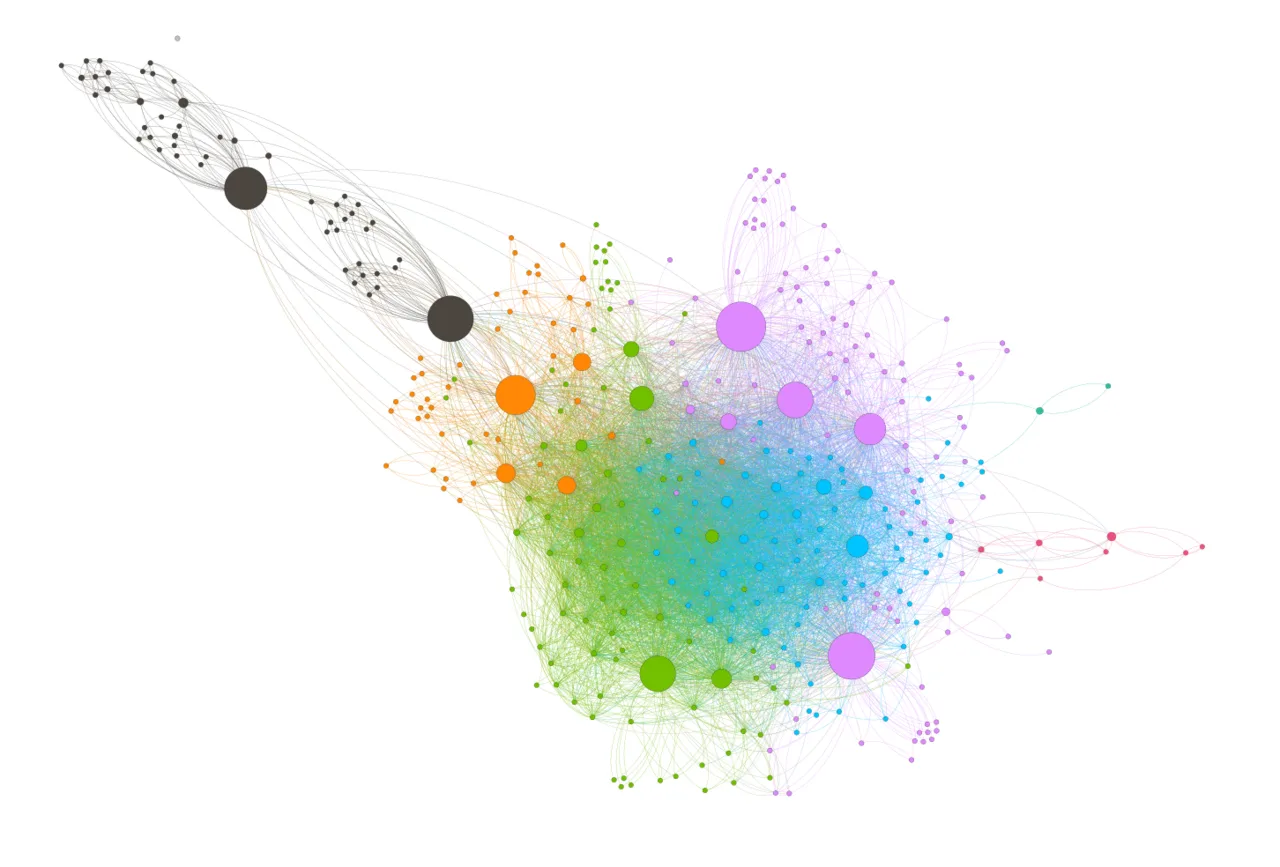
Network science represents entities as nodes and their relationships as edges to reveal patterns shared by systems from cells to economies. Its measures describe connection density, clustering, centrality, paths, and the distribution of links. Network structure affects how information, disease, and failures spread, making different topologies vary sharply in efficiency, robustness, and vulnerability.
In 1736, the Swiss mathematician Leonhard Euler sat with a puzzle that had absorbed the residents of Konigsberg, Prussia: could one walk across all seven bridges of the city, each exactly once, and return to the starting point?
Euler proved it was impossible, and in doing so invented graph theory - the mathematical language of connections.
For two and a half centuries, graph theory remained largely a branch of pure mathematics.
Then, in the 1990s, physicists and computer scientists with access to massive empirical datasets - the internet, the World Wide Web, protein interaction networks, power grids - began measuring real networks and found that their structures departed sharply from what mathematicians had assumed.
The result was network science, a genuinely new empirical discipline that has transformed how researchers understand complex systems from cells to societies.
The discipline rests on a deceptively simple abstraction: represent entities as nodes (also called vertices) and relationships between them as edges (also called links or ties). The internet is a network of routers and servers connected by cables and protocols.
A social network is people connected by friendships, collaborations, or communications. A neural network is neurons connected by synapses. A metabolic network is chemical compounds connected by enzymatic reactions.
What network science discovered is that these superficially different systems share deep structural regularities - patterns in how connections are distributed, how information flows, how networks fail, and how diseases spread - that transcend the specific content of any particular network.
The implications have proven consequential far beyond academic research. The topology of a contact network determines whether an epidemic spreads exponentially or dies out. The structure of an interbank network determines whether a bank failure stays local or becomes a systemic crisis.
The architecture of the brain's connectivity shapes both its functional efficiency and its vulnerability to neurological disease. Understanding networks is no longer a specialized technical pursuit; it is a prerequisite for understanding how complex systems behave at every scale from molecules to global economies.
"A random network and a scale-free network may have the same number of nodes and links, and yet they are fundamentally different in their topology, their robustness, and in how diseases, information, and failures spread through them." - Albert-Laszlo Barabasi
Key Definitions
Node (vertex): The fundamental unit of a network, representing an entity - a person, website, protein, neuron, city, or any other object whose relationships are being studied.
Edge (link, tie): A connection between two nodes, representing a relationship, interaction, or flow. Edges may be directed (from one node to another, as in a Twitter follow) or undirected (symmetric, as in a co-authorship link). Edges may also be weighted, with numerical values representing the strength or frequency of the connection.
Degree: The number of edges connected to a node. In directed networks, in-degree counts incoming edges and out-degree counts outgoing edges. Degree distribution - the statistical distribution of degrees across all nodes - is one of the most diagnostic properties of a network.
Clustering coefficient: A measure of the tendency of a node's neighbors to also be connected to each other. High clustering indicates locally dense cliques; low clustering indicates a more diffuse structure. The global clustering coefficient averages this across all nodes.
Betweenness centrality: A measure of how often a node appears on the shortest path between other pairs of nodes. Nodes with high betweenness centrality serve as bridges or brokers in the network and can be critical for information flow and network cohesion.
Network Types Compared
| Network Model | Degree Distribution | Clustering | Path Length | Real-World Examples |
|---|---|---|---|---|
| Random (Erdos-Renyi) | Bell curve (Poisson) | Low | Short | Early internet models |
| Small-world (Watts-Strogatz) | Bell curve | High | Short | Power grids, C. elegans neural network |
| Scale-free (Barabasi-Albert) | Power law (fat tail) | Moderate | Very short | WWW, citation networks, social networks |
| Regular lattice | Uniform | Very high | Long | Theoretical baseline |
| Hierarchical | Power law | High | Short | Biological metabolic networks |
Euler, Graph Theory, and the Birth of Network Science
From Pure Mathematics to Empirical Science
Euler's 1736 solution to the Konigsberg bridge problem established graph theory as a mathematical discipline, but for most of its history the field studied abstract graphs with prescribed properties rather than empirically measured networks.
The dominant model, developed by Paul Erdos and Alfred Renyi in 1959, assumed that networks form by randomly connecting pairs of nodes with equal probability. This random graph model has clean mathematical properties and was long assumed to approximate real networks.
The empirical revolution of the 1990s revealed that many real networks have far more heterogeneous, heavy-tailed degree distributions than the classic random-network model assumes. How universal strict "scale-free" (power-law) structure really is has since become contested.
The internet, the World Wide Web, citation networks, sexual contact networks, protein interaction networks, and airline route maps all departed dramatically from Erdos-Renyi random graphs in two specific ways: their degree distributions followed power laws rather than bell curves, and their clustering coefficients were far higher than random graphs of the same size and density predicted.
These discoveries were enabled by data availability that was genuinely new: the internet created machine-readable records of network structure at scales previously impossible to study.
Physicists, who had developed the statistical mechanics of complex systems, brought computational and analytical tools to problems that had previously been the exclusive domain of social scientists and mathematicians.
The result was an interdisciplinary synthesis that created network science as a distinct field by the late 1990s.
Nodes, Edges, and the Language of Structure
The network representation is powerful partly because it abstracts away content and retains only structure, making structural comparisons possible across completely different domains.
A food web (species connected by predation) and a corporate board network (directors connected by shared board membership) look very different in content but may share structural properties - similar degree distributions, similar clustering patterns, similar patterns of information flow - that reveal common organizing principles.
The basic vocabulary - nodes, edges, degree, clustering, path length - provides a shared language across disciplines.
A sociologist studying information diffusion, a virologist modeling epidemic spread, and a neuroscientist mapping connectivity all use the same structural tools, and findings in one domain can generate hypotheses in others.
This cross-disciplinary transfer has been one of network science's most productive features.
Small-World Networks
Milgram, Six Degrees, and the Columbia Study
The small-world phenomenon - the intuition that any two people on Earth are connected through a surprisingly short chain of acquaintances - was made famous by Stanley Milgram's 1967 experiments, reported in Psychology Today.
Milgram asked residents of Nebraska and Kansas to forward a letter to a target person in Boston, passing it only through people they knew on a first-name basis.
Letters that reached the target - the majority did not - passed through a median of approximately six intermediaries, giving rise to the popular notion of "six degrees of separation."
Milgram's methodology had significant limitations: the majority of letters never arrived, the sample was not representative, and the completion rate meant the successful chains may have been systematically atypical.
A more rigorous test came in 2003, when Duncan Watts, Peter Dodds, and their colleagues conducted an email-based replication using 60,000 participants and 18 target persons in 13 countries.[9]
Their study, published in Science, found that successful chains had between 5 and 7 steps on average - close to Milgram's original finding but with far better methodological controls and far greater geographic scope.
Watts and Strogatz: The Structural Foundation
The theoretical explanation for small-world phenomena came from Duncan Watts and Steven Strogatz's 1998 paper in Nature, "Collective Dynamics of Small-World Networks," which became one of the most cited scientific papers of the late twentieth century.
Watts and Strogatz showed that two seemingly incompatible properties - high clustering (your friends tend to know each other) and short average path length (any two nodes are connected through few intermediaries) - could coexist in the same network.[10]
Their model starts with a regular lattice, in which each node connects only to its nearest neighbors (maximally clustered, long path lengths), and gradually rewires edges at random.
Even a small fraction of long-range random rewirings dramatically reduces average path length while leaving clustering nearly intact, creating the small-world regime.
The intuition is that a few long-range shortcuts can dramatically compress the diameter of an otherwise clumped network without disrupting the local clustering that characterizes real social networks.
Watts and Strogatz validated their model against three empirical networks: the synaptic connections among the 302 neurons of the nematode Caenorhabditis elegans (the only completely mapped nervous system at the time), the Western United States power grid, and the film actor collaboration network.
All three showed the signature small-world pattern: clustering coefficients far higher than equivalent random graphs, average path lengths comparable to random graphs.
This convergence across systems as different as a worm's brain, a power grid, and Hollywood suggested that small-world structure - high clustering combined with short path lengths - is a common property of many real complex networks, though not literally universal.
The functional implications are significant. In neural networks, small-world organization enables rapid information integration across the brain (short path lengths) while supporting local specialization and computationally efficient processing (high clustering).
In social networks, small-world structure means that information and disease spread much faster than intuition would suggest, even through large populations.
Scale-Free Networks and Preferential Attachment
The Power Law Discovery
In 1999, Albert-Laszlo Barabasi and Reka Albert published a short paper in Science, "Emergence of Scaling in Random Networks," that crystallized the second major discovery of early network science.[1]
Analyzing the degree distribution of the World Wide Web - the pattern of how many links different pages had - they found not a bell curve centered on some average degree, as the Erdos-Renyi model predicted, but a power law: a tiny fraction of pages had enormous numbers of links, while the vast majority had very few.
A power-law degree distribution means there is no characteristic scale - the network has nodes with degrees spanning many orders of magnitude. Barabasi and Albert called these scale-free networks.
The same pattern appeared in the internet at the router level, in citation networks, in metabolic reaction networks, in sexual contact networks compiled by epidemiologists, and in many other systems. Scale-free structure turned out to be surprisingly common.
Barabasi and Albert proposed a generative mechanism: preferential attachment.[2] New nodes joining the network are more likely to connect to nodes that already have many connections - the rich get richer dynamic.
A new webpage is more likely to link to Google than to an obscure personal site; a new scientific paper is more likely to cite highly cited work.
This cumulative advantage process naturally produces a power-law degree distribution. The mechanism is simple and plausible, and it connected network structure to the growth dynamics of real systems.
Robustness and Fragility
In a landmark 2000 paper in Nature, Reka Albert, Hawoong Jeong, and Albert-Laszlo Barabasi demonstrated that scale-free networks have a striking and practically important structural property: they are simultaneously robust to random failure and fragile to targeted attack.[11]
In networks with a small number of very high-degree hubs, removing nodes at random tends to leave the network largely connected even after many nodes fail (this robust-yet-fragile pattern is characteristic of such hub-dominated networks rather than all networks) - because the probability of randomly hitting one of the few high-degree hubs is low, and removing low-degree nodes causes minimal disruption.
But when nodes are removed in order of decreasing degree - targeting the hubs - the network fragments rapidly.
This analysis has direct implications for network resilience and security. The internet has survived massive amounts of random hardware failure and has proven remarkably robust - precisely because most random failures hit low-degree nodes. But a targeted attack on the highest-degree routers could be catastrophic.
Biological networks show similar patterns: most random gene knockouts in model organisms produce no detectable phenotype, but knockouts of highly connected hub proteins in protein interaction networks are frequently lethal.
For epidemiology, scale-free structure implies that high-degree individuals serve as superspreaders - disproportionately responsible for epidemic spread.
This overturns the homogeneous mixing assumption of classical epidemic models and has practical vaccine allocation implications: targeting hubs with vaccination, even when random vaccination of the general population is infeasible, can dramatically reduce epidemic spread.
Pastor-Satorras and Vespignani's 2001 analysis in Physical Review Letters showed that in an idealized model, scale-free networks whose degree variance grows without bound have a vanishing epidemic threshold, meaning even a low-transmissibility pathogen can spread widely.[7] Real networks are finite, so they retain a small but nonzero threshold; the practical lesson is that highly hub-dominated networks are unusually easy for infections to invade if the network is truly scale-free.
Weak Ties, Structural Holes, and Social Capital
Granovetter and the Strength of Weak Ties
Mark Granovetter's 1973 paper "The Strength of Weak Ties," published in the American Journal of Sociology, made one of the most counterintuitive and influential arguments in social science: the connections that matter most for spreading information and creating opportunity are often not your close friends but your acquaintances.
The reasoning flows directly from network structure. Strong ties - close friends, family, colleagues in the same team - typically connect people who already share the same social circle and therefore have access to the same information.
Weak ties - acquaintances, former colleagues, friends-of-friends - more often bridge different social clusters.
In network terms, weak ties serve as the long-range rewirings in the Watts-Strogatz model: they connect otherwise separated communities and enable information to flow between clusters that would otherwise be isolated.
Granovetter tested this with Boston job seekers.[5] He found that people who found jobs through personal contacts more often found them through acquaintances than through close friends - weak ties, not strong ties, were the effective bridges to job market information unavailable within one's existing network.
His 1983 follow-up paper in Sociological Theory extended this analysis, and subsequent research in many countries and industries has replicated the core finding.
A 2022 study by Rajiv Sethi and colleagues, analyzing hundreds of millions of weak-tie formation events on LinkedIn, provided the largest-ever naturalistic test of the hypothesis and confirmed that weak ties across different industries and communities significantly predicted job transitions.
Burt's Structural Holes
Ronald Burt's 1992 book "Structural Holes" extended Granovetter's insight with a more formal analysis.[3] A structural hole exists when two nodes or clusters are connected only through a single broker - a node that bridges what would otherwise be disconnected components.
The broker gains informational advantages by having access to diverse, non-redundant information from both sides, and social capital advantages by controlling the flow of information between them.
Burt documented that individuals who bridged structural holes received earlier promotion, higher performance evaluations, and higher compensation than equally capable peers in more densely connected positions. The effect appeared across multiple corporate settings and occupational categories.
Studies of online social platforms have confirmed the pattern: users who bridge structural holes in their ego networks are more likely to generate novel ideas, gain followers, and achieve influence disproportionate to their number of connections.
The structural hole framework transformed the analysis of social capital from a vague notion of relationship value to a precisely measurable network property.
Contagion: Disease, Behavior, and Information
The SIR Model and Its Network Extensions
The classical epidemiological model of infectious disease - the SIR model, dividing populations into Susceptible, Infected, and Recovered compartments - assumes homogeneous mixing: every individual has an equal probability of contact with every other individual.
This assumption is analytically convenient but empirically false. Real contact networks are highly heterogeneous, and network structure profoundly shapes epidemic dynamics.
The basic reproduction number R0 - the expected number of secondary infections produced by one infected individual in a fully susceptible population - determines whether an epidemic grows or dies out. But in heterogeneous networks, the epidemic threshold depends critically on the degree distribution.
In scale-free networks with large degree variance, Pastor-Satorras and Vespignani showed that the effective epidemic threshold can approach zero, meaning that even very weakly transmissible pathogens can establish endemic presence.
The herd immunity implication follows: much lower vaccination coverage can interrupt transmission if vaccines are allocated to high-degree nodes rather than at random.
The "friendship paradox" - the observation that your friends have on average more friends than you do - can be exploited for targeted vaccination without requiring direct knowledge of the degree distribution: vaccinating random acquaintances of random individuals disproportionately hits hubs.
Simple and Complex Contagion
Damon Centola and Michael Macy's 2007 paper in the American Journal of Sociology distinguished two types of spreading process: simple contagion, in which a single contact with an infected or informed individual is sufficient for transmission (most biological diseases, most information), and complex contagion, in which transmission requires multiple independent exposures from different sources (behavioral change, belief adoption, social movement participation).
The distinction matters because simple and complex contagion spread through networks in opposite ways. Simple contagion benefits from long-range weak ties and scale-free hubs: these shortcuts accelerate spread across the network.
Complex contagion requires that multiple independent network neighbors expose a focal node to the same idea or behavior, which is precisely what dense local clusters provide.
For behaviors and beliefs that require social reinforcement - joining a new social movement, adopting a controversial health practice, changing a deeply held attitude - the weak ties that accelerate simple contagion may actually impede complex contagion, because a weak tie typically comes from outside one's dense local cluster and therefore does not multiply the social exposures needed for adoption.
Nicholas Christakis and James Fowler's 2007-2009 studies documented that obesity, smoking cessation, and happiness appeared to spread through social networks up to three degrees of separation, with having an obese friend increasing obesity risk by approximately 57 percent in their analyses.[4]
These findings attracted substantial methodological criticism: Cosma Shalizi and Andrew Thomas argued in 2011 that network-based spreading is statistically difficult to distinguish from homophily - the tendency of similar people to connect - without experimental manipulation, and that observational data cannot definitively establish causal contagion.
Brain and Biological Networks
Connectomics and the Human Brain
The application of network science to neuroscience has produced one of its most transformative programs. Sydney Brenner, John White, and colleagues' complete mapping of the C.
elegans nervous system in 1986 - 302 neurons and approximately 7,000 synaptic connections - provided the first complete connectome of any organism. Watts and Strogatz's analysis confirmed that even this tiny nervous system exhibits small-world organization.
The National Institutes of Health launched the Human Connectome Project in 2009, aiming to map white matter fiber tracts connecting cortical and subcortical regions using diffusion tensor MRI.
Olaf Sporns, Giulio Tononi, and colleagues had already proposed in 2005 that the brain's large-scale connectivity could be analyzed as a graph, and had found that brain networks showed small-world properties and that certain regions - including the default mode network, the precuneus, and regions of prefrontal cortex - served as highly connected hubs.[8]
The neurological implications of hub structure are significant. Hub regions appear to be disproportionately vulnerable in neurological disease.
Alzheimer's disease preferentially disrupts highly connected hub regions in early stages, consistent with the prediction that hub failures would most severely compromise network-wide integration.
Schizophrenia is associated with reduced small-world properties in functional connectivity networks - lower clustering and longer path lengths - suggesting disrupted local processing efficiency.
Autism spectrum disorder shows altered patterns of long-range connectivity with relative over-connectivity of local circuits and under-connectivity of long-range links, consistent with the atypical sensory processing and social cognition that characterize the condition.
Protein Interaction Networks and Drug Discovery
Protein-protein interaction (PPI) networks show scale-free properties: a small number of hub proteins interact with many partners, while most proteins have few interactions.
Barabasi and colleagues demonstrated that hub proteins in PPI networks are evolutionarily conserved across species and that the knockout of hub proteins is significantly more likely to be lethal than knockout of peripheral proteins.
This has direct implications for drug discovery: proteins with many interaction partners are attractive targets for broad therapeutic effect but also carry higher risk of side effects, and network pharmacology - designing drugs that target multiple nodes in a disease-associated network - has emerged as an explicit application of network science to molecular medicine.
Practical Applications
Financial Contagion and Systemic Risk
The 2008 financial crisis made network thinking about systemic risk urgently relevant.
The collapse of Lehman Brothers in September 2008 demonstrated that highly interconnected financial institutions could transmit failure rapidly across global markets in ways that traditional risk models, which treated institutions independently, had entirely failed to anticipate.
Andrew Haldane, then Executive Director for Financial Stability at the Bank of England, produced a series of influential papers applying network theory to financial stability.
Haldane and Robert May's 2011 paper in Nature argued that the structure of interbank lending networks - highly connected, with large institutions serving as hubs - created systemic fragility analogous to scale-free biological networks: robust to idiosyncratic shocks but fragile to targeted failures of hubs.[6]
The paper made the case for regulatory interventions targeting network structure, including limits on the concentration of interbank exposures and requirements for network disclosure that would enable systemic risk monitoring.
The COVID-19 pandemic provided an analogous demonstration in supply chain networks.
The concentration of global production of semiconductors, pharmaceutical ingredients, and personal protective equipment in a small number of geographic hubs - predominantly East Asia - meant that disruptions in those hubs propagated rapidly to global supply chains, revealing a scale-free fragility that had been invisible under normal conditions.
Winner-Take-All Dynamics and Network Effects
Network effects - the phenomenon in which a product or platform becomes more valuable as more people use it - create positive feedback dynamics that drive winner-take-all outcomes.
Metcalfe's Law states that the value of a network grows with the square of its number of users, and while the precise functional form is debated, the qualitative implication is clear: network goods exhibit increasing returns that can generate tipping points where a platform with a small initial advantage grows rapidly to dominate a market.
The scale-free structure of user connection networks - where popular accounts accumulate far more followers than average - amplifies these dynamics, providing a structural foundation for analyzing why digital markets so consistently produce concentrated outcomes.
Further Reading
For the complexity science context from which network science emerged, see What Is Complexity?. For the evolutionary psychology of group living that network structure shapes, see What Is Evolutionary Psychology?.
Sources & Further Reading
- Barabasi, Albert-Laszlo, and Reka Albert. "Emergence of Scaling in Random Networks." Science 286, no. 5439 (1999): 509-512.
- Barabasi, Albert-Laszlo. Linked: The New Science of Networks. Perseus, 2002.
- Burt, Ronald S. Structural Holes: The Social Structure of Competition. Harvard University Press, 1992.
- Christakis, Nicholas A., and James H. Fowler. "The Spread of Obesity in a Large Social Network over 32 Years." New England Journal of Medicine 357, no. 4 (2007): 370-379.
- Granovetter, Mark S. "The Strength of Weak Ties." American Journal of Sociology 78, no. 6 (1973): 1360-1380.
- Haldane, Andrew G., and Robert M. May. "Systemic Risk in Banking Ecosystems." Nature 469, no. 7330 (2011): 351-355.
- Pastor-Satorras, Romualdo, and Alessandro Vespignani. "Epidemic Spreading in Scale-Free Networks." Physical Review Letters 86, no. 14 (2001): 3200-3203.
- Sporns, Olaf, Giulio Tononi, and Rolf Kotter. "The Human Connectome: A Structural Description of the Human Brain." PLOS Computational Biology 1, no. 4 (2005): e42.
- Watts, Duncan J., Peter Sheridan Dodds, and M. E. J. Newman. "Identity and Search in Social Networks." Science 296, no. 5571 (2002): 1302-1305.
- Watts, Duncan J., and Steven H. Strogatz. "Collective Dynamics of Small-World Networks." Nature 393, no. 6684 (1998): 440-442.
- Albert, Reka, Hawoong Jeong, and Albert-Laszlo Barabasi. "Error and Attack Tolerance of Complex Networks." Nature 406, no. 6794 (2000): 378-382.