
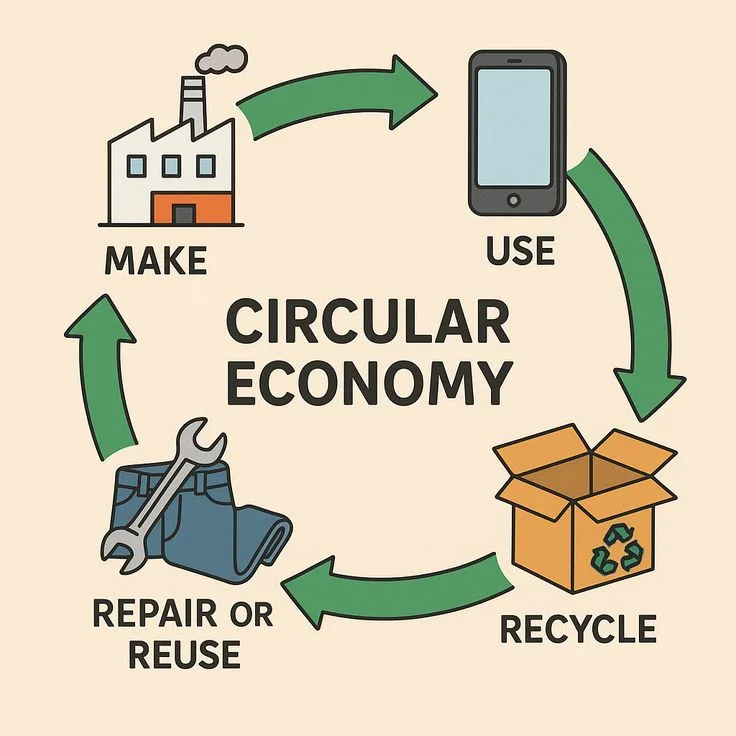
For most of industrial history, economies operated on a simple model: extract resources from the earth, transform them into products, sell those products, and discard them when they are no longer wanted. The sequence is so embedded in how production systems are designed that it has a name: the linear economy, or take-make-waste.
The linear model was spectacularly successful at generating material abundance. It was also, as the scale of global production grew, spectacularly wasteful. By one widely cited estimate, a large majority of the materials extracted for the global economy end up as waste relatively quickly rather than remaining in productive use. The exact share and time window vary by source and are difficult to pin down precisely.
The environmental and economic costs of that waste, in raw material consumption, landfill burden, greenhouse gas emissions, and lost economic value, are now large enough that a different model has moved from niche concept to mainstream policy agenda.
That alternative is the circular economy.
What Is the Circular Economy?
The circular economy is an economic system designed to keep materials, products, and resources in use for as long as possible, at the highest possible value, before eventually being recovered and regenerated.
Rather than following a linear path from extraction to disposal, materials ideally circulate in closed loops: products are designed to be repaired, reused, remanufactured, or recycled at end of life.
The Ellen MacArthur Foundation, founded in 2010 and the leading global organization promoting circular economy thinking, defines it through three principles:
- Design out waste and pollution: waste and pollution are not inevitable by-products; they are signals of poor design
- Keep products and materials in use: design for durability, repair, reuse, and material recovery
- Regenerate natural systems: return nutrients to the soil, rebuild natural capital, avoid extracting finite resources where renewable alternatives exist
"A circular economy is one that is restorative and regenerative by design, and which aims to keep products, components, and materials at their highest utility and value at all times." (Ellen MacArthur Foundation)
The concept draws from several earlier intellectual traditions: the cradle-to-cradle design philosophy of Walter Stahel, developed in the 1970s; industrial ecology, which applies ecological principles to industrial systems; and biomimicry, which looks to natural systems, where waste from one process is food for another, as models for industrial design.
What the circular economy concept did was synthesize these traditions into a business-accessible framework and connect them to mainstream economic and policy discourse.
Linear vs. Circular: A System Comparison
Understanding the circular economy requires seeing clearly how different it is from the default.
| Dimension | Linear Economy | Circular Economy |
|---|---|---|
| Resource flow | Extract, manufacture, dispose | Reuse, repair, remanufacture, recycle |
| Product design | Designed for function | Designed for longevity, disassembly, recovery |
| Business model | Sell units | May sell service or outcome |
| End of life | Landfill, incineration | Material recovery, biological return |
| Value driver | Volume of sales | Resource productivity |
| Growth model | Coupled to resource consumption | Decoupled from resource consumption |
| Risk profile | Exposed to commodity price volatility | Reduced exposure via material recirculation |
| Ownership | Transfer to customer at point of sale | Manufacturer often retains ownership |
The core economic argument for the circular economy is that decoupling economic growth from resource consumption becomes increasingly important as resource prices rise, as regulatory costs of waste increase, and as customer and investor pressure for sustainable practices grows.
The Scale of the Resource Problem
The numbers behind the linear economy's inefficiency are striking. The Global Resources Outlook 2019 published by the International Resource Panel found that resource extraction has tripled since 1970, reaching 92 billion tonnes per year by 2017.
If current trends continue, that figure is projected to reach 190 billion tonnes per year by 2060.
Resource extraction and processing account for approximately half of global greenhouse gas emissions and more than 90% of biodiversity loss and water stress, according to the same report.
The linear economy's reliance on virgin resource extraction is therefore not merely an efficiency question: it is a central driver of the environmental challenges that dominate the policy agenda.
The economic case for circularity strengthens as resources become scarcer. The World Bank projects that demand for critical minerals, essential for batteries, solar panels, and wind turbines, could increase by nearly 500% by 2050 under a 2-degree warming scenario, as the energy transition creates massive new material demands.
A circular economy that recovers and recirculates these minerals would substantially reduce the supply pressure and price exposure of that transition.
The Ellen MacArthur Foundation Framework
The Ellen MacArthur Foundation uses a diagram called the butterfly diagram to visualize circular flows. It distinguishes two cycles:
The Technical Cycle
Manufactured goods, laptops, furniture, vehicles, clothing, circulate through a hierarchy of interventions, each of which preserves more value than the one below it:
- Maintain and prolong: servicing, repair, upgrades that extend product life
- Reuse and redistribute: second-hand markets, rental, leasing
- Remanufacture and refurbish: restoring used components to original performance
- Recycle: processing materials back into usable input streams
The hierarchy matters because recycling, despite being the most commonly discussed form of circularity, is the lowest-value intervention. Melting a phone down to recover metals loses the design, manufacturing, and assembly value embedded in the device. Repairing it or refurbishing it preserves far more value.
Economists have formalized this through the concept of embedded value: a manufactured product contains not just the market value of its raw materials but the value of the energy, labor, knowledge, and infrastructure that transformed those materials.
A complex electronic device might have raw material value of a few dollars while its manufactured value runs into hundreds or thousands. Every level of the hierarchy that avoids destroying and re-creating the manufactured form preserves more of that embedded value.
The Biological Cycle
Biological materials, food, cotton, wood, bioplastics, can safely return to the natural world as nutrients if they are kept free from contamination. Composting, anaerobic digestion, and regenerative agriculture create biological flows that can be continuous rather than extractive.
The critical distinction is contamination: biological materials mixed with synthetic chemicals, plastics, or heavy metals cannot safely re-enter the biological cycle.
This creates a design imperative to keep biological and technical streams separate, which has implications for product design (avoiding composite materials that mix biological and synthetic components) and for waste management systems (separate collection for organic waste).
Why Traditional Recycling Is Not Enough
A persistent misconception is that the circular economy is primarily about recycling. It is not. Recycling is necessary but deeply insufficient.
Current global recycling rates are low: roughly 9% of plastic produced globally is recycled, according to a 2017 study by Roland Geyer and colleagues published in Science Advances. Of the rest, approximately 12% is incinerated and 79% accumulates in landfills or the natural environment.
The Geyer study, which compiled the first global mass balance of all plastics ever produced, found that of the 8.3 billion metric tons of plastic produced between 1950 and 2015, 6.3 billion metric tons had become waste.
Of that waste, only 9% was recycled, and much of what is technically "recycled" is downcycled into lower-quality products that eventually reach landfill anyway.
But even high recycling rates leave substantial value on the table. Recycling is an end-of-pipe solution that recovers some material input while losing all embedded design, manufacturing, and assembly value.
A more circular approach intervenes earlier: designing products that last longer and require less material, enabling sharing that reduces the total number of products needed, and building repair and maintenance infrastructure that extends product life before recycling is necessary.
The Planned Obsolescence Problem
A significant driver of low material lifespans in consumer goods is planned obsolescence: the deliberate design of products with limited lifespans to drive repeat purchases.
The concept was systematically developed by industrial designer Brooks Stevens in the 1950s, who coined the term "planned obsolescence" and described it as "instilling in the buyer the desire to own something a little newer, a little better, a little sooner than is necessary."
Planned obsolescence takes several forms: products that physically fail after a predictable period (physical obsolescence), software that stops working on older hardware (functional obsolescence), and fashion cycles that make last season's item seem outdated despite being physically intact (psychological obsolescence).
All three mechanisms shorten effective product lifespans and accelerate material throughput.
The European Commission's Circular Economy Action Plan (2020) directly targets planned obsolescence, proposing a Right to Repair framework that would require manufacturers to make spare parts available and to provide repairability scores on consumer products.
France became the first country to implement a repairability index in 2021, requiring products to display a score from 0 to 10 reflecting how easily they can be repaired.
Circular Business Models
Translating circular principles into commercial practice requires business model innovation. Several models have emerged:
Product as a Service (PaaS)
Instead of selling a product, the manufacturer sells the service the product delivers. The manufacturer retains ownership of the physical asset and therefore has a financial incentive to design it for durability, repairability, and material recovery.
Philips offers "light as a service" to commercial customers: hospitals and airports pay for illumination rather than buying light fittings. Philips designs for energy efficiency and component recovery because those are now its costs, not the customer's.
Since rolling out the program in the early 2010s, Philips has reported energy savings on the order of 50-75% for some of its service-model lighting installations compared with the conventional systems they replaced. These are company-reported figures for specific projects rather than an independently verified general result, partly because the revenue model aligns the manufacturer's interests with efficiency.
Michelin has offered tire-as-a-service contracts to trucking companies since 2013, charging by the kilometer rather than per tire. The model incentivizes Michelin to engineer tires that last longer and perform more efficiently, directly aligning commercial interest with material longevity.
Remanufacturing
Used products or components are disassembled, cleaned, repaired, and rebuilt to original specification. Remanufacturing can use substantially less energy than making a product new (reported savings vary widely by product, with high figures often cited for durable goods) and remanufactured items can often be sold at a discount while maintaining similar performance.
Renault's remanufacturing operation at Choisy-le-Roi in France processes tens of thousands of starter motors, gearboxes, and other components per year, selling them under its "Reman" brand at roughly 30-50% below new part prices. Caterpillar remanufactures more than 3 million units annually through its Cat Reman program.
The global remanufacturing market was valued at approximately $53 billion in 2019 (according to a study by the Remanufacturing Industries Council) and is projected to grow significantly as both supply chain resilience concerns and sustainability mandates drive demand for remanufactured components in the automotive, aerospace, and heavy equipment sectors.
Sharing and Access Models
Platforms that enable sharing, of cars, tools, workspace, clothing, reduce the total number of units needed to deliver equivalent utility. The sharing economy is not automatically circular, but when designed to reduce ownership-driven overcapacity, it can significantly reduce material throughput.
A 2016 analysis by the Rocky Mountain Institute and other researchers estimated that each shared car can take the place of a number of privately owned vehicles, with commonly cited figures in the range of roughly nine to thirteen; estimates vary with local conditions.
If private car ownership in dense urban areas were substantially replaced by car-sharing, the total stock of vehicles, and the materials required to produce them, would fall dramatically, even with no change in vehicle technology.
Regenerative Agriculture and Bio-Based Materials
In the biological cycle, regenerative agriculture practices, cover crops, reduced tillage, integrated livestock, rebuild soil carbon, reduce synthetic input dependence, and improve watershed health.
Companies including Patagonia and General Mills have invested in regenerative supply chains in part because healthy soil reduces long-term input costs and supply chain risk.
Industrial Symbiosis
Industrial symbiosis is the circular economy principle applied at the level of industrial clusters: the waste or byproduct stream from one company becomes the input stream for another. The Kalundborg Symbiosis in Denmark, developed organically since the 1970s, is the world's most studied example.
In Kalundborg, a power station, an oil refinery, a wallboard manufacturer, a pharmaceutical company, a soil remediation firm, and several other businesses exchange waste heat, steam, fly ash, and other byproducts in a network that eliminates thousands of tonnes of waste annually while reducing costs for all participants.
Corporate Examples in Practice
Interface
The Atlanta-based carpet tile company Interface is one of the most studied examples of circular economy implementation. Founder Ray Anderson committed in 1994 to eliminating the company's negative environmental impact by 2020, a goal he called "Mission Zero."
Interface developed programs to take back used carpet tiles, recycled fibers into new products, and experimented with bio-based materials. By 2019 the company reported a 96% reduction in greenhouse gas intensity and manufactured its first carbon-negative tile using bio-based raw materials.
The commercial case was validated: product quality improved, and operational innovations generated measurable cost savings.
Anderson's transformation has been studied in business schools as evidence that sustainability commitments do not require trading off financial performance.
Interface's total shareholder return from 1994 to 2019 substantially outperformed the broader market, a finding that challenges the assumption that circular economy investments are purely cost centers.
Fairphone
Fairphone, a Dutch electronics company, designs smartphones specifically for repairability and material transparency. The phone uses modular design so individual components, the screen, battery, camera, can be replaced by users. The company tracks conflict mineral sourcing and pays above-market prices for responsibly sourced materials.
Sales remain small relative to mainstream manufacturers, but the company has demonstrated that consumer electronics design for circularity is technically feasible.
iFixit, the repair platform that scores electronics repairability, awarded the Fairphone 4 a perfect 10/10 repairability score, a score no major smartphone manufacturer has achieved.
This technical benchmark establishes the proof of concept: the design choices that make a phone easy to repair are known, available, and commercially viable.
Apple's Material Recovery Efforts
Even large incumbents have begun investing in circular material flows. Apple's Daisy robot, unveiled in 2018, can disassemble 200 iPhones per hour to recover materials including cobalt, tin, aluminum, and rare earth elements with higher purity than conventional recycling.
Apple reported in 2022 that it had recovered 38,000 metric tons of materials from old devices through its take-back programs and is working toward a goal of sourcing all products from recycled or renewable materials.
The significance is not just environmental, it is strategic. Apple is a large consumer of certain critical materials, including some rare earth elements used in magnets and other components, and has said it is working to source these from recycled and responsibly mined sources. Precise single-company shares of world rare-earth supply are hard to verify and should be treated cautiously.
Recovering those elements from its own devices reduces exposure to supply chain disruptions and price volatility in materials sourced from a small number of geopolitically sensitive countries.
The Netherlands as Policy Leader
The Netherlands has committed to becoming a fully circular economy by 2050 and has developed a national roadmap with sector-specific targets. The Dutch government has used procurement, committing to circular criteria in public contracts, alongside regulatory requirements to drive adoption.
Amsterdam became the first major city to formally commission a circular economic strategy, developed with the Ellen MacArthur Foundation, published in 2020.
The Amsterdam strategy identified five material flows: food and organic waste, consumer goods, built environment, tourism and hospitality, and professional services, for targeted circular transition.
The city established a Doughnut Economics framework (developed by economist Kate Raworth) to guide the transition, aiming to meet citizens' needs while staying within planetary boundaries.
Barriers to Circular Economy Adoption
Despite the growing evidence of viability, circular adoption faces real structural barriers.
Economic Incentives Are Misaligned
Linear business models are often supported by subsidies for virgin resource extraction (fossil fuels, mining, industrial agriculture) that do not apply to recovered materials.
The International Monetary Fund estimated in 2023 that fossil-fuel subsidies, including implicit subsidies from unpriced environmental damage, were on the order of $7 trillion globally (an estimate that depends heavily on how implicit subsidies are valued), a figure that represents a massive competitive advantage for linear production relative to circular alternatives.
Until the economics of virgin and recovered materials are closer to parity, linear remains cheaper in many sectors.
The Price of Externalities
A fundamental reason the linear economy persists is that it does not pay the full cost of its impacts. The environmental damage from extraction, the carbon emissions from transportation and manufacturing, and the land use requirements of landfill are not fully reflected in the prices of linear products.
Pigouvian taxes (taxes designed to make prices reflect their social costs) and carbon pricing mechanisms are the most direct policy tools for correcting this misalignment, but they remain politically contested in most jurisdictions.
A 2022 study in Nature Sustainability estimated that if the full environmental costs of production were internalized in prices, circular products would be cost-competitive with linear alternatives in the majority of product categories examined. The barrier, in other words, is not circular technology, it is pricing.
Design Habits and Industrial Standards
Products are overwhelmingly designed by engineers and designers trained within linear assumptions.
Designing for disassembly, material recovery, or modular upgradeability requires different design criteria, different supplier relationships, and often different materials, changes that add upfront complexity even when they reduce lifetime costs.
Industry standards compound the problem. Building codes, product safety regulations, and supply chain management systems are built around linear assumptions.
Remanufactured components often face regulatory barriers even when they are functionally equivalent to new ones, because certification regimes do not account for the possibility that a component has been through more than one production cycle.
Collection Infrastructure
Circular models depend on recovering products and materials at end of use. In most markets, this infrastructure is underdeveloped. Consumers may have no convenient channel to return a product to the manufacturer.
Repair services have been systematically undercut by cheap new products for decades, reducing the density of repair expertise in the economy.
The European Union's Extended Producer Responsibility (EPR) regulations, which make manufacturers financially responsible for the collection and recycling of their products at end of life, are designed to create the economic pressure that builds collection infrastructure.
EPR has been most successful in electronics (under the WEEE Directive) and packaging, though implementation quality varies significantly across member states.
Consumer Behavior
Habits, price sensitivity, and limited awareness drive most consumer purchasing. The premium sometimes associated with sustainable or circular products faces resistance in price-competitive markets, particularly for commodity goods.
Consumer surveys (including work associated with Nielsen) have found that a large share of consumers, often cited around 70%, say they would change their habits to reduce environmental impact, even though actual purchasing data shows a much smaller premium-paying behavior, a pattern called the attitude-behavior gap in consumer psychology.
Designing circular products that are competitive on price and convenience, not just on sustainability credentials, is necessary to reach consumers beyond the committed early-adopter segment.
The Economic Case
The Ellen MacArthur Foundation and consultancies including McKinsey have estimated the economic value opportunity from circular economy transition:
- The Foundation estimates $4.5 trillion in economic value could be generated by 2030 through reduced material costs, new business models, and reduced waste disposal costs
- McKinsey estimates manufacturing-intensive European economies could gain $1.8 trillion annually by 2030 by shifting to circular approaches in food and agriculture, mobility, and the built environment
- Material cost savings from dematerialization and reuse are particularly significant for resource-intensive sectors: automotive, construction, and consumer electronics
- A 2022 Accenture study found that companies with circular economy strategies reported cost savings averaging 20-30% on materials in the product categories where circular models had been implemented
| Sector | Circular Opportunity | Estimated Value |
|---|---|---|
| Consumer goods | Longer product life, repair markets | $700 billion/year (EMF, 2013) |
| Mobility | Shared fleets, component remanufacturing | $590 billion/year (EMF, 2013) |
| Food and agriculture | Reducing food waste, soil restoration | $700 billion/year (EMF, 2013) |
| Built environment | Material reuse, modular construction | $540 billion/year (McKinsey, 2016) |
| Electronics | Refurbishment, rare earth recovery | $62 billion in recovered value (EMF, 2019) |
These estimates carry significant uncertainty, but they reflect a real economic logic: using less material to deliver equivalent utility is valuable when material prices are positive and rising.
The Jobs Argument
Beyond cost savings, circular economy advocates argue that the transition creates net employment. Repair, remanufacturing, and reuse are inherently more labor-intensive than virgin production: you cannot automate refurbishing a carpet tile the way you can automate spinning a new one.
A 2019 study by the International Labour Organization found that a transition to more circular and sustainable economic practices could create 24 million new jobs globally by 2030, while displacing a smaller number in extractive and manufacturing industries.
The net employment effect depends heavily on transition speed and the availability of retraining. But the directional argument, that more labor-intensive circular activities are more employment-generating than capital-intensive linear ones, is consistent with economic logic.
How Individuals and Organizations Can Engage
For individuals
The hierarchy applies to personal consumption: prioritize buying second-hand, repairing before replacing, choosing products designed for longevity, and selecting materials that can be composted or recycled cleanly. The most impactful changes are typically in categories with high material intensity: clothing, electronics, and food waste.
Food waste deserves particular attention: the United Nations Food and Agriculture Organization estimates that approximately one-third of all food produced globally is lost or wasted, roughly 1.3 billion tonnes per year.
The environmental footprint of that waste, including the land, water, and energy used to produce food that is never eaten, is substantial. Reducing household food waste is one of the highest-impact individual actions available.
For businesses
Circular opportunity assessment starts with mapping material flows to identify where the most value is currently being lost. Pilot programs in specific product lines or markets reduce risk while building operational capability.
Supplier collaboration is often necessary: a circular product design requires supply chain partners capable of taking back or processing returned materials.
The Ellen MacArthur Foundation's CE100 network, which includes more than 100 major global companies and governments, provides a practical forum for cross-industry collaboration on circular implementation.
Members include companies like Google, Renault, Unilever, and IKEA, all of which have active circular economy programs with measurable targets.
For policymakers
The most powerful policy levers include extended producer responsibility (making manufacturers responsible for end-of-life collection and processing), green public procurement (using government purchasing power to create demand for circular products), and removing subsidies that make virgin materials artificially cheap relative to recovered alternatives.
The EU's European Green Deal and its embedded Circular Economy Action Plan represent the most comprehensive policy effort to date, setting binding targets for recycled content in specific product categories, mandating repairability standards, and establishing EPR frameworks across sectors.
The EU battery regulation, which came into force in 2023, requires that electric vehicle batteries contain minimum percentages of recycled cobalt, lithium, and nickel, creating a mandatory market for recovered battery materials.
Conclusion
The circular economy is not a utopian vision or a marginal niche. It is a systemic response to the economic and environmental inefficiency of treating the earth as both an unlimited source of raw materials and an unlimited sink for waste.
The transition will be incremental, uneven, and dependent on changes in design practice, business models, policy, and consumer behavior that are all moving but at different speeds.
The companies and economies that move earliest face near-term costs and long-term advantages: lower material costs, reduced exposure to resource price volatility, and positioning for a regulatory environment that will increasingly price the externalities of linear production.
The logic of keeping things in use rather than disposing of them is, at its core, simple. Making that logic the default at industrial scale is the hard work ahead.
What is increasingly clear is that this work is not speculative. The technologies, business models, and policy frameworks that make circular economy viable are not theoretical, they exist and are operating at commercial scale.
The question now is how quickly the economics, regulations, and design norms of mainstream industry will converge with the pioneers who have shown the path.