
Diffusion: Some new technologies spread through society in years. Others take decades. A few never make it beyond a small enthusiast community despite their technical superiority. The fax machine outlasted many superior alternatives. Betamax lost to VHS.
QWERTY keyboards still dominate despite the existence of arguably more efficient layouts. And yet smartphones achieved global penetration at a speed that would have seemed implausible to previous generations.
What explains these differences? Why do some innovations spread quickly and broadly while others stall, fail, or spread only to a fraction of their potential market? The diffusion of innovations framework, developed by sociologist Everett Rogers over several decades, provides the most widely used answer.
What Diffusion of Innovation Is
Diffusion of innovations is the process by which a new idea, technology, practice, or product spreads through a social system over time.
Everett Rogers synthesized research across agricultural sociology, rural health, and education into a unified theory, first published in "Diffusion of Innovations" in 1962, a book that went through five editions, with the last published in 2003.
Rogers defined diffusion as "the process in which an innovation is communicated through certain channels over time among the members of a social system." Each of those four elements (the innovation, the communication channels, time, and the social system) shapes how adoption unfolds.
The framework is one of the most-cited in the social sciences. Its concepts, including early adopters, laggards, the S-curve, and the five adoption factors, have become standard vocabulary in marketing, public health, education policy, technology strategy, and organizational change.
The Five Adopter Categories
Rogers' most enduring contribution was identifying that not all members of a social system adopt innovations at the same time, and that the people who adopt early differ systematically from those who adopt late, not just in timing but in their characteristics, values, and social roles.
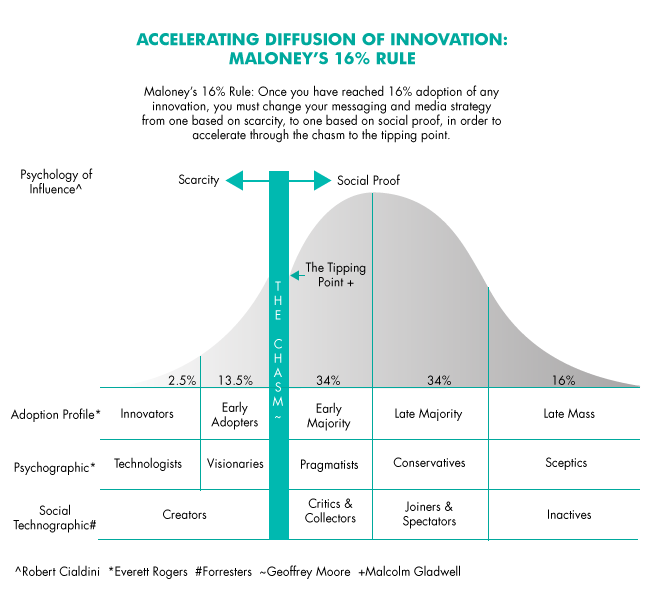
He described five adopter categories, distributed along a roughly normal curve:
Innovators (2.5%)
Innovators are the first to adopt. They are risk-tolerant, technically sophisticated, financially resourced, and cosmopolitan, meaning they are connected to networks outside their immediate community and can learn about new developments quickly.
They are willing to adopt based on technical evaluation alone, without requiring social proof.
Innovators are important to the diffusion process not as volume adopters but as gatekeepers. They absorb the failure risk of untested technologies, separating viable innovations from those that do not work before they reach the broader market.
Early Adopters (13.5%)
Early adopters are the second group and arguably the most influential in determining whether an innovation succeeds. Unlike innovators, they are embedded in their local social system and are opinion leaders: their adoption decisions are watched and interpreted by others.
Early adopters do not need broad social proof, but they do need enough evidence of feasibility to accept some risk. They adopt because they see genuine competitive or personal advantage in being early. When their adoption is seen to go well, it provides the social validation that opens the door for the more risk-averse early majority.
Early Majority (34%)
The early majority are pragmatic. They want solid evidence that an innovation works, references from people they trust, and assurance that support infrastructure exists.
They are connected within their social system and deliberate in their adoption process: they watch the early adopters carefully and wait until the innovation has demonstrated its value.
The early majority represents the crossing point into mainstream adoption. Winning this group is typically the critical challenge for any innovation trying to achieve broad adoption.
Late Majority (34%)
The late majority approach innovation with skepticism. They adopt primarily because of social pressure, because the innovation has become the norm and not adopting it starts to create social or practical disadvantage. They have limited economic surplus to absorb risk and tend to require that all uncertainty be resolved before adoption.
Laggards (16%)
Laggards are the last to adopt, and some never do. They are typically isolated from mainstream networks, oriented toward tradition and the past, and suspicious of change.
In some analyses, a significant portion of laggards represent people for whom the innovation is simply not relevant or accessible, rather than people ideologically opposed to change.
"Laggards may be alienated from a too-rapidly-changing social system. They preserve a modicum of innovation-resistance in a social system, thus slowing the diffusion process." (Everett Rogers, Diffusion of Innovations)
The S-Curve of Adoption
When cumulative adoption is plotted over time, it traces a characteristic S-curve shape. This pattern is one of the most robust empirical findings in the diffusion literature, observable across dozens of different types of innovation, social systems, and time periods.
The three phases of the S-curve reflect the social dynamics of adoption:
Slow start: Early adoption is slow because few people have tried the innovation, social proof is limited, and the costs of adoption (financial, learning, social risk) are not yet offset by visible benefits to others. Innovators and early adopters adopt during this phase.
Rapid growth: Once early adopters demonstrate success and opinion leaders validate the innovation, adoption accelerates.
Each new adopter adds to the social proof visible to others, and the infrastructure around the innovation (support, complementary products, trained professionals) builds out, lowering adoption barriers. This is the steep middle section of the S.
Saturation: Growth slows as the remaining non-adopters are harder to reach, either because they are laggards with fundamental resistance, because they lack access to the innovation or its prerequisites, or because the innovation is simply not relevant to them. The curve flattens near its ceiling.
| Adopter Category | Cumulative % at End of Category | Phase of S-Curve |
|---|---|---|
| Innovators | 2.5% | Flat start |
| Early Adopters | 16% | Beginning of rise |
| Early Majority | 50% | Steep growth |
| Late Majority | 84% | Decelerating growth |
| Laggards | 100% | Flattening toward ceiling |
The Five Factors That Predict Adoption Speed
Rogers identified five attributes of an innovation that consistently predict how quickly it will be adopted:
Relative Advantage: How much better is the innovation than the existing alternative? This is the strongest predictor of adoption speed. Innovations with clear, demonstrable, and communicable advantages over existing solutions diffuse faster.
The advantage can be economic, social, practical, or psychological: what matters is that potential adopters can perceive and believe in the advantage.
Compatibility: How well does the innovation fit with existing values, past experiences, and the needs of potential adopters? An innovation that requires wholesale behavioral change, or that conflicts with cultural values, faces much higher adoption barriers than one that integrates smoothly into existing practices.
The personal computer integrated into existing work patterns; the early versions of Google Glass required new behavioral norms that most people were unwilling to adopt.
Complexity: How difficult is the innovation to understand and use? Innovations that are easy to understand and require minimal learning diffuse faster.
Note that perceived complexity matters more than technical complexity: an objectively complex system that presents a simple interface will diffuse faster than a simpler system with a confusing user experience.
Trialability: Can potential adopters try the innovation before fully committing? Innovations that can be tested on a limited basis, returned if unsatisfactory, or experienced through a low-risk pilot reduce the perceived adoption risk and accelerate adoption.
Free trials, freemium models, and sample programs are all mechanisms to increase trialability.
Observability: How visible are the results of adoption to others? Innovations whose benefits are easily observed, and preferably discussed, by others spread faster because visibility creates social proof and word-of-mouth momentum.
Agricultural innovations in Rogers' original research spread fastest when farmers could literally see their neighbors' better crop yields.
Crossing the Chasm
While Rogers' model describes how innovations spread across an entire social system, technology strategist Geoffrey Moore identified a specific failure point that Rogers' model underemphasized.
In "Crossing the Chasm" (1991), Moore argued that a chasm exists between early adopters and the early majority that many technology innovations fail to bridge.
The chasm exists because early adopters and the early majority want fundamentally different things:
| Dimension | Early Adopters | Early Majority |
|---|---|---|
| Motivation | Want competitive advantage from being early | Want proven solutions with minimal risk |
| Tolerance for incompleteness | High: will work through bugs and gaps | Low: need complete, supported solutions |
| Reference needs | Trust their own evaluation | Need references from similar organizations |
| Relationship with vendor | Collaborative partners in development | Service relationship with clear accountability |
| Price sensitivity | Willing to pay premium for novelty | Price-conscious |
A product optimized for early adopters (incomplete, evolving, technically interesting, with close vendor relationships) is often poorly suited to the early majority's needs.
The early majority is watching early adopters, but they are asking: "Has this been proven for someone like me, with needs like mine, in a context like mine?" If the answer is not clearly yes, they will wait.
Moore's prescriptions for crossing the chasm involve focusing intensively on a single market segment, becoming the complete solution for that segment's specific needs, and using that beachhead to build the reference base that the early majority requires before adopting.
Real-World Examples of Diffusion Dynamics
Smartphones
Smartphone adoption followed the S-curve with characteristic dynamics. Early innovators were technology enthusiasts who accepted the limitations and high costs of early devices. Early adopters, professionals and technology workers, saw clear relative advantages and normalized the behavior.
By the time the iPhone launched in 2007, the early majority was ready for a compatible, sufficiently complete product with demonstrated value. By 2023, smartphone ownership reached roughly 54% of the world's population according to GSMA, exceeding 80-90% in high-income countries and specific saturated markets but lagging well behind in many low-income and least-developed regions, a gap GSMA attributes primarily to access and affordability barriers rather than preference, illustrating that a single global figure can obscure very different diffusion stages across regions.
Electric Vehicles
Electric vehicles are in the chasm phase in many markets as of the mid-2020s. Innovators and early adopters adopted them enthusiastically; the early majority remains cautious due to concerns about charging infrastructure, range anxiety, and upfront cost premiums, precisely the "complete solution" and "risk reduction" concerns Moore predicted.
The rate at which EV adoption crosses the chasm depends heavily on infrastructure investment, price parity, and reference visibility as early adopters in each community demonstrate normal, untroubled use.
Remote Work
Remote work as a normalized practice illustrates how external shocks can accelerate diffusion by collapsing the gradual adoption process. Prior to 2020, remote work was in the early adopter phase in many industries, used enthusiastically by technology workers and some knowledge workers but viewed with skepticism by the mainstream.
The COVID-19 pandemic functioned as a forced mass trial: it collapsed the trialability barrier, created universal observability, and demonstrated relative advantages that the late majority had not believed possible. Adoption that might have taken another decade occurred in weeks.
Implications for Launching New Ideas
Whether launching a product, a policy, a practice, or an organizational change, the diffusion framework generates useful practical questions:
Who are the innovators and early adopters for this idea? These are the people who will adopt based on the inherent value, before social proof exists. Identifying and serving them first is the foundation for all subsequent diffusion.
What opinion leaders need to validate this? Early majority adoption follows opinion leader adoption. Which people or organizations, if they adopt and discuss the innovation positively, will provide the credibility signal that pragmatic adopters require?
What is the perceived complexity and how can it be reduced? Complexity is the most controllable adoption barrier. Simplifying onboarding, creating clear documentation, building intuitive interfaces, and providing strong support all reduce complexity-driven resistance.
Where is the chasm? For any innovation targeting mainstream adoption, the gap between early adopter needs and early majority needs should be explicitly mapped. The communication and product strategy for crossing the chasm is different from the strategy for winning early adopters.
How can observability be increased? Case studies, public reference customers, visible metrics, and community forums all increase the observability of successful adoption, accelerating social proof for the next adopter cohort.
The diffusion framework is not a formula for guaranteed success. But it provides a map for understanding where an innovation stands in its journey through a social system, why resistance appears where it does, and what interventions are most likely to accelerate the journey to broad adoption.
When Innovations Fail to Diffuse
Not all innovations follow the S-curve to broad adoption. Many fail to diffuse at all, or diffuse only partially. Understanding the failure modes is as instructive as understanding the success pattern.
Technical superiority is insufficient: The QWERTY keyboard is the most frequently cited example of an inferior standard that won adoption due to path dependence and network effects.
Whether QWERTY is actually inferior to alternatives like Dvorak is debated (the evidence is weaker than the popular narrative suggests), but the principle is sound: adoption is driven by Rogers' five factors, not by technical optimality.
A technically superior innovation that scores poorly on compatibility, observability, or trialability will diffuse more slowly than a technically inferior one that scores well on those dimensions.
Network effects can lock in incumbents: Some technologies become more valuable as more people use them, creating strong incentives to adopt the standard that others have adopted. This gives early movers an advantage that can persist long after superior alternatives emerge.
The adoption of the standard is reinforced by existing users, making it extremely hard for a better alternative to dislodge it even if its relative advantage is clear in isolated comparison.
The reinvention problem: As innovations spread to later adopters, they are often modified to fit local conditions, values, and needs. Rogers called this reinvention. Moderate reinvention can accelerate adoption by improving compatibility.
Excessive reinvention can fragment an innovation into incompatible variants that prevent the network effects and shared infrastructure that support mainstream adoption.
Adoption discontinuation: Adoption is not irreversible. Discontinuation, the decision to stop using a previously adopted innovation, is a real phenomenon that Rogers analyzed but that is often overlooked in simplified treatments of the framework.
Innovations that are adopted but do not deliver sufficient value, or that are superseded by better alternatives before network effects solidify, can diffuse and then undiffuse.
Fax machines provide an example of technology that achieved near-universal business adoption and then was largely discontinued as email and digital document sharing superseded it.
The Role of Opinion Leaders
Among the five adopter categories, early adopters play a role disproportionate to their numbers because of their function as opinion leaders. Rogers devoted substantial attention to understanding who opinion leaders are and why their endorsement is so powerful.
Opinion leaders are not simply the most visible or most popular people in a social system. They tend to be:
- Slightly more innovative than their peers but not drastically so: people who are much more innovative than the mainstream (innovators) are too different to be trusted as guides; opinion leaders are close enough to the mainstream that their experience feels relevant
- Technically competent in the domain: their views are taken seriously because they are seen as genuinely knowledgeable
- Socially accessible: they interact broadly within the social system and are available to communicate about the innovation to others
- Conformist to norms in most respects: they are trusted precisely because they are not radical; their innovation-adoption is a departure from an otherwise conventional profile
This profile explains why early adopter targeting is such a central part of effective innovation launch strategy.
The goal is not to reach the most enthusiastic possible users, but to reach the most influential validators within the mainstream community: people whose adoption and positive experience will be seen as relevant evidence by the pragmatic early majority.
Diffusion of Innovation in Public Health
Rogers developed much of his framework from agricultural extension research (the study of how new farming practices spread among rural communities), but its applications in public health have been some of the most significant.
Vaccination programs, contraception adoption, handwashing practices, and HIV prevention behaviors have all been analyzed through the diffusion framework. The key insight for public health is that information dissemination alone does not produce adoption.
Knowing that a behavior is beneficial does not make it compatible with existing values, easy to trial, or visible in results. Public health interventions that focus on providing information without addressing the full set of adoption factors consistently underperform.
Successful public health diffusion campaigns share characteristics that Rogers' framework predicts: they work through trusted community members who function as local opinion leaders, they make the new behavior as compatible as possible with existing practices and values, they create visible demonstrations of success in early adopters, and they provide channels for easy trial before full commitment.
The global push for hand sanitizer adoption during the COVID-19 pandemic is a recent illustration. Initial adoption was driven by fear (a powerful motivation, but one Rogers' framework recognizes as creating short-term adoption rather than sustained behavior change).
Long-term adoption was sustained where hand sanitizer dispensers were placed prominently in high-traffic areas (reducing friction), where their use was normalized through widespread social visibility (observability), and where no significant value conflicts existed (compatibility).