
Actually: In 2013, Angela Duckworth stood at a TED Talk podium and delivered a talk that would be viewed more than 30 million times. The message was simple and powerful: talent isn't what separates those who succeed from those who don't. What matters is grit - a combination of passion and perseverance for long-term goals.
The idea resonated deeply in a culture that had grown tired of the "talent is everything" narrative and hungry for evidence that effort matters. Grit offered a more democratic vision of achievement: it's not about who you are born as, but how hard you work and how long you persist.
The research behind it was real, the evidence was intriguing, and the idea spread rapidly through schools, corporations, military training programs, and self-help culture. But as grit entered mainstream discourse, psychologists began reexamining the original studies - and what they found complicated the story considerably.
What Grit Is
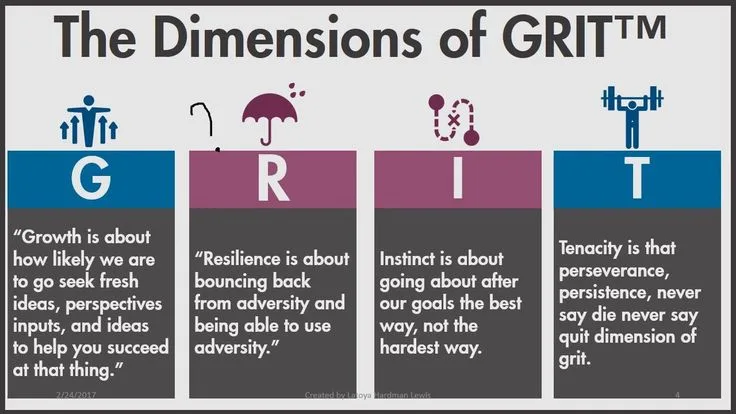
Angela Duckworth defines grit as passion and perseverance for long-term goals.[2] It is the tendency to sustain interest in and effort toward challenging objectives over months and years, even in the face of failure and adversity.
Grit has two components:
Consistency of interest (passion): Having stable long-term interests rather than constantly shifting passions. A gritty person pursues one thing deeply over time rather than jumping from enthusiasm to enthusiasm.
Perseverance of effort: Working hard and continuing to work hard when faced with setbacks. Not giving up when things get difficult.
Duckworth distinguishes grit from several related constructs:
- Talent: Innate ability, the rate at which someone improves with practice. Duckworth's core argument is that talent predicts success less well than grit.
- Conscientiousness: A well-established personality trait (one of the Big Five) that encompasses organization, diligence, and reliability. Grit is related to conscientiousness but, Duckworth argues, is more specifically focused on sustained pursuit of a single long-term goal.
- Short-term motivation: Grit is about persistence over years, not the drive to finish this week's project.
The Grit Scale (Grit-S) is an 8-item self-report measure that produces a score from 1 to 5. Sample items include:
- "Setbacks don't discourage me. I don't give up easily."
- "I am a hard worker."
- "My interests change from year to year." (reverse scored)
- "I finish whatever I begin."
The scale is freely available and has been completed by millions of people globally.
Duckworth's conceptual framework draws on earlier work in educational psychology and the psychology of expertise. K. Anders Ericsson's research on deliberate practice - the intensive, structured form of practice that drives expert skill development - provided a framework for understanding how effort translates to performance.[5]
Duckworth's contribution was to ask what psychological trait sustains the sustained effort that deliberate practice requires, over years, through the inevitable periods of failure and stagnation.
Grit was her answer: the stable orientation toward long-term goals that keeps someone engaged with deliberate practice when the immediate experience of it is difficult and unrewarding.
The Original Research: What Duckworth Found
Angela Duckworth's landmark 2007 paper, published in the Journal of Personality and Social Psychology with co-authors Christopher Peterson, Michael Matthews, and Dennis Kelly, reported results from several studies:[1]
Study 1 - West Point Cadet Basic Training ("Beast Barracks"): Every summer, West Point admits a new class of cadets and subjects them to an intensive six-week summer training program.
Historically, approximately 5% of cadets drop out during this period - a rate that had not been reduced by the admissions process designed to identify capable recruits.
Duckworth found that grit scores predicted who completed Beast Barracks better than the Whole Candidate Score (West Point's composite admissions index, which incorporates SAT scores, physical fitness, and leadership).
Study 2 - National Spelling Bee: Spelling Bee contestants who scored higher on grit had competed in more prior bees and studied more hours per week - controlling for verbal IQ. Grit predicted final ranking.
Study 3 - Ivy League undergraduates: Grit correlated with GPA even after controlling for SAT scores. Among highly intelligent students, the grittier ones achieved better grades.
Study 4 - West Point longitudinal follow-up: Gritty cadets were more likely to stay enrolled at West Point beyond the first summer.
The conclusion: grit predicts success in challenging environments beyond what cognitive ability alone would predict.
"The highly accomplished were paragons of perseverance... In every field, grit may be as essential as talent to high achievement." - Angela Duckworth, Grit: The Power of Passion and Perseverance (2016)
The Appeal of the Finding
The timing and framing of the grit concept were nearly perfect for the cultural moment. Malcolm Gladwell's 2008 book Outliers had just argued that innate talent was overrated and that extraordinary achievement required 10,000 hours of practice.
Carol Dweck's growth mindset research was gaining mainstream traction. There was enormous appetite for evidence that effort, not birth, determines success.
For educators, grit offered a school-safe intervention target. You can't change students' IQs, but maybe you can cultivate grit. For employers, it offered a new hiring criterion that emphasized resilience and commitment. For parents, it offered reassurance that hard work matters.
The appeal was partly narrative. Grit maps onto deep cultural stories about perseverance - the underdog who doesn't quit, the immigrant generation that worked against all odds, the athlete who trains while others sleep. These are compelling templates, and grit research appeared to give them empirical grounding.
The Replication Problems
By 2016, when Duckworth's popular book Grit was published, the research community had begun examining the evidence more carefully.
Crede's Meta-Analysis
In 2017, Marcus Crede, Michael Tynan, and Peter Harms published a meta-analysis of 88 studies involving over 66,000 participants.[3] Their findings:
| Finding | Detail |
|---|---|
| Overall grit-performance correlation | r = 0.18 (modest) |
| Perseverance of effort subscale | Substantially more predictive than consistency of interest |
| Consistency of interest subscale | Very weak relationship with outcomes |
| Overlap with conscientiousness | Extremely high (r = 0.84 in some studies) |
| Incremental validity beyond conscientiousness | Very small |
The study's central critique: most of the predictive power of the Grit Scale comes from the perseverance of effort subscale, which is nearly indistinguishable from conscientiousness.
The consistency of interest subscale - the "passion" component that was theoretically central to the grit concept - showed very little relationship with performance.
If grit largely measures what conscientiousness already measures, the question becomes: is grit a new discovery, or a relabeling of an existing construct with a more marketable name?
The meta-analysis also challenged the original West Point finding's generalizability. Dropout from Beast Barracks is a specific outcome in an extreme, self-selected environment. The applicability of these findings to everyday academic performance, civilian careers, and real-world achievement remained unclear.
The Conscientiousness Problem in Detail
Conscientiousness is one of the Big Five personality traits (along with openness, agreeableness, extraversion, and neuroticism). It is one of the most reliably studied constructs in personality psychology, with decades of research showing it predicts academic performance, job performance, and health outcomes.
Conscientiousness includes facets like: deliberateness, dutifulness, self-discipline, orderliness, achievement striving - and yes, perseverance. Studies measuring both grit and conscientiousness typically find correlations between 0.5 and 0.8.
Duckworth acknowledges the overlap but argues that grit's specific focus on maintaining a single long-term passion - rather than conscientiousness's broader "do your duty" orientation - constitutes a meaningful distinction.
Critics find this distinction too subtle to justify treating them as separate constructs, especially given the empirical overlap.
Roberts and colleagues (2014) were particularly direct: if the Grit Scale is essentially a measure of conscientiousness repackaged, then decades of conscientiousness research already tell us what grit research is finding - but without the need for a new scale, a new construct, or a popular book.[7]
The Passion Component Is Particularly Weak
The consistency of interest subscale - measuring whether someone maintains stable long-term interests - is arguably the more theoretically distinctive part of grit. And yet it shows very weak relationships with outcomes.
This raises a question about what advice to give people who want to succeed: should they pick one thing and stick with it? Research on career development and expertise suggests the answer is more nuanced.
Generalists who explore multiple domains before specializing often develop unique cross-domain insights. Range, as David Epstein argues in his 2019 book, may be as valuable as depth in many fields.[4]
Epstein's analysis of elite performers found that in many domains - particularly complex, fast-changing, or creative ones - broad early exploration followed by late specialization produced better outcomes than early commitment to a single path.
Nobel laureates in science are significantly more likely than average scientists to have serious hobbies outside their field; top CEOs more often come from generalist backgrounds than pure functional specialists.
The advice to "find your passion and never waver from it" - the implicit practical message of the consistency of interest subscale - is empirically questionable as life advice, even if gritty people who have found theirs tend to do well.
What Grit Overlooks
Beyond the measurement debates, the grit framework faces substantive criticism about what it implicitly deemphasizes.
Structural Opportunity
Grit is a story about individual effort and character. But outcomes in education, careers, and life are powerfully shaped by factors that have nothing to do with individual perseverance: family income, school quality, social networks, geography, discrimination, physical health, and luck.
When grit becomes the dominant frame for understanding success, it can subtly shift attention from structural factors to individual character.
The child who doesn't "make it" despite apparent effort may not have had less grit - they may have had fewer resources, less support, more adversity that consumed the resources that other children could direct toward achievement.
Randolph, Engelhard, and Duckworth (2011) examined grit and teacher effectiveness with inner-city students and found that teacher grit predicted their own perseverance but not student outcomes - student outcomes were more strongly predicted by teachers' relevant knowledge and skill.
The finding highlights a gap between what grit predicts and what actually matters for outcomes in complex, resource-dependent contexts.
Critics of the grit literature - including some within the field of developmental psychology - argue that grit research has been conducted disproportionately with high-achieving, relatively advantaged populations (West Point cadets, Ivy League students, National Spelling Bee contestants) and may generalize poorly to populations facing material disadvantage.
Economist Raj Chetty's large-scale research on economic mobility demonstrates that where a child grows up - the specific county, neighborhood, and school district - is one of the strongest predictors of their adult economic outcomes, accounting for variation that individual character traits cannot.[10]
Children with identical apparent traits raised in different environments achieve dramatically different outcomes. Structural factors of this magnitude cannot be explained by grit.
The Strategic Value of Quitting
The implicit message of grit - perseverance is virtuous, quitting is failure - conflicts with a substantial body of research on decision-making.
Sunk cost fallacy: Continuing to invest in a failing course of action because of past investment is a well-documented cognitive error. Grit encourages staying the course; rational decision-making sometimes requires abandoning it.
Opportunity cost: Every hour spent persevering on one goal is an hour not spent on alternatives. A highly gritty person who has picked the wrong goal may be worse off than a less gritty person who adapted more quickly.
Strategic quitting: Hospitality entrepreneur and author Chip Conley has argued that knowing when to quit is as important a skill as knowing how to persist. Perseverance is valuable when applied to the right goals; it's costly when applied to the wrong ones.
Seth Godin (2007) in The Dip makes a related argument: in most endeavors, there is a period of increasing difficulty (the Dip) between initial progress and eventual mastery. Quitters quit during the Dip. But some situations are not Dips - they are dead ends, where continued investment yields no further progress.
Wisdom lies not in universal perseverance but in the ability to distinguish Dips from dead ends. This judgment - knowing when to persist and when to quit - is arguably more valuable than raw persistence, and it is not captured by any measure of grit.
Burnout and Recovery
The science of performance and expertise - from sports science to workplace psychology - consistently shows that rest and recovery are not the opposite of high performance; they are part of it. Peak performers in any domain alternate between intense effort and deliberate recovery.
A culture that prizes grit above all else can create environments where people feel ashamed to take breaks, acknowledge limits, or step back. Burnout - chronic work stress that has not been successfully managed - is associated with reduced performance, health problems, and disengagement.
Grit without recovery is not a path to sustained high performance.
Christina Maslach and Michael Leiter's (2016) research on burnout identifies it as a response to chronic workplace stressors characterized by exhaustion, cynicism, and reduced professional efficacy.[6]
Burnout is not a failure of grit - it is what happens when grit is applied without the recovery, support, and realistic goal-setting that sustained performance requires. Framing burned-out workers as insufficiently gritty adds self-blame to an already damaging experience.
Sports science provides the most operationally precise understanding of effort-recovery balance. Periodization - structured alternation between high-intensity effort and active recovery - is the standard framework for athletic development at all levels.
Athletes who train without recovery phases do not improve faster; they develop overtraining syndrome and regress. There is no reason to believe the same principle does not apply to cognitive and motivational performance across the lifespan.
What the Evidence Actually Supports
After accounting for the replication concerns and theoretical critiques, what can we confidently say?
Perseverance of effort, broadly conceived, does matter. The relationship between effort-focused conscientiousness and outcomes is well-established across decades of research and meta-analyses. The domain labeled "grit" captures something real.
The relationship is modest, not dominant. Effect sizes in meta-analyses suggest that grit-related traits explain a meaningful but not overwhelming portion of variance in outcomes. Many other factors - intelligence, opportunity, domain-specific skills, social support - matter as much or more.
Passion stability (consistency of interest) shows weak effects. The distinctive "passion" component of grit does not perform well empirically. Advising people to pick one passion and never deviate is not strongly supported.
Context and domain matter enormously. The traits that predict success at West Point Beast Barracks may not predict success in creative fields, entrepreneurship, or domains that reward adaptation and learning agility over raw persistence.
Structural factors are large. Any individual-level explanation of outcomes that ignores family background, income, education quality, and social capital is incomplete in ways that matter.
Grit in Education: The Classroom Application
After Duckworth's TED Talk, grit entered schools rapidly and, in some cases, uncritically. Dozens of school districts began teaching "grit" as a character trait, administering the Grit Scale to students, and designing curricula around persistence and resilience.
The educational application has been more controversial than the research itself. Several concerns:
Misapplication to disadvantaged students: Critics including educator Alfie Kohn have argued that telling struggling students they need more grit - rather than addressing under-resourced schools, poverty, family stress, and structural inequality - is a form of victim-blaming dressed in psychological language.
A student whose school has no science lab doesn't need more grit to become a scientist; she needs a laboratory.
Teaching grit vs. building conditions for it: There is a difference between measuring whether someone currently shows gritty behavior and developing the conditions under which grit-like persistence can emerge.
Research on intrinsic motivation (Ryan and Deci's Self-Determination Theory) suggests that people persist when they have autonomy, feel competent, and find their work meaningful - not when they are told to persist.[8]
Programs that build intrinsic motivation may be more effective than programs that explicitly target "grit."
Assessment concerns: Using the Grit Scale to evaluate students raises concerns about measurement validity, self-report bias (students may answer based on what they think teachers want to hear), and potential misuse of scores in evaluation contexts.
Duckworth herself has expressed caution about over-rapid school adoption. In a 2015 NPR interview, she said, "I don't think it's particularly fair to sit children down and tell them they need to develop more grit... Grit I believe is real, but it is very very hard to measure."
Carol Dweck's growth mindset research offers a related but arguably better-supported intervention.[9] The growth mindset - the belief that abilities can be developed through effort and learning rather than being fixed - has been tested in school interventions and shows effects on academic persistence and achievement.
Critically, it operates through changing beliefs about the malleability of ability, which provides students a reason to persist through difficulty.
Grit without the growth mindset gives students a description of what they should do (persist) without the cognitive frame that makes persistence rational.
The more careful educational applications focus on growth mindset (Carol Dweck's related research), deliberate practice (K. Anders Ericsson), and developing intrinsic motivation - approaches with somewhat stronger and more consistent empirical support than grit specifically.
Grit vs. Other Predictors of Success
Situating grit within the broader landscape of success predictors helps calibrate its importance. Research consistently identifies several factors with stronger or comparable predictive validity:
| Predictor | Relationship to Outcomes | Notes |
|---|---|---|
| Cognitive ability (IQ, SAT) | Strong, broad | Predicts performance across most academic and professional domains |
| Conscientiousness | Strong, broad | Largest personality predictor of job and academic performance |
| Domain-specific skills and knowledge | Strong | Most immediate predictor of task performance |
| Deliberate practice | Moderate-strong | Hours of structured practice predict expert performance |
| Social support and mentorship | Moderate-strong | Peer and mentor relationships significantly affect trajectories |
| Socioeconomic background | Moderate-strong | Family income and parental education are strong predictors of outcomes |
| Grit (perseverance subscale) | Modest | Largely overlaps with conscientiousness |
| Grit (passion/consistency subscale) | Weak | Shows little predictive power in meta-analyses |
This ordering does not mean grit is unimportant. It means grit is one factor among many, and not the dominant one. Claiming that grit determines success more than cognitive ability, structural opportunity, or domain expertise is not supported by the evidence.
The table above also highlights a construct that the grit literature has been criticized for minimizing: socioeconomic background.
Research by Raj Chetty, John Friedman, and colleagues at the Opportunity Insights lab has used administrative data on tens of millions of Americans to show that parental income predicts children's adult earnings at levels that would require implausibly large grit differences to explain.
A framework for success that does not incorporate structural opportunity is necessarily incomplete.
Practical Takeaways
The grit debate does not settle into a clean verdict. Here is what the research most clearly supports:
Effort and follow-through are genuinely valuable. The broad class of behaviors associated with conscientiousness and perseverance - working hard, finishing what you start, being reliable - predict positive outcomes across many contexts. This is not in dispute.
Choose goals carefully before committing to them. Grit applied to the wrong goal is waste, not virtue. The investment of perseverance is only as valuable as the objective being pursued. Before committing to deep persistence, the question of whether this is the right goal is at least as important as the question of how hard to work.
Cultivate recovery as deliberately as effort. High performance over years requires managing energy, not just spending it. Rest, recovery, and strategic withdrawal from effort are not failures of grit; they are preconditions for sustained performance.
Structural self-awareness matters. Recognizing the role of opportunity, support systems, and external resources in your outcomes - not just your own perseverance - enables more honest self-assessment and more effective help-seeking.
Exploration before commitment may serve better than early passion fixation. The weak empirical performance of the consistency of interest subscale, combined with research on the value of generalist exploration in many fields, suggests that staying curious across multiple domains is not a deficit of grit but potentially an advantage in environments that reward adaptive expertise.
Grit is real enough to take seriously and oversimplified enough to treat with caution. The underlying truth - that sustained effort toward meaningful goals produces better outcomes than giving up - is not in doubt.
What grit research added is a measure of that tendency and a set of studies showing that effort matters even when talent varies. What it did not do, despite the cultural reception, is prove that grit is the primary engine of human achievement.
What you do with that is, appropriately, up to you.
Sources & Further Reading
- Duckworth, A. L., Peterson, C., Matthews, M. D., & Kelly, D. R. (2007). Grit: Perseverance and Passion for Long-Term Goals. Journal of Personality and Social Psychology, 92(6), 1087-1101.
- Duckworth, A. (2016). Grit: The Power of Passion and Perseverance. Scribner.
- Crede, M., Tynan, M. C., & Harms, P. D. (2017). Much Ado About Grit: A Meta-Analytic Synthesis of the Grit Literature. Journal of Personality and Social Psychology, 113(3), 492-511.
- Epstein, D. (2019). Range: Why Generalists Triumph in a Specialized World. Riverhead Books.
- Ericsson, K. A., Krampe, R. T., & Tesch-Romer, C. (1993). The Role of Deliberate Practice in the Acquisition of Expert Performance. Psychological Review, 100(3), 363-406.
- Maslach, C., & Leiter, M. P. (2016). Burnout. In G. Fink (Ed.), Stress: Concepts, Cognition, Emotion, and Behavior. Academic Press.
- Roberts, B. W., Lejuez, C., Krueger, R. F., Richards, J. M., & Hill, P. L. (2014). What Is Conscientiousness and How Can It Be Assessed? Developmental Psychology, 50(5), 1315-1330.
- Ryan, R. M., & Deci, E. L. (2000). Self-Determination Theory and the Facilitation of Intrinsic Motivation, Social Development, and Well-Being. American Psychologist, 55(1), 68-78.
- Dweck, C. S. (2006). Mindset: The New Psychology of Success. Random House.
- Chetty, R., Friedman, J. N., & Rockoff, J. E. (2014). Measuring the Impacts of Teachers. American Economic Review, 104(9), 2633-2679.