
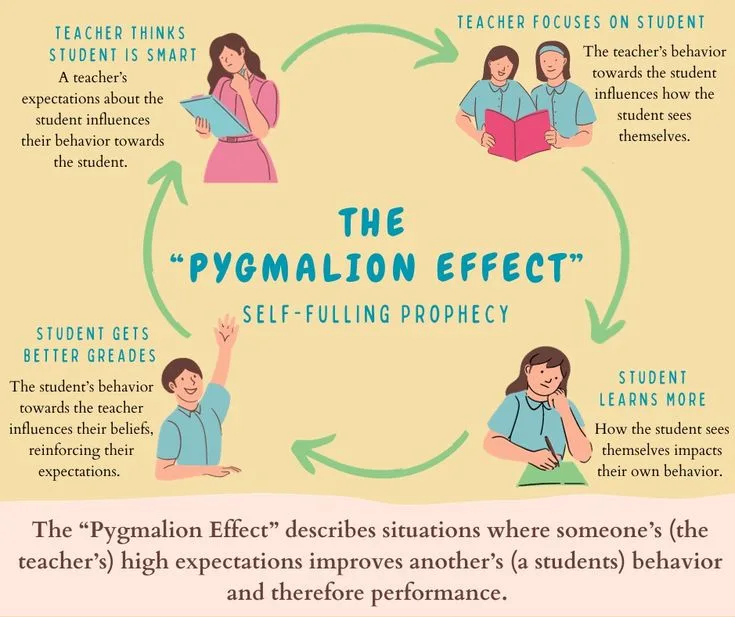
The pygmalion effect in practice depends on everyday differences in climate, intellectual challenge, opportunities to answer, and the quality of corrective feedback. Expectations can shape these behaviors without deliberate favoritism, giving some learners more chances to develop. The original school study was influential and contested, with its stronger reported results concentrated in younger grades and its power implications remaining important.
One morning in 1964, a researcher arrived at a public elementary school in San Francisco's Mission District and administered a test to several hundred students across six grade levels. The test was called the "Harvard Test of Inflected Acquisition" - a meaningless name that had been invented to sound impressive.
The test itself was a standard intelligence measure, the Flanagan Tests of General Ability, which the students' teachers had not seen before.
After scoring the results, the researcher gave each teacher a list of students in their class who had reportedly scored in the top 20% on the bloomer test and could therefore be expected to show unusual intellectual growth in the coming year.
The teachers were instructed to keep the list confidential and treat it as a professional intelligence.
There was one fact the teachers were not told: the list was fabricated. The students identified as "late bloomers" had been selected entirely at random. They were no different from their classmates on any measured dimension.
The researcher was Robert Rosenthal, a social psychologist then at Harvard University. His collaborator was Lenore Jacobson, principal of the school they had studied. Eight months later, they returned and retested all the students. What they found produced one of the most cited and contested findings in twentieth-century psychology.
The Oak School Experiment
The school in the study was called "Oak School" in the published research, a pseudonym used to protect the institution.
When Rosenthal and Jacobson returned in late 1964 and early 1965, they found that the randomly selected "bloomers" had indeed gained more IQ points than the control students - and the effect was striking, particularly in the youngest grades.
In grades 1 and 2 combined, the designated bloomers gained an average of 27.4 IQ points over the course of the academic year. The control students in the same grades gained an average of 12 points.
The gap of 15 IQ points between randomly assigned groups who had been identical at the start of the year represented a substantial difference - and it was entirely attributable to the expectations teachers held.
In older grades, the effects were smaller and less consistent. Grades 3 through 6 showed weaker or statistically unreliable effects. Rosenthal and Jacobson interpreted this as suggesting the effect was strongest when students were young and when teachers had not yet formed firm independent impressions of them.
"When teachers expected randomly selected students to show intellectual growth, those students did show significantly greater gains than their control group classmates." - Robert Rosenthal & Lenore Jacobson, "Pygmalion in the Classroom" (1968)
The study was published in 1968 as Pygmalion in the Classroom, named after the Greek myth in which the sculptor Pygmalion falls in love with his ivory statue, which Aphrodite then brings to life. The implication was clear: what we believe about people has the power to shape who they become.
The choice of name was deliberate and evocative, but also, later critics would note, ideologically loaded. The myth of Pygmalion is about creation through expectation - but it is also a story of power, in which a powerful figure's belief determines the reality of someone who begins as a passive object.
This tension - between the inspirational and the potentially patronizing implications of the metaphor - runs through the research literature.
How Expectations Are Transmitted
The most important question the original study raised was also the one it did not answer: how, exactly, did teachers' expectations translate into students' IQ scores? The teachers were told about the bloomers at the start of the year.
They had not changed the curriculum, the teaching methods, or any formal aspect of instruction. Yet somehow, their expectations had influenced outcomes measurable by a standardized intelligence test.
Rosenthal spent subsequent years investigating the transmission mechanisms, and by the early 1970s had identified what he called the four-factor model of teacher expectancy effects - four channels through which expectations are communicated to students, largely without either party being consciously aware of it.
The Four Channels
Climate: Teachers create a warmer socioemotional environment for high-expectation students. They smile more, make more eye contact, lean forward physically, and express more enthusiasm when interacting with students they believe to be high-potential.
Students experience this warmth as a signal about their worth and potential, and it affects both their motivation and their cognitive performance.
Input: Teachers assign more challenging material and more complex tasks to students they believe are capable. High-expectation students encounter more demanding intellectual content, which produces more learning - a straightforward but consequential effect.
Low-expectation students receive simpler material and thus fewer opportunities for cognitive development.
Output: Teachers give high-expectation students more opportunities to respond, speak, and demonstrate their thinking. They call on them more often, give them longer to answer before giving up or moving on, and prompt them with more substantive follow-up questions. This differential practice effect compounds over an academic year.
Feedback: When high-expectation students answer correctly, teachers praise more specifically and more warmly. When they answer incorrectly, teachers provide more detailed corrective feedback rather than simply moving on. This differentially high-quality feedback loop accelerates learning for students already believed to be capable.
The insidious feature of all four channels is that they operate through normal, unremarkable teacher behavior. No teacher who reads this description believes they are doing these things.
The behaviors are not dramatic acts of favoritism; they are subtle gradations in the texture of everyday interaction that accumulate over months into substantial developmental differences.
Nonverbal Transmission
Rosenthal's later research placed particular emphasis on nonverbal channels of expectancy transmission.
A 2002 paper by Rosenthal in Psychological Science reviewed evidence that teachers communicate expectations through body posture, facial expression, and paralinguistic cues - tone, rhythm, and inflection - that are processed implicitly by students without conscious awareness.
In a landmark series of studies, Rosenthal found that when thin slices of teacher-student interactions were shown to observers with the audio removed, observers could detect which students were high-expectation and which were low-expectation based purely on the teacher's body language toward them.
Teachers leaned toward high-expectation students, made more sustained eye contact, and displayed more open, welcoming postures. The nonverbal channel, processed outside conscious awareness by both parties, may be more powerful than anything said explicitly.
Replication and Critique
The original Pygmalion in the Classroom study attracted enormous attention and equally enormous criticism.
Methodological Criticisms
Robert Thorndike, a leading measurement psychologist, published a critique in 1968 noting that several features of the data were statistically implausible. The control students in grades 1 and 2 had gained only 5 IQ points over the year - an unusually low amount that suggested possible measurement error rather than experimental effect.
The improvement in bloomers might have reflected regression to the mean from an anomalously low baseline rather than genuine expectancy effects.
Methodologists also noted that the study reported only on the subset of classes and grades with significant results, raising concerns about selective reporting. The design lacked several controls that would later become standard in social psychology experiments.
A 1978 reanalysis by Stephen Raudenbush, examining 18 independent studies that attempted to replicate the effect, found that expectancy effects were indeed statistically significant - but smaller and more conditional than Rosenthal and Jacobson's original findings suggested.
The effect was strongest when teachers had not previously taught the student (were working from relatively fresh expectations) and weakest when teachers had previous knowledge of students that contradicted the experimental manipulation.
What the Research Consensus Says
By the 1990s and into the present, the Pygmalion effect has the status of a real but conditional phenomenon:
- It is real: The weight of evidence from dozens of studies confirms that teacher (and, in other contexts, manager and coach) expectations measurably affect performance.
- It is smaller than the original study implied: Effect sizes in meta-analyses are modest, not the dramatic 15-IQ-point gaps of the 1968 study.
- It is conditional: The effect is strongest when the target person lacks strong prior information about their own ability, when the expectation-holder is an important social authority, and when there is sustained contact over time.
- It works in both directions: Positive expectations improve performance; negative expectations depress it. The negative version - sometimes called the Golem effect - is at least as well-documented as the positive.
A comprehensive 1978 meta-analysis by Rosenthal and Rubin examined 345 studies of interpersonal expectancy effects and found a mean effect size of r = 0.30 - meaningful but not transformative. Across educational settings specifically, the effect was somewhat smaller, averaging around r = 0.20-0.25.
These figures suggest that expectancy effects are a real contributor to outcomes but one factor among many, not a dominant determinant.
| Expectancy Effect Variant | Who Holds Expectation | Direction | Effect |
|---|---|---|---|
| Pygmalion effect | Teacher/manager | Positive | Raises performance |
| Golem effect | Teacher/manager | Negative | Lowers performance |
| Galatea effect | The individual | Positive | Raises own performance |
| Reverse Pygmalion | Individual aware of low expectation | Negative | Lowers self-efficacy |
| Interpersonal expectancy | Experimenter/researcher | Any | Distorts research results |
The Galatea Effect: Self-Expectation
Closely related to the Pygmalion effect is what researchers call the Galatea effect - the impact of self-expectation on performance. Named after the ivory statue that Pygmalion created and loved, the Galatea effect refers to the way that what you believe about your own potential shapes what you achieve.
Israeli organizational psychologist Dov Eden conducted some of the most rigorous research on this phenomenon, primarily using military samples.
In one study with the Israeli Defense Forces, Eden assigned trainees to different "command potential" conditions, manipulating both what the trainee believed about themselves and what their commanders believed about them.
He found that both manipulations independently improved performance - and that the effects were additive.
Trainees who both believed in their own potential and whose commanders believed in them outperformed those who had only one or neither of these advantages.
This research suggests that expectation management - the deliberate, systematic cultivation of high but realistic beliefs about capability - is one of the most powerful and underused tools available to educators and managers.
Self-Efficacy and the Galatea Effect
The Galatea effect intersects with Albert Bandura's theory of self-efficacy (1977, 1997) - the belief in one's capacity to execute the behaviors required to produce specific outcomes. Bandura's research found that self-efficacy is a better predictor of performance than objective ability in many domains.
More capable people with low self-efficacy underperform relative to their potential; less capable people with high self-efficacy apply themselves more persistently and often outperform more capable peers.
The practical implication is that self-efficacy is a leverage point: it can be raised through mastery experiences, vicarious learning (seeing similar others succeed), verbal encouragement, and physiological feedback (learning to interpret nervousness as helpful arousal rather than incapacitating fear).
All of these mechanisms are teachable and learnable.
The Pygmalion Effect in Management
The organizational management literature has adapted the Pygmalion effect extensively, and the evidence for its operation in workplaces parallels the educational findings.
J. Sterling Livingston's Seminal HBR Article
In 1969, J. Sterling Livingston published "Pygmalion in Management" in the Harvard Business Review, arguing that the performance of employees is shaped by what managers expect of them.
Livingston synthesized available research and argued that managers who expect poor performance unconsciously communicate that expectation through the same behavioral channels Rosenthal had identified in classrooms: reduced challenge, less feedback, less warmth, fewer opportunities to demonstrate capability.
The article is still cited because it captures something managers consistently report recognizing: the subordinate who flourished under one manager's leadership and struggled under another's, without anything in their intrinsic capability changing.
Livingston was particularly concerned with what he called the "self-fulfilling spiral" in management: a manager who expects poor performance from an employee behaves in ways that produce poor performance, which confirms the original expectation, which leads to even lower expectations and more limiting behavior.
This spiral can run in the positive direction as well - and understanding that it can be deliberately reversed is the core practical implication of the research.
Manager Expectations in Practice
The four transmission channels operate in organizations as directly as in classrooms:
Climate: Managers who believe in an employee's potential treat them with more warmth, patience, and respect. Managers who have written off an employee communicate dismissiveness through tone, body language, and the quality of attention they give.
Input: High-expectation employees receive more challenging assignments, more complex projects, and more visible work. These assignments develop skills and build reputations - creating a compounding advantage for employees whose managers believe in them.
Output: High-expectation employees are given more speaking time in meetings, more opportunities to lead presentations, and more latitude in decision-making. This visibility and practice accelerates development.
Feedback: High-expectation employees receive more specific and developmental feedback. Their failures are treated as learning opportunities; low-expectation employees' failures are treated as confirmations of inadequacy.
Organizational Research on Pygmalion Effects
Oz and Eden (1994) conducted an organizational study in which they trained managers to hold high expectations for randomly assigned subordinates.
The subordinate groups whose managers had been given high expectations showed significantly better performance over a six-month period than control groups - replicating the educational finding in a corporate context.
McNatt (2000) published a meta-analysis of 17 workplace studies examining Pygmalion effects in organizational settings, finding a mean effect size of d = 0.81 - larger than the educational effects.
The organizational context may produce stronger effects because adult employees are more likely to internalize external expectations into their own self-concept, and because the channels through which expectations are transmitted (assignment quality, development opportunities, sponsorship for visibility roles) have more directly career-relevant consequences than classroom interactions.
Pygmalion Effects and Systemic Bias
One of the most important practical dimensions of Pygmalion research is its intersection with race, class, and gender bias in education and employment.
Racial Expectations in Schools
Jason Okonofua and Jennifer Eberhardt (2015), publishing in Psychological Science, conducted experimental studies showing that teachers who perceived a student as Black were more likely to respond punitively to a second behavioral infraction than to a first - demonstrating a "escalation" pattern that did not appear for white students.
This interaction between racial expectations and behavioral interpretation contributes to the well-documented disparity in school discipline by race.
Ferguson (2003), reviewing research on teacher expectations and racial achievement gaps, found consistent evidence that racial stereotypes shape the expectations teachers form, the instructional quality students receive, and ultimately the achievement gaps that are frequently attributed to other factors.
The Pygmalion mechanism provides a specific causal pathway linking bias to outcomes: teachers who hold lower expectations of students from particular groups enact all four channels of expectancy transmission differently with those students - less warmth, less challenge, less output opportunity, less developmental feedback.
Across a school career, these differences accumulate into genuine achievement differences that can be mistaken for evidence that the original lower expectations were justified.
Gender and Expectation
Research on gender and academic expectations shows domain-specific effects. Tiedemann (2000) found that teachers' math ability assessments of boys and girls were shaped by gender stereotypes even after controlling for actual performance differences.
Boys were assessed as having higher ability even when performing equivalently to girls. Over time, these assessments influence students' own beliefs about their math ability, their engagement with math, and ultimately their performance.
Cheryan, Ziegler, and colleagues (2017), reviewing decades of research on gender gaps in STEM, found that expectancy-based mechanisms - including stereotype threat (the apprehension of confirming negative stereotypes) and differential encouragement - were significant contributors to women's underrepresentation in certain STEM fields.
Practical Applications
For Educators
The Pygmalion research suggests several practical adjustments:
Audit expectations: Be aware of the factors that shape your expectations of students - past performance records, family background, appearance, track record of siblings. These factors may be influencing your behavior toward students in ways you are not conscious of.
Deliberately seek disconfirming evidence: When a student you have low expectations of does something surprising and competent, treat it as real information rather than an anomaly.
Equalize interaction patterns: Research consistently finds that teachers call on and provide detailed feedback to a subset of students, and that the subset correlates with perceived ability. Deliberately distributing opportunities more equally counteracts the expectancy transmission.
Use mastery rather than ability framing: Research on growth mindset by Carol Dweck converges with Pygmalion research in suggesting that framing ability as developable rather than fixed produces better outcomes.
Expectations framed as "I know you can learn this" rather than "You are naturally good at this" are more robust under setback.
Dweck's 2006 work in Mindset synthesizes decades of experimental evidence showing that students who hold incremental (growth) rather than entity (fixed) theories of intelligence show greater persistence, recover better from failure, and achieve more over time.
For Managers
Examine your low expectations: Identify the two or three direct reports you have, implicitly, written off. Ask yourself what specific behaviors have led to that assessment, whether those behaviors are changeable, and whether your own management has contributed to them.
Differentiate your engagement: If you find you are significantly more engaged with some team members than others - giving them better assignments, more time, more feedback - ask whether that differential is justified or whether it is expectancy-driven.
Use expectation as a management tool deliberately: Eden's research, and subsequent replications, found that managers can improve employee performance by communicating genuine high expectations explicitly and specifically.
"I'm assigning you this project because I believe you can handle it and I want to see you develop this skill" is more powerful than the same assignment delivered without context.
Train yourself on feedback quality: The most equalizable of the four transmission channels is feedback. A commitment to providing specific, developmental feedback to all team members - regardless of your assessment of their potential - directly counteracts Golem-effect dynamics.
What the Pygmalion Effect Is Not
Several common misappropriations of the research deserve correction.
It is not the same as positive thinking: The Pygmalion effect requires that expectations be transmitted through behavior. Privately believing that an employee will improve without changing how you behave toward them has no documented effect.
It is not magic: The effect works within the range of what is actually achievable. Expecting a student to gain 30 IQ points does not make it happen; the effect operates by unlocking development that was realistically possible but was being constrained by low expectations.
It does not override structural inequality: Expectancy effects operate within social systems that have their own powerful dynamics. Research by Jason Okonofua and colleagues found that racial bias in teacher expectations compounds over time, contributing to disciplinary disparities.
Addressing expectancy effects cannot substitute for addressing systemic bias, though both are necessary.
It does not guarantee that high expectations improve performance: Meta-analyses show consistent but moderate effects. Other factors - task difficulty, student prior knowledge, classroom resources, home environment - often matter more than expectancy effects in any given case.
It is not a manipulation technique: The research does not support using false positive expectations as a systematic management strategy. Eden's work with the IDF was conducted with genuine uncertainty about which trainees would perform well.
Managers who manufacture false high expectations for specific purposes, without genuine conviction, are unlikely to transmit them authentically - and may undermine trust when the gap between expressed and enacted expectations becomes apparent.
The Lasting Significance of the Research
The Pygmalion effect occupies an unusual position in the scientific literature: it is methodologically contested, empirically replicated in modest form, and practically significant far beyond what the effect sizes alone would predict.
The reason is that it isolates a mechanism - the behavioral transmission of beliefs - that operates constantly and pervasively in educational and organizational settings, with cumulative consequences that dwarf any individual interaction.
The 15-IQ-point gaps of the original study may have been statistical artifacts. The principle they illustrated - that the beliefs powerful people hold about others become, through the texture of everyday interaction, part of the environment in which those others develop - has survived decades of scrutiny and emerged as one of the most actionable insights social psychology has produced.
The Pygmalion effect is real, meaningful, and actionable. It is not a cure for complexity or inequity. But it is a genuine reminder that the beliefs we hold about others are not merely private - they become, through the thousand small behaviors of everyday interaction, part of the environment in which others grow.