
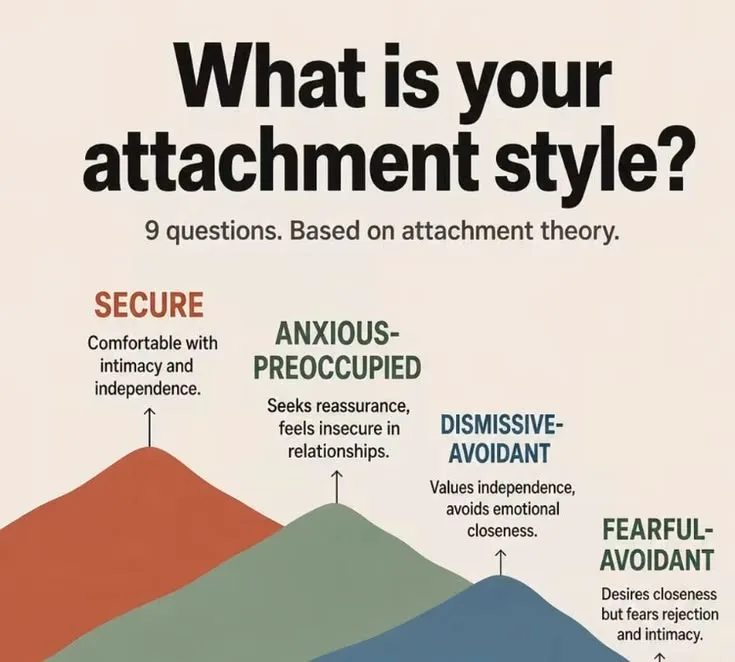
What Are Attachment Styles?
Attachment styles are the characteristic patterns people develop for managing closeness, distance, emotional need, and vulnerability in intimate relationships - patterns established in early childhood through repeated interactions with primary caregivers and shown by research to remain reasonably stable across the lifespan.
The framework originates in John Bowlby's attachment theory (1969), which identified attachment to a protective caregiver as a primary biological drive, and was extended by Mary Ainsworth's empirical work identifying three main patterns: secure, anxious-ambivalent, and avoidant.
Each style reflects a different internal working model - a mental template of whether the self is worthy of care and whether others can be trusted to provide it.
In 1969, a British psychiatrist named John Bowlby published the first volume of a trilogy that would quietly transform how psychologists, therapists, and eventually the general public understood human relationships.
Bowlby had spent years studying children separated from their parents during World War II evacuations, and what he found contradicted the prevailing behaviorist view that infants were attached to caregivers primarily because caregivers provided food.
Children who had all their physical needs met in institutions, Bowlby observed, still showed profound psychological damage from the absence of a consistent emotional bond. Attachment, he argued, was a primary biological drive - as fundamental to human survival as eating or sleeping.
Bowlby's framework described an attachment behavioral system: a set of behaviors (crying, clinging, reaching, following) whose biological function is to maintain proximity to a protective caregiver, especially under conditions of threat, illness, or distress.[1]
The system made evolutionary sense. Young humans are uniquely helpless for an unusually long period compared to other primates. An infant whose distress reliably brought a protective adult close was considerably more likely to survive.
The attachment system, in Bowlby's account, was shaped by natural selection because it solved a critical survival problem.
What Bowlby did not fully develop - but what subsequent research would elaborate into an enormously influential framework - was the question of what happens when the attachment system is activated and the caregiver does not respond, responds inconsistently, or responds in ways that are themselves frightening.
The answer to that question is the origin of what we now call attachment styles: the characteristic patterns people develop for managing closeness, distance, need, and vulnerability in intimate relationships - patterns that, research suggests, are established early, are reasonably stable across time, and extend their influence far beyond childhood.
"The propensity to make strong emotional bonds to particular individuals is a basic component of human nature, already present in germinal form in the neonate and continuing through adult life into old age." - John Bowlby, 1988
Key Definitions
Attachment: A deep emotional bond to a specific person, characterized by seeking proximity to that person when distressed, using them as a safe haven, and experiencing their presence as a secure base for exploration.
Attachment behavioral system: The set of behaviors - crying, calling, clinging, following - whose biological function is to maintain proximity to an attachment figure under threat.
| Attachment Style | Core Belief | Relationship Behavior | Prevalence (approx.) |
|---|---|---|---|
| Secure | "I am worthy of love; others are trustworthy" | Comfortable with intimacy and independence | ~55-60% |
| Anxious-Preoccupied | "I need others' approval; I fear abandonment" | Clingy, emotionally reactive, needs reassurance | ~15-20% |
| Dismissive-Avoidant | "I don't need others; closeness is uncomfortable" | Emotionally distant, values independence over intimacy | ~20-25% |
| Fearful-Avoidant | "I want closeness but fear getting hurt" | Conflicted; desires and fears intimacy simultaneously | ~5-10% |
Internal working model: Bowlby's term for the mental representation of oneself in relation to attachment figures, formed through repeated relational experiences and used as a template for subsequent relationships.
Strange Situation: Mary Ainsworth's structured laboratory procedure (1970) for classifying infant attachment patterns based on behavior during brief separations from and reunions with the caregiver.[2]
Earned security: A term describing individuals who had insecure or difficult early attachment histories but have achieved secure functioning in adulthood through later relationships, therapy, or reflective processing.
The Strange Situation and the Original Classification
The empirical foundation for attachment styles was laid by developmental psychologist Mary Ainsworth, who had worked with Bowlby in London before moving to Baltimore and then Uganda. Ainsworth's Uganda fieldwork (published in 1967) provided naturalistic observations of infant-mother pairs in the first year of life.
Her Baltimore research developed something far more operationally precise: the Strange Situation procedure (1970), a structured 20-minute laboratory protocol that became the standard tool for classifying infant attachment.
In the Strange Situation, a one-year-old infant and caregiver are brought into an unfamiliar room with toys. The caregiver leaves briefly (twice), and a stranger enters. The key observations are not the infant's behavior during separation but during reunion: how does the infant respond when the caregiver returns?
Ainsworth identified three patterns in her original sample:
Secure Attachment
Securely attached infants showed distress when the caregiver left - some cried, some simply became subdued - but were quickly and effectively comforted upon reunion.
They returned to exploration after reunion, using the caregiver as a "secure base." Their distress on separation indicated that the attachment system had been activated; their swift recovery on reunion indicated that the attachment system had been successfully regulated by the caregiver's response.
In Ainsworth's caregiving observations, securely attached infants had mothers who were consistently sensitive and responsive to their signals: noticing distress promptly, interpreting signals accurately, responding appropriately, and doing so reliably across situations.
The infant had learned, through hundreds of interactions, that expressing need reliably produced comfort.
Ainsworth's original Baltimore sample yielded approximately 65% secure infants. Population surveys across industrialized nations tend to find between 55% and 65% secure attachment, with some cross-cultural variation.
Anxious-Ambivalent (or Anxious-Preoccupied) Attachment
Anxiously attached infants were highly distressed during separation - sometimes inconsolably so - but were not easily soothed at reunion. They mixed clinging and crying with anger: pushing the caregiver away while also reaching for comfort.
Exploration was minimal throughout. The attachment system appeared unable to be deactivated even when the caregiver returned.
Ainsworth found that the caregivers of anxiously attached infants were not unresponsive so much as inconsistently responsive: sometimes sensitively attuned, sometimes distracted or unavailable. The infant had no reliable model for when comfort would come.
Under uncertainty, the evolutionary solution is to maximize the signal - cry louder, cling harder, never relax vigilance - because a loud signal that occasionally works beats a quiet signal that never does.
Prevalence estimates for anxious attachment in adults range from approximately 15-20%.
Avoidant Attachment
Avoidant infants showed minimal visible distress during separation and minimal apparent interest in the caregiver during reunion. They continued exploring, seemed unbothered by the stranger, and appeared to need little from the returning caregiver.
Ainsworth initially thought these infants might simply be particularly independent. Physiological measures - heart rate and cortisol levels - later revealed that avoidant infants were not calm; they were physiologically aroused. They had learned to suppress visible attachment behavior.
Ainsworth's caregiver observations showed that avoidant infants had caregivers who consistently rejected or minimized expressions of distress: rebuffing crying, discouraging clinginess, expressing discomfort with emotional closeness.
The infant's strategy - suppress the attachment signal - was adaptive given this environment. Expressing need produced rejection; suppressing it avoided rejection and maintained proximity.
Prevalence estimates for avoidant attachment in adults range from approximately 20-25%.
Disorganized Attachment: Main and Solomon (1986)
In 1986, Mary Main and Judith Solomon identified a fourth pattern that Ainsworth's original categories could not accommodate: infants who showed no coherent strategy during reunion - who approached and then abruptly froze, who showed fear of the caregiver, or who displayed contradictory behaviors simultaneously.[3]
Main and Solomon labeled this disorganized attachment. Their key insight was that disorganization occurs when the attachment figure is also a source of fear.
The infant faces an irresolvable paradox: the biological solution to fear is to approach the attachment figure, but the attachment figure is the source of the fear. The result is a behavioral collapse - the system cannot organize a coherent strategy.
Disorganized attachment is associated with severely disrupted caregiving environments: abuse, severe neglect, or caregivers whose own unresolved trauma causes them to behave in frightening ways - not necessarily abusively, but unpredictably and frighteningly.
Prevalence estimates are approximately 15-20% in normative community samples, higher in high-risk populations.
Main and Solomon's contribution also helped explain why disorganized attachment is the strongest childhood predictor of later clinical problems: without a coherent regulatory strategy, disorganized individuals develop a patchwork of compensatory behaviors that often produce significant relationship difficulties.
Adult Attachment: Hazan and Shaver (1987)
Bowlby himself believed that attachment was a "cradle to grave" phenomenon, but the formal extension of attachment research to adult romantic relationships came from Cindy Hazan and Phillip Shaver's 1987 paper in the Journal of Personality and Social Psychology.
Hazan and Shaver proposed that adult romantic love is an attachment process - that romantic partners serve as attachment figures, that the emotional dynamics of adult love parallel the infant-caregiver bond, and that adult attachment patterns correspond to childhood patterns.[4]
Their initial measure was strikingly simple: three paragraph descriptions of secure, anxious, and avoidant attachment styles, from which respondents chose the one that best described them.
Despite its simplicity, the measure predicted relationship satisfaction, history of romantic relationships, and relationship-relevant beliefs (anxious individuals endorsed beliefs about love as obsessive and consuming; avoidant individuals expressed skepticism about lasting love).
Hazan and Shaver's paper launched an enormous research program. Their three-category approach was formalized and extended by Kim Bartholomew and Leonard Horowitz (1991), who proposed a four-category model with two underlying dimensions: positivity of the model of self (do I see myself as worthy of love?) and positivity of the model of others (do I see others as trustworthy and available?).[8]
This produced a 2x2 grid with four styles: secure, preoccupied (anxious), dismissing-avoidant, and fearful-avoidant (corresponding roughly to the disorganized pattern in adults).
The most widely used continuous measure is the Experiences in Close Relationships (ECR) scale developed by Brennan, Clark, and Shaver in 1998, which measures two dimensions - attachment anxiety (fear of abandonment, preoccupation with relationship status) and attachment avoidance (discomfort with closeness, preference for self-reliance) - and allows placement anywhere in a two-dimensional space rather than forcing a categorical assignment.[5]
How Stable Are Attachment Patterns?
The popular account of attachment theory implies that early patterns are destiny: the anxious child becomes the anxious adult becomes the insecure partner. The research is more nuanced.
Waters et al. (2000) followed a sample from infancy to early adulthood and found that 72% of participants received the same attachment classification at age 20 as at 12 months - substantial stability, but not determinism.[6] The remaining 28% showed changes, and these changes were not random.
Negative life events - parental divorce, loss of a parent, abuse or neglect occurring after infancy, parental psychiatric illness - predicted shifts toward insecurity. Positive major experiences could shift patterns toward security.
This finding establishes two important things simultaneously: attachment patterns are stable enough to be meaningful predictors across decades, and they are not fixed.[9] The stability is not written in stone but in the accumulated weight of consistent relational experience.
Change requires new experience sufficient to revise the internal working model - which takes time, repetition, and usually significant emotional engagement.
Earned Security
Researchers studying adults with difficult early histories who nonetheless show secure adult functioning coined the term "earned security" to describe this trajectory.[11] Pearson et al.
and subsequent researchers found that earned-secure adults could describe their difficult childhoods coherently and without defensiveness - the hallmark of secure Adult Attachment Interview classification - even though the childhood itself had not been easy.
What distinguished them from insecure adults with similar histories was the quality of reflective processing: they had made sense of their experience rather than dismissing it or being overwhelmed by it.
The most common pathway to earned security involves significant relationships - a close friendship, a long-term romantic partnership, mentorship - that provide consistent, sensitive responsiveness over time. Psychotherapy, particularly attachment-focused therapy, provides another route.
Sue Johnson, Emotionally Focused Therapy, and Attachment
Canadian psychologist Sue Johnson developed Emotionally Focused Therapy (EFT) in the 1980s, explicitly grounding it in Bowlby's attachment framework.[7]
EFT conceptualizes couple distress as an attachment crisis: partners cycling through protest behaviors (anger, criticism, withdrawal) that reflect underlying needs for closeness and security that are not being met.
EFT's therapeutic logic is to slow down the conflict cycle, identify the attachment emotions beneath the surface behaviors, and create experiences of reaching for and receiving comfort between partners.
The goal is to create new attachment experiences in the therapy room - episodes of vulnerability met with responsiveness - that begin to revise internal working models.
Johnson's outcome research has been consistently strong. EFT shows recovery rates of approximately 70-73% and improvement rates of 86-90% in randomized controlled trials, with follow-up studies showing maintained gains at two-year follow-up. These are among the strongest outcome results in couples therapy research.
Attachment in the Workplace
Research by Neustadt, Chamorro-Premuzic, and colleagues has examined how attachment patterns affect workplace behavior.[12] The findings parallel relationship research:
Anxiously attached employees show higher job strain, greater sensitivity to criticism from supervisors, lower job satisfaction, and greater difficulty maintaining boundaries between work and personal emotional states. They may seek excessive reassurance from managers or respond to performance feedback with disproportionate distress.
Avoidantly attached employees show less help-seeking behavior, reduced collaboration, lower organizational commitment, and difficulty building the trust relationships that facilitate effective teamwork. Their self-reliance, adaptive in many respects, can shade into isolation or competitive rather than collaborative orientation.
Securely attached employees show better performance under stress, greater willingness to seek feedback, more effective conflict resolution, and stronger team relationships. The secure employee's ability to manage their own emotional states without constant external reassurance makes them relatively easy to manage and develop.
The Popularization Problem
Attachment theory has become enormously popular in self-help culture, social media, and popular psychology. This is broadly welcome - the research is strong and the concepts are genuinely illuminating for understanding relationship patterns. But the popularization has introduced several distortions worth naming.
The most significant is the tendency to treat attachment style as a fixed, permanent identity - "I am anxious attached" - rather than a pattern that varies across relationships and contexts.
Research consistently shows that attachment security is partly relationship-specific: a person may function relatively securely with one partner and more anxiously with another, depending on the partner's behavior and the relationship's history.
A second distortion is diagnostic misuse: using attachment labels to explain or excuse behavior rather than understand and change it. Identifying as avoidant can become a reason not to build emotional intimacy rather than a description of a pattern to work with.
A third problem is scale: the nuanced research findings - about stability and change, about earned security, about the role of the caregiving environment - get compressed into simplified pop-psychology formulations that strip the important qualifications.
The research does not say "your attachment style determines your relationship fate." It says that early patterns exert probabilistic influence that is real but modifiable.[10]
Practical Takeaways
Understanding attachment theory does not automatically change behavior, but it provides a useful map:
Identify patterns, not identities. Notice when attachment anxiety or avoidance is activated - specific triggers, specific relationships, specific contexts - rather than treating a style as who you are.
Understand what underlies conflict. Much relationship conflict that appears to be about the surface topic (chores, finances, time) is actually about attachment needs: fears of abandonment, fears of being controlled, needs for reassurance that are not being expressed directly.
Use secure functioning as a reference point. The secure person is not an idealized fantasy; they are someone who can ask for what they need directly, can tolerate a partner's occasional unavailability without catastrophizing, and can offer comfort without losing themselves. These are learnable behaviors.
Seek corrective experiences. Both within therapy and in relationships, new experiences of reaching for closeness and being met with sensitivity can gradually revise internal working models. This is slow work, but the research is clear that it can happen.
Be realistic about timelines. Attachment patterns are the product of thousands of interactions over years. Changing them requires comparable investment in new experience. Weekend workshops and single conversations do not move the needle significantly.
Sources & Further Reading
- Bowlby, J. Attachment and Loss, Vol. 1: Attachment. Basic Books, 1969. View source
- Ainsworth, M.D.S., Blehar, M., Waters, E., & Wall, S. Patterns of Attachment. Erlbaum, 1978.
- Main, M. & Solomon, J. "Discovery of an Insecure-Disorganized/Disoriented Attachment Pattern." In Brazelton & Yogman (Eds.), Affective Development in Infancy. Ablex, 1986.
- Hazan, C. & Shaver, P. "Romantic Love Conceptualized as an Attachment Process." Journal of Personality and Social Psychology, 52(3), 511-524, 1987. DOI: 10.1037/0022-3514.52.3.511
- Brennan, K.A., Clark, C.L., & Shaver, P.R. "Self-Report Measurement of Adult Attachment." In Simpson & Rholes (Eds.), Attachment Theory and Close Relationships. Guilford, 1998.
- Waters, E., Merrick, S., Treboux, D., Crowell, J., & Albersheim, L. "Attachment Security in Infancy and Early Adulthood: A Twenty-Year Longitudinal Study." Child Development, 71(3), 684-689, 2000. DOI: 10.1111/1467-8624.00176
- Johnson, S.M. Hold Me Tight: Seven Conversations for a Lifetime of Love. Little, Brown, 2008. View source
- Bartholomew, K. & Horowitz, L.M. "Attachment Styles Among Young Adults: A Test of a Four-Category Model." Journal of Personality and Social Psychology, 61(2), 226-244, 1991. DOI: 10.1037/0022-3514.61.2.226
- Mikulincer, M. & Shaver, P.R. Attachment in Adulthood: Structure, Dynamics, and Change. 2nd ed. Guilford, 2016. View source
- Belsky, J. "Theory Testing, Effect-Size Evaluation, and Differential Susceptibility to Rearing Influence." Child Development, 68(2), 1997. DOI: 10.2307/1131796
- Pearson, J.L., Cohn, D.A., Cowan, P.A., & Cowan, C.P. "Earned and Continuous-Security in Adult Attachment." Development and Psychopathology, 6(2), 359-373, 1994. DOI: 10.1017/S0954579400004636
- Neustadt, E.A., Chamorro-Premuzic, T., & Furnham, A. "Attachment at Work and Performance." Attachment and Human Development, 13(5), 2011. DOI: 10.1080/14616734.2011.602254