
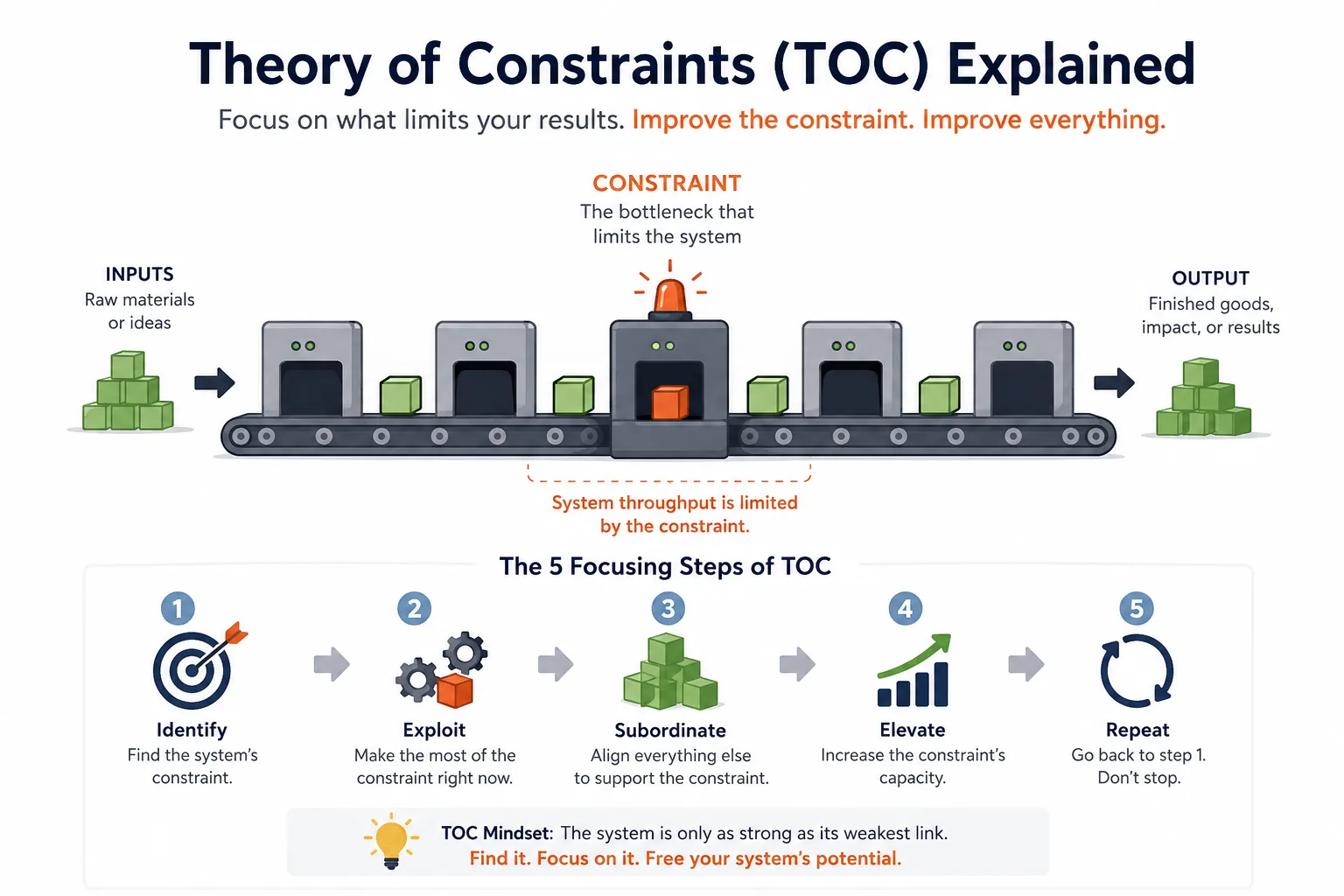
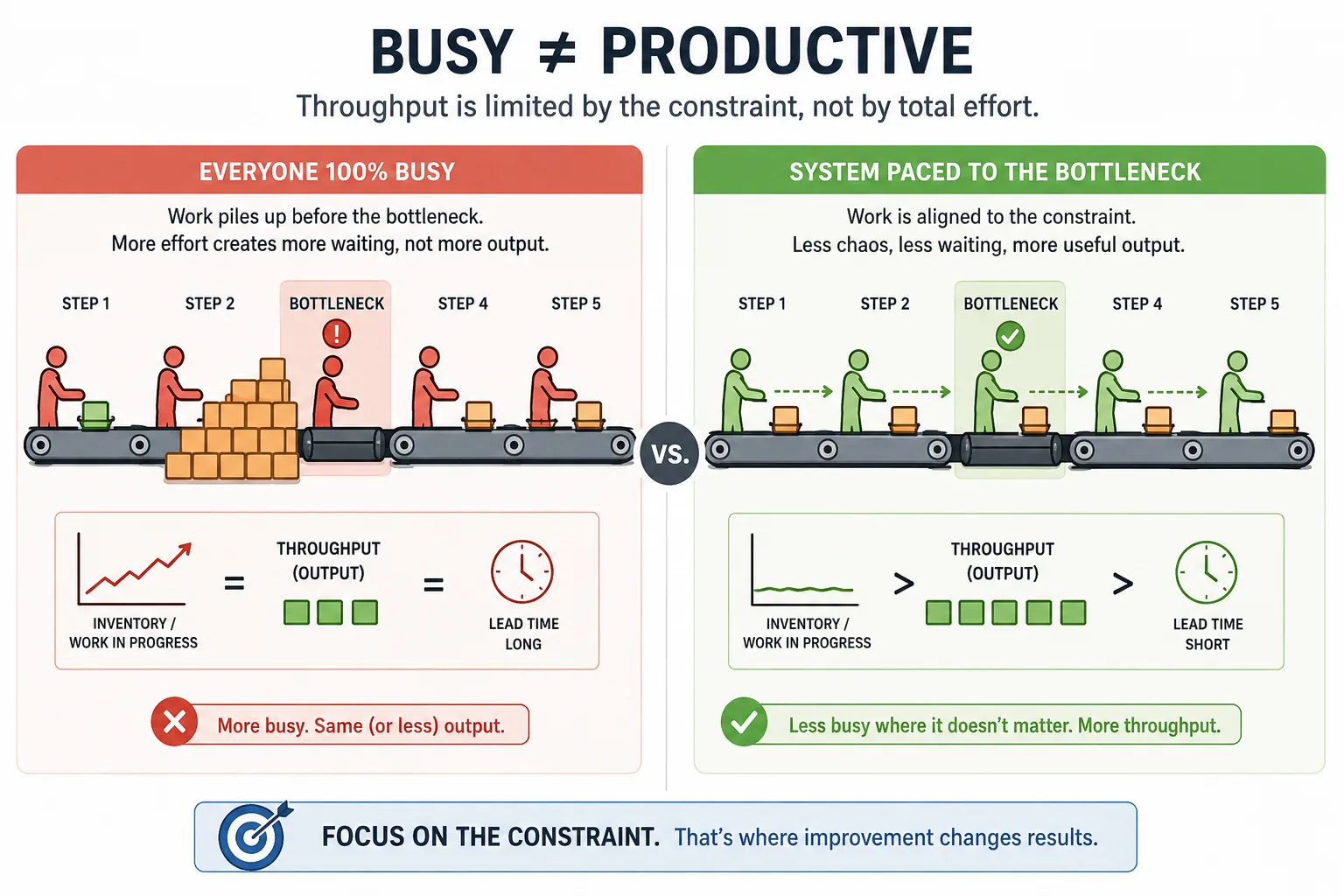
A system's output is governed by its limiting bottleneck, not by the average efficiency of its parts. The theory of constraints explained here focuses improvement on finding that limit, using it fully, aligning other work to its pace, expanding capacity only when necessary, and then looking for the next constraint. Keeping every non-bottleneck resource busy can create queues without increasing throughput.
Most systems, whether a factory line, a software team, a hospital, or a personal workflow, do not fail everywhere at once. They are limited by a small number of bottlenecks. The theory of constraints is a management philosophy built on a single powerful observation: in any complex system pursuing a goal, there is at least one constraint that limits how much the whole system can achieve.
Improve anything except that constraint, and the system as a whole does not get faster. Improve the constraint, and everything moves.
This idea reshapes how we think about improvement. Instead of trying to make every part of a process better, the theory of constraints says to find the one part that is holding back the rest and focus relentlessly there. It is a way of seeing systems as chains, where overall strength is determined by the weakest link rather than the average strength of all links.
The Core Idea: The Weakest Link
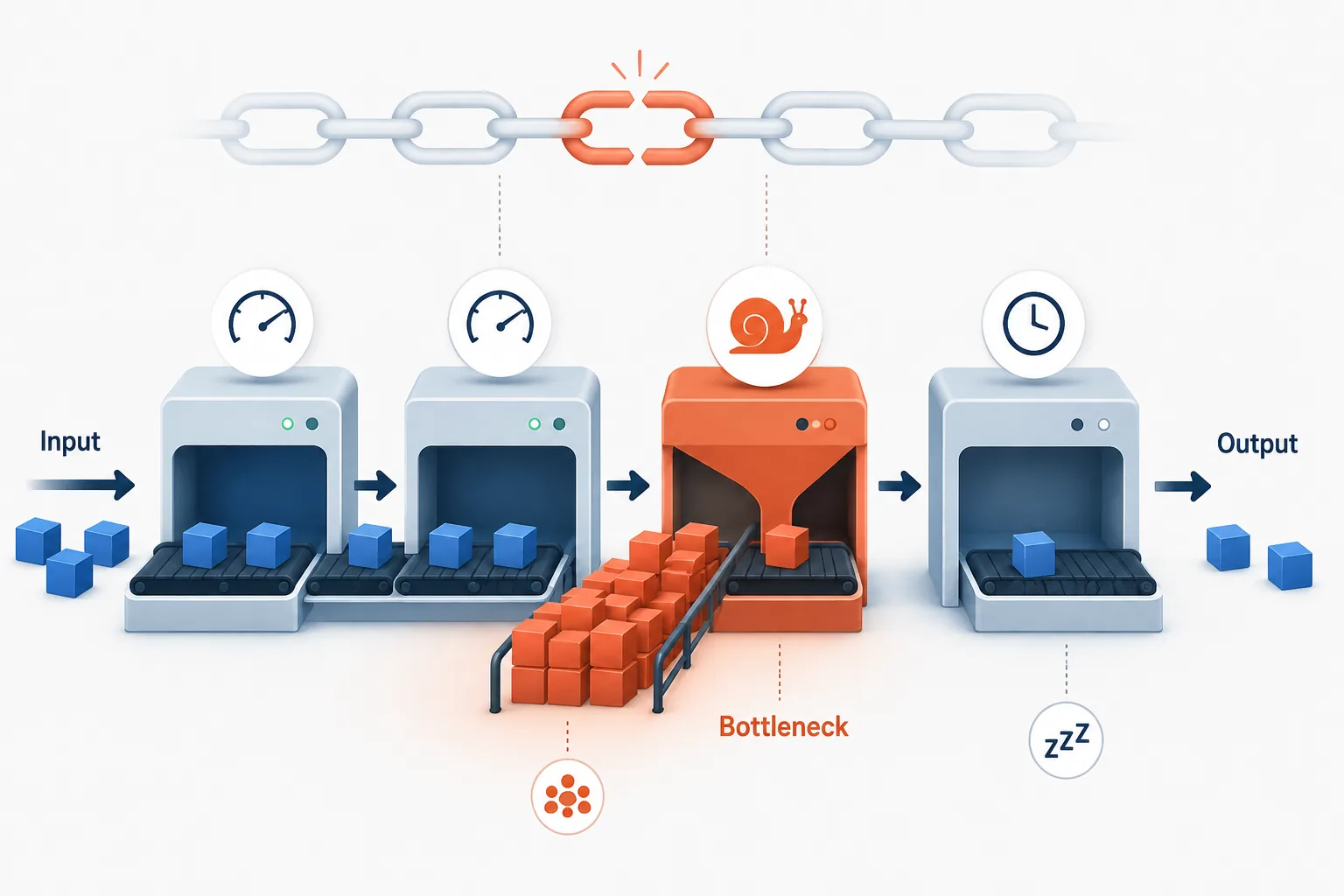
Imagine a chain being pulled apart. It breaks at its weakest link, no matter how strong the others are. Strengthening any link except the weakest one does nothing for the chain’s overall strength. A system that produces a flow, of products, cases, tasks, or output, works the same way. Its total throughput is capped by its most limiting step.
A constraint is that limiting step. It is the resource, policy, or point in the process that determines the pace of the whole. Everything upstream of the constraint can produce faster than the constraint can absorb, so work piles up in front of it. Everything downstream sits partly idle, starved of work because the constraint cannot feed it fast enough. The constraint sets the rhythm of the entire system.
This leads to a counterintuitive conclusion. Improving a non constraint, making a fast step even faster, does not increase output. It only produces more inventory waiting in front of the bottleneck or leaves downstream steps idle at a faster rate. Local improvements that ignore the constraint feel productive but do not move the goal.
Types of Constraints
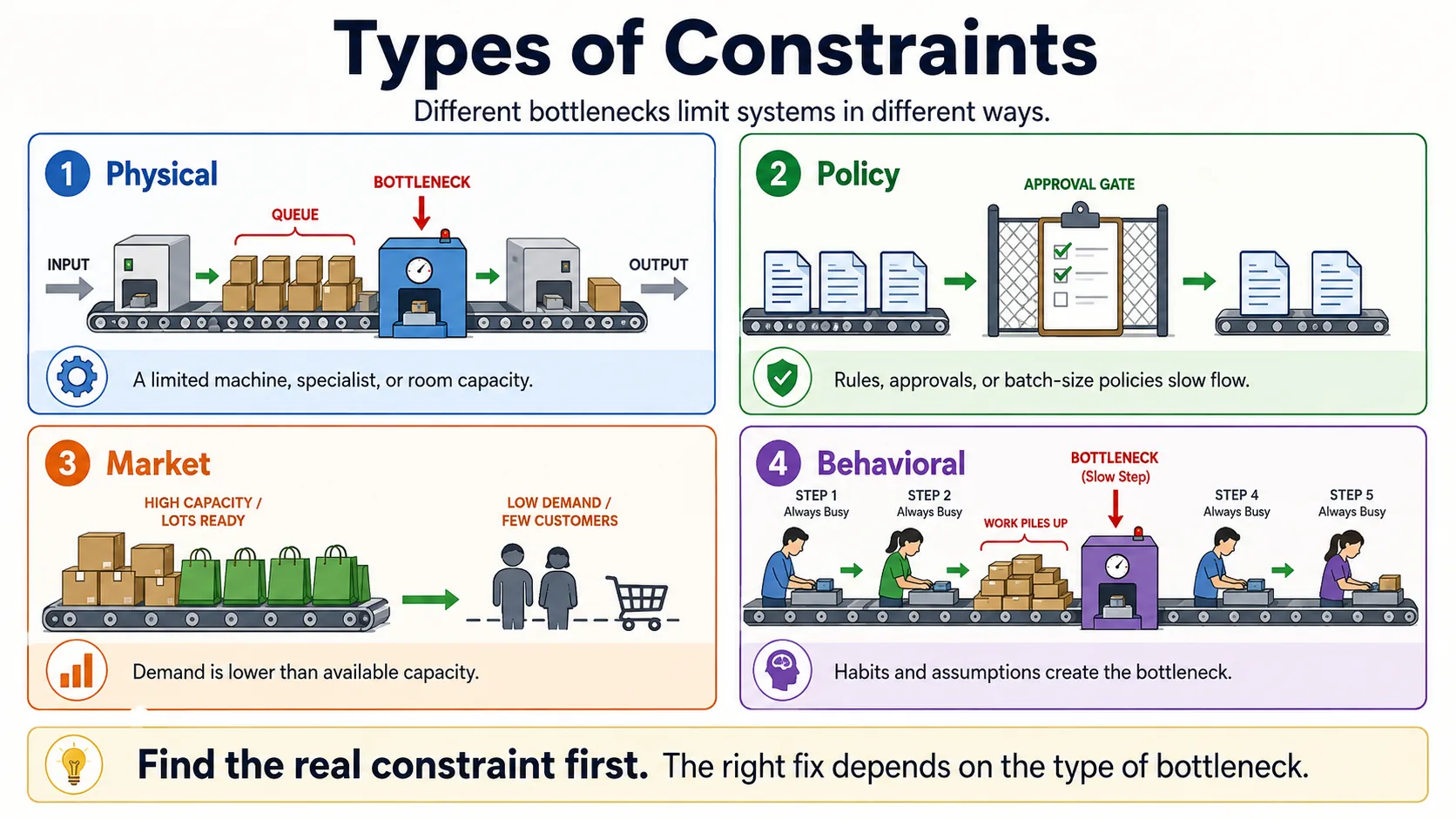
Constraints come in several forms, and identifying which kind you face changes how you respond.
| Constraint type | Description | Example |
|---|---|---|
| Physical | A limited resource or capacity | A single machine, a specialist, a room |
| Policy | A rule or practice that caps flow | An approval step, a batch size rule |
| Market | Demand is lower than capacity | Not enough customers to use full output |
| Behavioral | Habits or assumptions that limit action | Working to keep everyone busy rather than to move flow |
Physical constraints are the easiest to picture, but policy constraints are often the most common and the most overlooked. A rule that requires large batches, a sign off that only one person can give, or a metric that rewards local efficiency over overall flow can each throttle a system as effectively as a slow machine. Because policies are invisible in a way that machines are not, they frequently remain the real constraint long after physical capacity has been added.
The Five Focusing Steps
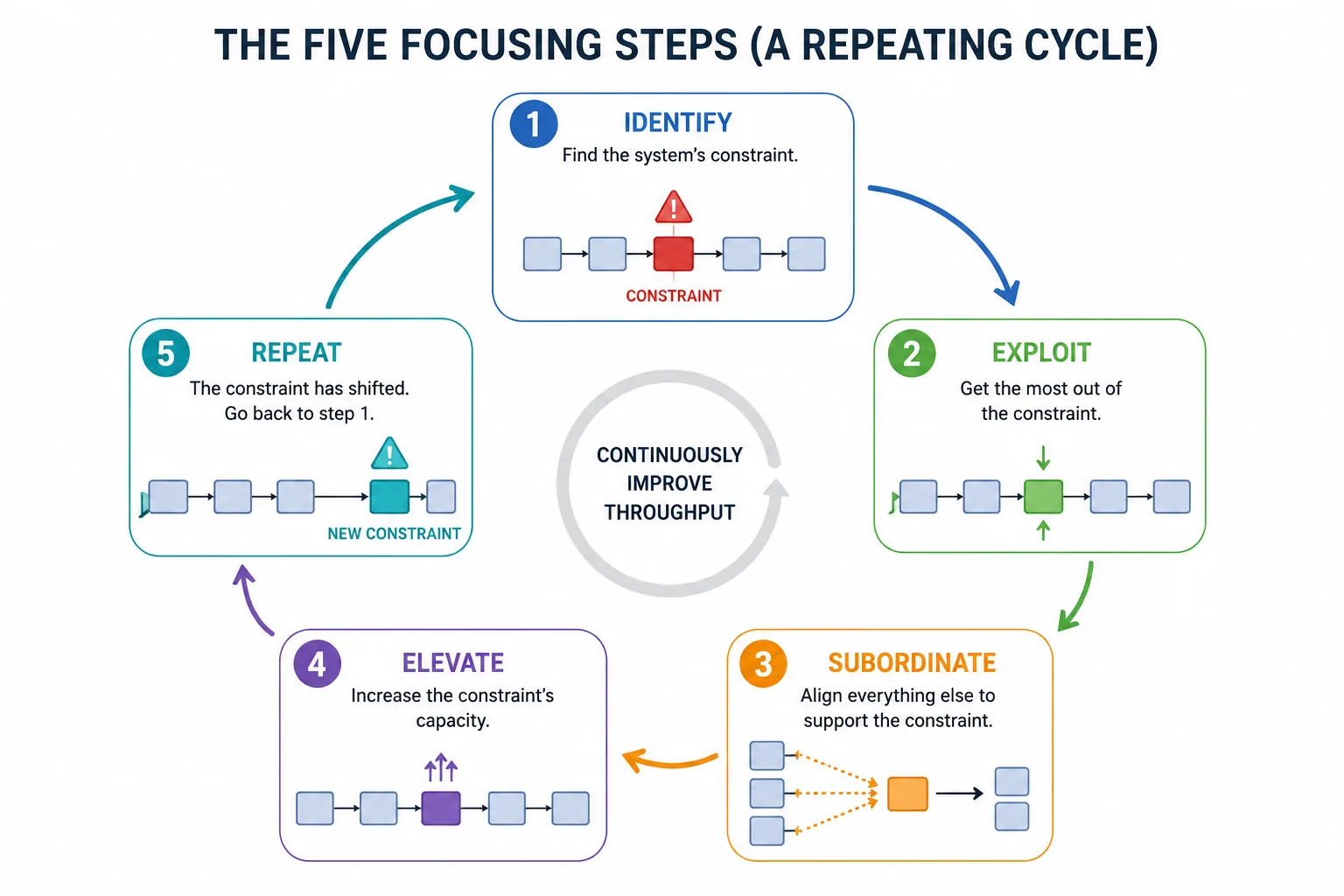
The theory of constraints offers a structured cycle for improving a system, often described as the five focusing steps. The cycle is meant to be repeated, because once one constraint is addressed, a new one emerges.
Step One: Identify the Constraint
Find the step that limits the system’s output. In a physical process, this is often where work visibly piles up: inventory accumulates in front of the constraint while later stages wait. In knowledge work, the constraint may be a single overloaded person, an approval gate, or a scarce skill. The goal is to locate the one point that sets the pace.
Step Two: Exploit the Constraint
Before spending money or adding capacity, get the most out of the constraint you already have. Make sure it is never idle, never working on the wrong things, and never blocked by trivial problems. If the constraint is a specialist, protect their time from tasks anyone could do. Exploiting means squeezing full value from the limiting resource as it stands.
Step Three: Subordinate Everything Else
Align the rest of the system to the constraint’s pace. Non constraint steps should not run flat out; they should produce exactly what the constraint can use, no more. This is the hardest step psychologically, because it means deliberately letting some resources sit idle rather than keeping everyone busy. Keeping non constraints fully loaded just creates waste in front of the bottleneck.
Step Four: Elevate the Constraint
If the constraint still limits the system after being fully exploited and supported, then invest to increase its capacity. This might mean buying another machine, hiring, or removing a limiting policy. Elevation comes fourth, not first, because exploiting and subordinating are cheaper and often solve the problem without new spending.
Step Five: Repeat, and Avoid Inertia
Once a constraint is broken, another part of the system becomes the new limit. Return to step one and find it. The final warning is to avoid inertia: do not let policies created to manage the old constraint linger and become the new constraint themselves. Continuous improvement means continually re examining where the true limit now lies.
Why the Theory Runs Against Intuition
The theory of constraints conflicts with a deeply held instinct that everyone and everything should be kept busy. In many organizations, an idle worker or an idle machine looks like waste, so managers push every resource to full utilization. The theory shows this is backwards. Loading non constraints to full capacity does not increase output, because the constraint caps the system regardless. It merely piles up unfinished work and hides the real bottleneck.
The correct measure of a system is not how busy each part is but how much the whole system produces toward its goal. Local efficiency, keeping one step maximally busy, can actively harm global performance if it overloads the constraint or floods it with work of the wrong priority. This shift from local to global thinking is the philosophical heart of the theory.
Applying It Beyond the Factory
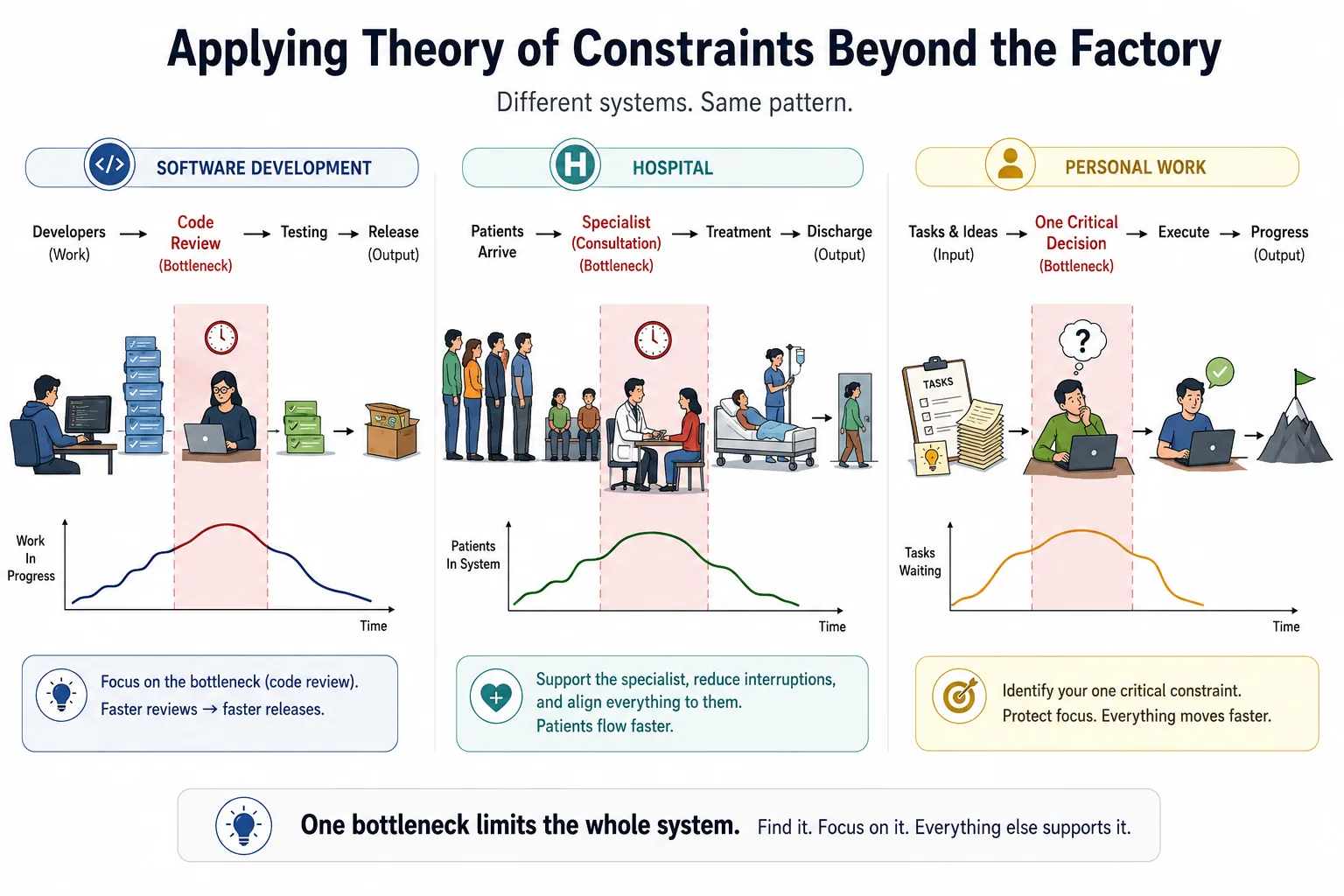
Although the theory of constraints grew out of manufacturing, its logic applies wherever work flows through steps toward a goal.
In software development, the constraint might be code review, testing, or a single senior engineer whose input everything waits on. Adding more developers upstream only lengthens the queue in front of that step. In a hospital, the constraint might be a scarce type of equipment or specialist, and scheduling everything else around that resource improves overall patient flow.
Even in personal productivity, there is usually one activity or decision point that gates your progress, and identifying it is more useful than optimizing tasks that were never the real limit.
The common thread is to resist the urge to improve everything and instead find the one thing that, if improved, would lift the whole system. That focus is what makes the theory so practical.
Conclusion
The theory of constraints reduces the sprawling problem of improving a complex system to a disciplined sequence: find the constraint, get the most from it, align everything else to it, expand it if needed, then repeat. Its central insight, that a system is limited by its weakest link and not by the average of its parts, explains why scattered improvements so often fail to move results.
By concentrating effort where the system is actually limited, and by resisting the false comfort of keeping every part busy, the theory turns improvement from a guessing game into a focused, repeatable practice.