
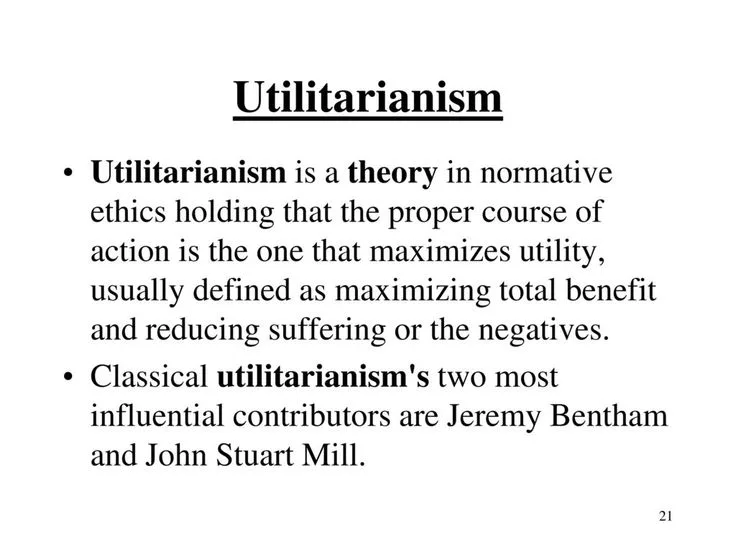
Utilitarianism explained begins with the greatest-happiness principle: actions and policies are right when they produce the best overall balance of wellbeing over suffering for everyone affected. Bentham treated pleasure and pain quantitatively, while Mill argued that pleasures also differ in quality. Later versions evaluate acts, rules, or preference satisfaction, and the theory continues to influence cost-benefit analysis and public-health allocation.
Of all the systematic moral theories developed in the Western philosophical tradition, utilitarianism is probably the one that has most directly shaped actual policy. Cost-benefit analysis, the standard tool of regulatory economics and public health decision-making, is essentially applied utilitarianism: the right policy is the one whose benefits, measured in money or quality-adjusted life years or some other metric, outweigh its costs by the greatest margin.
When a government agency decides how stringent to make automobile safety standards, or how to allocate a public health budget across competing interventions, or whether to approve a drug whose benefits for most patients are accompanied by serious risks for a minority, it is, whether it uses the vocabulary or not, making utilitarian calculations.
The theory's philosophical foundations were laid by Jeremy Bentham (1748-1832), who proposed in his 'Introduction to the Principles of Morals and Legislation' (1789) that the sole criterion of right action is the production of pleasure and the avoidance of pain.[1]
Bentham elaborated a hedonic calculus to make this criterion operational: one should assess the intensity, duration, certainty, propinquity, fecundity, purity, and extent of the pleasures and pains a proposed action would produce, then choose the action with the highest net score.
The calculus has never been practically applied in the mechanical form Bentham described, but its logic underlies modern welfare economics, cost-benefit analysis, and quality-adjusted life year calculations in healthcare resource allocation.
John Stuart Mill, who was educated from infancy by Bentham's colleague James Mill to be the movement's next champion, substantially revised the theory in 'Utilitarianism' (1863).[2]
Mill argued that pleasures differ in quality, not just quantity, that the pleasure of intellectual and aesthetic engagement is worth more than an equal quantity of simple sensory pleasure, a revision that Bentham's critics had been demanding and that Bentham's framework, with its purely quantitative calculus, could not accommodate. "It is better to be Socrates dissatisfied," Mill wrote, "than a fool satisfied."
Mill also connected utilitarianism to a broader liberal political philosophy and offered what he considered a proof of the principle, one that subsequent philosophers have found less than convincing but that reveals the theory's deeper commitments.
"The creed which accepts as the foundation of morals 'utility' or the 'greatest happiness principle' holds that actions are right in proportion as they tend to promote happiness; wrong as they tend to produce the reverse of happiness." John Stuart Mill, Utilitarianism (1863)
Key Definitions
Greatest happiness principle: The utilitarian foundational norm: right actions are those that produce the greatest net happiness (pleasure minus pain) across all affected parties, each counted equally.
Hedonic calculus: Bentham's proposed method for quantifying the moral value of pleasures and pains by assessing their intensity, duration, certainty, propinquity, fecundity, purity, and extent (the number of people affected).
Act utilitarianism: The view that the right action in any situation is the specific act that will produce the greatest net happiness, requiring case-by-case calculation.
Rule utilitarianism: The view that the right action is the one prescribed by the rule whose general adoption would produce the greatest net happiness, even if deviating from the rule in a particular case would produce better outcomes in that case.
Preference utilitarianism: A version of utilitarianism, associated with Peter Singer and R. M. Hare, that defines welfare in terms of preference satisfaction rather than hedonic experience, avoiding some objections to purely hedonistic accounts.
Varieties of Utilitarianism Compared
| Version | Key Claim | Main Proponent | Primary Advantage | Primary Objection |
|---|---|---|---|---|
| Hedonistic (act) | Right act = most pleasure for most people; calculate case by case | Bentham | Direct, consequentialist | Permits monstrous acts if they maximize utility |
| Higher pleasures | Pleasures differ in quality; higher pleasures count more | Mill | Avoids "pleasure machine" objection | What determines quality? Risks circular reasoning |
| Rule utilitarianism | Follow the rules whose adoption maximizes welfare | Brandt, Hooker | Avoids counterintuitive case-by-case results | Collapses into act utilitarianism in ideal conditions |
| Preference utilitarianism | Welfare = preference satisfaction, not hedonic state | Singer, Hare | Respects autonomy; avoids paternalism | Counts preferences that are adaptive or malformed |
| Effective altruism | We should maximize well-being globally; use evidence | Singer, MacAskill | Motivates real-world impact | Can demand too much; ignores personal relationships |
Bentham's Founding Vision
The Principle of Utility
Jeremy Bentham's 'Introduction to the Principles of Morals and Legislation' opens with one of the most confident sentences in the history of ethics: "Nature has placed mankind under the governance of two sovereign masters, pain and pleasure. It is for them alone to point out what we ought to do, as well as to determine what we shall do."
From this descriptive psychology, Bentham derived a normative ethics: since pleasure is the only intrinsic good and pain the only intrinsic evil, the right action is the one that maximizes the net balance of pleasure over pain across all affected individuals.
Bentham intended this as a scientific ethics, applying the same empirical and quantitative reasoning to moral questions that natural philosophers were applying to the physical world. His hedonic calculus attempted to operationalize moral calculation: seven dimensions of pleasure and pain (intensity, duration, certainty, propinquity, fecundity, purity, and extent) could in principle be measured and summed.
This aspiration to scientific rigor in ethics was both the theory's great strength, it provided a publicly accessible, non-dogmatic basis for moral and policy reasoning, and the source of persistent objections, since the relevant quantities are difficult to measure and interpersonal comparisons of welfare raise serious philosophical problems.
Bentham's political radicalism followed from his utilitarianism. If each person's pleasure and pain counts equally, then aristocratic privilege, legal inequalities based on birth, and laws that serve the interests of the few at the expense of the many are straightforwardly wrong.
Bentham campaigned for penal reform, opposed the punishment of victimless crimes, argued for the equal rights of women, and advocated for the decriminalization of homosexuality, positions that were radical for his time and that all follow from the equal weighting of all persons' interests that the greatest happiness principle requires.
The Panopticon and Its Critics
Bentham's practical projects also included the Panopticon, a proposed prison design in which a central watchtower would allow a single guard to observe all inmates at all times without the inmates knowing when they were being watched. The psychological effect would be that inmates behaved as if constantly watched even when they were not, producing maximum compliance with minimal actual surveillance.
Bentham regarded the Panopticon as a model application of his utilitarian management principles. Michel Foucault, in 'Discipline and Punish' (1975), used the Panopticon as the central metaphor for modern disciplinary society, arguing that the logic of surveillance and normalization that Bentham made explicit has come to characterize social institutions from schools and hospitals to factories and military organizations.
The Panopticon became the lens through which many twentieth-century critics read utilitarianism more broadly: as a technology of social control that reduces persons to measurable inputs and outputs in an aggregate welfare calculation.
Mill's Refinements
Quality of Pleasures
Mill's most controversial revision to Bentham's framework was the introduction of qualitative distinctions among pleasures. Bentham held that pleasures differ only in quantity, intensity, duration, and so on, and that the pleasure of poetry was intrinsically the same kind of thing as the pleasure of pushpin (a simple game), even if one might be more or less intense or durable.
Mill held that this was mistaken: the pleasures of intellect, feeling, and moral sentiment are intrinsically superior in kind to mere sensory satisfaction, and any person who had experienced both would prefer the former even at lower intensity.
The argument has a democratic structure: who is to judge? Mill's answer is that those who have experienced both types of pleasure are the competent judges, and they consistently prefer the higher over the lower. The person who has experienced both intellectual engagement and mere amusement, and who is clear-eyed about both, will prefer the former.
"It is better to be Socrates dissatisfied than a fool satisfied. And if the fool, or the pig, are of a different opinion, it is because they only know their own side of the question."
Critics have pressed Mill on the coherence of this revision. If pleasures differ in quality, and qualitatively higher pleasures are preferred regardless of their intensity or duration, then it becomes unclear what the relationship between quality and happiness actually is, and whether Mill has abandoned the hedonic framework that distinguishes utilitarianism from its rivals.
Henry Sidgwick, writing in 'The Methods of Ethics' (1874), attempted a more rigorous reconstruction of utilitarian theory that took seriously both the quantitative and qualitative dimensions of welfare while acknowledging that the theory's demands were more extreme than most people were prepared to accept.[3]
The Trolley Problem and Moral Psychology
Philippa Foot's Thought Experiment
Philippa Foot introduced the trolley problem in 1967 not primarily as a challenge to utilitarianism but as a vehicle for examining the doctrine of double effect, the principle that there is a moral difference between harm one causes as a foreseen side effect of achieving a good end and harm one causes as a means to a good end.[8] Foot's question was whether this doctrine could explain our divergent intuitions about structurally similar cases.
In the basic trolley case (pull a lever to divert a trolley from five to one), most people judge it permissible or even required to divert. In the footbridge case (push a large man off a bridge to stop the trolley, killing him but saving five), most people judge it impermissible. The utilitarian calculation is identical in both cases: five lives versus one.
The difference must lie elsewhere, and the doctrine of double effect offers one account: in the lever case the death of the one is a foreseen side effect of saving the five; in the footbridge case the man's death is the means by which the five are saved.
Joshua Greene's Dual-Process Account
Neuroscientist Joshua Greene used trolley scenarios in fMRI research at Princeton, arguing in a series of papers beginning in 2001 that the divergent intuitions reflect different neural systems. Personal moral violations (the footbridge case) trigger activity in regions associated with emotional processing including the medial prefrontal cortex and the amygdala, producing the strong aversion to pushing.
Impersonal violations (the lever case) engage regions associated with deliberate reasoning without the same emotional response. Greene concludes that the emotional reactions are artifacts of our evolutionary history, evolved for face-to-face social contexts, not reliable guides to moral truth in modern large-scale society.
Greene's conclusion is that utilitarian reasoning, more reflective, impartial, and calibrated to actual consequences, is more reliable than emotion-driven deontological intuitions.[9] Critics including John Mikhail argue that the intuitions track genuine moral distinctions (using versus redirecting harm) that have normative significance independent of their evolutionary origin. The debate remains active in both philosophy and cognitive science.
Peter Singer and Effective Altruism
Famine, Affluence, and Obligation
Peter Singer's 1972 paper 'Famine, Affluence, and Morality' is one of the most practically consequential works of twentieth-century moral philosophy.[6] Its argument is disarmingly simple: if we can prevent something bad from happening without sacrificing anything of comparable moral importance, we are morally required to do so.
The geographical distance between the person who can help and the person who needs help is morally irrelevant. Our spending on luxuries while others die of preventable causes is not a failure to give charity but a moral failure of the same kind as walking past a drowning child to avoid muddying our shoes.
The implications for affluent people in wealthy countries are radical. Singer subsequently argued that the utilitarian logic implied giving significant portions of one's income, he has at various times suggested ten percent or more, to the most effective charitable interventions, prioritizing global poverty relief, animal welfare (Singer's preference utilitarianism extends to sentient beings of all species), and existential risk reduction.[7]
Effective Altruism in Practice
The effective altruism movement, which grew rapidly from approximately 2010 onward, operationalized Singer's utilitarian reasoning through research and recommendation organizations. GiveWell, founded in 2006 by Holden Karnofsky and Elie Hassenfeld, developed rigorous methods for evaluating the cost-effectiveness of charitable interventions, focusing on interventions with randomized controlled trial evidence of efficacy.
Its top-recommended charities have consistently included malaria prevention (Against Malaria Foundation), vitamin A supplementation (Helen Keller International), and direct cash transfers (GiveDirectly), which have estimated costs per life saved in the range of hundreds to low thousands of dollars.
Will MacAskill's 'Doing Good Better' (2015) and 'What We Owe the Future' (2022) have brought effective altruist reasoning to a wide readership, with the latter making the case for longtermism, the view that the welfare of potential future people should dominate moral calculation because the expected number of future people vastly exceeds the current population. Longtermism remains controversial even within the effective altruism community.
Criticisms and Responses
The Justice Objection
Rawls argued in 'A Theory of Justice' that utilitarianism "does not take seriously the distinction between persons." Because utilitarianism aggregates welfare across individuals, it can in principle justify very severe harms to minorities if those harms produce sufficient benefits for majorities.[5]
A society that tortures ten people a year if this significantly increases everyone else's happiness would be required by utilitarian logic, but the requirement seems clearly unjust.
Utilitarians have developed several responses. Rule utilitarians argue that a general rule prohibiting torture would produce better outcomes than a rule permitting it whenever calculations favor it, because the institution of torture is corrosive in ways that extend beyond particular cases, and because authorities cannot reliably make accurate calculations.
Indirect utilitarians argue that the best utilitarian strategy in practice is to follow rights-respecting rules, since our calculations are unreliable and the predictability of rights-based norms has substantial social value.
Williams and the Integrity Objection
Bernard Williams's argument that utilitarianism undermines integrity has been enormously influential.[4] Williams contends that a moral theory that requires me to always maximize aggregate welfare makes my own projects, commitments, and relationships morally significant only instrumentally, as generators of welfare for the calculation, and not as constitutive of who I am.
If Jim can save nineteen lives by shooting one, the utilitarian requirement that he shoot alienates him from his own deepest commitments. "It is not merely that he is asked to do something distasteful or difficult: he is asked to alienate himself from his own actions and the source of his actions in his own convictions."
The integrity objection does not obviously refute utilitarianism, one might argue that our attachment to personal integrity is itself a bias that impartial moral reasoning should override, but it identifies a real tension between utilitarian demands and the structure of a human life lived from commitments.
Practical Applications and Policy
Despite the philosophical controversies, utilitarian reasoning underlies a great deal of contemporary policy analysis.
The QALY (quality-adjusted life year), used by health technology assessment bodies including the UK's National Institute for Health and Care Excellence to evaluate whether new medical treatments are cost-effective, is a direct application of utilitarian welfare measurement: it combines the quantity and quality of life produced by a treatment into a single metric that can be compared across interventions.
The threshold NICE uses, approximately 20,000 to 30,000 pounds per QALY gained, represents an implicit utilitarian judgment about how much welfare a healthcare system should sacrifice elsewhere to fund a new treatment.
Environmental cost-benefit analysis applies similar logic: the costs and benefits of regulations (including the statistical value of lives saved, ecological services preserved, and economic activity foregone) are measured and compared, and regulations are approved when expected benefits exceed expected costs.
The controversies that attend these calculations, about how to value a human life, how to discount future costs and benefits, how to handle irreversibility and catastrophic risk, are essentially philosophical controversies about the limitations of utilitarian aggregation.
References
- Bentham, J. (1789). An Introduction to the Principles of Morals and Legislation. Payne.
- Mill, J. S. (1863). Utilitarianism. Parker, Son, and Bourn.
- Sidgwick, H. (1874). The Methods of Ethics. Macmillan.
- Smart, J. J. C., & Williams, B. (1973). Utilitarianism: For and Against. Cambridge University Press.
- Rawls, J. (1971). A Theory of Justice. Harvard University Press.
- Singer, P. (1972). Famine, affluence, and morality. Philosophy and Public Affairs, 1(3), 229-243.
- Singer, P. (1975). Animal Liberation. New York Review.
- Foot, P. (1967). The problem of abortion and the doctrine of double effect. Oxford Review, 5, 5-15.
- Greene, J. (2013). Moral Tribes: Emotion, Reason, and the Gap Between Us and Them. Penguin Press.
Further Reading
- MacAskill, W. (2015). Doing Good Better. Guardian Faber.
- MacAskill, W. (2022). What We Owe the Future. Basic Books.
- Nozick, R. (1974). Anarchy, State, and Utopia. Basic Books.
- Parfit, D. (1984). Reasons and Persons. Oxford University Press.