
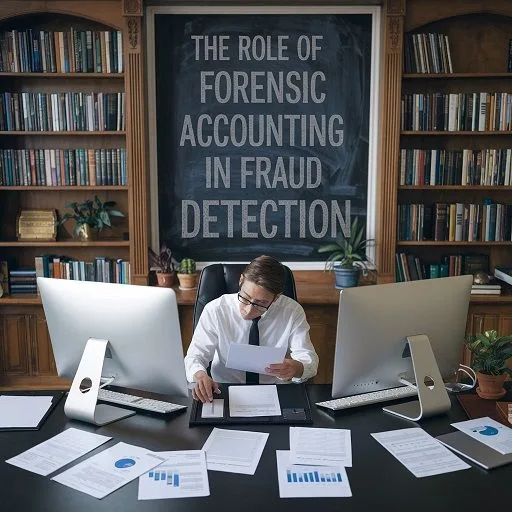
Most people picture accountants as professionals who work with ledgers, prepare tax returns, and audit financial statements against established standards. This picture is accurate for the majority of the accounting profession.
But there is a specialised corner of the field where accountants work alongside lawyers and law enforcement to investigate fraud, trace hidden assets, calculate damages in commercial disputes, and testify in court.
These are forensic accountants - and their work is considerably more varied, adversarial, and consequential than the profession's general reputation would suggest.
The field gained significant public attention through high-profile fraud investigations: the Enron collapse in 2001, the Bernie Madoff Ponzi scheme exposed in 2008, the FIFA corruption investigation that led to criminal charges across multiple countries, and ongoing corporate fraud cases investigated by the FBI's Financial Crimes Unit.
In each of these cases, forensic accountants were the professionals who examined the financial records, identified the mechanics of the fraud, quantified the losses, and built the evidentiary foundation that made prosecution possible.
The Association of Certified Fraud Examiners (ACFE) estimates that organisations lose approximately 5% of revenue to fraud each year - amounting to global losses of over $4.7 trillion annually based on 2022 GDP figures. The demand for professionals who can investigate and prevent these losses is substantial and growing.[3]
This guide explains what forensic accountants actually do, who employs them, what certifications matter, and how the career path develops from entry level through to senior practice.
"Fraud is the daughter of greed." - Forensic accounting maxim, widely attributed to ancient Roman legal tradition
Key Definitions
Forensic accounting: The application of accounting, auditing, and investigative skills to legal and regulatory matters. The term 'forensic' derives from the Latin 'forensis' - pertaining to the forum or court - and indicates that the work is intended to be used in legal proceedings.
Fraud examination: The investigation of alleged fraud through document review, transaction tracing, interviews, and analysis to determine whether fraud occurred, how it was executed, and who was responsible. The CFE (Certified Fraud Examiner) credential specifically certifies this skill set.
Asset tracing: The process of following the movement of funds or assets through a series of transactions to identify where money went, who controlled it, and whether it was hidden or converted to avoid detection.
Expert witness: A professional who testifies in court proceedings based on specialised knowledge. Forensic accountants frequently serve as expert witnesses, providing opinions on financial issues that a judge or jury cannot evaluate without specialised expertise.
Litigation support: Providing financial analysis and expert opinion to legal teams preparing for or engaged in litigation. A major portion of forensic accounting work in law firm and consulting firm contexts.
Chain of custody: The documented record of who collected, handled, transferred, or analysed evidence. Maintaining an unbroken chain of custody is essential for any evidence that may ultimately be used in legal proceedings.
Benford's Law: A mathematical principle that describes the expected frequency distribution of leading digits in naturally occurring numerical datasets. Forensic accountants use deviations from Benford's Law to flag potentially manipulated financial data for further investigation.
How Forensic Accounting Differs from Regular Accounting
The distinction matters for career planning and for understanding why the work commands premium compensation.
Regular accounting records transactions, prepares financial statements, and communicates financial position. The work is largely prospective - recording what is happening and reporting it accurately.
Auditing verifies that financial statements prepared by management comply with accounting standards and are free of material misstatement. Auditors work within defined frameworks (GAAP, IFRS) and report to shareholders.
Forensic accounting investigates when fraud, error, or dispute is suspected. The work is retrospective - examining what happened in the past and building evidence that will withstand legal scrutiny.
Forensic accountants must understand not just accounting principles but also legal procedure, evidence rules, and the requirements of testimony.
The adversarial context is the defining feature. A forensic accountant's work product - reports, schedules, testimony - will be attacked by opposing counsel. Every conclusion must be traceable to documented evidence. Every methodology must be defensible under cross-examination.
This requirement for intellectual rigour under adversarial pressure distinguishes forensic accounting from the rest of the profession.
| Dimension | Regular Accounting | Audit | Forensic Accounting |
|---|---|---|---|
| Primary purpose | Record and report | Verify compliance | Investigate and litigate |
| Time orientation | Current / prospective | Historical (past year) | Historical (any period) |
| Work product audience | Management, investors | Shareholders, regulators | Lawyers, courts, regulators |
| Adversarial pressure | Low | Moderate | High |
| Legal requirements | GAAP / IFRS compliance | Professional standards | Rules of evidence, expert testimony standards |
| Typical employer | Any organisation | Accounting firms, internal audit | Big 4 forensic, FBI, law firms |
What a Forensic Accountant Does: The Real Work
Forensic accounting work falls into several broad categories, each with distinct methods and outputs.[4]
Fraud Investigation
When an organisation suspects fraud - internal theft, embezzlement, expense manipulation, bribery, or financial statement fraud - it may hire a forensic accountant to investigate. The investigation follows a structured process.
Engagement definition: The forensic accountant meets with the client (typically legal counsel, to preserve privilege) to define the scope: what type of fraud is suspected, what time period is relevant, which records are available, and what outcome the client needs (internal findings, regulatory reporting, criminal referral, civil litigation support).
Document collection and preservation: Gathering financial records, emails, bank statements, invoices, contracts, and any other relevant documents.
Preserving the chain of custody - documenting who handled each piece of evidence and when - is critical because any evidence that might eventually be used in legal proceedings must be demonstrably untampered.
Transaction analysis: The forensic accountant works through the financial data systematically, looking for anomalies: payments to vendors who do not appear in other records, duplicate invoices, round-number transactions that suggest round-tripping, expenses that do not match policy, or bank balances that do not reconcile with ledger entries.
Modern fraud examinations often use data analytics tools to process millions of transactions efficiently, flagging statistical outliers for human review.
Interview: Forensic accountants conduct structured interviews with employees who may have knowledge of the suspected fraud, potential witnesses, and sometimes subjects of the investigation.
Interview technique - knowing what to ask, in what order, and how to handle inconsistent responses - is a specific skill developed through experience and the CFE examination curriculum.
Findings report: The investigation concludes with a detailed written report documenting the methodology, evidence examined, findings, and conclusions.[5] This report must be written to withstand scrutiny from opposing counsel - every factual claim must be traceable to documented evidence.
The Fraud Triangle: What Forensic Accountants Look For
The Fraud Triangle, developed by criminologist Donald Cressey in the 1950s, remains the dominant analytical framework in forensic accounting.[11] It holds that three elements are present in nearly all cases of occupational fraud:
Pressure: A personal or financial need that motivates the fraud. This may be financial strain, substance abuse, gambling debts, or the desire to maintain a lifestyle. Pressure is often invisible externally.
Opportunity: Access to assets or financial records, combined with weak internal controls that make fraud possible and harder to detect. Poor segregation of duties - the same person who authorises payments also reconciles the bank account - is a classic opportunity enabler.
Rationalisation: A moral justification the fraudster uses to excuse the behaviour. 'The company owes me this.' 'I will pay it back.' 'Everyone does it.' Rationalisation makes otherwise ethical people capable of sustained fraud.
Understanding the Fraud Triangle helps forensic accountants design investigations, assess internal controls, and evaluate the plausibility of alleged fraud schemes.
Litigation Support and Expert Witness Work
A large portion of forensic accounting work occurs in the context of civil litigation: commercial disputes, business valuations for divorce proceedings, shareholder disputes, insurance claims, and contractual disagreements about financial calculations.
In litigation support, the forensic accountant analyses financial information on behalf of one party, helping legal counsel understand the financial issues, prepare for depositions of opposing experts, and develop case strategy. This is advisory work that does not necessarily result in testimony.
When the case proceeds to trial or arbitration, forensic accountants may be qualified as expert witnesses and provide testimony about their findings.
Expert testimony requires not just technical expertise but the ability to explain complex financial concepts clearly to non-specialist judges and juries, and to maintain composure and credibility under cross-examination by opposing counsel.
Experienced expert witnesses command significant fees - $400-$800+ per hour for testimony time is common at senior levels.
Damages Quantification
In commercial litigation, forensic accountants are often engaged specifically to calculate damages: how much money did the plaintiff lose as a result of the defendant's actions?
Damages calculations require both accounting expertise and an understanding of legal doctrine. The measure of damages varies by case type - lost profits, diminution of business value, unjust enrichment, or lost wages are calculated differently and require different methodologies.
The forensic accountant's job is to select an appropriate methodology, apply it consistently, document the assumptions, and defend the result under challenge.
Common damages contexts include:
- Breach of contract: lost profits from a deal that did not close
- Intellectual property infringement: unjust enrichment from unauthorized use
- Securities fraud: investor losses attributable to misrepresentation
- Business interruption insurance: revenue lost due to insured events
- Employment disputes: lost earnings over the remaining work life
Asset Recovery and Tracing
In divorce proceedings, bankruptcy cases, and fraud recovery, forensic accountants are engaged to trace assets - to follow the movement of money or property through a series of transactions to determine where it went and who controlled it.
This may involve examining bank records across multiple jurisdictions, analysing cryptocurrency transactions, reviewing real estate filings, and examining trust and corporate structures used to obscure beneficial ownership.
Asset tracing has become increasingly sophisticated as fraudsters use more complex structures. Forensic accountants working in this area develop expertise in international transaction flows, offshore financial structures, and the red flags that indicate deliberate obfuscation.
Cryptocurrency tracing has become a significant new competency area in the 2020s.
Blockchain forensics tools (Chainalysis, CipherTrace, Elliptic) allow forensic accountants to trace Bitcoin and other cryptocurrency transactions across wallets and exchanges, even when the fraudster believed anonymity was guaranteed.[12]
The ACFE added cryptocurrency forensics content to its study materials in 2022.[2]
Corporate Compliance and Anti-Corruption
The Foreign Corrupt Practices Act (FCPA) in the United States and equivalent legislation in other jurisdictions (UK Bribery Act, OECD Anti-Bribery Convention) creates ongoing compliance obligations for multinational corporations.
Forensic accountants design and test internal controls, conduct risk assessments of high-risk markets and business relationships, and investigate potential violations when concerns arise.
FCPA investigations are a substantial practice area for the Big 4 forensic teams. When a company self-reports potential FCPA violations to the SEC or DOJ, or when regulators initiate an investigation, the forensic accounting work can span years, involve multiple countries, and generate fees in the tens of millions of dollars.
The DOJ's FCPA enforcement record shows consistently high penalties: the top 10 FCPA settlements as of 2024 each exceeded $400 million.[7] Goldman Sachs paid $2.9 billion in 2020 to resolve the 1MDB scandal. Airbus SE paid $3.9 billion in 2020 to resolve bribery investigations across three jurisdictions.
These headline figures represent only the penalty - the forensic accounting fees incurred during investigation are additional.
The Major Fraud Schemes: What Forensic Accountants Investigate
The ACFE's 2022 Report to the Nations categorised occupational fraud into three primary categories and found the following frequency and loss data across its global survey of 2,110 fraud cases:[1]
| Fraud Category | Frequency (% of Cases) | Median Loss |
|---|---|---|
| Asset misappropriation (theft, embezzlement) | 86% | $100,000 |
| Financial statement fraud (manipulation of accounts) | 9% | $593,000 |
| Corruption (bribery, kickbacks, conflicts of interest) | 50% | $200,000 |
Note: Percentages exceed 100% because many fraud schemes involve multiple categories simultaneously.
Asset Misappropriation Schemes
The most common fraud type by volume, asset misappropriation includes:
Billing schemes: Creating fake vendors or inflating invoices to extract company funds. The classic billing scheme involves an employee who creates a shell company, issues invoices to their employer for services never rendered, and approves payment.
Expense reimbursement fraud: Submitting personal expenses as business expenses, inflating legitimate expenses, or creating fictitious expense claims.
Payroll fraud: Creating ghost employees, falsifying hours or commission records, or manipulating payroll to divert funds.
Skimming: Intercepting cash before it enters the accounting system - most common in retail and hospitality environments where cash transactions are frequent.
Financial Statement Fraud
Less common by volume but far more damaging by value, financial statement fraud involves manipulation of reported financial results to mislead investors, regulators, or lenders.[10] Common schemes include:
Revenue recognition manipulation: Recognising revenue before it is earned (channel stuffing, side letters, bill-and-hold arrangements without genuine transfer of risk).
Improper capitalization: Recording expenses as capital assets to improve current-period earnings, as occurred at WorldCom in the early 2000s - the largest accounting fraud in US history at the time, at $11 billion.[9]
Reserve manipulation: Understating or overstating reserves (allowances for bad debts, warranty reserves, litigation reserves) to manage reported earnings.
Corruption and Bribery
Corruption schemes - bribery, kickbacks, conflicts of interest, bid rigging - are particularly prevalent in procurement and in international operations. They are also among the hardest to detect because they often leave limited direct paper trails and involve willing participants on both sides of the transaction.
Who Hires Forensic Accountants
Big 4 accounting firms (Deloitte, PwC, EY, KPMG) all maintain large forensic accounting and disputes advisory practices.
These practices handle some of the largest and most complex fraud investigations in the world, provide expert witnesses in major commercial litigation, and conduct anti-corruption investigations for multinational clients.
Starting a forensic career at a Big 4 firm provides broad exposure and strong exit opportunities.
The FBI's Financial Crimes Unit employs forensic accountants as Special Agents and as professional staff.
The career path is different from private sector work - the focus is on criminal investigation and prosecution rather than civil litigation - and the pay is typically lower, but the work is substantive and the cases are often significant.
The IRS Criminal Investigation (IRS-CI) is dedicated to investigating tax evasion and financial fraud with a tax element.
IRS Special Agents are the only federal agents with statutory jurisdiction over financial crimes, and the division has a historical conviction rate exceeding 90% - reflecting the forensic quality of their financial investigations.
Law firms in major commercial litigation markets hire forensic accountants as professional staff or work closely with external firms. In-house forensic accountants at law firms provide analysis and expert support across the firm's litigation practice.
Insurance companies employ forensic accountants to investigate large commercial fraud claims - arson, business interruption fraud, workers' compensation fraud, and financial statement manipulation in insurance contexts.
Corporate internal audit and compliance departments at large companies employ forensic accountants to investigate employee misconduct, vendor fraud, expense account abuse, and financial reporting irregularities.
Boutique forensic accounting firms specialise exclusively in forensic and investigative work, typically serving law firms and corporate clients who want dedicated expertise rather than the generalist approach of a Big 4 practice.
Examples include Berkeley Research Group (BRG), FTI Consulting's economic and financial consulting practice, and Huron Consulting.
Securities regulators - the SEC's Division of Enforcement in the United States and equivalent agencies in other jurisdictions - employ forensic accountants to investigate securities fraud, market manipulation, and insider trading.[13]
Certifications
CFE (Certified Fraud Examiner): The primary specialist credential, issued by the Association of Certified Fraud Examiners (ACFE). Covers four domains: financial transactions and fraud schemes, law (civil and criminal), investigation, and fraud prevention.
Requires two years of professional experience and completion of a multi-section examination. Widely recognised by employers who hire for fraud examination roles. Annual membership in the ACFE and continuing education maintain the credential.
CPA (Certified Public Accountant): The general accounting credential, widely held by forensic accountants who entered through traditional accounting paths. Not specifically forensic, but signals accounting competence and is often required or preferred for forensic roles at accounting firms and in financial statement fraud contexts.
CFF (Certified in Financial Forensics): A forensic specialisation credential issued by the American Institute of CPAs (AICPA). Requires CPA certification as a prerequisite. Valued in litigation support and expert witness contexts.
CAMS (Certified Anti-Money Laundering Specialist): Relevant for forensic accountants working in financial crime compliance, anti-money laundering, and sanctions contexts. Issued by ACAMS.
CCEP (Certified Compliance and Ethics Professional): Relevant for forensic accountants focused on corporate compliance and internal investigation roles.
CA (Chartered Accountant) with forensic specialisation: In the UK, Australia, Canada, and other Commonwealth jurisdictions, the CA qualification is the equivalent of the CPA. ICAEW and ICAS offer forensic accounting specialisations within the CA framework.
The combination of CPA and CFE is the most common credential pairing among senior forensic accountants at US firms. The CFF adds specific litigation support positioning. For government investigators (IRS-CI, FBI), the CPA alone is typically sufficient; the CFE is valued but not universally required.
Salary Ranges
The following figures reflect US market data from the ACFE 2022 Report to the Nations, BLS data, and Robert Half Finance & Accounting salary guides (2023-24).[8]
| Level / Role | Annual Salary (USD) |
|---|---|
| Entry-level (0-3 years, staff at Big 4 or similar) | $55,000 - $75,000 |
| Mid-level analyst / senior associate (3-6 years) | $75,000 - $110,000 |
| Manager / CFE with 5+ years experience | $100,000 - $140,000 |
| Senior manager / director | $130,000 - $180,000 |
| Big 4 partner / independent expert witness (senior) | $200,000 - $400,000+ |
| IRS Criminal Investigation Special Agent | $60,000 - $130,000 (GS scale) |
| FBI Financial Crimes Special Agent | $60,000 - $140,000 (GS scale) |
Expert witnesses who testify regularly in major commercial litigation can generate substantial additional income through engagement fees and testimony rates, particularly at senior levels in major financial centres.
United Kingdom: Junior forensic accountants at London firms earn GBP 30,000-45,000. Senior managers earn GBP 70,000-100,000. Big 4 partners earn GBP 150,000-300,000+.
The ACFE's 2022 salary survey of over 1,800 CFE holders found that CFE certification was associated with significantly higher earnings than non-CFE accountants at equivalent experience levels. The median annual earnings for CFE holders in the US was $104,500 - compared to $63,600 for non-credentialed fraud investigation professionals.[14]
Career Path
Entry (0-3 years): Typically begins with a general accounting role (audit or advisory at a Big 4 or regional firm) or directly in a forensic practice. Core skills developed include data analysis, transaction review, working paper documentation, and report writing. Beginning study for CPA and CFE.
Mid-level (3-6 years): Leading components of investigations under supervision, taking depositions, preparing expert report sections, and developing specific domain knowledge (FCPA, insurance fraud, matrimonial disputes). CFE certification typically obtained.
Senior / manager (6-10 years): Leading full investigations or significant components of large matters independently. Managing junior staff. Qualifying as a testifying expert in arbitration or court proceedings. Building client relationships.
Director / senior director (10+ years): Practice development, large matter oversight, significant expert witness practice. At Big 4 firms, the path toward partnership requires both technical excellence and business development capability.
Partner / senior expert (15+ years): Leadership of the forensic practice, significant expert witness profile, major case oversight, and firm-wide relationships with legal clients.
Developing Technology in Forensic Accounting
Forensic accounting is being significantly reshaped by data analytics, artificial intelligence, and specialised investigation tools.
Data analytics platforms (ACL/Galvanize, IDEA) allow forensic accountants to run quantitative tests on complete transaction populations - every vendor payment, every expense claim, every journal entry - rather than relying on sampling.
This dramatically increases the probability of detecting fraud and reduces the time required for initial analysis.
Predictive analytics and machine learning are increasingly used to build models that score transactions for fraud risk based on historical patterns. Organisations with mature forensic analytics practices can detect anomalies in near real-time rather than discovering fraud months or years after the fact.
eDiscovery and email analysis tools (Relativity, Nuix) enable forensic investigators to search, filter, and analyse millions of emails for keywords, patterns, and anomalies. Email is often the most valuable evidence in a fraud investigation - fraudsters frequently communicate the scheme explicitly and preserve the record.
Cryptocurrency forensics tools have become essential as digital assets are increasingly used to receive and move fraud proceeds. Blockchain analysis allows investigators to trace transactions even when multiple obfuscation layers are used.
Forensic accountants who develop proficiency in these technologies are significantly more valuable in the current market.
The ACFE's 2022 fraud report found that data analytics detection methods were cited as the most effective detection mechanism - identifying fraud in 38% of cases, compared to 17% for internal audit and 14% for account reconciliation.[6]
Practical Takeaways
Forensic accounting rewards two qualities above most others: methodical rigour and intellectual honesty.
The work product - investigation reports, expert testimony - must withstand attack from opposing counsel who will look for any flaw in methodology, any unsupported assertion, any inconsistency between the report and the underlying documents.
The forensic accountant who reaches conclusions that the evidence does not fully support creates serious problems for their client and their own professional reputation.
If you are considering this path from a general accounting background, the CFE study and examination process is a well-structured introduction to the field that provides both credential and knowledge.
The ACFE's study materials cover fraud schemes, investigation techniques, and legal framework comprehensively enough that candidates leave the process with a meaningful practical foundation even if they have not yet worked on actual investigations.
For accounting students early in their careers: Big 4 audit experience is a common entry point because it provides accounting competence and firm infrastructure, and several Big 4 firms have structured rotation programmes that allow staff to move into forensic practices after 2-3 years.
Starting in audit with the intention of moving to forensic is a well-documented path.
Sources & Further Reading
- ACFE. "Report to the Nations: 2022 Global Study on Occupational Fraud and Abuse." Association of Certified Fraud Examiners, 2022.
- ACFE. "Fraud Examiners Manual." ACFE, 2023 edition.
- Bureau of Labor Statistics. "Occupational Outlook Handbook: Accountants and Auditors." BLS.gov, 2023-24 edition.
- Singleton, T. W., & Singleton, A. J. "Fraud Auditing and Forensic Accounting." Wiley, 4th edition, 2010.
- Golden, T. W., Skalak, S. L., Clayton, M. M., & Pill, J. S. "A Guide to Forensic Accounting Investigation." Wiley, 2nd edition, 2011.
- PwC. "Global Economic Crime and Fraud Survey." PricewaterhouseCoopers, 2022.
- DOJ. "Foreign Corrupt Practices Act: An Overview." US Department of Justice, 2020.
- Robert Half. "2024 Salary Guide: Finance and Accounting." Robert Half, 2024.
- McLean, B., & Elkind, P. "The Smartest Guys in the Room: The Amazing Rise and Scandalous Fall of Enron." Portfolio, 2003.
- CFA Institute. "Global Survey of Investment Professionals on Financial Statement Fraud." CFA Institute, 2019.
- Cressey, D. R. "Other People's Money: A Study in the Social Psychology of Embezzlement." Free Press, 1953.
- Chainalysis. "2024 Crypto Crime Report." Chainalysis, 2024.
- SEC. "FCPA Resource Guide, 2nd Edition." US Securities and Exchange Commission, 2020.
- ACFE. "2022 Compensation Guide for Anti-Fraud Professionals." Association of Certified Fraud Examiners, 2022.
Further Reading
- KPMG. "Global Profiles of the Fraudster: Technology Enables and Inhibits." KPMG International, 2016.
- AICPA. "Certified in Financial Forensics (CFF) Credential." American Institute of CPAs, 2023.