
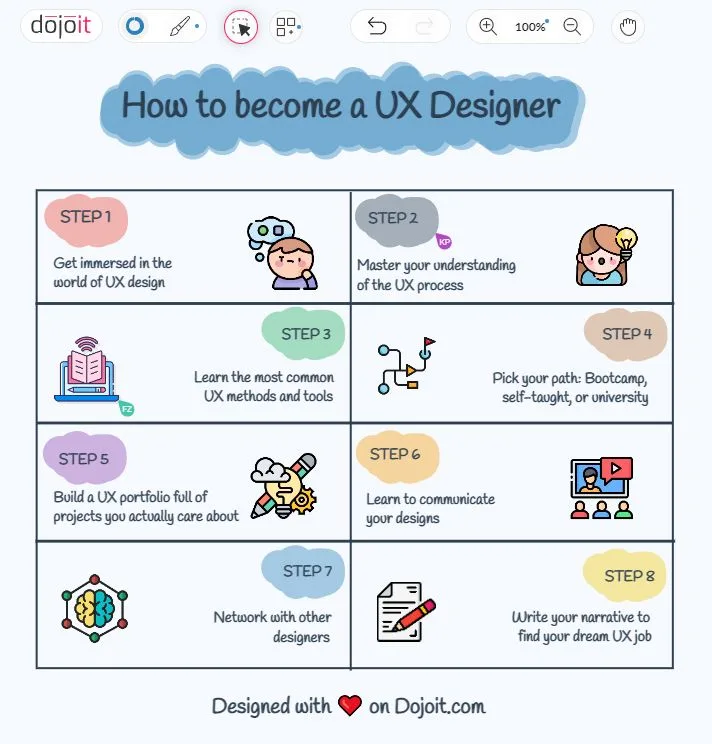
Becoming: UX design is one of the few knowledge-work careers where the question of how to enter is genuinely unsettled. In software engineering, the degree-versus-bootcamp debate has largely resolved in favour of demonstrable skills; in medicine or law, credentials remain obligatory.
UX design sits in an unusual middle ground: the field has professional frameworks and academic grounding in human-computer interaction and cognitive psychology, but most hiring decisions are made on the basis of a portfolio review rather than a transcript.
This creates genuine opportunity - and a genuine minefield of bad advice about how to exploit it.
The proliferation of UX bootcamps since 2015, and their aggressive marketing claims about employment outcomes, has produced a generation of aspiring designers who completed a 12-week programme, built three practice projects, and discovered that the market was more competitive than the enrolment brochure suggested.
The path into UX design is real, accessible, and does not require a specific credential - but it requires a portfolio that demonstrates actual thinking, and the ability to articulate your design process clearly to people who hire designers for a living.
This article is a practical guide to every viable route into UX design: what each path offers, what it costs in time and money, what you need in a portfolio before applying, what tools to learn and in what order, and what hiring managers actually evaluate in the first thirty seconds of reviewing your work.
"The best thing a new designer can do is stop asking which course to take and start asking which problems they are going to solve for real people. Hiring managers do not care where you learned Figma. They care what you figured out by using it."
- Don Norman, co-founder of the Nielsen Norman Group, at an NN/g conference, 2022[2]
Key Definitions
Human-Computer Interaction (HCI): The academic field from which UX design emerged, combining cognitive psychology, computer science, and design.[8] Degree programmes in HCI at Carnegie Mellon, Georgia Tech, and UCL are the most direct academic path into senior UX roles.
Bootcamp: An intensive, instructor-led programme - typically 12-36 weeks - designed to build a hirable skillset and portfolio in minimum time. Quality varies enormously; outcomes data should be independently verified before enrolment.
Portfolio: The primary hiring artefact in UX design. A collection of case studies documenting the designer's process on specific projects. For entry-level candidates, the portfolio matters more than credentials.
Case Study: A written and visual account of a single design project, including the problem, research approach, design decisions, iterations, and outcomes. The standard format for demonstrating process in both portfolios and interviews.
Figma: The dominant collaborative design tool for UI and UX work as of 2025-2026, used by the majority of professional designers at product companies. Proficiency is a baseline requirement for most roles.
Information Architecture (IA): The structural organisation of digital information - how content is categorised, labelled, and navigated. Strong IA thinking is one of the skills that differentiates mid-level designers from junior ones.
Usability Testing: A research method in which real users attempt to complete tasks with a product or prototype while the researcher observes. The most direct method for identifying design problems before they are shipped.
Entry Path Comparison
| Path | Duration | Cost | Market Reception | Best For |
|---|---|---|---|---|
| HCI/interaction design degree (undergrad) | 4 years | $40,000-$200,000 | Strongest for top-tier roles | Students entering directly from school |
| HCI Master's degree | 1-2 years | $30,000-$80,000 | Strong; 15% salary premium vs bootcamp | Career changers with time and resources |
| UX bootcamp (reputable) | 12-36 weeks | $7,000-$20,000 | Acceptable with strong portfolio | Career changers needing structured transition |
| Self-taught | 12-30 months | $0-$2,000 | Depends entirely on portfolio quality | Adjacent-role workers building toward UX |
The State of the UX Job Market in 2025-2026
Before choosing an entry path, it is worth understanding what the market actually looks like. According to the U.S. Bureau of Labor Statistics, employment of web and digital interface designers is projected to grow 16% from 2022 to 2032 - faster than the average for all occupations.[13]
However, this growth headline conceals significant nuance about what kind of designers are in demand.
The NN/g 2024 UX Careers Report surveyed over 3,000 practitioners globally and found that the median salary for a UX designer in the United States was $110,000, with significant variation by seniority, company type, and specialisation.[14]
Senior UX designers at product companies earned a median of $145,000; those at agencies earned approximately 15-20% less for comparable experience.
The same report found that 70% of UX job listings required 3 or more years of experience, creating the classic entry-level paradox that new designers must navigate.
Entry-level roles exist, but competition for them intensified meaningfully between 2022 and 2024 as the volume of bootcamp graduates increased faster than the volume of junior openings.
"The market is not oversaturated - it is undersaturated with designers who have real research skills and can clearly articulate their process. It is absolutely oversaturated with designers who can use Figma to make something look nice."
- Teresa Torres, author of 'Continuous Discovery Habits', in a 2023 ProductTalk interview[11]
Specialisation Creates Opportunity
The UX field has bifurcated into generalist and specialist tracks. UX researchers - designers focused primarily on qualitative and quantitative user research - are among the most consistently in-demand profiles.
Conversation designers (designing chatbot and voice interfaces) and accessibility specialists command significant premiums. Generalist UX designers face more competition than those who develop a specialisation alongside core design skills.
Degree vs Bootcamp vs Self-Taught: What Actually Matters
The first thing to understand about this question is that it is not the question hiring managers ask.
They do not ask 'where did you train?' at the portfolio review stage - they ask 'can you walk me through your process on this project?' The educational pathway matters only insofar as it shapes the quality of the work in your portfolio and the confidence of your explanations.
The Degree Route
A four-year degree in human-computer interaction, interaction design, cognitive psychology, or a closely related discipline provides the deepest theoretical foundation for a UX career.
Graduates of strong HCI programmes - Carnegie Mellon's MHCI, Georgia Tech's HCI degree, UCL's HCI programme, and comparable programmes at MIT, Stanford, and Cornell - are recruited aggressively by top-tier tech companies.
Master's programmes in HCI are a popular route for career changers. They typically run 12-24 months, cost $30,000-$80,000 in tuition, and produce graduates with both academic credentials and a portfolio developed in an academic context.
The NN/g 2024 UX Careers Report found that designers with HCI Master's degrees entered the field at starting salaries approximately 15% above the median for bootcamp and self-taught entrants, and reached senior level approximately one year faster on average.
The limitation is cost and time. For people entering straight from school with an interest in design and technology, the HCI degree is a strong long-term bet. For people changing careers at 30, the economics are more complex.
A degree also provides something that bootcamps cannot fully replicate: research methodology grounding.
The academic study of user research methods - survey design, experimental design, statistical analysis, ethnographic fieldwork - builds a rigour that accelerates career progression at the senior and staff levels, where UX strategy and research direction increasingly matter.
The Bootcamp Route
UX bootcamps accelerated in popularity from 2015 onwards. The best bootcamps - General Assembly's UX Design Immersive, Springboard's UX Career Track, CareerFoundry's UX Design Programme - teach a working design process, introduce Figma and research methodologies, and provide a structured environment for building a portfolio.[7]
The limitations are significant and frequently understated in marketing materials. Twelve weeks is not enough time to develop the depth of research skill or the nuanced stakeholder communication ability that differentiates competitive candidates. Bootcamp projects are typically brief and artificial compared to real product work.
Cost for reputable bootcamps ranges from $7,000 to $20,000. Before enrolling, request independently verified employment rate data within six months of graduation. Any programme that cannot provide this should be treated with scepticism.
What bootcamp graduates typically do well: UI execution in Figma, portfolio presentation structure, design process terminology, iterative prototyping.
What bootcamp graduates often lack: deep research methodology, information architecture theory, ability to handle ambiguous real-world briefs, stakeholder communication in complex organisations.
The gap is not insurmountable - but it must be actively closed, ideally before the first application.
The Self-Taught Route
A minority of working UX designers - approximately 15% according to NN/g 2024 data - are primarily self-taught.[1] This route is slower, requires more self-discipline, and demands that the learner construct their own curriculum without the scaffolding of an organised programme.
The self-taught route is most viable for people who already work adjacent to design - front-end developers, product managers, researchers, and content strategists who want to formalise their design work.
Key self-learning resources include: Google's UX Design Certificate on Coursera (a credible free-to-audit introduction), Nielsen Norman Group's online courses, Interaction Design Foundation's membership-based curriculum, Don Norman's 'The Design of Everyday Things,' and Steve Krug's 'Don't Make Me Think.'[5]
A self-directed learning path might look like this:
Months 1-3: Foundation. Complete Google's UX Design Certificate. Read 'The Design of Everyday Things.' Learn Figma through official tutorials and free Community files.[4] Conduct your first user interviews on a problem of your choosing.
Months 4-6: Portfolio development. Complete two serious self-directed projects with real user research. Document every decision. Get feedback on your work from working designers (ADPList, local IxDA chapter, design critique communities on Discord).
Months 7-12: Depth and application. Study information architecture using Louis Rosenfeld and Peter Morville's 'Information Architecture for the World Wide Web.' Add a third portfolio case study.[12] Begin applying for roles while continuing to iterate.
What Your Portfolio Must Include
Regardless of how you enter the field, your portfolio is what gets you interviews. Hiring managers report spending an average of 3-5 minutes on an initial portfolio review - enough time to assess two or three case studies and form a clear impression.
Case Study Structure
Each portfolio case study must clearly answer four questions: What problem were you solving and for whom? What did you discover through research? How did your research shape your design decisions? What was the outcome, and how do you know?
Most unsuccessful portfolios answer only the last question - they show polished final screens without explaining the problem, the research, or the decisions. This is the most common and most expensive portfolio mistake.
A strong case study includes: a problem statement explaining the business or user context; a description of research methods used and key findings; annotated sketches, wireframes, or process documentation showing how the design evolved; evidence of testing or validation; and an honest reflection on what was learned, including what did not work.
Portfolio Case Study Evaluation Criteria
| Criterion | What Hiring Managers Look For | Common Failure |
|---|---|---|
| Problem framing | Clear articulation of user and business problem | Solution-first opening, no context |
| Research evidence | Real methods, real users, genuine findings | Assumed user needs, no actual interviews |
| Design reasoning | Explicit connection between findings and decisions | Showing final screens without explaining why |
| Iteration evidence | Process artefacts: sketches, wireframes, rejected directions | Only final polished version shown |
| Outcome and learning | Honest reflection including what failed | Unrealistic success-only narrative |
| Presentation clarity | Readable in 5 minutes without a guided tour | Requires explanation to make sense |
What to Include When You Have No Professional Experience
Hiring managers understand that entry-level candidates lack professional project experience. What they cannot accept is a portfolio with no evidence of real user interaction.
Practice projects are acceptable if they demonstrate actual research - not assumed user needs, but conversations with real people, usability tests, or analysis of real behavioural data.
Including three case studies with genuine depth is more effective than including eight superficial ones. More projects do not signal more experience - they signal poor judgment about quality.
The most effective practice projects for entry-level portfolios are redesigns of real products with documented research, not invented products with invented users.
Choose a product with an identifiable user community you can recruit from - a local service, a tool used by a professional community you belong to, or a niche app with an active user forum.
Portfolio Presentation Platform
Your portfolio lives at a URL that hiring managers can access on any device. Recommended platforms in 2025-2026: Notion (flexible, widely used, easy to update), Webflow (visual polish without code), Cargo (design-forward aesthetic), or a self-coded site (signals technical familiarity to companies that value it).
Avoid PDF-only portfolios - they prevent linking to specific case studies and are harder to share and update. Avoid portfolio platforms that require the viewer to create an account.
Tools to Learn and in What Order
Figma First
Figma is the non-negotiable starting point. It is the dominant design tool for professional UX work globally. Learning Figma means understanding: frames and components; auto layout; prototyping and interaction; variables and design tokens; and developer handoff through dev mode.
Figma's own YouTube channel, along with Figma Community resources, provides free learning material of high quality. Aim to be proficient enough in Figma to build a fully interactive prototype from a set of wireframes before applying to jobs.
Figma proficiency milestones:
- Beginner: Can create frames, use basic shapes, text, and export assets
- Intermediate: Can build component libraries, use auto layout, and create multi-screen prototypes
- Advanced: Can use variables and design tokens, set up a design system, and prepare developer handoff specs
Aim for intermediate proficiency before your first application.
Research Methods Second
The tools for research - Maze, Lookback, UserTesting, Dovetail - matter less than the methodology. Learn how to: write a research plan, design an interview guide that does not lead respondents, synthesise qualitative data using affinity mapping, and present findings in a format that influences product decisions.
The most valuable skill in UX research is not knowing the right answer. Designers who go into interviews with a hypothesis they intend to confirm are not doing research. Research is the discipline of genuinely not knowing what users need and building methods to find out.
Supporting Tools After Fundamentals
Once Figma and research methods are established, additional tools worth learning include: Maze or Useberry for unmoderated usability testing; Dovetail or Notion for research synthesis; Optimal Workshop for information architecture testing; and Lottie or Principle for motion exploration.
Tool learning priority order:
- Figma (foundation - learn before everything else)
- A note-taking and synthesis tool (Dovetail, Notion, or Miro for affinity mapping)
- Maze or UserTesting (for running unmoderated usability tests)
- Optimal Workshop or Maze tree testing (for IA validation)
- Principle or Protopie (for advanced interaction prototyping - only after fundamentals are solid)
Salary Expectations at Each Career Stage
Understanding the compensation landscape helps set realistic expectations and negotiate effectively.
| Career Stage | Years Experience | Median US Salary (2024) | Range |
|---|---|---|---|
| Entry-level / Junior UX Designer | 0-2 years | $72,000 | $55,000-$95,000 |
| Mid-level UX Designer | 2-5 years | $103,000 | $82,000-$130,000 |
| Senior UX Designer | 5-8 years | $136,000 | $110,000-$165,000 |
| Lead / Principal UX Designer | 8+ years | $165,000 | $135,000-$210,000 |
| UX Director / Head of Design | 10+ years | $190,000 | $155,000-$260,000+ |
Source: NN/g 2024 UX Careers Report; Glassdoor 2024; LinkedIn Salary Insights 2024.[15]
Note: These figures reflect product company compensation. Agency compensation runs approximately 15-25% below these figures at comparable experience levels. FAANG and top-tier tech companies pay significantly above median.
Breaking In Without Experience
The most common barrier to the first UX job is the experience paradox: employers want experience, but how do you get experience without a job? The answer is to manufacture experience through structured self-directed work.
Volunteer and non-profit work: Organisations like Catchafire, VolunteerMatch, and Code for America regularly post design requests from non-profits. Designing a real flow for a real organisation produces real work, with real users, and a real outcome - all portfolio-worthy.
Design communities and challenges: ADPList connects aspiring designers with experienced mentors for free.[10] Design challenges on uxchallenge.com provide structured briefs with feedback communities.
Transitional roles: For people in adjacent roles, the most reliable route is lateral movement within their current organisation. A developer who proposes and leads a usability improvement initiative has legitimate design experience regardless of formal title.
The Adjacent-Role Advantage
People transitioning into UX from related fields have a significant and often underrated advantage: they bring domain expertise that pure design graduates lack. A nurse who learns UX design understands healthcare workflows that a new design graduate does not.
A software developer who pivots to UX brings technical fluency that enables better collaboration with engineering teams. A content strategist has language and communication skills that transfer directly to UX writing and information architecture.
If you are making a lateral move into UX, lead with your domain expertise in your portfolio and application materials. Your background is not a liability to overcome - it is a differentiator.
Hiring teams at healthcare companies, fintech firms, and enterprise software companies actively seek designers who understand the domain they are designing for.
The UX Design Learning Roadmap
For anyone starting from scratch in 2025-2026, a complete learning roadmap might look like the following:
Foundation Phase (Months 1-3)
- Learn the UX design process end-to-end (research, define, ideate, prototype, test)
- Begin Figma training, targeting intermediate proficiency
- Read: 'The Design of Everyday Things' (Norman), 'Don't Make Me Think' (Krug)[3]
- Conduct your first user interviews on a problem of genuine interest
Skill-Building Phase (Months 4-6)
- Complete first portfolio project with end-to-end research and documentation
- Learn usability testing methodology; run your first moderated test
- Study information architecture; conduct a card sort with real participants
- Join a design community: local IxDA chapter, ADPList, UX Discord servers
Portfolio Phase (Months 7-12)
- Complete two additional portfolio projects
- Get critique from working designers; iterate on your work
- Study at least two of the following: accessibility design, design systems, content strategy
- Begin informational interviews with working designers at companies that interest you
Application Phase (Months 10-18)
- Begin applying before you feel completely ready
- Use informational interview contacts for warm applications where possible
- Treat interview feedback as learning data; iterate on portfolio and presentation
- Continue skill development in parallel with applications
What Hiring Managers Actually Look For
Evidence of real research: Did the candidate talk to users? Do they know what they discovered, and did it change anything?
Clarity of reasoning: Can the candidate explain why they made design decisions, rather than just what they made?
Self-awareness: Does the candidate acknowledge what did not work and what they would do differently? Designers who present only successful outcomes are early-stage warning signs.
Communication: Portfolio presentation and the ability to answer 'why' questions confidently in an interview are more predictive of job performance than portfolio visual quality.
The Most Common Reasons Portfolios Get Rejected
Based on aggregated feedback from hiring managers published by Nielsen Norman Group and UXPA:[9]
- No evidence of user research - the most common and most disqualifying problem
- Solution-first presentation - opening with screens rather than problem context
- Superficial case studies - many shallow projects instead of a few deep ones
- No process artefacts - only final screens, no wireframes, sketches, or iteration evidence
- Unclear personal contribution - team projects where the individual's role is not specified
- No outcome or measurement - no evidence of whether the design achieved anything
- Visual design overemphasis - beautiful screens with no explanation of why design decisions were made
Practical Takeaways
Do not start by picking a bootcamp - start by consuming design work. Read case studies on NN/g, Figma's blog, and Medium's UX Collective for three months before deciding on a learning pathway. Understanding what good work looks like is a prerequisite for knowing how to produce it.
Build your portfolio around depth, not breadth. Three case studies with genuine research, documented decision-making, and honest reflection will outperform eight shallow project summaries every time.
Connect with working designers before you graduate. LinkedIn, ADPList mentorship, and local UXPA or IxDA chapters give you access to people who know what the market actually looks for.
Apply before you feel ready. The market feedback from applications and interviews is faster and more calibrated than self-assessment.
Develop a specialisation alongside your generalist foundation. UX researchers, accessibility specialists, and conversation designers are more consistently in demand than generalist UX designers and command salary premiums. Choose a direction that connects to your background and genuine interests.
Frequently Asked Questions
Do you need a degree to become a UX designer? No - many working UX designers are bootcamp graduates or self-taught. Portfolio quality matters far more than educational background to most hiring managers, though HCI Master's graduates enter at 15% higher starting salaries on average per NN/g data.
How long does it take to become a UX designer? A focused bootcamp or self-study plan typically produces a hirable portfolio in 6-12 months. Moving from portfolio to first job takes an additional 3-6 months of applications. Total timeline from zero to employed is commonly 9-18 months.
Is Figma enough to get a UX job? Figma proficiency is essentially required but not sufficient. Hiring managers also want evidence of research skills, information architecture thinking, and the ability to communicate design decisions. Figma is the execution tool; research and strategy are the differentiators.
Which UX bootcamps are worth the money? General Assembly, Springboard, and CareerFoundry are frequently cited programmes with some track record.[6] Always request verified employment rate data within 6 months of graduation before enrolling - any programme that cannot provide this should be treated with scepticism.
Sources & Further Reading
- Nielsen Norman Group. (2024). UX Careers Report 2024. nngroup.com/reports
- Norman, D., and Nielsen, J. (2024). The Definition of User Experience. nngroup.com
- Krug, S. (2014). Don't Make Me Think, Revisited. New Riders.
- Norman, D. (2013). "The Design of Everyday Things: Revised and Expanded Edition". Basic Books.
- Google. (2024). UX Design Certificate on Coursera. coursera.org/professional-certificates/google-ux-design
- Springboard. (2024). UX Design Bootcamp Outcomes Report 2024. springboard.com
- CareerFoundry. (2024). UX Design Programme Employment Outcomes. careerfoundry.com
- Interaction Design Foundation. (2024). UX Design Learning Pathway. interaction-design.org
- UXPA International. (2024). UX Salary and Skills Survey 2024. uxpa.org
- ADPList. (2024). Mentorship Report: Design Career Transitions. adplist.org
- Torres, T. (2021). Continuous Discovery Habits. Product Talk Press.
- Rosenfeld, L., and Morville, P. (2006). Information Architecture for the World Wide Web, 3rd Edition. O'Reilly Media.
- U.S. Bureau of Labor Statistics. (2023). Occupational Outlook Handbook: Web Developers and Digital Designers. bls.gov
- Glassdoor. (2024). UX Designer Salary Data: United States. glassdoor.com
- LinkedIn. (2024). LinkedIn Salary Insights: UX Designer. linkedin.com/salary
Further Reading
- Buley, L. (2013). The User Experience Team of One. Rosenfeld Media.
- Gothelf, J., and Seiden, J. (2021). Lean UX, Third Edition. O'Reilly Media.