
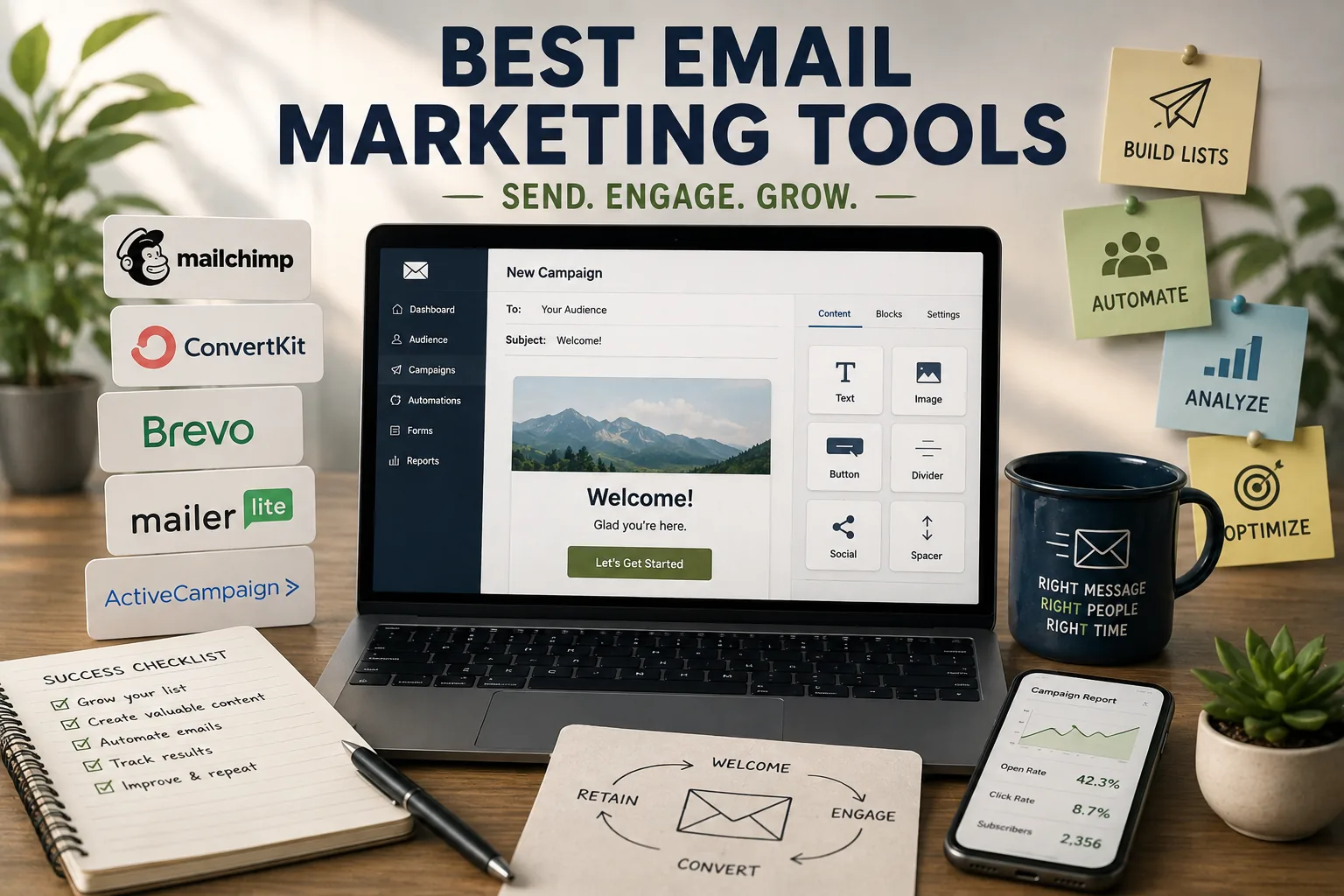
Sara Okonkwo had been writing about personal finance for four years when her Twitter following hit 40,000 and she decided to start a newsletter. She chose Mailchimp because she had heard the name, spent a weekend setting up a template she liked, and sent her first email to the 200 people who signed up in the first week.
Within six months she had 8,000 subscribers. The newsletter was working. Then she tried to set up a welcome sequence - a series of four emails that new subscribers would automatically receive over two weeks - and found that multi-step automations on Mailchimp's free plan were not available.
She upgraded. Then her list hit 1,500 and the monthly cost doubled. She felt like she was being taxed for growing.
A friend who ran a cooking newsletter had made a different choice from the start. She had started on ConvertKit specifically because a friend who ran a cooking newsletter had told her the automation features were better suited to content creators.
She had set up a five-email welcome sequence in an afternoon, was selling a $27 recipe guide directly from her ConvertKit landing page, and was paying $25/month for a list of 800 subscribers.
When Sara eventually migrated her list from Mailchimp to Beehiiv - a process she described as "three hours of my life I am not getting back" - she gained a referral program, an ad network, and a public archive page she had not known she wanted until she saw what her newsletter could look like as a standalone publication.
The email marketing tool you choose shapes your newsletter's ceiling before you have built anything. The cost model determines when growth becomes expensive. The feature set determines what you can automate and how. The platform's business model determines who the product is actually optimized for.
Most people choose based on name recognition and spend time later migrating to something better suited. This guide maps every major option - from newsletter-native platforms to enterprise automation suites - so the choice is made with full information the first time.
"The best email marketing tool is the one your subscribers actually receive in their inbox. Everything else is features. But features do matter once you are past the basics."
Newsletter Platforms for Creators
Beehiiv
Beehiiv was built by alumni of the Morning Brew newsletter team, and it shows. The platform is designed around the model of a newsletter as a standalone publication business - not just an email list, but a destination with its own URL, archive, subscriber base, and multiple revenue streams.
The Newsletter Publication Page gives every Beehiiv newsletter a public-facing website where past issues are archived and discoverable via search. New subscribers can read previous issues before signing up. This is functionality that other platforms either charge extra for or leave to you to build in a separate website builder.
The Ad Network allows newsletters to earn revenue from display-style newsletter sponsorships sourced from Beehiiv's advertiser marketplace.[3]
Rather than cold-emailing potential sponsors yourself, Beehiiv surfaces advertisers interested in your audience's demographics, and you approve or decline placements. The revenue share is 85% to the newsletter creator.
The Referral Program creates a subscriber growth loop. Configure incentives for readers who refer friends - free issues, downloadable content, merchandise, or public recognition. Every subscriber gets a unique referral link. Signups through that link are tracked and credited.
Newsletters using Beehiiv's referral program consistently report it as one of their highest-converting growth channels once the initial subscriber base reaches a few thousand readers.
Boosts allow paying to be recommended to subscribers of other Beehiiv newsletters. You set a cost-per-subscriber you are willing to pay, and Beehiiv surfaces your newsletter as a recommendation in relevant publications.
The subscriber acquisition cost varies by niche and demand but is typically lower than paid social media acquisition for newsletters.
Analytics are detailed and actionable: per-issue open rate trends, subscriber growth by acquisition source, segment-level engagement, and churned subscriber reporting.
Pricing: free up to 2,500 subscribers with unlimited sends. Scale $42/month (unlimited subscribers, full monetization access), Max $84/month (advanced analytics, custom integrations, 3D analytics).
Best for: newsletter creators who want a full publication platform rather than just email delivery. The combination of growth tools, ad network, and publication website makes Beehiiv the strongest platform for newsletters as standalone businesses.
Limitations: less suitable for businesses sending promotional or transactional email alongside editorial newsletters. E-commerce integration is not Beehiiv's focus.
Substack
Substack's defining advantage is zero upfront cost and built-in reader discovery. The platform earns only when you earn - 10% of paid subscription revenue - which means the business model is aligned with helping newsletters grow and monetize.
The Recommendation Network is Substack's most powerful growth feature: when a reader subscribes to one newsletter, Substack suggests similar newsletters to follow.
For writers building an audience in a defined niche (personal finance, technology, culture, fiction), being surfaced to the existing reader base of adjacent publications creates organic growth that is difficult to replicate on other platforms.
Notes functions like a social timeline within the Substack ecosystem - short posts, links, quotes, and reactions that circulate among Substack readers and writers. This creates a social layer around the email product that increases engagement and discoverability within the platform.
Reader apps for iOS, Android, and web provide a reading experience beyond the inbox. Subscribers can read your newsletter like they would read a media publication, browse your archive, and comment on posts without leaving the app.
Pricing: free for writers. Substack retains 10% of all paid subscription revenue.[4] Stripe processing fees (approximately 2.9% + $0.30 per transaction) apply additionally.
Best for: writers launching a newsletter with no upfront cost, creators who want built-in platform discovery to grow their subscriber base, and publications where paid subscriptions are the primary monetization model.
Limitations: the 10% revenue cut compounds significantly at scale. A newsletter earning $10,000/month in paid subscriptions loses $1,000/month to Substack fees - equivalent to 24 months of Beehiiv's Scale plan.
Customization options are minimal, and the platform has no advertising monetization, referral programs, or sponsor marketplace.
ConvertKit / Kit
ConvertKit (rebranding as Kit in 2024) was built explicitly for the creator economy: bloggers, course creators, authors, podcasters, and independent educators who build businesses around direct audience relationships.[2]
The Visual Automation Builder displays email sequences as a flowchart with clear branching logic. When a subscriber joins a list, they enter a sequence. After email three, if they clicked the product link, they branch into a purchase sequence.
If they did not click, they continue the nurture sequence. Building and editing this logic in a visual map is dramatically easier than configuring it as a list of text-based rules.
Sequences (drip campaigns) are the product's core strength. A welcome sequence, a course delivery sequence, an evergreen sales funnel - all are straightforward to configure with ConvertKit's tools.
The Creator Network allows cross-promotion with other ConvertKit creators: recommend another creator's newsletter at the end of your emails, and they recommend yours, growing both lists through mutual endorsement.
Commerce features allow selling digital products (ebooks, courses, templates, coaching packages) directly from a ConvertKit-hosted page. The purchase is tied to the subscriber's profile, enabling automatic tagging and sequence enrollment based on purchase history.
Pricing: free up to 1,000 subscribers with unlimited sends and basic automations. Creator $25/month (1,000 subscribers), Creator Pro $50/month (adds newsletter referral system, subscriber scoring). Pricing scales with list size.
Best for: content creators building businesses around digital products, courses, and direct audience relationships. The automation and sequence features are well-matched to the drip-and-nurture model common in creator businesses.
Limitations: email template design options are limited compared to Mailchimp or Flodesk. E-commerce and physical product integrations are weaker than dedicated e-commerce email tools. Pricing per subscriber becomes expensive at large list sizes.
Flodesk
Flodesk occupies a distinctive position in the email marketing market: flat-rate pricing regardless of list size. At $38/month, a 500-subscriber list costs the same as a 500,000-subscriber list.
The platform's other distinguishing feature is visual design. Flodesk's templates are among the most aesthetically refined of any email platform - clean, editorial, grid-based layouts that feel closer to editorial design than traditional email marketing.
The template library skews toward lifestyle, fashion, photography, and personal brand aesthetics, which explains its strong adoption among photographers, designers, and Instagram-native creators.
Checkout allows selling digital and physical products directly from Flodesk-hosted pages, with purchase-triggered automations available.
Pricing: $38/month flat (email + forms), $64/month flat (email + forms + Checkout). No per-subscriber cost.
Best for: visually oriented creators and small businesses who anticipate significant list growth and want pricing certainty. The flat-rate model becomes increasingly good value as list size grows.
Limitations: automation and segmentation capabilities are less advanced than ActiveCampaign, Klaviyo, or even ConvertKit. Not suitable for complex behavioral triggers or e-commerce automation at scale.
Email Marketing Platforms for Business
Mailchimp
Mailchimp is the most widely used email marketing platform in the world, with over 13 million users.[1] This breadth translates into the largest third-party integration library of any email tool: over 300 native integrations with Shopify, WooCommerce, Stripe, Salesforce, Canva, and most other major business tools.
The Journey Builder (Standard plan and above) creates multi-step automation sequences triggered by subscriber actions, date-based triggers, and e-commerce events. Welcome journeys, post-purchase follow-ups, abandoned cart reminders, and re-engagement campaigns are all buildable in the visual journey canvas.
Audience Management provides segmentation tools to target emails to specific subsets of the list based on demographics, behavior, purchase history, and custom tags. Combined with the journey builder, this enables fairly sophisticated lifecycle marketing without moving to a dedicated CRM platform.
The Creative Assistant uses AI to generate on-brand email designs from your existing logo and color palette - useful for small businesses that need professional-looking emails without dedicated design resources.
Pricing: free (500 contacts, 1,000 sends/month, limited automations), Essentials $13/month, Standard $20/month, Premium $350/month. Pricing scales steeply with list size - 50,000 contacts on the Standard plan is $350/month; 100,000 contacts is $800/month.
Best for: small businesses that need a general-purpose email platform with broad integrations, teams already using tools in the Mailchimp integration ecosystem, and e-commerce businesses starting with email marketing.
Limitations: pricing at mid-to-large list sizes is expensive relative to alternatives. The free tier has become restrictive. The platform has grown complex enough that finding specific features requires navigating an increasingly layered interface.
ActiveCampaign
ActiveCampaign combines email marketing with a full CRM, positioning it for businesses that need to manage the entire customer relationship - from initial lead capture through sales to retention - in a single platform.[5]
The Automation Builder is among the most powerful available in a non-enterprise product: conditions, branches, splits, goals, and wait steps allow building complex multi-path journeys that adapt to subscriber behavior in real time.
A lead who visits the pricing page gets a different email than a lead who downloaded a guide. A customer who purchases adds to a retention sequence. A churned customer enters a winback flow automatically.
Predictive Sending uses machine learning to determine the optimal send time for each individual subscriber based on their historical open patterns. Rather than sending to the entire list at 10am on Tuesday, each subscriber receives the email at the time their history suggests they are most likely to open.
Site Tracking captures every page a contact visits on your website and makes that behavioral data available for segmentation and automation triggers. A visitor who read your pricing page three times in a week can be automatically flagged for sales follow-up or entered into a targeted email sequence.
CRM and Deal Pipelines allow managing sales opportunities with stage-based tracking, task assignment, and email communication logged against each deal. For B2B businesses or high-consideration sales, this removes the need for a separate CRM tool.
Pricing: Starter $29/month (1,000 contacts), Plus $49/month, Professional $149/month. Scales with contact count.
Best for: B2B companies, service businesses with long sales cycles, and businesses that need sophisticated behavioral automation and CRM functionality alongside email marketing.
Klaviyo
Klaviyo is the standard email and SMS platform for Shopify-based e-commerce, used by over 150,000 paying merchants.[6] Its dominance in this category reflects genuine product-market fit: the platform is built from the ground up for the specific workflows of online retail.
Behavioral Triggers connect directly to Shopify and other e-commerce platforms. Browse abandonment (viewed a product, left without adding to cart), cart abandonment, post-purchase sequences, product replenishment reminders, and winback campaigns for customers who have not purchased in 90 days - all trigger automatically based on real-time behavioral data.
Revenue Attribution tracks which emails directly preceded a purchase and attributes revenue to specific campaigns, flows, and individual messages. A welcome sequence that generates $4,200 per month in attributed revenue is clearly worth its configuration time.
Attribution transparency is one of Klaviyo's strongest differentiators from general email platforms.
Predictive Analytics calculates an expected next order date, predicted lifetime value, and churn risk score for each subscriber based on their purchase history.
These predictions enable proactive segmentation: target high-lifetime-value customers with exclusive offers before competitors do, and identify at-risk customers for retention campaigns before they lapse.
SMS Integration shares flows and segmentation with email in the same platform. An abandoned cart sequence can start with an email, follow up with a text message, and conclude with a final email - all in one automation flow.
Pricing: free (250 contacts), $45/month (1,000 contacts), $175/month (5,000 contacts), $415/month (20,000 contacts), $700/month (50,000 contacts).
Best for: Shopify and e-commerce stores generating meaningful transaction volume. The revenue attribution features make the pricing justifiable when the platform is actively driving measurable sales.
Limitations: expensive at scale, overkill for businesses without significant e-commerce transaction data, and the per-contact pricing becomes a significant cost as lists grow.
Brevo (formerly Sendinblue)
Brevo's pricing model is its primary differentiator: unlimited contacts on all paid plans, with pricing based on email sends per month rather than list size.[7] A 500,000-contact list sending one email per month costs the same as a 500-contact list with the same send frequency.
This model is particularly advantageous for businesses with large contact databases and lower send frequency - quarterly newsletters to a large customer base, annual re-engagement campaigns, or businesses that maintain large lists but communicate infrequently.
Multi-Channel messaging includes email, SMS, WhatsApp Business, and push notifications from a single platform and automation builder. Building an automation flow that sequences an email, then an SMS, then a WhatsApp message uses the same drag-and-drop interface for all channels.
The free plan allows 300 emails per day with unlimited contacts - generous enough to support a growing list without a monthly fee, constrained only by daily send volume.
Pricing: free (300 emails/day, unlimited contacts), Starter $25/month (20,000 emails/month), Business $65/month (100,000 emails/month).
Best for: businesses with large contact lists and moderate send frequency, anyone who needs SMS and WhatsApp alongside email in one platform, and organizations outside the US where WhatsApp is a primary communication channel.
Comparison Table
| Tool | Price | Free Tier | Best For |
|---|---|---|---|
| Mailchimp | From $13/month | 500 contacts | E-commerce, broad integrations, small business |
| ConvertKit/Kit | From $25/month | 1,000 subscribers | Creator businesses, digital products, sequences |
| Beehiiv | From $42/month | 2,500 subscribers | Newsletter publications, growth tools, ad network |
| Substack | Free + 10% revenue | Unlimited | Writers, paid subscriptions, discovery network |
| ActiveCampaign | From $29/month | None | CRM + email, B2B, complex automation |
| Klaviyo | From $45/month | 250 contacts | Shopify, e-commerce, behavioral triggers |
| Brevo | From $25/month | 300 emails/day | Large lists, multi-channel, international |
| Ghost | From $9/month | None | Membership publications, 0% revenue share |
| Drip | From $39/month | None | E-commerce automation, Klaviyo alternative |
| Flodesk | $38/month flat | None | Visual design, flat pricing, creators |
Ghost: The Self-Hosted Alternative
Ghost occupies a different category from the platforms above: it is a full content management system built for independent publications, with membership and newsletter functionality built in.
Where Substack and Beehiiv are platforms you publish on (your newsletter lives on their infrastructure, their domain, their ecosystem), Ghost is software you own and control. Your publication runs on your domain, your server, your data.
Hosted Ghost plans ($9-36/month) manage the infrastructure for you, but the ownership model is fundamentally different from Mailchimp or Substack.
The membership model allows free and paid tiers with complete control over pricing, access levels, and member data. Ghost takes 0% of subscription revenue - you pay only Stripe's payment processing fees (approximately 2.9% + $0.30).[8] For a newsletter earning $5,000/month in subscriptions, Ghost keeps nothing. Substack keeps $500.
Pricing: Starter $9/month (500 members), Creator $25/month (1,000 members), Team $50/month (1,000 members + team access), Business $199/month (10,000 members).
Best for: established publications with significant paid subscription revenue where the economics of zero revenue share clearly favor ownership over Substack's free model with 10% cut.
Limitations: more setup required than Substack or Beehiiv, no built-in discovery network, and the growth tools available on Beehiiv (referral programs, ad network, Boosts) are not present.
Deliverability: The Issue Every Email Marketer Faces Eventually
Every email marketing discussion eventually arrives at deliverability - the question of how many of your sends actually reach the inbox rather than the spam folder.
The platforms above all maintain strong deliverability infrastructure, but sender reputation is partly a function of your own behavior: list hygiene, engagement rates, and authentication setup matter regardless of which platform you use.
The non-negotiable technical requirements as of 2024: SPF, DKIM, and DMARC records properly configured for your sending domain. Google and Yahoo now require bulk senders (anyone sending over 5,000 emails per day) to have these authentication records in place.
All major email platforms provide setup instructions; failure to configure them means a significant portion of your sends going to spam.
List hygiene practices that protect deliverability at scale: remove hard bounces immediately (all platforms handle this automatically), suppress subscribers who have not opened in 180 days (or run a re-engagement campaign and remove non-responders), and avoid purchased or scraped email lists entirely.
A list with a 15% open rate sends a strong signal to inbox providers that your email is wanted. A list with a 2% open rate sends the opposite signal, affecting inbox placement for the active portion of your list.
Tools like GlockApps ($9+/month) allow testing inbox placement across major email providers before sending. Mail-Tester (free) provides a quick spam score check. Google Postmaster Tools (free) shows your domain's reputation specifically with Gmail users, which is essential for consumer-facing newsletters.
Choosing a Platform by Business Type
Solo newsletter creator: Start on Beehiiv's free plan (2,500 subscribers) and upgrade to Scale ($42/month) when growth tools become relevant. The referral program alone often pays for the subscription in reduced acquisition cost.
If you prefer Substack's discovery network or zero upfront cost, Substack is a rational choice until paid subscription revenue exceeds roughly $500/month, at which point the 10% fee comparison with Beehiiv's flat rate becomes financially meaningful.
E-commerce business: Klaviyo if you are on Shopify and generating meaningful transaction volume. The behavioral triggers and revenue attribution justify the cost. ActiveCampaign or Drip for lower-volume stores or those on platforms other than Shopify.
Mailchimp Standard as a cost-effective alternative if advanced e-commerce automation is not yet needed.
B2B service business: ActiveCampaign for the CRM integration and complex automation. The ability to track individual contact behavior across multiple touchpoints and trigger emails based on that behavior is the strongest available in a mid-market tool.
Blogger or content creator selling digital products: ConvertKit for the sequence-focused automation, Creator Network cross-promotion, and built-in digital product sales. The platform is built for this exact model.
Large organization with existing large list: Brevo for the send-based pricing model that does not scale with contact count.
What the Research Shows
Research published by Litmus in 2025 found that email marketing generates an average return of $36 for every $1 spent - the highest ROI of any digital marketing channel measured in the study.[9]
The finding is consistent with earlier research and reflects both the direct ownership of an email list (no algorithmic intermediary) and the high intent of people who chose to subscribe.
The same Litmus report found that welcome email series generate 51% higher revenue per email than standard newsletters, reinforcing the value of the automated sequences available in ConvertKit, ActiveCampaign, and Klaviyo.
A subscriber's first week on your list is their highest-engagement period; an automated sequence that delivers value immediately compresses what would otherwise take months of regular newsletters into days.
Data from Beehiiv's 2025 State of Newsletter report found that newsletters with an active referral program grew 2.3x faster than those without, with a median subscriber acquisition cost via referral of $0.87 compared to $4-12 via paid social acquisition.
The referral program's effectiveness compounds with list size: larger lists have more potential referrers, generating more referred subscribers, who in turn become referrers themselves.
Sources & Further Reading
- Mailchimp. "Email Marketing Platform." mailchimp.com. View source
- ConvertKit. "The creator marketing platform." convertkit.com. View source
- Beehiiv. "The newsletter platform built for growth." beehiiv.com. View source
- Substack. "Start a newsletter." substack.com. View source
- ActiveCampaign. "Marketing Automation." activecampaign.com. View source
- Klaviyo. "Email and SMS marketing." klaviyo.com. View source
- Brevo. "Email Marketing and CRM." brevo.com. View source
- Ghost. "Turn your audience into a business." ghost.org. View source
- Litmus. "State of Email Report 2025." litmus.com. View source
See also: Best SEO Tools in 2026, Best Writing Tools in 2026, Best AI Tools for Creators in 2026, and Analytics Tools Explained.