
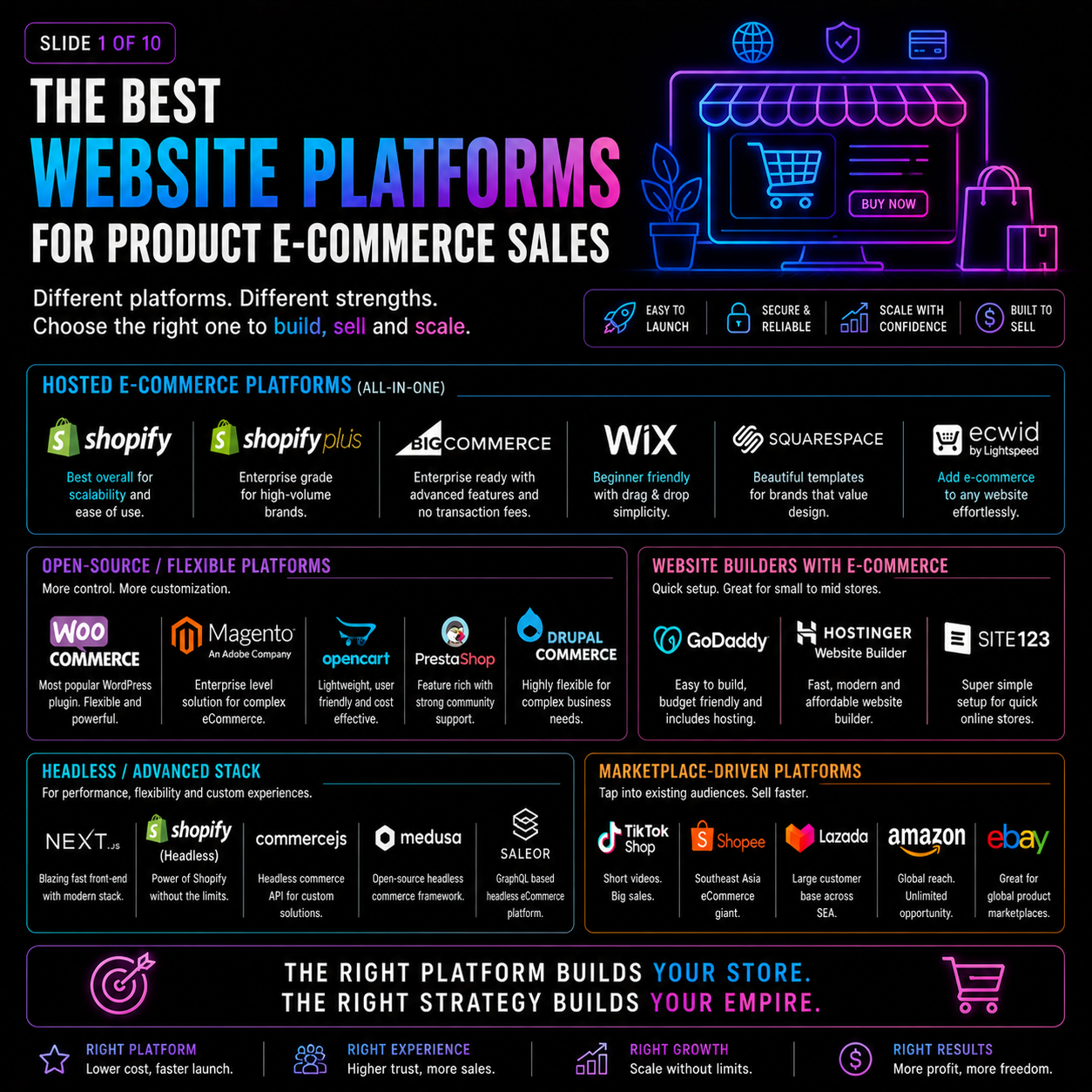
E-commerce platforms are the software systems that enable businesses to sell products and services online, handling everything from product catalogues and shopping carts to payment processing, inventory management, and order fulfillment.
In 2026, the global e-commerce market is projected to exceed $7.4 trillion in sales according to Statista, and the platform a merchant chooses on day one often determines the operational ceiling of their business for years to come.
This guide compares ten leading platforms - Shopify, WooCommerce, BigCommerce, Squarespace Commerce, Wix eCommerce, Ecwid, Magento (Adobe Commerce), PrestaShop, OpenCart, and Shift4Shop - across pricing, features, scalability, and the specific business types each serves best.
Selling online has never been technically simpler. A merchant can go from zero to a published store in an afternoon using any number of hosted platforms.
Yet the apparent ease of getting started masks a more consequential question: which platform will still serve your business well when your product catalogue has grown from 50 to 5,000 SKUs, your order volume has scaled from 10 to 1,000 per day, and your operational complexity has expanded to include wholesale accounts, international shipping, and multi-channel inventory synchronization?
The e-commerce platform market in 2026 is defined by three structural tensions. The first is between hosted convenience and self-hosted control: Shopify and BigCommerce manage your infrastructure; WooCommerce and Magento require you to manage it yourself.
The second is between simplicity and extensibility: Squarespace makes beautiful stores quickly but cannot support complex B2B workflows; Magento can support almost anything but demands significant engineering resources.
The third is between transaction fees and platform costs: some platforms charge percentages of revenue that compound painfully at scale; others charge flat fees that look expensive until you model them at volume.
"Commerce is at its finest when the transaction is invisible - when the only thing the customer remembers is the product and how it made them feel." - Tobias Lutke, co-founder of Shopify
Key Definitions
Hosted (SaaS) platform: An e-commerce solution where the vendor manages all infrastructure, security updates, and hosting. You pay a monthly subscription and focus on your store rather than your servers. Shopify, BigCommerce, and Squarespace Commerce are examples.
Self-hosted platform: Software you install and maintain on your own server or hosting account. You control all customization but are responsible for updates, security patches, and performance. WooCommerce, Magento, and PrestaShop are examples.
Transaction fee: A percentage of each sale charged by the platform in addition to payment processor fees. Shopify charges these when you use a third-party payment gateway; platforms like BigCommerce do not charge transaction fees at any tier.
This distinction becomes significant at scale - a 2% transaction fee on $500,000 in annual sales costs $10,000.
Payment gateway: The service that processes credit card and digital wallet transactions. Common gateways include Stripe, PayPal, Square, Adyen, and Shopify Payments. Gateway processing fees (typically 2.4-2.9% plus a fixed per-transaction amount) are separate from platform transaction fees.
Headless commerce: An architecture that decouples the customer-facing storefront from the backend commerce engine, allowing teams to build custom frontends using frameworks like Next.js or Remix while using a platform like Shopify or BigCommerce as the commerce API.
This approach is growing rapidly among mid-market and enterprise brands that want total control over the customer experience.
Total Cost of Ownership (TCO): The complete annual cost of running an e-commerce operation, including platform fees, hosting, themes, plugins/apps, payment processing fees, transaction fees, developer time, and maintenance. TCO is the only honest basis for platform comparison - monthly plan pricing alone is misleading.
E-Commerce Platforms at a Glance
| Platform | Type | Transaction Fee | B2B Support | App Ecosystem | Starting Price | Best For |
|---|---|---|---|---|---|---|
| Shopify | Hosted (SaaS) | 2% (non-Shopify Payments) | Via apps + Plus | 10,000+ apps | $39/mo | General retail, D2C brands |
| WooCommerce | Self-hosted (WordPress) | None | Via plugins | Extensive | Free (hosting extra) | WordPress sites, flexible builds |
| BigCommerce | Hosted (SaaS) | None | Native B2B Edition | Large | $39/mo | B2B + D2C, no transaction fees |
| Squarespace Commerce | Hosted (SaaS) | 3% (Business plan) | Limited | Limited | $28/mo | Design-first, lifestyle brands |
| Wix eCommerce | Hosted (SaaS) | None (Wix Payments) | Limited | Moderate | $36/mo | Visual design freedom |
| Ecwid by Lightspeed | Add-on (hosted) | None | Limited | Moderate | Free (1 product) | Embedding store into existing site |
| Magento/Adobe Commerce | Self-hosted or cloud | None | Advanced native | Large | Free (Open Source) | Enterprise, complex requirements |
| PrestaShop | Self-hosted | None | Via modules | Large (EU focus) | Free | European merchants |
| OpenCart | Self-hosted | None | Limited | Moderate | Free | Developer control, simple catalogues |
| Shift4Shop | Hosted (SaaS) | None (with Shift4 Payments) | Limited | Moderate | Free (US, Shift4) | US merchants, free plan |
Shopify: The Global Benchmark for Hosted Commerce
Shopify is the most widely used hosted e-commerce platform globally, powering over 4.6 million active stores as of early 2026 according to BuiltWith data. Its market position reflects a genuine balance of ease of use, feature depth, ecosystem richness, and scalability that no competitor fully matches at the entry and mid-market tiers.
Setup and Themes
Shopify's theme store offers hundreds of professionally designed themes, and its Online Store 2.0 editor supports drag-and-drop customization without sacrificing layout precision. Most merchants can configure a functional, visually appealing store without touching code.
For developers who need deeper customization, Liquid - Shopify's open-source templating language - provides full control over the storefront rendering layer.
The 2023 introduction of Shopify Magic, an AI-powered suite that generates product descriptions, suggests email subject lines, and automates image editing, added a layer of productivity tooling that has no equivalent on competing platforms.
App Store and Ecosystem
The Shopify App Store contains over 10,000 apps covering subscriptions (ReCharge, Skio), loyalty programs (Smile.io), reviews (Okendo, Judge.me), advanced inventory management, international pricing, and virtually any other feature the core platform does not include.
This ecosystem is a significant competitive advantage - a 2024 analysis by Pipe17 found that the average Shopify merchant uses 6-8 apps, and that app availability was cited as the primary reason for choosing Shopify over competitors by 34% of merchants surveyed.
However, the app dependency has costs. Multiple apps increase page load times, can create data inconsistencies, and add monthly subscription costs that are easy to underestimate. A store running eight apps at $15-$50 each adds $120-$400 per month on top of the platform fee.
Shopify Plus
For high-volume merchants, Shopify Plus starts at $2,500 per month and adds B2B features (wholesale pricing, customer-specific catalogues), checkout customization via Checkout Extensibility, dedicated merchant success support, and the Shopify Flow automation builder.
It is a compelling alternative to Magento for merchants in the $5M to $100M annual revenue range who want scale without the infrastructure complexity of a self-hosted platform.
Allbirds, Gymshark, Heinz, and Kylie Cosmetics are among the prominent brands running on Shopify Plus, demonstrating its viability for high-traffic, high-volume operations.
Limitations
Transaction fees when not using Shopify Payments (2% on Basic, 1% on Shopify, 0.5% on Advanced) remain the most commonly cited limitation. International merchants in countries where Shopify Payments is unavailable face compounding fee disadvantages.
Limited native subscription capabilities without third-party apps and constraints on checkout customization on lower tiers are also frequently noted.
Pricing
Basic: $39/month. Shopify: $105/month. Advanced: $399/month. Plus: from $2,500/month.
WooCommerce: Maximum Flexibility on WordPress
WooCommerce is the world's most installed e-commerce plugin, powering an estimated 6.5 million active stores according to BuiltWith - the largest raw count of any platform. It runs on WordPress and inherits all of WordPress's flexibility, community, and ecosystem depth, including its 60,000+ plugins and thousands of themes.
Flexibility and Ownership
WooCommerce can be shaped into almost any type of store: physical products, digital downloads, subscriptions, memberships, bookings, B2B wholesale portals, and hybrid models. There are no platform-level restrictions on payment gateways or checkout structure.
You own your data, your code, and your customer relationships without platform intermediation.
Total cost of ownership can be lower than Shopify at scale if you have technical staff who can manage the platform. There are no transaction fees at the platform level, and hosting costs scale more favorably than SaaS subscription tiers for high-volume operations.
Maintenance Overhead
WooCommerce's primary disadvantage is operational: someone must manage WordPress and WooCommerce updates, security plugins (critical - WordPress is the most targeted CMS by attackers), hosting performance, PHP version compatibility, and plugin conflicts.
A 2023 Sucuri security report found that WordPress sites accounted for 96.2% of all infected CMS sites they cleaned, largely due to outdated plugins and poor maintenance practices.
For merchants without technical staff, this overhead either creates risk (if maintenance is neglected) or additional cost (if outsourced to an agency at $100-$300/month for ongoing management).
Hosting Requirements
Managed WooCommerce hosting from providers like WP Engine, Kinsta, or SiteGround significantly reduces maintenance overhead by handling updates, backups, security scanning, and performance optimization. Budget $30-$100/month for quality managed hosting - a cost that must be factored into honest comparisons with hosted platforms.
When WooCommerce Wins
WooCommerce is the strongest choice when you already run a content-heavy WordPress site and want to add commerce without platform fragmentation, when you need customization depth that SaaS platforms cannot provide, or when you have development resources available to manage the platform.
For a detailed comparison of build-vs-buy tradeoffs, see automation vs manual processes.
BigCommerce: No Transaction Fees and Native B2B
BigCommerce is Shopify's most direct SaaS competitor and distinguishes itself on two axes: no transaction fees at any plan tier, and stronger native B2B capabilities. For merchants processing significant volume through third-party gateways, this pricing model produces meaningful savings.
No Transaction Fees
BigCommerce does not charge transaction fees regardless of which payment gateway you use. For a merchant processing $500,000 annually through Stripe, this saves $5,000-$10,000 per year compared to Shopify's non-Payments pricing.
At $2M in annual sales, the savings can exceed $20,000 - enough to cover the difference in platform costs and then some.
B2B Features
BigCommerce's B2B Edition includes customer-specific pricing, price lists, quote management, purchase order payment terms, company account hierarchies, and buyer role permissions natively, without requiring expensive third-party apps.
For manufacturers, distributors, or brands with complex wholesale relationships, this native capability is a significant advantage over Shopify's app-dependent B2B approach.
A 2024 Digital Commerce 360 report found that B2B e-commerce sales in the US exceeded $2 trillion, growing at 17% annually - far faster than B2C. Platforms with native B2B support are positioned to capture this growth without the integration complexity that app-dependent solutions require.
Headless Commerce
BigCommerce has invested heavily in headless commerce capabilities. Its GraphQL Storefront API and partnerships with frontend frameworks allow brands to build fully custom storefronts while using BigCommerce as the commerce backend.
This positions BigCommerce competitively against Shopify Hydrogen for brands that want SaaS convenience with custom frontend flexibility.
Annual Sales Limits
BigCommerce applies annual sales thresholds to each plan tier: Standard ($39/month) up to $50,000; Plus ($105/month) up to $180,000; Pro ($399/month) up to $400,000. Exceeding these thresholds triggers a mandatory upgrade - a structure that can create unexpected cost increases during rapid growth periods.
Squarespace Commerce: Design-First for Lifestyle Brands
Squarespace Commerce is the best option for merchants who prioritize visual design above all else and operate in categories where aesthetic presentation drives purchase decisions: fashion, art, photography, jewelry, and similar lifestyle products.
Design Quality
Squarespace's templates are consistently among the most attractive of any platform. The Fluid Engine block-based editor makes it possible to achieve sophisticated layouts without CSS knowledge.
For a small merchant without dedicated design resources, this matters significantly - a Baymard Institute study (2024) found that 94% of first impressions of e-commerce sites are design-related, and that visually trustworthy stores convert at 1.5-2x the rate of visually mediocre ones.
Limitations
Squarespace Commerce is not built for operational complexity. It lacks a robust app store, has limited payment gateway support (Stripe and PayPal primarily), and does not support advanced B2B, robust subscription management, or multi-currency pricing at lower tiers.
Merchants who outgrow basic direct-to-consumer operations will feel constrained quickly. The platform also offers limited API access, making it a poor choice for headless commerce or deep integrations.
Pricing
Business plan: $28/month (includes a 3% transaction fee). Commerce Basic: $37/month (no transaction fee). Commerce Advanced: $65/month (adds abandoned cart recovery and advanced shipping).
Wix eCommerce: Freeform Design for Small Merchants
Wix has evolved from a website builder into a competent e-commerce platform. Its drag-and-drop editor remains one of the most flexible in terms of visual layout freedom, and its Business and eCommerce plans add solid commerce functionality for small to mid-sized merchants.
Editor Freedom
Wix offers more positional freedom than Squarespace - elements can be placed anywhere on the canvas without snapping to a grid. This makes it easier to create truly unique layouts but also easier to create poorly structured ones without design guidance. For merchants with a clear visual vision, the freedom is valuable.
Wix Payments and App Market
Native Wix Payments eliminates transaction fees in supported countries. Wix's App Market has grown substantially and covers most standard e-commerce requirements - email marketing, shipping calculators, loyalty programs, and product reviews.
However, Wix stores are not easily migrated to other platforms due to proprietary site structure, creating vendor lock-in risk for merchants who may need to scale to a more capable system.
Pricing
Business plans start at $36/month. Business Elite (unlimited products, priority support) at $159/month.
Ecwid by Lightspeed: Add a Store to Any Existing Site
Ecwid takes a unique approach: rather than replacing your existing website, it adds a store to it. You can embed an Ecwid storefront into any existing site - WordPress, Wix, Squarespace, Joomla, or a custom HTML page - and manage products, inventory, and orders from a single Ecwid backend.
Multi-Channel Selling
Ecwid's strongest feature is its multi-channel sync: the same inventory can be sold through your website, Facebook Shop, Instagram Shopping, Amazon, and eBay simultaneously, with stock levels synchronized centrally.
For merchants already managing an audience on multiple platforms who want unified inventory management without platform migration, this is a genuinely practical solution.
A 2024 Shopify/Harris Poll survey found that 73% of consumers shop across multiple channels before purchasing. Merchants who can maintain consistent inventory and pricing across channels convert at higher rates than those with channel-specific operations.
Pricing
A free tier covers one product. Venture ($25/month) covers 100 products. Business ($45/month) is unlimited. All plans include a point-of-sale component for merchants selling in physical locations, making Ecwid unusual value for omnichannel operations.
Magento (Adobe Commerce): Enterprise Capability, Enterprise Cost
Magento, now branded Adobe Commerce in its enterprise form, is the most powerful and the most demanding platform in this comparison.
It is the platform of choice for large retailers with complex requirements: multi-site architectures, sophisticated promotions engines, custom ERP and OMS integrations, and B2B operations requiring quote management, requisition lists, and shared catalogues.
Scale and Customization
Adobe Commerce can support product catalogues of hundreds of thousands of SKUs, complex tier pricing, multi-warehouse inventory, multi-language and multi-currency storefronts, and deeply customized checkout flows that no SaaS platform can replicate without significant workarounds.
Coca-Cola, Nike, Ford, and HP have run Magento-based commerce operations, demonstrating its viability at enterprise scale.
The open-source version, Magento Open Source, remains available for free and is used by mid-market merchants who need Magento's flexibility without Adobe's enterprise licensing fees.
Total Cost of Ownership
The honest version of Magento pricing is not the license fee - it is the total cost including developer salaries or agency fees, hosting infrastructure (typically $500-$2,000/month for production-grade hosting), security maintenance, and upgrade cycles.
A 2023 analysis by Corra estimated that the average mid-market Magento deployment costs $50,000-$250,000 in the first year and $30,000-$100,000 annually thereafter for maintenance and development.
This investment is justified when the business requires capabilities no SaaS platform provides. For merchants in the $1M-$10M revenue range without highly specific operational requirements, Shopify Plus or BigCommerce will deliver comparable results at a fraction of the cost.
PrestaShop: Open-Source for European Merchants
PrestaShop is an open-source e-commerce platform with a large European user base - over 300,000 active stores according to PrestaShop's own data, concentrated in France, Spain, Italy, and Latin America. It is a viable self-hosted alternative to WooCommerce for merchants who do not want a WordPress dependency.
Module Ecosystem
PrestaShop's module marketplace contains thousands of extensions for payment, shipping, marketing, and analytics. European payment methods - Mollie, Klarna, iDEAL, local bank transfers - have particularly strong module coverage, reflecting the platform's European orientation.
The quality of modules is variable, and integration compatibility requires careful vetting, but the breadth is comparable to WooCommerce.
PrestaShop Hosted
In 2024, PrestaShop launched a hosted version in partnership with PrestaShop Platform, offering a SaaS-like experience for merchants who want PrestaShop's feature set without self-hosting. This moves PrestaShop closer to competing with Shopify in convenience, though the hosted offering is still maturing.
Pricing
The PrestaShop software is free. Hosting, themes, and modules represent the actual costs, typically $50-$200/month for a well-configured mid-tier store.
OpenCart: Lightweight PHP for Developer Control
OpenCart is a lightweight, open-source PHP platform that appeals to developers who want full code control without the complexity of Magento or the WordPress dependency of WooCommerce. Its codebase is straightforward, its admin interface is clean, and its extension marketplace covers most standard e-commerce features.
For technically capable merchants with modest catalogues (under 5,000 SKUs) who want a simple, customizable codebase and minimal platform overhead, OpenCart is a practical starting point. Its community is smaller than WooCommerce's or Magento's, which means fewer resources for troubleshooting and fewer available extensions.
Shift4Shop: Free for US Merchants Using Shift4 Payments
Shift4Shop (formerly 3dcart) offers a genuinely free plan for US merchants who use Shift4 Payments as their processor. The feature set is competitive with Shopify's mid-tier plans: unlimited products, no transaction fees, built-in blog, and over 100 free themes.
This makes it unusual value for US-based merchants willing to use the bundled payment processor.
For merchants comfortable with Shift4 Payments' rates and coverage, this is a legitimate free alternative to Shopify Basic. For merchants who need specific payment gateways or are based outside the US, the value proposition disappears quickly.
How to Choose: A Decision Framework
Choosing an e-commerce platform is a decision-making challenge that benefits from structured analysis rather than feature comparison alone. The right platform depends on your business type, technical resources, growth trajectory, and operational complexity.
Starting a new store with no technical background: Shopify for the broadest ecosystem and best support, or Squarespace and Wix for design-first merchants in lifestyle categories.
Existing WordPress site adding commerce: WooCommerce is the natural choice and avoids platform fragmentation.
High-volume D2C brand ($1M+ annual revenue): Shopify Plus or BigCommerce Pro, depending on payment gateway preferences and B2B requirements. Model the TCO of each, including transaction fees, before deciding.
B2B or wholesale operation: BigCommerce B2B Edition for native wholesale features, or Magento for highly complex pricing structures, ERP integration requirements, and multi-site operations.
Developer-built custom storefront (headless): Shopify Hydrogen or BigCommerce headless via their respective commerce APIs. Both offer robust GraphQL APIs; Shopify's ecosystem is larger, BigCommerce's pricing is more favorable for high-volume operations.
Budget-constrained merchant using an existing site: Ecwid for its embeddable approach and multi-channel sync.
Enterprise with complex ERP and multi-site requirements: Adobe Commerce (Magento) with dedicated development resources - but only with a clear-eyed budget for ongoing engineering investment.
European merchant seeking open-source: PrestaShop for its European payment and shipping integrations, or WooCommerce if you are already on WordPress.
Platform Migration: What to Know Before Switching
Platform migration is a significant undertaking that deserves realistic planning. Product data, customers, and order history can typically be migrated via CSV exports or services like Cart2Cart and LitExtension. However, several elements require careful handling:
- SEO equity: URL structures differ between platforms. Comprehensive 301 redirect mapping is essential to preserve search rankings. A poorly executed migration can lose 30-50% of organic traffic, according to Moz research.
- Custom functionality: Plugins, apps, and custom code do not transfer. Budget for rebuilding integrations on the new platform.
- Design: Templates and themes are platform-specific. Plan for design work on the new platform.
- Testing: Run the new store in parallel with the old one before cutting over. Allow 2-4 weeks for testing.
For guidance on evaluating whether to migrate or stay, strategic frameworks can help structure the decision.
Practical Takeaways
Shopify is the default correct choice for most new merchants without a specific reason to go elsewhere - its ecosystem depth, support quality, and reliability are genuinely better than alternatives at the entry tier.
BigCommerce's no-transaction-fee model produces meaningful savings at mid-to-high volume, particularly for merchants using Stripe or other non-platform gateways.
WooCommerce's cost advantage over Shopify is real but conditional - without technical staff, the maintenance overhead erases the savings and introduces security risk.
Magento rewards engineering investment and punishes under-resourcing; do not choose it without a realistic budget for ongoing development. Squarespace and Wix are correct for design-first merchants with simple catalogues; both create friction at operational scale.
Ecwid's multi-channel sync is a genuine capability differentiator for merchants managing inventory across web, social, and marketplace channels simultaneously.
The platform you choose matters less than understanding why you chose it and what you will do when you outgrow it. Every platform has a ceiling.
The best e-commerce operators know where their platform's ceiling is and plan accordingly - either by investing in their current platform's extensibility or by budgeting for migration when the time comes.
Sources & Further Reading
- Statista. (2025). Global e-commerce market size forecast 2024-2029. View source
- BuiltWith Technology Lookup. (2026). E-commerce technology usage statistics. View source
- Shopify Inc. (2026). Shopify pricing and plan comparison. View source
- WooCommerce. (2026). WooCommerce documentation and plugin ecosystem. View source
- BigCommerce Inc. (2026). BigCommerce B2B Edition.
- Digital Commerce 360. (2024). US B2B e-commerce market report. View source
- Baymard Institute. (2024). E-commerce UX research and benchmark studies. View source
- Sucuri. (2023). Hacked Website Trend Report. View source
- Adobe Inc. (2026). Adobe Commerce (Magento) documentation.
- PrestaShop SA. (2026). PrestaShop open-source e-commerce. View source
- Moz. (2023). The Beginner's Guide to SEO: Site Migrations. View source
- Pipe17. (2024). State of E-Commerce Operations Report. View source