
The cloud computing market has consolidated around three platforms that collectively handle the vast majority of the world's cloud workloads. AWS, Google Cloud, and Azure are not interchangeable commodities.
They have different pricing models, different organizational strengths, and genuinely different capabilities in specific domains. Choosing the wrong one for your context does not doom a project, but it creates friction that compounds over years.
The conversation about cloud platforms is distorted by two forces. First, vendor marketing promotes abstract feature parity that obscures real-world differences. Second, community discourse is tribal: AWS practitioners defend AWS, Google engineers talk up GCP, and Microsoft partners push Azure.
Cutting through both requires looking at market share data, actual pricing structures, and the kinds of workloads where each platform has a demonstrated edge.
In 2026, three developments define the landscape. AWS has doubled down on cost reduction via Graviton ARM processors and streamlined savings plan pricing.[5] Google has expanded Vertex AI and its TPU infrastructure in ways that create a genuine differentiation for ML workloads.[10]
Azure has deepened its OpenAI partnership, making it the default enterprise choice for organizations building on GPT-4 and successor models.[7] Understanding where each platform genuinely wins - not where its marketing claims to win - is the only way to make a rational decision.
"The best cloud is the one your engineers already know - with the second best being AWS."
Key Definitions
Cloud Infrastructure as a Service (IaaS): Rented compute, storage, and networking resources where you manage the operating system and above. EC2, Compute Engine, and Azure VMs are IaaS examples.
Platform as a Service (PaaS): Managed runtimes where the provider manages the infrastructure and you deploy application code. Elastic Beanstalk, App Engine, and Azure App Service are examples.
Serverless / FaaS: Functions that execute on demand with no server to manage. AWS Lambda, Google Cloud Functions, and Azure Functions. You pay per invocation rather than per running instance.
Managed Kubernetes: Kubernetes clusters where the control plane is operated by the cloud provider. EKS (AWS), GKE (Google), AKS (Azure).
Sustained Use Discount: Google Cloud's automatic pricing reduction applied when a VM runs for a significant portion of a billing month, with no reservation required.[3]
Savings Plans / Reserved Instances: AWS and Azure commitment-based discounts.[2] You commit to a specific compute spend or instance type for 1 or 3 years in exchange for 40-70% off on-demand rates.
Market Share and Competitive Positioning
Per Synergy Research Group's Q4 2024 data, the three hyperscalers together hold approximately 66% of worldwide cloud infrastructure revenue, with the gap between AWS and its competitors narrowing slowly but not dramatically.[1]
| Provider | Q4 2024 Market Share | Founded | HQ |
|---|---|---|---|
| Amazon Web Services (AWS) | ~33% | 2006 | Seattle, WA |
| Microsoft Azure | ~22% | 2010 | Redmond, WA |
| Google Cloud Platform (GCP) | ~11% | 2008 | Sunnyvale, CA |
| Alibaba Cloud | ~4% | 2009 | Hangzhou, China |
| Oracle Cloud | ~2% | 2016 | Austin, TX |
| IBM Cloud | ~2% | 2013 | Armonk, NY |
| Others | ~26% | - | - |
Source: Synergy Research Group, Cloud Infrastructure Market Share Q4 2024.
AWS's market share has declined slowly from its peak above 40% as Azure and GCP have grown. But "declining slowly" does not mean "losing." AWS still processes more cloud workloads than Azure and GCP combined on most metrics.
Its lead in available regions (32 geographic regions, 102 availability zones as of 2025) and its service catalog breadth (200+ services) remain unmatched.
Azure's growth story is an enterprise sales story. Microsoft had existing relationships with virtually every large organization through Windows Server, Active Directory, Office 365, and SQL Server. Converting those relationships into cloud contracts required less convincing than starting cold.
Azure grew from roughly 8% market share in 2016 to 22% in 2024 largely through this enterprise motion.
GCP's 11% share understates its technical standing. Google runs some of the world's largest distributed systems. The infrastructure underpinning Search, YouTube, and Gmail is the same infrastructure GCP customers access.
GCP's weakness is not capability but go-to-market and the lingering enterprise trust problem created by Google's history of discontinuing products.
Service Catalog Comparison
| Service Category | AWS | Google Cloud | Azure |
|---|---|---|---|
| Virtual Machines | EC2 (many instance families) | Compute Engine | Azure Virtual Machines |
| Serverless Functions | Lambda | Cloud Functions / Cloud Run | Azure Functions |
| Managed Kubernetes | EKS | GKE | AKS |
| Object Storage | S3 | Cloud Storage | Blob Storage |
| Managed Relational DB | RDS, Aurora | Cloud SQL | Azure SQL Database |
| NoSQL / Document DB | DynamoDB | Firestore, Bigtable | Cosmos DB |
| Data Warehouse | Redshift | BigQuery | Synapse Analytics |
| ML / AI Platform | SageMaker | Vertex AI | Azure ML + OpenAI Service |
| CDN | CloudFront | Cloud CDN | Azure CDN / Front Door |
| DNS | Route 53 | Cloud DNS | Azure DNS |
| API Gateway | API Gateway | Cloud Endpoints / Apigee | API Management |
| Container Registry | ECR | Artifact Registry | Azure Container Registry |
| Message Queue | SQS, SNS | Pub/Sub | Service Bus, Event Grid |
| CI/CD | CodePipeline, CodeBuild | Cloud Build | Azure DevOps, GitHub Actions |
| Secrets Management | Secrets Manager, Parameter Store | Secret Manager | Key Vault |
AWS's catalog is the broadest. For any given task, there is almost certainly an AWS-native service that handles it. The tradeoff is that with 200+ services, many with overlapping purposes, the decision of which service to use for a given problem is itself a research task.
GCP has a tighter, more curated catalog. Some categories that AWS handles with multiple specialized services, GCP handles with one well-designed service. This makes GCP's catalog more approachable for new users.
Azure's catalog mirrors AWS's breadth, and for organizations with existing Microsoft infrastructure, the equivalents are usually obvious. Azure SQL is recognizably SQL Server. Azure AD (now Entra ID) is recognizably Active Directory.
Pricing Comparison for Common Workloads
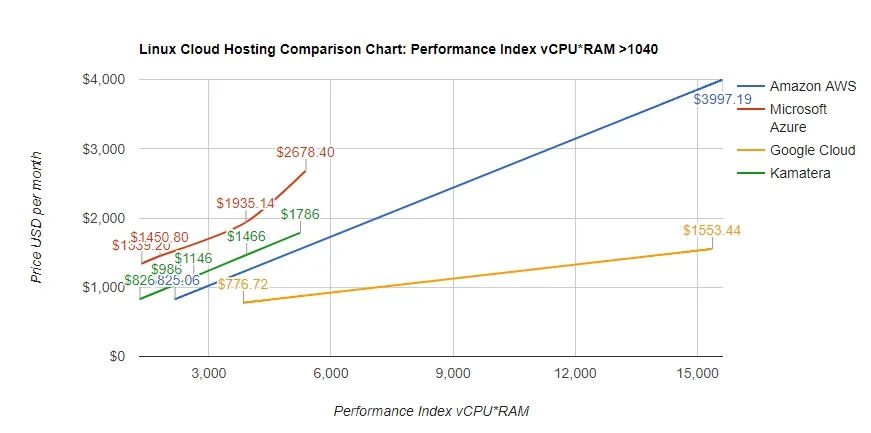
Published pricing is a starting point. Large customers negotiate significant discounts off published rates. The comparisons below use public list prices as of early 2026.
Compute: 4 vCPU / 16 GB RAM General Purpose Instance, On-Demand, us-east Region
| Provider | Instance Type | On-Demand Price/hour | With 1-Year Commitment |
|---|---|---|---|
| AWS | m7g.xlarge (Graviton ARM) | $0.1632 | ~$0.10 (Savings Plan) |
| AWS | m7i.xlarge (Intel x86) | $0.2016 | ~$0.12 (Savings Plan) |
| Google Cloud | n2-standard-4 | $0.1901 | ~$0.13 (1-yr committed) |
| Google Cloud | n2-standard-4 (sustained use) | ~$0.143 | automatic, no commitment |
| Azure | D4s v5 | $0.192 | ~$0.12 (1-yr reserved) |
Source: AWS, Google Cloud, Azure pricing pages, February 2026. Prices vary by region.
Key observations from this comparison:
AWS Graviton (ARM) instances are 15-20% cheaper than x86 equivalents for the same vCPU/RAM configuration. Teams that have not migrated compatible workloads are effectively overpaying. Most applications built with modern Linux runtimes (Python, Node.js, Java, Go) run on Graviton without modification.
Google Cloud's sustained use discount is the most friendly to unpredictable workloads. If you run an instance for 50% or more of a month, you automatically receive a progressively deeper discount. At 100% monthly runtime, the automatic discount is approximately 30%.
No reservation commitment, no advance planning. AWS and Azure require explicit commitment contracts to achieve similar discounts.
Azure and AWS list prices are broadly comparable for general-purpose compute before discounts.[4] The differences become meaningful at scale when either sustained use patterns or committed use contracts are applied.
Storage: 1 TB Object Storage, Standard Tier, us-east
| Provider | Storage Cost/TB/month | GET Requests (per 10,000) | Egress to internet (per GB) |
|---|---|---|---|
| AWS S3 | $23.00 | $0.04 | $0.09 |
| Google Cloud Storage | $20.00 | $0.04 | $0.08 |
| Azure Blob Storage | $21.52 | $0.004 | $0.087 |
Source: AWS, Google Cloud, Azure pricing pages, February 2026.
Storage pricing is competitive across all three. Egress is where real costs accumulate in multi-cloud or hybrid architectures. All three charge $0.08-0.09/GB for data leaving the cloud.
For applications moving significant data out of the cloud - to end users, to on-premises systems, or to other cloud providers - these egress charges are material.
Free Tier Comparison
| Feature | AWS Free Tier | Google Cloud Free Tier | Azure Free Tier |
|---|---|---|---|
| New account credit | None | $300 for 90 days | $200 for 30 days |
| Compute (always free) | 750 hrs t3.micro (12 months) | 1 e2-micro/month (eligible regions) | None after 12 months |
| Functions (always free) | 1M Lambda invocations/month | 2M Cloud Functions invocations/month | 1M Azure Functions executions/month |
| Object Storage (always free) | 5 GB S3 (12 months) | 5 GB Cloud Storage | 5 GB Blob Storage (12 months) |
| NoSQL DB (always free) | 25 GB DynamoDB | 1 GB Firestore | 25 GB Cosmos DB (400 RU/s) |
| Data warehouse (always free) | None | 1 TB BigQuery queries/month | None |
| Duration of trial compute | 12 months only | Permanent (small instance) | 12 months only |
The most meaningful always-free tiers for running small production workloads:
AWS Lambda plus DynamoDB plus API Gateway can host a small serverless API indefinitely at zero cost. The 1 million Lambda invocations and 25 GB DynamoDB remain free after the 12-month trial period expires. This combination supports modest production traffic without payment.
Google Cloud's permanent f1-micro Compute Engine instance is useful for running a small server, a personal VPN, or a lightweight background worker permanently at no cost. BigQuery's 1 TB monthly query allowance is valuable for data work.[6]
Azure's Cosmos DB always-free tier (1,000 RU/s, 25 GB) is generous for document database use cases and more capable than AWS DynamoDB's free tier at typical throughput levels.
AWS: The Default Choice and Why That Matters
AWS launched in 2006 and spent years operating without serious competition. That head start produced a service catalog that now exceeds 200 services - more than either competitor - and a global infrastructure spanning 32 geographic regions and 102 availability zones.
These numbers represent real deployment options for latency-sensitive applications and data residency requirements.
The Ecosystem Advantage
AWS's ecosystem advantage compounds over time. More third-party tools integrate with AWS first. Terraform has more AWS resources with more complete implementations than GCP or Azure equivalents. More Stack Overflow questions have AWS answers.[11]
More companies have AWS-certified engineers. When something breaks at 2am, the probability of finding a documented solution is highest with AWS.
The certification path is the most recognized in the industry. The AWS Solutions Architect Associate is a standard hiring credential at companies ranging from startups to Fortune 500 enterprises. The certification structure - foundational, associate, professional, and specialty tracks - provides a clear development roadmap.[8]
AWS certifications appear in more job listings than Azure and GCP certifications combined, based on LinkedIn job posting analyses.
AWS Spot and Graviton: The Underused Cost Advantages
AWS Spot Instances - unused EC2 capacity sold at 60-90% discounts off on-demand pricing - are one of the best cost optimization tools in cloud computing.
The constraint is that Spot Instances can be reclaimed with a two-minute warning, making them appropriate for fault-tolerant workloads, batch processing, machine learning training, and stateless services but not for workloads requiring guaranteed availability.
Graviton ARM processors, now in their fourth generation (Graviton4), offer 20-40% better price-performance than equivalent x86 instances. AWS's internal teams migrated substantial workloads to Graviton, and the Amazon.com retail site itself runs largely on Graviton.
Teams that have not migrated compatible workloads are leaving meaningful cost savings on the table.
AWS's Weaknesses
The console is genuinely harder to navigate than Google Cloud's. With 200+ services, finding what you need requires knowing its name. The UI is inconsistent across services because different teams built them independently over years. This is a real productivity friction for teams new to the platform.
AWS EKS is more complex to set up than GKE, which is expected given that Kubernetes was created at Google. Teams new to Kubernetes often find the EKS experience more opaque. Node management, add-on versioning, and networking configuration require more explicit configuration on EKS than on GKE.
Google Cloud: Technical Excellence With an Enterprise Sales Gap
Google Cloud Platform performs above its market share on technical benchmarks. Google runs some of the world's largest distributed systems, and GCP customers benefit from that infrastructure. The gap between GCP's technical capabilities and its market share reflects a go-to-market weakness and a historical trust problem.
Where Google Cloud Genuinely Leads
BigQuery is one of the most capable managed data warehousing products available. It separates storage from compute, scales to petabytes without capacity planning, and runs complex analytical queries across billions of rows in seconds.
The serverless pricing - you pay per TB of queries processed, not for running compute - makes it accessible to teams that cannot justify a dedicated Redshift cluster.
GKE is the best managed Kubernetes service. Kubernetes was built at Google, and the operational maturity of GKE reflects that origin. Auto-upgrade, node auto-provisioning, binary authorization, and Workload Identity are more mature than equivalent AWS and Azure implementations.
Vertex AI gives access to Google's foundation models, TPU hardware for training, and managed services for the full ML lifecycle. For organizations building AI applications, access to the infrastructure that powers Google's own AI research is substantively valuable.
Google's network is one of the three or four best global private networks. Traffic between GCP regions travels on Google's own fiber where possible, not the public internet. For latency-sensitive global applications, this produces measurable performance advantages.
The Trust and Continuity Problem
Google has a well-documented history of discontinuing products that did not achieve sufficient scale. This history creates legitimate hesitation among enterprises making long-term infrastructure commitments.
Google has been explicit since 2021 about treating GCP as a core strategic business, and it signed 10-year contracts with large enterprises to signal commitment. But rebuilding trust after a pattern of product abandonments is slow.
The sales organization has improved substantially since 2021 but still does not match AWS or Azure's enterprise relationship depth. For large contracts involving multi-year commitments and complex support terms, GCP's sales process is less refined.
Azure: Enterprise Relationships and Microsoft Integration
Azure's competitive position is anchored in Microsoft's existing enterprise relationships. Microsoft had relationships with virtually every large organization through Windows Server, Active Directory, Office 365, and SQL Server. The path from those products to Azure cloud services is short and well-marked.
The Microsoft Stack Integration Advantage
For organizations running Microsoft-centric infrastructure, Azure's integration is substantively valuable, not just marketed as such. Azure Entra ID (formerly Active Directory) is the default identity provider for Office 365, meaning SSO for Azure workloads requires almost no additional configuration.
Azure SQL is managed SQL Server that preserves compatibility with on-premises SQL Server code. Azure DevOps integrates natively with both Azure infrastructure and GitHub (which Microsoft owns).
The OpenAI partnership is Azure's most strategically significant recent development. Azure OpenAI Service gives enterprises access to GPT-4, DALL-E, and Whisper models with data privacy protections that the consumer OpenAI API does not provide.
For regulated industries sending data to AI models - healthcare, finance, legal - Azure OpenAI offers the AI capabilities with contractual data handling guarantees that compliance teams require.
Azure's Developer Experience Gap
Azure's console and developer tooling are generally rated lower than AWS or GCP by developers who use all three. The Azure Portal is functional but navigating between services requires more clicks. Documentation quality is inconsistent across services. Azure CLI is capable but less elegant than the AWS CLI or gcloud CLI.
These are not disqualifying problems, but they represent real productivity overhead for developer teams that are new to Azure and do not have institutional knowledge of where things live.
Certification Paths Compared
Certifications signal competency to employers and represent a structured learning path for practitioners. The demand for each certification type reflects the job market.
| Certification Track | AWS | Google Cloud | Azure |
|---|---|---|---|
| Entry level | Cloud Practitioner | Cloud Digital Leader | AZ-900 Fundamentals |
| Associate architect | Solutions Architect Associate | Associate Cloud Engineer | AZ-104 Administrator |
| Professional architect | Solutions Architect Professional | Professional Cloud Architect | AZ-305 Solutions Expert |
| DevOps / SRE | DevOps Engineer Professional | Professional DevOps Engineer | AZ-400 DevOps Engineer |
| Data / ML | Machine Learning Specialty | Professional ML Engineer | DP-100 Data Scientist |
| Security | Security Specialty | Professional Cloud Security | AZ-500 Security Engineer |
| Job market value | Highest | High (data/ML focus) | High (enterprise/Microsoft) |
Source: LinkedIn job listings analysis, Indeed.com, and cloud provider certification pages, 2024-2025.
AWS certifications appear in the largest number of job listings across industries. Google Cloud certifications carry strong weight for data engineering and ML roles specifically. Azure certifications are most valued in enterprise environments and Microsoft partner organizations.
Strengths Summary and When to Choose Each
AWS is the right choice when: your team has no existing cloud expertise and needs to hire certified practitioners from a large talent pool; your workload is general-purpose web applications, microservices, or data pipelines; you need the broadest service catalog and want to stay on a single provider; or your organization has no existing commitment to Google or Microsoft ecosystems.
Google Cloud is the right choice when: your primary workload involves data analytics, machine learning, or AI; you need the best managed Kubernetes experience (GKE); you are building on BigQuery and find its pricing model and capabilities a better fit than Redshift; or you are a GCP-credentialed team that will not need to hire new practitioners.
Azure is the right choice when: your organization runs Windows Server, Active Directory, or SQL Server on-premises and is migrating to cloud; you use Office 365 and want seamless identity integration; you need Azure OpenAI Service for compliant AI workloads in regulated industries; or your target employer base is enterprise Microsoft shops.
Multi-Cloud Reality
The Flexera 2024 State of the Cloud Report found that 87% of enterprises use multiple cloud providers.[9] But this statistic is often misread.
Most of that multi-cloud usage is not "we chose to split workloads across providers for resiliency." Most of it is "we acquired a company that uses GCP and we use AWS, and we have not finished consolidation." True strategic multi-cloud - running the same application across providers for failover - is rare and expensive.
The practical implication: for most organizations, pick one primary cloud and use it well. The cost and complexity of genuine multi-cloud architecture is significant.
Use a secondary cloud for specific workloads where it has a decisive capability advantage (BigQuery for analytics while running primary workloads on AWS, for example), not as a default architecture pattern.
Practical Takeaways
For career-oriented developers starting from scratch: learn AWS first. The job market demand, certification recognition, and community resources are unmatched. Spend six months genuinely understanding IAM, VPC, EC2, RDS, Lambda, S3, and CloudFront before looking at other platforms.
For data engineers and ML practitioners: Google Cloud is worth serious consideration. BigQuery's capabilities and pricing model are best-in-class for analytics workloads. Vertex AI is the most accessible ML platform for teams working with Google's models.
For developers in Microsoft-centric enterprises: Azure is the practical choice. The integration with existing Microsoft infrastructure reduces migration friction and the OpenAI partnership provides AI capabilities with enterprise compliance coverage.
For minimizing cost on small projects and personal work: AWS Lambda plus DynamoDB for the always-free serverless tier, or Google Cloud's permanent f1-micro instance for a persistent server. Both run indefinitely at zero cost for modest workloads.
Sources & Further Reading
- Synergy Research Group, 'Cloud Infrastructure Market Share Q4 2024,' synergyr esearchgroup.com
- AWS Pricing Documentation - aws.amazon.com/pricing
- Google Cloud Pricing - cloud.google.com/pricing
- Azure Pricing Calculator - azure.microsoft.com/pricing
- AWS Graviton Processor - aws.amazon.com/ec2/graviton
- BigQuery Documentation and Pricing - cloud.google.com/bigquery/docs
- Azure OpenAI Service - azure.microsoft.com/products/ai-services/openai-service
- AWS Certification Overview - aws.amazon.com/certification
- Flexera State of the Cloud Report 2024 - flexera.com/learn/cloud/state-of-the-cloud
- Google Cloud Vertex AI - cloud.google.com/vertex-ai
- Stack Overflow Developer Survey 2024 - survey.stackoverflow.co
Further Reading
- Gartner Magic Quadrant for Cloud Infrastructure and Platform Services, 2024