
Streaming subscriptions have gone from a bargain to a real budget consideration. The promise of cord-cutting (pay less than cable, watch what you want when you want) is still partially true, but accumulating four streaming services at full price now costs more than a basic cable package did a decade ago.
According to Deloitte's 2025 Digital Media Trends survey, the average American household subscribes to four streaming services and spends approximately $61/month on streaming before adding live TV options.[11] That is a meaningful household expense that deserves deliberate decision-making.
The honest question is no longer "which service has more content?" Each of the three has. Much content that no one could watch it all in a lifetime.[10] Netflix by itself added over 800 original titles in 2024.
What actually matters is which app carries the shows you will sit down and watch, at a monthly price that fits how often you turn it on and who else lives in your house.
Three structural changes that have recast the market through 2026 are these. All three services have greatly widened what they offer for their ad-supported tiers and password sharing crackdowns have pushed many homes either to pay more or to consolidate subscriptions. Bundle pricing has also brought genuinely good value across multiple services via Disney's bundle as well as through carrier partnerships.
These factors make the analysis more nuanced than a simple per-service comparison.
Nobody subscribes to all three services forever. The smart play is knowing which one to keep when you have to cut.
Key Differences at a Glance
| Feature | Netflix | Hulu | Disney Plus |
|---|---|---|---|
| Monthly price (standard) | $15.49 | $17.99 | $13.99 |
| Ad-supported tier | $7.99/mo | $7.99/mo | $7.99/mo |
| 4K content | Yes (Premium) | Yes (Premium) | Yes (standard) |
| Downloads/offline | Yes | Yes (limited) | Yes |
| Simultaneous streams | 2 (standard) | 2 | 4 |
| Live TV option | No | Yes (+$65/mo) | No (ESPN Bundle) |
| International originals | Extensive | Limited | Limited |
| Next-day TV episodes | No | Yes (major networks) | No |
| Sports content | Limited | ESPN (bundle) | ESPN (bundle) |
| Family/kids content | Good | Good | Excellent |
| FX content | No | Yes | Yes (international) |
| National Geographic | No | No | Yes |
| Marvel/Star Wars | No | No | Yes |
| Password sharing policy | Restricted | Restricted | Restricted |
| Profiles | 5 | Unlimited | 7 |
The Streaming Market in 2026: Where Things Stand
A meaningful inflection point arrived for the streaming industry in 2023-2024. Growth-at-any-cost, which had been subsidized by cheap capital, came to an end.[4] Profitability became what the industry was mandated to deliver.
Price rises, ad tier expansions, rules against password sharing and content library rationalization have been direct results for subscribers. Shows were cancelled mid-run to cut licensing costs as part of that.[13]
Nielsen's monthly Gauge report puts streaming at roughly 40% of all US television viewing time, up from 26% back in 2020.[5] Viewers moving away from traditional cable and broadcast TV is a permanent shift.[12]
Yet the competitive dynamics have changed. Instead of all streaming services growing together, growth is now mostly zero-sum as the total addressable market matures.
Netflix remains the dominant service with 301 million paid subscribers globally as of early 2026.[1]Disney Plus has approximately 153 million subscribers after its growth plateau and some subscriber loss following price increases.[2]
Hulu counts about 53 million subscribers. That represents slower growth but it also means a stable base of viewers who particularly value its live TV and next-day network content.[3]
Because they influence content investment, these numbers count. With its scale allowing it to distribute a $17 billion content budget across a global audience and produce economics that smaller services cannot equal, Netflix's numbers matter.
Netflix: The Content Volume Champion
Around the globe, Netflix is still the most watched streaming service. The company has 301 million paid subscribers. It spends about $17 billion a year on content and has created the most recognized brand in streaming.
Because these facts produce a real advantage by which the scale of investment means more content gets made and Netflix collects subscriber data that other services cannot match at that scale, they are relevant.
Why Netflix's Content Strategy Works
Netflix's global originals strategy has been its most important differentiator. While competitors were focused primarily on American English-language content, Netflix invested in Spanish, Korean, Brazilian, German, French, and Japanese originals.[15]
The Korean drama Squid Game turned into the most-watched show in Netflix history and opened the door for Korean series across Western markets. Money Heist drew a massive worldwide following ahead of its finale and Lupin brought French thrillers to viewers who rarely watched foreign-language TV.
Dark, the German sci-fi series, has achieved cult status internationally.
Pulling series from around the world does two things at once: it gives viewers shows with a noticeably different rhythm, plotting style and cultural backdrop than standard Hollywood TV.
It also lets Netflix hand subscribers outside the English-speaking world big-budget shows made in their own language and culture, which keeps cancellation rates down in its fastest-growing regions.
It helps to know how Netflix's recommendation engine works because it directly steers what you see on the home screen. Netflix constantly A/B tests thumbnail images, showing different cover art for the exact same title depending on what kind of actors or genres you clicked before.
The recommendation system prioritizes completing series over introducing new shows. This is effective at reducing churn but can create a feeling of being trapped in a narrow content loop.
When Netflix seems to show you the same type of content over and over again, deliberately add a new genre to your watch history and that resets the recommendations.
The Netflix Film Resurgence
The old knock that Netflix originals felt like straight-to-DVD movies no longer holds up in 2026. All Quiet on the Western Front took home the Oscar for Best International Film and The Power of the Dog was a major awards contender.
Genuine credibility as a destination for prestige film has built up through the service, in part by acquiring international films that have trouble finding theatrical distribution. In part by bringing in directors who are acclaimed.
Evolution has also come to Netflix's approach of going from theatre to stream. Some films are now released by the company with short theatrical windows before becoming exclusive to streaming. This addresses the criticism of directors and studios who thought Netflix's initial model skipped the theatrical experience altogether.
Content Categories Where Netflix Leads
- True crime documentaries. The genre was set up by Making a Murderer and Netflix has kept putting in large investments.
- Nature documentaries. The David Attenborough series are exclusives and count as a compelling recurring reason to subscribe.
- Stand-up comedy. With new material coming in regularly from major acts, this is the most complete library of comedy specials available.
- International drama: Unmatched depth in Korean, Spanish, French, and Scandinavian content
- Prestige drama series. Flagship dramas like Ozark, The Crown, Stranger Things and their newer replacements have kept both critical quality and viewer numbers high.
Netflix's Weaknesses
There is no live content on Netflix. There is no sports, no news and no event television. This is a hard constraint for the growing group of viewers who want one streaming service to replace all of their entertainment.
Netflix has experimented with live event programming (live sports in specific international markets, live comedy specials), but it is not a comprehensive live TV solution.
Recent TV episodes are absent. If you want to watch last night's episode of a broadcast network show, Netflix does not have it and will not have it unless that show has an existing deal.
The limitation mattered less when broadcast television was going down fast but live sports and events that people make an appointment to watch stay culturally relevant.
Pass on to the password sharing crackdown. That was put in place fully in 2023 and added friction.[9] Extra users can be added through the 'add a member' feature for $7.99/month. Yet the restriction pushed
Sign-ups bounced back after the initial wave of complaints and Netflix counts the move as a big revenue win, even if traveling and logging in across devices is more annoying now.
Hulu: The Current TV and Bundle Advantage
Of all major streaming services, Hulu holds a unique place in the market. It is the only one that reliably gives next-day episodes from broadcast network television. Shows from NBC, ABC, Fox and CBS appear on Hulu the day following their broadcast.
For viewers who follow network TV, a declining but still substantial audience, Hulu is the most practical streaming replacement for linear television.
The Next-Day TV Advantage in Practice
Next-day network TV availability is what makes Hulu stand out and keeps a subscriber base that otherwise appears redundant alongside Netflix. Think about how subscribers put it to use.
- Sports fans. Those who watch Monday Night Football on ABC can see it on Hulu the following day.
- News-adjacent programming viewers can see late night shows, awards ceremonies and broadcast news specials within hours of their airtime.
- Procedural drama followers. Those who stay on top of network dramas (Grey's Anatomy, Law and Order franchises, NCIS) get their whole viewing covered without needing a DVR or cable subscription.
Cord-cutters who feel attached to network television culture yet do not want cable are the ones that gain most from this advantage. In a way that Netflix does not attempt at all, Hulu closes the gap for them.
Hulu Originals: Small Slate, High Impact
Hulu has a smaller original content budget than Netflix yet its collection of flagship originals gets disproportionately good reviews. The Handmaid's Tale was the first streaming series to win the Emmy for Outstanding Drama Series.[6]
Only Murders in the Building is a comedy-mystery that has won critical praise and commercial success. The Bear, which is technically an FX production but available via the Hulu-FX deal, has been called one of the best shows of the decade and has won many awards.
The FX relationship is particularly valuable and represents programming quality that exceeds what Hulu's own production budget would produce. FX's critically regarded slate (What We Do in the Shadows, Abbott Elementary, Fleishman Is in Trouble, Reservation Dogs, The Americans (library)) streams on Hulu in the US.[16]
Hulu gains access to a content pipeline that has a strong critical standing. It consistently wins awards and prompts cultural discussion.
"Hulu is what happens when you program for people who actually watch television carefully, rather than people who want something on in the background."
Television critic, The Atlantic 2025
Hulu Live TV: The Cord-Cutter's Cable
Hulu with Live TV, at about $83 per month, is costly for a streaming service but the package is positioned as a cable replacement. It comes with these features.
- 90+ live channels including major broadcast networks and cable news
- Unlimited DVR storage (no cap on recordings)
- Full Hulu on-demand library
- Disney Plus and ESPN Plus included in the base price
Sports fans should note that the ESPN Plus inclusion matters a lot to them. A large live sports portfolio (NHL, UFC, some MLB games and college sports) comes with ESPN Plus and that makes the bundle attractive to certain viewers. The live TV bundle brings in NFL games on ABC and ESPN.
NBA games available through ESPN's broadcast rights are included.
At the same time, $83 per month is close to what basic cable costs and more than any single streaming service. To do the value math, you have to be honest about how much live TV you actually watch.
When the honest answer is "Sunday football and sometimes a network primetime show", the math does not favor upgrading to live TV.
When the honest answer is daily news, regular sports and weekly network shows, the bundle gets close to what cable replaces.
Disney Plus: The Franchise Universe
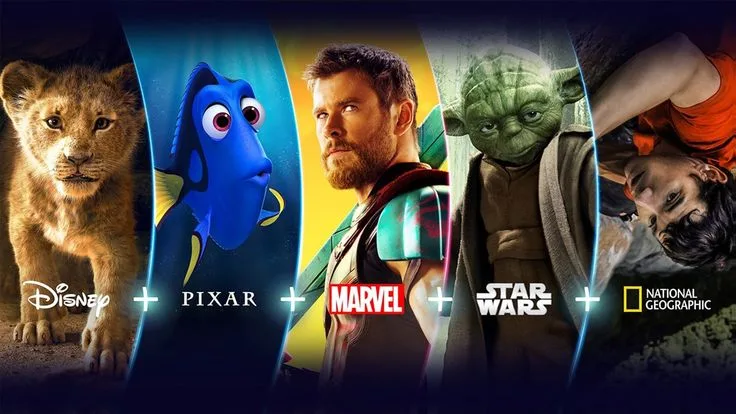
Disney Plus launched in November 2019 with a strategy based on owned franchise intellectual property. Disney's acquisitions (Pixar, Marvel, Lucasfilm (Star Wars), 20th Century Fox, and National Geographic) gave it a catalog of franchise entertainment with existing global audiences.
Disney fans were expected to pay for access to new content in universes they already loved and that was the business model assumption.
That bet paid off in the beginning: Disney Plus hit 100 million subscribers faster than any streaming service ever had.[8]
But growth has plateaued as the supply of franchise content has not fully met demand, and some Marvel and Star Wars productions have received mixed reactions that have temporarily dampened enthusiasm for new entries.
The Marvel and Star Wars Machine
If you follow the Marvel Cinematic Universe or Star Wars closely, Disney Plus is pretty much mandatory. The MCU series on Disney Plus, including WandaVision, Loki, Hawkeye, Moon Knight, Ms. Marvel, She-Hulk and newer releases, all feed into one ongoing story.
Skip the series and you miss key backstory for the next movie in theaters. Tying the shows and movies together rewards diehard fans and turns Disney Plus into a year-round staple rather than a service you dip into once a year.
Star Wars on Disney Plus has been more uneven in quality. The Mandalorian's first season won wide praise for getting back the franchise's adventure spirit and Andor has been called some of the best Star Wars content ever made, a serious political drama that engages with the franchise's mythology in an adult register.
Later seasons and spinoff series have met more mixed responses and there has been debate about the franchise's creative direction. Yet the total content volume keeps Disney Plus as the place where Star Wars fans go.
The National Geographic and FX Content Layer
Disney's acquisition of 21st Century Fox brought National Geographic into the Disney Plus catalog.
National Geographic documentaries and series give the service content that skews older than its Disney/Marvel/Star Wars core - wildlife documentaries, science programming, adventure content, and environmental journalism that broadens appeal beyond families with children.
In international markets, FX programming is available directly on Disney Plus (rather than Hulu, which is primarily a US service). For international subscribers, this means access to the FX content library (acclaimed dramas, comedies, and limited series) that US Hulu subscribers receive.
Outside the United States, Disney Plus comes across as a more complete service than what a US-centric comparison shows.
Disney Plus Value and 4K Access
4K HDR content comes standard in the basic Disney Plus subscription without needing to move up to a premium tier. Virtually the whole Disney catalog (classic animated films through new MCU releases) appears in 4K HDR on the standard plan. To get 4K on Netflix takes the Premium tier that costs $22.99 per month.
This represents a genuine value advantage for viewers with 4K televisions and fast enough internet connections.
On the standard plan, the service also backs 4 simultaneous streams. That is more than Netflix's standard 2 streams and for homes where several viewers watch different content, this cuts the need to move up to higher tiers.
The Disney Bundle Value Analysis
The Disney Bundle (combining Disney Plus, Hulu and ESPN Plus) is the best multi-app deal in streaming. Here is how 2026 pricing breaks down:
| Bundle option | Monthly price | What's included |
|---|---|---|
| Disney Bundle Basic (ads) | ~$16.99 | Disney+, Hulu, ESPN+ with ads |
| Disney Bundle Premium (no ads) | ~$29.99 | Disney+, Hulu no ads, ESPN+ |
| Hulu Live TV Bundle | ~$83/month | All of above + 90+ live channels |
Without ads, subscribing to Disney Plus ($13.99) and Hulu ($17.99) individually totals $31.98 a month. The Disney Bundle Premium at $29.99 gives both services plus ESPN Plus for less than the two by themselves.[14] Households that use both services find the bundle is the mathematically right choice.
Pricing Analysis: The Full Year View
The full-price individual subscription costs are meaningful when viewed annually:
| Service | Ad-supported | Standard | Premium |
|---|---|---|---|
| Netflix | $95.88/yr | $185.88/yr | $275.88/yr |
| Hulu | $95.88/yr | $215.88/yr | - |
| Disney Plus | $95.88/yr | $167.88/yr | - |
| All three (standard) | - | $569.64/yr | - |
| Disney Bundle (no ads) | - | $359.88/yr | - |
About $210 a year is saved by the Disney Bundle versus subscribing to Disney Plus and Hulu at standard prices on their own. It brings in ESPN Plus at no extra cost.
Ad-supported math. All three ad-supported tiers cost about $288/year to subscribe and that is about half what standard subscriptions run across all three tiers. People who can tolerate a lot of ads and want broad content access for real will find this money worth it.
The 2023-2024 price increases across all three services have also made the case for rotation - subscribing to one service for 3 months, watching what you want, cancelling, and subscribing to another. All three services make cancellation easy and do not punish re-subscription.[7]
A viewer who spends 3 months on Netflix, 2 months on Hulu, and 3 months on Disney Plus spends approximately $120-150 for 8 months of streaming versus $400+ for continuous subscriptions to all three.
Content Calendar: When to Subscribe to What
One of the less-discussed strategies for streaming services is timing subscriptions around content releases.
Netflix has historically released prestige content in the fall (September-December) ahead of awards season. Subscribing in October through January captures the most prominent new releases. Summer releases tend toward lighter blockbuster content.
Hulu has its greatest value during broadcast television's fall premiere season from September to November and during major sporting events that have broadcast coverage. January through April brings in awards season for FX shows.
Disney Plus is most valuable around theatrical release windows - subscribing before a new MCU or Star Wars film releases in theaters means accessing the related TV content for context. Disney Plus also has meaningful holiday content (Disney animated classics, holiday specials) making November-January particularly rich.
Recommendations by Household Type
Single person, primarily interested in prestige drama and film: Netflix Standard or ad-supported. The broadest single-service content library for solo viewing.
Family with young children. Disney Plus is the key anchor and add the full Disney Bundle if any household member follows sports or network TV and the math works.
Sports fan who wants to cut cable. Hulu with Live TV comes with a high price tag but covers everything. The bundle brings in ESPN Plus and broadcast sports. Measure it against the specific sports you actually watch.
TV enthusiast who follows network shows: Hulu without ads for next-day episodes is the core value. Add Netflix for prestige original content.
Budget-conscious viewer who must pick one. Netflix ad-supported gives the biggest single-service library and Disney ad-supported is the best value for families with children.
MCU or Star Wars follower. Keeping up with the connected universe makes Disney Plus non-negotiable. The bundle brings in a lot of value.
Viewers in international markets. Outside the US, Disney Plus is most often stronger internationally because it brings in FX content that US viewers get on Hulu.
Sources
- Netflix Q4 2025 Earnings Release -
- Disney Fiscal Year 2025 Annual Report
- Hulu Subscriber Update - Disney Investor Day 2025
- 'The Streaming Wars' - Bloomberg Technology coverage
- Nielsen Streaming Rankings Monthly Reports
- Emmy Awards 2025 Streaming Category Statistics
- Antenna Analytics Streaming Subscriber Data Q3 2025
- Variety: 'What Disney Plus Learned From Its First Five Years' 2025
- The Verge: Netflix Password Sharing Analysis 2024
- Reelgood Content Catalog Analysis 2025
- Deloitte Digital Media Trends Survey 2025 -
- Nielsen Gauge Monthly TV Viewing Report 2025
- 'The Economics of Streaming Profitability' - Wall Street Journal Technology 2025
- Disney Bundle Pricing History 2022-2026
- 'International Streaming Strategy: How Netflix Won Non-English Markets' - Variety 2025
- Hulu FX Content Relationship Explained - Hulu Newsroom
Further Reading
- JustWatch Streaming Market Share Data 2026
- decider.com Monthly 'What to Watch' surveys