
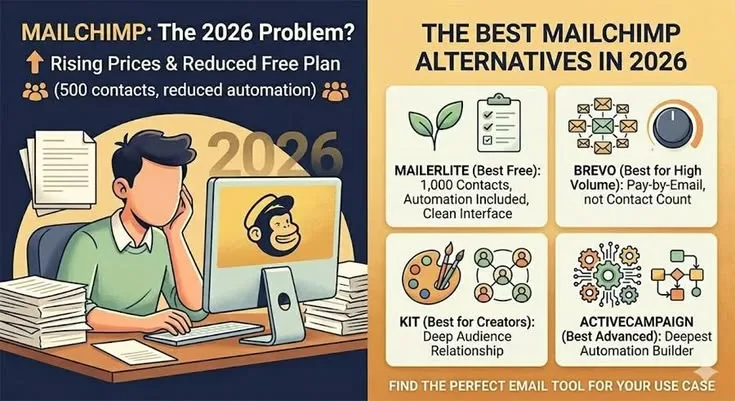
Alternatives: Priya runs a food and culture newsletter that she started during the pandemic. She built her list the slow way: consistent writing, a few press mentions, and word of mouth.
By late 2022 she had 6,200 subscribers and was paying Mailchimp $65/month, which felt like a significant line item but one she had accepted as the cost of doing business.
Then she got the email from Mailchimp announcing pricing changes and decided to actually read her invoice for the first time in months.
She discovered that she was being billed for 8,400 contacts - not the 6,200 active subscribers she thought she had. The remaining 2,200 were people who had unsubscribed at various points over two years. She was paying for contacts who had explicitly asked not to hear from her.
She spent twenty minutes trying to figure out how to remove unsubscribed contacts from her billing count and concluded that the answer was either that you could not, or that the interface was designed to make it difficult to figure out.
She did what most people do: she looked for the cheapest way to get the same functionality. She found MailerLite, moved her list in an afternoon, and dropped from $65/month to $17/month. The functionality she used daily - campaign creation, a basic welcome sequence, list segmentation - was identical.
The features she was paying for on Mailchimp but not using - website builder, social media scheduling, CRM - did not follow her, and she has not noticed their absence. The migration took four hours including time spent rebuilding her automation sequence.
The lesson is not that Mailchimp is a bad product. It is that email marketing platforms have diverged significantly in pricing model, automation depth, and target use case, and defaulting to the name-brand platform without comparison is expensive.
The alternatives below are not ranked by quality - they are matched to specific use cases where they deliver more value than Mailchimp for a specific user's actual needs.
"Paying for unsubscribed contacts is not a feature. It is a pricing decision that deserves scrutiny."
Why People Look for Mailchimp Alternatives
Mailchimp established the email marketing category for small businesses and remained the obvious choice for years.
The reason people now actively evaluate alternatives is a combination of pricing structure changes, feature depth relative to cost, and a clear segmentation of the market into creator-focused, e-commerce-focused, and automation-focused platforms that serve their niches better than a generalist tool can.
Charging for unsubscribed contacts. Mailchimp's billing counts all contacts in your audience, including unsubscribed ones, toward your plan tier. Competitors including MailerLite, Brevo, Kit, and Beehiiv bill only for active subscribers.
For a list with natural churn - which describes every list - the difference between billing models creates a real cost gap that grows over time.
Significant price increases in 2023. Legacy free plan users were moved to plans with meaningful monthly costs. The Standard plan, which most small businesses need for full automation, starts at $20/month for 500 contacts and scales to approximately $75-80/month for 5,000 contacts.
MailerLite provides comparable functionality at approximately half that price at equivalent subscriber counts.
Automation gated on higher tiers. Full automation sequences - behavioral triggers, conditional branching, multi-step workflows - require the Standard plan. Users on the Essentials plan have limited automation capabilities. Several competitors provide full automation at lower price points.
Interface bloat. Mailchimp has added website building, social media scheduling, postcards, a CRM, and other features over the years. The core email workflow is harder to navigate as a result. Users who just want to send newsletters and manage sequences find the interface more complex than necessary.
Creator and newsletter platforms have emerged. Beehiiv and Kit (formerly ConvertKit) were purpose-built for newsletter creators and offer monetization tools - paid subscriptions, ad networks, referral programs, digital product sales - that Mailchimp does not provide.
For creators, these platforms are more capable for their specific use case.
ConvertKit / Kit
Kit (formerly ConvertKit) is the longest-established creator-focused email marketing platform. It was built for writers, bloggers, and independent creators who need clean automation and direct product sales, and that focus is visible in every part of the product.
Features: Visual automation builder for creating branching email sequences based on tags, behaviors, and purchase history. Tag-based subscriber management rather than lists - a subscriber can have any number of tags and receive different sequences based on them.
Creator Network for cross-promotion between Kit newsletters. Commerce feature for selling digital products, courses, and paid subscriptions directly from Kit without a third-party storefront.
Landing page builder with customizable templates. Broadcast emails with A/B subject line testing. Integrations with Teachable, Gumroad, Shopify, and major CMS platforms.
Pricing: Free (up to 1,000 subscribers, limited automation). Creator $29/month (1,000 subscribers, all features). Creator Pro $59/month (1,000 subscribers, advanced reporting, priority support). Pricing scales with subscriber count.
Pros vs Mailchimp: Tag-based segmentation is more flexible than Mailchimp's list/segment structure. Built-in digital product sales eliminates the need for a separate platform. Automation depth is greater at equivalent price points. No charge for unsubscribed contacts.
Cons vs Mailchimp: Email design templates are minimal - Kit's aesthetic is text-heavy by design, which suits creators but not brands that need highly designed HTML emails. Integration ecosystem is smaller than Mailchimp's. Reporting is less detailed than Mailchimp's analytics.
Best for: Writers, bloggers, educators, and independent creators who send newsletters, sell digital products, and want automation without complexity. Strong choice for anyone building a business around an audience.
Beehiiv
Beehiiv was built by people from the Morning Brew team with a specific vision: a platform that treats newsletters as a business model rather than a marketing channel. The monetization features are more developed than any other tool in this comparison.
Features: Built-in referral program with custom rewards - subscribers who refer friends unlock benefits you define. Ad Network connecting newsletters with advertisers at CPM rates for passive monetization. Paid subscriptions for premium content tiers.
Boosts: pay to be recommended by other Beehiiv newsletters to their audiences, or earn by recommending others. 3D analytics tracking acquisition, engagement, and retention simultaneously. Custom newsletter subdomain and website.
SEO-optimized web archive of all newsletter issues. Email templates with drag-and-drop editing. Segmentation and automation on paid tiers.
Pricing: Launch free (2,500 subscribers, all core features). Grow $42/month (10,000 subscribers). Scale $84/month (100,000 subscribers). All tiers include all features - unlike most platforms, there are no features gated behind higher plan tiers.
Pros vs Mailchimp: The monetization ecosystem - ad network, paid subscriptions, boosts, referral program - is unique. No feature gating by tier means the free plan is genuinely functional. Designed specifically for newsletter publishing, so every feature is relevant to that use case. Strong SEO for the web archive of newsletter issues.
Cons vs Mailchimp: Not designed for traditional e-commerce email marketing or business newsletters. Less suitable for brands sending product promotions, transactional sequences, or complex behavioral automation. The platform is relatively young compared to Mailchimp.
Best for: Newsletter publishers and independent writers who want to grow and monetize a newsletter. Media creators, journalists, and analysts building subscriber-based businesses.
Brevo
Brevo (formerly Sendinblue) is a European-headquartered email marketing platform with GDPR compliance built into its architecture and the most generous free tier by send volume in the category.
Features: Free tier includes 300 emails per day (9,000/month) with no subscriber limit. SMS marketing alongside email from the same dashboard. Transactional email API for developer-managed sending. Marketing automation with behavioral triggers.
Contact segmentation. Landing pages and sign-up forms. WhatsApp messaging campaigns at higher tiers. A/B testing. Detailed reporting. European data centers with full GDPR compliance.
Pricing: Free (300 emails/day, unlimited contacts). Starter $25/month (20,000 emails/month). Business $65/month (automation, A/B testing, advanced reporting). Enterprise custom.
Pros vs Mailchimp: Free tier is more generous than Mailchimp's for senders with large lists who send infrequently. No charge for contacts - billing is by emails sent, not subscribers stored. SMS + email in one platform. GDPR compliance and EU data residency for European businesses.
Cons vs Mailchimp: Daily send limit on the free tier restricts time-sensitive campaigns to large lists. Automation on the Starter plan is limited. Interface has improved but is less polished than Mailchimp's. SMS coverage varies by country.
Best for: European businesses with GDPR requirements. Organizations that send infrequently to large lists. Businesses that want email and SMS in a single platform.
ActiveCampaign
ActiveCampaign is the most powerful automation system available to non-enterprise users. It sits between email marketing and CRM, and the line between those two categories is deliberately blurred in its feature design.
Features: Visual automation builder with branching logic of arbitrary complexity. Built-in CRM with deal pipelines, contact scoring, and task assignment. Site tracking captures page visits from known contacts and triggers automations based on browsing behavior.
Predictive sending optimizes delivery time for each individual contact based on their historical open patterns. Conditional content blocks show different email content to different segments in the same send. Integration with 900+ apps. Machine learning lead scoring.
Pricing: Starter $29/month (1,000 contacts), Plus $49/month (1,000 contacts, CRM, landing pages), Professional $149/month, Enterprise custom. Pricing scales with contact count.
Pros vs Mailchimp: Automation depth is significantly greater. The CRM integration eliminates the gap between marketing automation and sales follow-up. Behavioral triggers based on website activity are more sophisticated. Contact scoring allows automatic segmentation based on engagement level.
Cons vs Mailchimp: Learning curve is real. New users spend several weeks getting functional with the automation builder. The interface reflects complexity that simpler users find overwhelming. More expensive than Mailchimp and most alternatives at equivalent contact counts.
Best for: SaaS companies with complex onboarding sequences. B2B organizations with long sales cycles. Coaches, course creators, and businesses with elaborate email funnels. Teams where email is a primary revenue channel and automation sophistication produces measurable outcomes.
Klaviyo
Klaviyo dominates e-commerce email marketing, particularly for Shopify stores. Its integration depth and behavioral automation capabilities are purpose-built for retailers and direct-to-consumer brands.
Features: Deep Shopify, WooCommerce, and BigCommerce integrations that pull product catalog, order history, and customer behavior data in real time. Pre-built flows for abandoned cart, browse abandonment, post-purchase, price-drop alerts, and win-back campaigns, configurable without custom development.
Segmentation based on purchase history, product categories, predicted CLV, and next order date. Revenue attribution showing exactly how much each flow and campaign generated. SMS alongside email in the same automation flows. AI-generated copy suggestions.
Pricing: Free (250 contacts, 500 emails/month). Paid starts at $45/month for 1,001-1,500 contacts, scaling to approximately $700/month for 100,000 contacts. SMS has additional per-message costs.
Pros vs Mailchimp: E-commerce integration depth is unmatched. Revenue attribution is detailed and reliable. Pre-built flows for standard e-commerce scenarios save significant setup time. Behavioral automation based on actual purchase data is more sophisticated than Mailchimp's e-commerce features.
Cons vs Mailchimp: Expensive at scale. Not well-suited for non-e-commerce use cases. The interface is complex for users unfamiliar with e-commerce data models. Pricing can increase rapidly as list size grows.
Best for: E-commerce brands, particularly Shopify merchants, where behavioral email automation drives measurable revenue and the ROI justifies the platform cost.
MailerLite
MailerLite is the cleanest, most straightforward Mailchimp alternative for small businesses and independent senders. It offers a strong free tier, lower paid plan pricing, and an interface that is noticeably less cluttered than Mailchimp's.
Features: Email campaign builder with drag-and-drop and rich text options. Automation builder with visual workflow editor including behavioral triggers and conditional branching. Landing page builder with custom domain support. Pop-up and embedded form builder.
A/B testing for subject lines and content. Segmentation by behavior, location, and custom fields. Website builder at paid tiers. E-commerce integration for Shopify, WooCommerce, and others. Detailed analytics with click maps and engagement metrics.
Pricing: Free (1,000 subscribers, 12,000 emails/month, basic automation, landing pages). Growing Business $9/month annual or $10/month monthly (1,000 subscribers, all features). Advanced $18/month annual (1,000 subscribers, additional automation, custom HTML editor). Pricing scales with subscriber count.
Pros vs Mailchimp: Significantly cheaper at equivalent subscriber counts. Strong free tier. No charge for unsubscribed contacts. Cleaner interface. Full automation on the Growing Business plan at $9/month vs Mailchimp Standard at significantly higher cost.
Cons vs Mailchimp: Smaller integration ecosystem than Mailchimp. Less advanced reporting. Approval process for new accounts can delay getting started. Less brand recognition, which occasionally matters when integrating with third-party tools.
Best for: Small businesses, bloggers, and nonprofits with straightforward email marketing needs who want the best value for the features they actually use. The first paid platform many Mailchimp users switch to.
Flodesk
Flodesk takes a contrarian pricing position: one flat rate, unlimited subscribers, unlimited emails. The entire platform is priced at $38/month regardless of list size.
Features: Email design templates that are among the most visually striking available - the aesthetic targets lifestyle brands, photographers, and creators for whom visual brand identity in email matters. Drag-and-drop email builder. Automation workflows for welcome sequences and drip campaigns.
Opt-in forms and landing pages. Basic segmentation by form or segment. E-commerce integration through Flodesk Checkout at $64/month combined.
Pricing: $38/month regardless of subscriber count. No free tier (21-day free trial).
Pros vs Mailchimp: Predictable flat pricing is a genuine advantage as list size grows - at 50,000 subscribers, $38/month vs $350/month on Mailchimp Premium is a significant difference. Email design templates are beautiful for brands where aesthetics are a priority.
Cons vs Mailchimp: Automation and segmentation capabilities are less developed than Mailchimp Standard or ActiveCampaign. No free tier. Reporting is basic compared to more sophisticated platforms. Integration ecosystem is limited.
Best for: Lifestyle brands, photographers, designers, and creators with growing lists where predictable flat pricing is preferred and email design quality is a brand priority.
Omnisend
Omnisend is an e-commerce marketing platform that combines email, SMS, and push notifications in a single automation workflow.
Features: Pre-built e-commerce automation workflows for abandoned cart, welcome series, and post-purchase sequences. SMS campaigns with two-way messaging. Web push notifications as a third channel alongside email and SMS. Segmentation based on purchase behavior, predictive analytics, and engagement.
Product picker for inserting product listings directly from your e-commerce store into emails. Scratch cards and spin-to-win gamification for engagement campaigns.
Pricing: Free (250 contacts, 500 emails/month, 60 SMS/month). Standard $16/month (500 contacts, 6,000 emails/month). Pro $59/month (500 contacts, unlimited emails).
Pros vs Mailchimp: SMS and push notifications alongside email in a single automation. E-commerce focus with product picker and behavioral flows. More affordable than Klaviyo for mid-size stores. Strong free tier for testing.
Cons vs Mailchimp: Less suitable for non-e-commerce use cases. Integration ecosystem is smaller. Less design flexibility than some alternatives.
Best for: E-commerce businesses that want to add SMS alongside email marketing without managing two separate platforms. An alternative to Klaviyo for stores where Klaviyo's pricing is not yet justified.
Drip
Drip is an e-commerce automation platform that reports every metric in terms of revenue impact. The entire UX is oriented around connecting email activity to sales outcomes.
Features: Visual automation builder with branching logic. Deep Shopify, WooCommerce, and Magento integrations. Revenue attribution for every workflow and campaign. Pre-built playbooks for standard e-commerce scenarios. Behavioral email triggers based on browse and purchase activity.
SMS alongside email. Segmentation based on CLV, purchase frequency, and product categories. Detailed e-commerce reporting.
Pricing: $39/month for up to 2,500 active people. Pricing scales with contact count.
Pros vs Mailchimp: Revenue-focused reporting connects email activity to sales more directly. Automation depth is greater than Mailchimp Standard. E-commerce integration is more capable for behavioral targeting.
Cons vs Mailchimp: No free tier. More complex than MailerLite or Kit. Less suited to non-e-commerce use cases.
Best for: Growing e-commerce brands that want automation depth between Mailchimp's simplicity and Klaviyo's cost.
Zoho Campaigns
Zoho Campaigns is the email marketing component of the Zoho suite. For organizations already using Zoho CRM, Zoho Desk, or other Zoho products, it provides native integration without the need for a separate email marketing platform.
Features: Free tier of 6,000 emails/month to up to 2,000 contacts. Email campaign builder and basic automation. CRM integration for syncing contacts, deals, and lead status. Segmentation and personalization. SMS campaigns alongside email. Reporting and A/B testing. Integration with the entire Zoho ecosystem.
Pricing: Free (6,000 emails/month, 2,000 contacts). Standard $3/month (base, scales with contacts).
Pros vs Mailchimp: Generous free tier. Extremely low cost for Zoho ecosystem users. Native CRM integration eliminates data sync complexity.
Cons vs Mailchimp: Less polished interface. Automation is less developed than ActiveCampaign or Kit. Best value only if you are already in the Zoho ecosystem.
Best for: Businesses already using Zoho CRM or other Zoho products who want email marketing tightly integrated with their CRM data.
Comparison Table
| Tool | Entry price | Free tier | Best automation | E-commerce focus | Creator features | Best for |
|---|---|---|---|---|---|---|
| Mailchimp | $13/month | Limited | Standard+ | Moderate | Moderate | General small business |
| Kit (ConvertKit) | $29/month | 1,000 subs | Yes | Via integrations | Excellent | Writers, creators |
| Beehiiv | $42/month | 2,500 subs | Moderate | No | Excellent | Newsletter publishers |
| Brevo | $25/month | 300/day | Yes | Moderate | No | EU businesses, infrequent sends |
| ActiveCampaign | $29/month | No | Excellent | Via integrations | Moderate | Complex automation |
| Klaviyo | $45/month | 250 subs | Excellent | Excellent | No | Shopify/ecommerce |
| MailerLite | $9/month | 1,000 subs | Good | Good | Moderate | Small businesses, cost |
| Flodesk | $38/month | No (trial) | Basic | Via Checkout | Good | Lifestyle brands |
| Omnisend | $16/month | 250 subs | Good | Excellent | No | Ecommerce + SMS |
| Drip | $39/month | No | Good | Excellent | No | Growing ecommerce |
| Zoho Campaigns | $3/month | 6,000/mo | Moderate | Moderate | No | Zoho ecosystem users |
Who Should Switch and Who Should Stay
Stay with Mailchimp if: You have a well-established setup with automations, segments, and integrations that would require significant effort to migrate. Your integration requirements specifically depend on Mailchimp's ecosystem. You have negotiated pricing at higher volume. The interface works for your team without friction.
Switch to MailerLite if: You are leaving Mailchimp primarily for cost reasons and want equivalent functionality at lower price. The migration is straightforward and the savings are immediate.
Switch to Kit if: You are a writer, creator, or independent educator building a business around your audience. You sell digital products or want to. Automation sequences and tag-based segmentation are important to your workflow.
Switch to Beehiiv if: Newsletter publishing is your primary model and you want referral programs, an ad network, and paid subscriptions built in rather than bolted on through third-party tools.
Switch to Klaviyo if: You run an e-commerce store, particularly on Shopify, and behavioral email automation tied to purchase history is your core use case. The higher pricing is justified at scale by revenue attribution.
Switch to Brevo if: Your business is European and GDPR compliance and EU data residency are requirements. You send infrequently to a large list and want to avoid per-subscriber pricing.
Switch to ActiveCampaign if: Your business has complex automation requirements - multi-step sequences, CRM pipeline integration, lead scoring - that Mailchimp Standard cannot satisfy.
Switch to Flodesk if: Your list is growing toward a size where Mailchimp's per-subscriber pricing becomes expensive and you prioritize beautiful email design over advanced automation.
The honest assessment: Mailchimp's pricing structure - charging for unsubscribed contacts and gating automation on higher tiers - is a genuine disadvantage compared to most alternatives in 2026.
The brand recognition and integration ecosystem remain advantages, but for most users they do not outweigh the cost differential. Migration is a real investment of time, but for most list sizes, the payback period in savings is under six months.
See also: Best Alternatives to Shopify for Online Stores | Best AI Tools for Creators | Automation Tools Compared