
Agile grew from the limits of long, sequential software projects whose slow feedback made changing requirements costly. It is best understood through its values: favor collaboration, working software, customer involvement, and adaptation when tradeoffs arise. Iterative delivery is meant to expose assumptions early, though ceremonies alone do not make an organization responsive to change.
If you have spent any time in a technology company, you have almost certainly encountered the word "agile." It appears in job descriptions ("looking for an agile practitioner"), in team rituals (the daily standup, the sprint retrospective), and in organizational transformation announcements ("we are becoming an agile organization").
It is also, frequently, used to describe things that are not agile in any meaningful sense - teams that run two-week sprints but plan everything upfront, organizations that call themselves agile while maintaining all the approval structures and risk aversion of traditional project management.
Understanding what agile actually is - where it came from, what it prescribes, how different frameworks implement it, and where it fails - is useful whether you are a software developer, a product manager, someone working with a technology team, or just trying to understand how software gets built.
The Origins: Why Agile Emerged
To understand agile, you need to understand what it was reacting against.
Through the 1970s, 1980s, and 1990s, the dominant approach to software development was what practitioners called waterfall: a sequential process in which requirements were fully documented, then designed, then built, then tested, then released.
The name comes from the visual representation - each phase flows down into the next like water over a series of falls.
Waterfall had an appealing logic. It mirrored how other engineering disciplines worked: you design a bridge before you build it, and you do not change the design halfway through construction. Comprehensive upfront planning seemed like it should produce more predictable outcomes.
In practice, waterfall software projects failed at alarming rates. The 1994 Chaos Report by the Standish Group, which surveyed large software projects in American companies, found that only 16 percent of projects were delivered on time and on budget, while 31 percent were cancelled outright and 53 percent overran significantly.
The causes were predictable in retrospect: requirements that changed during the 12 to 18 month development cycle, technical assumptions that proved wrong, and the impossibility of fully specifying in advance how a complex system should behave before it has been built.
The core problem was feedback latency. In waterfall development, the customer did not see working software until the end of the project - often years after requirements were gathered.
By then, the world had changed, priorities had shifted, and the thing that had been built was not quite what was needed. And there was no opportunity to course-correct.
"The hardest single part of building a software system is deciding precisely what to build." - Fred Brooks, The Mythical Man-Month, 1975
The Research Behind the Problem
The data supporting the case against waterfall accumulated through the 1980s and 1990s. The U.S. Department of Defense's own studies found that between 1979 and 1994, roughly half of contracted software development delivered either nothing usable or software so poor it was never used in production.
The General Accounting Office reported in 1992 that 75 percent of large government software projects were either canceled or never used by their intended operators.
These failures shared a structure: large upfront contracts, comprehensive documentation produced months before coding began, and minimal exposure of working software to real users until final delivery.
The path dependency of waterfall - every phase locked in before the next began - meant that requirements errors discovered during testing were extraordinarily expensive to fix, because they required revisiting decisions made at the start of the entire process.
Iterative approaches existed before the Agile Manifesto. Barry Boehm's Spiral Model (1986) explicitly incorporated risk-driven iteration. Rational Unified Process (RUP) incorporated incremental delivery.
The software engineering community had been debating the limits of waterfall for over a decade before the 2001 meeting that produced the manifesto. What the manifesto provided was a concise, memorable articulation of what alternatives had in common.
The Agile Manifesto
In February 2001, seventeen software practitioners gathered at the Snowbird ski resort in Utah to discuss their shared frustrations with heavyweight development processes and the approaches they had individually found to work better.
The group included Kent Beck (Extreme Programming), Ken Schwaber and Jeff Sutherland (Scrum), Ward Cunningham (wiki inventor), Martin Fowler (refactoring), and others who had spent years developing and applying iterative approaches to software.
They produced the Agile Manifesto: a document of twelve principles organized around four core values.
The Four Values
- Individuals and interactions over processes and tools
- Working software over comprehensive documentation
- Customer collaboration over contract negotiation
- Responding to change over following a plan
The word "over" is important. The manifesto does not say processes, documentation, contracts, and plans have no value - it says the items on the left should be valued more than the items on the right when trade-offs must be made.
The Twelve Principles
The principles elaborate the values into practical guidance, including:
- Deliver working software frequently, in weeks rather than months
- Business people and developers must work together daily throughout the project
- Build projects around motivated individuals and trust them to get the job done
- Working software is the primary measure of progress
- Continuous attention to technical excellence and good design enhances agility
- Simplicity - the art of maximizing the amount of work not done - is essential
- The best architectures, requirements, and designs emerge from self-organizing teams
The twelve principles are worth reading in full (they are publicly available at agilemanifesto.org).
They describe a set of working practices that have proven durable: the emphasis on working software as the primary measure, the distrust of heavyweight documentation, the insistence on close collaboration with customers, and the embrace of change rather than resistance to it.
Why the Manifesto Resonated So Widely
The manifesto's impact was partly due to timing. The dot-com boom of the late 1990s had produced enormous pressure to ship software faster and more frequently. Companies that failed to deliver quickly lost market share; companies that got working software in front of users early could iterate and survive.
The Chaos Report's damning statistics were widely circulated. The practitioner community was ready for a synthesis.
The manifesto also benefited from being brief. The entire document - four values, twelve principles - can be read in under ten minutes. This made it easy to share, quote, and reference in ways that lengthy methodological frameworks could not match.
The simplicity was a feature, not a limitation: the manifesto articulated principles and left implementation to individual teams, which allowed it to be applied across an enormous range of contexts.
Scrum: The Most Common Agile Framework
Scrum is the most widely adopted agile framework, used by a majority of agile teams according to annual State of Agile surveys. According to the 15th Annual State of Agile Report (2021), Scrum was used by 66 percent of respondents practicing agile - and when Scrum/Kanban hybrid approaches are included, the figure exceeds 80 percent.
It structures work into fixed-length iterations called sprints - typically two weeks - with a defined set of roles, artifacts, and ceremonies.
Roles
Product Owner: The person responsible for defining and prioritizing what the team builds. They maintain the product backlog - an ordered list of features, bug fixes, and other work - and are accountable for maximizing the value of the team's output.
The Product Owner represents stakeholder interests and makes final calls on what the team works on.
Scrum Master: A servant-leader who helps the team understand and apply Scrum principles, removes impediments to progress, and facilitates ceremonies. The Scrum Master is not a project manager; they have no authority over the team's work but are responsible for the health of the team's process.
Development Team: The self-organizing group of engineers, designers, testers, and others who do the actual work. In Scrum, the team decides collectively how much work to take on each sprint and how to accomplish it.
Artifacts
Product Backlog: The master list of all potential work for the product, ordered by priority. The Product Owner owns this and keeps it current.
Sprint Backlog: The subset of backlog items the team has committed to completing in the current sprint, plus the plan for how to accomplish them.
Increment: The working, potentially shippable product that results from each sprint. The increment represents all the work completed to date and must meet the team's definition of done.
Ceremonies
| Ceremony | Timing | Purpose | Typical Duration |
|---|---|---|---|
| Sprint Planning | Start of each sprint | Decide what to build and how | 2-4 hours |
| Daily Standup | Every working day | Synchronize, surface blockers | 15 minutes |
| Sprint Review | End of each sprint | Demo completed work to stakeholders | 1-2 hours |
| Sprint Retrospective | End of each sprint | Reflect on process, identify improvements | 1-1.5 hours |
| Backlog Refinement | Mid-sprint (ongoing) | Clarify and estimate upcoming work | 1-2 hours/week |
The retrospective is arguably the most important ceremony for long-term team health. It is where continuous improvement happens. Teams that run retrospectives effectively tend to improve steadily over time; teams that skip or phone in retrospectives tend to calcify around their current dysfunctions.
Story Points and Estimation
One of Scrum's most discussed and debated practices is the use of story points for estimating work. Story points are a relative, dimensionless unit of effort - a task estimated at 8 points is roughly twice as complex as one estimated at 4.
Fibonacci-like scales (1, 2, 3, 5, 8, 13, 21) are commonly used, reflecting the practical reality that precise distinctions between, say, 6 and 7 are rarely meaningful in software estimation.
The purpose of points is to enable velocity tracking - after a few sprints, a team knows roughly how many points they can complete per sprint, which enables reasonable forecasting of future delivery.
Critics argue that the abstraction of story points adds ceremony without value, and several organizations (including Basecamp and Linear) have publicly moved to simpler approaches such as t-shirt sizing (S/M/L/XL) or no estimation at all, relying on cycle time metrics instead.
Kanban: Flow Over Sprints
Kanban originated in Toyota's manufacturing system in the 1940s as a method for managing inventory flow. David Anderson adapted it for software development in the 2000s, and it has become a significant alternative to Scrum for teams whose work does not fit the sprint model.
The core of Kanban is a board that visualizes work moving through stages (typically: To Do, In Progress, Done) and WIP limits - maximum numbers of items allowed in each stage simultaneously.
WIP limits are central to Kanban's philosophy. They prevent the accumulation of work-in-progress that creates the illusion of productivity while actually slowing the flow of completed work.
When a WIP limit is reached in a stage, the team cannot pull more work into that stage until work moves through it - which forces collaboration to unblock stuck work rather than piling new work on top of existing backlogs.
Where Kanban works better than Scrum:
- Support and operations work where items arrive continuously and unpredictably
- Teams with high variability in task size where sprint commitments are unreliable
- Teams transitioning from no process who need to start with minimal ceremony
- Bug-fixing teams or platform teams with reactive workloads
Where Scrum works better than Kanban:
- Feature development with distinct deliverables that benefit from sprint-level focus
- Teams that need the external structure of sprint commitments to maintain velocity
- Products with stakeholders who benefit from regular sprint demos
Kanban Metrics
Kanban teams track different metrics than Scrum teams. The key measures are:
Cycle time: How long it takes a single work item to travel from "started" to "done." Reducing cycle time is the core optimization goal in Kanban.
Lead time: How long it takes from when work is requested to when it is delivered. Lead time includes any waiting time before work begins.
Throughput: How many items are completed per unit time. This replaces velocity in the Kanban mental model.
Cumulative Flow Diagram (CFD): A chart that shows how many items are in each stage over time. Narrowing bands indicate healthy flow; widening bands indicate accumulation in a particular stage.
These metrics are more empirically grounded than story point velocity, because they measure actual delivery rather than estimated effort. A team with a stable cycle time of 3 days can reliably forecast that 10 items will take approximately 30 days without any estimation session.
SAFe and Scaling Agile
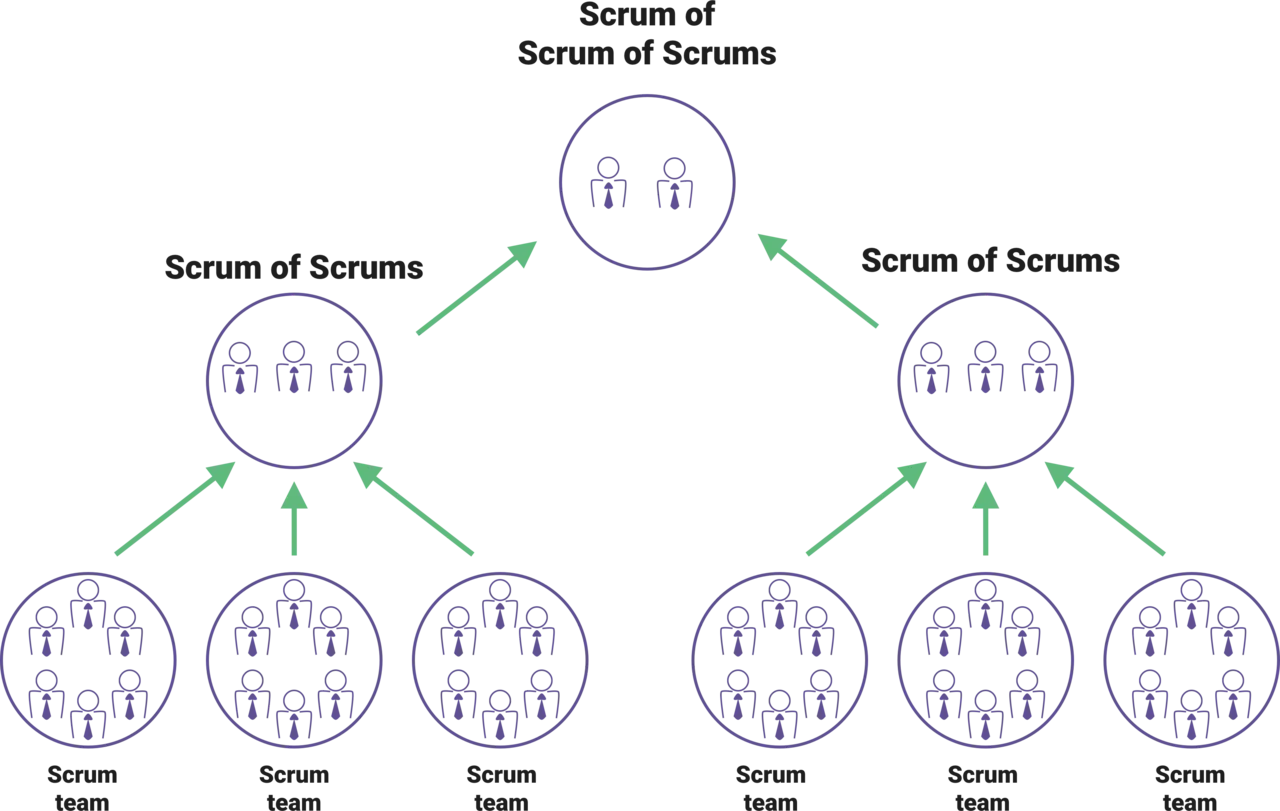
The Scaled Agile Framework (SAFe) was developed by Dean Leffingwell and first published in 2011 to address a real problem: how do you coordinate 10, 20, or 100 agile teams working on an integrated product or platform without reintroducing the bureaucratic overhead that agile was designed to eliminate?
SAFe introduces a hierarchy of planning:
- Team level: Standard Scrum or Kanban sprints (2 weeks)
- Program level: Agile Release Trains (ARTs) - groups of 50 to 125 people (5-12 teams) aligned around a common mission and synchronized on Program Increment (PI) Planning events every 8 to 12 weeks
- Portfolio level: Strategic themes, value streams, and budget allocation across programs
PI Planning is SAFe's signature practice: a two-day event in which all teams in a release train gather - ideally in person - to align on priorities, identify dependencies between teams, and commit to a set of objectives for the coming quarter.
The Controversy Around SAFe
SAFe is the most widely adopted scaling framework but also the most controversial among agile practitioners. Critics argue that:
- It reintroduces heavyweight planning and governance processes that undermine agility at the team level
- It creates a large consultant and certification industry that benefits from complexity
- The PI Planning ceremony is expensive and its value does not always justify the cost
- Large organizations use SAFe as a framework for doing the same waterfall planning they always did, but calling it agile
Supporters counter that:
- Coordination between teams doing interdependent work is a genuine problem that requires a framework
- SAFe has helped many organizations move from entirely waterfall processes to more iterative delivery
- The framework's prescriptiveness, while reducing local flexibility, reduces the variance of bad implementations
The honest assessment is that SAFe is the least bad option for some large organizations and an unnecessary overhead for others. Its appropriateness depends heavily on the degree of technical interdependency between teams and the organization's starting level of agile maturity.
Other Scaling Frameworks
SAFe is not the only answer to scaling. LeSS (Large-Scale Scrum), developed by Craig Larman and Bas Vodde, takes a different approach: rather than adding coordination layers, it applies Scrum directly at scale with a single product backlog across all teams working on the same product, and a single sprint review.
LeSS deliberately minimizes additional roles and artifacts, arguing that the coordination problems SAFe addresses are often symptoms of poorly designed architecture that should be fixed rather than managed around.
Spotify's model - squads, tribes, chapters, and guilds - became influential after a 2012 blog post, but the company has since clarified that the model described in that post was never a formal framework, was never fully implemented as described, and has evolved significantly.
Organizations that adopted "Spotify model" as a template were implementing a snapshot of one company's experimental thinking rather than a tested methodology.
Common Agile Failures
Agile has been implemented badly far more often than it has been implemented well. Several failure modes recur.
"Agile in Name Only"
Teams that run sprints but plan all requirements upfront, teams with Product Owners who do not have genuine authority over the backlog, organizations that add "agile" vocabulary to existing command-and-control structures. The ceremonies are present; the values are absent. The result is the overhead of agile without its benefits.
A 2020 survey by the Business Agility Institute found that 44 percent of respondents described their organization's agile transformation as either stalled or regressing after an initial period of progress. The most commonly cited reason was leadership failing to embrace agile values themselves while requiring adoption from teams.
The Missing Product Owner
When the Product Owner is unavailable, unclear, or unable to make decisions - because they are a proxy for a committee, a contract, or an absent executive - the team loses the continuous feedback and prioritization guidance that makes sprints productive.
Work gets built without stakeholder input, and the sprint review becomes a formality rather than a genuine feedback loop.
Velocity as a Target
In Scrum, velocity - the number of story points or tasks completed per sprint - is a planning tool, a measure of the team's historical capacity used to forecast future capacity.
When management treats velocity as a performance target, teams game the metric: story point inflation, taking on easy work, and avoiding complex tasks that reduce velocity even when they are the most valuable work.
Goodhart's Law - "when a measure becomes a target, it ceases to be a good measure" - applies with particular force to velocity. A team that increases velocity quarter over quarter while delivering less value is optimizing the metric rather than the outcome.
Neglecting Technical Debt
Agile's emphasis on working software delivered quickly can, if not counterbalanced, lead to accumulation of technical debt - shortcuts in the codebase that speed up delivery in the short term but slow it down over time.
Teams that do not invest in refactoring, testing infrastructure, and code quality during sprints find that their velocity declines as the codebase becomes harder to change.
The retrospective is the mechanism for surfacing this; teams that skip retrospectives or treat them superficially typically miss this degradation until it is severe.
Agile as Ceremony Without Engineering Practices
Kent Beck's Extreme Programming (XP) - one of the frameworks that contributed to the Agile Manifesto - emphasized engineering practices alongside process: test-driven development (TDD), pair programming, continuous integration, and refactoring as first-class practices.
Early advocates of agile argued that these engineering disciplines were prerequisites for sustainable fast delivery.
In many organizations, agile was adopted as a set of management and process practices while engineering practices received little attention. The result is teams that hold daily standups and run two-week sprints but have fragile test suites, infrequent integration, and codebases accumulated with unaddressed technical debt.
The process practices of agile deliver limited value without the engineering practices that make frequent delivery sustainable.
When Agile Is the Wrong Tool
Agile is not universally superior. Several contexts are genuinely better served by more structured approaches.
Regulatory and compliance projects with fixed, externally specified requirements benefit from waterfall's comprehensive documentation and sign-off structure. The requirements do not change; the cost of discovering compliance gaps in production is high; documentation trails are required.
Agile's embrace of change and minimal documentation works against these needs.
Safety-critical embedded systems in medical devices, aircraft, and industrial control systems have verification requirements that necessitate detailed specifications and formal testing processes.
The FDA's guidance on software in medical devices, for example, requires documentation discipline that is incompatible with minimal-documentation agile approaches.
Projects with fixed-scope contracts in which the client has purchased a defined deliverable are structurally misaligned with agile's adaptive approach.
Agile works best when both the supplier and customer accept that requirements will evolve; it works poorly when the customer expects a predetermined output and judges the project against that.
Very small projects with short timelines and a single developer often generate more overhead from agile ceremonies than value. A one-week task does not benefit from sprint planning, daily standups, and retrospectives.
The appropriate question is not "is this project agile or not" but "what level of planning discipline and what feedback frequency best fit the uncertainty level, scale, and constraints of this specific work?"
The Cynefin Framework and Method Selection
The Cynefin framework, developed by Dave Snowden at IBM in 1999, provides a useful model for thinking about which management approach fits which context. It categorizes problems into:
| Domain | Characteristics | Appropriate Response |
|---|---|---|
| Clear | Cause and effect are obvious | Apply best practice, follow standard process |
| Complicated | Cause and effect require analysis | Analyze, apply good practice (expert judgment) |
| Complex | Cause and effect are only apparent in retrospect | Probe, sense, respond (iterative experimentation) |
| Chaotic | No cause-and-effect relationships discernible | Act, sense, respond (stabilize first) |
| Confused | Domain is unclear | Break into parts, classify each |
Software development typically operates in the complex domain: requirements and technical constraints are not fully knowable upfront, and the behavior of the system only becomes clear as it is built.
This is precisely the context where iterative, feedback-driven approaches like agile deliver the most value over upfront-planning approaches.
When work genuinely falls into the clear or complicated domain - well-understood requirements, established technical solutions - the case for agile over waterfall weakens.
What Actually Makes Agile Work
Research on high-performing software teams - including the DORA (DevOps Research and Assessment) research program - identifies several factors that correlate with effective delivery that are consistent with agile principles:
- Small, frequent deployments: Teams that deploy to production daily or multiple times daily have better outcomes than teams that batch large releases
- Automated testing: Comprehensive test automation enables the confidence required to deploy frequently
- Trunk-based development: Working on short-lived feature branches rather than long-lived parallel branches
- Loosely coupled architecture: Systems designed so that different components can be changed independently, which enables team autonomy
- High deployment autonomy: Teams that can deploy their component without requiring coordination with other teams
These are architectural and engineering practices as much as process practices. The implication is that agile methodology without the underlying technical practices (continuous integration, test automation, trunk-based development, deployment automation) delivers limited value - the ceremonies are present but the acceleration is not.
Agile and DevOps are most effective together.
The DORA Metrics
The DORA research program, which has surveyed tens of thousands of software teams since 2014, identified four key metrics that distinguish elite software delivery performance:
| Metric | Elite Performers (2023) | Low Performers |
|---|---|---|
| Deployment frequency | Multiple times per day | Less than once per month |
| Lead time for changes | Less than one hour | More than six months |
| Change failure rate | 0-5% | 16-30% |
| Failed deployment recovery time | Less than one hour | More than one week |
Elite performers are not just faster - they also have lower failure rates and recover faster when failures do occur. This data directly challenges the intuition that moving faster means accepting more defects. Teams that deploy frequently maintain their quality through automation, testing, and small batch sizes, not by slowing down.
Team Topology and Agile
Team Topologies, a 2019 book by Matthew Skelton and Manuel Pais, provides a framework for organizing teams to enable fast flow of delivery.
The core insight is that Conway's Law - "organizations design systems that mirror their communication structures" - means that team structure directly shapes software architecture and delivery speed.
Agile practices alone cannot overcome the delivery friction created by poorly organized teams with too many cross-team dependencies.
The framework identifies four team types: stream-aligned teams (delivering directly to users), enabling teams (helping other teams adopt new capabilities), complicated-subsystem teams (managing genuinely complex technical components), and platform teams (providing self-service infrastructure).
Aligning team structure to minimize hand-offs and dependencies is a prerequisite for the autonomy and fast feedback that agile promises.
Practical Takeaways for Evaluating Agile Claims
When a team or organization claims to be "agile," these questions distinguish genuine adoption from performance:
- Does the team have a Product Owner with genuine authority to prioritize the backlog?
- Does the team deploy working software at the end of every sprint, or do sprints accumulate into a release that ships quarterly?
- Do retrospectives actually change team behavior, or do they produce lists that are never revisited?
- Does the team track cycle time and whether delivery is improving, or only velocity?
- Are engineering practices - automated testing, continuous integration, refactoring - treated as seriously as process practices?
Agile, done well, is not primarily a set of ceremonies. It is a set of values - about feedback, about working software, about collaboration - implemented through practices that are continuously refined by the team using them. The ceremonies are the scaffolding.
The outcome is a team that delivers value reliably, improves continuously, and adapts to change without re-planning from scratch.
The fact that most agile implementations fall short of this ideal does not invalidate the ideal. It reflects the difficulty of genuine organizational change, and the gap between adopting the vocabulary of a methodology and internalizing its values.