
What Are Mobile Tech Trends?
Mobile technology trends are the directional shifts in how smartphones and tablets are built, connected, and used - encompassing new hardware capabilities (faster processors, foldable screens, dedicated AI chips), new network infrastructure (5G and its low-latency implications), evolving platform policies (privacy regulations, app store rules), and emerging development frameworks that respond to all of the above.
Understanding these trends matters because the applications that succeed in the next three to five years will be built on capabilities that are only beginning to reach broad adoption today, and the teams that develop fluency with those capabilities now hold a meaningful advantage.
In January 2007, Steve Jobs held up the original iPhone and told the audience they were looking at a revolutionary internet communicator, a phone, and a widescreen iPod. "An iPod, a phone, and an internet communicator," he said, repeating it three times. "Are you getting it?"
The audience got it. But Jobs and nearly everyone else did not fully grasp what they were actually introducing. The iPhone was not just a new device category. It was the deployment vehicle for an entire economy of attention, behavior, and commerce that did not previously exist.
Within five years, 500 million people were carrying computers more powerful than anything widely available a decade earlier, permanently connected to a global information network, loaded with applications that had not been imagined when the phone was announced.
The lesson of that moment is not that mobile was predicted. It is that transformative technology change is consistently underestimated even by its inventors.
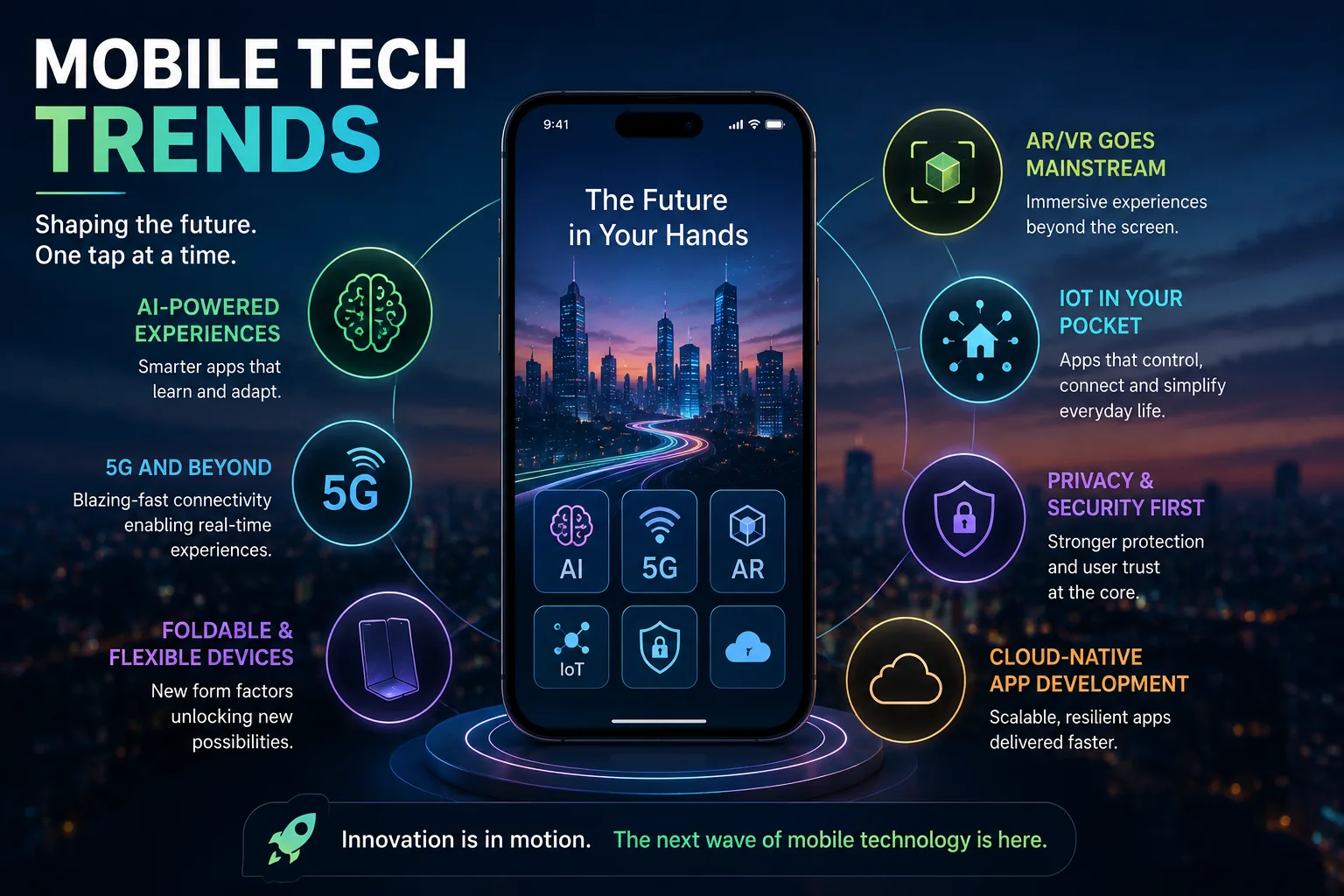
This principle applies directly to the forces reshaping mobile in the middle of this decade: 5G infrastructure buildout, on-device artificial intelligence, augmented reality maturation, privacy-first regulatory transformation, and new physical form factors.
Each of these trends is already underway. None has reached its full impact yet. Together, they are redrawing what mobile applications are, what they can do, and how they must be built.
| Trend | Current State | Primary Impact on Apps | Key Constraint |
|---|---|---|---|
| 5G | Deployed in major cities; rural gaps remain | Ultra-low latency enables edge compute, cloud gaming | mmWave range extremely limited |
| On-device AI | Dedicated neural engines standard on flagship devices | Privacy-preserving personalization, real-time vision | Model size and compute budgets |
| Augmented reality | ARKit/ARCore mature; consumer adoption limited | Retail visualization, spatial computing preview | Headset form factor still pending |
| Privacy regulation | GDPR, ATT, CCPA widely enforced | Consent-first design, on-device data processing | Attribution and analytics disrupted |
| Foldable screens | Maturing; niche but growing | Large-canvas productivity on portable devices | App adaptation complexity |
Transformative technology change is consistently underestimated even by its inventors.
The capability being built into mobile devices today - AI inference, spatial computing, persistent connectivity - will enable applications that are not yet imagined, just as the 2007 iPhone audience did not imagine ride sharing, mobile banking, or social video.
5G: Infrastructure That Changes What Is Possible
The Technical Shift Behind the Marketing
Mobile carriers have marketed 5G primarily as a speed upgrade - faster download times, higher video quality, better streaming. That framing captures the smallest part of the story. The capabilities that matter most for application developers are not download speed but latency, bandwidth density, and network architecture.
Ultra-low latency is the capability that opens new application categories. Fourth-generation (4G LTE) networks have typical round-trip latencies of 30-50 milliseconds. 5G mmWave deployments achieve latencies below 5 milliseconds in controlled conditions; real-world 5G sub-6GHz deployments typically achieve 10-20ms latency.
This might seem like an academic difference, but consider the applications where latency is the fundamental constraint.
Remote surgery assistance, in which a surgeon at a hospital guides a procedure at a remote location using robotic instruments, requires latency below the threshold of human perception - approximately 20ms for basic haptic feedback, ideally under 5ms for precise instrument control.
This was not feasible over 4G. It is feasible over 5G mmWave deployments in hospitals.
Cloud gaming - streaming video game output from a remote server rather than processing the game locally - requires latency low enough that controller inputs feel responsive. Xbox Cloud Gaming and NVIDIA GeForce Now both launched on 4G and delivered acceptable experiences for casual play.
On 5G, input latency approaches that of locally running games, making even competitive play viable. This changes the economics of mobile gaming: instead of optimizing game complexity for what a phone's GPU can render, developers can design for datacenter GPUs and stream the output.
Massive bandwidth (theoretical peak of 10 Gbps for 5G mmWave) enables rich media experiences that would saturate 4G capacity.[1] Volumetric video - three-dimensional video captured from multiple camera angles that users can move around in - requires 100 Mbps or more per stream.
8K live streaming, multi-camera sports experiences where viewers choose their angle, and real-time holographic communication all become technically feasible. Whether users want and pay for these experiences is a separate question from whether the infrastructure can support them.
Network slicing is the 5G capability least discussed in consumer marketing but most important for enterprise applications. Network slicing allows a 5G carrier to partition the network into logically separate virtual networks with guaranteed quality-of-service parameters for each slice.
A hospital can purchase a slice with guaranteed sub-5ms latency and 99.999% reliability for critical monitoring equipment, entirely independent of consumer traffic on the same physical infrastructure.
Industrial automation, autonomous vehicle coordination, and emergency services can all receive guaranteed service levels without being affected by Netflix traffic.
What 5G Means for Application Development
The developer implications of 5G are not primarily "make the app download faster." They are structural.
Offloading computation to edge servers becomes viable when the round-trip to the nearest edge location takes 10ms rather than 50ms.
Applications that today must run expensive machine learning inference locally - to avoid the unacceptable latency of a server round trip - can instead use edge-hosted models with larger parameter counts and higher accuracy.
The trade-off between on-device efficiency and server-side capability shifts.
High-fidelity real-time collaboration becomes possible. Shared AR experiences where multiple users in different locations see and interact with the same virtual objects in real time require synchronized state updates fast enough that objects do not visibly jump between positions. This requires both low latency and consistent bandwidth.
The persistent challenge is coverage heterogeneity. 5G mmWave, which delivers the most dramatic capability improvements, has extremely limited range (300-500 meters) and cannot penetrate buildings effectively. It is deployed in dense urban areas and specific venues.
Sub-6GHz 5G has better coverage but more modest performance improvements over 4G.
The practical advice for developers is to design for 5G capabilities when they are available while maintaining graceful degradation to 4G behavior - not as a polite gesture to legacy users, but because the majority of users in most markets will be on 4G for years to come.
On-Device AI: Intelligence Without the Server Round-Trip
The Hardware That Changed the Equation
The story of on-device artificial intelligence begins with silicon. Apple's A11 Bionic chip, introduced in the iPhone 8 in 2017, was the first mainstream smartphone processor to include a dedicated Neural Engine - specialized hardware designed for the matrix operations that underlie machine learning inference.
The A11's Neural Engine could perform 600 billion operations per second. The A17 Pro, introduced in 2023, delivers 35 trillion operations per second from a 16-core Neural Engine.
Google's Tensor processing units in Pixel phones, Qualcomm's Hexagon Neural Processing Units in Snapdragon chips, and Apple's Neural Engine all represent the same industry conclusion: machine learning inference is important enough to warrant dedicated silicon rather than borrowing GPU or CPU cycles.
The consequence is that models that required cloud servers five years ago run entirely on device today.
Apple's on-device dictation engine - which transcribes speech to text locally without a network connection - uses the Neural Engine to achieve accuracy comparable to server-based recognition systems. This happens locally, in real time, with no data leaving the device.
The privacy and latency benefits are both real.
What Developers Can Do With On-Device AI Today
Computational photography represents the most visible current application. Night Mode on modern iPhones and Pixel phones captures multiple rapid exposures, analyzes them using neural networks that distinguish real structure from noise, and combines them into a single image with characteristics no individual exposure could produce.
Portrait Mode's depth estimation, which separates subjects from backgrounds for bokeh effects, runs a neural network on each frame in real time. These capabilities feel like camera improvements; they are actually AI applications.
Computer vision for app developers is available through platform SDKs that abstract the underlying neural network complexity.
Apple's Vision framework provides object detection, face analysis, text recognition (used for Live Text), document scanning, and pose estimation through a consistent API that automatically utilizes the Neural Engine.[2]
Google ML Kit offers equivalent capabilities for Android, plus barcode and QR code detection, language identification, and translation.[3]
Example: A home improvement app that allows users to photograph a room and receive paint color suggestions uses Core ML's scene understanding to identify wall surfaces, Vision's segmentation to separate walls from furniture and flooring, and a custom style model to suggest colors based on existing elements.
This entire pipeline runs locally in under 500ms on a current iPhone.
Natural language processing runs on-device for increasingly sophisticated tasks. On-device translation - Apple Translate and Google Offline Translation both offer complete language packs downloadable to the device - eliminates the privacy concern of sending conversation content to cloud servers.
Predictive text and smart reply features analyze message content locally.
Predictive features that anticipate user behavior are becoming standard in high-retention apps.
An on-device model that learns from a user's behavior patterns - which content they engage with, at what times, following what triggers - can prefetch content they are likely to want next, create personalized notification timing, and adapt app behavior to individual usage patterns.
This personalization happens without transmitting behavioral data to a server.
The Development Reality
On-device AI development requires thinking about resource constraints that server-side ML ignores. A Large Language Model with 70 billion parameters is not running on a mobile phone.
The models that run on mobile devices are carefully compressed versions: quantized (reduced precision arithmetic), pruned (sparse weight matrices), and often distilled (smaller models trained to mimic larger ones).
A 100-megabyte Core ML model running on an iPhone is architecturally different from a cloud-hosted model, not merely smaller.
Test on the full range of target devices. An inference task that takes 100ms on an iPhone 15 Pro may take 800ms on an iPhone 11 and 2,000ms on a budget Android device. The performance profile must be understood across the real device distribution of your users, not just your development hardware.
Platform SDKs (Core ML on iOS, ML Kit on Android) should be the starting point for any on-device AI feature. These SDKs abstract hardware differences, handle model loading and caching, and provide optimized execution pathways.
Building custom inference pipelines with TensorFlow Lite or ONNX Runtime is appropriate when platform SDKs lack the specific capability you need, not as a default approach.
Augmented Reality: Moving Beyond Novelty
The State of Mobile AR in 2026
Pokémon GO brought augmented reality to mass consciousness when it launched in 2016 - 21 million daily active users in its first month. The gameplay was simple: virtual creatures appeared overlaid on the real world through the phone camera.
The technical limitations were obvious: AR objects did not interact with real surfaces, did not respond to lighting, and floated unrealistically in space.
ARKit (Apple, 2017) and ARCore (Google, 2018) introduced capabilities that enabled convincing AR for the first time: plane detection (finding floors, tables, and walls), light estimation (matching virtual object lighting to ambient conditions), and robust world tracking (keeping virtual objects anchored to physical positions as the user moves).[4]
The capabilities have expanded substantially since.
Object occlusion - introduced in ARKit 3 using LiDAR sensors on iPhone Pro models - allows virtual objects to be correctly hidden behind real objects, creating depth that makes AR feel physically plausible rather than obviously overlaid.
Before occlusion, a virtual character would appear in front of a table even when logically it should be behind it. With occlusion, the character passes behind the table correctly.
Persistent anchors allow virtual objects to remain in place across app sessions.[5] Place a virtual sticky note on your refrigerator in an AR app, return to the app tomorrow, and the note is still there. This is foundational for AR applications where users build spatial relationships with virtual content over time.
Body and hand tracking provide skeletal pose estimation accurate enough for fitness applications to analyze movement form, retail applications to enable virtual try-on of clothing and accessories, and gaming applications to use the user's actual body as a controller.
The commercial applications that have moved beyond novelty are concentrated in retail and commerce. IKEA Place, which allows customers to see furniture at full scale in their actual rooms before purchasing, is the canonical example. Wayfair, Houzz, and most major furniture retailers now offer equivalent functionality.
Sephora and L'Oreal offer virtual makeup try-on. Warby Parker allows virtual eyeglass frame try-on. These applications have demonstrable effect on purchase confidence and return rate reduction.
WebAR: Reducing the Installation Friction
One of the persistent barriers to AR adoption is the requirement to install an app specifically to use an AR experience.
A customer browsing a retailer's website who sees a "View in AR" button faces a decision: install a dedicated app, experience the AR feature, and potentially keep an app they never use again. Many users decline.
WebAR delivers augmented reality experiences through the browser without any installation. Google's Model Viewer project, 8th Wall, and Zappar's WebAR platform all enable browser-based AR on iOS and Android.[12] The user visits a URL, grants camera permission (a single tap), and sees the AR experience.
Capabilities are more limited than native ARKit/ARCore: no persistent anchors, limited plane detection, less accurate object occlusion. For single-use experiences - view a product in AR before purchase, experience a marketing activation, try a filter - the reduced capability is an acceptable trade-off for dramatically lower friction.
For development teams already supporting web experiences, WebAR is often the faster path to AR feature availability than building and maintaining a native AR experience across both iOS and Android.
The Spatial Computing Horizon
Apple's Vision Pro, released in February 2024, is a $3,499 headset that represents Apple's long-term bet on spatial computing - an interaction paradigm where digital information exists in three-dimensional space around the user rather than confined to a flat screen.
The device is not a consumer mass market product in its initial form; it is a developer and enthusiast device that reveals Apple's roadmap.
The development investment Apple is making in spatial computing - visionOS, spatial interaction APIs, Reality Composer Pro for 3D content creation - suggests the company's conviction that headset form factors will eventually be mainstream.
Whether that happens in three years or twelve, developers who have built experience with spatial interface design will have meaningful advantage.
For most developers, the immediate practical implication is not "build for Vision Pro" but "understand that three-dimensional space is becoming an interface domain." Apps that understand position, depth, and spatial relationships - not just flat screen coordinates - are better positioned for the medium-term trajectory of mobile platforms.
Privacy: The Permanent Regulatory and Cultural Shift
What Apple's ATT Actually Changed
In April 2021, Apple released iOS 14.5 with App Tracking Transparency.[6] Apps that wished to track users across other apps and websites - the foundation of behavioral advertising - were required to present a system permission dialog requesting explicit consent.
The text was direct: "[App] would like to track your activity across other companies' apps and websites."
The opt-in rate was approximately 15-25%. Three in four users, when directly asked whether they wished to be tracked across applications, said no.
The financial consequences were immediate and large. Meta Platforms reported a $10 billion annual revenue impact in their 2022 earnings. Snap's stock fell 25% on earnings results directly attributed to ATT's impact on advertising targeting effectiveness.
The mobile advertising ecosystem - which had been built on the assumption of near-universal tracking capability - had to rebuild around a much smaller pool of consenting users.
This was not primarily a technical failure. The targeting capabilities still worked on consenting users. The failure was that the capabilities had been built on an assumption - that users would passively permit tracking if never directly asked - that turned out to be incorrect when tested directly.
Google's response was the Privacy Sandbox for Android, announced in early 2022: a collection of APIs designed to enable advertising use cases without requiring individual user tracking.[7] Topics API groups users into broad interest categories based on app usage without exposing individual behavior.
Attribution Reporting provides aggregate, privacy-preserving conversion measurement rather than user-level attribution chains. These APIs represent an attempt to preserve advertising utility while eliminating the individual surveillance layer.
First-Party Data as Competitive Moat
The post-ATT advertising landscape systematically advantages companies with direct user relationships. An app that has email addresses, push notification subscribers, and account-linked behavior data has targeting and measurement capabilities that apps without these assets do not.
Building first-party data is not primarily a privacy trend response - it is good product development. Users who provide their email address, enable push notifications, and create accounts are higher-intent and higher-value users.
The relationship creates a communication channel, a feedback mechanism, and a retention lever that anonymous users cannot provide.
The practical implication is that apps which previously relied on third-party advertising infrastructure for both acquisition measurement and re-engagement are investing in owned channels: push notification strategies, email programs, in-app engagement mechanics that create direct user relationships rather than mediated advertising relationships.
Privacy as Product Feature
A meaningful segment of users - disproportionately educated, affluent, and technically informed - actively chooses products based on privacy posture. Apple has built a significant marketing program around privacy as differentiation: the "Privacy.
That's iPhone." campaign explicitly contrasted Apple's data handling with competitors.
For application developers, this creates both an opportunity and a design imperative. Apps that collect minimal data, are transparent about what they collect, offer meaningful user controls, and communicate clearly about their privacy practices differentiate positively in a market where many competing apps are opaque or adversarial.
Signal's growth to 40 million users was driven substantially by users seeking an alternative to Facebook-owned WhatsApp following Meta's 2021 privacy policy update.
Connecting privacy and security principles to product design produces better outcomes than treating privacy compliance as a legal checkbox exercise.
New Form Factors: Designing Beyond the Rectangle
Foldable Phones: From Experiment to Viable Category
Samsung's Galaxy Z Fold series launched in 2019 at $1,980 with hinge reliability concerns, a software ecosystem that had not adapted to the unusual form factor, and a screen crease visible in strong light. By 2024, the fifth-generation Fold addressed all three criticisms.
Hinge longevity testing showed 200,000+ fold cycles without failure. Material Design 3's adaptive layouts made most major Android apps usable on the large interior screen.[9] The crease remained but became substantially less prominent.
Cumulative sales of Samsung foldable devices surpassed 10 million units by 2024. Google's Pixel Fold, OnePlus Open, and Motorola Razr brought competition. The foldable category is not a niche experiment; it is a small but real market segment with distinct usage patterns that reward adaptation.
The design challenge for foldable optimization is not difficult in principle but requires intentional work. An app that works correctly on a standard phone in both portrait and landscape orientation handles most of the state transitions involved in folding and unfolding. What additional work is required is:
Continuity across fold states. When a user unfolds their phone while using your app, the app should resize and reflow gracefully without losing state. The user should not be returned to a home screen or forced through a navigation reset.
Posture awareness. A device partially folded to approximately 90 degrees (the "laptop posture," where the phone sits on a surface with the top half displaying content) creates an interaction pattern different from either a flat phone or a fully unfolded flat device.
Media apps can display video in the top half with playback controls in the bottom half. Video calling apps can display the call in the top half with camera preview in the bottom, eliminating the need to hold the device.
Large screen layouts. The fully unfolded Galaxy Z Fold 5 provides a 7.6-inch interior screen. Content that fills a phone screen leaves enormous empty space on a tablet-sized screen.
Responsive layouts that use the additional space for split-pane navigation, expanded content areas, or additional context produce significantly better experiences than phone layouts scaled up.
The Implications of Growing Screen Sizes
Even without foldables, phone screens have grown substantially. The iPhone 15 Plus and Pro Max have 6.7-inch displays. Many Android flagships exceed 6.8 inches. This growth creates mobile UX challenges that compound over time.
One-handed use becomes progressively harder as screen size grows. Steven Hoober's 2013 research established that 49% of smartphone users hold their phones one-handed. On a 4.7-inch iPhone, users could comfortably reach most of the screen with their thumb in a one-handed grip.
On a 6.7-inch phone, the top quarter of the screen is unreachable for most users in a one-handed grip without repositioning.
The design response is zone-based layout: critical actions in the bottom third, navigation in the bottom bar, progressive disclosure that keeps primary interactions reachable without requiring grip shifts.
This is not a new principle - it appeared in Apple's Human Interface Guidelines when the iPhone 6 Plus launched - but it becomes more consequential as average screen size increases.
Monetization: Business Models Under Pressure
Subscription Saturation and Its Design Implications
The shift from paid apps to subscription monetization has been dramatic and broadly successful: App Store subscription revenue grew from $10 billion in 2017 to over $37 billion in 2023.
But the growth in subscription offerings has been faster than user willingness to subscribe, creating subscription fatigue - a documented phenomenon where users actively audit and cancel subscriptions as their aggregate subscription burden grows.
Sensor Tower research from 2023 found that 57% of users in the United States had cancelled at least one subscription in the previous six months due to perceived lack of value.[11]
The number of active subscriptions the average US smartphone user maintains grew from 2.7 in 2019 to 4.4 in 2023 - and users report feeling at or near their personal limit.
The business model implication is that competing on "subscription with more features" is increasingly insufficient.
Subscriptions that succeed in a saturated market deliver either unique value unavailable elsewhere, habit-forming engagement that users do not want to interrupt, or visible ongoing investment (new content, new features, improvements) that justifies continuous payment.
Annual pricing discounts (typically 30-40% relative to monthly pricing) convert monthly subscribers to annual commitments, dramatically reducing churn. A user who has committed to an annual subscription is 3-4x less likely to cancel on impulse than a monthly subscriber. The revenue trade-off is worthwhile at most churn rates.
Tiered pricing that reflects real usage differences outperforms single-tier pricing because it captures willingness-to-pay variation. Heavy users who extract substantial value will pay premium prices if premium features are genuinely differentiated.
Light users who might not subscribe at all will subscribe at lower prices if a basic tier exists. One-size pricing leaves both segments undermonetized.
The App Store Duopoly Under Regulatory Pressure
The European Union's Digital Markets Act, which took effect in March 2024, classifies Apple and Google as "gatekeepers" subject to obligations including allowing third-party app stores on their platforms, permitting alternative payment systems, and enabling apps to direct users to external payment flows.[8]
Apple's compliance has been grudging - the fee structure for alternative payment processing was designed to maintain Apple's economic position while technically complying with the letter of the regulation.
But the direction is clear: the regulatory consensus that app stores cannot maintain permanent 30% commissions and exclusive distribution control is growing globally.
For developers, the practical near-term implication is primarily in the EU: alternative payment processing is available for apps that comply with the new rules, allowing potentially significant commission savings.
The longer-term implication, as regulatory pressure spreads across jurisdictions, is a gradually more open distribution environment.
Cross-Platform Maturity and the AI-Assisted Development Future
Flutter and React Native as Production Standards
The persistent critique of cross-platform frameworks - that they cannot match the performance and quality of native development - has become substantially less accurate. Google's own Flutter team has shipped major applications including the Google Pay redesign and parts of Google Classroom.
Meta continues to use React Native extensively across its app portfolio. The technical gap that existed in 2019 has narrowed significantly through framework improvement and toolchain maturity.
The remaining true advantages of native development are concentrated in three areas: first access to new platform APIs (native developers can use features the day Apple or Google releases them, cross-platform users wait for framework support), maximum rendering performance in frame-rate-critical applications (games, video processing, complex animations), and deepest integration with platform-specific services (HealthKit, CarPlay, Android Auto).
For the large majority of business applications, consumer applications, and productivity tools, these advantages are not decisive. A Flutter app or React Native app can deliver user experience indistinguishable from native for the use cases these apps contain.
The development efficiency and team size advantages of maintaining a single codebase are real and compounding.
AI-Assisted Development in Practice
GitHub Copilot, introduced in 2021, has been followed by purpose-built coding assistants from dozens of vendors.
These tools have become genuinely useful for mobile development in specific contexts: generating boilerplate code (network layer implementations, view model scaffolding, database schema migrations), suggesting completions for API usage patterns, translating between Swift and Kotlin for cross-platform implementation, and writing unit test scaffolding.
The productivity improvement estimates vary widely - claims of 40-55% developer productivity improvement come from GitHub's own research and should be treated with appropriate skepticism about selection effects and measurement methodology.
The honest observation from practitioners is that AI assistants are useful for routine, pattern-following tasks and significantly less useful for architectural decisions, novel problem solving, and debugging complex state interactions.
The larger implication for the trajectory of mobile development is that the baseline productivity available to a single developer continues to improve.
Apps that would have required three engineers in 2020 may be producible by one engineer in 2026, with AI assistance handling the routine implementation work while the engineer focuses on product decisions and complex implementation challenges.
What Research Reveals About Emerging Mobile Technology Adoption
The academic and industry literature on emerging mobile technologies provides a grounded perspective on which trends are driven by genuine user demand versus marketing cycles, and which investments are generating measurable returns.
GSMA Intelligence's The Mobile Economy 2024 report, produced by the research arm of the Global System for Mobile Communications industry association and representing data from 800 network operators across 220 countries, found that 5G connections surpassed 1.7 billion globally by end of 2023, representing 20% of total mobile connections.[10]
The report projected that 5G would reach 5.5 billion connections (55% of global total) by 2030 - a trajectory that makes 5G infrastructure planning relevant for developers building consumer applications today.
More consequential for application developers, the GSMA data found that 5G users generated 2.9x more mobile data traffic than 4G users on the same networks, with premium content consumption (4K streaming, live sports, cloud gaming) accounting for 62% of the incremental traffic.
The data suggests that 5G availability drives a genuine behavioral shift toward richer media consumption rather than merely faster loading of existing content.
The GSMA report also found that network slicing deployments for enterprise applications - the capability that enables guaranteed quality-of-service for specific use cases - were present in 23% of commercial 5G networks by end of 2023, ahead of analyst projections, suggesting faster enterprise adoption than consumer adoption for advanced 5G capabilities.
Researchers at Carnegie Mellon University's Robotics Institute, led by Louis-Philippe Morency and Yonatan Bisk, published longitudinal research on on-device language model inference performance in "The State of LLM Deployment at the Edge" presented at NeurIPS 2023.
Analyzing inference latency, accuracy, and energy consumption of large language model variants across 47 mobile device types, the study found that models with parameter counts below 3.5 billion could achieve inference latency under 500ms on current-generation flagship devices (Apple A17 Pro, Qualcomm Snapdragon 8 Gen 3), making conversational AI interactions feasible without server round-trips.
At the 7-billion parameter threshold - models like Llama 2 7B - inference latency on flagship devices averaged 2.1 seconds per response token, unsuitable for conversational applications but potentially appropriate for batch processing tasks.
The energy consumption findings were significant for mobile developers: a 30-second on-device LLM inference session consumed approximately the same battery as streaming 4K video for 45 seconds, suggesting that on-device AI is energy-intensive enough to warrant user-facing transparency about when it is running.
The Carnegie Mellon research established empirical performance baselines that replaced speculation about what on-device AI was capable of with measured data.
Daqing Zhang and colleagues at the Institut Mines-Telecom in Paris published a systematic review of mobile augmented reality adoption patterns, "Augmented Reality in Mobile Commerce: A Systematic Literature Review," in the International Journal of Information Management (Volume 60, 2021).
The review analyzed 89 studies examining AR adoption in retail and e-commerce contexts, finding consistent evidence that product visualization AR features (showing virtual products in users' physical spaces) reduced product return rates by an average of 22% across the studies measured, and increased purchase confidence ratings by 31%.
The largest single AR commerce deployment studied was IKEA Place, for which IKEA reported that users who engaged with AR product visualization made purchase decisions 34% faster than users browsing the same products through standard photography.
Wayfair disclosed in a 2022 investor presentation that users who engaged with their AR "View in Room" feature had a 3x lower return rate than users who purchased without AR, and spent 26% more per order.
The Zhang et al. review also found that AR try-on features in fashion and beauty contexts - virtual clothing, makeup, and eyewear - showed the highest measured impact on conversion rates, with Sephora's Virtual Artist feature associated with a 200% higher conversion rate for products featuring the try-on option compared to products without it.
The review established that mobile AR in commerce contexts is generating measurable revenue outcomes rather than functioning purely as novelty.
Real-World Deployments of Emerging Mobile Technologies
The most instructive data on emerging mobile technologies comes from deployments at scale with documented outcomes, rather than controlled experiments or projections.
Apple Vision Pro: Developer Ecosystem Signals (2024). Apple's February 2024 launch of Vision Pro at $3,499 provided an unprecedented view into early spatial computing adoption.
By May 2024, Apple's App Store analytics showed that over 2,000 applications had been built specifically for visionOS, with 600 of those launching on release day - a developer engagement level that exceeded both Apple Watch (approximately 3,000 apps in first year) and iPad (approximately 1,000 apps in first year) on equivalent timelines.
The categories with the highest developer adoption were productivity (350+ apps), entertainment (280+ apps), and health/fitness (180+ apps).
Spatial design patterns documented by Apple's visionOS Human Interface Guidelines showed a fundamental shift from the 2D spatial model of iPhone apps to a 3D volumetric model where apps could exist at any scale in physical space and respond to gaze, hand gestures, and voice simultaneously.
Adobe's Lightroom for visionOS, launched in May 2024, allowed photographers to view images at full-wall scale and make color corrections using hand gestures - a workflow impossible on any existing display format.
The Vision Pro launch demonstrated that a $3,499 niche product could generate sufficient developer interest to establish meaningful ecosystem momentum, supporting Apple's long-term spatial computing strategy even before consumer mass-market pricing.
Apple's App Tracking Transparency: Measured Market Impact (2021-2022). Apple's April 2021 iOS 14.5 release with App Tracking Transparency provides one of the most thoroughly measured natural experiments in mobile technology history.
The mechanism and its opt-in rates (15-25% across different studies) created a documented before-and-after condition for mobile advertising effectiveness.
Meta Platforms disclosed in their Q1 2022 earnings call that ATT had created what they estimated as a $10 billion annual revenue headwind - a specific and substantial quantification of the advertising revenue impact.
Snap Inc. disclosed in August 2021 that ATT was causing measurement errors of 20-30% in their advertising attribution systems, meaning that approximately 25% of the purchase conversions their advertising drove could no longer be measured or attributed.
Appsflyer's data found that the share of iOS installs with user-level attribution data fell from approximately 60% before ATT to approximately 25% after - the other 75% of installs were attributable only at the aggregate or probabilistic level.
The measured impact of ATT established that privacy regulations can cause measurable, large-scale changes to mobile business models within months of implementation, which has implications for how developers should approach dependence on third-party tracking infrastructure.
5G and Cloud Gaming: Xbox Cloud Gaming Adoption Metrics (2021-2024). Microsoft's Xbox Cloud Gaming (xCloud) provides the most extensively documented case study of 5G-enabled mobile gaming at scale.
Launching publicly in September 2020, the service allowed users to stream console-quality games to mobile devices without local game installation.
By June 2024, Microsoft reported that Xbox Cloud Gaming had been used by over 40 million players since launch, with mobile representing approximately 65% of sessions.
The technical performance data Microsoft disclosed showed that 5G users experienced average input latency of 40-60 milliseconds - within the range that players describe as "acceptable" for most game genres, though above the 20ms threshold that competitive gamers consider ideal.
On 4G LTE, average input latency ranged from 80-120 milliseconds, at the upper edge of acceptable for casual games and above acceptable for fast-paced action games.
Microsoft's data also found that 5G users had 47% lower session abandonment rates compared to 4G users, directly quantifying the user experience improvement attributable to 5G connectivity rather than to device hardware.
The xCloud adoption data established that cloud gaming on mobile is viable as a mainstream use case at 5G network speeds, while remaining marginal on 4G for game categories requiring low input latency.
Positioning for What Comes Next
The technology forces described in this article - 5G, on-device AI, AR, privacy transformation, new form factors - are not equal in their certainty or timeline. 5G infrastructure buildout is measurable and following a predictable curve.
On-device AI capability is improving at a rate driven by semiconductor physics and is highly predictable over 3-5 year windows. Privacy regulation is policy-driven and geographically uneven.
Developers and product teams who try to bet on specific technology outcomes often find themselves building for a future that arrives differently than expected.
The more durable investment is in capabilities that remain valuable across a range of futures: deep understanding of mobile UX principles that apply regardless of which specific features become standard, performance optimization skills that matter as long as mobile devices have resource constraints, and the analytical capabilities described in mobile analytics that measure whether the product is working.
Technical trends create possibilities; products extract value from them only when the underlying user need is genuinely served.
The next transformation in mobile will surprise everyone in its specifics and confirm everyone's intuition in its general direction: more intelligent, more responsive, more private, and more ambient than what we have today.
Sources & Further Reading
- Qualcomm Technologies. "The 5G Economy: How 5G Will Contribute to the Global Economy." Qualcomm Research.
- Apple Inc. "Core ML." Apple Developer Documentation. View source
- Google Developers. "ML Kit for Firebase." Firebase Documentation. View source
- Apple Inc. "ARKit." Apple Developer Documentation. View source
- Google Developers. "ARCore Overview." Google Developers. View source
- Apple Inc. "App Tracking Transparency." Apple Developer Documentation. View source
- Google. "Privacy Sandbox for Android." Android Developers. View source
- European Commission. "Digital Markets Act." European Commission.
- Google. "Material Design: Adaptive and Foldable Screens." Material Design 3.
- GSMA. "The Mobile Economy 2024." GSMA Intelligence. View source
- Sensor Tower. "Subscription App Trends." Sensor Tower Insights.
- 8th Wall. "WebAR: Augmented Reality in the Browser." 8th Wall. View source