
Ann Cavoukian had a problem with how the world built technology. As Ontario's Information and Privacy Commissioner in the 1990s, she watched organization after organization collect vast amounts of personal data, suffer breaches or misuse incidents, and then scramble to add privacy protections after the damage was done.
It was like installing smoke detectors after a fire had already destroyed the building.
In 1995, Cavoukian proposed a radical idea: privacy should be built into the design of systems and processes from the very beginning, not bolted on as an afterthought. She called it Privacy by Design (PbD), and she articulated seven foundational principles that would eventually be codified into law.
In 2018, the European Union's General Data Protection Regulation (GDPR) made "data protection by design and by default" a legal requirement for any organization processing EU residents' data.[2]
What had been an idealistic framework became a compliance obligation overnight. And yet, years after GDPR's enactment, most organizations still treat privacy as a legal department concern rather than a design discipline.
They retrofit privacy notices onto data-hungry systems, add consent checkboxes to forms that collect far more than they need, and maintain privacy policies written by lawyers that no user reads.
This article examines what Privacy by Design actually means in practice: the principles behind it, the engineering techniques that implement it, the organizational changes it requires, and the companies that have succeeded-or failed-at embedding privacy into their products and services.
The Seven Foundational Principles
A Framework That Became Law
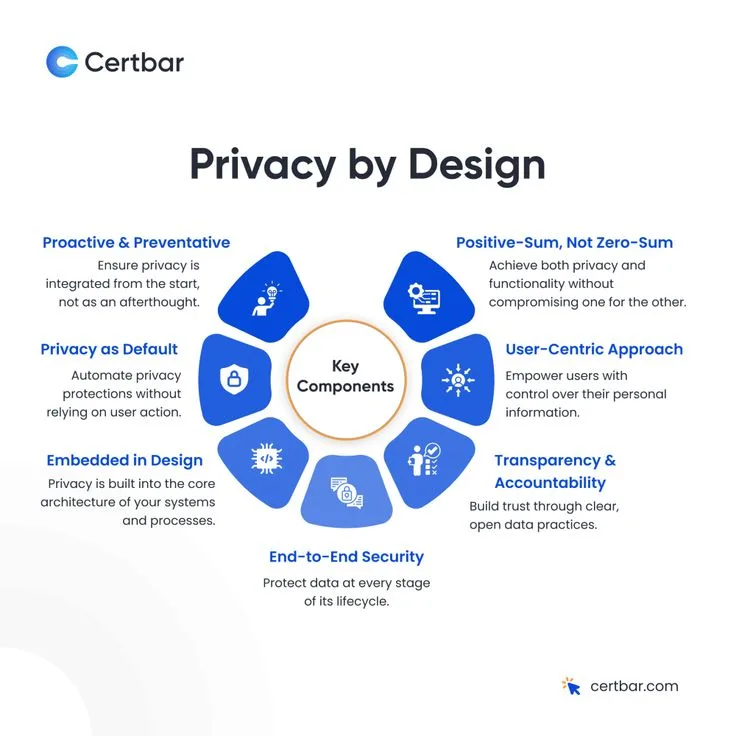
Cavoukian's seven principles form the backbone of Privacy by Design.[1] Understanding them is essential because they appear, explicitly or implicitly, in virtually every modern privacy regulation.
1. Proactive not reactive; preventive not remedial. Privacy measures should anticipate and prevent privacy-invasive events before they occur. Don't wait for breaches or complaints. Conduct Privacy Impact Assessments (PIAs) before launching new systems, products, or data collection practices.
Example: Apple's approach to on-device processing for features like Siri voice recognition and photo categorization.
Rather than uploading personal data to cloud servers for processing (creating a privacy risk that would need to be mitigated), Apple designed these features to process data directly on the user's device. The privacy risk was prevented by architecture, not addressed by policy.
2. Privacy as the default setting. Systems should protect privacy automatically. Users shouldn't need to take action to protect themselves. The most privacy-protective settings should be the out-of-the-box experience.
Example: When Facebook launched in 2004, user profiles were public by default. Users had to navigate complex settings to restrict visibility. When Signal launched its messaging app, end-to-end encryption was on by default-users didn't need to enable it, configure it, or even understand it.
The default revealed the company's actual priorities.
3. Privacy embedded into design. Privacy should be an integral component of the system's core functionality, not a separate add-on. This means privacy requirements are considered alongside functional requirements during system design, not addressed in a separate privacy review after the system is built.
4. Full functionality - positive-sum, not zero-sum. Privacy by Design rejects the idea that privacy must come at the cost of functionality, security, or business value. It seeks "win-win" solutions where privacy AND other objectives are achieved.
This principle challenges the common assumption that tradeoffs between privacy and utility are inevitable.
5. End-to-end security - full lifecycle protection. Data must be protected from the moment it's collected through processing, storage, and eventual destruction. Privacy protection doesn't end when data is archived or backed up.
6. Visibility and transparency. Organizations must be open about their data practices. Users, regulators, and auditors should be able to verify that privacy protections are functioning as claimed. This means clear documentation, independent audits, and accountability mechanisms.
7. Respect for user privacy - keep it user-centric. The interests of the individual whose data is being processed should be paramount. This means providing granular consent options, user-friendly privacy controls, and meaningful choices about data use.
"Privacy by Design is not about privacy versus functionality, or privacy versus security, or privacy versus business interests. It's about achieving all of these together, through creative and innovative design thinking." - Ann Cavoukian, creator of the Privacy by Design framework
Data Minimization: The First and Most Powerful Technique
Collect Less, Risk Less
Data minimization is the principle of collecting only the data strictly necessary for a specific, stated purpose. It is the single most effective privacy technique because data that doesn't exist can't be breached, misused, or mishandled.
Despite its simplicity, data minimization runs counter to the instincts of most organizations. The default impulse is to collect everything-"we might need it someday." This creates vast stores of sensitive data with no defined purpose, no clear retention policy, and no owner responsible for its protection.
1. Question every field. For every piece of data collected, ask: what specific business function requires this? If the answer is "we've always collected it" or "we might want to analyze it later," that's not a justifiable purpose.
2. Use the minimum fidelity necessary. If you need to verify a user is over 18, you need a date of birth check, not their full birth date stored permanently. If you need to know a user's general location for weather features, you need a city or postal code, not their precise GPS coordinates.
Example: When Apple launched Apple Pay, it was designed so that Apple never sees the user's credit card number, the merchant never receives it, and the transaction history stays on the device.
Apple created a payment system that processes billions of dollars while minimizing the data it touches. Contrast this with early mobile payment systems that stored full card details on servers as a "feature."
3. Implement data retention limits. Define how long each type of data will be kept and automate its deletion when the retention period expires.
Google's auto-delete feature for location history and web activity-introduced after years of criticism about indefinite data retention-allows users to set data to automatically delete after 3, 18, or 36 months.
| Data Type | Minimization Approach | Example |
|---|---|---|
| Age verification | Check threshold, don't store birth date | Over-18 boolean instead of date of birth |
| Location services | Use approximate location | City-level rather than GPS coordinates |
| Analytics tracking | Aggregate before storage | Session counts instead of individual page views |
| Communication content | End-to-end encryption | Provider cannot access message content |
| Payment processing | Tokenization | Token replaces card number after initial verification |
| User behavior | On-device processing | Recommendations computed locally, not on servers |
Privacy-Enhancing Technologies
Engineering Solutions to the Privacy Problem
Privacy-Enhancing Technologies (PETs) are technical mechanisms that enable functionality while protecting individual privacy. They represent the "positive-sum" principle in action-achieving both utility and privacy through engineering rather than policy.
1. Differential privacy. A mathematical framework that adds carefully calibrated random noise to data or query results. The noise is large enough to prevent identifying individual records but small enough to preserve accurate aggregate statistics.
Apple uses differential privacy to learn which emoji are most popular, which websites cause Safari to crash, and which QuickType suggestions are helpful-all without learning this information about any specific user.[3]
Example: The U.S. Census Bureau adopted differential privacy for the 2020 Census, adding noise to published statistics to prevent the re-identification of individuals while maintaining the statistical accuracy needed for congressional apportionment and federal funding allocation.[5]
The approach was controversial-some argued the noise reduced accuracy for small geographic areas-illustrating the genuine tradeoffs involved in privacy decisions.
2. Federated learning. Machine learning models are trained across multiple devices or servers holding local data samples, without exchanging the raw data. Instead of sending all user data to a central server for model training, the model goes to the data, learns locally, and only the model updates (not the data) are aggregated.[10]
Google uses federated learning to improve the Gboard keyboard's next-word predictions.[6] Each phone trains the model on its local typing data, sends only the model updates (not the keystrokes) to Google, and receives an improved global model. The individual typing data never leaves the device.
3. Homomorphic encryption. Allows computations to be performed directly on encrypted data without decrypting it first. The result, when decrypted, is the same as if the computation had been performed on the plaintext data. This enables cloud computing on sensitive data without the cloud provider ever seeing the unencrypted data.
4. Zero-knowledge proofs. Allow one party to prove to another that a statement is true without revealing any information beyond the truth of the statement. You can prove you're over 21 without revealing your age or any identifying information. You can prove you have sufficient funds for a transaction without revealing your balance.
5. Secure multi-party computation. Multiple parties jointly compute a function over their combined data without any party revealing their individual data to others. Useful for collaborative analytics, benchmarking, and joint research where data cannot be shared due to competitive or regulatory constraints.
Privacy by Default: Making Protection the Easy Path
Why Defaults Define Reality
Research consistently shows that the vast majority of users never change default settings. A 2020 study published in the Journal of Consumer Research found that over 90% of users accept default privacy settings without modification. This means defaults are not neutral choices-they are decisions made on behalf of users.
When a social media platform defaults profiles to "public," it has effectively decided that most users' information will be publicly visible. When a messaging app defaults to end-to-end encryption, it has decided that most conversations will be private.
The default reveals the organization's actual values more clearly than any privacy policy.
1. Most restrictive settings by default. Data sharing off. Tracking opt-in, not opt-out. Minimal data collection unless the user explicitly enables more. Profile visibility limited to connections, not the public.
2. Opt-in rather than opt-out for non-essential data uses. Essential data processing (necessary for the service to function) can proceed with clear notice. Non-essential processing (advertising, analytics, third-party sharing) should require explicit opt-in consent.
3. Short retention periods by default. Data is retained only as long as necessary for the stated purpose. If longer retention is needed, the user should be informed and given a choice.
Example: The contrast between WhatsApp and Telegram illustrates default design choices. WhatsApp enabled end-to-end encryption by default for all chats in 2016-every message, every photo, every call is encrypted without users doing anything.
Telegram, despite marketing itself as a privacy-focused messenger, defaults to unencrypted cloud chats. End-to-end encrypted "Secret Chats" exist but must be manually initiated for each conversation. The default tells you which product prioritizes privacy in practice versus in marketing.
Transparency and User Control
Making Privacy Understandable
Transparency is a foundational principle of Privacy by Design, but most privacy disclosures fail at their primary purpose: enabling users to make informed decisions about their data.
The average website privacy policy is over 4,000 words long-longer than this article. A 2008 Carnegie Mellon study estimated that reading every privacy policy a person encounters in a year would take 76 full work days.[4] Privacy policies are written by lawyers for regulators, not by designers for users.
1. Layered notices. Provide a brief, plain-language summary at the point of data collection, with links to detailed information for users who want more. The summary should answer: what data, why, who sees it, how long it's kept, and how to object.
2. Contextual disclosure. Explain data practices at the moment they're relevant, not in a separate document. When an app requests location access, explain in that moment why it needs location and what it will do with it.
3. Meaningful consent mechanisms. Consent should be: specific (for defined purposes, not blanket authorization), informed (user understands what they're consenting to), freely given (not conditional on service access for non-essential processing), and revocable (easy to withdraw).
4. User-accessible data controls. Users should be able to: view what data an organization holds about them, correct inaccuracies, delete their data, export their data in a portable format, and modify their consent choices. These controls should be easy to find and use, not buried in settings menus behind three layers of navigation.
"If you can't explain your data practices in plain language that a non-expert can understand, you probably don't understand them well enough yourself." - Aza Raskin, co-founder of the Center for Humane Technology
Organizational Implementation
Making Privacy by Design a Reality
Privacy by Design is not a technology project-it's an organizational transformation. It requires changes to how products are designed, how decisions are made, and how privacy is valued within the organization.
1. Privacy Impact Assessments (PIAs). Before launching new products, features, or data collection practices, conduct a PIA. Identify what personal data will be processed, assess risks to individuals, and document mitigations.
GDPR requires Data Protection Impact Assessments (DPIAs) for high-risk processing. But PIAs should be routine for all projects, not just those legally required.
2. Privacy engineering as a discipline. Embed privacy engineers within product development teams. Like security engineers who participate in secure system design, privacy engineers should participate in system design from the earliest stages, not review completed designs for privacy issues.
3. Training and culture. Every employee who handles personal data-developers, product managers, customer support, marketing-should understand basic privacy principles and their responsibilities. Privacy culture means employees ask "should we collect this?" before "can we collect this?"
4. Vendor and partner management. Third parties that process personal data on your behalf must meet your privacy standards. Data processing agreements should specify what data is shared, for what purposes, with what protections, and with what audit rights. The supply chain dimension of privacy is frequently underestimated.
5. Privacy metrics. Measure privacy performance: number of data subject requests received and response times, results of privacy audits, volume of data collected per user over time (should be decreasing as minimization improves), number of third parties with access to personal data, and privacy incidents reported.
Case Studies: Success and Failure
Organizations That Got It Right
DuckDuckGo built a search engine that doesn't track users. Every search is anonymous-no search history, no user profiles, no personalized results.
The company demonstrates that an advertising-supported business model doesn't require surveillance: ads are targeted to the search query, not the user. DuckDuckGo has grown to over 100 million daily queries, proving that privacy can be a competitive advantage.[11]
ProtonMail designed email with end-to-end encryption so that even Proton cannot read user emails. The architecture makes privacy structural rather than dependent on policy. Even if Proton were compelled to hand over data by a court order, encrypted email content would be unreadable without the user's password.
Organizations That Got It Wrong
Cambridge Analytica / Facebook represents the canonical privacy failure. Facebook's platform allowed third-party applications to access not just the data of users who installed the app, but the data of all their friends-without those friends' knowledge or consent.
Cambridge Analytica used this access to harvest data on 87 million Facebook users to build voter profiles for political campaigns.[7] The scandal revealed that Facebook's privacy controls were designed to appear protective while enabling extensive data access.
Clearview AI scraped billions of photos from social media and other public websites to build a facial recognition database, then sold access to law enforcement.[9] The company argued that publicly available photos had no privacy expectation. Courts and regulators in multiple countries disagreed, issuing fines and bans.
Clearview demonstrates what happens when technical capability outpaces privacy consideration-the question of "can we?" was answered without asking "should we?"
The Economic Argument for Privacy
Privacy by Design is often framed as a cost-an additional burden on development teams, a constraint on data collection, a barrier to personalization. This framing misses the substantial economic benefits.
1. Reduced breach costs. Organizations that collect less data, encrypt what they collect, and control access tightly suffer less damage from breaches. IBM's Cost of a Data Breach report consistently shows that organizations with mature data protection programs experience breach costs significantly below average.[8]
2. Regulatory compliance by architecture. Organizations that build privacy into their systems meet new regulations with minimal additional effort because the architecture already supports privacy requirements. Organizations that bolt privacy on must re-engineer for each new regulation.
3. Customer trust as competitive advantage. Consumer surveys consistently show growing privacy concerns and willingness to switch to privacy-respecting alternatives. Apple has made privacy a central marketing differentiator, generating brand loyalty and premium pricing partly based on privacy reputation.
4. Reduced technical debt. Privacy retrofits are expensive and often incomplete. Building privacy in from the start, like building security in from the start, is cheaper over the lifecycle of a system than adding it later.
5. Avoiding cognitive bias in data collection. Organizations that collect everything often suffer from data overload-more data doesn't automatically mean better decisions. Data minimization forces clarity about what information actually drives business value.
Where Privacy Engineering Is Heading
The field of privacy engineering is evolving rapidly, driven by tightening regulations, advancing technology, and shifting consumer expectations.
Automated privacy compliance. Tools that scan code and data flows to identify privacy violations before deployment, similar to how static analysis tools find security vulnerabilities. Privacy as code-expressing privacy policies in machine-readable formats that systems enforce automatically.
Confidential computing. Hardware-based trusted execution environments that protect data during processing, closing the last major gap in data lifecycle protection. Major cloud providers (Azure, GCP, AWS) now offer confidential computing options.
Synthetic data. Generating artificial datasets that preserve the statistical properties of real data without containing any actual personal information. Useful for testing, development, and analytics without privacy risk.
Decentralized identity. User-controlled digital identity systems where individuals hold their own credentials and share only what's necessary for each interaction, rather than relying on centralized identity providers that accumulate personal data.
The direction is clear: privacy is moving from a legal checkbox to an engineering discipline, from a cost center to a competitive differentiator, and from an afterthought to a fundamental design requirement. Organizations that embrace this shift early will find themselves well-positioned.
Those that resist will find themselves retrofitting, re-engineering, and paying fines.
Research Evidence: The Science Behind Privacy by Design
Since Ann Cavoukian articulated the foundational principles in 1995, researchers across computer science, law, behavioral economics, and public policy have produced empirical evidence examining how Privacy by Design functions in practice---when it works, when it fails, and why.
Acquisti, Brandimarte, and Loewenstein (2015), "Privacy and Human Behavior in the Age of Information": Published in Science, this comprehensive review by Alessandro Acquisti, Laura Brandimarte, and George Loewenstein examined how individuals actually respond to privacy decisions.
The research found that privacy preferences are highly context-dependent, inconsistent over time, and significantly influenced by default settings and framing.
Users who were shown their data displayed more prominently subsequently chose more restrictive privacy settings---a finding with direct implications for transparency design.
The study provided behavioral science grounding for the Privacy by Default principle, demonstrating empirically that defaults do not merely reflect user preferences but actively shape them.
Cavoukian, Taylor, and Abrams (2010), "Privacy by Design: Essential for Organizational Accountability and Strong Business Practices": Cavoukian and colleagues examined the organizational implementation of PbD across multiple sectors.
The paper documented that organizations implementing Privacy by Design reduced privacy-related complaints and regulatory inquiries by a measurable margin compared to organizations relying on compliance-only approaches.
The study found that privacy incidents requiring remediation cost organizations an average of 3-5 times more than equivalent privacy protections implemented at design time---the "cost of retrofit" providing an economic argument for proactive privacy design that complements the ethical and regulatory arguments.
Bélanger and Crossler (2011), "Privacy in the Information Systems Literature": A systematic review published in MIS Quarterly synthesizing 25 years of privacy research across 320 studies.
The meta-analysis found that information sensitivity, institutional trust, and perceived control over personal data were the strongest predictors of willingness to share information.
The research demonstrated that user trust---which Privacy by Design is explicitly designed to build---has measurable effects on adoption rates, user engagement, and willingness to share data necessary for service improvement.
Organizations with higher trust scores achieved similar data collection outcomes with fewer privacy violations and less regulatory friction.
Luger, Moran, and Rodden (2013), "Consent for All: Revealing the Hidden Complexity of Terms and Conditions": A CHI Conference study examining how users respond to consent mechanisms found that 97% of study participants accepted app permissions without reading them.
When researchers redesigned consent interfaces to present information at the point of relevance (contextual disclosure) rather than in upfront terms and conditions, comprehension of privacy implications increased by 74%.
The study provided empirical support for layered, contextual disclosure over comprehensive upfront privacy policies---directly informing best-practice Privacy by Design implementation.
Gurses, Troncoso, and Diaz (2011), "Engineering Privacy by Design": A workshop paper that translated Cavoukian's principles into engineering practices, identifying specific software design patterns that implement Privacy by Design.
The researchers categorized privacy patterns into data minimization patterns (anonymization, pseudonymization, aggregation), access control patterns (need-to-know enforcement, consent management), and accountability patterns (audit logging, data flow documentation).
The paper established a vocabulary connecting legal principles to software engineering practice and influenced subsequent privacy engineering curriculum at technical universities.
Case Studies: Organizations That Operationalized Privacy by Design
Abstract principles become concrete through examination of organizations that have systematically implemented Privacy by Design---successfully and unsuccessfully---and the measurable outcomes that resulted.
Apple's App Tracking Transparency (2021): When Apple introduced App Tracking Transparency (ATT) in iOS 14.5, it required all apps to request explicit user permission before tracking users across apps and websites owned by other companies.
The default was no tracking; users had to actively opt in. Adoption data collected by Flurry Analytics found that globally, approximately 13-14% of users opted into tracking when prompted. In the United States, opt-in rates were around 15%.
The result: approximately 85% of iOS users were not trackable across third-party apps and websites. Meta (Facebook) disclosed that ATT cost it $10 billion in advertising revenue in 2022, illustrating the economic significance of default settings in privacy design.
Apple's implementation demonstrated that Privacy by Default, at scale across one billion active devices, has measurable market consequences that extend well beyond any single organization's systems.
Signal Protocol Adoption (2016-present): The Signal Protocol, developed by Moxie Marlinspike at Open Whisper Systems, was designed with privacy by architecture: end-to-end encryption is structural, not optional.
When WhatsApp adopted the Signal Protocol for all messages in 2016, it became the largest deployment of end-to-end encryption in history, covering more than two billion users.
The cryptographic design means that WhatsApp cannot read message content regardless of legal requests---a Privacy by Design outcome that is enforced architecturally rather than by policy commitment.
WhatsApp has responded to numerous law enforcement requests for message content with the technically accurate statement that no message content exists on its servers.
The Signal Protocol demonstrates that privacy-protective architecture can be scaled to global deployment and adopted by commercial services without meaningful impact on the user experience.
Sidewalk Toronto (2017-2020): Alphabet's Sidewalk Labs proposed a technology-enabled urban development on Toronto's waterfront that included extensive data collection from sensors embedded in public infrastructure.
Despite Sidewalk Labs publishing a draft privacy framework and engaging with external privacy experts including Ann Cavoukian, the project's data governance model was criticized by privacy advocates, the Ontario Privacy Commissioner, and eventually Cavoukian herself, who resigned from her advisory role.
The project was cancelled in May 2020. Sidewalk Labs cited economic conditions related to COVID-19, but public resistance to the data collection model was significant throughout.
The case study illustrates the limits of retroactive privacy assessment: embedding data collection infrastructure in physical urban development raises privacy questions that are difficult to address through design principles once the core architectural decision (sensor-embedded public spaces) has been made.
Critics argued that Privacy by Design cannot fix a model in which pervasive public surveillance is the foundation rather than the exception.
ProtonMail Legal Orders (2021): ProtonMail, headquartered in Switzerland, received a legally binding order from Swiss authorities (acting on a request through Europol from French authorities) requiring it to log the IP address of a French climate activist.
ProtonMail complied with the order and the IP address was used to identify the activist.
The case illustrated both the strength and the limits of architectural privacy design: ProtonMail's end-to-end encryption meant authorities could not access email content, but metadata---specifically the IP address used to access the service---was not within the scope of ProtonMail's end-to-end encryption claims.
ProtonMail subsequently updated its marketing to clarify that it cannot guarantee anonymity against requests from Swiss law enforcement. The incident demonstrates that Privacy by Design requires precise definition of the threat model being addressed and clear communication to users about what is and is not protected.
Dutch Tax Authority SyRI System (2020): The Dutch government's System Risk Indication (SyRI) combined data from multiple government databases (income, employment, benefits, debts, utilities) using algorithmic analysis to identify citizens at risk of fraud.
A Dutch court ruled in February 2020 that SyRI violated Article 8 of the European Convention on Human Rights protecting private life.
The court found that the system lacked transparency (citizens could not know they were being analyzed), lacked proportionality (the scope of data analysis exceeded what was necessary), and lacked adequate safeguards.
SyRI was shut down. The case represents a judicial validation of Privacy by Design principles: data minimization, purpose limitation, and transparency are not merely regulatory requirements but legally enforceable rights with direct application to government data systems.
Sources & Further Reading
- Cavoukian, Ann. "Privacy by Design: The 7 Foundational Principles." Information and Privacy Commissioner of Ontario, 2009.
- European Parliament. "General Data Protection Regulation (GDPR), Article 25: Data Protection by Design and by Default." Official Journal of the European Union, 2016.
- Apple Inc. "Differential Privacy Overview." Apple Machine Learning Research, 2017.
- McDonald, Aleecia M. and Cranor, Lorrie Faith. "The Cost of Reading Privacy Policies." I/S: A Journal of Law and Policy for the Information Society, 2008.
- Abowd, John M. "The U.S. Census Bureau Adopts Differential Privacy." Proceedings of the 24th ACM SIGKDD, 2018.
- Google AI Blog. "Federated Learning: Collaborative Machine Learning without Centralized Training Data." Google, April 2017.
- Cadwalladr, Carole and Graham-Harrison, Emma. "Revealed: 50 million Facebook profiles harvested for Cambridge Analytica." The Guardian, March 2018.
- IBM Security. "Cost of a Data Breach Report 2024." IBM, 2024.
- Hill, Kashmir. "The Secretive Company That Might End Privacy as We Know It." The New York Times, January 2020.
- Bonawitz, Keith et al. "Towards Federated Learning at Scale: A System Design." Proceedings of MLSys, 2019.
- DuckDuckGo. "Privacy, Simplified." DuckDuckGo Company Page, 2024.