
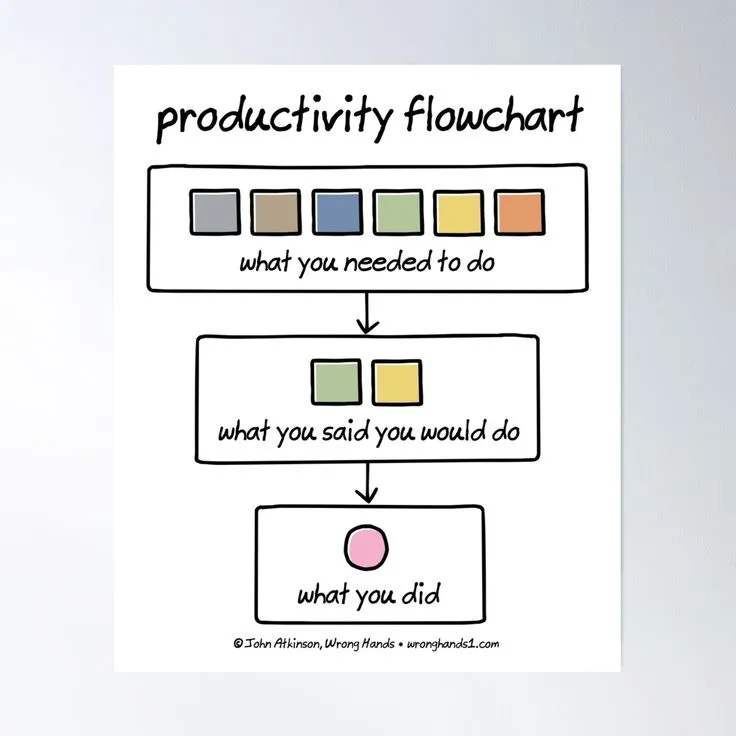
Productivity systems that scale are designed for reduced capacity and disruption, not only for periods of perfect focus and energy. A resilient core uses a trusted capture location, simple priorities, and recovery mechanisms, while optional layers can be removed without collapse. Complexity creep, interdependent maintenance steps, and peak-performance assumptions make systems brittle when life becomes unpredictable.
Most productivity systems work beautifully for about three months. Then life gets complicated. A product launch collides with a family crisis. A new job introduces unfamiliar demands. A health setback reshapes what is possible in a day.
The elegant system that worked when conditions were stable collapses under pressure, and the person who built it finds themselves starting over - often with a new app, a new framework, a new set of color-coded categories - hoping this time will be different.
"Systems thinking is a discipline for seeing wholes. It is a framework for seeing interrelationships rather than things, for seeing patterns of change rather than static snapshots." - Peter Senge, The Fifth Discipline
The distinction between systems that survive disruption and systems that shatter under it is not complexity or completeness. It is the degree to which the system is designed for the person operating it rather than for an idealized version of that person under ideal conditions.
Systems that scale are built on principles sturdy enough to survive chaos, not on routines that require perfect conditions to function.
In 2001, David Allen published "Getting Things Done," which became one of the most influential productivity frameworks of the decade.[1] GTD's core insight - that the mind is for having ideas, not holding them - drove millions of knowledge workers to implement capture systems, weekly reviews, and project lists.
The book went on to sell millions of copies. Within two years, online communities were documenting GTD collapses: people who had implemented the full system, maintained it for months, experienced a disruption, fallen behind on the weekly review, watched inboxes fill, and eventually abandoned the whole apparatus.
The failure was not in the system's logic; the failure was that the system had no graceful degradation. When you could not do everything, there was no guidance on what to do with less.
This is the challenge of productivity systems at scale: they must work not just when you are operating at full capacity but when you are overwhelmed, depleted, sick, distracted, or simply busier than the system anticipated. They must have recovery mechanisms. They must degrade gracefully and rebuild incrementally.
The Scaling Problem in Productivity
Why most systems fail to scale comes down to three structural flaws that appear repeatedly across different methodologies.
The first is complexity creep. Every productivity framework starts simple and grows. A task manager gains projects, which gain areas, which gain sub-areas, which gain tags, which gain multiple tag categories. A calendar system gains time blocks, which gain buffers, which gain theme days, which gain nested routines.
Each addition seems to solve a specific problem, but the aggregate effect is a system that requires significant cognitive overhead to maintain.
When capacity is reduced - by illness, overwork, or external chaos - the system becomes the thing that needs managing rather than the tool that helps manage everything else.
The second is brittleness through interdependence. Many systems are designed as integrated wholes where each component depends on the others functioning correctly. The GTD weekly review is essential because it is the mechanism by which all other components stay current.
If the weekly review is missed consistently, projects become stale, next actions become irrelevant, and the entire system loses fidelity. A system built on a single critical-path component will fail whenever that component fails.
The third is optimization for peak performance. Most productivity systems are designed and documented by people in a period of high motivation and available time. The system is calibrated for what a focused, energetic person can accomplish.
Real life contains long stretches of reduced capacity - illness, caretaking responsibilities, high-stress periods, periods of low motivation or mild depression. A system designed for peak performance has no answer for how to operate at 60%.
What scaling actually requires is a different design philosophy: minimum viable system at the core, optional enhancements that can be added and removed without destabilizing the whole, and explicit protocols for reduced-capacity operation.
| System Component | Scales Well | Does Not Scale | Reason |
|---|---|---|---|
| Single capture inbox | Yes | Multiple inboxes | Reduces decision overhead |
| Weekly review | Partially | Daily full review | Too much maintenance burden |
| Project-level priorities | Yes | Task-level priorities | Survives partial disruption |
| Time blocking | Partially | Fixed schedules | Needs flexibility |
| Energy-matched tasks | Yes | Equal effort all day | Resilient to capacity variation |
The Minimum Viable Productivity System
Before adding any methodology or framework, establishing a minimum viable system provides the foundation that survives disruption. This minimum viable system has exactly three components.
Component 1: A trusted capture location. A single place where every commitment, idea, task, and obligation is recorded immediately upon encountering it. Not a system of capture locations - one location.
The requirement is not organization but completeness: nothing that enters your attention should disappear into the ambient noise of daily life without being recorded somewhere.
The capture location can be anything that is always accessible: a physical pocket notebook, an app on a mobile phone, a voice memo application. The specific tool matters less than two properties: it must be always available, and it must be checked and processed regularly.
A capture system that captures but never processes is a different kind of anxiety machine - the obligation is recorded but never resolved.
Example: Jeff Weiner, former CEO of LinkedIn, kept a private Twitter account where he captured ideas throughout the day that he would process during scheduled buffer time. The tool was unconventional; the function was conventional. The capture did not have to be systematic to be effective - it had to be consistent and processed.
Component 2: A daily decision about the three most important tasks. Each day, before any reactive work begins, identify the three outcomes that would make the day genuinely successful.
Not the three tasks from the top of the task list, not the three items in the inbox, but the three outcomes that are most important given the current state of all commitments.
This practice is the minimum engagement with prioritization that a productive knowledge worker needs. It can be done in two minutes. It establishes intention rather than allowing the day to be entirely shaped by whoever emails first. It creates a reference point for mid-day recalibration.
Example: Warren Buffett reportedly uses a related version: the "two-list strategy," in which you write your 25 most important goals and then circle the 5 most important. The remaining 20 are not secondary priorities - they are distractions to actively avoid.
The same clarity of selection applies at the daily level: three most important, not fifteen. The constraint is the point.
Component 3: A weekly fifteen-minute review. Once per week, review all open commitments: open projects, outstanding tasks, scheduled deadlines, and calendar for the next two weeks.
The review has two purposes: ensuring that nothing is falling through the cracks, and adjusting priorities based on new information. This is the system's maintenance operation. Without it, the system drifts out of sync with reality.
The fifteen-minute duration is intentional. A thirty or sixty-minute weekly review is an aspiration; a fifteen-minute review is a commitment. The length constraint forces focus on what is genuinely necessary: what needs to move forward, what has been completed, what has changed.
Anything that cannot be addressed in fifteen minutes is a planning session, not a review, and should be scheduled separately.
These three components - trusted capture, daily intention, weekly review - constitute a complete minimum viable system. They can be done with a pocket notebook and a calendar. They survive every form of disruption because they are small enough to maintain at reduced capacity.
They provide the foundation on which more sophisticated practices can be built when conditions permit.
Adding Complexity Incrementally
The minimum viable system can be extended with four categories of enhancement, each of which adds value without creating critical dependencies. These enhancements can be added and removed as circumstances change without destabilizing the core.
Project Tracking
For anyone managing more than five ongoing projects simultaneously, a dedicated project list that tracks the current status and next action for each project reduces the cognitive overhead of remembering where things stand.
The project list minimum: For each project, record three things: a brief statement of the desired outcome, the most recent update or status, and the next concrete action required to move it forward. This is not a full project management system - it is a reference that ensures no project is forgotten and that the next step is always clear.
When to add more: Add milestones and deadlines when projects have defined end dates with consequences. Add stakeholder tracking when projects involve coordinating with multiple people. Add risk tracking when projects have significant uncertainty.
Add each of these only when the absence of that tracking is causing actual problems, not speculatively.
Example: The software project management company Basecamp maintains that their own internal project management follows a principle of minimum documentation: for each project, a kickoff document defining scope and approach, and then nothing else until a ship note when the work is complete.
The constraint forces clarity about what is actually necessary and discourages the overhead that accumulates when documentation becomes an end in itself.
Time Blocking
Time blocking - scheduling specific tasks or work types into defined calendar blocks - reduces the friction of starting work by converting decisions ("what should I work on?") into scheduled commitments made during a calmer planning moment.
The minimum time block structure: Block three categories of time: deep work (uninterrupted focus on important complex tasks), shallow work (email, administrative tasks, short meetings), and buffers (unscheduled time for the unexpected).
The ratio will depend on the nature of the work, but most knowledge workers function best with at least two to three hours of protected deep work per day.
Common mistakes in time blocking: Over-precision (scheduling tasks in fifteen-minute increments creates administrative overhead that defeats the purpose), over-commitment (blocking every hour leaves no buffer for the inevitable disruptions), and rigidity (treating the time block as a rule rather than an intention).
Example: Cal Newport, author of "Deep Work," maintains a rigid time block schedule that he plans at the start of each week and revises when plans change.
Newport's system is more elaborate than most people need, but his core practice - protecting morning hours for uninterrupted writing and research - is the element that produces his output.[3] The deep work blocks are the foundation; the surrounding structure serves them.
Energy Management
Productivity systems focused exclusively on time management systematically underperform because they treat all hours as equivalent when they are not.
A technically accurate schedule that puts difficult analytical work at 3 PM when energy is lowest will produce worse results than a less precise schedule that aligns important work with peak cognitive capacity.
The energy audit: Spend one week noting energy levels at 90-minute intervals throughout the day, rating each period on a simple 1-3 scale.
After a week, patterns emerge: the hours of peak cognitive capacity (typically within 1-3 hours of waking for most people), the post-lunch energy valley common in the early afternoon, and the second-wind period that some people experience in the late afternoon or evening.
These patterns are relatively stable for any individual and provide the basis for scheduling important work at high-energy times and administrative work at low-energy times.
Example: Daniel Pink, in "When: The Scientific Secrets of Perfect Timing," synthesizes chronobiology research showing that human performance across a wide range of cognitive tasks follows a predictable daily rhythm with a peak, a trough, and a rebound.[4]
The specific timing varies by chronotype (morning people have peaks earlier; evening people have peaks later), but the pattern is universal. Productivity systems that ignore chronobiology leave significant performance on the table.
The practical implication: Design the sequence of work, not just the schedule. What gets done in the morning? What gets done in the afternoon? What gets done in the evening if needed? The answers should be driven by cognitive demand of the task matched to energy availability, not by the sequence in which tasks arrived in the inbox.
Recovery Protocols
The element most missing from published productivity frameworks is explicit guidance for what to do when the system has fallen apart. This is not a failure state that requires starting over - it is a predictable condition that every system will eventually enter and that good systems are designed to recover from.
The three-day recovery: When the system has been neglected for more than a week - inbox overflowing, task list stale, commitments tracked inconsistently - the standard recovery protocol is: clear the inbox to zero (archive or delete everything older than one week without reading it; if it was important, someone will follow up), run the weekly review to identify what is still active and relevant, and resume the minimum viable system.
Do not try to reconstruct everything that was missed. Start fresh with the current state of reality.
The reduced-capacity protocol: When operating at reduced capacity - illness, high stress, caregiving demands - drop everything except the three most important commitments and the capture system. Explicitly permit everything else to wait.
The system is not an obligation that runs in parallel with a difficult life; it is a tool that serves life, and it should be adjusted accordingly.
Example: Google's SRE (Site Reliability Engineering) practice has formalized the concept of graceful degradation for software systems - the principle that when a system is under stress, it should maintain core functionality while shedding non-essential functionality.[7]
The same design principle applies to personal productivity systems. The "core functionality" of a personal system is: knowing the most important thing to do next and not losing track of critical commitments. Everything else is enhancement.
Organizational Productivity Systems
The scaling challenge becomes exponentially more complex when the system must serve not an individual but a team or organization. Individual productivity systems can be optimized for a single person's cognitive style, work patterns, and preferences.
Organizational systems must accommodate multiple people with different styles, coordinate across functions, and maintain consistency without requiring heroic ongoing effort.
The Coordination Overhead Problem
Andy Grove, the legendary Intel CEO whose book "High Output Management" remains one of the definitive texts on organizational management, identified the fundamental tension in organizational productivity: the more people involved in accomplishing any output, the more coordination overhead is required.
Every additional person adds communication costs, synchronization requirements, and potential for misalignment.
Grove's solution was radical clarity about the managerial output model: a manager's output is the output of their team, not the output of their individual efforts.[2]
The productivity system of a manager must be oriented primarily toward enabling and coordinating team output, not optimizing personal task completion. This inversion is counterintuitive but essential.
The principles that follow from this:
- Meetings are not interruptions to a manager's productive work; they are the manager's productive work
- A manager who is very busy but whose team is confused about priorities is underperforming
- The most valuable personal productivity investment for a manager is reducing the coordination costs imposed on their team
Shared Information Architecture
Teams waste enormous amounts of time searching for information that exists somewhere but is not findable. Research by McKinsey estimates that knowledge workers spend approximately 20% of their work time - one day in five - searching for information or recreating information that already exists.[6]
For a ten-person team, this represents approximately two full-time employees' worth of effort dedicated to information retrieval rather than value creation.
The solution is not a more sophisticated information management system but agreement on information architecture principles:
Single source of truth for each information type: Project status in one place. Meeting notes in one place. Reference documentation in one place. The specific tools matter less than the agreement that each information type lives in exactly one location.
Findability over perfect organization: Information that is well-organized but difficult to find is less valuable than information that is imperfectly organized but easily searched. Tool selection should prioritize search capability over categorical organization.
Explicit archival decisions: Information in active use and information preserved for reference require different treatment. Active information should be immediately accessible; archived information should be findable but not cluttering the active workspace.
Example: GitLab, the fully remote software company with over 2,000 employees, maintains a publicly accessible company handbook of over 2,000 pages that documents virtually every operational decision, process, and principle governing how the company operates.[8]
The handbook is the single source of truth for all organizational knowledge. When a question arises about how something should be done, the answer is either in the handbook or is added to the handbook after being answered.
The result is a productivity system that scales across a globally distributed team without depending on institutional memory held by specific individuals.
Meeting Architecture
Meetings are the most visible and most frequently criticized component of organizational productivity systems - and the most important to design deliberately.
Poorly designed meeting architecture creates enormous drag on organizational output; well-designed meeting architecture enables coordination that could not happen through asynchronous communication alone.
The meeting audit framework: For each recurring meeting, answer four questions:
- What decision or alignment is this meeting enabling that could not happen another way?
- Who must be present to accomplish that outcome? (Anyone else is overhead.)
- How long does achieving that outcome actually require?
- How frequently does the outcome need to be achieved?
The answers to these questions will reveal that most recurring meetings are too long, involve too many people, and occur more frequently than the decisions they support require.[9]
Meeting types and their appropriate design:
Decision meetings exist to reach decisions that require input from multiple stakeholders. They should be structured: agenda with decision clearly stated, relevant context pre-shared, decision made and recorded, next actions assigned. Duration: as long as the decision requires, typically 30-60 minutes.
Information sharing meetings exist to communicate information to multiple people simultaneously. These are frequently improvable: most information sharing is more efficient as written communication that recipients read asynchronously.
The justification for synchronous information sharing is that it enables immediate questions and discussion. If that is not the actual function, the meeting should be replaced with written communication.
Creative/collaboration meetings exist to generate ideas or solve problems that benefit from real-time interaction. These are where meeting investment pays off most clearly: the rapid iteration of in-person or video-call brainstorming produces outputs that serial asynchronous communication cannot.
Relationship meetings - one-on-ones between managers and direct reports - are investments in the working relationship that enable all other collaboration. Research on management effectiveness consistently shows that regular, structured one-on-ones are among the highest-value activities a manager can perform.
These should be weekly or biweekly, structured around the direct report's priorities rather than the manager's, and protected from cancellation.
Example: Amazon's "two-pizza team" principle (teams small enough to be fed by two pizzas) is a structural approach to keeping coordination costs manageable.
Jeff Bezos has described the primary function of this constraint: it keeps the group small enough that a single meeting can include everyone relevant, which means fewer secondary communication channels are needed to keep everyone aligned.
The meeting architecture principle follows from the team architecture.
The Role of Tools
The productivity tool industry generates billions in revenue and enormous amounts of discourse about which tools are best. The actual relationship between tools and productivity is less influential than the discourse suggests.
What tools can do: Reduce friction in consistent practices by making capture, tracking, and review faster and more convenient. Store and retrieve information reliably. Automate repetitive administrative tasks. Provide visibility into the state of work across a team.
What tools cannot do: Create the habits and practices that make a system work. Compensate for unclear priorities, poor judgment about what is important, or insufficient time for deep work. Solve coordination problems that are fundamentally about communication and role clarity rather than information management.
The tool selection principle: Choose the simplest tool that reliably serves the practices you have already established. Tools should follow practices, not precede them.
The most common productivity mistake is implementing an elaborate tool in the belief that the tool will create the practice, when the causation runs in the opposite direction.
The switching cost problem: Moving from one tool to another has three costs: migration time (moving or recreating existing data), learning curve (becoming fluent in the new tool), and system disruption (breaking the habits and workflows built around the old tool).
These costs are typically underestimated because the future state (proficient use of the new tool) is compared to the past state (established use of the old tool) rather than to the transition state (incompetent use of the new tool with old system partially dismantled).
Example: The productivity writer Tiago Forte documented publicly that he had moved his entire note-taking practice from Evernote to Notion and then from Notion to a combination of Notion and Roam Research.[5] Each migration took significant time and created disruption.
His retrospective assessment was that the migrations produced marginal improvement in output relative to the cost. The lesson he drew: tool migrations should be driven by specific, concrete problems that the current tool cannot solve - not by the allure of a new tool's features.
Measuring Productivity System Effectiveness
How do you know whether a productivity system is working? The naive answer - tracking how much you accomplish - conflates output volume with output quality and can incentivize the wrong behaviors (busy work over important work, short-term tasks over long-term projects).
What to actually measure:
Completion rate on important tasks: Not all tasks, but tasks that were identified as important. A system that reliably gets the important things done while routinely failing to complete the unimportant ones is working correctly. A system that completes everything at equal rates is not making useful distinctions.
Cognitive load: How often do you experience anxiety about forgotten commitments? How frequently do you lie awake at night worrying about things you might have missed? A well-functioning productivity system moves commitments out of the mind and into a trusted external system, reducing cognitive load.
If the system is running well, the answer to "is there anything I'm forgetting?" should reliably be "I don't know, but I have a system that will remind me."
Recovery speed after disruption: How long does it take to return to a functional state after an unexpected disruption? This is perhaps the best single measure of a system's scaling ability. Systems that take days or weeks to recover from a disruption are too brittle.
Systems that can be restored to functional state in 30 minutes are well-designed.
Energy in versus energy out: Does maintaining the system require more effort than it saves? This calculation is often invisible because the cost of the system (time spent on reviews, organizing, updating) is observable while the benefit (work not forgotten, decisions made faster, stress reduced) is invisible.
Periodically estimating both sides of this equation provides a reality check on whether the system overhead is justified by its outputs.
Long-Term System Design
A productivity system built for a person at 30 may not serve that person at 40. Career changes, family changes, health changes, and evolving goals change the demands that a productivity system must meet.
Systems that are designed as permanent solutions require periodic redesign; systems that are designed as evolving frameworks adapt as circumstances change.
Annual system review: Once per year, evaluate the productivity system against current life conditions. Is the system serving the goals and responsibilities that currently matter? Are there components that exist for historical reasons but no longer serve current needs? Are there new needs that the system is not addressing?
The five-year question: What would a person who has my current responsibilities but significantly more resources - more time, more money, more help - accomplish in five years that I would like to accomplish?
Working backward from this answer identifies the highest-priority areas where improved productivity would have the most impact. These areas are where system investment is most justified.
Designing for change: The most durable productivity systems are not the most elaborate but the most adaptable. They are built on principles rather than procedures, on clarity about what matters rather than detailed rules for how to accomplish everything.[10]
When circumstances change, the principles remain useful even as the specific practices must evolve.
The productivity systems that scale are not the ones that promise to handle everything - no system does. They are the ones that maintain their essential function under pressure, recover quickly when disrupted, and evolve incrementally as the demands placed on them change.
Minimum viable at the core. Optional enhancements at the edges. Recovery protocols embedded by design. This is the architecture of a productivity system that lasts.
See also: Personal Knowledge System Design, Lightweight System Design Principles, and Team Workflow Improvement Ideas.
What Research Shows About Productivity Systems That Scale
Mihaly Csikszentmihalyi, professor of psychology at Claremont Graduate University and former chair of the psychology department at the University of Chicago, studied optimal human performance across several decades using an experience sampling method: paging participants at random intervals throughout the day and asking them to report their mental state and activity.
Published across multiple papers in the American Psychologist and synthesized in "Flow: The Psychology of Optimal Experience" (Harper and Row, 1990), Csikszentmihalyi's research on over 8,000 participants found that the highest-quality experiences and most productive work states occurred when task challenge closely matched individual skill level.
His finding that productivity systems that create too many or too few demands both degrade performance explains why systems designed for peak-capacity operation fail during disruption: the mismatch between system demands and available cognitive capacity collapses the flow state that makes complex work possible.
Gloria Mark at the University of California Irvine's Donald Bren School of Information and Computer Sciences has studied digital interruption and recovery for over two decades, publishing findings in journals including Communications of the ACM and Human Factors.
Her landmark research, observing workers directly, found that knowledge workers switch tasks about every three minutes and that the average time to return to original task after an interruption is 23 minutes and 15 seconds.
In subsequent research published in 2016, Mark found that heavy multitaskers showed elevated cortisol (stress hormone) levels throughout the day and demonstrated 40% lower performance on complex cognitive tasks compared to single-task-focused workers.
Her findings establish the cognitive cost of productivity systems that fail to protect focused attention as far greater than the time cost of interruptions alone.
Leslie Perlow at Harvard Business School, in collaboration with consultants at Boston Consulting Group, conducted a rigorous field experiment published in Harvard Business Review (2012) and the journal Management Science (2014).
Perlow and colleagues worked with BCG consulting teams over 12 weeks, implementing structured "predictable time off" - guaranteed quiet times free from client demands and interruptions.
Teams with protected time reported 58% higher job satisfaction, 72% higher work-life satisfaction, and 74% higher likelihood of remaining at the firm long-term compared to control teams.
Critically, client satisfaction scores did not decrease - they increased by an average of 11 points - demonstrating that protected focused work time benefits output quality rather than reducing it.
Roy Baumeister at Florida State University and his colleagues, conducting research published in the Journal of Personality and Social Psychology (1998) and synthesized in "Willpower: Rediscovering the Greatest Human Strength" (Penguin Press, 2011, with John Tierney), demonstrated that self-control and decision-making ability draw on a limited cognitive resource that depletes through use.
Their experiments found that participants who performed demanding self-control tasks earlier in a study made significantly worse decisions and showed lower persistence in subsequent tasks.
The implication for productivity system design is direct: systems that front-load decisions, administrative tasks, and system maintenance compete with the cognitive resources available for complex work, explaining why systems requiring daily planning rituals and complex organizational maintenance degrade performance rather than enhancing it.
Real-World Case Studies in Productivity Systems That Scale
Microsoft's Viva Insights team, working with data from 30,000 Microsoft employees over an 18-month period from 2020 to 2022, conducted one of the largest natural experiments in organizational productivity ever documented, publishing findings in the Microsoft Work Trend Index 2022.
The research found that employees with fewer than 5 hours per week of focused, uninterrupted work time were 43% less likely to report high job satisfaction and had 29% lower self-reported productivity scores.
Microsoft's analysis showed that meeting hours had increased by 252% between 2020 and 2022, with the median employee spending 57% of their week in meetings, email, and instant messaging rather than focused work.
Microsoft subsequently implemented organization-wide "focus time" blocks in their Viva Insights product, and internal pilot teams using protected focus blocks reported 34% improvement in work completion rates.
4-day workweek trials conducted by Andrew Barnes at Perpetual Guardian, a New Zealand estate planning firm, in 2018 provided the first rigorously measured case study of reduced-hour productivity.
Barnes and researchers from the University of Auckland and the University of Technology Sydney documented the results in a report published through the economic consultancy Jarvis Walker.
Over the 8-week trial, employee productivity increased by 20%, work-life balance satisfaction improved by 24%, and stress levels decreased by 7%.
Critically, client satisfaction and revenue were maintained. Perpetual Guardian permanently adopted the 4-day week following the trial, and the study catalyzed similar trials at Microsoft Japan (which reported 40% productivity improvement), Unilever New Zealand, and eventually over 30 companies participating in the 4 Day Week Global program in 2022.
Shopify's "Chaos Monkey for meetings" initiative, launched in January 2023 when CEO Tobi Lutke canceled all recurring meetings of more than two people, provided a natural experiment in meeting reduction at scale.
Shopify removed 12,000 recurring calendar events in a single action, freeing an estimated 76,500 hours per week across the organization.
Shopify's internal data, shared publicly, showed that the average employee had regained 12 hours per week of reclaimed time.
Follow-up surveys conducted 90 days later found that 87% of employees reported the same or better team coordination outcomes, and 71% reported feeling more productive.
Shopify's quarterly earnings in the 18 months following the initiative showed consistent revenue growth, suggesting the meeting reduction did not impair organizational coordination capacity.
Asana, the work management platform, publishes an annual Anatomy of Work Index measuring how employees across industries spend their time.
Their 2023 report, based on 13,000 respondents across seven countries, found that employees spent only 27% of their time on skilled work they were hired to do; 60% was spent on coordination, status updates, and administrative work that surrounds and supports the core work.
Asana's own internal productivity initiative, implementing what they call "No Meeting Wednesdays" and reducing meeting durations through standardized agendas, shifted the ratio for their own employees to 43% time on core work and 57% on coordination - a 59% improvement in time-on-skilled-work.
Asana tracked this change against their engineering output metrics and found a 28% increase in features shipped per quarter during the same period.
Sources & Further Reading
- Allen, David. Getting Things Done: The Art of Stress-Free Productivity. Penguin Books, 2015. View source
- Grove, Andrew. High Output Management. Vintage Books, 1995. View source
- Newport, Cal. Deep Work: Rules for Focused Success in a Distracted World. Grand Central Publishing, 2016. View source
- Pink, Daniel. When: The Scientific Secrets of Perfect Timing. Riverhead Books, 2018. View source
- Forte, Tiago. Building a Second Brain: A Proven Method to Organize Your Digital Life and Unlock Your Creative Potential. Atria Books, 2022. View source
- McKinsey Global Institute. "The Social Economy: Unlocking Value and Productivity Through Social Technologies." McKinsey and Company, 2012.
- Beyer, Betsy et al. Site Reliability Engineering: How Google Runs Production Systems. O'Reilly Media, 2016. View source
- GitLab. "GitLab Handbook." GitLab. View source
- Fried, Jason and Hansson, David Heinemeier. It Doesn't Have to Be Crazy at Work. Harper Business, 2018. View source
- Covey, Stephen. The 7 Habits of Highly Effective People. Simon and Schuster, 2004. View source