
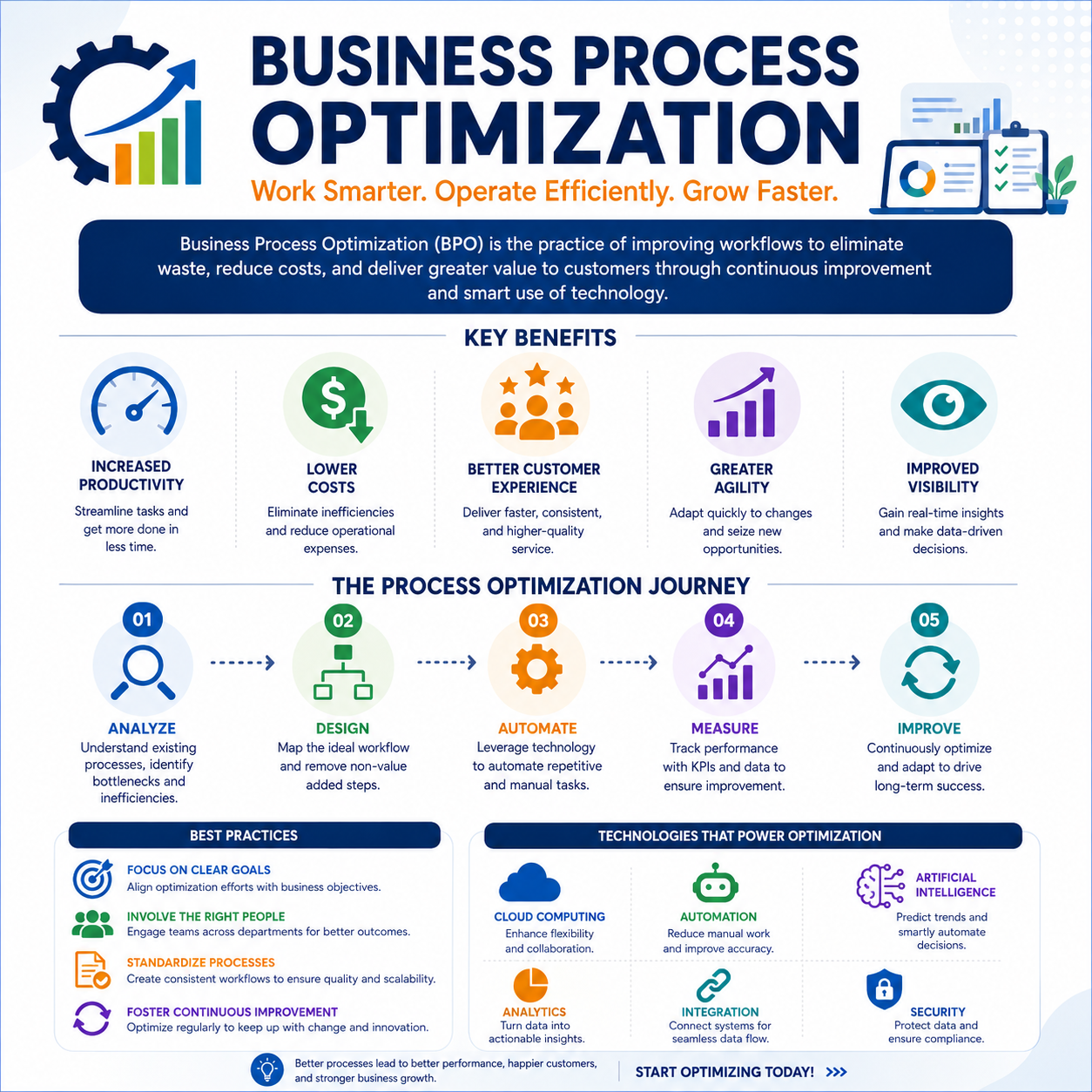
Process optimization strategies begin with diagnosis: improve the binding bottleneck before polishing work that does not limit overall throughput. Observation can reveal waiting, rework, handoffs, errors, and unnecessary steps, but the first question is whether a process should exist at all. Eliminating obsolete or unused work can produce more value than making it marginally faster.
Toyota's production system did not emerge from a theory. It emerged from decades of close observation on the factory floor, led by engineers like Taiichi Ohno who spent hours watching workers assemble vehicles and asking a relentless series of questions: Why is this step done this way?[3] What happens when it goes wrong? Where does work pile up? What would happen if this step were eliminated?
"The most dangerous kind of waste is the waste we do not recognize." - Shigeo Shingo, Toyota Production System consultant
The result was Lean manufacturing - a philosophy and a set of practices that transformed automotive production and eventually influenced software development, healthcare, logistics, and organizational management worldwide. The core insight was simple and radical: most of what organizations do is waste.
Value-adding activities account for a small fraction of total time; the remainder is waiting, transportation, rework, overproduction, and unnecessary motion.
The same insight applies at every level, from factory floors to knowledge workers' daily routines. Process optimization is the disciplined practice of finding and reducing waste - not just doing things faster, but doing less of the wrong things and more of the right ones.
It requires accurate diagnosis before intervention, focus on the right bottleneck before addressing secondary constraints, and the intellectual honesty to eliminate unnecessary steps before optimizing necessary ones.
Identifying Which Processes to Optimize First
The most common mistake in process improvement is optimizing in the wrong place. Resources spent improving a process that does not constrain overall output produce no improvement in throughput.
The Theory of Constraints, developed by Eliyahu Goldratt and described in his business novel "The Goal," provides the corrective framework.[1]
The Theory of Constraints states: every system has a single binding constraint (the bottleneck) that limits the rate at which the system achieves its goal. Improving anything other than the constraint does not improve overall system performance - it merely creates more work waiting at the bottleneck.
Finding the bottleneck requires observation:
- Where does work pile up? Work accumulates upstream of the constraint.
- What step makes everything else wait?
- What step is always busy while others have idle time?
- What process generates the most complaints about slowness?
Example: A software engineering team is struggling with slow feature delivery. The CEO wants to hire more engineers, believing that development is the bottleneck.
An analysis of cycle time reveals that development work sits waiting for code review for an average of 3.5 days before being reviewed, and that 40% of reviews require substantial rework.
The bottleneck is not development capacity - it is code review quality and timeliness. Hiring more engineers would make the code review backlog worse, not better.
The correct intervention is improving code review throughput: reducing review time, improving developer skills to reduce rework, or both.
| Optimization Approach | Best For | Time to Results | Risk Level |
|---|---|---|---|
| Bottleneck removal | Throughput limits | Medium | Low |
| Error rate reduction | Rework-heavy processes | Medium | Low |
| Handoff elimination | Cross-team friction | Slow | Medium |
| Automation | Repetitive manual tasks | Slow | Medium |
| Batch size reduction | Long lead times | Fast | Low |
| Decision rights clarification | Approval bottlenecks | Fast | Low |
Prioritization heuristics beyond bottleneck analysis:
- Frequency times time cost: Processes done 100 times per week warrant more attention than processes done once per month, even if the per-instance time is similar.
- Error rate impact: Processes with high error rates generate rework that multiplies the total cost far beyond the nominal process time. A 10% error rate on a 30-minute process effectively makes it a 33-minute process before rework.
- Cross-functional friction: Processes that require handoffs between teams are disproportionately expensive because they involve waiting, context loss, and coordination overhead. A process with four team boundaries has exponentially more friction risk than one with no handoffs.
- Subjective frustration: Processes that people consistently complain about or work around are often genuinely suboptimal. The psychology of frustration is a leading indicator of process failure.
The Crucial Distinction: Eliminating vs. Optimizing
The first question when confronting any process is not "how do we make this faster?" It is "do we need to do this at all?"
This is not a rhetorical question. Many organizational processes exist because they were put in place years ago to address a problem that has since been solved by different means, or because someone believed they were best practice without testing whether they applied in context.
They persist because no one is explicitly responsible for questioning them and because the inertia of "this is how we do things" is powerful.
Elimination criteria:
- The process produces an output that is never used
- The problem the process addresses no longer exists
- A downstream process already catches the issue this process is meant to prevent
- The time spent on the process exceeds the cost of the problems it prevents
- The process was designed for a business context that has significantly changed
Example: A marketing team produces a weekly status report that is emailed to twelve stakeholders. A brief survey reveals that seven of the twelve rarely read it, three read only one or two sections, and only two read it thoroughly and find it useful.
Rather than optimizing the report (making it shorter, cleaner, or better formatted), the team eliminates it and replaces it with a one-paragraph summary for the two engaged stakeholders and a shared dashboard for anyone who wants on-demand access. Total time savings: three hours per week. The elimination took ten minutes of conversation.
The elimination challenge: The political difficulty of elimination is often greater than its analytical difficulty. Processes have owners. Removing a report that someone has produced every week for two years feels like a judgment on their work.
Framing elimination conversations around the value of the output - not the work of the person producing it - makes them more productive. "The report isn't generating the value we need for the time it takes" is different from "your report isn't useful."
Lean Thinking Applied to Knowledge Work
While Lean manufacturing focuses on physical production, its core concepts translate directly to knowledge work with modest adaptation.
The eight wastes (adapted for knowledge work):
Overproduction: Generating more output than is needed. Reports no one reads. Documentation that is never consulted. Features that were built but are not used. The classic knowledge work waste.
Waiting: Idle time while waiting for approvals, responses, or inputs from others. A knowledge worker waiting for legal approval on a contract, or waiting for a manager's sign-off on a decision they are empowered to make, is experiencing waiting waste.
Transportation: Unnecessary handoffs between people or systems. Each time information changes hands, context is lost, delays occur, and errors can be introduced. The three-email chain that could have been a three-minute conversation is transportation waste.
Overprocessing: Applying more effort than the task requires. Perfecting work that will be discarded or never closely examined. A slide deck that took 12 hours to produce for a 10-minute internal presentation is overprocessing.
Inventory: Work in progress that has been started but not completed. Unfinished projects, half-developed features, and partially written documents all represent inventory waste - energy invested that has not yet produced value.
Motion: Unnecessary switching between tools, applications, or contexts. The cognitive cost of context-switching is substantial; motion waste in knowledge work is primarily the friction of moving between different environments to complete a single task.
Defects: Errors that require rework. A report with incorrect data that must be corrected and redistributed. Code that passes review but fails in production. The rework cost is always higher than the cost of getting it right the first time.[10]
Underutilization: Failing to use the skills and knowledge available. Over-specialization that prevents people from contributing where they have relevant expertise. Insufficient delegation that keeps leaders doing work that others could do as well.
Example: A content creation team maps their article production process and identifies the following wastes: they produce outlines that their editor substantially revises before writing begins (overprocessing the outline step, creating defects requiring rework).
Writers wait an average of 4 days for editorial feedback because the editor batches reviews (waiting waste). The editorial brief is stored in one system, the draft in another, and the final article in a third (motion waste). Addressing these three wastes reduces cycle time from 3 weeks to 10 days without increasing headcount.
Value Stream Mapping
Value stream mapping is a visual tool borrowed from Lean manufacturing for understanding how work flows through a process. It captures every step from initiation to completion, including the time each step takes, the wait time between steps, and who or what is responsible for each step.
Creating a value stream map involves:
Identifying the flow: Define the start and end points of the process you are mapping. For a content publication process, this might be "topic approved" to "article published and promoted."
Walking the process: Follow an actual piece of work through every step, recording what happens, who does it, and how long it takes - including the wait time between steps. This "walk" reveals the reality of how work actually flows, which frequently differs from how it is described in process documentation.
Calculating lead time vs. process time: Lead time is total elapsed time from start to finish. Process time is the time the work is actively being worked on. The ratio reveals the proportion that is waste (waiting). In most knowledge work processes, process time is 10-30% of lead time; the remainder is waiting.
Identifying improvement opportunities: Where is the longest wait? Where do errors occur most frequently? Where does work pile up? Each of these is a candidate for focused improvement effort.
Example: A sales team maps their customer proposal process and discovers that a proposal that takes 4 hours to write has a total lead time of 12 days, primarily because it sits waiting for pricing approval from finance for 7 of those days.
The improvement is not in making the writing faster - it is in redesigning the approval process: granting the sales team authority to approve standard pricing themselves, with escalation only for non-standard requests.
DMAIC: The Structured Improvement Cycle
For complex processes where the cause of performance problems is not obvious, the DMAIC cycle (from Six Sigma methodology) provides structure:
- Define: What is the process, who are its customers, and what do they need? Define the problem precisely, including the gap between current and desired performance.
- Measure: What is the current performance? Collect baseline data before any changes are made. The baseline is essential for evaluating whether improvements are real.
- Analyze: What is causing the performance gap? Identify root causes, not symptoms. Tools: fishbone diagrams, 5 Whys analysis, statistical correlation analysis.
- Improve: Design and implement changes to address root causes. Pilot the improvement with a small portion of the process before full implementation.
- Control: How do we ensure the improvement persists? Put monitoring and feedback mechanisms in place to detect regression and maintain the improved performance.
The key discipline is in the "Measure" and "Analyze" phases. Most improvement efforts jump directly to solutions without establishing a baseline or rigorously identifying root causes.
The result is solutions to the wrong problems, or solutions to the right problems that cannot be confirmed as effective because there is no baseline to compare against.
Example: Google's Site Reliability Engineering (SRE) practice uses a structured incident review process that parallels DMAIC.[4]
After every significant outage, teams conduct a blameless post-mortem that defines the incident, measures the impact, analyzes contributing factors (not just proximate causes but underlying systemic conditions), identifies improvements, and implements monitoring to detect recurrence.
The "blameless" framing matters: when accountability focuses on people rather than systems, the analysis stays at the surface and the underlying conditions are not addressed.
Making Process Changes Stick
Research on organizational change consistently shows that process improvements fail more often than they succeed - not because the improvements were wrong, but because implementation was treated as a technical problem when it is primarily a human one.[9]
Why improvements fail to stick:
- The people doing the work were not involved in designing the change, so they do not understand the rationale and have no ownership
- The improvement addresses leadership's frustration rather than frontline workers' actual pain
- The new process is more complex than the old one, requiring sustained effort to maintain
- There is no feedback mechanism to detect when people revert to old behavior
- The benefits are not visible to the people doing the extra work the new process requires
What makes changes stick:
Involvement: Process changes designed by the people who do the work succeed more often than top-down mandates.[7] Even if the conclusion is the same, the involvement builds understanding and commitment.
Visible benefit: The people affected should be able to see how the change makes their work easier or better, not just how it benefits the organization. "This reduces the rework you hate doing" is more motivating than "this improves our cycle time metrics."
Simplification: When possible, improvements should make the process simpler, not more complex. A new step in a process requires ongoing effort to maintain; removing a step creates permanent relief.
Monitoring with feedback: Establish a mechanism to detect when the new process is not being followed and a clear path to address it without blame.
Example: When Alcoa CEO Paul O'Neill declared worker safety his top priority in 1987 - over financial metrics, over production targets - he backed this with a system that required every manager who became aware of a safety incident to notify him personally within 24 hours, along with a plan for preventing recurrence.
The feedback loop was visible, took precedence over everything else, and came with genuine executive attention. Alcoa's safety performance improved dramatically, and so, incidentally, did its financial performance - because the discipline that drove safety also drove operational excellence across every aspect of production.
Measuring Process Improvement
Process optimization without measurement is intuition, not management.[8] Baseline metrics establish what you are starting from; outcome metrics tell you whether you succeeded.
Useful process metrics:
- Cycle time: Total elapsed time from process start to completion. The most fundamental process speed metric.
- Process time: Time the work is actively being worked on (vs. waiting). Process time as a percentage of cycle time reveals how much of the process is waste.
- Error rate: Percentage of work items requiring rework. High error rates indicate either insufficient quality controls or insufficient capability.
- Throughput: Number of work items completed per unit time. A direct measure of process capacity.
- Defect escape rate: Errors that reach downstream steps before being caught. Defects that escape to customers are far more expensive than defects caught internally.
Leading vs. lagging indicators: Lagging indicators (customer satisfaction, revenue impact) reflect outcomes but take time to measure. Leading indicators (cycle time, error rate) respond quickly to process changes and enable faster iteration.
An improvement strategy that relies only on lagging indicators cannot course-correct quickly enough to be effective.
Balancing Consistency and Flexibility
A persistent tension in process design is between standardization (which enables consistency, quality, and efficiency) and flexibility (which enables responsiveness to variation and creative problem-solving).
The resolution: standardize where consistency matters most, build in flexibility where it adds value, and document the boundary clearly.
- Standardize repeatable processes where quality depends on consistency: compliance-related work, customer-facing communications, safety-critical procedures
- Apply principles, not procedures to creative work, novel situations, and rapidly changing domains
- Build exception handling into the design: every standard process should have a clear mechanism for deviating when circumstances warrant, without requiring the entire process to be redesigned
The goal of process optimization is not to eliminate judgment but to free cognitive resources for the work that requires it. A well-optimized process handles the routine efficiently, so that human attention is available for the genuinely non-routine.
See also: Workflow Automation Ideas, Team Workflow Improvement Ideas, and Lightweight System Design Principles.
What Research Shows About Process Optimization
Nicole Forsgren, Jez Humble, and Gene Kim at the DevOps Research and Assessment (DORA) organization conducted the largest longitudinal study of software delivery performance ever undertaken, tracking over 31,000 professionals across 2,000 organizations between 2013 and 2019.
Their research, published in "Accelerate: The Science of Lean Software and DevOps" (IT Revolution Press, 2018), identified four key metrics - deployment frequency, lead time for changes, mean time to restore service, and change failure rate - that distinguish elite-performing organizations from low-performing ones.
Elite organizations deployed code 208 times more frequently than low performers and had 106 times faster lead times from code commit to deployment (2019 State of DevOps Report).
Critically, Forsgren and colleagues found that these performance gains were not achieved by working faster but by eliminating waste in handoffs, batch sizes, and approval processes - exactly the process optimization insights Lean manufacturing had identified decades earlier for physical production.
Michael Hammer, the MIT computer science professor who popularized "business process reengineering" in a landmark Harvard Business Review article in 1990, described the outcomes of systematic process redesign at major corporations.
Hammer and co-author James Champy reported in "Reengineering the Corporation" (HarperCollins, 1993) that companies conducting fundamental process redesign - rather than incremental improvement - achieved average cost reductions of 30-40% and cycle time improvements of 50-90% for the redesigned processes.
Their most cited case, Ford Motor Company's accounts payable redesign, reduced the AP department from 500 to 125 employees while processing more invoices more accurately.
Hammer's finding that most organizations redesign processes around existing departmental structures rather than around the actual flow of work explains why incremental improvement so often produces modest gains.
James Womack and Daniel Jones at the Lean Enterprise Institute studied the diffusion of Toyota Production System principles beyond automotive manufacturing, publishing their findings in "Lean Thinking" (Simon and Schuster, 1996).[2]
Tracking 50 companies across manufacturing and service industries that implemented Lean principles over 3-5 year periods, Womack and Jones found average improvements of 50% in defect reduction, 75% reduction in manufacturing or process time, and 90% reduction in work-in-progress inventory.
Their key finding for knowledge work application was that the ratio of value-added time to total process time in most organizations is between 1% and 5%: for every hour of work that directly adds value, 19 to 99 hours are consumed by waiting, transportation, overprocessing, and other forms of waste.
Mikel Harry and Richard Schroeder, who helped develop the Six Sigma methodology at Motorola in the late 1980s and documented it in "Six Sigma: The Breakthrough Management Strategy Revolutionizing the World's Top Corporations" (Currency/Doubleday, 2000), tracked the financial impact of systematic process measurement and improvement across Motorola's manufacturing and service operations.
Their analysis found that organizations achieving Six Sigma quality levels (3.4 defects per million opportunities) spent an average of 5% of revenue on quality-related costs, compared to 20-30% of revenue for companies with average quality levels.[5]
The cost difference - 15-25 percentage points of revenue - represents the true cost of process failure and demonstrates why systematic process optimization produces such dramatic financial returns.
Real-World Case Studies in Process Optimization
Toyota's Georgetown, Kentucky manufacturing plant, which opened in 1988 as the first US facility fully implementing the Toyota Production System, documented a remarkable performance trajectory over its first decade.
University of Michigan professor Jeffrey Liker, who conducted a 20-year research study of Toyota documented in "The Toyota Way" (McGraw Hill, 2004), found that Georgetown's defect rate fell from 135 defects per 100 vehicles in 1990 to 38 defects per 100 vehicles in 1997 - a 72% improvement - while simultaneously reducing labor costs per vehicle by approximately 40% through waste elimination.
Georgetown eventually matched Japanese Toyota plants in quality metrics, which Toyota management had initially believed impossible given differences in the US labor environment. The plant's success demonstrated that the process optimization gains of TPS were attributable to the system rather than to Japanese cultural factors.
Alcoa, the aluminum manufacturer, undertook a safety-focused process optimization program beginning with CEO Paul O'Neill's arrival in 1987.[6]
O'Neill's mandate that every manager report any safety incident to him personally within 24 hours, along with a plan for preventing recurrence, created a systematic feedback loop that produced data about process failures throughout the organization.
As documented by Charles Duhigg in "The Power of Habit" (Random House, 2012), Alcoa's worker injury rate fell from one worker injury per week to one of the lowest rates in any industrial company in America by 1994.
More significantly, the process discipline that O'Neill imposed through safety tracking also improved operational processes: net income grew from $48.4 million in 1987 to $1.49 billion in 2000, and market capitalization increased from approximately $3 billion to over $27 billion.
General Electric implemented Six Sigma process optimization beginning in 1995-1996 under then-CEO Jack Welch.
GE's commitment to Six Sigma, documented in Welch's autobiography "Jack: Straight from the Gut" (Warner Books, 2001), involved training over 100,000 employees in Six Sigma methodology and linking 40% of senior management compensation to Six Sigma outcomes.
GE Healthcare specifically applied Six Sigma to its MRI scanner manufacturing process, reducing defects by 83% and cut production cycle time for MRI systems from 100 days to 25 days.
GE reported total savings from Six Sigma implementation exceeding $12 billion in the first five years of the program, establishing it as one of the most financially documented process optimization programs in corporate history.
Amazon's fulfillment center operations have undergone continuous documented process optimization since the company opened its first warehouse in 1997.
Amazon's investment in operations research and industrial engineering, described in Brad Stone's "The Everything Store" (Little, Brown, 2013), produced order picking speeds that Amazon reported improved from approximately 60 items per hour in 1997 to over 300 items per hour in 2012 through systematic process redesign - before robotic automation was widely deployed.
Their "Kaizen" continuous improvement events, conducted quarterly in each fulfillment center, identify and eliminate specific sources of motion waste, waiting waste, and defect waste in picking, packing, and shipping processes.
Amazon's fulfillment cost as a percentage of revenue fell from approximately 15% in 2000 to under 10% by 2010, with further improvements following robotic integration beginning in 2012.
Sources & Further Reading
- Goldratt, Eliyahu. The Goal: A Process of Ongoing Improvement. North River Press, 1984. View source
- Womack, James and Jones, Daniel. Lean Thinking: Banish Waste and Create Wealth in Your Corporation. Simon and Schuster, 1996. View source
- Ohno, Taiichi. Toyota Production System: Beyond Large-Scale Production. Productivity Press, 1988. View source
- Beyer, Betsy et al. Site Reliability Engineering. O'Reilly Media, 2016. View source
- George, Michael. Lean Six Sigma. McGraw Hill, 2002. View source
- O'Neill, Paul. "Transforming Organizational Cultures." Harvard Business School. View source
- Rother, Mike. Toyota Kata: Managing People for Improvement, Adaptiveness, and Superior Results. McGraw Hill, 2009. View source
- Deming, W. Edwards. Out of the Crisis. MIT Press, 2018. View source
- Kotter, John. Leading Change. Harvard Business Review Press, 2012. View source
- Shingo, Shigeo. Zero Quality Control: Source Inspection and the Poka-Yoke System. Productivity Press, 1986. View source