
Understanding: A tutorial displays diagrams on one screen while explaining them in text on another, forcing learners to constantly switch attention between sources. A textbook decorates pages with colorful but irrelevant images. An online course presents complete worked solutions before learners attempt similar problems themselves.
These scenarios violate cognitive load theory: principles explaining how working memory's limited capacity affects learning. Understanding these principles remains academic unless translated into practical design choices for courses, study methods, documentation, and instructional materials.
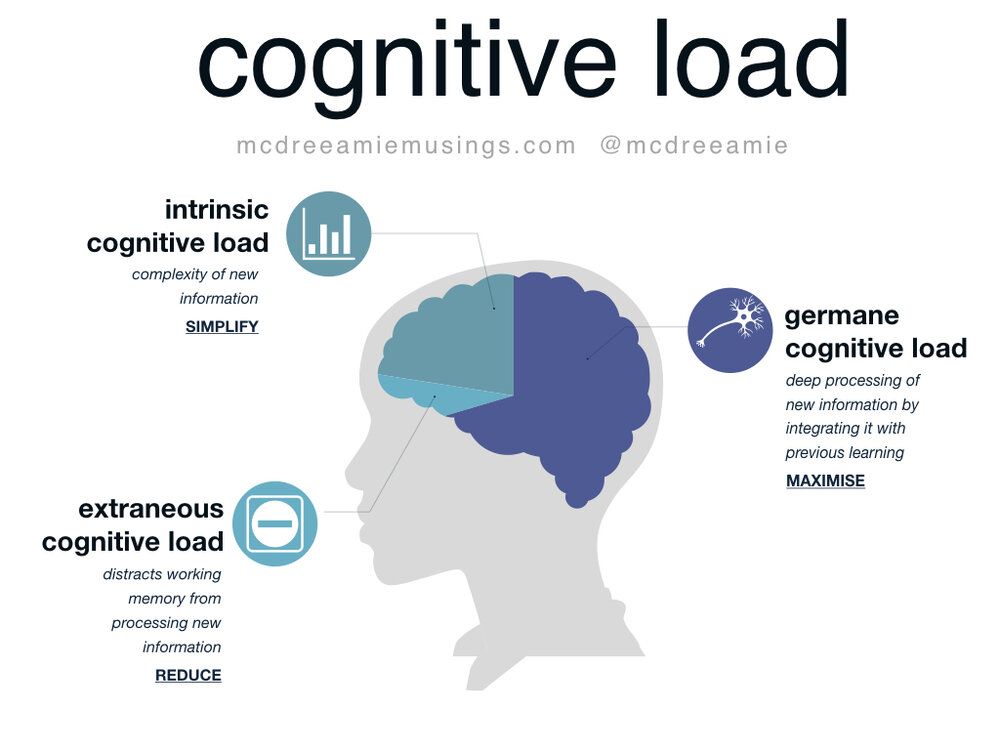
The theory identifies three types of cognitive load: intrinsic (material's inherent complexity), extraneous (unnecessary mental work from poor presentation), and germane (productive effort building understanding).
Effective instructional design minimizes extraneous load that wastes cognitive capacity, manages intrinsic load through appropriate sequencing, and optimizes germane load directing mental resources toward actual learning.
Working memory holds approximately 4-7 chunks of information temporarily. Exceed this capacity and learning breaks down: information doesn't transfer to long-term memory, problem-solving fails, understanding remains superficial.
But schema development packages multiple elements as single chunks, dramatically expanding effective capacity for domain experts compared to novices.
"If the material must be understood rather than merely presented, then the structure of knowledge must match the structure of the learner's cognitive apparatus." - John Sweller
This analysis examines how to apply cognitive load theory practically: reducing extraneous load through better presentation, managing intrinsic load through chunking and sequencing, supporting schema development, optimizing worked examples and practice problems, applying principles across learning contexts (self-study, instruction, documentation), and recognizing when theory's assumptions don't hold.
| Load Type | Definition | Design Goal | Common Violations |
|---|---|---|---|
| Intrinsic | Material's inherent complexity from element interactivity | Manage through sequencing and prerequisites | Presenting advanced material before foundations are laid |
| Extraneous | Mental work from poor presentation (unrelated to learning) | Minimize by removing unnecessary elements | Split-attention effect, decorative images, redundant text and audio |
| Germane | Productive mental effort that builds schemas and long-term memory | Optimize by directing effort toward schema construction | Passive reading instead of retrieval practice |
The Three Types of Cognitive Load
Intrinsic Load: Material's Inherent Complexity
Definition: Mental work required by the material itself, independent of presentation.
Sources:
- Element interactivity: How many elements must be processed simultaneously
- Conceptual difficulty: Abstractness, unfamiliarity, precision required
- Prerequisites: Amount of prior knowledge needed
Example comparison:
- Low intrinsic load: Learning vocabulary words (individual elements processed independently)
- High intrinsic load: Understanding object-oriented inheritance (must simultaneously grasp: objects, classes, relationships, method overriding, polymorphism, all interdependent)
Key insight: Intrinsic load is not fixed. It depends on learner's prior knowledge:
- Expert: Object-oriented concepts are single chunked schema, low load
- Novice: Each concept is separate element requiring active processing, high load
Cannot eliminate intrinsic load: complexity is inherent. But can manage it through appropriate sequencing and prerequisite building.
Extraneous Load: Wasted Mental Work
Definition: Mental work caused by poor instructional design, not contributing to learning.
Common sources:
- Split attention: Related information separated forcing integration work
- Redundancy: Same information presented multiple ways requiring reconciliation
- Unclear organization: Learner must figure out structure instead of content
- Decorative elements: Irrelevant images, animations, sounds consuming attention
- Inefficient modality: Text duplicating spoken word forcing processing both
- Search requirements: Finding relevant information amid clutter
Example: Geometry tutorial shows diagram on left page, explanation on right page. Learner must:
- Read text
- Find corresponding diagram part
- Hold text in memory while searching
- Integrate text and diagram
- Repeat for each element
This integration work is extraneous: doesn't teach geometry, just wastes cognitive capacity that should process geometric concepts.
Critical: Extraneous load is entirely preventable. Good design eliminates it.
Germane Load: Productive Learning Effort
Definition: Mental work directed toward schema construction and automation, actual learning.
Activities:
- Pattern recognition across examples
- Connecting new information to existing knowledge
- Abstracting principles from specifics
- Organizing information into coherent structures
- Practicing to automate procedures
Goal: Once extraneous load is eliminated and intrinsic load is manageable, maximize germane load: direct all available cognitive capacity toward productive learning effort.
Example: After seeing three worked examples of factoring quadratics, learner notices pattern in coefficient relationships. This pattern recognition is germane load, building reusable schema.
Reducing Extraneous Cognitive Load
Principle: Eliminate unnecessary mental work so cognitive capacity can focus on actual learning.
Technique 1: Integrate Related Information
Problem: Split attention between text and diagram, forcing integration work.
Solution: Place text adjacent to or within corresponding diagram elements.
Bad example:
[Diagram of heart with labeled parts A, B, C, D]

Separate legend:
A: Right atrium receives deoxygenated blood
B: Right ventricle pumps blood to lungs
C: Left atrium receives oxygenated blood
D: Left ventricle pumps blood to body
Learner must search between diagram and legend repeatedly.
Good example:
[Diagram with labels directly on parts:
"Right atrium: receives deoxygenated blood"
"Right ventricle: pumps to lungs"
etc.]
No search required: attention stays on diagram, cognitive capacity processes anatomy.
Applies to: Code and comments, diagrams and explanations, formulas and variables, procedures and rationales.
Technique 2: Eliminate Redundancy
Problem: Same information presented multiple ways forces reconciliation: "Are these saying the same thing? Which should I focus on?"
The redundancy effect: Identical information in text and narration increases load rather than reinforcing. Working memory must process both, compare them, verify redundancy.
Bad example: Video narrates explanation while identical text appears on screen. Learner processes audio, processes text, confirms they match, tripling work without adding information.
Good example: Either narrate with supporting visuals, or provide text with diagrams, not both saying identical things.
Exception: Redundancy helps when:
- Information is complementary not identical (audio explains, text provides reference)
- Learner controls which modality to use
- Material is very simple (minimal load regardless)
Technique 3: Progressive Complexity
Problem: Presenting full complexity immediately overwhelms working memory.
Solution: Start with simplified version, progressively add elements as learner builds schemas.
Example: Teaching recursion
Bad: Start with complex algorithm (quicksort, tree traversal) requiring understanding: recursion concept, base case, recursive case, stack behavior, specific algorithm logic, simultaneously.
Good:
- First: Simple countdown function (introduces recursion concept with familiar operation)
- Then: Factorial (adds accumulation pattern)
- Then: Fibonacci (adds multiple recursive calls)
- Finally: Complex algorithms (learner has schema for recursion itself, can focus on algorithm specifics)
Each step's intrinsic load is manageable. Schemas from earlier steps chunk into single elements in later steps.
Technique 4: Remove Decorative Elements
Problem: Irrelevant but interesting elements (animations, images, metaphors) consume attention without contributing to learning.
The coherence principle: People learn better from focused materials than from materials with extraneous interesting content.
Example: Lesson on lightning formation includes fascinating but irrelevant information about famous people struck by lightning. This grabs attention, but attention directed away from formation mechanism. Result: less learning.
Application: Be ruthless. If element doesn't directly support learning goal, remove it. Interesting tangents that seem harmless actually compete for limited cognitive resources.
Technique 5: Worked Examples for Novices
Problem: Asking novices to solve problems independently before understanding requires simultaneously learning solution strategy AND executing it: double load.
Solution: Provide worked examples showing complete solution process. Learner processes solution steps without execution load.
"Students need to see problems solved before they can learn to solve problems. The worked example is not a shortcut, it is the path." - Richard Clark
Example: Teaching physics problems
Bad for novices: "Now you try: Calculate force given mass and acceleration."
Novice must:
- Recall F = ma formula
- Identify which values are given
- Determine solution sequence
- Execute calculation
- Verify result makes sense
All simultaneously, exceeds working memory.
Good for novices:
Problem: Object with 5kg mass accelerates at 2m/s². Find force.

Solution:
1. Identify relevant formula: F = ma
2. Identify given values: m = 5kg, a = 2m/s²
3. Substitute: F = (5kg)(2m/s²)
4. Calculate: F = 10N
Learner processes solution pattern without execution burden. Builds schema for problem-solving approach.
Critical: As competence develops, transition to practice problems. Worked examples help novices; practice helps intermediates/experts.
Managing Intrinsic Cognitive Load
Principle: Match task difficulty to learner's current capacity, building complexity progressively.
Technique 1: Chunking Information
Working memory capacity: 4-7 chunks (not individual elements)
Chunking: Grouping related elements into meaningful unit that operates as single chunk.
Example: Learning phone number
Unchunked: 2 0 2 5 5 5 0 1 2 3 (10 elements, exceeds working memory)
Chunked: 202-555-0123 (3 chunks: area code, prefix, line)
Same information, but organized structure reduces load from 10 elements to 3 chunks.
Application to learning:
- Present information in meaningful groups not isolated facts
- Teach organizational framework first, then fill in details
- Use concept maps showing relationships
- Provide advance organizers giving structure before content
Example: Teaching programming language
Bad: List all syntax rules individually (variables, loops, functions, operators, types, classes...)
Good: Organize by purpose:
- Data (variables, types)
- Control flow (conditionals, loops)
- Modularity (functions, classes)
- Operations (operators, methods)
Structure reduces load, learner knows where each concept fits.
Technique 2: Build on Prior Knowledge
Schema: Organized knowledge structure in long-term memory packaging related information as single unit.
Key insight: Intrinsic load is relative to schemas. What's complex for novices is simple for experts because experts' schemas chunk information.
Example: Reading code
Novice reads: for (int i = 0; i < n; i++) as individual tokens requiring working memory for: keyword, parentheses, initialization, condition, increment, curly braces...
Expert recognizes: Standard loop pattern, single chunk. Working memory available for loop's content, not syntax.
Application:
- Activate prior knowledge before introducing new content
- Explicitly connect new information to existing schemas
- Build prerequisite schemas before dependent concepts
- Spiral curriculum: Revisit concepts with increasing sophistication
Technique 3: Part-Task Training for Complex Skills
Problem: Some skills involve so many simultaneous elements that full task overwhelms.
Solution: Practice sub-components separately until automated, then combine.
Example: Learning to drive
Full task simultaneously:
- Steering
- Accelerating/braking
- Monitoring mirrors
- Watching road
- Obeying signs
- Navigating
All at once exceeds novice capacity.
Part-task approach:
- Practice steering in empty lot (one skill)
- Add acceleration control
- Add mirror checking
- Gradually combine until full driving
Each component becomes automated (low load), freeing capacity for integrating next component.
Applies to: Programming (syntax → logic → design), writing (mechanics → organization → argumentation), complex procedures.
Technique 4: Fading from Examples to Problems
Worked example effect: Novices learn better from studying examples than solving problems.
Expertise reversal effect: As competence grows, examples become redundant, practice problems become more effective.
Optimal progression:
- Complete worked examples: Full solution shown
- Completion problems: Partial solution, learner completes final steps
- Analogous problems: Similar to examples but learner solves independently
- Novel problems: Different from examples, requiring transfer
Example: Teaching algebra
Step 1 (novice): Show completely worked equation solving
Step 2: Provide equation with first three steps completed, learner completes last two
Step 3: Provide similar equation type, learner solves from beginning
Step 4: Provide different equation type requiring adapted approach
Gradual transition from low load (study example) to higher load (solve independently) as schemas develop.
Optimizing Germane Cognitive Load
Principle: Once extraneous load is eliminated and intrinsic load is manageable, maximize productive learning effort.
Technique 1: Encourage Schema Induction
Goal: Help learners abstract patterns and principles from examples.
Methods:
Compare and contrast: Show multiple examples side-by-side, highlighting similarities and differences.
Example: Teaching function composition in math
- Show
f(g(x))with multiple function pairs - Highlight: Always evaluate inner function first
- Contrast with
g(f(x))showing order matters - Pattern emerges: Composition flows right to left
Explicit reflection: Ask learners to articulate principles.
Prompt: "What do all these examples have in common? What principle is being demonstrated?"
Forces generalization, moving from specific instances to abstract rule.
Variation: Present same concept through different contexts/representations to encourage deep understanding rather than surface feature learning.
Technique 2: Support Automation Through Practice
Goal: Move knowledge from controlled processing (requires working memory) to automatic processing (minimal cognitive load).
Key principles:
1. Spaced repetition: Practice distributed over time more effective than massed practice. Schemas strengthen and consolidate during spacing intervals.
2. Deliberate practice: Focus on weakness areas, slightly beyond current competence. Mindless repetition of mastered material doesn't build schemas efficiently.
"It is not practice that makes perfect; it is the right kind of practice, targeted, effortful, and just beyond your current ability, that builds genuine competence." - Anders Ericsson
3. Varied practice: Solve similar problems in different contexts. Builds flexible schemas that transfer, not brittle procedures tied to specific contexts.
4. Retrieval practice: Testing enhances learning more than re-studying. Retrieving information strengthens schema connections.
Example: Learning programming patterns
Bad: Solve 50 identical loop problems in one session.
Good:
- Solve 5 loop problems
- Wait 1 day, solve 5 more with variation
- Week later, solve different problem types requiring loops
- Month later, complex problems where loops are one component
Spacing and variation build robust, automated schemas.
Technique 3: Use Dual Modality Appropriately
Modality effect: When material is high in element interactivity, presenting some information auditorially and some visually can reduce load compared to all visual.
Mechanism: Visual and auditory working memory are partially separate. Using both expands effective capacity.
"When words and pictures are combined, people can build verbal and pictorial mental representations and create connections between them, far exceeding what either channel alone could achieve." - Richard E. Mayer
Example:
All visual (high load): Diagram with lengthy text labels. Both consume visual working memory, compete for same resource.
Dual modality (lower load): Diagram (visual) with spoken explanation (auditory). Working memory channels don't compete, can process more information simultaneously.
Caveat: Only helps when:
- Material has high element interactivity (must process elements simultaneously)
- Visual and auditory information are complementary not redundant
- Learner controls pacing (can pause/replay narration)
Doesn't help: Simple material, redundant information, uncontrolled pacing.
Applying Principles Across Learning Contexts
Context 1: Self-Study
Reduce extraneous load:
- Take notes that integrate information from different sources rather than separate lists
- Summarize in own words rather than highlighting (processing vs. passive reading)
- Remove distractions (notifications, background media) competing for attention
- Use external aids (concept maps, organized notes) as working memory extension
Manage intrinsic load:
- Start with overview before diving into details (build framework schema first)
- Break study into focused sessions (respect working memory fatigue)
- Use progressive complexity: simple tutorials before complex texts
- Test understanding before advancing (ensure prerequisite schemas before building on them)
Optimize germane load:
- Actively generate explanations (forces schema building)
- Create own examples applying concepts
- Practice retrieval (flashcards, practice problems) not just re-reading
- Deliberately connect new information to what you already know
Context 2: Teaching/Instructional Design
Reduce extraneous load:
- Design slides with minimal text, using visuals to support (not decorate)
- Integrate code and explanation (comments within code, not separate explanation)
- Provide organized handouts/references (not forcing students to search during class)
- Eliminate interesting tangents that don't serve learning objective
Manage intrinsic load:
- Assess prerequisite knowledge; don't assume, verify
- Use advance organizers: "Today we'll cover three concepts: A, B, C, and how they relate"
- Sequence from simple to complex, confirming understanding before advancing
- Provide worked examples before assigning practice
Optimize germane load:
- Ask students to explain reasoning (articulation builds schemas)
- Use comparison problems highlighting key principles
- Encourage deliberate practice on weakness areas
- Space learning over multiple sessions, not cramming all content at once
Context 3: Technical Documentation
Reduce extraneous load:
- Place code examples adjacent to explanation, not separated
- Use consistent formatting and structure (familiar pattern reduces processing)
- Provide clear navigation (table of contents, search) reducing information search
- Eliminate marketing language in technical sections (compete for attention)
Manage intrinsic load:
- Organize by user journey (tasks people need to accomplish) not internal structure
- Provide "Getting Started" before comprehensive reference
- Include conceptual overview before API details
- Progressive disclosure: summary → details → advanced
Optimize germane load:
- Include worked examples with explanations of why, not just how
- Provide practice exercises with solutions
- Show common patterns and anti-patterns
- Link related concepts explicitly
Common Misapplications and Limitations
Misapplication 1: Over-Simplification
Error: Reducing intrinsic load so much that learning trivializes.
Problem: Some complexity is necessary. Removing challenge removes germane load, productive difficulty that builds understanding.
Example: Breaking every concept into tiny, isolated pieces prevents seeing relationships. Learner can't integrate information because integration was done for them.
Correct approach: Simplify initially, then progressively challenge. Start manageable, increase complexity as schemas develop.
Misapplication 2: Assuming Universal Expertise Level
Error: Designing for homogeneous audience when learners have varied backgrounds.
Problem: What's appropriate load for experts is overwhelming for novices, and vice versa.
Expertise reversal effect: Instructional techniques helping novices (worked examples, heavy scaffolding) become redundant for experts, actually increasing load.
Solutions:
- Adaptive materials: Different versions for different levels
- Self-paced learning: Learners skip known material
- Just-in-time information: Provide help only when requested
- Pre-assessment: Direct learners to appropriate starting point
Misapplication 3: Ignoring Motivation
Limitation: Cognitive load theory focuses on cognitive factors, sometimes neglecting motivational factors.
Problem: Minimizing load might reduce engagement if taken too far.
Example: Some "extraneous" elements (storytelling, humor, interesting context) might increase load slightly but dramatically improve motivation, net positive for learning.
Balance: Don't sacrifice motivation for minimal load reduction. Find engaging ways to present material that respect cognitive limits without becoming sterile.
Limitation 1: Individual Differences
Theory assumption: Working memory capacity is limited (true in general).
Reality: Specific capacity varies. Some people have higher working memory capacity, process faster, or have more relevant prior knowledge.
Implication: Principles apply on average. Design for typical learner, but provide flexibility (skipping ahead, getting more support) for individual variation.
Limitation 2: Domain Specificity
Research context: Cognitive load theory primarily studied in well-structured domains (math, science, technical skills).
Less clear: Application to ill-structured domains (creative writing, design, strategic thinking) where problem-solving is more open-ended.
Caution: Principles still apply but may need adaptation for domains where multiple solutions exist, creativity matters, and procedural schemas are less central.
Key Takeaways
Three types of cognitive load:
- Intrinsic: Material's inherent complexity, manage through sequencing, chunking, prerequisite building
- Extraneous: Wasted mental work from poor presentation, eliminate through better design
- Germane: Productive learning effort building schemas, maximize once other loads are managed
Working memory limits shape learning:
- Capacity of 4-7 chunks (not individual elements)
- Overload prevents information transfer to long-term memory
- Schema development chunks multiple elements into single units, expanding effective capacity
- Experts have low cognitive load for domain material because extensive schemas chunk information
Reducing extraneous load:
- Integrate related information (eliminate split attention)
- Remove redundancy (identical information in multiple modalities increases load)
- Progressive complexity (start simple, add elements as schemas develop)
- Eliminate decorative elements (interesting but irrelevant content consumes attention)
- Use worked examples for novices (studying solutions lower load than solving independently)
Managing intrinsic load:
- Chunk information into meaningful groups matching natural organization
- Build on prior knowledge, activate existing schemas before introducing new concepts
- Part-task training for complex skills (automate components before combining)
- Fade from examples to problems as competence develops (expertise reversal effect)
Optimizing germane load:
- Encourage schema induction through comparison, contrast, explicit reflection
- Support automation through spaced, deliberate, varied retrieval practice
- Use dual modality appropriately (visual + auditory expands effective working memory for high-interactivity material)
Practical applications:
- Self-study: Integrate notes, start with overviews, break into focused sessions, practice retrieval
- Teaching: Minimize slide text, use advance organizers, provide worked examples, encourage explanation
- Documentation: Place code adjacent to explanations, organize by user journey, progressive disclosure
Common misapplications:
- Over-simplification removing necessary challenge and integration opportunities
- Assuming homogeneous expertise when learners vary (use adaptive/self-paced materials)
- Ignoring motivation in pursuit of minimal load (balance cognitive efficiency with engagement)
Limitations to recognize:
- Individual differences in working memory capacity and processing speed
- Theory developed primarily for well-structured domains, application to creative/strategic domains less studied
- Motivation matters alongside cognition, don't sacrifice engagement for marginal load reduction
Cognitive load theory transforms from abstract principles to actionable design when you eliminate unnecessary mental work (extraneous load), sequence complexity appropriately (intrinsic load), and direct cognitive resources toward schema building (germane load).
The goal isn't to make learning effortless, productive difficulty strengthens schemas, but rather to ensure mental effort contributes to actual learning rather than wrestling with poor presentation.
Key Researchers and Their Contributions
Cognitive load theory was developed by a relatively small research community centered at the University of New South Wales, with important contributions from researchers in the Netherlands, Germany, and the United States.
John Sweller (born 1946) completed his doctorate at the University of Adelaide and joined the University of New South Wales in Sydney, where he spent most of his career in the School of Education.
His initial research in the 1980s focused on problem-solving in mathematics and science, where he noticed that conventional problem-solving instruction (assign problems, have students attempt solutions) was far less effective than studying worked examples.
He attributed this to cognitive load: solving an unfamiliar problem simultaneously requires learning the solution method and executing it, overwhelming working memory.
Sweller's 1988 paper "Cognitive Load During Problem Solving: Effects on Learning" in Cognitive Science formally introduced cognitive load theory and demonstrated the worked example effect.
Subsequent research with Paul Chandler established the split-attention effect, the redundancy effect, and the modality effect through a series of experiments in geometry and algebra instruction.
Sweller received the Distinguished Scientific Contribution Award from the American Educational Research Association in 2019.
Fred Paas works at the Erasmus University Rotterdam in the Netherlands and has been one of the most prolific cognitive load researchers outside Australia.
His key contribution was developing a method for measuring cognitive load using subjective ratings: after completing a learning task, participants rate how much mental effort they expended on a 9-point scale.
This simple measure, introduced in his 1992 dissertation research, proved to reliably track cognitive load as it varied across instructional conditions and has been used in hundreds of subsequent studies.
Paas also extended cognitive load theory to physical education, motor learning, and the design of simulations, showing that the theory's principles apply beyond academic subjects to skill development in physical and procedural domains.
Jeroen van Merrienboer is a professor at Maastricht University in the Netherlands who developed the Four-Component Instructional Design (4C/ID) model, an approach to instructional design for complex skills that extends cognitive load theory.
While Sweller's work focused primarily on isolated instructional effects, van Merrienboer's model addresses the challenge of teaching integrated, complex skills (surgical procedures, aircraft piloting, software architecture) that involve multiple interacting components.
His 2005 paper with Sweller in Educational Psychology Review, "Cognitive Load Theory and Complex Learning: Recent Developments and Future Directions," is one of the most cited papers in the field.
Van Merrienboer has applied the 4C/ID model to medical education at Maastricht's problem-based medical school, one of the world's leading centers for medical education research.
Slava Kalyuga works at the University of New South Wales and has made major contributions to the expertise reversal effect, the finding that instructional techniques effective for novices can become ineffective or counterproductive for experts.
Kalyuga's experimental work in the early 2000s showed that worked examples, which reliably improve novice learning, can actually impair expert learning because experts have sufficient schemas to solve problems independently and studying solutions provides redundant information that they must process without benefit.
This finding has practical implications for adaptive learning systems that must adjust instructional support to individual knowledge levels.
Richard E. Mayer (born 1947) at the University of California, Santa Barbara has extended cognitive load theory to multimedia learning, developing a parallel framework called the cognitive theory of multimedia learning (CTML) and conducting dozens of experiments on how the combination of words and images affects learning.
Mayer's research has been particularly influential in educational technology and online learning design.
His principles for reducing extraneous cognitive load in multimedia, including the coherence principle (removing extraneous material improves learning), the redundancy principle (presenting the same information in multiple formats hurts rather than helps), and the modality principle (animations with narration outperform animations with on-screen text), have been directly derived from experiments and have shaped the design of educational software, MOOCs, and corporate training programs.
Historical Case Studies That Changed the Field
The development of cognitive load theory proceeded through a series of experiments that established specific effects and built the cumulative empirical case for the theory's practical recommendations.
The Geometry Experiments at UNSW (1985-1991). John Sweller and Paul Chandler conducted a series of experiments with Australian secondary school students learning geometry and algebra that established several of the core effects in cognitive load theory.
In the split-attention experiments, students learned from diagrams and associated explanatory text that were either integrated (text placed adjacent to the relevant diagram element) or separated (diagram on one page, text on another).
Integrated formats consistently produced better learning outcomes, measured by transfer performance on novel problems. The effect sizes were large (Cohen's d often exceeding 1.0), making the practical significance unambiguous.
These experiments, published in journals including Cognition and Instruction, Journal of Educational Psychology, and Educational Psychology Review between 1988 and 1992, provided the empirical foundation for the claim that instructional design choices have substantial effects on learning.
The Physics Worked Example Studies at the University of Maastricht (1994). Paas and van Merrienboer published a 1994 study in the Journal of Educational Psychology that demonstrated the variability effect in physics problem-solving: students who practiced with varied problem formats showed better transfer to novel problems than students who practiced with repetitive formats matched for total practice time.
The variability effect suggests that appropriate challenge and variation during practice builds more flexible and generalizable schemas than repetitive practice of identical problem types, refining the earlier finding that worked examples benefit novices.
This work helped clarify when students should transition from worked examples to independent problem-solving: variability in practice problems becomes beneficial once initial schemas are established.
The MOOC Learning Analytics Research at Coursera (2013-2015). The expansion of massive open online courses (MOOCs) provided cognitive load researchers with unprecedented data on how millions of learners interact with instructional materials.
Research teams including Philip Guo at MIT (working with edX data) analyzed hundreds of thousands of video viewing sessions and found results consistent with cognitive load theory predictions: videos longer than 6 minutes showed dramatically higher dropout rates, videos where instructors spoke at faster rates were correlated with higher disengagement, and videos that mixed talking-head footage with screencasts of problem-solving had higher completion rates than either alone.
These findings, published in the Learning at Scale conference proceedings in 2014, directly influenced MOOC platform design at Coursera, edX, and Khan Academy, which subsequently standardized on shorter video segments and mixed production formats.
The Cognitive Load Theory Meta-Analysis (2011). Sweller, Ayres, and Kalyuga's 2011 meta-analysis of cognitive load research, summarized in their Springer book Cognitive Load Theory, synthesized findings from hundreds of experiments conducted over 25 years.
The meta-analysis confirmed that the major effects identified in the 1980s and 1990s (worked example effect, split-attention effect, redundancy effect, modality effect, expertise reversal effect) were robust across age groups, subject domains, and instructional media.
The largest and most reliable effects were the worked example effect (studies consistently showing that novice students learn more from studying worked solutions than from attempting problems independently) and the modality effect (studies consistently showing that presenting verbal information auditorily rather than in text reduces cognitive load for high-complexity material).
This consolidation of evidence strengthened the theory's claims to practical applicability and stimulated the next generation of research on adaptive learning and online education.
How These Ideas Are Applied Today
Cognitive load theory has moved from educational psychology research into the design of medical training, online learning platforms, workplace learning systems, and software interfaces.
Medical Education and Simulation Training. Medical schools worldwide have adopted cognitive load theory principles in their curriculum design, particularly as simulation-based medical education has expanded.
The Simulation Center at Massachusetts General Hospital, one of the largest in the United States, uses scenario design principles derived from cognitive load research: simulations begin with simplified cases involving single complications before advancing to complex scenarios with multiple simultaneous issues.
Research by Brydges, Dubrowski, and Regehr at the University of Toronto demonstrated that medical residents who learned procedural skills (central line insertion) through directed, structured self-guided practice outperformed those who received only unstructured independent practice - a finding consistent with the broader cognitive-load principle that novices benefit from guidance rather than being left to discover procedures unaided.
The Australian Medical Council and the UK's General Medical Council have both incorporated cognitive load awareness into their standards for medical curriculum design.
Corporate E-Learning and Training Design. The e-learning industry, which generates over $300 billion annually according to Global Market Insights, has incorporated cognitive load theory principles through instructional design standards including the Articulate Storyline and Adobe Captivate platform designs.
Organizations including IBM's Global Learning Solutions, Deloitte University, and the U.S. Army's Distributed Learning Program have adopted design standards that include maximum video segment lengths (typically 5-8 minutes, consistent with cognitive load research on attention), integration of text with visuals rather than text-only slides, and progressive complexity in course sequencing.
The Association for Talent Development's CPTD (Certified Professional in Talent Development) certification, the industry's primary professional credential, includes cognitive load theory as a core content domain, reflecting its institutionalization in professional practice.
Software Interface Design. The application of cognitive load theory to user interface design has influenced software development practices at major technology companies.
Google's Material Design guidelines explicitly reference the need to minimize cognitive load through consistent visual patterns, progressive disclosure of complexity, and reduction of extraneous information.
Apple's Human Interface Guidelines similarly emphasize simplicity and the elimination of unnecessary interface elements.
Microsoft's Fluent Design System incorporates cognitive load principles through its approach to information hierarchy and visual complexity management.
Research by researchers including Don Norman (whose 1988 book The Psychology of Everyday Things popularized cognitive psychology's application to design) and Steven Franconeri at Northwestern University (who studies visual working memory in the context of data visualization) has connected cognitive load theory to the practical design of dashboards, analytics interfaces, and data visualization tools used in business intelligence software.
Adaptive Learning Platforms. Technology-enabled adaptive learning systems are beginning to implement the expertise reversal effect at scale, adjusting instructional support based on individual learner knowledge levels.
Knewton (acquired by Wiley in 2019) and McGraw-Hill's ALEKS platform use knowledge space theory combined with cognitive load principles to provide worked examples to novice students and reduced scaffolding to more advanced students, dynamically adjusting based on performance data.
Research on intelligent tutoring systems, including Steenbergen-Hu and Cooper's meta-analyses published in the Journal of Educational Psychology (2013 for K-12 students, 2014 for college students), found mixed but generally positive learning gains compared with non-adaptive instruction, with moderate effects for college students in particular - a pattern broadly consistent with domains where cognitive load theory is well established, such as mathematics and science.
Sources & Further Reading
Sweller, J., Ayres, P., & Kalyuga, S. (2011). Cognitive Load Theory. Springer. DOI: 10.1007/978-1-4419-8126-4 [Comprehensive overview]
Sweller, J. (1988). "Cognitive Load During Problem Solving: Effects on Learning." Cognitive Science 12(2): 257-285. DOI: 10.1207/s15516709cog1202_4 [Foundational paper]
Paas, F., Renkl, A., & Sweller, J. (2003). "Cognitive Load Theory and Instructional Design: Recent Developments." Educational Psychologist 38(1): 1-4. DOI: 10.1207/S15326985EP3801_1
Chandler, P., & Sweller, J. (1991). "Cognitive Load Theory and the Format of Instruction." Cognition and Instruction 8(4): 293-332. DOI: 10.1207/s1532690xci0804_2 [Split-attention effect]
Mayer, R. E., & Moreno, R. (2003). "Nine Ways to Reduce Cognitive Load in Multimedia Learning." Educational Psychologist 38(1): 43-52. DOI: 10.1207/S15326985EP3801_6
Kalyuga, S., Ayres, P., Chandler, P., & Sweller, J. (2003). "The Expertise Reversal Effect." Educational Psychologist 38(1): 23-31. DOI: 10.1207/S15326985EP3801_4
Paas, F., & Van Merriënboer, J. J. (1994). "Variability of Worked Examples and Transfer of Geometrical Problem-Solving Skills." Journal of Educational Psychology 86(1): 122-133. DOI: 10.1037/0022-0663.86.1.122
Renkl, A., & Atkinson, R. K. (2003). "Structuring the Transition from Example Study to Problem Solving in Cognitive Skill Acquisition." Educational Psychologist 38(1): 15-22. DOI: 10.1207/S15326985EP3801_3
Van Merriënboer, J. J., & Sweller, J. (2005). "Cognitive Load Theory and Complex Learning." Educational Psychology Review 17(2): 147-177. DOI: 10.1007/s10648-005-3951-0
Clark, R. C., Nguyen, F., & Sweller, J. (2006). Efficiency in Learning: Evidence-Based Guidelines to Manage Cognitive Load. Pfeiffer. [Practical applications]
Kirschner, P. A. (2002). "Cognitive Load Theory: Implications of Cognitive Load Theory on the Design of Learning." Learning and Instruction 12(1): 1-10. DOI: 10.1016/S0959-4752(01)00014-7
Cowan, N. (2001). "The Magical Number 4 in Short-Term Memory." Behavioral and Brain Sciences 24(1): 87-114. DOI: 10.1017/S0140525X01003922 [Working memory capacity]
Ericsson, K. A., Krampe, R. T., & Tesch-Romer, C. (1993). "The Role of Deliberate Practice in the Acquisition of Expert Performance." Psychological Review 100(3): 363-406. [Foundational deliberate practice research]
Mayer, R. E. (2009). Multimedia Learning (2nd Edition). Cambridge University Press. [Coherence and modality principles]
Roediger, H. L., & Karpicke, J. D. (2006). "Test-Enhanced Learning: Taking Memory Tests Improves Long-Term Retention." Psychological Science 17(3): 249-255. [Retrieval practice effect]
Sweller, J. (1994). "Cognitive Load Theory, Learning Difficulty, and Instructional Design." Learning and Instruction 4(4): 295-312. [Germane load and schema formation]
Ausubel, D. P. (1960). "The Use of Advance Organizers in the Learning and Retention of Meaningful Verbal Material." Journal of Educational Psychology 51(5): 267-272. [Advance organizers]
Baddeley, A. D., & Hitch, G. (1974). "Working Memory." In G. H. Bower (Ed.), The Psychology of Learning and Motivation (Vol. 8, pp. 47-89). Academic Press. [Working memory model]
Paivio, A. (1991). "Dual Coding Theory: Retrospect and Current Status." Canadian Journal of Psychology 45(3): 255-287. [Dual coding and modality effect]
Clark, R. C., & Mayer, R. E. (2011). E-Learning and the Science of Instruction (3rd Edition). Pfeiffer. [Applied cognitive load in digital learning]