
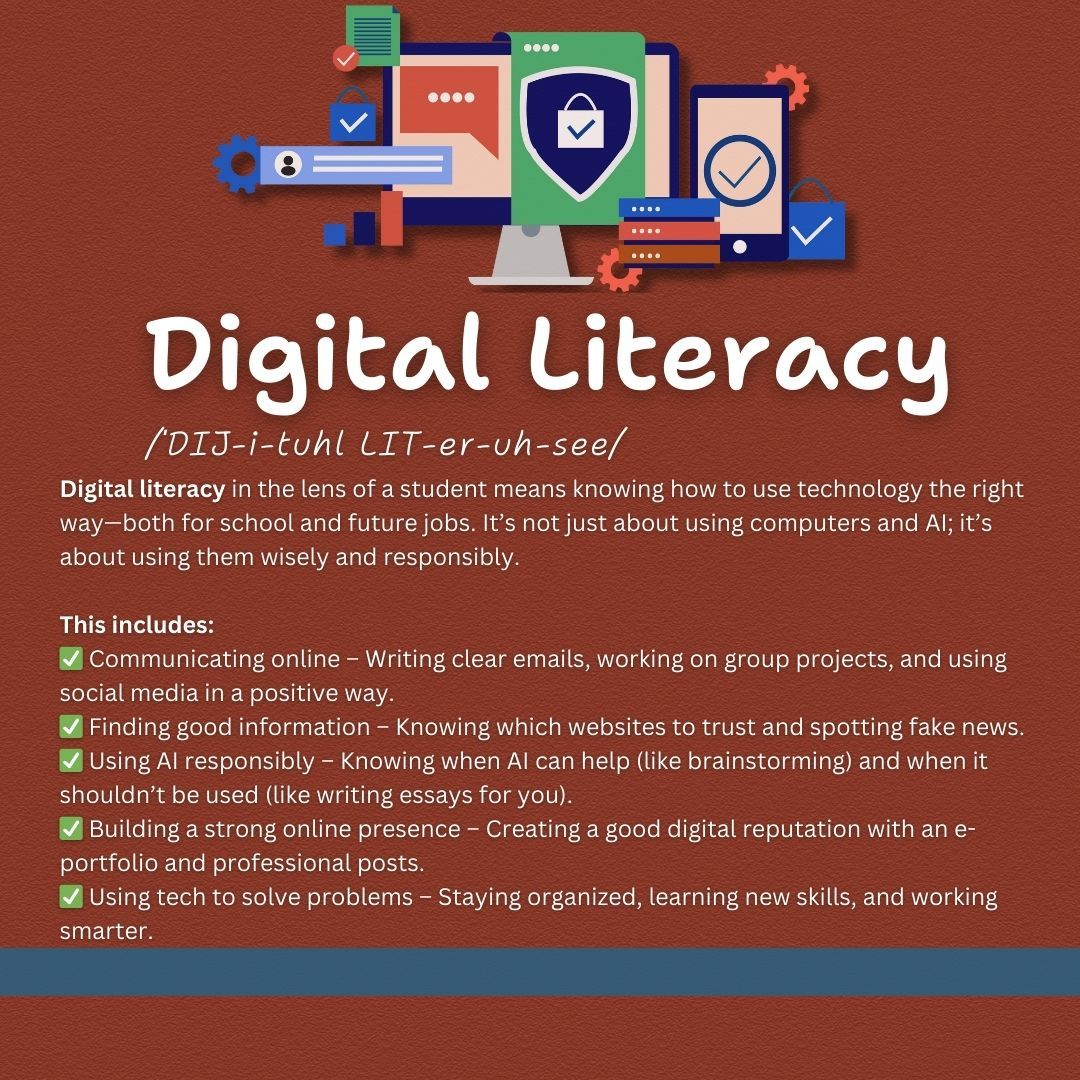
Understanding digital literacy goes beyond operating devices. It includes technical skills, critical information evaluation, source and bias assessment, privacy and security practices, and the ability to participate responsibly in an algorithmic media environment. As content creation, disinformation, synthetic media, and AI-generated text expand, digital literacy requires judging information quality and tracing claims to appropriate sources, not just navigating software confidently.
The term "digital literacy" has been in circulation since at least the mid-1990s, but its meaning has shifted significantly with the technology it describes. What began as a description of basic computer competence has grown into a framework for navigating one of the most complex information environments in human history.
Understanding what digital literacy actually involves - and what the research shows about who has it and who doesn't - matters for anyone who works with information, teaches, or simply wants to engage responsibly with the world they live in.
The stakes have never been higher. The World Health Organization declared an "infodemic" during the COVID-19 pandemic - an overabundance of information, much of it false, spreading faster than the disease itself. State-sponsored disinformation campaigns operate at industrial scale.
Synthetic media can make anyone appear to say anything. Large language models generate authoritative-sounding text that may be entirely fabricated.
The information environment of 2025 is structurally different from anything human cognition evolved to navigate, and the skills needed to navigate it are neither intuitive nor adequately taught.
A Brief History of the Concept
The phrase was popularized by Paul Gilster in his 1997 book "Digital Literacy," where he defined it as the ability to understand and use information in multiple formats from a wide range of sources when it is presented via computers.[1]
Gilster's emphasis was on critical thinking and information evaluation, not just technical competence. He was concerned that people would learn to use computers without developing the judgment to use them well.
This emphasis on judgment over mere technical skill distinguished digital literacy from computer literacy, the term that had dominated the 1980s. Computer literacy meant knowing how to use a word processor, navigate a file system, and understand basic hardware.
Digital literacy meant knowing how to think critically in a digital environment.
The distinction matters more now than it did in 1997. The democratization of content production - anyone can publish anything to a global audience - combined with the industrialization of misleading content production - state actors, political operatives, and financially motivated fraudsters now produce disinformation at scale - has created an information environment where navigating confidently requires substantially more than technical competence.
As the internet transformed from a technical curiosity into the dominant medium for communication, commerce, and news, the concept expanded further.
Today it encompasses dimensions that Gilster could not have fully anticipated: algorithmic media environments, social media dynamics, deepfake detection, and the behavior of large language models that can produce authoritative-sounding content that is factually wrong.
The UNESCO Media and Information Literacy framework, updated in 2021, defines the field as "a combination of knowledge, attitudes, skills, and practices required to access, analyse, evaluate, use, produce, and communicate information and media content in order to participate and engage in personal, professional, and societal life." This expansion from Gilster's original formulation reflects how much the scope of digital participation has grown.
The Components of Digital Literacy
There is no single universally agreed definition of digital literacy, but most contemporary frameworks treat it as a cluster of related competencies.[12] The major components are:
Technical Literacy
Technical literacy refers to the functional skills needed to use digital devices and software. This includes using computers, smartphones, and tablets; navigating operating systems and applications; basic troubleshooting; understanding files, folders, and basic security practices like password management and two-factor authentication.
Technical literacy is a prerequisite for the other components but is not sufficient on its own. A person can be technically proficient - comfortable with multiple devices and applications - while lacking the critical skills to evaluate the information those devices deliver.
The scope of technical literacy expands constantly. Competencies that were advanced in 2010 (using cloud storage, navigating social platforms) are now basic.
Current technical literacy increasingly involves understanding how to interact with AI tools, manage privacy settings across multiple platforms, and recognize the difference between software-generated and human-created content.
As of 2023, the OECD estimates that approximately 1.3 billion people globally remain without access to the internet - the most fundamental dimension of technical exclusion. But even among the connected, the quality of digital access varies enormously.
Mobile-only internet access (browsing through a smartphone without a computer) produces meaningfully different information behaviors than broadband desktop access, tending toward shorter reading sessions, more algorithmic content consumption, and less active information search.
Information Literacy
Information literacy is the ability to recognize when information is needed, find it efficiently, and evaluate it critically. This includes:
- Understanding how search engines work and how their results are shaped by relevance algorithms, advertising, and personalization
- Distinguishing primary from secondary sources
- Evaluating source credibility and potential bias
- Understanding the difference between a peer-reviewed study, a press release, an opinion piece, and a news report
- Tracing claims to their original sources rather than accepting downstream reports
The American Library Association has defined information literacy as a foundational competency for lifelong learning.
In the digital age, it has become both more important and more difficult, because the volume of available information is orders of magnitude larger and the production and distribution of misleading content has industrialized.
Search engine results, in particular, require critical navigation skills that are rarely explicitly taught. A page's position in search results reflects a combination of relevance signals, domain authority, advertising relationships, and recency - none of which is reliably correlated with accuracy or trustworthiness.
Google's search quality rater guidelines run to over 170 pages, attempting to translate "quality" into measurable signals - a document length that conveys the difficulty of the problem.
The distinction between navigational search (looking for a specific site you know exists), informational search (seeking to learn about a topic), and transactional search (looking to buy or act) shapes what results are returned and how they should be evaluated.
Students who lack this vocabulary often interpret all search results with the same uncritical acceptance, treating an advertised link and a curated encyclopedia entry as equivalently reliable.
Media Literacy
Media literacy extends information literacy to the specific properties of media content. It involves understanding how media messages are constructed, by whom, for what purpose, and with what intended effect. This includes:
- Recognizing advertising and sponsored content, including native advertising that mimics journalism
- Understanding how images and video can be manipulated or decontextualized
- Recognizing emotional manipulation techniques used in political and commercial communication
- Understanding how algorithms shape what content is shown to whom
- Awareness of how the format of a medium (video vs. text, short vs. long, platform vs. broadcast) affects how information is processed and how the audience is likely to respond
The platform dimension of media literacy has become increasingly important. Social media algorithms optimize for engagement metrics - likes, shares, watch time, comments - that are correlated with emotional arousal rather than accuracy.
Understanding that the information environment you experience on social media is curated by an engagement-optimizing algorithm, not by editorial judgment about importance or truth, changes how you interpret what you see.
Research by Epstein and Robertson (2015, PNAS) found that search engine rankings could shift voting preferences by 20% or more among undecided voters - an effect large enough to change election outcomes in close races.
The study, which was controversial, pointed to the political stakes of media literacy: people who do not understand how information is ranked and presented are more susceptible to that ranking shaping their beliefs in ways they cannot detect.
Communication and Participatory Literacy
The third major component concerns how people produce and share content in digital environments. Communication literacy includes:
- Understanding privacy, data, and the implications of sharing personal information online
- Responsible participation in online communities and social platforms
- Copyright, attribution, and intellectual property in digital contexts
- Creating and contributing content - not merely consuming it
- Understanding the social and ethical dimensions of online interaction, including harassment, disinformation, and coordinated inauthentic behavior
The data literacy dimension of this component has become increasingly important as data collection and algorithmic decision-making have expanded.
People who do not understand that their online behavior generates data used to profile, target, advertise to, and in some cases discriminate against them are not capable of giving meaningful informed consent to the terms of their digital participation.
A 2019 Pew Research Center study found that while 81% of Americans felt they had little or no control over the data companies collected about them, only 37% had taken any steps to manage their privacy online.[16]
The gap between concern and behavior reflects not laziness but the genuine complexity of privacy management - cookie consent banners, privacy settings, and data deletion processes are designed to be difficult enough to deter most users.
Some frameworks add additional components: coding literacy (basic programming), data literacy (understanding how data is collected, analyzed, and used), and AI literacy (understanding how automated systems make decisions and generate content). These reflect the expanding scope of what digital participation now involves.
Why Digital Literacy Is Harder Than It Looks
The intuitive assumption is that young people - who have grown up with smartphones and social media - are naturally digitally literate. This assumption has been tested consistently, and it consistently fails.
A landmark 2016 study by the Stanford History Education Group, led by Sam Wineburg, tested middle school, high school, and college students on basic tasks: identifying sponsored content, evaluating the credibility of a tweet, and distinguishing a news story from a blog post.[2]
The results were striking in their uniformity: across age groups and educational contexts, students performed poorly.[14] College students at elite universities were fooled by official-looking documents that a brief investigation would have revealed as misleading.
More than 80% of middle schoolers did not question the provenance of a social media post with a "promoted" label - assuming it was a news article rather than paid advertising.
Wineburg's team has continued this research. A 2022 report found that many adults, including university graduates and professional journalists, struggled to distinguish legitimate scientific organizations from well-funded advocacy groups with similar names.
The ability to operate a smartphone does not generalize to the ability to evaluate information on it.
"Young people's ability to reason about the information on the internet can be summed up in one word: bleak." - Sam Wineburg, Stanford History Education Group
The explanation is not stupidity or laziness. It is that the skills required for critical evaluation of digital content are genuinely difficult and largely untaught. Most school curricula, where they address media at all, focus on production skills - how to make a video or manage a social media presence - rather than evaluation skills.
The assumption that students will intuit critical evaluation from their experience of using technology is not supported by evidence.
The digital native concept, popularized by Marc Prensky in 2001, argued that young people who had grown up with digital technology would have fundamentally different cognitive and learning styles from older "digital immigrants." The concept was embraced by educators and policymakers but was poorly supported by evidence from the start.
A comprehensive 2009 review by Kirschner and van Merrinboer in Educational Psychologist found no empirical support for the existence of a generation of students who thought and learned fundamentally differently due to digital immersion.
Facility with devices does not produce critical evaluation skills; it produces fluency in device operation.
The Misinformation Problem
Digital literacy has become a public health concern as well as an educational one. The rapid spread of health misinformation during the COVID-19 pandemic demonstrated that misinformation can have direct consequences for population health.
The World Health Organization described an "infodemic" - an overabundance of information, including large amounts of false and misleading content, spreading faster than the disease itself.
Research on misinformation has produced several consistent findings:
False news travels faster than true news. A 2018 MIT study by Vosoughi, Roy, and Aral analyzed 126,000 news stories shared on Twitter over 11 years.[3] False stories spread to 1,500 people six times faster than true stories. The effect was driven by human sharing behavior, not automated bots.
People shared false news more because it was more novel and emotionally engaging - it was surprising.
This finding has been replicated in subsequent work: a 2022 study by Altay and colleagues in Science Advances extended the analysis and found that the novelty-driven sharing of false news was consistent across political topics, health topics, and celebrity news.[19]
Familiarity increases perceived credibility. Repeated exposure to a claim makes it feel more true, a phenomenon called the illusory truth effect. This is dangerous in algorithmic media environments designed to show us content similar to what we have engaged with before.
Repeated exposure to a false claim, even if you initially recognized it as false, incrementally increases its felt credibility.
Pennycook and colleagues (2018, Journal of Experimental Psychology: General) found that the illusory truth effect operated even when participants were warned about it - knowing the mechanism does not neutralize it.
Corrections rarely fully undo misinformation. Research by Lewandowsky and colleagues (the "misinformation effect") has found that corrections partially reduce but rarely eliminate belief in a false claim, particularly when the false claim fits existing values or identity.[4]
Once a false claim is established in someone's belief system, the correction must compete with the original claim and with any reasoning the person has done using that claim as a premise.
This is sometimes called the continued influence effect: corrected information continues to influence reasoning even after the correction is accepted.
Pre-bunking outperforms debunking. Inoculation theory research by Sander van der Linden and colleagues at Cambridge shows that warning people about manipulation techniques before they encounter them provides more durable resistance than correcting beliefs after they have formed.
Games like "Bad News" (developed by researchers at Cambridge and the University of Exeter) use this approach, asking players to take the role of a misinformation producer and thereby learn the techniques from the inside.
A 2022 study found that one game of Bad News reduced susceptibility to misinformation by approximately 21% on an independent evaluation task.[11]
Emotional content spreads further. Content that triggers moral outrage, fear, or disgust spreads farther on social platforms than neutral content. Brady and colleagues (2017, PNAS) found that each moral or emotional word added to a tweet increased retweet probability by approximately 20%.[8]
This creates structural incentives for producers of content - including misleading content - to maximize emotional engagement.
The SIFT Method
Given that most people lack the time for exhaustive source verification on every piece of content they encounter, researchers and educators have developed practical heuristics for rapid evaluation.
The most widely taught is the SIFT method, developed by Mike Caulfield at Washington State University:[7]
S - Stop. Pause before sharing, liking, or reacting. The impulse to share is often triggered by emotional engagement, which is exactly when judgment is most likely to fail. The simple act of pausing breaks the automatic response chain.
I - Investigate the source. Before reading deeply, spend a minute finding out who is behind the claim. Open a new tab and look up the author, website, or organization. Is this source known? What is its editorial stance, funding, and history?
This step can be done in under a minute and dramatically reduces the chance of being misled. Crucially, it should happen before deep engagement with the content.
F - Find better coverage. If the claim seems significant, look for other sources covering the same story. Lateral reading - moving across multiple sources rather than reading deeply on one - is the method used by professional fact-checkers and is more reliable than deep analysis of a single source.
Fact-checkers routinely navigate away from the site they are evaluating within seconds, checking what others say about the source rather than what the source says about itself.
T - Trace claims to original context. When a source cites a statistic, a quote, or a study, find the original. Claims are frequently distorted in transmission. A study's findings, a politician's statement, and a photograph can all be taken out of context in ways that fundamentally change their meaning.
| SIFT Step | What to Do | Why It Matters | Time Required |
|---|---|---|---|
| Stop | Pause before reacting or sharing | Emotional state impairs judgment | Seconds |
| Investigate source | Look up who is behind the claim | Source context predicts reliability | 1-2 minutes |
| Find better coverage | Check multiple sources laterally | No single source should determine belief | 2-5 minutes |
| Trace to origin | Find the original study, quote, or image | Downstream distortion is common | Varies |
Research by Caulfield and colleagues has found that brief training in SIFT significantly improves source evaluation performance in experimental settings.
The key insight is that SIFT is fast: the goal is not exhaustive investigation but sufficient investigation to distinguish trustworthy sources from unreliable ones before making decisions about what to believe or share.
The comparison between SIFT's lateral reading approach and the instinct most people bring to information evaluation - deep reading of a single source - is instructive.
Wineburg's research found that experienced professional fact-checkers spent an average of 26 seconds on a website before navigating away to check it against external sources.
Novice information consumers spent far longer on the original site, trying to evaluate it from the inside - an approach that sophisticated content producers can and do exploit by making misleading sites look credible on the surface.
Digital Literacy Gaps
Digital literacy is not evenly distributed. Research consistently identifies gaps along educational, socioeconomic, and geographic lines.
The OECD's Programme for the International Assessment of Adult Competencies (PIAAC), which surveys adults in 38 countries on digital problem-solving skills, has found that roughly a third of adults in most developed countries score at only basic or below-basic levels.[13] The gaps are largest among:
- Adults without post-secondary education
- Adults over 55 (though this gap is narrowing as more educated older adults age into the measurement pool)
- Rural and lower-income populations
- Adults in countries with lower broadband penetration
Crucially, age is less predictive than education. A 60-year-old with a university degree typically outperforms a 20-year-old who did not complete secondary school on source evaluation tasks.
This finding directly challenges the "digital native" narrative - the popular belief that growing up with technology produces critical digital skills.
The racial and socioeconomic dimensions of digital literacy gaps compound existing educational inequalities. Students in under-resourced schools receive less instruction in information evaluation skills. Communities with lower broadband penetration have less practice with online navigation.
The result is that digital literacy gaps tend to track and reinforce existing socioeconomic inequalities, meaning that the information environment advantages people who are already advantaged in other ways.
The Common Sense Media report "The Common Sense Census: Media Use by Tweens and Teens" (2022) found that while 97% of U.S.[17] teenagers used social media, only 17% reported having received any instruction in evaluating the credibility of online information at school.
Among teenagers from lower-income households, the figure was even lower. The gap between online exposure and digital literacy instruction is largest precisely among the populations most vulnerable to misinformation.
Research has also found differences by political identity in specific domains. Studies on selective exposure have found that partisans across the political spectrum show lower critical evaluation of information that confirms their existing views and higher critical evaluation of information that challenges those views.
This motivated reasoning is consistent across demographics and education levels in politically salient domains. Kahan and colleagues (2017, PNAS) found, counterintuitively, that higher science literacy and numeracy were associated with greater polarization on politically motivated topics - not less.[9]
More skilled thinkers applied their skills in the service of defending existing beliefs, not in the service of accuracy.
The Platform Literacy Problem
A growing area of digital literacy research concerns what might be called platform literacy - understanding how specific platforms are designed, how their algorithms work, and how they are monetized.
Most users of social media platforms have limited understanding of how content is ranked and selected for their feeds. Few understand the role of engagement optimization - the design principle that platforms maximize time spent and engagement, often regardless of the quality or accuracy of the content that achieves those goals.
A 2021 internal Facebook study leaked to the Wall Street Journal found that the platform's own researchers had concluded that Instagram was "toxic for teen girls" in ways that were directly related to algorithmic features.
The same researchers found that 64% of people who joined extremist groups on Facebook did so because the platform's recommendation algorithm had actively suggested those groups.
These are not unintended side effects of neutral technology - they are documented outputs of systems designed to maximize engagement.
Understanding that a platform is designed to maximize emotional engagement, that outrage reliably increases engagement, and that this creates incentives for polarizing and sensationalized content - this is platform literacy, and it provides a context that changes how a person interprets their media diet.
A 2021 study by Lorenz-Spreen and colleagues found that awareness of algorithmic curation significantly reduced susceptibility to misinformation sharing in experimental conditions.[6] Simply knowing that the content you see is selected for engagement, not accuracy, changes how you evaluate it.
The researchers estimated that a brief intervention explaining algorithmic curation reduced misinformation sharing intentions by approximately 15% - a meaningful effect at social scale.
"We are building products that are maximizing the amount of time people spend on the platform, and the most powerful way to do that is to feed people content that makes them angry or afraid. We know this and we continue to do it." - Testimony summarizing internal Meta research, U.S. Senate Commerce Committee hearing, 2021
Platform literacy also involves understanding the attention economy - the competitive market for human attention in which digital platforms are the primary participants.
The attention economy was described by Herbert Simon as early as 1971 (before the internet), but it has been transformed by digital technology into a global system in which billions of dollars flow to whoever can most effectively hold human attention.
Understanding this structural dynamic - that the information environment you inhabit is organized primarily around monetizing your attention, not informing you - is a prerequisite for navigating it critically.
AI Literacy as an Emerging Component
AI literacy - understanding how large language models work, what they can and cannot do, and how to interpret their outputs - is rapidly becoming a component of digital literacy as AI-generated content becomes widespread.
AI systems can produce authoritative-sounding text that is factually incorrect. Large language models generate text based on statistical patterns in training data, not from comprehension of reality. They can fabricate citations, misattribute quotes, and present incorrect information with the same fluent confidence as accurate information.
A 2024 study by Dahl and colleagues at Stanford found that ChatGPT fabricated plausible-sounding legal case citations in approximately 30% of instances when asked to cite case law - a finding with obvious implications for any use of AI in information-sensitive contexts.
Evaluating AI outputs requires understanding that these systems generate plausible text, not necessarily accurate text.
The criteria for evaluating AI-generated content are similar to the criteria for evaluating any other information source - checking claims against primary sources, verifying citations exist and say what they are claimed to say - but the need for verification is higher because the output is designed to sound authoritative.
AI literacy also includes understanding the specific limitations of AI systems: the training cutoff date problem (AI systems may have outdated information), the tendency to hallucinate (to generate confident-sounding information that has no basis in reality), and the ways in which AI systems can be prompted to produce misleading or harmful content.
The detection of AI-generated content adds another layer. As generative AI tools become more capable, the distinction between human-written and AI-written content becomes harder to detect.
Deepfake video and audio synthesis - already sophisticated enough to be used in political influence operations - extends the problem to audiovisual media.
A 2023 report by the AI Now Institute identified AI-generated media as one of the top emerging threats to information integrity, noting that the detection tools currently available lag significantly behind the generation tools.
| AI Literacy Component | What It Involves | Why It Matters |
|---|---|---|
| Understanding hallucination | AI systems confidently state false information | Prevents uncritical acceptance of AI outputs |
| Verifying citations | AI can fabricate plausible-looking references | Requires checking all sources AI provides |
| Training cutoff awareness | AI knowledge has a date limit | Prevents treating AI as current news source |
| Deepfake recognition | Synthetic media can fabricate video/audio | Core media authentication skill |
| Prompt sensitivity | AI outputs vary significantly by question framing | Shapes how to interact with AI tools |
What Effective Digital Literacy Education Looks Like
Research on digital literacy education has produced some clear findings about what works:
Active practice beats passive instruction. Students who practice source evaluation tasks improve more than those who are lectured about misinformation. Skill-based approaches, where students actually evaluate real content, outperform awareness-based approaches.
A 2020 study by Breakstone and colleagues at the Stanford History Education Group found that a 12-lesson civic online reasoning curriculum produced significant improvements in source evaluation performance across high school students from diverse socioeconomic backgrounds - with the gains maintained at follow-up six weeks later.
Lateral reading is a teachable skill. Wineburg and colleagues have found that professional fact-checkers use lateral reading - opening multiple tabs and checking sources against each other - rather than deep reading of a single source.
This counterintuitive approach is faster and more reliable, and it can be taught in a short training session with measurable effects on source evaluation performance.
In one study, students taught lateral reading strategies outperformed university historians on source evaluation tasks after just one training session.
Prebunking outperforms debunking. Inoculation theory research shows that warning people about manipulation techniques before they encounter them provides more durable resistance than correcting beliefs after they have formed.
The mechanism is psychological: exposure to a weakened form of a manipulation technique, along with an explanation of how it works, produces cognitive "antibodies" that help people recognize and resist the technique when they encounter it at full strength.[10]
Motivation matters. People who are motivated to find accurate information perform better on source evaluation tasks than those who are motivated to confirm their existing beliefs. This suggests that the affective and motivational dimensions of digital literacy - actually caring about accuracy - are as important as the cognitive skills.
Education that builds intrinsic motivation for accuracy may be more durable than education that focuses only on skills.
Pennycook and Rand's "accuracy nudge" research found that simply prompting people to consider accuracy before sharing significantly reduced sharing of misinformation - suggesting that the problem is not only a skill deficit but an attention deficit.[15]
Short-format interventions work. A 2022 meta-analysis by Lewandowsky and van der Linden reviewed 31 studies on misinformation interventions and found that brief educational interventions - including online games, short videos, and one-page tip sheets - produced significant improvements in accuracy of information evaluation.
The effects were modest but consistent, and they did not decay rapidly over follow-up periods.
The implication for curriculum design is encouraging: digital literacy does not require years of specialized instruction. Targeted, practice-based interventions of a few hours can produce meaningful, measurable improvements.
The challenge is systemic implementation - ensuring that every student receives this instruction, not just those whose teachers have encountered the research.
The Structural Dimension
Digital literacy is often framed as an individual skill problem - if only people were better at evaluating information, misinformation would have less impact. This framing, while not wrong, is incomplete.
The information ecosystem has structural features that make critical evaluation difficult regardless of individual skill level.
Platforms that optimize for engagement over accuracy, algorithmic amplification of emotional content, and the industrialization of misleading content production are structural factors that individual skill cannot fully counteract.
Research by Pennycook and Rand has found that even highly educated, analytically skilled individuals share misinformation at meaningful rates - partly because social media contexts activate social and emotional processing rather than deliberate evaluation.[5] The platform context, not just the individual, shapes information processing.
This suggests that effective responses to misinformation require structural interventions - platform design changes that reduce algorithmic amplification of false content, friction in sharing workflows that encourages pause before spreading, and transparency about funding and ownership of information sources - alongside individual literacy education.
Individual digital literacy matters and is worth developing, but it operates in a structural context that either supports or undermines its exercise.
The European Union's Digital Services Act (2022) represents one legislative attempt at structural intervention, requiring large platforms to provide transparency about their recommendation algorithms, conduct risk assessments for systemic harms, and create appeals processes for content moderation decisions.[18]
The Act's full implementation and effectiveness remain to be assessed, but it reflects a growing consensus among policymakers that platform design choices are policy questions, not merely technical ones.
The news desertification problem adds another structural dimension. As local newspaper closures accelerate - more than 2,500 U.S.
local newspapers have closed since 2005, according to the Local News Initiative at Northwestern University - communities are losing the institutions that traditionally provided verified, local information.
In the absence of local journalism, information vacuums are filled by social media content of highly variable quality.
Digital literacy skills that help people evaluate national and international information sources do not fully compensate for the absence of trustworthy local information infrastructure.
Why This Matters Now
The spread of AI-generated content, synthetic media, and sophisticated influence operations makes the stakes of digital literacy higher than ever. The technical barriers to producing convincing misinformation have dropped dramatically.
State-sponsored disinformation campaigns operate at industrial scale. Algorithmic amplification rewards emotionally engaging content over accurate content.
In this environment, individual digital literacy is a personal and social necessity. The ability to pause before sharing, investigate sources, find corroborating coverage, and trace claims to their origins is not a specialist skill for librarians and journalists.
It is a basic competency for participation in a democratic information society.
It is also, importantly, a learnable skill. The research on SIFT training, lateral reading, and prebunking demonstrates that targeted instruction produces measurable improvements in relatively short interventions. This is a solvable problem - not easy, given the scale and the institutional challenges, but tractable.
The evidence base for effective digital literacy education now exists. The remaining challenge is implementation at the scale the problem requires.
Democracy's ability to function depends on citizens being able to distinguish trustworthy from untrustworthy information. Courts' ability to administer justice depends on evidence standards that the general population can understand.
Public health depends on the population's ability to evaluate medical information. Digital literacy is not an elective capacity. It is foundational infrastructure for a functioning society in the information age.
Sources & Further Reading
- Gilster, P. (1997). Digital Literacy. John Wiley & Sons.
- Wineburg, S., McGrew, S., Breakstone, J., & Ortega, T. (2016). Evaluating Information: The Cornerstone of Civic Online Reasoning. Stanford History Education Group.
- Vosoughi, S., Roy, D., & Aral, S. (2018). The spread of true and false news online. Science, 359(6380), 1146-1151.
- Lewandowsky, S., Ecker, U. K. H., & Cook, J. (2017). Beyond misinformation: Understanding and coping with the "post-truth" era. Journal of Applied Research in Memory and Cognition, 6(4), 353-369.
- Pennycook, G., & Rand, D. G. (2019). Lazy, not biased: Susceptibility to partisan fake news is better explained by lack of reasoning than by motivated reasoning. Cognition, 188, 39-50.
- Lorenz-Spreen, P., Geers, M., Pachur, T., Hertwig, R., Lewandowsky, S., & Herzog, S. M. (2021). Boosting people's ability to detect microtargeted advertising. Scientific Reports, 11, 15919.
- Caulfield, M. (2017). Web Literacy for Student Fact-Checkers. Pressbooks.
- Brady, W. J., Wills, J. A., Jost, J. T., Tucker, J. A., & Van Bavel, J. J. (2017). Emotion shapes the diffusion of moralized content in social networks. Proceedings of the National Academy of Sciences, 114(28), 7313-7318.
- Kahan, D. M., Peters, E., Dawson, E. C., & Slovic, P. (2017). Motivated numeracy and enlightened self-government. Behavioural Public Policy, 1(1), 54-86.
- Lewandowsky, S., & van der Linden, S. (2021). Countering misinformation and fake news through inoculation and prebunking. European Review of Social Psychology, 32(2), 348-384.
- van der Linden, S., Roozenbeek, J., & Compton, J. (2020). Inoculating against fake news about COVID-19. Frontiers in Psychology, 11, 566790.
- UNESCO. (2021). Media and Information Literacy: Reinforcing Human Rights, Countering Radicalization and Extremism. UNESCO.
- OECD. (2021). 21st-Century Readers: Developing Literacy Skills in a Digital World. PISA, OECD Publishing.
- Breakstone, J., Smith, M., Wineburg, S., Rapaport, A., Carle, J., Garland, M., & Saavedra, A. (2021). Students' civic online reasoning: A national portrait. Educational Researcher, 50(8), 505-515.
- Pennycook, G., McPhetres, J., Zhang, Y., Lu, J. G., & Rand, D. G. (2020). Fighting COVID-19 misinformation on social media: Experimental evidence for a scalable accuracy-nudge intervention. Psychological Science, 31(7), 770-780.
- Pew Research Center. (2019). Americans and Privacy: Concerned, Confused and Feeling Lack of Control Over Their Personal Information. Pew Research Center.
- Common Sense Media. (2022). The Common Sense Census: Media Use by Tweens and Teens 2021. Common Sense Media.
- AI Now Institute. (2023). AI Now Report 2023. AI Now Institute.
- Altay, S., Berriche, M., & Acerbi, A. (2023). Misinformation on social media: How much, which kinds, and why? Harvard Kennedy School Misinformation Review, 4(1).