
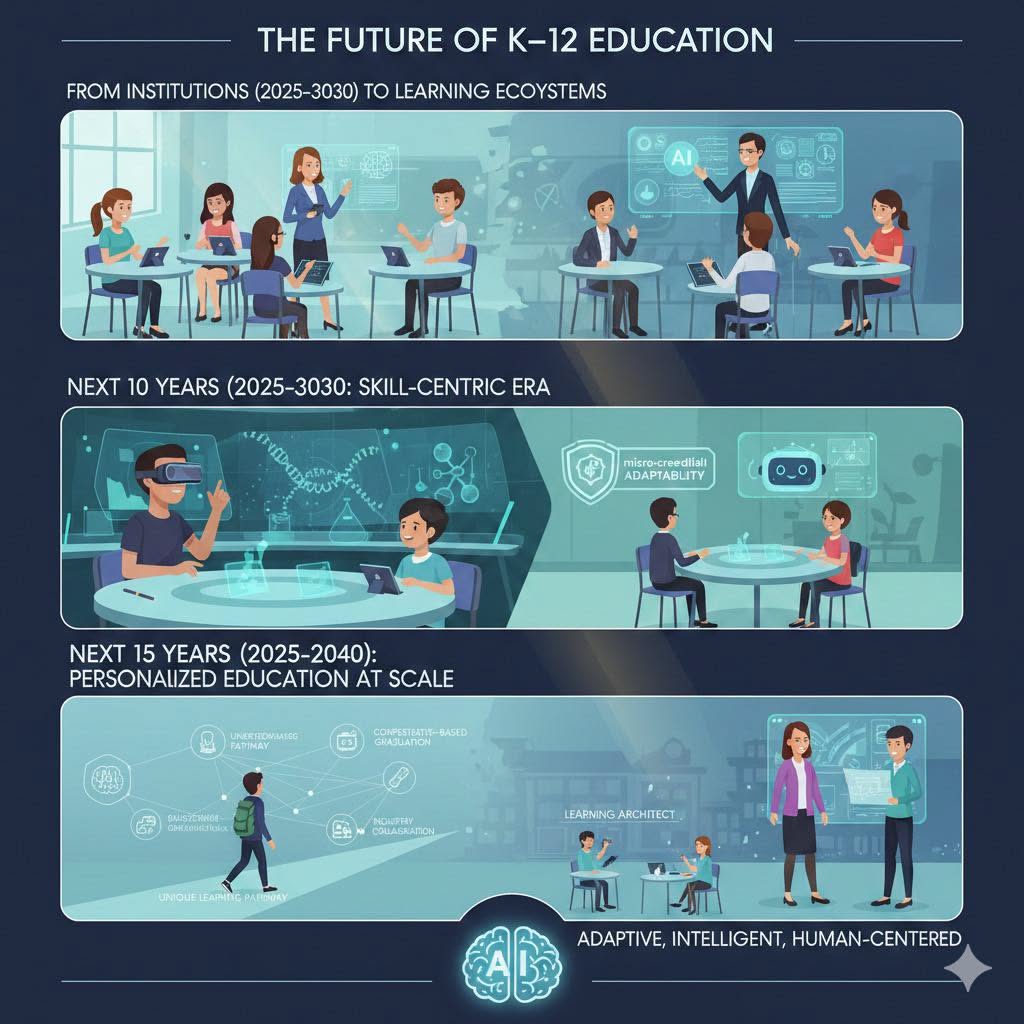
Schooling and learning can become confused when institutions focus on sorting and credential-granting more than genuine understanding. Where education is headed depends on whether systems can separate those functions and create more flexible ways for people to learn throughout life.
In 1971, Ivan Illich published a book called "Deschooling Society." He argued that compulsory schooling had become more about sorting and credential-granting than about genuine learning, and that the two had been so thoroughly conflated that most people could no longer tell them apart.[1]
His prescription - decentralized learning webs that let people connect with resources and with each other outside institutional structures - was considered radical fringe thinking.
Fifty years later, an estimated 1.5 billion students worldwide used some form of online learning during the COVID-19 pandemic. Millions of people hold credentials from institutions that did not exist a decade ago. Employers are increasingly removing degree requirements from job postings.
The world's largest tutoring operation may soon be an AI.
Illich was not entirely right. But the questions he asked are now mainstream.
The current moment in education is one of simultaneous pressure from multiple directions. Demographic shifts are changing who arrives at the schoolhouse door. Technological change is altering both what skills are valuable and what tools exist to develop them.
Employer skepticism about traditional credentials is growing. And a decade of cognitive science research has established, beyond reasonable dispute, that the way most schools teach is not how human beings actually learn best.
These pressures do not all point in the same direction, and they will not resolve cleanly. But understanding them individually is a prerequisite for thinking clearly about where education goes next.
The Credential Crisis
What Credential Inflation Actually Means
Credential inflation describes a well-documented phenomenon: over time, the qualifications required for jobs rise without a corresponding rise in the actual skills those jobs demand. A secretary in 1965 needed a high school diploma.
The same position, often now titled "executive assistant" or "administrative coordinator," routinely requires a bachelor's degree. The job has not changed much. The credential threshold has.
Research by Joseph Fuller and Manjari Raman at Harvard Business School put specific numbers to the pattern. Analyzing job postings and employment data, they found that 67% of job postings for production supervisors required a college degree, but only 16% of currently employed production supervisors held one.
The same gap appeared in administrative assistants, dental hygienists, and dozens of other occupations. Their 2017 report, "Dismissed by Degrees," estimated that degree inflation was excluding more than 6 million Americans from middle-skill jobs they were otherwise qualified to perform.[2]
This is not harmless. When jobs require credentials that are not actually needed to perform the work, several things happen:
- Workers spend years and significant money acquiring credentials of limited vocational relevance
- Employers screen out qualified candidates who would have been perfectly capable
- The degree functions as a sorting signal - a proxy for intelligence, perseverance, or class background - rather than as an evidence of specific preparation
- Student debt loads rise while returns on education, in the aggregate, become more uneven
- Social mobility pathways narrow for workers who lack time or resources for extended academic credentialing
The aggregate cost of credential inflation to the U.S. economy has been estimated in the hundreds of billions of dollars annually, once you account for the productivity of displaced workers, the cost of their educational debt, and the waste of organizational resources spent screening out qualified candidates.
The Degree as a Signal
The economic theory behind credential inflation draws on Michael Spence's signaling model from 1973, which won him a share of the Nobel Prize in Economics.
Spence observed that in labor markets with information asymmetries - employers cannot fully assess a candidate's ability before hiring - education can function as a costly signal even if it teaches nothing relevant.[3]
If finishing a four-year degree requires persistence, cognitive capacity, and the ability to navigate complex social institutions, employers can use degree completion as a screening device without caring what the degree is in.
The signal works for employers regardless of whether the education is useful. It is valuable to workers because employers demand it.
The problem is that when everyone signals, the signal loses value - and the arms race escalates. A bachelor's degree was an effective signal when only 20% of the population held one. When 40% hold one, the differential advantage shrinks, and the pressure to acquire a master's or professional degree increases.
The National Center for Education Statistics (2023) reports that the share of the U.S. adult population with at least a bachelor's degree reached 38% in 2022, up from 24% in 1995. The credential premium has not kept pace with this expansion.
Bryan Caplan's controversial but extensively argued 2018 book "The Case Against Education" takes the signaling critique to its logical extreme, arguing that the majority of the private return to a college degree reflects signaling rather than genuine human capital development.
Even economists who reject Caplan's most provocative conclusions acknowledge that the signaling component of education is substantial and that its growth creates real social inefficiencies.[4]
Signs of a Breaking System
There are genuine signals that the credential-education complex is under stress:
Employer defection: By 2022, IBM, Google, Apple, and dozens of other major employers had removed bachelor's degree requirements from significant portions of their job postings. Maryland became the first U.S. state to formally remove degree requirements from thousands of state government positions.
The alternative credential market - bootcamps, certifications, apprenticeships - has grown substantially.
According to the Council on Adult and Experiential Learning, the number of working-age Americans with some college but no degree exceeded 36 million by 2020, and employers in tight labor markets are increasingly reaching into this pool.
Enrollment decline: U.S. college enrollment fell by roughly 1.4 million students between 2020 and 2022, a drop that partly reflects COVID disruptions but also a longer-term trend among young men and working-class students questioning the value proposition.
The National Student Clearinghouse reported community college enrollment was down 14.7% between spring 2020 and spring 2022. More striking still, a 2023 Gallup poll found that only 42% of Americans rated a four-year college education as "very important," down from 70% a decade earlier.
Return heterogeneity: Research by economists at the Federal Reserve Bank of New York shows that the economic return to a bachelor's degree varies dramatically by institution, major, and student background. The "college premium" - the average wage advantage of degree holders - conceals enormous variance.
A philosophy degree from a regional state university produces a very different economic return than a computer science degree from a competitive research university.
A 2022 analysis by Georgetown University's Center on Education and the Workforce found that 30% of workers with associate's degrees out-earn workers with bachelor's degrees. The average conceals a distribution with very fat tails.
Student debt crisis: U.S. student loan debt surpassed $1.77 trillion in 2023, according to Federal Reserve data - more than either credit card debt or auto loan debt. The average borrower who completed a four-year degree carried approximately $29,000 in federal student loan debt.
For graduate and professional degree holders, the average was substantially higher. The debt-to-earnings ratios for certain programs at certain institutions have become difficult to defend on any financial calculation.
What Research Says About Learning Itself
The Online Learning Question
The COVID-19 pandemic forced the largest real-world experiment in online education ever conducted. What did it find?
The short answer is that delivery medium matters less than design quality and learner readiness.
A 2019 meta-analysis by the U.S. Department of Education (updated from a 2010 original) examined more than 50 controlled studies of online versus face-to-face instruction.
On average, online instruction produced modestly better learning outcomes - an effect size of about 0.2 standard deviations - but the variation between studies was enormous.[5] Highly interactive, well-scaffolded online courses substantially outperformed passive lecture formats in person.
The finding that mattered was not the average but the range: the best online instruction was dramatically better than mediocre in-person instruction, and the worst online instruction was barely functional.
"The most successful online learning is not a digital version of sitting in a lecture hall. It is a fundamentally different experience built around interactivity, spaced practice, and immediate feedback." - U.S. Department of Education meta-analysis, 2019
The pandemic data was sobering. A large-scale study by Kuhfeld and colleagues (2020) published by NWEA found that students who shifted to remote learning showed significantly lower learning gains in mathematics than pre-pandemic cohorts, particularly in younger grades.[6]
The effect was concentrated among low-income students who lacked stable internet access, quiet study space, and parental support for remote learning. This was not a failure of online learning as a technology.
It was a failure of implementation under resource constraints - the conditions most likely to produce poor outcomes in any delivery format.
The MOOC (Massive Open Online Course) revolution promised democratization of elite education. MIT and Harvard launched edX; Stanford's faculty launched Coursera. The promise was real, but the completion rates were not. Average completion rates for MOOCs hover around 5-15%, with many studies reporting even lower figures.
A 2019 study by Kizilcec and colleagues examining MOOC completion across 50 courses and 750,000 learners found that only 6.5% of registered users completed the courses.[14]
Free courses taken without external accountability, peer community, or financial commitment have predictably high dropout rates. The technology is not the constraint - motivation and structure are.
How Memory and Learning Actually Work
Decades of cognitive science research have produced remarkably clear findings about effective learning - findings that most traditional educational practice ignores.
Retrieval practice (the testing effect): Retrieving information from memory strengthens retention far more than re-reading or reviewing it. A landmark study by Roediger and Karpicke (2006) showed that students who spent study time taking tests rather than re-studying remembered 50% more material one week later.[7]
The effect is robust across subject areas, age groups, and content types. Henry Roediger's lab at Washington University in St. Louis has replicated it in dozens of follow-up studies. Schools that test frequently are not assessing learning at the expense of teaching it - they are teaching it.
Spaced practice: Learning distributed across time produces stronger retention than the same amount of learning crammed into a single session (massed practice).
A student who studies for 30 minutes on Monday, Wednesday, and Friday will remember more than a student who studies for 90 minutes on Sunday - even though the total time is identical.
Cepeda and colleagues' 2006 review in Psychological Bulletin, examining data from 254 studies, found strong support for spacing effects across a wide range of learning tasks.[8]
The optimal gap between study sessions depends on the desired retention interval: if you want to remember something for a year, you should study it across weeks, not days.
Interleaving: Mixing different types of problems or subjects during practice produces superior long-term retention and transfer compared to blocked practice (completing all problems of one type before moving to the next). Interleaving feels harder and less productive to learners, which may explain why it remains rare in most curricula.
A key study by Taylor and Rohrer (2010) in Applied Cognitive Psychology found that students who practiced interleaved math problems scored 25% higher on a test one day later compared to students who practiced the same problems in blocked fashion.[9]
Desirable difficulty: Conditions that feel challenging and slow the acquisition of skill often produce better long-term retention. This is deeply counterintuitive - both teachers and learners tend to optimize for fluency during the learning session, not for retention and transfer afterward.
Robert Bjork at UCLA, who coined the term "desirable difficulties," summarizes the paradox: "The very conditions that seem to impede learning during practice can enhance long-term retention and transfer."
Elaborative interrogation and self-explanation: Asking "why" questions while studying - and generating explanations for why facts are true - produces substantially better retention than passive reading.
Chi and colleagues' work on self-explanation effects has shown that students who explain material to themselves as they study it learn two to three times more than those who read without generating explanations.
| Learning Strategy | Short-term Performance | Long-term Retention | Use in Schools |
|---|---|---|---|
| Re-reading / reviewing | High | Low | Very common |
| Retrieval practice / testing | Moderate | High | Uncommon |
| Spaced practice | Moderate | High | Rare |
| Interleaved practice | Low (initially) | High | Very rare |
| Elaborative interrogation | Moderate | High | Uncommon |
| Self-explanation | Moderate | High | Uncommon |
| Highlighting / underlining | High (feels productive) | Very low | Very common |
The gap between the strategies most students use and the strategies that cognitive science has validated as effective is not a minor misalignment. It represents an enormous systematic waste of student time and effort.
John Dunlosky and colleagues' 2013 review in Psychological Science in the Public Interest rated the ten most commonly used study strategies by their evidence base and found that the two most commonly used (highlighting and rereading) received ratings of "low utility." The two least commonly used (spaced practice and retrieval practice) received ratings of "high utility."[10]
Competency-Based Education
The Time-Based Model's Fundamental Problem
Traditional education is organized around seat time: students receive credit for spending a defined number of hours in a course, regardless of whether they have actually learned the material. A student who masters calculus in six weeks and a student who struggles through the same content in sixteen weeks earn the same credit.
This model made sense when education was delivered in physical classrooms with fixed schedules. It makes much less sense in an era when learning can be self-paced, technology can assess mastery in real time, and the labor market rewards demonstrated skill rather than time served.
The Carnegie Unit, the standard measure of academic credit in U.S. secondary and higher education, was originally defined in 1906 as 120 hours of instruction time. It was designed to standardize teacher pensions - not to measure learning.
More than a century later, it remains the foundational unit of educational accounting despite having no demonstrated relationship to the actual acquisition of knowledge or skill.
Competency-based education (CBE) decouples credit from time. Students advance when they demonstrate mastery of defined competencies, not when they have completed a fixed duration of instruction. The approach aligns much better with what we know about learning: some students need more time on some material, some less.
Allowing students to move faster through content they already understand and spend more time on content they have not mastered is simply efficient.
The Evidence from Western Governors University
Western Governors University, founded in 1997 by a consortium of U.S. state governors, is the largest CBE institution in the country, serving over 150,000 students primarily in business, education, healthcare, and information technology.
Research on WGU outcomes has generally been positive. A 2019 study by the RAND Corporation found that WGU bachelor's degree graduates had employment outcomes comparable to graduates of traditional universities, at substantially lower cost (average time to degree completion was roughly 2.5 years; average total cost was under $20,000 in tuition).[18]
A separate study found that WGU nursing graduates passed licensing examinations at rates above the national average.
A 2022 analysis by Third Future Schools of students in CBE programs found that students in mastery-based learning environments were 1.5 grade levels ahead in mathematics compared to their non-CBE peers after two years.
The effect was especially pronounced for students who had been performing below grade level at the start of the intervention - suggesting that CBE has particular value for students who have been poorly served by the standard time-based model.
CBE is not without criticism. Skeptics argue that competency frameworks can be narrow, that some of what universities produce - intellectual breadth, exposure to diverse ideas, social capital - cannot be easily defined as competencies, and that the model works better for professional-technical fields than for humanities or sciences.
These criticisms have merit. CBE is probably not the right model for all of education. But the underlying insight - that the point of education is demonstrated capability, not time in seats - is difficult to argue with.
The most productive path may be a hybrid: time-based structures for experiences that genuinely benefit from cohort learning and intellectual community, and competency-based progression for skill acquisition that can be assessed objectively.
The Skills vs. Knowledge Debate
What Employers Say They Want
The most consistent finding from employer surveys over the past decade is that employers want graduates who can think, communicate, collaborate, and adapt - and they report that recent graduates are not reliably prepared in these dimensions.
The Association of American Colleges and Universities conducts regular surveys of both employers and college students. Their 2021 findings are striking:
- 96% of chief academic officers at colleges believe they are preparing students effectively for the workforce
- 11% of business leaders strongly agree that recent graduates have the skills their businesses need
The gap between institutional self-assessment and employer perception is enormous. It suggests either that colleges are measuring the wrong things, that employers have unrealistic expectations, or both.
Given the consistency of the finding across multiple surveys and years, it likely reflects genuine misalignment between what institutions value (the ability to perform well on academic assessments) and what employers value (the ability to function effectively in complex, ambiguous, collaborative work environments).
The World Economic Forum's Future of Jobs reports have consistently placed analytical thinking, creativity, resilience, and active learning at the top of the most-valued skills for the coming decade - capabilities that are not easily measured by grades or standardized tests.
The WEF's 2023 report projected that 44% of workers' core skills would be disrupted in the next five years by automation and AI.[17] The premium on adaptability and continuous learning has never been higher.
LinkedIn's 2023 Workplace Learning Report found that "learning agility" - the ability to learn new skills rapidly in response to changing conditions - was the attribute most frequently cited by talent acquisition professionals as predictive of high performance, ahead of domain expertise, experience, or educational credentials.
The False Dichotomy
The "skills vs. knowledge" framing is somewhat misleading. Complex skills are built on organized knowledge. You cannot think critically about a domain you do not understand. Creative problem-solving in medicine requires knowing medicine.
Effective communication about a technical subject requires understanding the technical subject.
The more accurate framing may be: the purpose of education should be the development of transferable, knowledge-based capabilities - not the accumulation of inert information that can be retrieved from a search engine, but the deep structural understanding that enables novel application.
This is the distinction between surface learning (memorizing facts and procedures for reproduction on tests) and deep learning (understanding principles well enough to apply them to new situations).
Research consistently shows that surface learning dominates in high-stakes testing environments, because surface approaches are more efficient for passing standardized tests.
Marton and Saljo's foundational 1976 study on learning approaches first identified this distinction, and it has been replicated in educational contexts across cultures and disciplines.
Transfer - the ability to apply what you learned in one context to a different context - is the gold standard of educational effectiveness and the dimension on which schools most consistently underperform.
Robert Haskell's 2001 synthesis "Transfer of Learning: Cognition, Instruction and Reasoning" concluded that transfer is systematically undertaught, partly because it requires extended practice in varied contexts and cannot be demonstrated on the narrow, domain-specific assessments that dominate educational measurement.
AI Tutoring and Personalized Learning
The 2 Sigma Problem
In 1984, educational psychologist Benjamin Bloom published a paper describing what he called the "2 sigma problem." He reported that students who received one-on-one human tutoring performed two standard deviations better than students taught in conventional classroom settings - an extraordinary effect size equivalent to the difference between the 50th and 98th percentile.[11]
The "problem" was that one-on-one tutoring at scale is economically impossible.
Bloom challenged educational researchers to find ways to achieve two-sigma results in conventional classroom settings. The challenge went largely unmet for decades. Mastery learning, cooperative learning, and several other approaches produced meaningful effect sizes - 0.5 to 1.0 standard deviations - but nothing close to two sigma.
The gap between what expert one-on-one tutoring could produce and what classroom instruction could produce remained enormous.
AI tutoring systems represent the first serious candidates for a technological solution.
What AI Tutoring Can Do
Current AI tutoring systems range from sophisticated adaptive practice platforms to AI-based conversational tutors.
Carnegie Learning's MATHia, an adaptive mathematics platform, has been studied in multiple randomized controlled trials and shows consistent positive effects - students using the platform learn approximately 1.5 years' worth of material in one year in some studies.
A 2019 RCT published in the Journal of Research on Educational Effectiveness found effect sizes of 0.20 standard deviations for MATHia versus standard instruction - modest but consistent and meaningful at scale.
Khan Academy's Khanmigo, built on GPT-4, acts as a Socratic tutor: rather than giving students answers, it asks guiding questions, identifies misconceptions, and adapts to each student's pace and prior knowledge. Early qualitative reports from teachers are generally positive; rigorous outcome data is still emerging.
Perhaps the most striking preliminary evidence comes from a 2023 study by Bastani and colleagues at the University of Pennsylvania's Wharton School.[12]
They conducted a randomized experiment with 1,000 students using an AI tutor for math and found that the AI-tutored group showed a 48% improvement in learning outcomes compared to the control group on post-test scores.
The effect was particularly strong for students in the middle of the performance distribution.
What AI tutoring does well:
- Endless patience: the system never becomes frustrated or disengaged
- Immediate feedback: errors are flagged instantly, before misconceptions solidify
- Adaptive difficulty: content adjusts in real time to the learner's current level
- Availability: 24/7 access without scheduling constraints
- Consistency: every student receives the same quality of interaction regardless of the day, the class size, or the teacher's other demands
What AI tutoring cannot (yet) do well:
- Build genuine relationships and motivation with students who feel disconnected
- Navigate the social and emotional complexity of a classroom
- Inspire, model intellectual curiosity, or convey genuine passion for a subject
- Handle the unexpected, the creative, and the deeply personal dimensions of learning
- Recognize and appropriately respond to a student in emotional distress
The Teacher's Evolving Role
The most likely trajectory is not replacement but transformation. As AI systems take on more of the direct instruction and practice scaffolding, teachers may be freed to focus on higher-value functions: mentoring, facilitating discussion, providing emotional support, designing challenging projects, and building the relational environment in which students feel safe enough to take intellectual risks.
"The bottleneck in most classrooms is not information delivery. It is the human connection that transforms information into understanding, and challenge into growth. Technology can solve the first problem. It cannot solve the second." - Sal Khan, founder of Khan Academy, speaking at the Aspen Ideas Festival, 2023
This is not guaranteed. The risk is that AI tutoring becomes a cost-cutting mechanism rather than a quality-enhancement mechanism - replacing teachers without replacing what makes teaching valuable.
Historical precedent is not encouraging: previous waves of educational technology (educational television, computer-assisted instruction, the original wave of online courses) were more often used to reduce costs than to improve quality.
The determining factor will be whether institutions treat AI as a tool that amplifies human instruction or as a substitute for it.
The research on teacher effectiveness suggests the stakes are high. Eric Hanushek at Stanford has consistently found that teacher quality explains more variance in student outcomes than any other school-based factor - including class size, curriculum, and school resources.[13]
A student assigned to a teacher at the 85th percentile of effectiveness rather than the 50th percentile gains approximately one additional year of learning over a school year. This effect compounds over time.
The irreplaceable element of teaching is not instruction delivery - that AI can do. It is the human judgment, relationship, and mentorship that the best teachers provide.
Alternative Credentials and Pathways
The Rise of Micro-Credentials
Stackable micro-credentials - short, focused certifications in specific skills - have grown dramatically. Google, AWS, Microsoft, and dozens of other employers and platforms offer credentials recognized by their respective industries. LinkedIn Learning, Coursera, and edX now host thousands of courses leading to verified certificates.
Coursera reported over 100 million registered learners by 2022 and documented employer partnerships that explicitly accepted their certificates in lieu of degree requirements.
The Google Career Certificates program, launched in 2018, offers six-month online certificates in fields like data analytics, UX design, IT support, and project management.
Google's own studies show that 75% of certificate graduates report an improvement in their career within six months of completing the program. More than 150 employers had signed on as hiring partners as of 2023.
The fundamental advantage of micro-credentials is their specificity and speed. A 40-hour certification course in data analysis is much faster and cheaper than a four-year degree, and for employers hiring specifically for data analysis skills, it may be equally informative.
The fundamental challenge is the absence of a common quality standard. The market is fragmented - hundreds of credential providers with varying rigor, recognition, and shelf life.
Employers are still figuring out how to evaluate non-traditional credentials, and the signaling value of micro-credentials varies enormously by field, employer, and geography.
IMS Global Consortium's research on credential transparency (2022) found that only 38% of employers had formal policies for evaluating non-traditional credentials, and actual hiring decisions for those credentials were highly variable even within organizations with formal policies.
Apprenticeships and Work-Based Learning
European countries - particularly Germany, Switzerland, and Austria - have long operated robust apprenticeship systems that provide structured, paid work-based learning leading to recognized qualifications.
Roughly 60% of German secondary students enter apprenticeship programs rather than academic tracks, choosing from approximately 325 recognized vocational training occupations.
Outcomes are strong: German youth unemployment is substantially lower than in countries with primarily academic education systems, and the skills match between graduates and labor market needs is better.
The German model is not directly transferable to countries without the institutional infrastructure, employer culture, and union involvement that make it function - but it demonstrates that alternatives to the academic pathway can work at scale.
The U.K.'s Apprenticeship Levy, introduced in 2017, attempted to expand apprenticeships by requiring large employers to fund a training levy.
Results have been mixed: while the number of apprenticeship starts remained high, critics noted a shift toward higher-level apprenticeships that primarily benefited existing employees receiving formal credentials for skills they already had, rather than expanding opportunities for school leavers.
In the United States, registered apprenticeships serve approximately 600,000 participants annually - a fraction of the German system relative to population. The Biden administration's 2021 apprenticeship initiative aimed to expand this to 2 million participants.
Progress has been slow, partly because the U.S. lacks the industry-level coordination mechanisms that make the German dual-system function, and partly because employer incentives to invest in worker training are weaker when workers can freely leave for competitors.
Income Share Agreements and Alternative Financing
A further dimension of alternative education is alternative financing. Income share agreements (ISAs) allow students to fund education in exchange for a percentage of their future income for a defined period, rather than taking on fixed debt.
Lambda School (now Bloom Institute of Technology) popularized ISAs for coding bootcamps; the model has since spread to other fields.
The evidence on ISAs is mixed. Proponents argue they align school incentives with student outcomes - schools only profit when graduates earn above a threshold.
Critics note that ISAs can be poorly regulated, that the "alignment of incentives" argument breaks down when schools select for students likely to succeed regardless of instruction, and that for students who do earn high incomes, the total cost can substantially exceed equivalent student loan financing.
The Global Picture: What International Data Tells Us
The OECD's PISA assessments, conducted triennially across approximately 80 countries, provide the most consistent international data on educational outcomes.[15]
The 2022 PISA results, published in December 2023, documented the global impact of pandemic-era disruption: average reading, mathematics, and science scores fell across almost all participating countries, with the largest declines in mathematics.
The declines were largest in countries that had extended school closures and were concentrated in students from lower socioeconomic backgrounds.
But the PISA data also reveals structural patterns that predate the pandemic. The performance gap between students from the wealthiest and poorest quartiles within countries has remained stubbornly persistent across two decades of PISA data.
In most countries, socioeconomic background is the single strongest predictor of educational outcomes - more predictive than school quality, teaching approach, or curriculum.
"What we have learned from 20 years of PISA is that excellence and equity in education are not opposites - the highest-performing systems have achieved both.[16]
The lowest-performing systems have typically sacrificed equity for a narrow version of excellence, or sacrificed excellence for a false version of equity." - Andreas Schleicher, OECD Director of Education, PISA 2022 report
This finding challenges both progressive and conservative educational reform narratives.
It suggests that school-based interventions, while important, cannot fully compensate for the effects of poverty and family circumstance on educational outcomes - but also that high-performing systems have found ways to substantially reduce the socioeconomic-outcome correlation through strong universal early childhood programs, equitable resource distribution, and teacher placement policies that send the best teachers to the most disadvantaged schools.
What Is Actually Changing
The most honest assessment of the future of education is that it is changing slowly at the edges and barely at all at the center.
Elite universities retain enormous prestige advantages. The earnings premium for a Harvard or Stanford degree is not going away. The social networks, signaling value, and class reproduction functions of elite higher education are highly resistant to disruption.
Applications to the most selective U.S. universities hit record highs in 2023, even as overall enrollment declined. The scarcity that makes elite credentials valuable is a feature, from the perspective of those inside the system.
Below the elite level, the picture is more volatile. Regional public universities and for-profit institutions are under genuine pressure from online alternatives, declining enrollment, and employer skepticism.
The Hechinger Report tracked 29 small private colleges that closed or announced closure between 2018 and 2023. The pace of closures accelerated with the pandemic. Some will adapt; others will not survive.
The technologies of learning - adaptive software, AI tutoring, video lectures, collaborative online environments - are genuinely powerful.
They are not being widely deployed in the most effective ways, partly because educational institutions are slow to change and partly because effective deployment requires significant investment in teacher development and curriculum redesign.
The fundamental question education faces is whether its purpose is certification or capability. The answer to that question will determine whether the changes at the edges eventually reach the center - or whether the system's credential-granting function proves more durable than its learning function.
What seems most certain is that the current system cannot continue unchanged. The combination of rising costs, declining enrollment, growing employer skepticism, and accelerating technological capability creates pressure that the 19th-century institutional design of most schools and universities will struggle to absorb.
Whether the result is reform or crisis - or which institutions experience which outcome - depends on decisions being made now by policymakers, employers, technology developers, and the students and families who choose how to invest in learning.
Summary
The future of education is not one thing. It is a set of tensions: between credentials and capabilities, between scale and personalization, between institutional inertia and technological possibility.
The evidence suggests that learning science knows far more about how to teach effectively than most educational institutions actually practice. That gap - between what we know and what we do - is where the future of education will be decided.
The most likely outcome is not revolution but gradual diversification: more pathways, more types of credentials, more use of technology for direct instruction, and - if the best-case scenarios for AI tutoring materialize - a genuine possibility of closing the two-sigma gap at scale.
Whether that translates into a more equitable, more capable society depends on choices that are political and institutional, not merely technological.
The students entering school today will spend their careers in a world shaped by AI, climate disruption, and geopolitical volatility that is genuinely difficult to anticipate.
The education system's most important job may not be to teach them specific content - much of which will be outdated within a decade - but to develop in them the capacities for learning, adaptation, and judgment that will remain valuable regardless of what specific challenges they face.
Whether current institutions are up to that task, and whether the alternatives being built at the edges can achieve it at scale, is the central question education faces in the coming generation.
Sources & Further Reading
- Illich, I. (1971). Deschooling Society. Harper & Row.
- Fuller, J., & Raman, M. (2017). Dismissed by Degrees: How Degree Inflation Is Undermining U.S. Competitiveness and Hurting America's Middle Class. Accenture, Grads of Life, Harvard Business School.
- Spence, M. (1973). Job market signaling. Quarterly Journal of Economics, 87(3), 355-374.
- Caplan, B. (2018). The Case Against Education: Why the Education System Is a Waste of Time and Money. Princeton University Press.
- U.S. Department of Education. (2019). Evaluation of Evidence-Based Practices in Online Learning: A Meta-Analysis and Review of Online Learning Studies (updated). Office of Planning, Evaluation and Policy Development.
- Kuhfeld, M., Tarasawa, B., Johnson, A., Ruzek, E., & Lewis, K. (2020). Learning during COVID-19: Initial findings on students' reading and math achievement and growth. NWEA.
- Roediger, H. L., & Karpicke, J. D. (2006). Test-enhanced learning: Taking memory tests improves long-term retention. Psychological Science, 17(3), 249-255.
- Cepeda, N. J., Pashler, H., Vul, E., Wixted, J. T., & Rohrer, D. (2006). Distributed practice in verbal recall tasks: A review and quantitative synthesis. Psychological Bulletin, 132(3), 354-380.
- Taylor, K., & Rohrer, D. (2010). The effects of interleaved practice. Applied Cognitive Psychology, 24(6), 837-848.
- Dunlosky, J., Rawson, K. A., Marsh, E. J., Nathan, M. J., & Willingham, D. T. (2013). Improving students' learning with effective learning techniques. Psychological Science in the Public Interest, 14(1), 4-58.
- Bloom, B. S. (1984). The 2 sigma problem: The search for methods of group instruction as effective as one-to-one tutoring. Educational Researcher, 13(6), 4-16.
- Bastani, H., Bastani, O., Sungu, A., Ge, H., Kabakcl, O., & Mariman, R. (2023). Generative AI can harm learning. Wharton School Working Paper.
- Hanushek, E. A., & Rivkin, S. G. (2010). Generalizations about using value-added measures of teacher quality. American Economic Review, 100(2), 267-271.
- Kizilcec, R. F., Piech, C., & Schneider, E. (2013). Deconstructing disengagement: Analyzing learner subpopulations in massive open online courses. In Proceedings of the Third International Conference on Learning Analytics and Knowledge.
- OECD. (2023). PISA 2022 Results: The State of Learning and Equity in Education. OECD Publishing.
- Schleicher, A. (2018). World Class: How to Build a 21st-Century School System. OECD Publishing.
- World Economic Forum. (2023). Future of Jobs Report 2023. WEF.
- RAND Corporation. (2019). Evaluation of Western Governors University. RAND.