
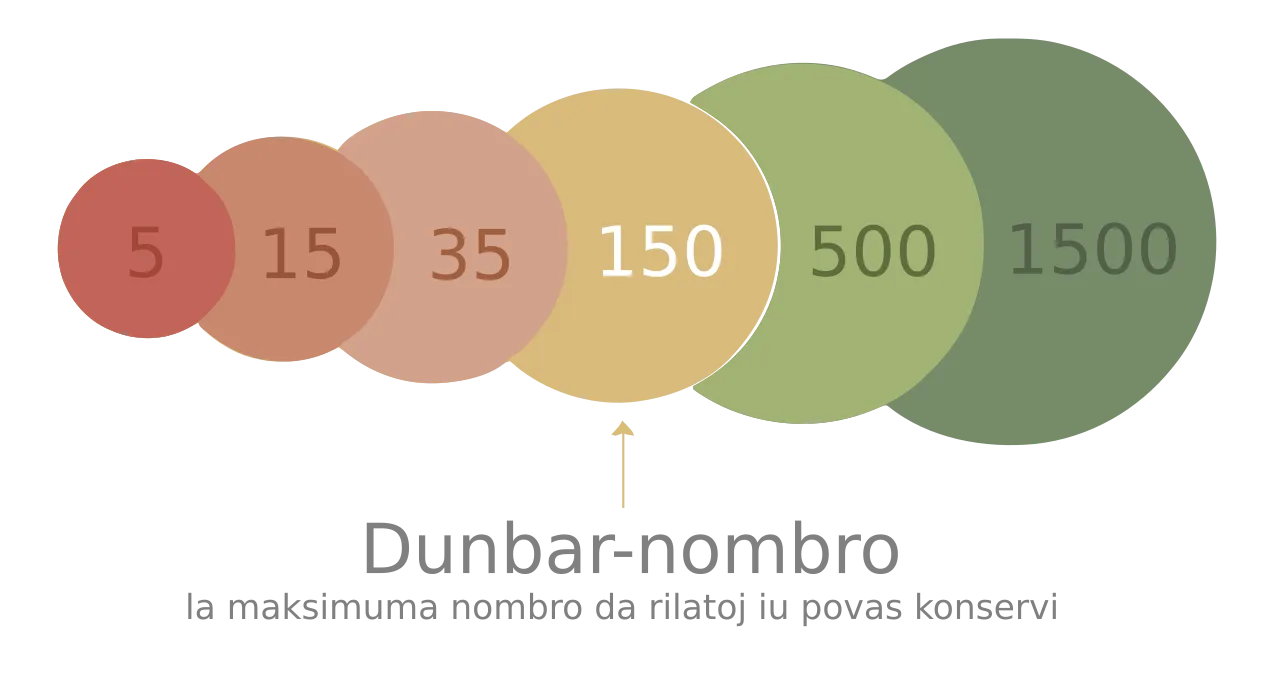
Social connection is limited by the time and cognitive capacity needed to maintain genuine relationships. The Dunbar number is the debated estimate that this limit is around 150 people, despite the much larger networks technology can make visible to each person.
Every person alive carries what might be called a social budget: a finite capacity for maintaining genuine relationships.
No matter how extroverted, ambitious, or technologically connected a person becomes, the number of individuals they can meaningfully track and truly know appears to be constrained by the architecture of the human brain.
The theory that pins this limit at around 150 people is known as the Dunbar Number, and it has become one of the most cited and debated ideas in social science.
Who Is Robin Dunbar and Where Did the Number Come From?
Robin Dunbar is a British anthropologist and evolutionary psychologist, currently based at the University of Oxford. His research in the early 1990s began not with human beings but with other primates.
He was investigating why primates, relative to other mammals, have such large brains, and specifically such large neocortices, the region of the brain responsible for complex cognition, social reasoning, and self-awareness.
The Neocortex Ratio
Dunbar found a striking correlation: the ratio of the neocortex volume to the rest of the brain was strongly predictive of the typical social group size for any given primate species. Gibbons, with a relatively smaller neocortex ratio, live in small family groups of around 6 to 8.
Chimpanzees, with a larger ratio, form troops of roughly 30 to 80. Gorillas fall somewhere in between.
When Dunbar extrapolated the regression line to the human neocortex ratio, the predicted social group size came out at approximately 147.8, rounded to 150 in most popular accounts.
The logic behind the correlation is intuitive once stated. Social living requires keeping track of an enormous amount of information: who is allied with whom, who has wronged whom, what obligations exist between individuals, who can be trusted and in what circumstances, and what each person's current emotional and social status might be.
This social bookkeeping requires cognitive resources. The neocortex, Dunbar proposed, evolved in large part to meet this demand. Bigger groups require more powerful social processing hardware.
The Social Brain Hypothesis
Dunbar's broader framework is called the social brain hypothesis: the proposition that the disproportionate cognitive development of primates, relative to other mammals, was driven primarily by the demands of social life rather than by the demands of physical problem-solving or ecological navigation.
This was a controversial claim when first published in the early 1990s because the prevailing view emphasized ecological factors such as food-finding, tool use, and predator avoidance as the primary drivers of primate brain evolution.
The social brain hypothesis predicts that the computational demands of tracking social relationships grow faster than group size. In a group of 10, there are 45 possible pairwise relationships to track. In a group of 50, there are 1,225. In a group of 150, there are 11,175.
The neocortex must scale to handle not just individual relationships but the second-order understanding required by alliance tracking: knowing that A and B are allies, B and C are rivals, and therefore predicting how the A-C relationship will develop.
This second-order social reasoning, understanding the relationships among others and not just your own relationships with each person, is cognitively demanding in ways that cannot be fully offloaded to external tools or delegated to others. It requires dedicated neural architecture.
Validation Against Historical and Anthropological Data
Dunbar did not rely on the primate regression alone. He tested the 150 prediction against a wide range of independent data sources:
- Hunter-gatherer band sizes: Across dozens of documented hunter-gatherer societies worldwide, residential communities average around 150 members before they fragment or reorganize.
- Neolithic villages: Archaeological evidence from early agricultural settlements shows village sizes clustering around 150 before they split into daughter settlements.
- Military unit sizes: Most armies throughout recorded history have used a tactical unit of approximately 100 to 200 soldiers: the Roman maniple, the Hutterite colony limit, the British Army company. Military commanders appear to have independently discovered that direct, trust-based coordination breaks down above this threshold.
- Christmas card lists: In a study of British households, Dunbar found that the average person sent cards to around 153 people, a social network proxy that reflects the same underlying cognitive limit.
"The figure of 150 seems to represent the maximum number of individuals with whom we can have a genuinely social relationship, the kind of relationship that goes with knowing who they are and how they relate to us."
Robin Dunbar, Grooming, Gossip, and the Evolution of Language (1996)
The Cross-Cultural Archaeological Evidence
The archaeological data supporting the 150 figure is particularly striking because it comes from contexts where social organization was shaped entirely by practical constraints, with no knowledge of any social-psychological theory.
Analysis of Neolithic settlement data from across the Middle East shows that settlements consistently remained below approximately 150-200 inhabitants before new settlements were established.
Khirokitia in Cyprus, one of the best-preserved Neolithic sites, had an estimated population of around 300-500 at its peak, but internal spatial organization suggests it was effectively divided into functionally separate sub-communities of 100-150.
A study of contemporary hunter-gatherer societies by Dunbar and colleagues examined 21 documented groups across Africa, South America, and Australia. The mean residential band size was 148.4.
The consistency across cultures separated by tens of thousands of miles and thousands of years of independent development is not easily dismissed as coincidence.
The Nested Layers of Human Social Circles
One of the most practically useful extensions of Dunbar's work is the identification of nested social layers inside and beyond the 150 figure.
Dunbar and colleagues, including colleagues Sam Roberts and Will Dunbar, found that human social networks are not flat: they are organized in a series of concentric circles, each roughly three times larger than the one inside it.
| Layer Name | Approximate Size | Relationship Quality |
|---|---|---|
| Support clique | 5 | Closest confidants; whose loss would be devastating |
| Sympathy group | 15 | Those you turn to for emotional and material support |
| Affinity group | 50 | Regular social companions; strong familiarity |
| Dunbar group | 150 | Full social network; stable trust and cooperation |
| Acquaintance layer | 500 | People you know by name and face |
| Recognition layer | 1,500 | People whose face you can recognize |
Each transition represents a qualitative change in relationship type. The innermost group of 5 consists of people with whom you communicate multiple times per week and would turn to in a serious crisis. The 15-person sympathy group comprises those whose death would profoundly affect you.
The 50-person group covers those you would invite to a party. The 150-person Dunbar group is the limit for a community in which everyone can know everyone else well enough to cooperate without needing formal rules or enforcement mechanisms.
Why Three Times?
The consistent ratio of approximately three between each layer is not fully explained, but researchers have proposed that it reflects the different frequencies of social contact required to maintain different depths of relationship. Maintaining a close confidant relationship requires very frequent interaction.
Maintaining a stable acquaintance requires far less. The threefold scaling may reflect a natural discretization of contact frequency bands.
A 2020 study published in Proceedings of the National Academy of Sciences by Dunbar and colleagues analyzed mobile phone data from 35 million users across Europe. It found that the contact frequency patterns in the data mapped closely onto the predicted 5/15/50/150 layering structure.
People contacted their innermost circle (around 5 individuals) at rates roughly 10 times higher than their third layer (around 50 individuals). The frequency gradient matched the theoretical prediction from social circle theory remarkably well.
The Cost of Maintaining Relationships
A key insight embedded in the layered model is that relationships require investment to maintain.
Dunbar's research suggests that humans dedicate roughly 20% of their social time to grooming relationships, which in modern terms means conversation, shared experience, mutual support, and social interaction. This 20% is effectively the social maintenance budget.
The innermost circles are maintained through high-frequency interaction at relatively low effort per episode. Seeing a close friend briefly and frequently is cheaper, in total time, than maintaining a large acquaintance network through occasional intensive social engagement.
The layered structure reflects an optimal allocation of this finite maintenance budget.
When people experience major life transitions, such as relocation, career change, the birth of children, or retirement, the layers often reorganize.
Some people fall through the layers as contact frequency drops; others are promoted inward as new life circumstances generate shared experience and mutual reliance. The layers are not fixed; they are dynamic equilibria maintained by ongoing social investment.
What Dunbar's Number Means for Organizations
The 150-person limit has significant implications for how organizations function.
Research by Dunbar and others, as well as independent organizational data, suggests that companies and groups below 150 tend to operate with informal coordination: social trust, shared norms, and direct personal knowledge of colleagues substitute for formal hierarchy.
Above 150, these informal mechanisms break down and formal structures (org charts, written policies, performance management systems) become necessary.
Case Studies in Organizational Design
W.L. Gore and Associates, the manufacturer of Gore-Tex fabric, famously applies this principle. Gore limits factory units to roughly 150 workers. Rather than building large centralized manufacturing plants, the company constructs smaller facilities and adds new buildings rather than expanding existing ones.
The company's founder, Bill Gore, cited the observation that below 150 people, everyone knows everyone else and social pressure is a sufficient coordination mechanism, so formal management layers are largely redundant.
Gore's organizational results are often cited in support of the Dunbar principle in organizational settings. The company has consistently ranked among the best places to work in surveys by Fortune and comparable publications.
Employee tenure tends to be long, innovation rates are high, and management overhead is lower than comparably sized firms in manufacturing.
Hutterite colonies provide a centuries-old natural experiment. This Anabaptist religious group has practiced communal living since the 16th century. Community elders long ago established a rule that when a colony reaches approximately 150 members, it must split and found a new colony.
The elders did not derive this from any modern science; they discovered through experience that social cohesion and economic cooperation deteriorated above that threshold.
Military units across cultures and centuries converge on similar numbers. The US Army company consists of 80 to 225 soldiers. The Roman legion's tactical subunit, the maniple, had 120 to 160 men.
The consistency is remarkable given that these organizations arose independently and were concerned with battlefield effectiveness rather than social psychology.
The Startup-to-Corporation Transition
The organizational dynamics of Dunbar's Number have significant practical implications for growing technology companies.
Startups frequently describe a qualitative shift in company culture somewhere between 50 and 150 employees, what founders often describe as "losing the feeling of knowing everyone." Below this threshold, the company can operate through direct relationships, shared norms, and informal coordination.
Above it, without deliberate structural investment, informal mechanisms begin failing.
Research on organizational behavior at scaling companies suggests that the 150-person transition is associated with increased need for formal documentation of processes, explicit onboarding systems, HR functions, and management layers.
Companies that invest in this structural scaffolding before the transition manage it more gracefully than those that attempt to preserve informal-only coordination past the threshold.
Conversely, organizations that retain informal characteristics, such as flat structures, direct access to leadership, and shared spaces that facilitate serendipitous interaction, within units or teams smaller than 150 tend to show higher engagement and faster information flow than equivalent-size organizations structured around formal hierarchy.
Does the Dunbar Number Apply to Online Social Networks?
The rise of social media presented an apparent challenge to Dunbar's thesis. If the cognitive limit is 150, how do people manage networks of 5,000 Facebook friends or 500,000 Twitter followers?
Research suggests the answer is: they do not actually manage them. Studies of Twitter data by Dunbar's group found that despite wildly varying follower counts, active, reciprocal engagement (the kind that constitutes a genuine social relationship) consistently clustered in the 100 to 200 range, regardless of total network size.
Large follower counts represent an audience, not a social circle. A celebrity with a million followers is broadcasting, not maintaining a million relationships.
A 2016 study published in Royal Society Open Science analyzed 3.3 million Twitter users and found that the emotionally close network (the people with whom users had consistent, mutual, substantive exchanges) had a median size of approximately 100 to 200, fully consistent with the Dunbar prediction.
This finding has significant implications for how we think about social media platforms. The technology has not expanded human social capacity. It has primarily made it easier to broadcast to, and passively observe, larger audiences of acquaintances while maintaining the same basic social circle size.
What Social Media Actually Changes
What social media does appear to change, according to Dunbar's 2021 paper "An Evolutionary Perspective on the Human Capacity for Friendship," is the maintenance cost of relationships.
Digital communication allows people to sustain contact with connections that would otherwise fade due to geographic separation or life changes.
A person who moves cities can remain in meaningful contact with more members of their sympathy group than was possible when contact required physical proximity.
This maintenance-cost reduction may allow people to sustain relationships at the 50-person and 150-person layers that would otherwise decay, effectively slowing the turnover in middle and outer circles.
The cognitive limit on active tracking still applies, but the geographic mobility that previously forced layer-reorganization can be partially compensated by low-cost digital contact.
The practical implication: social media is better understood as a relationship maintenance tool than a relationship expansion tool. It helps keep existing relationships alive across distances but does not appear to substantially expand the number of relationships people actively track.
Criticisms and Challenges to the Dunbar Number
The Dunbar Number is widely cited, but it is not scientifically unchallenged.
The 2021 Statistical Challenge
A 2021 study by Patrik Lindenfors, Andreas Wartel, and Johan Lind, published in Biology Letters, re-examined the statistical basis of Dunbar's primate regression.
They found that when they included a broader range of primate species and used more rigorous statistical modeling, the confidence interval around the human social group size estimate was so wide, ranging from roughly 2 to over 500, that 150 was not statistically distinguishable from much larger or smaller numbers.
The study argued that Dunbar's 150 figure was imprecisely estimated and perhaps overconfidently stated.
Dunbar responded that the Lindenfors study used a different approach to measuring social group size across species, one he argued was inappropriate for the comparison, and that the broader pattern of evidence from anthropology, history, and organizational studies remained consistent with his prediction.
The methodological debate continued in subsequent publications.
Cultural and Contextual Variation
Critics also point out that human group sizes vary enormously across cultures, economic systems, and technological contexts. Industrial cities, online communities, and modern corporate structures all involve navigating far more than 150 relationships, even if most are shallow.
Whether the Dunbar Number describes a hard cognitive ceiling or simply a comfortable optimum is debated.
A significant critique raised by researchers including psychologist Bernard Bridgeman is that the relationship between neocortex size and social cognition may be less direct than Dunbar's model assumes.
Other aspects of brain architecture, including the prefrontal cortex, temporal-parietal junction, and default mode network, contribute to social cognition in ways that may not be captured by the neocortex ratio alone.
The neurological substrate of social capacity is more distributed and complex than the original model suggested.
Individual Differences
People vary in their social capacity. Some individuals, particularly those high in extraversion or with professional roles requiring broad network maintenance (salespeople, politicians, community organizers), appear to actively maintain significantly more relationships than 150.
Whether this reflects genuine cognitive differences or simply different calibrations of relationship depth is unclear.
Research on individual variation in social network size suggests that there is a roughly threefold range in the reported size of stable social networks, from around 100 to around 300, with 150 near the median.
This variation is partially predicted by personality traits (especially extraversion) and partially by life circumstances (professional roles that incentivize broad network maintenance show consistently larger active networks).
Why the Dunbar Number Keeps Mattering
Despite methodological debates, the Dunbar Number remains a powerful conceptual tool precisely because it captures something intuitively recognizable: there is a point beyond which a social group changes character.
The tight-knit small team where everyone knows each other's quirks, trusts each other's judgment, and coordinates through informal conversation is qualitatively different from the large organization where strangers pass in corridors and policy documents govern behavior.
Understanding this transition point helps explain why:
- Startups feel different from corporations even when the product hasn't changed
- Small towns have different social dynamics than cities
- Squad-level teams in military and sports contexts outperform similarly skilled but less cohesive larger groups
- Online communities fragment and formalize as they scale
The human brain has a social budget. Spending it wisely, knowing which relationships to invest in and which layer of the circle to place people in, is one of the most consequential decisions people make, even when they make it unconsciously.
The Loneliness Epidemic and Dunbar's Framework
The relevance of Dunbar's layered model extends to one of the most widely discussed public health concerns of recent decades: the reported epidemic of loneliness in industrialized societies.
A 2023 advisory from the US Surgeon General reported that approximately half of American adults reported measurable loneliness, and that social isolation carried health risks comparable to smoking 15 cigarettes a day.
Dunbar's framework suggests a specific diagnosis. The loneliness crisis is not primarily a problem of insufficient acquaintances (the 500-1500 layer) but of depletion in the innermost circles, particularly the 5-person support clique and 15-person sympathy group.
Geographic mobility, long working hours, declining participation in community institutions, and the replacement of in-person socializing with passive digital consumption all selectively erode the innermost circles while leaving the outer layers nominally intact.
A person with 500 LinkedIn connections and 200 Instagram followers but only two genuine close confidants is, by Dunbar's framework, severely socially impoverished in the dimensions that matter most for wellbeing, regardless of what their total network size suggests.
Practical Implications of the Dunbar Number
Understanding the layered structure of social circles has several practical applications:
For leaders: The most critical relationships are in the innermost two circles (the 5 and 15 layers). Leaders who lose connection with their core circle, by becoming isolated by seniority or surrounded only by yes-sayers, often lose touch with organizational reality.
For organizations: When a team or unit grows beyond 150, investing in formal structures before that transition (documented processes, onboarding systems, explicit norms) prevents the social disruption that comes from informal coordination mechanisms suddenly failing.
For individuals: Being deliberate about which of the 50 slots in your affinity group are occupied has an enormous effect on wellbeing. Research on social support consistently shows that the quality and size of this middle-circle group predicts health, longevity, and resilience more strongly than almost any other social variable.
For community builders: Online platforms and communities that want to maintain genuine engagement rather than passive broadcast audiences should consider design choices that facilitate the formation of smaller subgroups (the 15 and 50 circles) rather than optimizing only for total membership numbers.
For urban planners and architects: The Dunbar principle has been applied to the design of residential communities, co-working spaces, and office buildings.
Environments designed to keep functional unit sizes below 150, such as shared kitchens, neighborhood courtyards, and floor-specific common areas, facilitate the informal relationship-building that makes social cohesion possible without formal institutional structure.
Conclusion
The Dunbar Number is one of those rare scientific ideas that is both specific enough to be testable and broad enough to illuminate phenomena across biology, anthropology, history, and organizational design. The exact figure of 150 may be debated, and the statistical confidence intervals around it may be wide.
But the underlying insight, that human social cognition has real limits rooted in primate brain evolution and that these limits shape the dynamics of every group from families to armies to online communities, is supported by a remarkable convergence of evidence.
The layered model of social circles, from the innermost five confidants to the widest recognition network of 1,500, provides a practical map of the social landscape that most people intuitively recognize when they see it, even without any knowledge of Dunbar's research.
The circles feel real because they reflect the actual gradients of investment, intimacy, and frequency that characterize how humans actually manage relationships.
Understanding those limits is not a reason for pessimism. It is an invitation to think carefully about which relationships we invest in, how we design institutions that must function beyond the range of informal trust, and what we are really asking for when we seek more connections in a world that makes accumulating them easier than ever before.
The social brain evolved over millions of years to navigate groups of a few hundred. The challenge of the 21st century is building lives and institutions that honor those limits rather than ignoring them, while also building the bridges between groups that allow for the cooperation that no single 150-person band can sustain alone.