
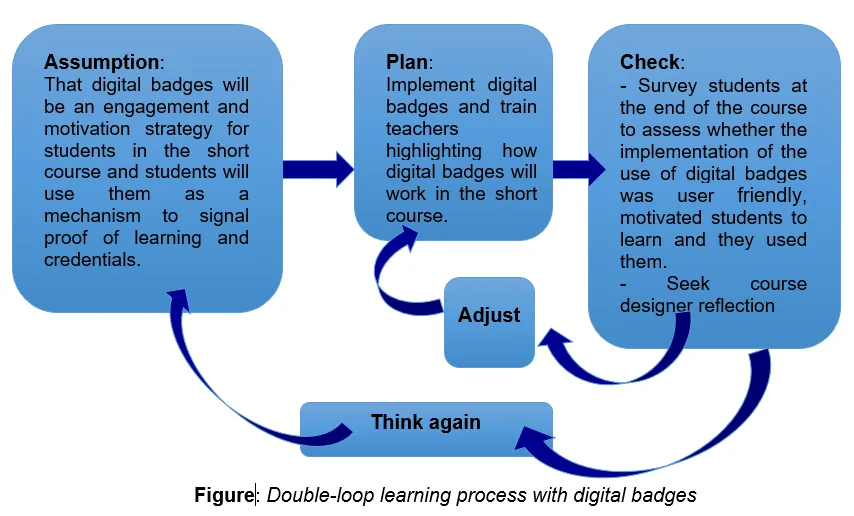
In the 1970s, a management theorist named Chris Argyris set out to study a paradox he had observed in high-performing organizations: the people who were best at their jobs were often the worst at learning from their mistakes.
Argyris studied professionals: lawyers, doctors, consultants, senior managers. These were people who had succeeded at every stage of their careers through technical mastery.
When things went wrong, they became, in his words, "skilled at incompetence." They could defend their reasoning, deflect responsibility, and maintain the appearance of competence while systematically avoiding the uncomfortable inquiry that genuine learning requires.
The framework he and Donald Schon developed to explain this, double-loop learning, remains one of the most useful and underutilized concepts in organizational theory.
The Thermostat Analogy
Argyris and Schon used the thermostat as their central illustration, and it remains the clearest way to understand the distinction.
A thermostat is programmed to maintain a room at a set temperature. When the room drops below 68 degrees, it turns on the heat. When the room rises above 68 degrees, it turns off the heat. The thermostat detects an error (temperature out of range) and corrects it (adjusts heating).
This is single-loop learning: detect the mismatch between actual state and desired state, and correct the behavior to close the gap.
But notice what the thermostat never does: it never questions whether 68 degrees is the right target. It never asks whether anyone in the room might prefer a different temperature. It never considers whether the entire heating approach might be flawed.
These questions require a second feedback loop: one that evaluates not just the gap between actual and target, but the target itself.
Double-loop learning is what happens when an actor, individual or organization, questions the governing variables (the values, assumptions, and objectives embedded in the system) rather than simply adjusting actions to meet those variables more efficiently.
The Origins: Argyris, Schon, and Organizational Learning
Chris Argyris and Donald Schon introduced double-loop learning in their 1974 book Theory in Practice: Increasing Professional Effectiveness, and elaborated on it in Organizational Learning: A Theory of Action Perspective (1978).
The concepts emerged from observations Argyris made over years of consulting work with corporations, professional firms, and public sector organizations.
What made their research unusual for its era was its focus on the gap between what organizations claimed to do and what they actually did.
Rather than studying formal policy and stated strategy, Argyris and Schon focused on the moment-to-moment behavior of managers and professionals: the specific things they said and did not say in meetings, the reasoning they used to defend decisions, the patterns that appeared again and again across organizations that otherwise had little in common.
The concept of double-loop learning has been developed and applied by subsequent researchers including Peter Senge, whose The Fifth Discipline (1990) introduced the concept of learning organizations to mainstream management audiences.
Senge's work drew heavily on Argyris and Schon to argue that the capacity for double-loop inquiry is a defining characteristic of organizations capable of genuine adaptation and innovation, as opposed to those that merely optimize their existing operations.
More recently, the concept has been integrated into frameworks for organizational agility, psychological safety research, and the academic field of organizational behavior.
A 2019 meta-analysis by Zacher and colleagues reviewing organizational learning research found that the distinction between exploratory learning (analogous to double-loop) and exploitative learning (analogous to single-loop) was one of the most consistent predictors of organizational adaptation to environmental change.
The Framework in Full: Governing Variables, Strategies, Consequences
Argyris and Schon described human action as governed by a mental model they called the theory of action. Every person operates with a theory about what goals to pursue, what strategies will achieve them, and what consequences are acceptable.
The theory of action has two components:
Espoused theory is what people say they believe. Managers often say they value open communication, continuous improvement, and honest feedback.
Theory-in-use is what their actual behavior reveals they believe. The same managers may punish people who deliver bad news, dismiss challenges to their decisions, and respond to errors by seeking someone to blame.
The gap between espoused theory and theory-in-use is where most organizational dysfunction lives. Double-loop learning requires making that gap visible and working on it. This is inherently threatening, because it means acknowledging that what you say you believe and what you actually practice are different.
This distinction has significant practical consequences. Organizations frequently invest in training programs, culture initiatives, and strategy retreats that address the espoused theory (what people say they value) while leaving the theory-in-use entirely untouched.
The result is organizations that speak the language of learning, feedback, and continuous improvement while systematically suppressing the information those values would require.
The Three Loops
| Loop | What Changes | Question Being Answered | Example |
|---|---|---|---|
| Single-loop | Behaviors and strategies | Are we doing things right? | Adjusting a process to reduce defect rates |
| Double-loop | Governing variables and assumptions | Are we doing the right things? | Questioning whether defect reduction is the right goal |
| Deutero (triple-loop) | The learning system itself | Are we learning in the right way? | Examining why the organization keeps having the same conversations without reaching conclusions |
Deutero-learning, the third loop, deserves particular attention. Where double-loop learning questions the goals and assumptions of a specific activity or strategy, deutero-learning examines the organization's capacity for learning itself.
It asks: What are our shared assumptions about how to learn? Where do those assumptions break down? What prevents us from learning what we most need to learn?
Argyris and Schon argued that deutero-learning is what distinguishes organizations that can sustain improvement over time from those that make one-time adjustments and then stabilize. The capacity to reflect on and improve the learning process itself is the deepest form of organizational intelligence.
Why Smart People Resist Double-Loop Learning
Argyris's most counterintuitive finding was that the professionals who appeared to need double-loop learning the most, the highly educated and highly successful, were the most resistant to it. He called this phenomenon "skilled incompetence."
The logic is uncomfortable but compelling: high achievers have built their identities around being competent. They have rarely failed. Their self-concept depends on being right. When confronted with evidence that their assumptions are mistaken, they do not experience this as information. They experience it as a threat.
The professionals Argyris studied had developed remarkably sophisticated defenses against this threat. They could construct elaborate reasoning that attributed problems to external factors while protecting their own judgment. They could deflect challenges through careful positioning of questions.
They could frame disagreement as emotional rather than substantive, and appear generous toward critics while systematically dismissing their arguments.
Argyris documented these patterns with notable precision. In Overcoming Organizational Defenses (1990), he described consulting interventions where he would present managers with transcripts of their own behavior: concrete evidence of the gap between what they said they valued and what they actually did.
The response was almost universally to defend the behavior rather than examine it.
Model I Behavior
Argyris and Schon described the predominant human response pattern as "Model I." In Model I, people pursue four governing values:
- Achieve the purpose as I define it
- Win, and do not lose
- Suppress negative feelings (in self and others)
- Be rational: appear to behave according to logic
Model I produces what they called defensive routines: patterns of behavior that protect individuals from embarrassment and threat by making them undiscussable. A defensive routine is not a lie. It is a mutually maintained fiction: an agreement, often unspoken and often unconscious, to not examine certain things.
Examples of defensive routines in practice:
- Holding a post-mortem after a failed project where everyone agrees the real problem was "communication issues" rather than examining the flawed strategy
- Responding to criticism with detailed justification rather than genuine inquiry into whether the criticism is valid
- Framing a fundamental policy failure as an "implementation problem" to avoid questioning the policy
- Promoting consensus in meetings while true disagreement is expressed only afterward, informally
"The most skilled professionals are the most adept at defending against learning, because they have the most sophisticated repertoire of moves for making the undiscussable undiscussable." Chris Argyris, "Teaching Smart People How to Learn," Harvard Business Review, 1991
Model II: The Alternative
Argyris and Schon proposed Model II as the alternative pattern: the governing values that would support double-loop learning rather than prevent it. Model II values include:
- Valid information: Making explicit what you know, what you infer, and what you are uncertain about
- Free and informed choice: Sharing decision-making authority and encouraging genuine alternatives rather than the appearance of alternatives
- Internal commitment: Ensuring people act from their own convictions rather than external compliance
- Continuous learning: Seeking information that might disconfirm current views, not just confirming information
The critical observation is that Model II is genuinely difficult. Most people have been socialized toward Model I: in schools that reward the appearance of competence, organizations that punish visible failure, and professional cultures that conflate confidence with credibility.
Moving toward Model II requires deliberate practice and typically requires external support.
Defensive Routines in Organizations
Individual defensive routines aggregate into organizational defensive routines. When enough people share the same protective patterns, those patterns become embedded in the culture: invisible, taken-for-granted, and therefore almost impossible to challenge from within.
Argyris described a common organizational pattern he called the doom loop:
- An error occurs
- The error is detected by individuals who find it threatening
- Defensive routines are activated: the error is explained, minimized, or attributed externally
- The underlying assumptions that caused the error remain intact and unchallenged
- Similar errors recur
The doom loop is self-reinforcing. Each cycle strengthens the defensive routines. Each cycle adds another layer of "undiscussables." The organization becomes increasingly skilled at not learning.
Organizational Defensive Routines in Practice
In his 1990 book Overcoming Organizational Defenses, Argyris catalogued specific organizational defensive routines. Among the most common:
The mixed message: A senior leader says, "I want people to take risks and not be penalized for honest failure." The same leader then quietly disadvantages people whose risks fail. Both messages are conveyed, but only one is acted on. No one explicitly addresses the contradiction.
The undiscussable undiscussability: Not only are certain topics avoided, but the fact that they are avoided is itself not discussed. The subject is so sensitive that even naming it as a no-go zone is off-limits.
The skilled incompetent team: A high-performing team develops collective norms that make it impossible to examine the assumptions underlying their success. When market or technological change makes those assumptions obsolete, the team's very effectiveness at operating within the old framework becomes an obstacle to adaptation.
The blame shift: When an initiative fails, the explanation converges on individual failure or external factors rather than examining whether the premise of the initiative was sound. The premise survives to generate more failed initiatives.
Research on organizational failure has documented these patterns across industries and cultures.
A 2016 analysis by Edmondson and Verdin in Harvard Business Review examined 25 years of organizational failures and found that the common thread was not bad individual decisions but systematic suppression of information that would have enabled correction: the defensive routines Argyris described decades earlier.
What Double-Loop Learning Looks Like in Practice
Moving from single-loop to double-loop requires more than good intentions. It requires specific, deliberate practices that counteract the pull of defensive routines.
Productive Reasoning
Argyris contrasted "defensive reasoning" with "productive reasoning." The difference:
Defensive reasoning: The conclusions are fixed; evidence is selected to support them; the reasoning is private and cannot be tested by others; alternative views are treated as attacks.
Productive reasoning: Claims are made explicit; the evidence is specified; the inference from evidence to conclusion is stated; alternative conclusions are genuinely considered; the reasoning can be challenged and tested.
Productive reasoning sounds simple. In practice, it requires deliberately surfacing the mental process that most people keep private.
Argyris described this as "making your reasoning transparent": not simply explaining your conclusion, but showing the chain of inference from evidence to conclusion in a way that others can examine and test.
The key question that distinguishes productive from defensive reasoning is: "What would it take to change my view?" If the answer is "nothing could change my view," the reasoning is defensive by definition.
The Left-Hand Column Exercise
One of the most practically useful double-loop learning tools is Argyris's left-hand column exercise:
- Identify a difficult conversation you had recently, one that did not go well
- On the right side of the page, write what was actually said
- On the left side, write what you were thinking and feeling but did not say
The left-hand column is where the real theory-in-use lives. When people see it written out, they often discover that their unexpressed thoughts completely contradict their stated positions. That gap is the starting point for double-loop inquiry.
The exercise works because it makes concrete what is usually abstract. It is easier to examine a specific statement, such as "I thought they were being defensive, but I said nothing because I didn't want a confrontation," than to examine a general pattern of conflict avoidance.
Argyris's original research used a version of this exercise with MBA students and senior executives and found that even very short conversations revealed striking mismatches between stated values and actual communication patterns.
Participants consistently rated themselves as open and direct, while their left-hand columns revealed that they systematically withheld information they believed the other party would find threatening.
Action Science
Argyris developed a methodology he called "action science" for facilitating double-loop learning in organizations. Key features:
- Meetings are recorded and transcribed
- Participants examine the transcripts for evidence of defensive routines
- Facilitators ask participants to explain their reasoning: not to justify it, but to make it transparent
- Alternative interpretations are explicitly considered
- The goal is to produce conditions where the undiscussable becomes discussable
This is uncomfortable work. Argyris's intervention sessions were notoriously difficult, with participants frequently becoming defensive about their defensiveness.
The action science approach has been adapted by subsequent practitioners into a range of workshop, coaching, and consulting formats.
Common elements include the use of real organizational cases (not hypotheticals), attention to the specific language participants use to describe problems, and a persistent focus on inference: the step between observable data and the conclusions people draw from it.
Psychological Safety as a Prerequisite
Subsequent researchers, most prominently Amy Edmondson at Harvard Business School, extended Argyris and Schon's work by examining the conditions that make double-loop learning possible.
Edmondson's research on psychological safety found that teams with high psychological safety, where members believed they could speak up, admit errors, and challenge assumptions without punishment, consistently learned more, innovated more, and performed better over time than teams low in psychological safety.
In a widely cited study of hospital nursing teams (1999), Edmondson found something initially paradoxical: high-performing teams reported more errors than low-performing teams.
The explanation was not that high-performing teams made more mistakes; it was that they felt safe enough to report and discuss them. Low-performing teams were suppressing information: single-loop concealment rather than double-loop inquiry.
Google's Project Aristotle (2012-2015), an internal study of team effectiveness, identified psychological safety as the single most important factor distinguishing high-performing teams from others. It outranked individual talent, compensation, and managerial skill.
Teams with high psychological safety were more likely to leverage the diverse skills of their members, more likely to catch and correct errors before they compounded, and significantly more innovative in their approaches.
Without psychological safety, double-loop learning cannot occur. People will not question governing assumptions if doing so threatens their position.
Edmondson's research also identified the specific behaviors that leaders can use to create psychological safety.
Leaders who frame work as a learning challenge rather than an execution challenge, who acknowledge their own fallibility, who invite participation explicitly, and who respond constructively to bad news: these behaviors create the conditions that make double-loop inquiry possible.
Leaders who signal that errors are unacceptable, who respond to challenge with defensiveness, and who rely on hierarchical authority rather than argument reliably destroy those conditions.
Double-Loop Learning in Different Domains
In Medicine: The Morbidity and Mortality Conference
Medicine has institutionalized a version of double-loop inquiry: the morbidity and mortality (M&M) conference, where adverse outcomes are reviewed not merely to assign blame or correct specific technical errors, but to examine whether protocols, assumptions, or system designs contributed to the outcome.
Well-run M&M conferences are double-loop: they ask "was our protocol itself flawed?" not just "did someone fail to follow the protocol?" Poorly run ones are single-loop: they identify who made the technical error and move on.
A 2019 study published in the Journal of Surgical Education reviewed M&M conference practices across surgical programs and found that conferences explicitly structured to examine system-level factors (staffing, protocol design, communication patterns) produced measurably better quality improvement outcomes than those focused primarily on individual accountability.
The double-loop structure, in other words, was not just philosophically superior; it was associated with better patient safety outcomes.
In Software: Blameless Postmortems
The site reliability engineering (SRE) culture developed at Google and propagated through the DevOps movement has institutionalized the blameless postmortem: a practice explicitly designed to move beyond single-loop error attribution to double-loop system analysis.
The blameless postmortem asks not "who failed?" but "what combination of conditions made this failure possible, and how do we change those conditions?" This is double-loop: it examines the system assumptions, not just the individual actions.
Google's SRE book (Beyer et al., 2016) describes the blameless postmortem as one of the most important practices for maintaining reliable systems at scale. The argument is straightforward: when people fear punishment for errors, they hide errors.
When errors are hidden, the conditions that produced them remain intact and produce more errors. Only when errors are surfaced and examined without threat can the underlying system conditions be understood and changed.
The tech industry's widespread adoption of this practice represents one of the most successful applications of double-loop learning principles in a non-academic setting.
In Strategic Planning: The Pre-Mortem
Gary Klein's pre-mortem technique is a structured double-loop practice for planning. Before a project begins, the team imagines it has already failed and asks: "What went wrong?" This short-circuits the single-loop tendency to assume the plan is correct and look only for implementation errors.
Research by Klein and his colleagues (Klein, 2007) found that the pre-mortem technique improved identification of potential problems by up to 30% compared to standard risk assessment approaches.
The mechanism is specifically double-loop: the pre-mortem creates permission to challenge the governing assumptions of the plan by removing the political cost of pessimism.
Saying "here is what will go wrong with our plan" in a pre-mortem is acceptable; saying the same thing in a planning meeting is often treated as disloyalty.
In Education: The After-Action Review
The U.S. Army's after-action review (AAR) process, developed in the 1970s and refined through decades of military training, is one of the most studied implementations of structured double-loop learning. The standard AAR asks four questions:
- What was supposed to happen?
- What actually happened?
- Why was there a difference?
- What can we do differently next time?
The third question, why was there a difference, is the double-loop question. It creates space to examine whether the plan itself was flawed, not just whether execution failed to match the plan.
A 2004 study by Darling, Parry, and Moore in Harvard Business Review documented Army AAR practices and their application to business contexts.
Organizations that adapted the AAR process showed significant improvements in their ability to learn from experience, with the most important factor being the leader's willingness to genuinely examine whether the original strategy was sound, rather than attributing all gaps to execution.
Implementing Double-Loop Learning: What Actually Works
The research literature converges on several conditions that support genuine double-loop learning in organizations:
1. Leadership modeling. Leaders who publicly acknowledge when their assumptions were wrong (not as performance, but genuinely) create permission for others to do the same. This is difficult. It requires leaders to prioritize the organization's learning over their own image.
Edmondson's research found that leader fallibility modeling was one of the strongest predictors of team psychological safety. When leaders said things like "I was wrong about that and here is what it showed me," team members felt substantively safer raising their own uncertainties and errors.
2. Separating inquiry from evaluation. When questioning assumptions is connected to performance evaluation, people will not question assumptions. Learning forums need to be genuinely separate from appraisal processes, at least initially.
This separation is harder than it sounds in practice. Organizations routinely say they value learning from failure while simultaneously using evidence of failure in performance reviews. Employees are not fooled by the stated value; they respond to the actual consequence.
Structural separation (distinct forums, explicit norms, sometimes anonymous contribution) can help, but requires sustained leadership commitment.
3. Slowing down. Single-loop corrections are fast; double-loop inquiry takes time. Organizations under relentless time pressure default to single-loop. Building slack into the system is a structural requirement.
Research on organizational learning consistently finds that time pressure is one of the strongest inhibitors of reflective learning. The relationship is nearly linear: organizations with more competitive, time-pressured operating environments show systematically lower rates of double-loop learning.
This is not because their people are less capable of reflection, but because there is no space for it.
4. External facilitation. Internal hierarchies make it very difficult to question governing assumptions because those assumptions usually benefit someone with power. External facilitators with no stake in the existing order can ask questions insiders cannot.
Argyris was explicit about this in his consulting work. The questions most necessary for double-loop learning, such as "Why do we keep pursuing this strategy when it has failed repeatedly?" or "What assumption underlies our reluctance to share this information?", are often politically impossible for insiders to raise.
External facilitators provide cover for inquiry that would otherwise be suppressed.
5. Systematic documentation. Learning is lost when it remains informal. Double-loop insights need to be codified: not just in new procedures, but in updated mental models that are explicitly articulated and shared.
The failure to document is one of the most common ways double-loop insights are lost.
An organization may genuinely question a governing assumption in a meeting or workshop, reach new understanding, and then find six months later that the old assumption is operating again. Nothing changed in the formal systems that encode and transmit the organization's implicit theories.
Measuring Double-Loop Learning
One of the persistent challenges in applying Argyris and Schon's work is the difficulty of measuring whether double-loop learning is actually occurring, as opposed to the appearance of it.
Several approaches have been developed by organizational researchers:
Linguistic analysis: Examining whether the language used in post-event reviews includes questioning of assumptions (indicators: "we assumed that...," "what we didn't question was...," "the underlying logic was...") or remains at the level of execution (indicators: "we should have done X instead of Y," "better communication would have helped").
Policy change tracking: Double-loop learning should, over time, produce changes in stated policies, stated values, or explicit strategy, not just changes in execution. Organizations that produce many process changes but no policy changes may be engaging only in single-loop adaptation.
Error recurrence rates: If the same categories of error recur repeatedly despite corrective actions, this is a reliable sign that double-loop inquiry has not occurred: the corrections addressed symptoms while the underlying causes remained intact.
360-degree feedback on inquiry behaviors: Asking colleagues to rate whether specific behaviors associated with double-loop learning occur, such as "Does this leader ask questions that challenge our basic assumptions?" or "Are we encouraged to raise concerns about our strategy, not just our execution?", can provide practical organizational data.
Why This Matters Now
The conditions that make double-loop learning most valuable (rapidly changing environments, high uncertainty, novel problems, need for genuine innovation) are precisely the conditions that characterize many organizations today.
Single-loop learning is effective when the world is stable, problems are familiar, and the existing set of goals and assumptions is reliably producing good outcomes. When none of those conditions hold, single-loop becomes dangerous.
Organizations that only refine their execution while the strategy is wrong simply become more efficient at failing.
Research on organizational learning supports this directly: organizations with documented double-loop learning practices tend to outperform those without them in periods of environmental volatility, while performing comparably during stable periods.
Double-loop learning provides an asymmetric advantage: it costs something in efficiency during stable periods and pays back substantially during change.
Double-loop learning is not comfortable. It requires questioning assumptions that may have served an organization well for years. It requires having conversations that everyone has tacitly agreed to avoid. It requires leaders to model a kind of intellectual vulnerability that their training has generally not cultivated.
But the alternative, continuing to optimize actions within a set of governing variables that no longer fit reality, is exactly the pattern Argyris observed in those skilled professionals who could not learn from failure.
The question double-loop learning asks is the hardest one in any organization: not "are we doing this right?" but "is this the right thing to be doing at all?"
Summary
| Concept | Definition | Example |
|---|---|---|
| Single-loop learning | Corrects errors while keeping existing goals and assumptions intact | Fixing a bug in code without questioning whether the feature should exist |
| Double-loop learning | Examines and modifies governing variables: assumptions, values, objectives | Asking whether the feature being built solves the right customer problem |
| Deutero-learning | Examines the organization's learning processes themselves | Asking why the team keeps discovering the same type of problem late in development |
| Espoused theory | What people say they believe and value | "We welcome honest feedback" |
| Theory-in-use | What actual behavior reveals they believe | Penalizing people who deliver unwelcome news |
| Defensive routines | Cultural patterns that prevent double-loop inquiry | Attributing every failure to "communication issues" |
| Model I behavior | The dominant human pattern; values winning and suppressing negative emotion | Defending a decision rather than genuinely examining criticism |
| Model II behavior | The alternative; values valid information and genuine inquiry | Asking "What would it take to change my view on this?" |
- Argyris and Schon (1974, 1978) developed the framework from empirical observations of professional behavior
- Defensive routines are the cultural patterns that prevent double-loop inquiry by making threatening questions undiscussable
- Argyris found high-performing professionals are often the most resistant to double-loop learning: what he called "skilled incompetence"
- Psychological safety (Edmondson, 1999) is a prerequisite: without it, people will not surface the information needed for genuine double-loop inquiry
- Practical tools include the left-hand column exercise, blameless postmortems, pre-mortems, action science, and after-action reviews
- Implementing double-loop learning requires leadership modeling, time allocation, structural separation of inquiry from evaluation, and often external facilitation
- The advantage of double-loop learning is asymmetric: it costs something during stable periods and pays back substantially during environmental change