
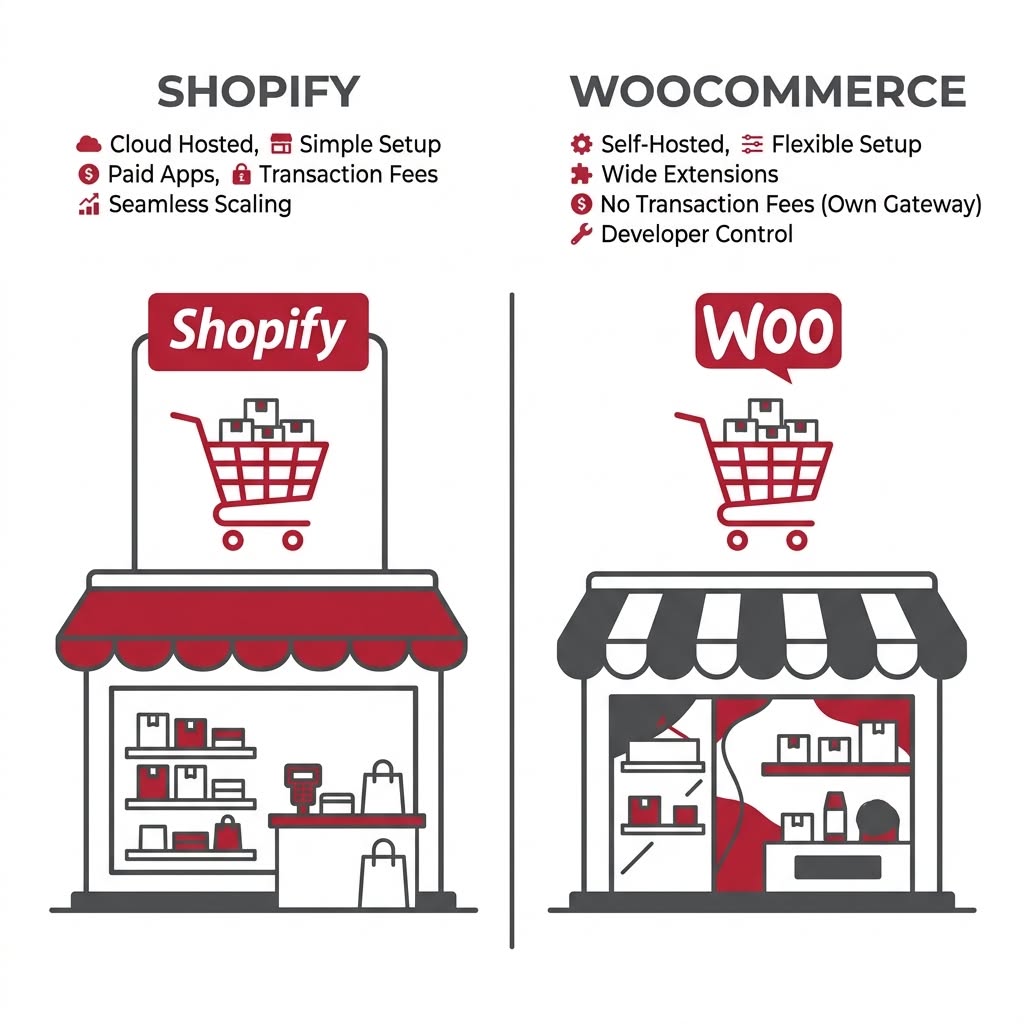
Shopify or WooCommerce is primarily a choice between managed convenience and self-hosted control. Shopify handles infrastructure, security, support, and scaling for a subscription plus possible app and transaction costs; WooCommerce offers code and data control but requires WordPress knowledge, hosting, maintenance, and technical responsibility. Total cost, launch speed, content needs, customization, and team capability determine the better fit.
The moment you decide to sell something online, two names appear everywhere: Shopify and WooCommerce. They are the dominant forces in e-commerce, together powering an estimated 40 percent of all online stores globally.
Shopify alone holds approximately 28 percent of the US e-commerce platform market as of 2025, making it the single largest platform by merchant count in North America (Statista, 2025).[5]
WooCommerce, built on WordPress, powers roughly 37 percent of all online stores worldwide when counted across all traffic segments, making it the largest by raw install count.[4]
Almost every comparison article on the internet bends over backward to avoid picking a winner, hedging every sentence with 'it depends on your needs.' This article is not going to do that. In most cases, one of these platforms is objectively better for a given situation, and we will tell you which one directly.
The fundamental difference is not features or price. It is philosophy. Shopify believes that running an online store should be as close to effortless as possible, and it charges a monthly subscription to deliver that experience.
WooCommerce believes that every business is different and that store owners should have complete control over their infrastructure, code, and data. That control comes with responsibility, hosting costs, and ongoing maintenance.
Neither philosophy is wrong. Which one is right for you depends on what your business is, how technical you are, and what your actual priorities are.
We have run both platforms through a thorough comparison covering pricing, transaction fees, flexibility, performance, scalability, SEO, app ecosystems, and the real total cost of ownership that most surface-level comparisons ignore. The answer is clearer than most people think.
"The best e-commerce platform is the one you will actually use to generate revenue, not the one with the longest feature list or the lowest sticker price." - Drew Sanocki, former Director of Merchant Success, Shopify
Key Definitions
Hosted platform: A software-as-a-service model where the platform provider manages servers, security, backups, and infrastructure. You pay a subscription fee and focus on running your store.
Self-hosted: You install the software on your own server and manage all infrastructure yourself. WooCommerce is a self-hosted WordPress plugin.
Transaction fee: A percentage fee charged by Shopify when you use a third-party payment gateway instead of Shopify Payments.[12] This is distinct from payment processing fees charged by card networks.
Total cost of ownership (TCO): The complete annual cost of running a platform including subscriptions, hosting, apps, themes, developer time, and payment processing - not just the headline platform price.
Platform Overview at a Glance
| Feature | Shopify | WooCommerce |
|---|---|---|
| Hosting | Fully managed (included) | Self-hosted (you pay separately) |
| Base cost | From $39/month | Free plugin; hosting $20-$100+/month |
| Transaction fees | 0.5-2% (waived with Shopify Payments) | None from platform (gateway fees apply) |
| Setup difficulty | Beginner-friendly | Requires WordPress knowledge |
| Flexibility | Good, some structural limits | Near-unlimited with code access |
| Scalability | Automatic, handled by Shopify | Manual, requires infrastructure work |
| SEO control | Good | Excellent (full WordPress access) |
| Plugin/app ecosystem | 8,000+ apps | 59,000+ WordPress plugins |
| Data ownership | Vendor-controlled | Fully yours |
| Support | 24/7 live chat and phone | Community forums; no central support |
| Market share (US) | ~28% of US e-commerce stores | ~20% (WooCommerce-specific installs) |
| Best for | Non-technical owners, fast launch | Technical teams, content-heavy stores |
Pricing: The Real Total Cost of Ownership
Shopify Plan Breakdown
Shopify offers four main pricing tiers for standard merchants, plus Shopify Plus for enterprise.[1]
| Plan | Monthly (annual billing) | Transaction fee (non-Shopify Payments) | Card rate (Shopify Payments, online) | Staff accounts |
|---|---|---|---|---|
| Basic | $39 | 2.0% | 2.9% + 30c | 2 |
| Shopify | $105 | 1.0% | 2.6% + 30c | 5 |
| Advanced | $399 | 0.5% | 2.4% + 30c | 15 |
| Plus | From $2,300 | 0.15% | Negotiated | Unlimited |
Source: Shopify pricing page, 2026.
The plan cost is only the starting point. Most stores need apps for functionality Shopify does not include natively: email marketing ($15-50/month), advanced product filtering ($20-40/month), subscription billing ($50-100/month), loyalty programs ($20-50/month), and bundle discounts ($15-30/month).[10]
A store with four or five paid apps adds $100-250/month to the base plan cost.
Transaction fees are the other hidden cost. A Basic plan store processing $15,000/month in revenue through a third-party gateway pays $300/month in transaction fees alone - nearly eight times the platform subscription cost.
Enabling Shopify Payments eliminates this, but Shopify Payments is unavailable in several countries including India, most of Southeast Asia, and parts of Latin America.[3]
Realistic total monthly spend for a growing Shopify store:
- Small store (under $5k/month revenue): $50-120/month (Basic + 2-3 apps)
- Growing store ($5k-30k/month revenue): $150-400/month (Shopify plan + apps + potential transaction fees)
- Scaling store ($30k-100k/month revenue): $450-700/month (Advanced + full app stack)
WooCommerce True Cost Breakdown
WooCommerce the plugin is free. WordPress is free. But building a functional store requires the following:
| Cost Component | Annual Cost Range | Notes |
|---|---|---|
| Managed WordPress hosting | $300-$1,200/year | Kinsta, WP Engine, SiteGround, Cloudways |
| Domain name | $12-15/year | .com via major registrar |
| SSL certificate | $0-100/year | Usually included with quality hosting |
| Premium theme | $60-150 one-time or $180-300/year | Astra Pro, Flatsome, etc. |
| WooCommerce Subscriptions | $279/year | Official extension |
| WooCommerce Bookings | $249/year | If applicable |
| Abandoned cart plugin | $79-199/year | CartFlows, Recover etc. |
| Email marketing plugin | $0-300/year | Mailchimp, Klaviyo integration |
| Advanced shipping plugin | $79-149/year | Table Rate Shipping etc. |
| Security plugin | $99-200/year | Wordfence, iThemes Security |
| Developer maintenance | $0-5,000+/year | Depending on complexity |
Source: Published pricing from woocommerce.com and plugin marketplaces, 2026.
Realistic total annual spend for a growing WooCommerce store:[2]
- Small store (basic functionality): $600-1,200/year ($50-100/month)
- Growing store (subscriptions, marketing, advanced shipping): $1,800-3,600/year ($150-300/month)[9]
- Complex store (custom development, enterprise hosting): $5,000-20,000+/year
The honest conclusion: for most stores, the total cost of ownership is similar. WooCommerce is not the free option that marketing articles suggest, and Shopify is not the expensive option that WooCommerce advocates claim. The true cost difference between the platforms at small to mid-market scale is typically under $100/month.
Flexibility and Customisation
Where WooCommerce Wins Completely
WooCommerce is built on WordPress, and WordPress gives you complete access to the server, the database, the files, and the code. You can modify anything.
Developers can write custom PHP, create entirely new product types, integrate any third-party API, and structure the database in ways that Shopify's hosted architecture simply does not permit.
This matters enormously for certain businesses. If you sell a complex product with hundreds of configurable variables, if you need to integrate tightly with a custom ERP or inventory system, or if your store has an unusual business model - rentals, multi-vendor marketplaces, complex B2B pricing tiers, booking-based commerce - WooCommerce's open architecture makes those things possible without expensive workarounds.
Where Shopify's Structure Becomes a Constraint
Shopify's Liquid templating system and its API are powerful, but you are always working within Shopify's framework. You cannot modify Shopify's checkout beyond approved customisations (checkout.liquid is restricted to Plus plans).
You cannot access the underlying server or database. URL structures follow some fixed patterns. These constraints are not major problems for standard stores, but they become painful when your business model does not fit Shopify's assumptions.
Shopify Plus, starting at $2,300/month, opens up checkout customisation and more advanced API access.[6] At that price point the cost comparison changes entirely, and you are evaluating an enterprise platform, not comparing it to a self-hosted WordPress setup.
SEO Capabilities: A Real Difference
SEO is one area where WooCommerce has a genuine and meaningful structural advantage.
WordPress was designed as a content management system first. Its URL structures, metadata controls, content organisation, and plugin ecosystem for technical SEO (Yoast SEO, Rank Math, All in One SEO) give WooCommerce stores complete control over every technical and on-page SEO variable.
You can create any URL structure, add any structured data markup, build complex internal linking architectures, and deploy content-heavy category pages that rank for head and mid-tail keywords.
Shopify's SEO is solid for most stores. It auto-generates sitemaps, allows meta tag editing, and supports canonical URLs.
But certain structural limitations exist: the /collections/ and /products/ URL path prefixes are fixed, blog content lives in a separate /blogs/ subdirectory, and the content architecture is less flexible than WordPress.
These issues do not prevent Shopify stores from ranking well, but they can become constraints for stores pursuing aggressive content-led SEO strategies.
For stores relying primarily on paid acquisition, brand search, or marketplace traffic, the SEO difference is largely irrelevant. For stores where organic search is the primary acquisition channel and blog content is a core strategy, WooCommerce's advantage is real.
App Ecosystems and Integrations
| Metric | Shopify | WooCommerce / WordPress |
|---|---|---|
| Official app/plugin directory | 8,000+ apps | 59,000+ plugins |
| Quality control | Shopify reviews and vets apps | Variable quality |
| Average app cost | $10-50/month (subscription) | $0-300/year (usually one-time) |
| Native integrations | Strong (Shopify Payments, Shipping, etc.) | Via plugins |
| Enterprise integrations (SAP, Salesforce, etc.) | Available | Available |
The 59,000+ WordPress plugins include everything from simple utilities to full ERP integrations.[11] The sheer volume means almost every conceivable functionality exists somewhere in the ecosystem.
The downside is variable quality: plugins can conflict with each other, fall out of maintenance, or introduce security vulnerabilities if not regularly updated.
Shopify's app store is smaller but more curated. Apps must meet Shopify's review standards. The subscription pricing model means you are more likely to get actively maintained, supported software - but it also means costs accumulate predictably month over month.
Performance and Scalability
Shopify's Automatic Infrastructure
Shopify handles hosting, CDN delivery, database performance, checkout reliability, and server scaling automatically. When your store goes viral and receives 50,000 visitors in an hour, Shopify's infrastructure handles it. You will not wake up at 3am to a crashed server on your biggest sale day.
This is not a marginal benefit - it is a core value proposition for founders and small teams without a dedicated technical person.
Independent performance tests consistently show Shopify stores loading in under 2 seconds on optimised themes, with Time to First Byte (TTFB) values below 200ms on Shopify's CDN-backed infrastructure.
WooCommerce's Performance Ceiling
WooCommerce can match or exceed Shopify's performance, but only with deliberate infrastructure investment. A WooCommerce store on cheap shared hosting will perform poorly.
On a properly configured managed WordPress host (Kinsta, WP Engine, Nexcess) with Redis object caching, a CDN (Cloudflare, BunnyCDN), and database optimisation, WooCommerce can deliver excellent performance at scale.[7]
The challenge is that this configuration requires technical knowledge and ongoing maintenance. Poorly provisioned WooCommerce stores have crashed under Black Friday traffic loads with real revenue consequences.
According to WP Engine's 2024 performance report, WooCommerce stores with proper caching configurations average load times competitive with Shopify, but unconfigured installations average 4-6 seconds - well above the threshold where bounce rates increase significantly.[8]
For businesses without a dedicated technical team, Shopify's automatic performance management is a significant safety feature.
Use Cases: Which Platform Wins
The Solo Founder Launching a First Store
Shopify wins. The hosted, managed experience means you spend your time on products and marketing rather than server configuration. Shopify's onboarding is genuinely excellent. You can have a fully functional store live in a weekend without touching code.
For a first store with uncertain revenue, the predictable monthly cost and zero maintenance overhead are meaningful advantages.
The Brand with a Content-Heavy SEO Strategy
WooCommerce wins. If your traffic strategy relies on producing large volumes of blog content, long-form buying guides, category landing pages, and deeply interlinking editorial and product content, WordPress is the best content platform ever built.
WooCommerce sitting inside WordPress gives you the full power of Gutenberg, ACF, and WordPress's content architecture without compromising your store. Shopify's blog is functional but limited.
The Business Needing Complex Product Customisation
WooCommerce wins. If your products have hundreds of variants, if customers need to upload files, configure products visually, set up custom pricing rules based on account type, or access rental and booking workflows, WooCommerce's open architecture handles this better and cheaper than Shopify.
The Store Doing Serious Volume
Shopify wins. For high-volume stores processing thousands of orders daily and running large marketing campaigns, Shopify Advanced or Plus handles volume without requiring you to manage infrastructure.
The checkout reliability, fraud protection tools, and dedicated support are hard to match without significant WooCommerce infrastructure investment.
The Agency Building Multiple Stores
WooCommerce wins if clients need highly customised experiences and you have development resources. Shopify wins if you want a standardised, maintainable setup across clients with predictable costs and centralised billing.
The B2B Merchant with Complex Pricing
WooCommerce wins. B2B e-commerce often involves customer-specific pricing tiers, purchase order workflows, net payment terms, and custom catalogues. WooCommerce's open architecture supports these patterns natively with plugins. Shopify B2B features exist but are primarily available on Shopify Plus at enterprise pricing.
Migration: What Switching Actually Involves
If you start on one platform and want to move to the other, the process is more complex than most vendors admit.
Migrating from WooCommerce to Shopify: Product data, customer records, and order history can be exported via CSV and imported to Shopify. URL structures will change (Shopify's fixed /products/ and /collections/ paths), requiring redirect mapping for SEO continuity.
Custom functionality built in PHP will need to be recreated using Shopify apps or Liquid. Expect 20-100 hours of migration work for a moderately complex store.
Migrating from Shopify to WooCommerce: Shopify provides data exports for products, customers, and orders. The technical setup of WordPress, WooCommerce, hosting, and theme is the larger challenge. All Shopify app functionality needs to be replaced with WordPress plugins.
Custom themes need to be rebuilt. For a complex store, expect similar migration effort.
Both migrations require URL redirect management, payment gateway reconfiguration, and testing of every store function. Neither is trivial for a live store processing daily orders.
Final Verdict
Choose Shopify if: you are launching your first store, you do not have a technical background, you value predictable pricing and managed infrastructure, your store model fits standard e-commerce patterns, or you cannot afford downtime due to server issues.
Choose WooCommerce if: you are building a content-led brand with serious SEO ambitions, you need deep product customisation or unusual business logic, you have a WordPress developer on your team or budget, data ownership is a business requirement, or you are building a multi-vendor marketplace or complex B2B setup.
Consider Shopify Plus if: you are doing more than $1 million in annual revenue and need checkout customisation, dedicated support, and the advanced API access that Shopify's enterprise tier offers.
The platform choice will not determine whether your business succeeds. Execution, product quality, and marketing matter far more. But choosing the wrong platform can cost you time, money, and sales at the worst possible moments.
For most people reading this, Shopify's managed simplicity is the lower-risk choice. For developers and technically capable teams, WooCommerce's freedom is worth the overhead.
Sources & Further Reading
- Shopify pricing plans, 2026 - shopify.com/pricing
- WooCommerce plugin and extension overview - woocommerce.com
- Shopify Payments availability by country - help.shopify.com
- WooCommerce and WordPress market share data - BuiltWith Technology Trends, 2025
- Statista, 'Market share of leading e-commerce software platforms in the United States as of 2025'
- Shopify Plus overview - shopify.com/plus
- Kinsta managed WordPress hosting benchmark report, 2025 - kinsta.com
- WP Engine, 'WooCommerce Performance Report 2024' - wpengine.com
- WooCommerce Subscriptions official plugin pricing - woocommerce.com/products
- Shopify App Store directory - apps.shopify.com
- WordPress.org plugin directory - wordpress.org/plugins
- Shopify transaction fee documentation - help.shopify.com/en/manual/payments