
An alternative to Adobe Premiere Pro is any video editing application that can perform non-linear editing (NLE) - cutting, arranging, and exporting video footage non-destructively - without requiring an Adobe Creative Cloud subscription, which costs $22.99-$59.99 per month for Premiere Pro alone or $89.99 per month for the full suite as of 2025.
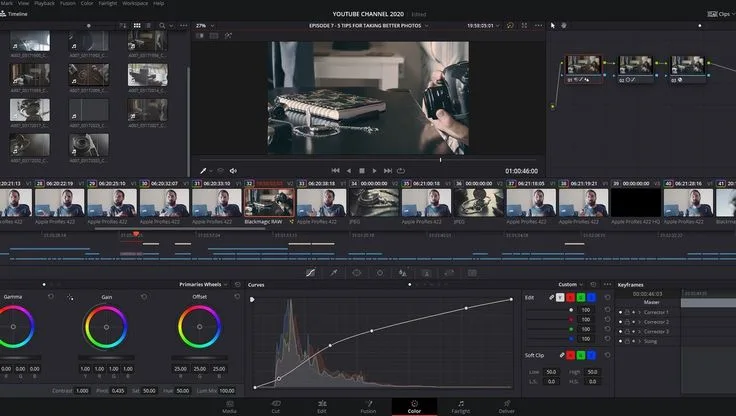
The most capable free alternative is DaVinci Resolve by Blackmagic Design, which offers professional-grade editing, industry-standard color grading, visual effects compositing, and audio post-production at no cost. For macOS users, Final Cut Pro offers a one-time $299.99 purchase that eliminates ongoing subscription fees entirely.
Adobe Premiere Pro has occupied the center of the professional video editing landscape for over thirty years. It launched in 1991 as Adobe Premiere, predating most of the operating systems currently in widespread use.
The tool has accumulated decades of features, deep integration with After Effects, Audition, and the rest of the Creative Cloud suite, and a professional ecosystem of plugins, training resources, and institutional familiarity that no competitor can fully replicate.
But in 2025, Premiere's dominance faces its most serious challenge ever - not because the software has gotten worse, but because the alternatives have gotten dramatically better while Adobe's subscription pricing has continued to climb.
The competitive landscape changed permanently when Blackmagic Design began offering DaVinci Resolve as a free download.
What was once a specialized color grading tool used in high-end Hollywood post-production became a complete post-production suite: a full non-linear editor (the Edit page), a motion graphics compositor (Fusion), a DAW-quality audio editor (Fairlight), and the industry's best color grading tools - all free.
Studios that once used Resolve only for color grading began using it for complete editorial workflows. The move pressured every other video editing tool in the market to justify its pricing.
This article evaluates ten alternatives to Adobe Premiere Pro, from professional-grade tools to accessible consumer applications, covering features, learning curve, hardware requirements, and the specific use cases each serves best.
"The democratization of professional filmmaking tools is not a story about software quality catching up to expensive tools. It is a story about expensive tools losing the economic justification for their price."
- Walter Murch, editor of Apocalypse Now and The English Patient, No Film School interview (2019)
Key Definitions
Non-Linear Editor (NLE): A video editing application that allows editors to access any frame in the timeline non-destructively, without affecting the original media files. All modern professional video editors are NLEs. The term distinguishes them from older linear editing systems where footage had to be assembled sequentially on tape.
Color Grading: The creative process of adjusting and enhancing the color of video footage to achieve a specific look or mood, distinct from color correction (fixing technical problems like white balance errors or exposure issues).
DaVinci Resolve's grading tools are considered the industry standard, used on productions from Blade Runner 2049 to The Crown.
Proxy Editing: A workflow technique where editors work with lower-resolution copies of footage to reduce system strain, then relink to original high-resolution files for final export. Essential for 4K and 8K workflows on hardware that cannot play back full-resolution footage in real time.
Codec: The algorithm used to encode and decode video. Different codecs (H.264, H.265/HEVC, ProRes, DNxHR) have different compression levels, quality characteristics, and hardware support. Codec compatibility is one of the most important factors when choosing an NLE, as some editors handle certain codecs significantly better than others.
GPU Acceleration: The use of graphics processing unit (GPU) hardware to accelerate video processing tasks including playback, effects rendering, and export encoding.
Modern NLEs rely heavily on GPU acceleration; the quality and VRAM capacity of your graphics card significantly affects editing performance, particularly for color grading and effects-heavy work.
Magnetic Timeline: A timeline design (pioneered by Final Cut Pro X in 2011) where clips automatically ripple and rearrange to fill gaps, preventing accidental holes in the edit. Initially controversial among editors accustomed to track-based timelines, now widely praised by users after habituation for its efficiency in certain workflows.
Video Editing Tools Compared
The following table summarizes the ten alternatives evaluated in this article. Pricing reflects 2025 figures; platform availability refers to full desktop applications.
| Tool | Platform | Price | Color Grading | Audio Tools | Best For |
|---|---|---|---|---|---|
| DaVinci Resolve | Mac/Win/Linux | Free ($295 Studio) | Industry standard | Fairlight DAW | Professional editing, color, all-in-one |
| Final Cut Pro | macOS only | $299 one-time | Good | Decent | Apple ecosystem, Apple Silicon performance |
| Vegas Pro | Windows only | $399 perpetual | Moderate | Strong | Windows professionals, audio-heavy work |
| Kdenlive | Mac/Win/Linux | Free (open source) | Basic | Basic | Linux users, budget creators |
| OpenShot | Mac/Win/Linux | Free (open source) | None | Basic | Absolute beginners, simple cuts |
| Lightworks | Mac/Win/Linux | Free (720p) / $24/mo | Basic | Basic | Legacy users, budget-conscious editors |
| HitFilm | Mac/Win | Free / $349/yr | Basic | Basic | VFX, compositing, YouTube creators |
| Camtasia | Mac/Win | $179/yr | None | Basic | Screen recording, tutorial creation |
| iMovie | macOS only | Free | Basic | Basic | Apple beginners, personal projects |
| Clipchamp | Windows | Free (Win 11) | None | Basic | Windows casual users, quick edits |
DaVinci Resolve: The Free Professional Standard
Blackmagic Design released DaVinci Resolve 12 as a free download in 2015. The decision was, from a competitive standpoint, one of the most disruptive moves in creative software history. Resolve had previously cost up to $995 for the full version and was used exclusively by dedicated colorists in high-end post-production facilities.
Making it free removed the pricing objection that had limited adoption beyond that specialized audience. By 2024, Blackmagic reported over 7 million registered Resolve users, making it one of the most widely installed professional creative applications in the world.
What DaVinci Resolve Does Well
The color grading tools in Resolve are without parallel in any NLE at any price. The node-based color pipeline allows colorists to build complex, non-destructive grading chains with unlimited flexibility. The scopes (waveform, vectorscope, histogram, CIE chromaticity) are reference-quality.
The HDR grading palette supports Dolby Vision, HDR10+, and HLG workflows. The color science and image processing algorithms have been refined over two decades of use on major film and television productions including Blade Runner 2049 (colorist Jill Bogdanowicz), Avengers: Endgame, Dune, and The Crown.
The Edit page functions as a full NLE supporting multicam editing (up to 64 angles), nested timelines, subtitle tracks, and intelligent editing features. The interface follows a track-based paradigm familiar to Premiere users, reducing the learning curve for those switching from Adobe.
Fusion, Resolve's compositing module, handles motion graphics and visual effects including 3D particle systems, planar tracking, rotoscoping, and node-based compositing. While not as mature as After Effects for motion design work, Fusion is significantly more capable than the built-in effects in any other free NLE.
Fairlight is a professional digital audio workstation (DAW) built directly into Resolve. It supports ADR (automated dialogue replacement) recording, professional noise reduction, bus-based mixing, and surround sound up to Dolby Atmos 7.1.4. For many workflows, Fairlight eliminates the need for a separate audio post-production application.
DaVinci Resolve Studio ($295 one-time purchase, no subscription) unlocks temporal and spatial noise reduction (considered the best in any NLE), DaVinci Neural Engine AI tools (face recognition, speed warp, magic mask), multi-GPU support, 8K output, collaboration features, and stereoscopic 3D.
The free version handles the vast majority of professional editorial work; Studio adds capabilities primarily relevant to high-end production and VFX workflows.
Where DaVinci Resolve Falls Short
Resolve's interface is built around a different conceptual model than Premiere. The page-based workflow - Cut, Edit, Fusion, Color, Fairlight, Deliver - requires new mental mapping for editors coming from Premiere's single-workspace approach.
Each page is essentially a specialized application; learning to work across them efficiently takes time.
Hardware requirements are more demanding than Premiere for some workflows, particularly Fusion compositing and real-time color grading with multiple nodes.
Blackmagic recommends 16 GB of RAM minimum and a dedicated GPU with at least 4 GB of VRAM; for professional work, 32 GB of RAM and a GPU with 8+ GB of VRAM is more realistic. The application runs on Windows, macOS, and Linux - the only professional-grade NLE with native Linux support.
Media management is less mature than Premiere's media browser and project management system. Large projects with thousands of media files can become unwieldy. The collaboration features in Studio are powerful but require a PostgreSQL database setup that adds complexity.
Pricing
Free (DaVinci Resolve). $295 one-time purchase for DaVinci Resolve Studio. No subscription. No feature degradation over time. Blackmagic's business model subsidizes the free software through sales of their professional hardware (cameras, capture cards, video I/O devices, control surfaces).
Final Cut Pro: Apple's Professional Editor
Final Cut Pro X, launched in 2011, was initially one of the most controversial software releases in creative technology history.
Apple removed many features from its predecessor Final Cut Pro 7, reorganized the interface around magnetic timelines rather than track-based editing, and introduced new organizational concepts (Events, Libraries) that alienated longtime users.
The backlash was severe: a petition demanding Apple restore Final Cut Pro 7 gathered 15,000 signatures, and high-profile editors publicly switched to Premiere.
Thirteen years of development have addressed most of the initial complaints. Apple added multicam, advanced color tools, Motion 5 integration, ProRes RAW support, and - most significantly - optimized Final Cut Pro for Apple Silicon hardware in ways that no competitor has matched.
By 2024, Final Cut Pro had become the preferred editor for a large segment of YouTube creators, independent filmmakers, and broadcast professionals on macOS.
What Final Cut Pro Does Well
Final Cut Pro's performance on Apple Silicon hardware is remarkable and represents a genuine competitive advantage. The M-series chips' dedicated media engines handle ProRes, ProRes RAW, HEVC, and H.264 transcoding in real time without requiring proxy workflows that would be necessary on equivalent PC hardware.
An M2 MacBook Air can smoothly play back multiple streams of 4K ProRes footage - a task that requires a dedicated GPU costing several hundred dollars on a Windows machine.
The magnetic timeline, once controversial, is now recognized as a genuinely efficient way to edit once mastered. It eliminates sync problems, automatically handles gap management, and allows rapid rearrangement of sections without the manual track management required in traditional timelines.
Background rendering keeps the timeline responsive during export. The Compressor companion app ($49.99) adds batch encoding, distributed rendering, and custom codec settings.
Where Final Cut Pro Falls Short
Final Cut Pro is macOS-exclusive, full stop. Windows and Linux editors cannot use it. The Apple ecosystem lock-in is both a feature (for those committed to Apple hardware) and a limitation (for mixed-platform teams).
Collaboration features, while improving with the 2023 addition of cloud-based collaboration, are less mature than Premiere's Production system for large multi-editor teams.
Plugin support is narrower than Premiere's, though the FxFactory ecosystem provides hundreds of high-quality third-party effects and transitions.
Pricing
$299.99 one-time purchase on the Mac App Store. 90-day free trial available. For comparison, Premiere Pro at $22.99/month costs $275.88 per year - meaning Final Cut Pro is cheaper than 13 months of Premiere.
Apple also offers a $6.99/month subscription option and a $199.99 one-time Pro Apps Bundle for Education that includes Final Cut Pro, Logic Pro, and Motion.
Vegas Pro: The Windows Professional's Alternative
Vegas Pro traces its lineage to Sonic Foundry's Vegas Video (2000), acquired by Sony in 2003 and later sold to Magix in 2016. It has a long history on Windows and a user base deeply loyal to its timeline-based editing model, which some editors prefer to both Premiere and DaVinci Resolve's approaches.
Vegas Pro's GPU acceleration on NVIDIA hardware has historically been strong, particularly for HEVC and AVC encoding through NVENC. The software supports a wide range of codecs including Sony XAVC, RED R3D, and various HDR workflows.
The audio editing tools, inherited from Sonic Foundry's background in professional audio software (Sonic Foundry also created Sound Forge and ACID), are above average for a video editor - Vegas Pro includes a built-in audio time stretch, pitch shift, and channel mixing that rival standalone audio tools.
Vegas Pro 22 (released 2024) added AI-assisted features including smart scene detection, AI-powered color matching, and speech-to-text subtitle generation. The planar motion tracking and stabilization tools have improved substantially in recent versions.
The main limitation is ecosystem. Vegas Pro has fewer third-party plugins, less training content, and a smaller professional community than Premiere or Resolve. It also runs on Windows only, and Magix's marketing has sometimes confused the product line with consumer-oriented "Vegas" products.
Pricing
Vegas Pro 22 Edit: $249.99 perpetual. Vegas Pro 22 Suite (including Boris FX and NewBlueFX plugins): $399.99 perpetual. Subscription options start at $19.99 per month. All perpetual licenses include one year of updates.
Kdenlive: Open-Source Power for Linux and Beyond
Kdenlive (KDE Non-Linear Video Editor) is a free, open-source video editor built on the MLT Multimedia Framework and FFmpeg, maintained by the KDE community since 2003. It runs natively on Linux, macOS, and Windows, though its primary user base and deepest optimization is on Linux.
For Linux users, Kdenlive is the most capable free native editing option by a significant margin.
It supports unlimited video and audio tracks, a comprehensive library of effects and transitions (over 200), color grading via scopes (waveform, histogram, vectorscope), keyframeable effects, proxy editing for performance on lower-spec hardware, and nested timelines.
The interface is clean and logical, organized around a familiar track-based timeline paradigm.
Kdenlive also integrates with Glaxnimate for 2D vector animation, supports hardware-accelerated encoding through VAAPI and NVENC, and can export to virtually any format that FFmpeg supports - which is effectively every format in existence.
The limitations are real for professional work. Node-based compositing, professional color science (LUT management is basic), comprehensive audio processing, and multi-user collaboration are absent. Stability, while much improved in recent years, still does not match commercial applications for very complex projects.
But for journalists, educators, YouTube creators, and individual content producers on tight budgets who primarily work on Linux, Kdenlive offers solid capability without cost.
Pricing
Free and open source under the GPL license.
OpenShot: The Simplest Free Cross-Platform Option
OpenShot is another open-source NLE, designed specifically around accessibility and ease of use. Created by Jonathan Thomas in 2008, it has been downloaded over 100 million times according to the project's website.
The interface is intentionally minimal: a media browser, timeline, preview panel, and properties panel. Import media, drag it to the timeline, add transitions and titles, export.
For users who find DaVinci Resolve overwhelming and want something that does not require a learning investment, OpenShot delivers functional basic editing. It supports unlimited tracks, 70+ transition effects, title creation with Blender integration, slow motion and time effects, and audio mixing.
The limitations become apparent quickly for anything beyond simple cuts. OpenShot lacks advanced color tools, lacks multi-camera support, has no effects node system, and can be slow with high-resolution media (4K editing requires patience on mid-range hardware).
The development pace is slower than commercial alternatives, and stability can be inconsistent with complex projects.
But as an entry point for learning video editing, a tool for teachers creating simple instructional videos, or a quick-edit solution for social media content, OpenShot works - and the learning curve from zero to productive is measured in minutes rather than hours.
Pricing
Free and open source under the GPL license.
Lightworks: Decades of Professional History
Lightworks carries one of the most impressive film credits of any NLE: it was used to edit The Wolf of Wall Street (Thelma Schoonmaker, editor), Pulp Fiction (Sally Menke, editor), Hugo, Mission: Impossible, Braveheart, and The King's Speech, among many other major productions.
The software dates to 1989, making it one of the oldest non-linear editing systems in existence.
EditShare acquired the product in 2009 and has maintained it since, releasing both free and paid versions. The free version exports at up to 720p resolution with an H.264 codec - sufficient for web content and social media but not for broadcast or cinema delivery.
Lightworks Create ($9.99/month) and Lightworks Pro ($23.99/month or $174.99/year) remove resolution limits, add Boris Graffiti titling, multicam support, and professional codec export.
The interface reflects its age: functional but dated compared to Premiere, Resolve, or Final Cut Pro. Lightworks uses a unique "bin-based" organizational system that experienced editors appreciate but newcomers find unintuitive.
For editors who learned on older Lightworks versions and value its specific media management model and precise trimming tools, it remains a viable professional tool.
For new learners, the steep learning curve and dated UI are harder to justify when DaVinci Resolve is available for free with a more modern interface.
Pricing
Lightworks Free: $0 (720p export limit). Lightworks Create: $9.99/month or $99.99/year. Lightworks Pro: $23.99/month or $174.99/year.
HitFilm: Editing Meets Visual Effects
HitFilm, developed by FXhome (founded in 2001), merged a non-linear editor with a visual effects compositor in a single application.
The target audience is content creators who want to add particle effects, lightsaber effects, explosions, green screen compositing, and cinematic visual effects to their videos without learning Fusion or After Effects.
The free version of HitFilm includes the full editing timeline, over 400 effects and presets, compositing tools, 3D model import, and color correction. HitFilm Pro ($349/year or a perpetual license option) adds advanced effects, Boris FX integration, higher-quality export options, and priority support.
HitFilm's edit timeline is competent rather than professional-grade. Its real strength is the compositing tools, which are more accessible than Fusion or After Effects but more capable than the basic effects in consumer editors.
The tutorial ecosystem is extensive - FXhome has invested heavily in YouTube tutorials demonstrating specific effects - which makes the learning curve manageable for self-taught creators.
YouTube creators who produce gaming content, short films, music videos, or action-oriented content find HitFilm a natural fit. For documentary, corporate, or narrative long-form editing, other tools are more appropriate.
Pricing
HitFilm Free: $0. HitFilm Pro: $349/year or one-time purchase options available.
Camtasia: Screen Recording and Tutorial Creation
Camtasia, developed by TechSmith (founded 1987, headquartered in Okemos, Michigan), occupies a specific and well-defined niche: software tutorial creation and screen-recorded training content.
It combines a screen recorder, webcam recording, and a simplified video editor optimized for producing instructional videos, software walkthroughs, and corporate training materials.
Camtasia is not a general-purpose video editor and does not attempt to be one. It lacks color grading, multicam support, professional codec handling, and the timeline flexibility of Premiere or Resolve.
What it does well is make the creation of annotated screen recordings simple and fast: click-highlight animations, cursor effects, callout annotations, zoom-and-pan on screen regions, and interactive quiz elements that can be embedded in SCORM-compatible output for learning management systems.
For L&D (Learning and Development) professionals, software companies producing documentation and tutorials, educators creating online course content, and anyone whose primary output is screen-recorded instructional video, Camtasia's specialized toolset justifies its cost over general-purpose editors that would require more setup time to achieve the same result.
TechSmith's 2023 report on workplace video found that 75% of employees prefer watching a video to reading documentation - a statistic that explains why Camtasia has maintained a healthy business for over two decades despite the proliferation of free alternatives for general video editing.
Pricing
$179.88/year (Camtasia Pro). One-time perpetual purchase: $299.99 (Camtasia). Both include Snagit screen capture software.
iMovie: Apple's Free Consumer Editor
iMovie is Apple's free video editor, included with every Mac since 2003 and available on iPad and iPhone. For users new to video editing, iMovie's learning curve is among the lowest of any tool discussed here.
It supports 4K editing, basic color correction (with automatic enhancement), transitions, titles, green screen compositing, and picture-in-picture.
iMovie's timeline is a simplified version of Final Cut Pro's magnetic timeline, which makes it a legitimate stepping stone for creators who may eventually graduate to Final Cut Pro. The workflow concepts, keyboard shortcuts, and organizational metaphors transfer directly.
The limitations are real for anything beyond personal projects: no multicam editing, limited color tools (no scopes, no LUTs, no node-based grading), no third-party plugin support, limited title customization, and export options are restricted to a handful of presets.
But for personal projects, family videos, school presentations, and social media content, iMovie does everything needed at zero cost - and its integration with the Apple ecosystem (AirDrop, iCloud, Photos library access) makes it frictionless for Apple users.
Pricing
Free with macOS. Also free on iPad and iPhone.
Clipchamp: Microsoft's Free Windows Editor
Clipchamp is Microsoft's video editor, acquired in September 2021 for a reported $100+ million and integrated into Windows 11 as a free built-in application replacing the discontinued Windows Movie Maker. Its browser-based origins give it a clean, modern interface that is significantly more polished than its predecessor.
Clipchamp supports basic multi-track editing, text overlays with templates, transitions, one-click background removal using AI, audio visualization, stock media library access, and screen recording. Export is available up to 1080p for free users.
Clipchamp is a consumer tool. It lacks the depth, performance, and codec support for professional work.
But as a free, instantly available option on every Windows 11 machine, it serves casual editors and business users who need to produce basic marketing videos, social media content, internal communications, or quick presentations without buying or learning specialized software.
For many small business owners and office workers, Clipchamp is the only video editor they will ever need.
Pricing
Free (included with Windows 11). Microsoft 365 subscription unlocks additional premium templates, stock media, and branding kit features.
How to Choose: A Decision Framework
The right alternative to Premiere Pro depends on your specific situation. Here is a decision framework based on common scenarios:
You are a professional editor leaving Premiere to reduce costs. DaVinci Resolve is the single most compelling choice. The free version is genuinely professional-grade, the one-time $295 Studio price is cheaper than a single year of Premiere, and the color tools are objectively better.
The transition requires learning a new interface paradigm, but the investment pays off within months.
You are a macOS professional who values performance above all else. Final Cut Pro's combination of Apple Silicon optimization, one-time pricing, and the magnetic timeline's efficiency makes it the strongest macOS-native option. The $299.99 investment is recouped versus Premiere within 13 months.
You are a Windows professional who prefers track-based editing. Vegas Pro is the most mature non-Adobe track-based NLE on Windows. Its audio tools are particularly strong for music video, podcast video, and audio-heavy documentary work.
You are a Linux user. DaVinci Resolve (the only professional-grade Linux NLE) or Kdenlive (the best open-source Linux NLE) are your options. Resolve is more capable; Kdenlive is lighter and fully open source.
You are a beginner or casual creator. iMovie on macOS, Clipchamp on Windows 11, or OpenShot on any platform. Start with the free tool on your system; graduate to DaVinci Resolve or Final Cut Pro when you outgrow it.
You primarily create screen-recorded tutorials. Camtasia is purpose-built for this workflow and will save significant time versus configuring a general-purpose editor for screen recording annotation.
You want visual effects and compositing. HitFilm's integrated compositor makes VFX accessible without the learning curve of Fusion or After Effects. For more advanced compositing, DaVinci Resolve's Fusion module is more powerful and free.
For related comparisons, see alternative design tools to Figma, alternative photo editors to Photoshop, and best video editing tools. If you are exploring the broader creator economy, understanding your tool costs is one of the most impactful decisions you can make early.
Sources & Further Reading
- Blackmagic Design. (2024). DaVinci Resolve 19 Features and Release Notes. blackmagicdesign.com/products/davinciresolve
- Apple. (2024). Final Cut Pro - Features and Technical Specifications. apple.com/final-cut-pro
- Adobe. (2025). Premiere Pro Plans and Pricing. adobe.com/products/premiere/pricing
- Magix. (2024). Vegas Pro 22 - Features and Specifications. vegascreativesoftware.com
- KDE Community. (2024). Kdenlive - Free and Open Source Video Editor. kdenlive.org
- OpenShot Studios. (2024). OpenShot Video Editor. openshot.org
- EditShare/LWKS. (2024). Lightworks Video Editing Software. lwks.com
- FXhome. (2024). HitFilm - Video Editing and VFX Software. fxhome.com/hitfilm
- TechSmith. (2024). Camtasia - Screen Recording and Video Editing. techsmith.com/camtasia
- Apple. (2024). iMovie for Mac. apple.com/imovie
- Microsoft. (2024). Clipchamp - Video Editor in Windows 11. clipchamp.com
- No Film School. (2019). "Walter Murch on the Past, Present, and Future of Post-Production." nofilmschool.com
- Frame.io. (2023). The State of Video: Industry Report 2023. frame.io
- Puget Systems. (2024). DaVinci Resolve Hardware Recommendations. pugetsystems.com
- TechSmith. (2023). Video Viewer Study 2023: Workplace Video Trends. techsmith.com