
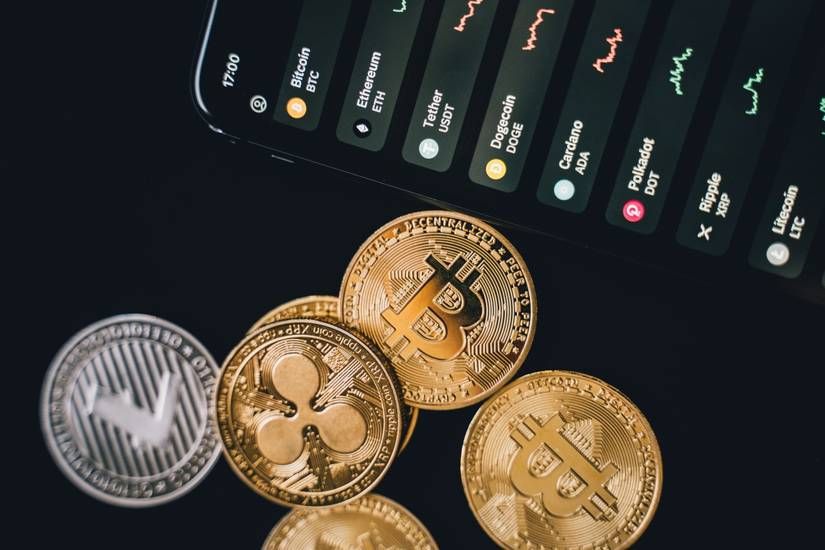
Cryptocurrency uses cryptography and distributed ledgers to transfer digital value without a conventional central intermediary. How cryptocurrency works begins with solving digital double spending through shared transaction records and consensus mechanisms such as Bitcoin's proof of work. The technology can enable scarcity and censorship resistance, but it also brings tradeoffs in storage, computational cost, risk, and regulation.
Cryptocurrency is a form of digital money secured by cryptography and recorded on a distributed ledger called a blockchain, allowing people to transfer value over the internet without relying on banks, governments, or any central authority.
Since Bitcoin's creation in 2009, the cryptocurrency ecosystem has grown to encompass thousands of digital assets, decentralized financial services, non-fungible tokens, and a regulatory landscape that is still being written.
As of early 2025, the total cryptocurrency market capitalization has fluctuated between $1 trillion and $3.5 trillion, with Bitcoin alone commanding roughly half of that figure.
Understanding cryptocurrency requires separating the technology from the speculation, the genuine use cases from the marketing, and the enduring innovations from the cyclical manias.
This article explains how the major systems work at a technical level, what problems cryptocurrency genuinely solves, where the significant risks remain, and how the regulatory environment is evolving.
"The root problem with conventional currency is all the trust that's required to make it work. The central bank must be trusted not to debase the currency, but the history of fiat currencies is full of breaches of that trust." - Satoshi Nakamoto, P2P Foundation forum post, February 11, 2009
The Core Problem: Digital Scarcity and the Double-Spend Problem
Before cryptocurrency, the fundamental challenge of digital money was the double-spend problem. Physical cash solves this naturally - when you hand someone a $20 bill, you no longer have it. But digital files can be copied infinitely. What prevents someone from spending the same digital dollar twice?
Traditional payment systems solve this with trusted intermediaries. Banks maintain centralized ledgers and guarantee that each dollar is spent only once. Visa, Mastercard, and PayPal serve as verification layers.
The system works, but it requires trust in institutions, charges transaction fees (typically 1.5-3.5% for card payments), excludes the estimated 1.4 billion adults globally who lack bank accounts (World Bank Global Findex Database, 2021), and is subject to censorship - any government or institution that controls the intermediary can freeze accounts, block transactions, or seize funds.
Satoshi Nakamoto (a pseudonym; the real identity remains unknown) published the Bitcoin whitepaper, "Bitcoin: A Peer-to-Peer Electronic Cash System," in October 2008 - six weeks after Lehman Brothers collapsed. The timing was not coincidental.
The paper proposed a radically different solution to the double-spend problem: a distributed public ledger maintained by thousands of independent participants, where fraudulent alteration of the transaction history would be computationally prohibitive.
This achieved two things simultaneously:
- Trustless transactions: Parties can exchange value without trusting each other or any central authority. The protocol itself enforces the rules through mathematics and computational cost.
- Digital scarcity: Bitcoin's supply is mathematically capped at 21 million coins, making it impossible to inflate through central issuance - a direct contrast to fiat currencies, where central banks can (and routinely do) expand the money supply.
How Bitcoin Works: The Technical Foundation
The Blockchain
A blockchain is a chain of data blocks, each containing a batch of validated transactions.
Every block includes a cryptographic hash - a mathematical fingerprint - of the previous block, creating an immutable chain: altering any historical transaction would change that block's hash, invalidate the link to the next block, and require recalculating every subsequent block.
With over 800,000 blocks in the Bitcoin blockchain as of 2025, this recalculation is computationally impossible for any entity that does not control a majority of the network's processing power.
Every participant running a full node on the Bitcoin network maintains a complete copy of the transaction history from the genesis block (mined by Nakamoto on January 3, 2009, with the embedded message: "The Times 03/Jan/2009 Chancellor on brink of second bailout for banks") to the present.
This redundancy is both Bitcoin's strength - there is no single point of failure, no server to hack, no company to shut down - and its limitation, as the database now exceeds 500 GB and grows with every block.
Mining and Proof of Work
Bitcoin's consensus mechanism is proof of work (PoW). To add a new block to the chain, a miner must solve a computational puzzle: finding a number (called a nonce) such that, when combined with the block's transaction data and processed through the SHA-256 hash algorithm, the output meets a specific difficulty target.
This requires enormous trial-and-error computation - the Bitcoin network currently performs approximately 500 exahashes per second (500 quintillion hash calculations every second).
The miner who first finds a valid solution broadcasts it to the network. Other nodes verify the solution (which takes milliseconds - asymmetry between finding and verifying is fundamental to the system's security) and add the block. The winning miner receives two rewards:
- Block subsidy: Newly created Bitcoin (currently 3.125 BTC per block following the April 2024 halving)
- Transaction fees: Fees paid by users who want their transactions included in the block
The difficulty of the puzzle adjusts every 2,016 blocks (approximately two weeks) to maintain an average block time of 10 minutes regardless of how much computing power enters or leaves the network. This self-adjusting mechanism is one of the most elegant aspects of Bitcoin's design.
The Halving: Bitcoin's Supply Schedule
Bitcoin's issuance schedule is hardcoded into the protocol and cannot be changed without consensus from the majority of network participants. The block subsidy halves approximately every four years:
| Period | Block Reward | Total BTC Mined by End of Period | % of Total Supply |
|---|---|---|---|
| 2009-2012 | 50 BTC | ~10.5 million | 50% |
| 2012-2016 | 25 BTC | ~15.75 million | 75% |
| 2016-2020 | 12.5 BTC | ~18.375 million | 87.5% |
| 2020-2024 | 6.25 BTC | ~19.6875 million | 93.75% |
| 2024-2028 | 3.125 BTC | ~20.34 million | 96.875% |
| ~2140 | 0 BTC | 21 million | 100% |
The halving reduces the rate at which new Bitcoin enters circulation, creating a disinflationary supply curve. After approximately 2140, no new Bitcoin will be created and miners will be compensated entirely through transaction fees.
Whether this fee-only security model can sustain network security in the long term is one of the most important open questions in Bitcoin's design - and one that will not be definitively answered for over a century.
Historically, halvings have preceded significant price increases (the 2012, 2016, and 2020 halvings were each followed by substantial bull markets within 12-18 months).
However, correlation does not establish causation, and the relationship between supply reduction and price is mediated by demand, market sentiment, macroeconomic conditions, and regulatory developments.
Wallets, Keys, and Self-Custody
Bitcoin is not stored "in" a wallet the way cash sits in a billfold. The blockchain records which public addresses own which Bitcoin.
What you actually possess is a private key - a 256-bit number (one of 2^256 possible values, a number so large it exceeds the estimated number of atoms in the observable universe) that proves your right to spend the Bitcoin associated with its corresponding public address.
Your wallet is software (or hardware) that manages these keys. This creates security implications that are fundamentally different from traditional banking:
- Lose your private key, lose your Bitcoin permanently. There is no password reset, no customer service number, no recovery process. Chainalysis estimated in 2023 that approximately 3.7 million Bitcoin (roughly $150-250 billion at 2024-2025 prices) are permanently inaccessible due to lost keys - including an estimated 1.1 million BTC believed to belong to Satoshi Nakamoto, untouched since 2009.
- Self-custody vs. exchange custody: Storing Bitcoin on a centralized exchange (Coinbase, Kraken, Binance) means trusting the exchange to manage your keys. The collapse of FTX in November 2022 - which destroyed approximately $8 billion in customer funds through fraud and mismanagement - demonstrated the risk vividly. The earlier collapse of Mt. Gox in 2014 (850,000 BTC lost) reinforced the same lesson. The crypto community's axiom - "not your keys, not your coins" - reflects hard-learned experience.
- Hardware wallets (Ledger, Trezor) store private keys on dedicated physical devices that never connect directly to the internet, protecting against remote attacks. They represent the gold standard for self-custody security.
The Cryptocurrency Ecosystem Beyond Bitcoin
Bitcoin established the template, but the ecosystem has expanded dramatically. Understanding the major categories is essential for navigating the space.
Ethereum and Smart Contracts
Ethereum, launched in 2015 by Vitalik Buterin (who published the whitepaper at age 19) and a team of co-founders, added a transformative feature to the blockchain concept: smart contracts - self-executing programs stored on the blockchain that run automatically when predefined conditions are met.
This transformed blockchain from a payment ledger into a programmable platform. Smart contracts enable:
- Decentralized exchanges (DEXs): Trades execute automatically through code, without a central counterparty holding your funds
- Lending protocols: Collateral is locked in a smart contract, and loans are issued algorithmically - no credit check, no bank, no human judgment
- Non-fungible tokens (NFTs): Verifiable ownership of unique digital assets recorded on-chain
- Decentralized Autonomous Organizations (DAOs): Organizations governed by token-weighted voting rather than traditional corporate structures
In September 2022, Ethereum completed "The Merge" - transitioning from proof of work to proof of stake (PoS), reducing its energy consumption by approximately 99.95% (Ethereum Foundation estimates). In proof of stake, validators lock up (stake) ETH as collateral to earn the right to validate transactions.
Misbehaving validators lose their staked ETH (a mechanism called slashing), replacing the computational cost of mining with financial cost of misconduct.
The Altcoin Landscape
Beyond Bitcoin and Ethereum, thousands of alternative cryptocurrencies exist with varying degrees of utility, innovation, and legitimacy:
| Category | Notable Examples | Primary Purpose | Assessment |
|---|---|---|---|
| Layer 1 blockchains | Solana, Avalanche, Cardano | Faster/cheaper smart contract platforms | Some offer genuine technical improvements; many are marketing-driven |
| Stablecoins | USDC, Tether (USDT), DAI | Price-stable crypto for payments and DeFi | Essential infrastructure; varying trust models |
| DeFi governance tokens | AAVE, Uniswap (UNI), Maker (MKR) | Governance rights over DeFi protocols | Value tied to protocol usage and fees |
| Layer 2 solutions | Arbitrum, Optimism, Base | Scaling solutions for Ethereum | Addressing real throughput limitations |
| Privacy coins | Monero (XMR), Zcash (ZEC) | Enhanced transaction privacy | Legitimate use cases; regulatory scrutiny |
| Meme coins | Dogecoin, Shiba Inu, PEPE | Community speculation | No intrinsic utility; pure sentiment trading |
| Exchange tokens | BNB (Binance) | Native tokens of centralized exchanges | Utility within exchange ecosystem |
The honest assessment: the vast majority of altcoins have no genuine utility that distinguishes them from existing infrastructure. Many were created during bull markets to capitalize on retail speculative demand, with marketing centered on technological buzzwords rather than substantive use cases.
The 2021-2022 cycle saw thousands of new tokens launched, the majority of which lost 90-99% of their value by 2023.
Decentralized Finance (DeFi): Rebuilding Finance in Code
DeFi represents the most technically ambitious application of smart contracts: reconstructing core financial services - lending, borrowing, trading, insurance, yield generation - without traditional financial intermediaries.
How DeFi Lending Works
A DeFi lending protocol like Aave or Compound operates through overcollateralized loans: to borrow $1,000 worth of one cryptocurrency, you deposit $1,500 or more of another as collateral.
The smart contract holds the collateral and automatically liquidates it if the collateral-to-loan ratio drops below a threshold (typically 150% for volatile assets). No credit check. No bank. No human judgment. Just code executing predetermined rules.
Decentralized exchanges like Uniswap use automated market makers (AMMs) - mathematical formulas (typically the constant product formula: x * y = k) that set prices based on the ratio of assets in liquidity pools. Users who deposit assets into these pools earn a share of trading fees proportional to their contribution.
DeFi's Genuine Achievements
DeFi demonstrated that core financial functions can operate programmatically without human intermediaries. At peak in November 2021, over $180 billion in assets were locked in DeFi protocols across multiple blockchains (DeFi Llama data). Key achievements include:
- Permissionless access: Anyone with a crypto wallet can access DeFi services. No application process, no minimum balance, no geographic restriction.
- Composability: DeFi protocols can be combined like building blocks ("money legos"), enabling financial products that would require months of legal and technical work in traditional finance to be assembled in hours.
- Transparency: All transactions, collateral levels, and protocol parameters are publicly auditable on the blockchain - a level of transparency that traditional finance does not offer.
DeFi's Documented Risks
DeFi has also revealed serious structural vulnerabilities:
- Smart contract exploits: Code bugs have led to hundreds of millions in losses. The Ronin Bridge hack ($625 million, 2022), Wormhole hack ($325 million, 2022), and Beanstalk flash loan attack ($182 million, 2022) demonstrated that code is only as secure as its weakest link.
- Oracle manipulation: DeFi protocols depend on external price feeds ("oracles") to function. Manipulating these feeds - briefly distorting the price a protocol sees - has been a common and profitable attack vector.
- Regulatory uncertainty: The legal status of DeFi tokens and protocols remains unclear in most jurisdictions. The SEC's enforcement actions against various DeFi protocols in 2023-2024 signaled increasing regulatory attention.
- Leverage amplification: DeFi's permissionless composability allows users to stack leverage across multiple protocols simultaneously - creating positions that would violate risk limits in traditional finance and that amplify losses catastrophically during market downturns.
Stablecoins: The Infrastructure Layer
Stablecoins are the connective tissue that makes cryptocurrency practically useful for commerce and DeFi. Without price stability, a currency is dysfunctional for everyday transactions - no merchant wants to accept payment in an asset that might lose 20% of its value overnight.
The three major design approaches:
Fiat-collateralized (centralized): Issuers hold dollar reserves and issue tokens on a 1:1 basis. USDC (issued by Circle) and USDT (issued by Tether) are the largest, with combined circulation exceeding $150 billion as of early 2025. The risk is counterparty trust: you must believe the issuer actually holds the reserves it claims.
USDC has been regularly audited by Grant Thornton and publishes monthly attestations. Tether's reserve composition has been subject to persistent scrutiny and was fined $41 million by the CFTC in 2021 for making misleading statements about its reserves.
Crypto-collateralized (decentralized): DAI, issued by the MakerDAO protocol, maintains its dollar peg through overcollateralized positions in Ethereum and other crypto assets. It is fully transparent and decentralized - anyone can verify the collateral on-chain.
The trade-off is capital inefficiency (more than $1 in collateral is required for each $1 of DAI) and vulnerability to sharp crypto price drops that can trigger cascading liquidations.
Algorithmic (experimental): Terra's UST attempted to maintain its peg through algorithmic mechanisms involving a paired token (LUNA) without full collateral backing. In May 2022, it collapsed in a classic bank-run dynamic, wiping out approximately $40 billion in combined UST and LUNA value in less than a week.
The collapse destroyed the savings of retail investors across Asia and Latin America and prompted regulatory agencies worldwide to accelerate stablecoin oversight.
Real Use Cases vs. Speculation: The Honest Assessment
Where Cryptocurrency Has Demonstrated Genuine Value
Cross-border remittances: Migrant workers sending money home face average fees of 6.2% through traditional channels (World Bank Remittance Prices Worldwide, 2024). Stablecoin-based remittance services have achieved costs below 1%, potentially saving billions annually for some of the world's most economically vulnerable populations.
Companies like Wise (formerly TransferWise) and crypto-native services like Stellar and Circle are actively serving this market.
Censorship-resistant value storage: In countries with capital controls, currency crises, or authoritarian financial surveillance - Venezuela, Argentina, Turkey, Nigeria, Ukraine - cryptocurrency has provided a practical store of value and payment mechanism when local currency cannot.
During Russia's invasion of Ukraine in 2022, the Ukrainian government raised over $100 million in cryptocurrency donations within weeks. In Argentina, stablecoin adoption has surged as the peso lost over 50% of its value in 2023 alone.
Financial inclusion: An estimated 1.4 billion adults globally are unbanked (World Bank, 2021). Crypto wallets require only a smartphone and internet access - no bank relationship, no credit history, no government ID in some implementations.
In sub-Saharan Africa and Southeast Asia, mobile-first crypto platforms are providing savings, lending, and payment services to populations that traditional banking has not reached.
Programmable finance: Smart contracts enable financial products that are genuinely novel: insurance that pays automatically based on verifiable data (parametric insurance), savings accounts that earn yield through lending protocols without a bank intermediary, and conditional payments that execute when predetermined conditions are met.
Where Speculation Dominates
The majority of cryptocurrency trading volume at most points in its history has been speculative rather than tied to genuine economic activity.
Metrics tracking actual utility - active wallet addresses, on-chain transaction counts excluding exchange-to-exchange transfers, real DeFi usage - consistently show that retail and institutional speculation accounts for the dominant share of price movements.
A 2023 study by the Bank for International Settlements (BIS) found that approximately 75% of Bitcoin investors who entered the market since 2015 have lost money, because retail participants disproportionately buy at peak enthusiasm and sell at peak despair.
The study estimated that the median retail crypto investor held positions worth less than their initial investment.
This does not make cryptocurrency worthless - many transformative technologies pass through speculative phases before practical adoption stabilizes (the dot-com bubble preceded the genuine internet economy). But it does mean that most historical price action reflects sentiment cycles rather than fundamental value growth.
Volatility, Risk, and the Historical Record
Bitcoin has experienced multiple drawdowns of 70-85% from peak to trough:
| Period | Peak | Trough | Decline | Recovery Time to New High |
|---|---|---|---|---|
| 2011 | ~$31 | ~$2 | -93% | ~2 years |
| 2013-2015 | ~$1,150 | ~$200 | -83% | ~3 years |
| 2017-2018 | ~$19,800 | ~$3,200 | -84% | ~3 years |
| 2021-2022 | ~$69,000 | ~$15,500 | -77% | ~2 years |
These are not anomalies. They are the structural norm for an asset with uncertain fundamental value, no cash flows to discount, high leverage in derivatives markets, and a participant base heavily influenced by social media sentiment.
Bitcoin purchased at essentially any point before 2021 and held to late 2024 produced substantial returns.
But the journey required surviving drawdowns that would bankrupt leveraged positions and psychologically devastate most retail investors.
"In the short run, the market is a voting machine, but in the long run, it is a weighing machine." - Benjamin Graham, The Intelligent Investor (1949)
Graham was writing about equities, not cryptocurrency, but the principle applies with added intensity: crypto's short-term price is almost entirely a voting machine driven by narrative and sentiment.
Whether it will prove to be a weighing machine over the long term - reflecting genuine utility and adoption - remains the central unresolved question.
The Regulatory Landscape: Where Things Stand
Cryptocurrency regulation varies dramatically across jurisdictions and is evolving rapidly:
United States: The regulatory framework remains fragmented. The SEC has argued that most cryptocurrencies (excluding Bitcoin) are securities and has pursued enforcement actions against exchanges (Coinbase, Binance) and token issuers. The CFTC treats Bitcoin and Ethereum as commodities.
Congress has debated but not yet passed comprehensive crypto legislation as of early 2025.
The approval of spot Bitcoin ETFs in January 2024 (BlackRock's iShares Bitcoin Trust, Fidelity's Wise Origin Bitcoin Fund, and others) represented a significant institutional legitimization, bringing in over $50 billion in net inflows within the first year.
European Union: The Markets in Crypto-Assets Regulation (MiCA), effective 2024, provides the most comprehensive regulatory framework globally, covering stablecoin issuers, crypto asset service providers, and market abuse provisions.
MiCA creates a passporting system allowing licensed crypto businesses to operate across all EU member states.
Asia: China has banned cryptocurrency trading and mining since 2021. Japan has a comprehensive licensing regime dating to 2017. Singapore and Hong Kong have positioned themselves as regulated crypto hubs with clear licensing frameworks. India has imposed a 30% tax on crypto gains and a 1% TDS (tax deducted at source) on transactions.
Emerging markets: El Salvador adopted Bitcoin as legal tender in 2021 (the only country to do so). The Central African Republic briefly followed but reversed course.
Most developing nations are focusing on Central Bank Digital Currencies (CBDCs) - government-issued digital currencies that use blockchain-adjacent technology but remain centrally controlled - rather than embracing decentralized cryptocurrency.
The regulatory direction globally is clearly toward more oversight, particularly for:
- Stablecoins (which regulators view as potential systemic risks to monetary policy)
- Exchanges (where consumer protection failures have been most catastrophic)
- DeFi (which poses novel challenges for existing regulatory frameworks designed for intermediated finance)
The central tension in crypto regulation: how to protect consumers and financial stability without destroying the permissionless innovation that makes cryptocurrency genuinely different from existing financial infrastructure.
Energy Consumption: The Environmental Question
Bitcoin's proof-of-work consensus mechanism consumes significant energy. The Cambridge Centre for Alternative Finance estimated Bitcoin's annualized electricity consumption at approximately 100-150 TWh in 2024 - comparable to the energy use of countries like the Netherlands or Argentina.
The environmental critique is legitimate but requires nuance:
- Energy mix matters more than total consumption. A 2022 study by the Bitcoin Mining Council estimated that the Bitcoin network uses approximately 59% sustainable energy (hydro, solar, wind, nuclear), though this figure is self-reported and disputed by environmental groups.
- Ethereum's transition to proof of stake eliminated 99.95% of its energy consumption, demonstrating that high energy use is a design choice, not an inherent feature of blockchain technology.
- Stranded energy utilization: Some Bitcoin miners operate at locations with stranded energy resources - hydroelectric dams producing excess power, natural gas flaring sites, curtailed wind and solar installations - that would otherwise go unused. This does not eliminate the environmental concern but complicates the narrative that Bitcoin mining is purely wasteful.
- The comparison baseline matters: The traditional financial system - bank branches, data centers, ATM networks, armored cash transport - also consumes enormous energy, though precise comparisons are methodologically difficult.
The Honest Assessment
Cryptocurrency is neither the future of all finance nor a speculative bubble destined for zero. It is a genuinely novel technology that has demonstrated real utility in specific contexts, generated massive speculative excess, experienced several cycles of dramatic loss, and continued building infrastructure through each cycle.
The technology works: blockchain-secured, cryptographically verified transactions are real and functioning at scale. The use cases in remittances, censorship resistance, financial inclusion, and programmable finance are genuine.
The volatility, the fraud, the regulatory uncertainty, and the dominance of speculation over utility are also genuine.
For anyone evaluating whether and how to engage with cryptocurrency, the evidence-based framing is: this is a high-volatility, high-uncertainty asset class with documented long-term potential and documented risks of catastrophic loss.
The responsible approach is sizing exposure appropriately - small enough that a total loss would be painful but not devastating - and understanding that the vast majority of individual cryptocurrencies will eventually go to zero, even if the asset class as a whole survives and grows.
Sources & Further Reading
- Nakamoto, S. "Bitcoin: A Peer-to-Peer Electronic Cash System." 2008. View source
- Buterin, V. "Ethereum White Paper: A Next-Generation Smart Contract and Decentralized Application Platform." 2013. View source
- Antonopoulos, A.M. Mastering Bitcoin: Programming the Open Blockchain, 3rd Edition. O'Reilly Media, 2023.
- Antonopoulos, A.M. & Wood, G. Mastering Ethereum: Building Smart Contracts and DApps. O'Reilly Media, 2018.
- Vigna, P. & Casey, M.J. The Truth Machine: The Blockchain and the Future of Everything. St. Martin's Press, 2018.
- Cambridge Centre for Alternative Finance. Cambridge Bitcoin Electricity Consumption Index.View source
- World Bank. Remittance Prices Worldwide Quarterly.View source
- World Bank. The Global Findex Database 2021.View source
- Bank for International Settlements. "Crypto Shocks and Retail Losses." BIS Working Papers No. 1140, 2023.
- European Commission. Markets in Crypto-Assets Regulation (MiCA).
- DeFi Llama. Total Value Locked Dashboard.View source
- Chainalysis. The 2024 Crypto Crime Report.View source
- Lewis, M. Going Infinite: The Rise and Fall of a New Tycoon. W.W. Norton, 2023. (Account of FTX collapse)
- Popper, N. Digital Gold: Bitcoin and the Inside Story of the Misfits and Millionaires Trying to Reinvent Money. Harper, 2015.