
Understanding: In 1970, a mathematician at IBM named Edgar F. Codd published a paper that would quietly reshape how the modern world stores and retrieves information.
Codd's "relational model of data for large shared data banks" proposed organizing data into tables - rows and columns - and defined a set of mathematical operations for querying those tables.
Several years later, IBM researchers developed a language to implement Codd's ideas. They called it SEQUEL, later shortened to SQL (Structured Query Language), and the world has been using it ever since.
SQL is now over fifty years old. It has outlasted dozens of competing paradigms, survived the rise of the internet, adapted to cloud computing, and remained the dominant language for accessing structured data in everything from small startups to multinational financial institutions.
Understanding SQL is one of the most practically useful technical skills an adult professional can acquire, and it is more accessible than most people assume.
What SQL Is and What It Does
SQL (pronounced "sequel" or "S-Q-L" depending on context) is a standardized language for communicating with relational databases.
A relational database is a system that stores data organized into tables: think of a spreadsheet with rows (individual records) and columns (attributes of those records), but with far more power to store millions of rows, enforce data integrity, and query across multiple connected tables simultaneously.
SQL lets you do four broad categories of things with data:
- Read (retrieve) data from tables
- Write (insert) new data into tables
- Modify (update) existing data
- Delete data
The vast majority of SQL users spend most of their time on the first category - reading and querying data to answer business or analytical questions. This is sometimes called data retrieval or querying, and it is what this article focuses on.
What SQL Is Not
SQL is not a general-purpose programming language like Python or JavaScript. It cannot write files to disk, make network requests, or build applications on its own. It is purpose-built for data manipulation and retrieval.
SQL also does not specify how data is stored internally - that is the job of the database management system (DBMS) that runs the SQL code.
This distinction matters practically: the same SQL query will run on PostgreSQL, MySQL, and Microsoft SQL Server because the language is standardized (though each system has its own extensions and syntax variations). You learn SQL once and apply it across many systems.
The Scale of SQL's Reach
SQL is not simply an academic tool or a niche technical skill. According to Stack Overflow's annual developer survey, SQL has consistently ranked among the top five most commonly used languages and technologies across all developer categories since the survey began tracking it, including in their 2023 and 2024 reports.[8]
Among data professionals - analysts, data engineers, and data scientists - SQL regularly ranks as the single most used tool.
The 2023 Burtch Works Study of data professionals found that SQL proficiency was cited as a required skill in over 72% of analytics job postings, making it more universally required than Python, R, or any visualization tool.
This pervasiveness reflects not just historical momentum but genuine ongoing utility: as long as organizations store structured data in relational systems, SQL is how that data is accessed.
The Historical Context: From Codd's Theory to Modern Practice
Edgar Codd and the Relational Model
Edgar F. Codd's 1970 paper "A Relational Model of Data for Large Shared Data Banks," published in Communications of the ACM, was a landmark in computer science.[1]
At the time, databases were navigational - to retrieve data, you had to know exactly where it was stored and how to traverse the data structure to reach it. This made applications brittle and tightly coupled to physical storage layout.
Codd proposed a fundamentally different abstraction: organize all data as relations (tables), and provide a mathematical set of operations for manipulating them. The physical storage implementation would be hidden from users, who would interact with data through the logical structure alone.
This separation of logical and physical layers is now so taken for granted that it is difficult to appreciate how radical it was in 1970.
SEQUEL to SQL
IBM researchers Donald Chamberlin and Raymond Boyce developed SEQUEL (Structured English Query Language) between 1974 and 1977 as a user-friendly implementation of Codd's relational algebra.[2] The name was later changed to SQL due to a trademark conflict. IBM's initial commercial product was SQL/DS in 1981.
Meanwhile, Oracle Corporation (then Relational Software) released the first commercially available SQL-based RDBMS in 1979, beating IBM to market. The competitive rush to implement relational databases helped establish SQL as the de facto standard before any formal standardization body had acted.
The American National Standards Institute (ANSI) published the first SQL standard in 1986, with the ISO standard following in 1987.
"SQL's endurance is a testament to the power of a good abstraction. The relational model maps naturally onto how businesses think about their data, and SQL expresses that model in a language accessible to non-programmers."
- adapted from Joe Hellerstein, Readings in Database Systems
The Five Core SQL Clauses, Explained in Plain English
Most SQL queries that analysts and developers write use a small set of core clauses. Understanding what each one does removes most of the mystery.
SELECT and FROM: The Foundation
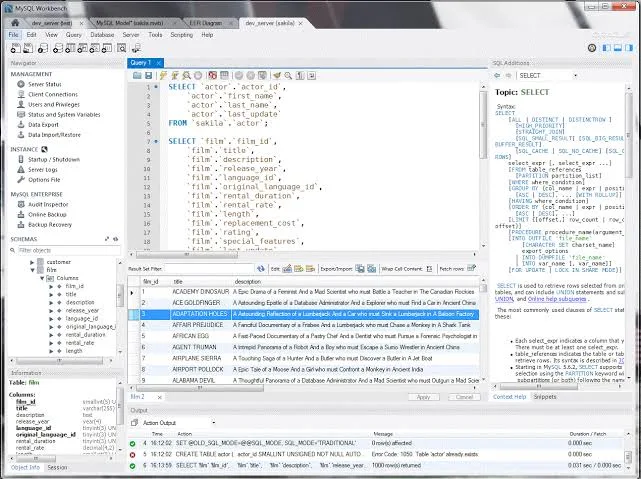
Every SQL query begins with these two clauses. SELECT specifies which columns you want to retrieve. FROM specifies which table to retrieve them from.
SELECT first_name, last_name, email
FROM customers;
This query returns the first name, last name, and email address of every row in the customers table. The semicolon ends the statement.
If you want every column without listing them all:
SELECT *
FROM customers;
The asterisk is shorthand for "all columns." In production code, most experienced developers avoid SELECT * because it retrieves columns you may not need, making queries slower and harder to understand.
WHERE: Filtering
The WHERE clause filters rows. Instead of retrieving all customers, you might want only those in a specific country or who signed up after a certain date.
SELECT first_name, last_name, email
FROM customers
WHERE country = 'Germany'
  AND signup_date > '2023-01-01';
This returns only customers from Germany who signed up after January 1, 2023.
WHERE clauses use comparison operators (=, >, <, >=, <=, !=) and logical operators (AND, OR, NOT) to build conditions.
You can also use IN to match against a list, BETWEEN for ranges, and LIKE for pattern matching:
SELECT first_name, last_name
FROM customers
WHERE country IN ('Germany', 'France', 'Netherlands')
  AND email LIKE '%@gmail.com';
ORDER BY: Sorting
The ORDER BY clause controls the order in which results are returned. Results are sorted ascending (A to Z, smallest to largest) by default; add DESC for descending order.
SELECT first_name, last_name, signup_date
FROM customers
ORDER BY signup_date DESC;
This returns all customers sorted by signup date, most recent first.
GROUP BY and Aggregate Functions: Summarizing
GROUP BY is where SQL becomes genuinely powerful for analysis. It groups rows that share the same value in a specified column and lets you calculate aggregate statistics for each group.
Aggregate functions include:
- COUNT() - count of rows
- SUM() - total of a numeric column
- AVG() - average of a numeric column
- MAX() and MIN() - highest and lowest values
SELECT country, COUNT(*) AS customer_count
FROM customers
GROUP BY country
ORDER BY customer_count DESC;
This returns a table showing each country and how many customers are in it, sorted from most to fewest. A query that might take a human analyst hours in a spreadsheet runs in seconds.
The HAVING clause adds conditions that apply after grouping - analogous to WHERE but for aggregate results:
SELECT country, COUNT(*) AS customer_count
FROM customers
GROUP BY country
HAVING COUNT(*) > 100
ORDER BY customer_count DESC;
This returns only countries with more than 100 customers.
JOIN: Combining Tables
JOIN is arguably the most important concept in relational SQL. Real-world data is rarely stored in one table. A business might have a customers table, an orders table, a products table, and a payments table. JOINs let you combine information from multiple tables in a single query.
SELECT customers.first_name, customers.last_name, orders.order_date, orders.total_amount
FROM customers
INNER JOIN orders ON customers.customer_id = orders.customer_id
WHERE orders.total_amount > 100;
This query links each order to the customer who placed it (using the shared customer_id column) and returns the name, order date, and amount for orders over $100.
| JOIN type | What it returns |
|---|---|
| INNER JOIN | Only rows with matches in both tables |
| LEFT JOIN | All rows from the left table; NULLs where no match in right |
| RIGHT JOIN | All rows from the right table; NULLs where no match in left |
| FULL OUTER JOIN | All rows from both tables; NULLs where no match on either side |
| CROSS JOIN | Every combination of rows from both tables |
Understanding JOINs is the single skill that most separates basic SQL users from effective ones. Most interesting analytical questions require combining data from at least two tables, and most of the complexity in real-world SQL queries lives in the JOIN logic.
Why SQL Has Dominated for Fifty Years
SQL's persistence is not an accident. It has endured because it solves a genuinely hard problem - expressing complex data retrieval operations in human-readable form - and because the relational model it was built on turns out to be a surprisingly good fit for how organizations naturally structure information.
The Relational Model Is a Good Fit for Business Data
Most business data has natural structure: customers have orders, orders have line items, products belong to categories, employees report to managers. The relational model captures these relationships naturally, and SQL's JOIN operation lets you navigate them in queries.
When data is normalized correctly - stored without redundancy, with each fact recorded once - SQL systems are efficient, consistent, and easy to audit.
Database normalization is the process of organizing a database to reduce redundancy and improve data integrity.[3] Codd formalized this through a series of normal forms (1NF through BCNF and beyond), each eliminating specific types of data anomaly.
A well-normalized database ensures that updating a customer's address in one place updates it everywhere - you cannot have conflicting copies of the same fact.
SQL Is Declarative, Not Procedural
SQL tells the database what you want, not how to get it. You do not specify algorithms for searching or sorting; you state your conditions and let the database's query optimizer figure out the most efficient execution plan.
This is why analysts who are not programmers can write useful SQL queries: the cognitive model is closer to "ask a question" than "write an algorithm."
The query optimizer inside a database system like PostgreSQL or Oracle is a sophisticated piece of software that analyzes your query, examines available indexes, estimates the size of intermediate result sets, and chooses an execution plan from among potentially thousands of alternatives.[4]
Users get the benefit of this optimization automatically.
Network Effects and Ecosystem Maturity
Fifty years of use means an enormous ecosystem: training materials, StackOverflow answers, database tools, BI platforms, and application frameworks all speak SQL. Every major relational database (PostgreSQL, MySQL, SQL Server, Oracle, SQLite) uses SQL.
Every major cloud data warehouse (Snowflake, BigQuery, Redshift, Azure Synapse) uses SQL as its primary interface. The cost of replacing this ecosystem is immense, and the alternatives have not provided compelling enough reasons to do so for most use cases.
The SQL ecosystem has also evolved. Modern SQL dialects support JSON data types, allowing semi-structured data to be stored and queried within relational systems. Window functions added in SQL:2003 support analytical calculations that were previously only possible in procedural code.
These additions have extended SQL's reach into use cases it could not previously serve.
SQL in Practice: Common Use Cases
Business Intelligence and Reporting
Analysts at nearly every company write SQL queries to answer business questions. How many users signed up last month? What is the average order value by product category? Which marketing channel produces the highest-value customers? SQL queries feed dashboards, reports, and ad hoc analyses that inform business decisions.
Business intelligence platforms - Tableau, Looker, Power BI, Metabase - all generate SQL under the hood when users interact with drag-and-drop interfaces.
Understanding SQL allows analysts to bypass those interfaces when needed, write more complex logic than drag-and-drop tools support, and debug unexpected results by examining the underlying query.
Data Engineering and ETL
ETL (Extract, Transform, Load) pipelines move data from operational systems into data warehouses. SQL is the dominant language for the transformation step: cleaning data, joining it from multiple sources, aggregating it into analytical tables.
dbt (data build tool) has become the de facto standard for SQL-based data transformation in modern data stacks. It allows data engineers to define transformations as SQL SELECT statements, manage dependencies between transformations, and test data quality - all while maintaining the underlying code in version control.
Application Development
Backend applications use SQL to read and write data persistently. When you log into a website, the application runs a SQL query to verify your credentials. When you place an order, it writes a record to an orders table. SQL is embedded in virtually every non-trivial web application.
Object-relational mappers (ORMs) like SQLAlchemy (Python), ActiveRecord (Ruby), and Hibernate (Java) allow developers to interact with databases using object-oriented code instead of raw SQL, but they generate SQL under the hood.
Developers who understand SQL can diagnose ORM-generated queries that are slow or incorrect, an increasingly common performance and debugging skill.
Data Science
Data scientists use SQL to pull and prepare datasets before applying statistical methods or machine learning models. Being able to write SQL efficiently is consistently listed as a core skill for data science roles, separate from Python or R proficiency.
In many data science workflows, the most time-consuming part of the work is not modeling but data preparation: joining disparate tables, filtering outliers, creating training and test sets, and aggregating features.
SQL handles this efficiently and in a way that is auditable and reproducible in ways that ad hoc procedural data manipulation is not.
SQL and NoSQL: Understanding the Distinction
The rise of NoSQL databases in the 2000s and 2010s was often framed as SQL's potential replacement. The reality is more nuanced.
What NoSQL Solves
NoSQL databases were developed to address specific limitations of relational systems at internet scale.
When companies like Google, Amazon, and Facebook needed to store and serve billions of records with millisecond latency across globally distributed servers, traditional relational databases struggled with the write throughput and horizontal scaling requirements.[6]
Google's Bigtable (Chang et al., 2006) and Amazon's Dynamo (DeCandia et al., 2007), both described in widely cited research papers, established the architectural patterns for NoSQL systems.[5]
These papers documented genuine limitations of relational databases at internet scale and motivated the engineering community to develop alternatives.
NoSQL databases trade the rigid structure and consistency guarantees of relational systems for flexibility and scale:
- Document databases (MongoDB) store JSON-like documents with flexible schemas - good for content management, user profiles, and applications where the data structure changes frequently.
- Key-value stores (Redis) store data as simple key-value pairs - extremely fast, used for caching, session management, and real-time leaderboards.
- Column-family stores (Cassandra) are optimized for time-series data and write-heavy workloads at massive scale.
- Graph databases (Neo4j) model data as nodes and edges - good for social networks, recommendation engines, and fraud detection.
What SQL Handles Better
For most business data - transactions, customer records, inventory, financial data - relational databases with SQL remain the better choice. They offer:
- ACID transactions (Atomicity, Consistency, Isolation, Durability) - guarantees that data is never left in an inconsistent state
- Powerful querying across multiple related tables
- Data integrity constraints - foreign keys, unique constraints, check conditions
- Mature tooling and decades of operational knowledge
The CAP theorem, formalized by Eric Brewer (2000) and later proven by Gilbert and Lynch (2002), demonstrates that distributed systems cannot simultaneously guarantee all three of consistency, availability, and partition tolerance.[7]
NoSQL systems typically sacrifice consistency for availability and partition tolerance; SQL systems prioritize consistency. This theoretical tradeoff maps to practical engineering choices.
The Practical Reality: Both Are Used
Most organizations of meaningful scale use both SQL and NoSQL systems, choosing based on specific requirements.[10]
An e-commerce company might use PostgreSQL for its transactional data (orders, inventory, customers), Redis for caching session data and product listings, and a data warehouse like Snowflake (which uses SQL) for analytics. SQL and NoSQL are not competitors; they are complements.
| Dimension | SQL (relational) | NoSQL |
|---|---|---|
| Data structure | Tables with fixed schemas | Flexible (documents, key-value, graphs) |
| Query language | SQL (standardized) | Varies by system |
| Transactions | Full ACID support | Often eventual consistency |
| Scaling | Vertical (larger servers) | Horizontal (more servers) |
| Best for | Structured business data, complex queries | High-volume writes, flexible schemas, specific data models |
| Maturity | 50+ years | 10-20 years for most systems |
| Analytical capability | Excellent (especially warehouses) | Limited for complex analytics |
SQL Career Relevance
Who Uses SQL at Work
SQL is unusual among technical skills in how broadly it is used across roles that do not carry "engineer" or "developer" in their title.
- Data analysts query databases daily to answer business questions
- Business intelligence professionals build dashboards and reports powered by SQL
- Data engineers build pipelines that transform data using SQL
- Product managers at data-driven companies access metrics directly via SQL
- Financial analysts at technology companies query financial databases
- Operations and strategy professionals at data-mature companies pull their own reports
- Marketing analysts segment audiences, measure campaign performance, and track attribution
The democratization of SQL access - through tools like Mode, Looker, Hex, and in-browser SQL environments - has reduced the technical barrier to running queries, making SQL increasingly relevant for roles that were previously dependent on engineering teams to pull data.
Salary and Hiring Data
Job postings that list SQL as a required skill span an enormous range of industries and roles. According to LinkedIn Insights data and Glassdoor salary analysis from 2023-2024, SQL proficiency is associated with a meaningful salary premium for data analyst roles compared to similar roles requiring only spreadsheet skills.
The Bureau of Labor Statistics projects that data analyst and data scientist roles - both requiring SQL - will grow substantially faster than average across all occupations through 2030.
Data engineering roles, where SQL is the primary transformation language, command some of the higher salaries in the knowledge economy. The 2023 Burtch Works compensation study found median compensation for mid-level data engineers in the range of $130,000-$160,000 in the United States, with SQL listed as a foundational competency.[9]
How Long It Takes to Learn
A motivated learner can achieve functional proficiency - writing SELECT, WHERE, GROUP BY, and basic JOIN queries - in approximately 10 to 20 hours of focused practice.
This is substantially faster than most programming languages, because SQL is declarative, uses familiar English words, and the feedback loop (run a query, see the result) is immediate.
Advanced SQL skills - window functions, CTEs (Common Table Expressions), query optimization, complex multi-table queries - take considerably longer, but basic proficiency is within reach of any adult willing to practice on a real dataset. The investment-to-utility ratio for SQL is exceptionally high compared to most technical skills.
SQL Concepts Beyond the Basics
Subqueries
A subquery is a SQL query nested inside another query. They allow you to use the result of one query as input to another.
SELECT first_name, last_name
FROM customers
WHERE customer_id IN (
  SELECT customer_id
  FROM orders
  WHERE total_amount > 500
);
Subqueries can appear in the SELECT clause, FROM clause, or WHERE clause. When used in the FROM clause, they are sometimes called derived tables or inline views.
CTEs (Common Table Expressions)
CTEs use the WITH keyword to create temporary named result sets, making complex queries more readable by breaking them into labeled steps.
WITH high_value_customers AS (
  SELECT customer_id, SUM(total_amount) AS lifetime_value
  FROM orders
  GROUP BY customer_id
  HAVING SUM(total_amount) > 1000
)
SELECT c.first_name, c.last_name, hvc.lifetime_value
FROM customers c
INNER JOIN high_value_customers hvc ON c.customer_id = hvc.customer_id
ORDER BY hvc.lifetime_value DESC;
CTEs improve readability considerably.
They also enable recursive CTEs, which can process hierarchical data like organizational reporting structures or bill-of-materials trees.
Window Functions
Window functions (introduced in SQL:2003 and now supported by all major databases) perform calculations across a set of rows related to the current row without collapsing them into a single aggregate. They enable calculations like running totals, rankings, and moving averages that previously required procedural code.
SELECT
  first_name,
  last_name,
  total_amount,
  RANK() OVER (ORDER BY total_amount DESC) AS spending_rank,
  SUM(total_amount) OVER () AS all_customers_total,
  total_amount / SUM(total_amount) OVER () AS pct_of_total
FROM orders
INNER JOIN customers USING (customer_id);
Window functions are one of the most powerful additions to SQL in the past two decades and are particularly valued in analytical contexts.
ROW_NUMBER, RANK, LAG, LEAD, SUM OVER, and AVG OVER are among the most commonly used.
Indexes
An index is a data structure that speeds up data retrieval at the cost of storage space and write speed. A database without indexes on frequently queried columns performs full table scans for every query - examining every row - which is slow for large tables.
An index on the customer_id column in an orders table allows the database to jump directly to the relevant rows.
Understanding which columns to index and why is an important part of SQL performance tuning.
The general guidance: index columns that appear frequently in WHERE clauses, JOIN conditions, and ORDER BY clauses; avoid indexing columns with very low cardinality (few distinct values, like boolean flags); be cautious about indexing tables with very high write rates, since indexes must be updated on every insert and update.
Transactions and ACID Properties
SQL databases manage concurrent access and failure recovery through transactions - logical units of work that either complete entirely or are entirely rolled back if something goes wrong.
The four ACID properties - Atomicity (all-or-nothing execution), Consistency (data must remain in a valid state), Isolation (concurrent transactions don't interfere), and Durability (committed changes persist) - are what make relational databases reliable for financial and transactional systems.
BEGIN;
  UPDATE accounts SET balance = balance - 500 WHERE account_id = 1;
  UPDATE accounts SET balance = balance + 500 WHERE account_id = 2;
COMMIT;
If the database crashes between the two UPDATE statements, the transaction is rolled back entirely.
The debit and credit either both happen or neither happens - which is exactly what correctness requires for a financial transfer.
Common Misconceptions About SQL
"SQL is outdated." SQL has been regularly updated (SQL:1999, SQL:2003, SQL:2011, SQL:2016, SQL:2023) and modern SQL includes features like window functions, CTEs, JSON support, and temporal tables that address many of the criticisms made against earlier versions.
The 2023 standard includes features for property graph queries and multi-dimensional arrays.
"NoSQL databases have replaced SQL." They have not. SQL remains dominant for structured data management, and the major NoSQL databases occupy specific niches rather than displacing relational systems generally. Even some NoSQL databases (like CockroachDB and FaunaDB) have added SQL query interfaces in response to user demand.
"SQL is only for technical people." SQL's declarative, English-like syntax makes it one of the more accessible technical tools available. Many analysts, product managers, and operations professionals without software engineering backgrounds become proficient SQL writers.
"You need to memorize everything." Professional SQL users look things up constantly. Knowing the concepts and structure matters far more than memorizing exact syntax. The ability to read and modify existing queries, understand what a query is doing, and debug unexpected results are far more valuable than rote memorization.
"SQL can't handle big data." Modern SQL-based data warehouses - Snowflake, Google BigQuery, Amazon Redshift, Databricks SQL - routinely process petabytes of data.
Snowflake and BigQuery can execute analytical queries across billions of rows in seconds by leveraging distributed query execution. SQL's applicability to large-scale analytics has expanded dramatically in the past decade.
Getting Started With SQL
The fastest way to learn SQL is to practice on real data. Several platforms offer free SQL environments with sample databases:
- Mode Analytics SQL Tutorial - browser-based, no setup required
- SQLZoo - interactive exercises with immediate feedback
- Khan Academy - free beginner-friendly course
- PostgreSQL + pgAdmin - free, full-featured local setup
- DBeaver - free universal database client that works with most SQL databases
- Kaggle SQL courses - free, with integrated notebooks and public datasets
The best practice dataset is data you actually care about. Many analysts report that the moment SQL clicks is when they use it to answer a question they genuinely wanted answered - not when they complete a tutorial exercise.
Start with a publicly available dataset in your industry or domain, load it into a free PostgreSQL instance, and work through real questions.
SQL has been the language of data for fifty years for good reason. It maps well to how organizations think about information, it is more accessible than most technical tools, and its reach into nearly every data-related career makes learning it one of the highest-return investments of technical time available to a working professional.
Sources & Further Reading
- Codd, E. F. (1970). "A relational model of data for large shared data banks." Communications of the ACM, 13(6), 377-387.
- Chamberlin, D. D., & Boyce, R. F. (1974). "SEQUEL: A structured English query language." Proceedings of the 1974 ACM SIGFIDET Workshop on Data Description, Access and Control, 249-264.
- Date, C. J. (2003). An Introduction to Database Systems (8th ed.). Pearson.
- Hellerstein, J. M., Stonebraker, M., & Hamilton, J. (2007). Architecture of a Database System. Foundations and Trends in Databases.
- Chang, F., et al. (2006). "Bigtable: A distributed storage system for structured data." Proceedings of OSDI 2006.
- DeCandia, G., et al. (2007). "Dynamo: Amazon's highly available key-value store." ACM SIGOPS Operating Systems Review, 41(6), 205-220.
- Brewer, E. (2000). "Towards robust distributed systems." Proceedings of the 19th Annual ACM Symposium on Principles of Distributed Computing (PODC).
- Stack Overflow. (2024). Developer Survey 2024. stackoverflow.com/research.
- Burtch Works. (2023). The Burtch Works Study: Salaries and Careers for Analytics, Data Science, and AI/ML Professionals.
- Kleppmann, M. (2017). Designing Data-Intensive Applications. O'Reilly Media.