
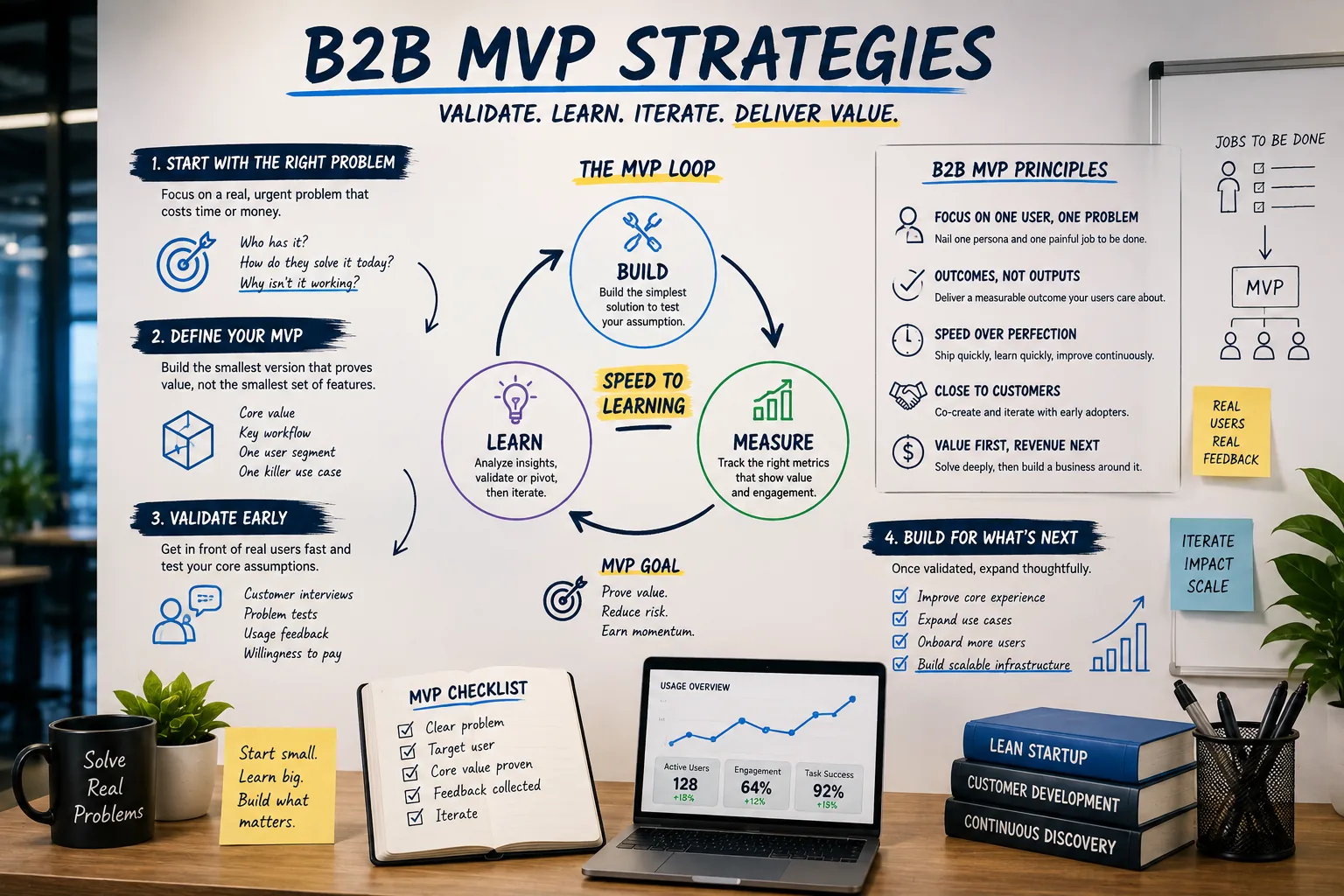
Strategies: Figma did not start as a design tool. In 2012, when Dylan Field and Evan Wallace began working on what would become a $20 billion acquisition offer by Adobe (later abandoned due to regulatory concerns), their first prototype was a browser-based image editor that no professional designer would have taken seriously.
The rendering was slow, the feature set was primitive, and the tool lacked virtually every capability that designers considered essential.
But Field had done something that most B2B founders skip: before writing a single line of code, he had spent months interviewing designers at companies like Airbnb, Dropbox, and Google, identifying a specific pain point that existing tools (primarily Sketch and Adobe Illustrator) failed to address.
The pain was not editing power - it was collaboration. Designers could not work simultaneously on the same file, could not share interactive prototypes without exporting, and could not get developer handoff without third-party tools.
Field focused his earliest prototype on solving the collaboration problem specifically.[2] The first version of Figma was not a comprehensive design tool - it was a multiplayer design environment. Features that existing tools handled well were deprioritized; the one thing that existing tools could not do was built first.
This focus, derived from months of customer interviews before any code was written, is why Figma's MVP succeeded when dozens of prior attempts to unseat Adobe had failed.
The B2B MVP story almost always contains this element: specific customer problems discovered through genuine conversation, translated into focused product decisions that deliver precise value rather than general capability.
"A startup is not just a smaller version of a large company. A startup is a temporary organization in search of a scalable, repeatable, profitable business model." - Steve Blank The B2B context makes this discipline both more accessible (B2B customers are usually willing to talk about their problems in detail) and more consequential (B2B sales cycles are long enough that a poorly conceived MVP can consume years before failure becomes obvious).[1]
Why B2B MVPs Are Different From Consumer MVPs
Building a B2B MVP involves different constraints, different success metrics, and different risks than building a consumer MVP. Understanding these differences shapes every decision from customer discovery to launch.
Sales cycle length: A consumer product can be validated in weeks through app downloads, user signups, and engagement data. A B2B product often requires months of sales process before even the first paying customer is secured.
This means the cost of testing a wrong hypothesis is measured in months of effort, not days of data. Getting the hypotheses right before building is proportionally more important.
Buyer vs. user distinction: In B2B, the person who decides to purchase (the buyer - often a VP, director, or executive) is frequently different from the person who will actually use the product daily (the user - often an individual contributor).
An MVP can delight users while failing to address the ROI and risk concerns that drive buyer decisions.[6] Both constituencies must be understood.
Procurement and security complexity: Enterprise B2B companies often require SOC 2 compliance, security reviews, legal review of contracts, and procurement processes that can add months to the sales cycle.
An early-stage B2B MVP can rarely satisfy these requirements, which means initial customers must be organizations willing to purchase without standard enterprise procurement processes - typically smaller companies or departments within larger organizations that can move quickly.
Contract and pricing expectations: B2B buyers expect contracts, invoicing, and pricing structures that consumer apps do not need. Building the commercial infrastructure (contracts, terms of service, invoicing) alongside the product is a startup overhead that consumer founders rarely face at the same stage.
Referenceability requirements: B2B buyers frequently require references from existing customers before purchasing.
A new B2B product with zero customers cannot provide these references, creating a chicken-and-egg problem that requires navigating through founder relationships, beta programs, and discounting that gets customers to accept the reference risk in exchange for pricing benefit.
The Design Partner Model: B2B Validation Before Building
The most effective B2B MVP strategy replaces the traditional "build, then sell" sequence with "learn, then build, then sell." Design partners - customers who collaborate on product development before a full product exists - are the mechanism.
What a design partner is: A design partner is an organization that agrees to work closely with you during product development, providing feedback, sharing workflows, and often paying a discounted rate or providing other value (testimonials, case studies, reference calls) in exchange for early access and influence over product direction.
The ideal design partner profile:
- Feels the pain acutely: the problem you are solving is a significant frustration in their current workflow
- Has decision-making speed: the contact can commit to the partnership without months of approval cycles
- Is willing to be visible: they will provide references, case studies, and testimonials when the product is ready
- Is in your ideal customer profile: they represent the market you ultimately want to serve
- Is non-competitive: they will not share your unreleased product with competitors
Design partner acquisition: Founders acquire design partners through warm introductions (most effective), targeted cold outreach with specific articulation of the problem, conference and community connections, and social proof from respected advisors.[8]
The most important element of the acquisition conversation is demonstrating that you have done serious thinking about the problem - that the conversation will be valuable to the design partner, not just to you.
What design partner engagement looks like: Regular (weekly or bi-weekly) working sessions where the design partner walks through their current workflow, evaluates early prototypes, reacts to design concepts, and provides feedback on proposed features. The founder listens more than they pitch; the goal is learning, not selling.
Example: Rippling, the HR and IT management platform founded by Parker Conrad in 2016, conducted extensive design partner work before launching.
Conrad spent months understanding the specific operational pain of keeping HR records, IT systems, and benefits management synchronized - a problem he had experienced at his previous company Zenefits.
By deeply understanding this operational reality through conversations with potential customers before and during early development, Rippling built a product specifically architected for the pain it had thoroughly understood, contributing to the company's rapid growth to $10 billion valuation by 2022.
Concierge MVPs: Faking It Before Building It
A concierge MVP is a technique where the startup delivers the product's value manually - with founders doing the work - before building the technology that will eventually automate it. The customer gets the outcome they want; the founders learn what delivering that outcome actually requires.
Why concierge MVPs work in B2B: B2B customers typically care about outcomes, not the mechanism that delivers them. If a healthcare practice management software promises to reduce billing errors, the practice manager cares about fewer billing errors, not about the specific software architecture.
A concierge MVP delivers the outcome manually, validates that customers value it, and teaches founders exactly what the automation must do.
The information value of concierge work: When founders manually perform the work their product will eventually automate, they discover the edge cases, exceptions, and complexities that automated systems must handle.
This learning typically reveals that the original product spec was wrong in important ways - assumptions that seemed reasonable in a design document prove incorrect in practice.
Concierge MVP examples in B2B:
Market research analysis: Instead of building a market research automation tool, spend three months manually conducting research for clients. Learn which methodologies they trust, which data sources they value, what format makes findings actionable.
Accounting categorization: Instead of building ML-powered transaction categorization, manually categorize transactions for pilot clients. Learn the exception cases, industry-specific patterns, and presentation formats that make categorized data actually useful for accounting decisions.
Supply chain optimization: Instead of building an optimization algorithm, manually analyze a client's supply chain data and make optimization recommendations. Learn what data quality problems exist in the real world and what tradeoffs customers actually care about.
Example: WageWorks (now acquired by HealthEquity), a benefits administration company, famously started by having founders manually handle flexible spending account administration for initial customers.
The manual process was unsustainable at scale, but it taught them exactly what the automation needed to handle, which edge cases mattered, and which features customers valued versus tolerated.
This learning informed product decisions that made WageWorks competitive against much better-funded competitors.
Pre-Selling B2B Products Before They Exist
Pre-selling - collecting payment (or firm commitments for payment) before the product is built - is the most powerful validation mechanism available to B2B founders, and also the most underutilized.
The pre-sell's informational value: A customer who signs a contract and writes a check for a product that does not yet exist has provided the most unambiguous validation possible that the problem is real, the proposed solution is compelling, and the price is acceptable.
Letters of intent, pilot agreements, and soft commitments provide weaker but still meaningful signals.
Pre-sale mechanics for B2B:
Pilot agreements: A paid pilot (typically 10-20% of full contract value) in exchange for early access, significant discounting, and design partner involvement. The pilot payment validates willingness to pay; the discounting acknowledges the product's early-stage risk for the buyer.
Letters of intent (LOIs): Non-binding written commitments to purchase if the product meets defined specifications. LOIs provide social validation (showing other potential customers that serious organizations are committed), facilitate fundraising, and give founders accountability targets for product development.
Founding customer pricing: Some B2B founders offer "founding customer" pricing - significant discounts (50-80%) in exchange for early commitment, reference agreement, and case study participation. This approach works when the product's eventual value is clear but the current state would not command full price.
The pre-sell conversation structure: The pre-sell conversation is not a product demo. It begins with the problem, focuses on the outcome the product enables, and treats the product as the means to an end rather than the subject itself.
Founders who lead with product features struggle to pre-sell; founders who lead with "how much would it be worth to your organization if you could reliably achieve X?" discover what customers are actually willing to pay and why.
Example: Ironclad, a contract management software company, pre-sold its first several customers before the product could support their use cases.
Founder Jason Boehmig and his team closed contracts with law firms and corporate legal departments based on detailed proposals and product roadmaps, then built the features required to fulfill those contracts.
The pre-sold customers provided revenue, feedback, and early references that enabled Ironclad to raise venture capital and hire the engineering team needed to build the full product. By 2022, Ironclad had raised $330 million and reached a valuation of $3.2 billion.
B2B Pricing in MVP Stage: Finding the Sustainable Level
B2B pricing during the MVP stage requires balancing two competing risks: pricing so low that customers do not take the product seriously (or that the business model is unworkable at scale) and pricing so high that no early customer is willing to pay before the product is fully proven.
Starting price anchoring: B2B prices, once established, are difficult to raise significantly. Early pricing decisions establish market expectations. If a product launches at $200/month and later wants to charge $500/month, most existing customers will resist the increase as breaking the implicit contract.
Starting at a defensible price and selectively discounting (for design partners, pilot customers, or early adopters) is better than starting low and trying to raise later.
B2B pricing floor calculation: The minimum viable B2B price for a subscription product depends on the cost to acquire and serve each customer. Typical B2B SaaS unit economics:
- Sales cycle cost for direct sales: $2,000-15,000 per closed deal (for SMB) or $20,000-100,000+ per deal (for enterprise)
- Customer success and support cost: $50-500/month depending on complexity
- Infrastructure and operational cost: typically 20-40% of revenue at early stage
For a product requiring $5,000 in sales cost to acquire a customer, with $200/month in ongoing cost to serve, the business needs customers paying at least $300-400/month to achieve reasonable unit economics - and this is before accounting for the cost of building the product.[9]
The enterprise vs. SMB pricing divergence: Many B2B startups face an early choice between targeting enterprise buyers (higher contract values, longer sales cycles, more complex procurement) and SMB buyers (lower contract values, shorter sales cycles, higher churn).
Most successful B2B startups start with SMB to validate product-market fit and learn customer needs, then expand upmarket to enterprise as the product matures.
Example: Zoom Video Communications initially targeted small businesses and individual users with simplified, low-cost video conferencing. Enterprise video conferencing incumbents (Cisco WebEx, Microsoft Lync, Polycom) were not concerned because Zoom's initial SMB pricing was far below enterprise contract values.
By the time Zoom was competitive with enterprise features and security certifications, they had achieved massive scale and brand recognition that made enterprise sales far easier than if they had attempted enterprise direct sales from the beginning.
B2B MVP Metrics: What to Measure and Why
Selecting the right metrics for a B2B MVP determines what the team optimizes toward. Choosing wrong metrics can lead to impressive-looking data that masks fundamental commercial problems.
Leading indicators vs. lagging indicators: Lagging indicators (revenue, customer count) confirm that a strategy worked. Leading indicators (conversion rates, time-to-first-value, engagement patterns) indicate whether the strategy is working before the financial results confirm it.
Essential B2B MVP metrics:
| Metric | What It Measures | Healthy Benchmark |
|---|---|---|
| Sales cycle length | Time from first contact to signed contract | Under 60 days for SMB |
| Time to first value | Days from contract signing to first meaningful outcome | Under 14 days |
| Net Promoter Score at 90 days | Customer satisfaction and referral intent | Above 40 |
| Logo retention at 12 months | Percentage of customers still active after one year | Above 80% |
| Expansion revenue percentage | Share of growth from existing customers | Above 30% |
Sales cycle length: How long from first contact to signed contract? If the average sales cycle is six months, the startup cannot iterate quickly based on customer feedback; each iteration requires six months to validate.
Long sales cycles signal either that the product is targeting the wrong buyer (someone with longer internal approval requirements) or that the value proposition is insufficiently clear.
Time to first value: How long after signing a contract does the customer receive their first meaningful value from the product? Products where customers wait weeks or months for value churn at much higher rates than products that deliver immediate outcomes.
Net Promoter Score at 90 days: Are customers who have been using the product for 90 days likely to recommend it to peers? High NPS at 90 days indicates that product-market fit is developing; low NPS indicates that the product is not yet earning its place in customers' workflows.
Logo retention at 12 months: What percentage of customers from 12 months ago are still customers today? For B2B products, 80%+ annual logo retention is a positive signal; below 60% indicates a fundamental product or customer success problem.[7]
Expansion revenue percentage: What percentage of revenue growth comes from existing customers expanding their usage versus new customer acquisition? A high expansion revenue percentage indicates product-market fit; customers value the product enough to pay more over time.
See also: Validation-Driven Startup Ideas, Niche SaaS MVP Strategies, and Lean Startup Ideas That Work.
What Research Shows About B2B MVP Success
Harvard Business School professor Frank Cespedes, in his 2021 study "Sales Management That Works" published by Harvard Business Review Press, analyzed 500 B2B companies across 12 industries and found that companies who conducted structured customer discovery before product development achieved first-revenue milestones 2.3 times faster than those who built first.
His research found that B2B startups investing at least 8 weeks in pre-build customer interviews closed their first paying contract in an average of 4.2 months, compared to 9.7 months for those who skipped structured discovery.
Cespedes's team also documented that 67% of B2B startups that skipped pre-build discovery had to make fundamental product pivots within 18 months, losing an average of $340,000 in misdirected engineering investment.
Research from MIT Sloan School of Management's Entrepreneurship Center, led by Professor Fiona Murray and published in the journal "Strategic Management Journal" in 2020, examined 312 B2B technology startups that went through the MIT delta v accelerator between 2015 and 2019.
Murray's team found that design partner programs - structured relationships with customers who co-develop the product - were the single strongest predictor of reaching $1 million ARR within 24 months.
Startups with two or more design partners at product launch hit the $1M ARR threshold at a rate of 71%, compared to 23% for those without design partners.
The study also found that design partner customers had 4.1 times higher 12-month retention rates than customers acquired through standard sales processes, suggesting that co-developed products achieved substantially better product-market fit.
A landmark 2019 study from Stanford Graduate School of Business, conducted by Kathleen Eisenhardt and colleagues and published in "Administrative Science Quarterly," analyzed B2B MVP strategies across 47 enterprise software startups over a five-year period.
The research found that pre-selling - collecting signed contracts or letters of intent before product completion - reduced total time-to-product-market fit by an average of 34% compared to build-then-sell approaches.
More strikingly, B2B startups that collected at least three pre-sale commitments before beginning full development had an 82% survival rate at the 36-month mark, compared to a 41% survival rate for startups that launched without pre-sale validation.
Eisenhardt's team attributed the survival difference to the discipline pre-selling imposed on product scope: pre-sold startups shipped more focused products because the contracts defined specific deliverables.
Christoph Loch at Cambridge Judge Business School, whose 2022 research in "Journal of Product Innovation Management" examined B2B pricing strategy during MVP stages across 88 European SaaS companies, found that startups who anchored pricing above their comfort zone in early sales conversations achieved 47% higher average contract values at 18 months than those who led with discounted rates.
Loch's study documented a "price anchoring persistence effect" - early pricing decisions shaped market expectations for an average of 28 months, making it structurally difficult for underpricers to correct course without significant customer relationship disruption.
Real-World Case Studies in B2B MVP Strategy
Figma's design partner program between 2012 and 2014 represents one of the most studied B2B MVP execution sequences in Silicon Valley history. Co-founder Dylan Field spent 18 months in structured design partner relationships with teams at Airbnb, Dropbox, and Twitter before Figma's public launch.
Each design partner received a dedicated Figma team member who attended their weekly design syncs, gathered detailed feedback on prototype usability, and co-designed specific workflow features.
By the time Figma launched publicly in September 2016, the product had been refined through approximately 2,400 hours of structured design partner engagement.
The result: Figma reached $10 million ARR within 18 months of public launch - a pace that contemporaries Sketch and InVision, both of which launched with more features but less customer co-development, did not match until their fourth and fifth years respectively.
Rippling, the HR and IT management platform founded by Parker Conrad in 2016, used an explicitly documented concierge MVP approach for its first eight months.[3]
Conrad and two operations team members manually onboarded each of Rippling's first 23 customers, handling data migration, system configuration, and employee record synchronization entirely by hand.
The manual process took 40-60 hours per customer - clearly unsustainable - but generated a granular understanding of where automated workflows broke down in real business environments.
When Rippling built its automated onboarding engine, it handled 94% of edge cases correctly in first-customer testing because the concierge phase had revealed those edge cases explicitly.
Conrad has stated publicly that the concierge period saved Rippling approximately 18 months of post-launch debugging that competitors who skipped manual delivery experienced instead. By 2022, Rippling had reached a $10 billion valuation.
Ironclad, the contract management software company, executed a pre-sell-first strategy that has become a teaching case at multiple law schools. In 2016, founder Jason Boehmig closed six contracts with corporate legal departments and law firms before Ironclad had the features those contracts required.
Each contract specified feature delivery milestones with associated payment tranches - $2,000 on signing, $3,000 on delivery of milestone 1, $5,000 on full delivery.
The pre-sold contracts generated $60,000 in committed revenue that Boehmig used to justify hiring Ironclad's first two engineers. More importantly, the contracts defined exactly what the first version of Ironclad needed to do, eliminating the feature prioritization debates that consume early-stage product teams.
Ironclad reached $330 million in funding and a $3.2 billion valuation by 2022, with Boehmig consistently attributing the company's focused early product to the discipline imposed by pre-sell commitments.[4]
Zoom Video Communications' entry strategy into the enterprise market between 2013 and 2016 demonstrates the SMB-to-enterprise B2B MVP pathway at scale.[5]
Founder Eric Yuan, who had previously led engineering at Cisco WebEx, intentionally targeted small businesses and individual users with a free tier while enterprise competitors ignored the segment as unprofitable.
Within 18 months, Zoom's SMB user base had grown to 40,000 organizations - a customer base that enterprise IT departments began encountering through their employees' personal Zoom accounts.
This bottom-up adoption pattern generated 1,200 inbound enterprise inquiries by the end of 2015, allowing Zoom to build its enterprise sales team reactively rather than through expensive outbound prospecting.
The result: Zoom's enterprise customer acquisition cost was estimated by Andreessen Horowitz at 40-60% lower than WebEx's at comparable growth stages, a direct result of the SMB validation and organic enterprise demand that the low-friction MVP approach generated.
Sources & Further Reading
- Blank, Steve. The Four Steps to the Epiphany: Successful Strategies for Products that Win. K&S Ranch, 2013. View source
- Field, Dylan. "Figma: Design for Everyone." Figma Blog. View source
- Conrad, Parker. "Rippling: Company Story." Rippling.
- Boehmig, Jason. "Building Ironclad." Ironclad Blog. View source
- Zoom. "Zoom Annual Report." Zoom Investor Relations.
- Dixon, Matthew and Adamson, Brent. The Challenger Sale. Portfolio, 2011. View source
- Lemkin, Jason. "SaaStr: B2B SaaS Benchmarks." SaaStr. View source
- Weinberg, Gabriel and Mares, Justin. Traction: How Any Startup Can Achieve Explosive Customer Growth. Portfolio, 2015. View source
- Sequoia Capital. "Sequoia SaaS Benchmarking." Sequoia Blog.
Further Reading
- Horowitz, Ben. The Hard Thing About Hard Things. HarperCollins, 2014. View source