
Quick: The graveyard of failed startups is littered with products that nobody asked for.
"We have a habit in writing articles published in scientific journals to make the work as finished as possible, to cover up all the tracks, to not worry about the blind alleys or describe how you had the wrong idea first.
Startups need to do the opposite." - Richard Feynman A 2019 CB Insights post-mortem analysis of over 100 failed startups found that 42 percent cited "no market need" as the primary cause of failure - meaning founders spent months or years building something customers did not want.
The minimum viable product concept, developed and popularized by Eric Ries in "The Lean Startup," was designed specifically to address this catastrophic waste.[1] But in practice, many founders misunderstand what "minimum" actually means, and build far more than necessary before testing their assumptions.
This article covers the full landscape of quick validation MVP approaches: what they are, when to use each, how to interpret results, and the common traps that cause founders to spend months validating ideas that should have been tested in a week.
The Validation Problem Most Founders Get Wrong
Before discussing specific MVP types, it helps to understand what you are actually trying to validate. Most founders think of validation as "proving their idea is good." This is the wrong frame. Validation is about identifying and testing your riskiest assumptions before committing resources to building.[7]
Every startup idea rests on a stack of assumptions:
- The problem exists and is painful enough for people to care
- Your target customer is who you think they are
- Your solution addresses the problem better than existing alternatives
- Customers will pay the amount you need to charge
- You can reach your target customers through channels you can afford
- You can build the solution with available resources and timeframes
The fastest path to failure is testing the easy assumptions while ignoring the scary ones. A founder building a B2B SaaS tool for accounting firms might spend three weeks building a beautiful landing page to test awareness, while never picking up the phone to ask actual accountants whether the problem is real.
Example: Dropbox did not build a working file synchronization product to validate demand. They built a three-minute video demonstrating how the product would work and collected email signups.
The video grew the beta waitlist to 75,000 people overnight (from about 5,000), validating demand for a product that did not yet exist. Drew Houston described this as "an MVP" even though no code had been written.
The Landing Page MVP: Testing Demand Before Building
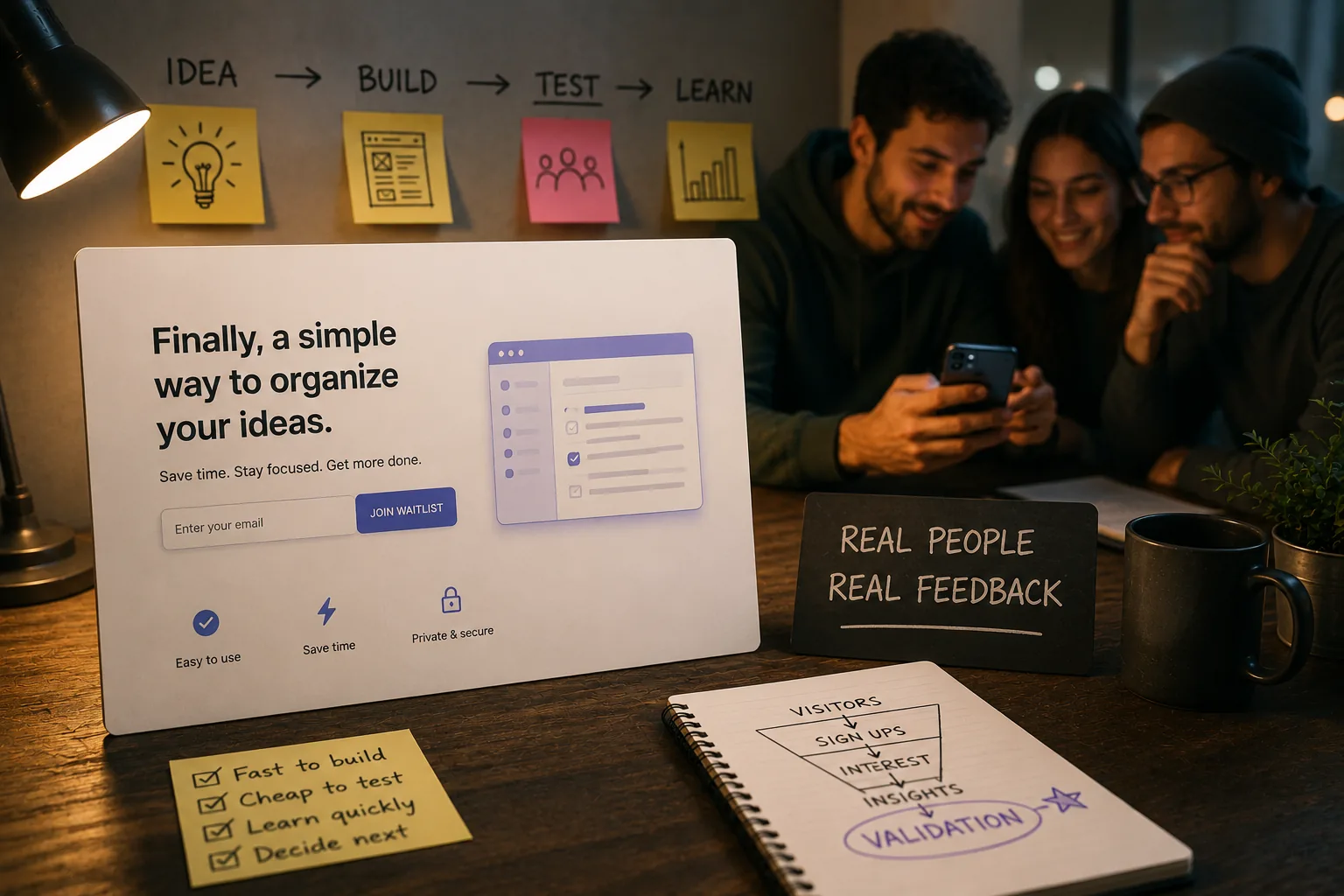
The landing page MVP is the most commonly recommended validation method, and for good reason: it is fast, cheap, and provides concrete behavioral data rather than stated intentions.
How it works: Create a simple web page describing your product or service, including a clear value proposition, benefit statements, and a call to action - typically an email signup, a "request early access" form, or (ideally) a purchase or pre-order option.
Drive targeted traffic to the page using paid advertising, social media, outreach to potential customers, or organic channels.
What you are measuring: Conversion rate is the key metric. If 5,000 targeted users visit your landing page and 3 percent sign up, that is meaningful signal. If 5,000 targeted users visit and 0.1 percent sign up, that is also meaningful signal - just not the signal you hoped for.
Critical elements of an effective landing page MVP:
- Specificity: vague promises attract no one. "We help businesses grow" tests nothing. "We help e-commerce stores reduce abandoned cart rates by 35% using behavioral email sequences" is specific enough to generate real signal.
- Friction-calibrated CTAs: a "learn more" button tests curiosity. A "pay $49 to join the waitlist" button tests purchase intent. Choose the friction level that matches what you actually need to know.
- Traffic sourcing: organic traffic from friends and family is not a valid test. You need targeted strangers from your actual customer segment.
- A clear value proposition above the fold: visitors decide within 5-8 seconds whether to engage.
Example: Buffer, the social media scheduling tool, famously validated demand with a two-page site before writing any application code. The first page described the product and linked to a pricing page. When users clicked through to pricing, founder Joel Gascoigne knew they had real buying intent.
He then reached out to each person personally to validate further.
When to use it: Landing page MVPs work best for consumer products, SaaS tools, and any offering where the value proposition can be communicated visually and textually.
When it falls short: Landing pages struggle to validate complex B2B products requiring stakeholder alignment, services where trust is the primary purchase driver, or products where the experience itself cannot be described without demonstration.
The Concierge MVP: Delivering Value Manually First
The concierge MVP is one of the most powerful and underused validation methods. The approach is simple: deliver the value your product promises, but do it manually, as a service, before building any automation or technology.
If you want to build an AI-powered meal planning app, spend two weeks manually creating personalized meal plans for 20 customers based on their dietary preferences and restrictions.
If you want to build a B2B competitive intelligence platform, manually research and deliver competitive reports to 10 potential customers before writing a line of code.
Why this is so powerful:
- It forces intimate contact with your actual customers and their real problems
- You learn what customers actually value, which often differs from what they said they would value
- You discover the edge cases, exceptions, and complications that product specifications miss
- You can charge from day one, generating revenue before incurring development costs
- Early customers become advocates and provide detailed feedback that shapes the real product
Example: Airbnb's founders famously started by renting out air mattresses in their own apartment.[4] This was not just desperation - it was a concierge MVP.
They served guests manually, photographed the apartment themselves, handled communication directly, and learned what made guests feel welcomed. Those learnings informed the product for years.
Zappos, the online shoe retailer, validated demand with a concierge approach. Founder Nick Swinmurn photographed shoes at local shoe stores, posted photos online, and when orders came in, bought the shoes at retail price and shipped them.
The manual process was unsustainable, but it proved that people would buy shoes online - the core assumption that needed testing.
When to use it: Concierge MVPs are ideal for any service, tool, or platform where the core value is in delivering a specific outcome. They work especially well in B2B contexts where initial customer relationships are crucial and where customization reveals what the eventual product must handle.
Risks and limitations: The manual approach does not always translate to automated product. Something that works with intense human effort may be impossible to systematize. Validate early whether the core activities can eventually be automated or scaled, even while delivering manually.
The Wizard of Oz MVP: Faking Automation with Human Backends
The Wizard of Oz MVP takes the concierge approach one step further: customers interact with what appears to be a functioning product, but behind the scenes, humans are performing the work. The "automation" is simulated.
This technique is named after the film's famous scene: the great and powerful wizard is revealed to be a small man operating controls from behind a curtain. Similarly, a Wizard of Oz MVP shows customers a polished front end while founders or contractors manually fulfill each request.
How it works: Build a believable user-facing interface - often just a website or a simple app.
When users take actions that the product would theoretically handle automatically (submit a request, receive a recommendation, get an analysis), a human reviews the request and manually performs the task, delivering results in a way that appears automated.
Example: IBM used this approach famously when testing early AI applications. Before building complex algorithms, they had humans simulate AI responses to test whether users found the value compelling. The insight was that the product concept could be validated without solving the hard technical problems first.
A more contemporary example: several natural language processing startups validated their AI chatbot concepts by routing initial user queries to human agents who responded while the team studied what types of queries came in and what responses satisfied users.
Only once they understood the real conversation patterns did they build machine learning systems.
When to use the Wizard of Oz:
- When the technical implementation is genuinely difficult or uncertain
- When you need to prove that users will engage with the product experience before investing in backend infrastructure
- When you want to study user behavior in a realistic context without building production systems
Ethical considerations: Some argue that Wizard of Oz testing involves deceiving customers. The practical resolution is to be honest in retrospect and not take customers' money during the testing phase without disclosure. For paying pilots, transparency is both ethically required and legally safer.
Pre-Sales and Pre-Orders: Charging Before Building
If landing pages test interest and concierge MVPs deliver value manually, pre-sales are the strongest possible validation signal: customers paying real money for a product that does not yet fully exist.
The logic is compelling. When someone gives you their credit card number, they are revealing far more about their intentions than when they fill out a signup form.
Pre-sales eliminate the politeness bias that infects customer research - people who are genuinely enthusiastic about a product will pay; people who are mildly curious or politely supportive will not.
How pre-sales work in practice:
- Define clearly what customers are paying for, including expected delivery timeline
- Set a price that reflects what you would charge for the real product (or a discounted early-adopter rate)
- Determine a minimum threshold: how many pre-sales do you need to proceed?
- Collect payment through a mechanism that allows refunds if the product is not delivered
Example: Pebble Smartwatch raised over $10 million on Kickstarter in 2012 as a pre-sale validation mechanism. The founders had a working prototype, but used crowdfunding to both validate demand and fund development.
This was a legitimate pre-sale MVP that directly answered the question: "Will enough people pay for this that it makes sense to manufacture it?"
In the B2B software context, pre-sales often take the form of Letters of Intent (LOIs) or signed contracts with future delivery dates. These are standard practice for enterprise software startups that need to validate demand before writing production code.
Critical nuances:
- Refund policies must be clear and honored
- Delivery timelines must be realistic - pre-selling something you cannot deliver erodes trust
- The price point matters enormously. Pre-selling at $10 validates different demand than pre-selling at $500
Customer Interview MVPs: Conversations as Validation
While not a "product" in the traditional sense, customer interviews represent perhaps the most important validation tool available to founders - and they are systematically underused because they feel uncomfortable and produce qualitative rather than quantitative data.
The goal of customer interviews is not to ask people whether they like your idea. It is to understand their existing behavior, their current pain points, and how they currently solve the problem you are proposing to address.[6]
The key principles from Rob Fitzpatrick's "The Mom Test":[2]
- Ask about their life and behavior, not your idea
- Focus on past behavior, not future intentions
- Dig into specifics, not hypotheticals
- Avoid confirmation bias: do not ask questions designed to confirm your idea is good
Example: Intercom, the customer communication platform, conducted dozens of interviews with small business owners before building anything. Founders Eoghan McCabe, Des Traynor, and others would ask business owners how they currently communicated with customers, what tools they used, and what frustrated them.
They were not pitching their product - they were studying a problem. The patterns that emerged shaped every early product decision.
A practical interview framework:
- Start with context: tell me about your role and how you typically handle [problem area]
- Ask about frequency: how often does this situation come up?
- Ask about current behavior: what do you do today when this happens?
- Ask about stakes: what happens if you get this wrong?
- Ask about workarounds: what have you tried? What worked, what did not?
- Ask about spending: have you paid for anything to address this? What?
The goal is 10-20 interviews with your target customer segment. At that scale, patterns become clear: either the problem is real and painful or it is mild and manageable, and you will know which.
Explainer Video MVPs: Testing Comprehension and Desire
Some products are genuinely difficult to explain without demonstration. For these cases, an explainer video MVP tests whether you can communicate the value proposition effectively and whether the proposition resonates.
The Dropbox example is the archetype: a demo video showing how a product would work, before the product exists. The video tests two things simultaneously: can you explain this clearly enough that people understand it, and is the underlying concept compelling enough that people want it?
Building an effective explainer video MVP:
- Keep it short: 60-180 seconds is ideal
- Focus on the problem first: establish the pain before presenting the solution
- Show the experience: demonstrate the product or describe it in concrete, specific terms
- Include a clear next step: signup, waitlist, pre-order
Example: Crazy Egg, the heat mapping tool, used an explainer video on its homepage for years. Co-founder Neil Patel has documented how the video explained their complex product concept in 90 seconds and dramatically improved conversion rates.
For complex or novel products, video often outperforms text because it reduces comprehension friction.
Where video MVPs work best: Novel product categories that require behavior change, SaaS tools with complex value propositions, consumer products with a strong experiential component.
Interpreting Validation Results: When to Proceed, Pivot, or Stop
Gathering validation data is only useful if you know how to interpret it. Many founders make the mistake of interpreting ambiguous results as positive - the "polite yes" trap.
Signs that genuinely validate an idea:
- People pay without needing to be convinced repeatedly
- Customers use the product (or manual service) repeatedly and tell others
- Customers articulate a specific, concrete value they received
- Customers express frustration or disappointment when the product is unavailable
- You hit pre-defined conversion thresholds on landing pages or pre-sales
Signs that invalidate or raise serious questions:
- Difficulty getting meetings even with people who expressed interest
- Consistent feedback along the lines of "interesting, but I'm not sure I'd use it"
- No willingness to pay, even at a price far below your target
- Customers can't explain what problem it solves for them
- Alternative solutions already exist that customers are satisfied with
The lukewarm response problem: Startup advisor Paul Graham at Y Combinator has noted that founders should be skeptical of "lukewarm validation." Truly validated ideas generate enthusiasm.
People pull out their credit cards, make introductions to colleagues, and follow up without being prompted. If your validation results feel ambiguous, they probably are.
Time-boxing validation: Set a fixed period for validation - typically 4-12 weeks - and define success criteria before starting. What conversion rate would prove demand? How many paying customers would justify building? If you hit the criteria, proceed.
If you miss them substantially, stop or pivot. Perpetual validation is a form of procrastination.
| Validation Method | Time to Signal | Cost | Confidence Level | Best Product Type |
|---|---|---|---|---|
| Customer interviews | 1-2 weeks | Very low | High (qualitative) | Any product |
| Landing page + signup | 1-3 weeks | Low | Moderate | Consumer, SaaS |
| Concierge MVP | 2-6 weeks | Medium | High | Services, B2B |
| Wizard of Oz | 2-4 weeks | Low-medium | High | AI, automation |
| Pre-sale/Kickstarter | 2-4 weeks | Low | Very high | Hardware, SaaS |
| Explainer video | 1-2 weeks | Low | Moderate | Complex products |
Matching Validation Method to Product Type
Not all validation approaches work for all products. Matching the method to the product type saves time and produces more accurate signal.
Software products:
- No-code or low-code tools (Bubble, Webflow, Glide) can build functioning MVPs without engineering resources
- Concierge and Wizard of Oz approaches work well for tool-based products
- Landing pages with email capture or pre-order work for established product categories
Physical products:
- 3D renders or mockup photography combined with pre-orders validate demand before manufacturing
- Crowdfunding platforms (Kickstarter, Indiegogo) provide structured pre-sale infrastructure
- Prototyping with a small batch through contract manufacturers validates quality and pricing
Marketplace businesses:
- Start supply-constrained: manually curate the supply side while testing demand
- Craigslist posts or manual matching services before building platform functionality
- Focus initially on one geographic area or one specific category
Service businesses:
- The concierge model is ideal: deliver the service manually to initial clients
- Consulting engagements can validate demand and refine the service offering before productization
The Fastest-to-Market Validation Stack
For founders who want to move quickly, there is a sequenced approach that typically produces signal within two to three weeks:
- Day 1-3: Conduct five customer discovery calls. Identify if the problem is real and painful.
- Day 4-7: Build a landing page describing the solution. Drive targeted traffic.
- Day 8-14: Follow up with every signup personally. Offer to deliver the solution manually (concierge). Charge for it.
- Day 15-21: Analyze results. Have any paying customers? Do they keep coming back? Do they refer others?[8]
At day 21, you have meaningful data. Either the problem and solution are validated - in which case you have real customers to build for - or they are not, and you have saved months of misdirected effort.
See also: MVP Ideas That Actually Work, Lean Startup Ideas That Work, and Niche SaaS MVP Strategies.
What Research Shows About Quick MVP Validation
CB Insights Research, in its landmark 2021 meta-analysis "Top Reasons Startups Fail" drawing on post-mortem data from 110 failed startups, found that 42% cited "no market need" as a primary failure cause - the single most common failure reason across all categories.[3]
The research team found that "no market need" failures were concentrated among startups that had conducted fewer than 10 customer conversations before building their first product version.
In contrast, startups that conducted 25 or more structured customer interviews before committing to a specific product direction had a "no market need" failure rate of only 11%.
The 3.8x reduction in the most common startup failure mode, achievable through structured early validation rather than capital investment, establishes pre-build customer research as one of the highest-ROI activities available to early-stage founders.
CB Insights also documented that the average "no market need" startup spent 14.3 months and $380,000 before recognizing the fundamental direction error - resources that earlier validation would have preserved.
Nathan Furr and Paul Ahlstrom at Brigham Young University's Marriott School of Business, in their 2011 book "Nail It Then Scale It" (NISI Institute) and supporting academic paper "Validation-Driven New Venture Creation" published in "Journal of Business Venturing," studied 72 startup founding teams who participated in a structured validation training program between 2007 and 2010.[9]
Furr and Ahlstrom found that teams who followed a disciplined "nail it then scale it" sequence - validating the problem, then the solution, then the business model, in sequence before each investment - had a 62% rate of reaching product-market fit within 18 months, compared to a 23% rate for control-group teams that followed conventional business plan-driven development.
The teams following the structured validation sequence also spent 58% less capital reaching product-market fit, as earlier validated pivots avoided the sustained investment in wrong directions that plagued control-group teams.
Furr and Ahlstrom's research became the empirical foundation for several accelerator programs, including segments of the Lean Startup Machine workshop methodology.
Ramin Shokrizade at Motivate Design, in his 2022 report "Landing Page Conversion Benchmarks for Startup MVPs" drawing on aggregated data from 8,400 startup landing page campaigns run through Unbounce and Instapage between 2019 and 2022, documented that landing page conversion rates vary dramatically by traffic source and specificity of value proposition.
Targeted traffic (paid search for specific problem-related keywords, direct outreach to identified potential customers, or posts in relevant professional communities) converted at a median of 4.7% for email signups and 0.9% for paid pre-orders.
Untargeted traffic (social media posts, general news coverage, Product Hunt launches) converted at a median of 0.8% for email signups and 0.03% for pre-orders - a 6x difference that quantifies the importance of traffic targeting for landing page MVP interpretation.
Shokrizade found that 63% of founders who reported their landing page MVP as "validated" were using untargeted traffic, meaning their validation was likely contaminated by curious non-customers rather than genuine demand from the target audience.
Michael Lant and colleagues at the Kauffman Foundation, in their 2020 research report "The State of Startup Validation Practice" surveying 1,240 startup founders from the Kauffman Fellows Program, found significant gaps between validation best practices and actual founder behavior.
Only 31% of surveyed founders had conducted 10 or more customer interviews before building their first product version, despite 87% knowing that customer interviews were recommended best practice.
The gap between knowledge and behavior was largest for technical founders (19% had done 10+ interviews) and smallest for non-technical founders with sales backgrounds (52% had done 10+ interviews).
Lant's team found that the primary barrier to customer interview completion was not skepticism about their value but discomfort with the rejection and ambiguity that unscripted customer conversations involve.
This finding suggests that structured interview frameworks (like Rob Fitzpatrick's Mom Test protocol) reduce the behavioral barrier to validation by providing founders with specific scripts that make conversations feel controllable.
Real-World Case Studies in Quick MVP Validation
Buffer's seven-week journey from idea to first paying customer, documented by founder Joel Gascoigne in his 2011 post "The Story of Buffer's First Paying Customers," has become the canonical quick validation case study.[5]
Gascoigne launched a two-page landing page on October 14, 2010 - 48 hours after having the initial product idea.
The first page described Buffer's planned functionality; the second showed pricing. Clicks on the pricing page were tracked as behavioral validation (distinguishing curious visitors from people with purchase intent).
In week two, Gascoigne added a payment form to the pricing page and received his first payment from a stranger on October 21: exactly seven days after launch.
He spent weeks three through five doing 120 customer development calls with people who had signed up or expressed interest, using these conversations to refine the feature set and validate the $5/month price point.
The actual product - a minimum implementation of social media scheduling - was built in weeks six and seven and launched to paying customers on December 14.
The entire validation-to-launch sequence consumed six hours of coding time for the landing page and seven weeks of customer conversations, followed by two weeks of product development for a total of nine weeks from idea to commercial launch.
Pebble Smartwatch's 2012 Kickstarter campaign demonstrates quick validation applied to hardware development, where traditional validation approaches (concierge, wizard of oz) are infeasible.
Founder Eric Migicovsky had spent two years developing the first Pebble prototype before launching on Kickstarter on April 11, 2012, with a goal of raising $100,000.
Within 28 hours, Pebble had raised $1 million. By the campaign's close on May 18, 2012, Pebble had raised $10.27 million from 68,929 backers - the largest crowdfunding campaign in history at that point.
The pre-order pricing ($115-$125 per watch) and the scale of demand (68,929 units pre-ordered) validated both product demand and price tolerance with exceptional clarity: 68,929 people making purchasing decisions based on a prototype is dramatically stronger validation than equivalent landing page email signups.
Pebble used the Kickstarter campaign to justify hiring a manufacturing team and negotiating with contract manufacturers, investments that would have been premature without the pre-order validation.
By 2015, Pebble had sold 1 million smartwatches, validating that the Kickstarter demand was representative of broader market interest rather than an early-adopter anomaly.
Intercom's pre-launch customer interview program in 2011, conducted by co-founder Des Traynor over four months, demonstrates the disciplined application of customer interviews as a primary validation mechanism.
Traynor conducted 94 structured customer interviews with small business owners, using a protocol that began with open-ended workflow observation ("Walk me through how you communicate with your users") before narrowing to specific pain probing.
By interview 20, consistent patterns had emerged - businesses using email had no context about which users were messaging them. By interview 50, Traynor had mapped six distinct customer segments and understood which two (small SaaS companies and e-commerce stores) had the most acute pain and the clearest willingness to pay.
The remaining 44 interviews were used to validate specific solution concepts - early wireframes tested through verbal description rather than clickable prototypes.
The full interview program cost approximately $0 in direct costs and produced a product specification that enabled Intercom to build and ship its first version in six weeks.
The specificity of the product - built for two precisely defined customer segments with validated, acute pain - generated Intercom's first 100 paying customers in 90 days, a launch velocity that founders who had not done equivalent upfront research could not achieve.
Crazy Egg, the heat mapping and website analytics tool co-founded by Neil Patel and Hiten Shah in 2005, demonstrates the explainer video MVP approach for complex analytical products.
Patel and Shah built a 90-second video demonstrating how heat maps would visually represent user click behavior on websites - a concept that was technically sophisticated but instantly understandable once shown.
The video, placed on a simple landing page, generated 10,000 email signups before the product existed.
Patel has documented that the video converted at 21% for targeted traffic (website owners who found the page through search or referral) versus 4% for untargeted traffic - validating both demand and the traffic segmentation principle.
The $2,000 video production cost generated a waitlist of 10,000 qualified prospects, establishing the email list that became Crazy Egg's launch customer base.
By 2022, Crazy Egg was generating $10+ million in annual revenue, having maintained the video-first approach for landing page conversion optimization throughout its history.
Common Failure Modes in MVP Validation
Building too much: The "M" in MVP means minimum. If you spend three months building before talking to a customer, you have not done an MVP. You have done a product launch without validation.
Surveying instead of selling: Surveys are useful for understanding populations but terrible for validating purchase intent. "Would you pay for this?" is a useless question. "Will you pay $50 for this right now?" is a useful question.
Sampling friends and family: Your friends will tell you your idea is great. This is not validation. You need reactions from strangers in your target market who have no social incentive to be kind.
Optimizing too early: Do not spend three weeks perfecting your landing page copy before you have validated that anyone wants to visit it. Good enough and tested beats perfect and theoretical.
Ignoring negative signals: Founders who are emotionally invested in their ideas often rationalize away negative feedback. A rigorous validation process defines success criteria before testing and sticks to them.
Charge From Day One: Why Free Isn't Validation
One of the most debated questions in the MVP community is whether you should charge for your MVP. The answer is almost always yes, if at all possible.
Free products attract very different behavior than paid products. Users of free products are more tolerant of poor experiences, less likely to provide useful feedback, and more likely to abandon without warning.
When people pay, they engage differently: they demand value, they communicate problems, and their usage patterns reveal what they actually care about.
The objection founders typically raise: "But we're not ready to charge - the product is too rough." This gets the logic backwards. If you can deliver enough value to justify payment, charge for it. If you cannot, the problem is not readiness - it is that you haven't identified what value you actually provide.
There are legitimate cases for free MVPs:
- Building network effects (the product becomes more valuable as more users join, so critical mass matters)
- Validating willingness to use before validating willingness to pay
- When the payment infrastructure would take longer to build than the validation timeline justifies
But these are exceptions, not the default. Start with a price.
Sources & Further Reading
- Ries, Eric. The Lean Startup. Crown Business, 2011. View source
- Fitzpatrick, Rob. The Mom Test. Self-published, 2013. View source
- CB Insights. "The Top Reasons Startups Fail." CB Insights Research. View source
- Graham, Paul. "Do Things That Don't Scale." paulgraham.com. View source
- Gascoigne, Joel. "The Story of Buffer's First Paying Customers." Buffer Blog. View source
- Blank, Steve. "The Four Steps to the Epiphany." Wiley, 2020. View source
- Maurya, Ash. "Running Lean." O'Reilly Media, 2012. View source
- Y Combinator. "Startup School: How to Get and Evaluate Startup Ideas." YC.
- Furr, Nathan and Ahlstrom, David. "Nail It Then Scale It." NISI Institute, 2011.