
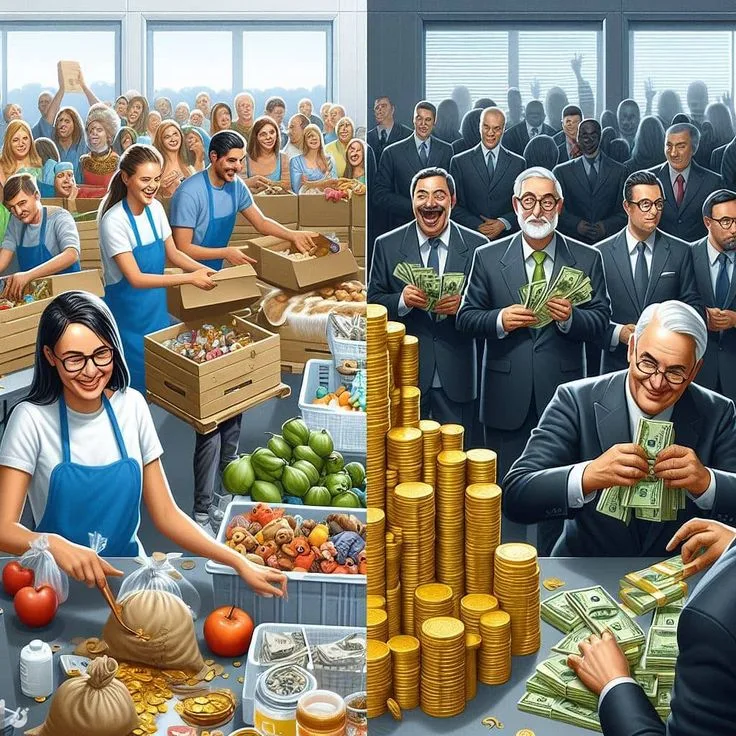
Understanding: A century ago, most workers in industrialized nations made things. Steel, textiles, furniture, machines. The factory defined the working life. Today, in developed economies, the overwhelming majority of workers do not make things.
They provide services: they care for children and elderly parents, drive passengers across cities, write software, serve food, teach, nurse, clean, and organize.
This is the service economy, and it has reshaped labor markets, wage structures, gender dynamics, and the nature of work itself in ways that are still not fully understood or honestly priced.
The Shift from Manufacturing to Services
The transition from an industrial to a service economy in the United States took most of the twentieth century. As recently as 1950, manufacturing employed roughly 30 percent of the US workforce. By 2023, it employed less than 9 percent.
The reasons are layered. Automation reduced the labor content of manufacturing production significantly, as factories produce more output than ever before with far fewer workers. Globalization moved labor-intensive manufacturing to lower-wage countries.
And rising incomes in wealthy nations shifted consumer spending toward services. As people grow more prosperous, the marginal utility of additional physical goods declines faster than the utility of additional services: health, education, recreation, care.
The Bureau of Labor Statistics projects that the ten fastest-growing occupations over the next decade will all be in services: home health aides, personal care aides, nurse practitioners, software developers, and food service workers dominate the list.
"We are not moving from making things to doing nothing. We are moving from making things to doing things for each other. The question is whether we value what we do for each other adequately." Guy Standing, The Precariat (2011)
The Scale of the Shift
To understand the magnitude of this transformation, consider raw numbers. In 1979, US manufacturing employment peaked at approximately 19.5 million workers. By 2010, it had fallen below 12 million.
As of 2023, approximately 13 million Americans work in manufacturing, a sector that now produces substantially more economic output per worker than it did in 1979, thanks to automation, but employs far fewer people.
Meanwhile, services now account for approximately 80 percent of US GDP and a comparable share of private-sector employment. The United Kingdom, Germany, France, Japan, and Canada all show similar patterns, with services employment ranging from 70 to 85 percent of the total workforce depending on how narrowly the category is defined.
The McKinsey Global Institute's 2021 analysis of post-pandemic labor demand concluded that by 2030, demand for physical and manual roles in predictable environments would decline by approximately 10 percentage points as a share of total labor demand, while demand for technological, social-emotional, and high-skill cognitive roles would grow by roughly 5 to 7 percentage points each.
Deindustrialization and Its Geographic Legacy
The shift was not experienced uniformly. Manufacturing jobs were concentrated in specific regions: the Rust Belt states of Ohio, Pennsylvania, Michigan, and Indiana; the textile regions of the Carolinas; the steel towns of Pennsylvania and West Virginia.
When manufacturing contracted, these regions experienced concentrated unemployment, population decline, and the erosion of the tax base that funded local schools and services.
The service economy that replaced manufacturing grew predominantly in different places: coastal cities, college towns, technology hubs. San Francisco, New York, Boston, Seattle, and Austin absorbed most of the growth in high-paying knowledge services.
Former industrial centers were left with the lower end of the service economy (retail, food service, healthcare) at far lower wage levels than the manufacturing jobs they replaced.
This geographic dimension of the service economy transition is central to understanding the political economy of the past three decades.
The communities most disrupted by deindustrialization did not uniformly share in service economy prosperity, a dynamic that has shaped electoral politics across the United States, United Kingdom, and much of Western Europe since the 1990s.
What Counts as the Service Economy
The service sector is not monolithic. It spans an enormous range of occupations and wage levels, which makes aggregate statistics deceptive.
| Service Segment | Examples | US Median Wage (approx.) |
|---|---|---|
| Professional services | Lawyers, accountants, consultants | $80,000-$120,000+ |
| Healthcare (clinical) | Physicians, nurses, therapists | $55,000-$200,000+ |
| Finance and insurance | Analysts, brokers, underwriters | $65,000-$100,000+ |
| Education | Teachers, professors | $45,000-$75,000 |
| Retail trade | Sales workers, cashiers | $28,000-$35,000 |
| Food service | Cooks, servers, food prep | $25,000-$32,000 |
| Home care | Home health aides, personal care | $27,000-$32,000 |
| Transportation / rideshare | Drivers, couriers | $32,000-$40,000 |
The top end, high-skill professional and knowledge services, is very well compensated. The bottom end, where the most workers are and where most growth is projected, is not. This polarization, sometimes called the hourglass economy, is one of the defining features of service-economy labor markets.
The Hourglass in Detail
Labor economist David Autor at MIT, through decades of research on labor market polarization, has documented what he calls routine-biased technological change: automation has displaced middle-skill, routine cognitive and physical jobs (clerical work, assembly, bookkeeping) while complementing high-skill cognitive work and leaving low-skill manual service work relatively unchanged.
The result is a hollowing out of middle-skill employment, with growth concentrated at the high and low ends.
Between 1979 and 2012, Autor's research found that employment shares in high-wage occupations and low-wage occupations both grew, while middle-wage occupations declined. The middle, skilled factory workers, administrative staff, data entry clerks, contracted.
This is not primarily a story about inequality between workers and executives. It is a story about the economic returns to different types of skill, shaped by what technology can and cannot replace.
The practical implication: a college graduate entering finance or software development in 2025 enters a service economy that richly rewards their skills.
A worker without specialized credentials entering food service, retail, or basic care work enters a service economy that has not raised real wages in these occupations significantly since the 1970s.
Care Work: The Invisible Foundation
Within the service economy, care work occupies a peculiar position. It is essential to social reproduction: without people to care for children, the elderly, the ill, and the disabled, nothing else functions. Yet it is among the most poorly compensated formal work in the economy, and a vast share of it remains entirely unpaid.
The Gender Dimension
Care work's undervaluation is inseparable from its gender history. For most of modern history, care work was performed by women within households without compensation.
This was institutionalized in social policy and cultural norms: it was not considered "real" work in the economic sense because it did not generate market transactions.
When care work became paid and formalized in the twentieth century (nurseries, home care agencies, elder care facilities), the legacy of low valuation followed it.
Occupations that require genuine skill, significant physical and emotional labor, and specialized knowledge (nursing assistant, childcare worker, home health aide) pay far less than occupations requiring comparable training and effort in male-dominated sectors.
The care penalty, the wage discount associated with working in care occupations, has been documented across OECD countries. In the US, holding education, experience, and hours constant, workers in care occupations earn approximately 6 to 11 percent less than workers in comparable non-care occupations.
Paula England at New York University has spent decades documenting this penalty across occupational categories. Her research finds that as any occupation becomes more female-dominated, its wages tend to fall relative to comparable male-dominated occupations, a pattern she calls devaluation by association.
The link between feminization and lower wages appears even after controlling for skill requirements, physical demands, and required credentials.
Childcare: A Market Failure in Plain Sight
The US childcare market provides one of the clearest illustrations of care work's structural undervaluation. The median annual cost of center-based infant care in 2023 exceeded $20,000 in most major metropolitan areas, approaching $35,000 to $40,000 in some cities.
For families with two children, childcare costs frequently exceed mortgage or rent payments.
Despite this high cost to parents, childcare workers remain among the lowest-paid workers in the economy. The median annual wage for childcare workers in 2023 was approximately $29,000, less than parking lot attendants, refuse collectors, or taxi drivers.
Annual turnover in the childcare sector routinely exceeds 30 to 40 percent, driven directly by wages that make the work unaffordable as a career for workers who have any alternative.
The paradox of expensive care and poor wages reflects a fundamental market structure problem: most families cannot afford to pay significantly more, and the subsidy systems that would bridge the gap do not exist at adequate scale in the United States.
Most peer nations (Germany, France, the Nordic countries, Canada) address this through substantial public subsidies to childcare. The US has no equivalent national system, producing a market in which parents are financially strained, workers are underpaid, and quality is highly variable.
The Care Deficit
Aging populations and declining family sizes are creating growing demand for formal care work precisely as informal family care becomes less available. The number of Americans aged 65 and older is projected to nearly double between 2020 and 2050.
Home health aide and personal care aide are among the single fastest-growing occupations in absolute numbers.
Meeting this demand requires a large, stable, adequately paid care workforce. Current wage levels create high turnover: annual turnover rates in direct care work often exceed 50 to 60 percent, which degrades care quality and increases training costs.
The fundamental tension between care work's market undervaluation and its social necessity is unresolved.
The cost to the healthcare system of high care worker turnover is substantial. The PHI (Paraprofessional Healthcare Institute), a workforce research organization, estimated in 2021 that turnover in direct care occupations costs the home care industry approximately $8.2 billion annually in the United States, a direct consequence of wages low enough that workers routinely exit for better opportunities in retail, food service, or other low-wage work.
"We have constructed a care economy that works for almost no one. Parents can't afford the care they need. Workers can't survive on care wages. And the country needs millions more care workers in the coming decades. The math does not work." PHI National, Direct Care Workers in the United States, 2021
The Platform Economy and Service Labor
The most dramatic reorganization of service work in the early twenty-first century has been the rise of platform economy companies: digital intermediaries that match service providers with customers in real time.
Uber and Lyft match drivers with riders. DoorDash and Instacart match couriers with customers. TaskRabbit matches handypeople with homeowners. Upwork matches freelance professionals with employers. The platforms collectively employ (or more precisely, contract with) tens of millions of workers in the US alone.
The Contractor Model
The defining feature of platform service work is worker classification as independent contractors rather than employees. This distinction has enormous consequences.
Independent contractors are not entitled to minimum wage, overtime, employer-side payroll tax contributions, workers compensation, unemployment insurance, health insurance, or retirement benefits.
All costs and risks associated with the work (vehicle maintenance, gas, healthcare, income volatility) fall on the worker.
Platforms argue that contractor status provides workers with flexibility: the ability to set their own hours and work as much or as little as they choose. Research on whether workers genuinely value this flexibility above the benefits they forgo has produced mixed results.
For workers who use platforms as a primary income source, the evidence of net financial disadvantage is fairly clear. For workers who use platforms for supplemental income alongside other employment, the flexibility argument is more credible.
A 2018 study by Lawrence Katz and Alan Krueger found that alternative work arrangements, including platform and gig work, accounted for the entirety of US employment growth between 2005 and 2015. All net job creation during that decade was in non-traditional employment arrangements with reduced labor protections.
Scale of the Platform Workforce
The magnitude of platform work is difficult to measure precisely because platforms resist classification schemes that would generate regulatory scrutiny, and because many workers participate on a casual or part-time basis.
The Pew Research Center's 2021 survey found that 16 percent of American adults had earned money from an online gig platform at some point.
The Bureau of Labor Statistics, using a more conservative definition, estimated in 2017 that approximately 1.6 million workers drove for ride-sharing platforms in any given week.
A Federal Reserve Bank of New York analysis using tax records estimated that approximately 9 percent of US workers received income from digital platforms in 2020, a figure that includes both full-time and supplemental participants.
The European Commission estimated in 2021 that approximately 28 million people across EU member states worked through digital labor platforms, a figure it projected would reach 43 million by 2025.
Algorithmic Management
Platform work has also introduced algorithmic management at scale: the use of automated systems to assign work, monitor performance, adjust compensation rates, and discipline or deactivate workers without human managerial involvement.
For drivers, this manifests as surge pricing that is determined by algorithms, rating systems that can result in deactivation if scores fall below thresholds, and real-time route optimization that provides no scope for driver discretion.
Workers report that the absence of a human manager does not make algorithmic management feel less controlling. In many ways, they describe it as more total, because there is no relationship to appeal to and no context the system can take into account.
Research by Veena Dubal at the University of California, Irvine, published in 2023, examined what she called algorithmic wage discrimination: the practice of platforms using behavioral data to identify the minimum rate at which a specific worker will accept a task.
Workers who demonstrate willingness to accept lower-paying jobs receive more of them; workers who reject low offers are shown lower-value work.
This price discrimination, Dubal argues, applies market segmentation tools developed for consumer pricing to the labor market in ways that systematically disadvantage workers who cannot afford to decline work.
Why Service Work Resists Automation
A common assumption is that service jobs will eventually be automated just as manufacturing jobs were.
The evidence suggests this prediction is true for some service work, particularly routine cognitive tasks like data entry, bookkeeping, and basic customer service, but substantially false for the largest categories of human-contact service work.
What Makes Care Hard to Automate
A 2013 Oxford study by Frey and Osborne estimated the probability of automation for hundreds of occupations. Care occupations ranked among the lowest probability categories:
- Home health aides: estimated 35 percent automation probability
- Mental health counselors: estimated 9 percent
- Occupational therapists: estimated 1 percent
- Elementary school teachers: estimated 1 percent
The difficulty is not primarily technological. It is structural. Effective care requires physical presence in unstructured environments, real-time adaptive social judgment, genuine emotional attunement, and often the capacity to physically assist someone whose needs change moment by moment.
A robot can administer medication on schedule. It cannot read the nonverbal signals of a distressed dementia patient, understand that what they need right now is a familiar face and a quiet voice, and calibrate its response accordingly. The relational dimension of care is, for now, irreducibly human.
Since the Frey and Osborne study, more nuanced analyses have emerged. MIT economist Daron Acemoglu and Boston University's Pascual Restrepo, in a series of papers from 2018 to 2022, argued that automation's effects depend critically on whether technology complements or substitutes for labor.
In service occupations requiring social judgment, physical dexterity in unstructured environments, and real-time emotional responsiveness, the complementarity hypothesis holds: AI tools may augment care workers' capabilities without replacing them.
The nurse with an AI diagnostic assistant may be more effective than the nurse without one, without the assistant replacing the nurse.
AI's Selective Impact on Service Work
Generative AI, large language models, and increasingly capable robotics have raised new questions about the automation of service work since 2020. The evidence so far supports a selective picture.
Customer-facing roles involving scripted responses to common queries (call center work, basic help desk support, standardized financial advice) face genuinely high automation risk.
Goldman Sachs estimated in 2023 that AI could potentially replace the equivalent of 300 million full-time jobs globally, with white-collar professional services facing more exposure than had been previously modeled.
But physical service work (the care worker, the electrician, the nurse, the physical therapist) continues to demonstrate resistance.
Humanoid robotics capable of operating effectively in the unstructured environments of homes, hospitals, and schools remain expensive, unreliable, and far from deployable at scale as of 2025. The timeline for automation of physical care work is measured in decades, not years.
The Baumol Effect
Economist William Baumol identified a related long-term trend in his concept of the cost disease. In sectors where labor productivity can be increased through technology (manufacturing, agriculture, finance), automation reduces the number of workers needed per unit of output.
In sectors where the work inherently requires human time (healthcare, education, performing arts), productivity gains are limited by the nature of the service itself.
Over time, as wages across the economy rise in line with productivity in the automatable sectors, the cost of inherently labor-intensive services rises too. It takes the same number of nursing hours to care for a patient today as it did in 1980.
But nurses' wages have risen alongside economy-wide wages. This creates persistent upward pressure on the cost of human services that is structural, not amenable to productivity fixes.
The Baumol effect explains why healthcare and education costs consistently outpace general inflation in developed economies, and why no technological solution is fully adequate as a response.
The only way to simultaneously provide high-quality human care and keep its cost down is to underpay the people providing it, which is precisely what the US has done in the lower tiers of its care sector.
Pay Disparities and the Political Economy of Service Work
The wide wage range within the service sector is not random. It reflects the degree to which different service occupations have been able to restrict entry, organize collectively, accumulate political capital, or leverage credentials that limit competition.
Physicians earn very high incomes in part because medical licensing restricts the supply of practitioners. Lawyers benefit from bar membership requirements. Teachers are partly protected by union contracts in many jurisdictions.
Home health aides, food service workers, and retail workers, the lower end of the service economy, have low unionization rates, no professional licensing requirements, and high labor supply.
The result is a bifurcated labor market in which the skill, emotional labor, and social value of a job have an imperfect and sometimes inverted relationship with its compensation.
Unionization Rates in Service Work
The divergence between unionization rates at different tiers of the service economy is stark. As of 2023, Bureau of Labor Statistics data showed union membership rates of:
- Government workers (heavily service-oriented): 32.5 percent
- Education workers: approximately 34 percent
- Healthcare workers (excluding physicians): approximately 10 percent
- Food service workers: approximately 1.2 percent
- Retail workers: approximately 4.4 percent
- Home health and personal care workers: approximately 6 percent
The correlation between unionization rates and wages in service work is direct and well-documented. When fast food workers in New York, California, and other states secured higher minimum wages through legislative and campaign pressure, wages rose substantially.
The Fight for $15 campaign, which began in 2012, had by 2023 resulted in state and local minimum wage increases that covered millions of service workers, with documented wage gains in fast food employment approaching 30 to 40 percent in states that implemented the increases.
Minimum Wage and Service Work
Because so much service employment is clustered at or near minimum wage, minimum wage policy has outsized effects on the service sector compared to the rest of the economy.
The Congressional Budget Office's 2021 analysis of a federal $15 minimum wage estimated it would raise wages for 17 million workers, the vast majority of them in service occupations, while potentially reducing total employment by approximately 1.4 million workers.
The empirical evidence on minimum wage effects in service work is more nuanced than the simple supply-and-demand model suggests.
A series of natural experiments comparing counties across state borders, where one side experienced a minimum wage increase and the other did not, have generally found smaller employment effects than traditional models predicted, partly because the service sector is not particularly mobile: you cannot offshore a restaurant or a childcare center.
The Future of Service Work
Several converging trends will shape the service economy over the coming decades.
Aging demographics will dramatically increase demand for healthcare and elder care. OECD countries will need millions more care workers over the next 30 years. How those jobs are compensated will determine whether they can be staffed adequately.
AI and automation will continue replacing the cognitive and routine dimensions of service work (phone-based customer service, basic legal document review, standardized financial advice) while having less impact on physical presence, skilled trades, and relational care.
Platform labor law is evolving. California's AB5, the UK Supreme Court ruling classifying Uber drivers as workers, and EU platform work directives all represent attempts to extend employment protections to platform workers.
How these legal contests resolve will substantially affect the wages and conditions of tens of millions of service workers.
Care work valuation remains a central policy question. Several proposals, including public investment in childcare and elder care as economic infrastructure, wage subsidies for direct care workers, and universal basic income as a floor for precarious service workers, have attracted significant policy attention without reaching consensus.
The Care Infrastructure Argument
One of the most influential frameworks in recent policy debate has been the argument for treating care work as economic infrastructure: comparable in importance to roads, broadband, and utilities.
Economists including Heather Boushey, Laura Tyson, and Ariane Hegewisch have argued that underinvestment in childcare and elder care reduces labor force participation (particularly by women), suppresses productivity, and imposes long-term costs on economic growth that dwarf the short-term costs of care subsidies.
The Biden administration's Build Back Better framework included $400 billion in care economy investments (childcare subsidies, direct care worker wage increases, and Medicaid expansion for home care) before failing to pass in full in 2021 and 2022.
Even in its scaled-back form, the policy debate represented a significant shift in how care work's economic centrality is discussed at the federal level.
The comparison to other developed economies is instructive. Countries that have invested substantially in care infrastructure (the Nordic nations, France, Germany) show higher rates of female labor force participation, lower child poverty rates, and competitive economic performance relative to peers.
The argument that care investment is fiscally neutral or positive over a ten-year horizon has gained substantial empirical support.
Technology and the Future of Low-Wage Service Work
For the large portion of service work that is neither automatable nor amenable to wage premiums from credentials, the future depends heavily on labor market policies.
The combination of demographic pressure increasing demand for care work, continued automation displacing middle-skill work, and the structural undervaluation of care creates a labor market configuration that is politically and economically unstable.
Some states have begun addressing this through sectoral wage-setting for specific care occupations. Massachusetts, New York, and California have enacted or proposed minimum wage provisions specifically for home care workers and childcare providers that exceed the general minimum wage.
Federal policy through Medicaid reimbursement rates directly affects the wages of millions of home health workers; increases in those rates in the American Rescue Plan Act of 2021 resulted in documented wage increases in states that passed them through to workers.
Summary
The service economy is not a single thing. It ranges from highly compensated knowledge work in law, finance, and technology to the poorly paid, physically demanding, and often invisible work of caring for children and elderly people.
The transition from manufacturing was driven by automation, globalization, and changing consumer demand, and it has created a labor market that is simultaneously more flexible and more unequal than the industrial economy it replaced.
Platform companies have extended market logic into previously informal service arrangements while redistributing the risks of work onto workers. The hourglass economy, growth at the high and low ends of the wage distribution with contraction in the middle, has widened inequality even as overall economic output has grown.
Care work, essential to everything else the economy does and resistant to automation, sits at the center of these tensions.
The service economy's future will be shaped less by technology than by decisions: about how to value work done for and with other human beings, about whether the risks of employment are borne by workers or distributed more broadly, and about whether democratic societies are willing to pay, through taxes or wages, what it actually costs to care for their children and their elders.
Those decisions remain open, which means they remain, at least in part, choices.