
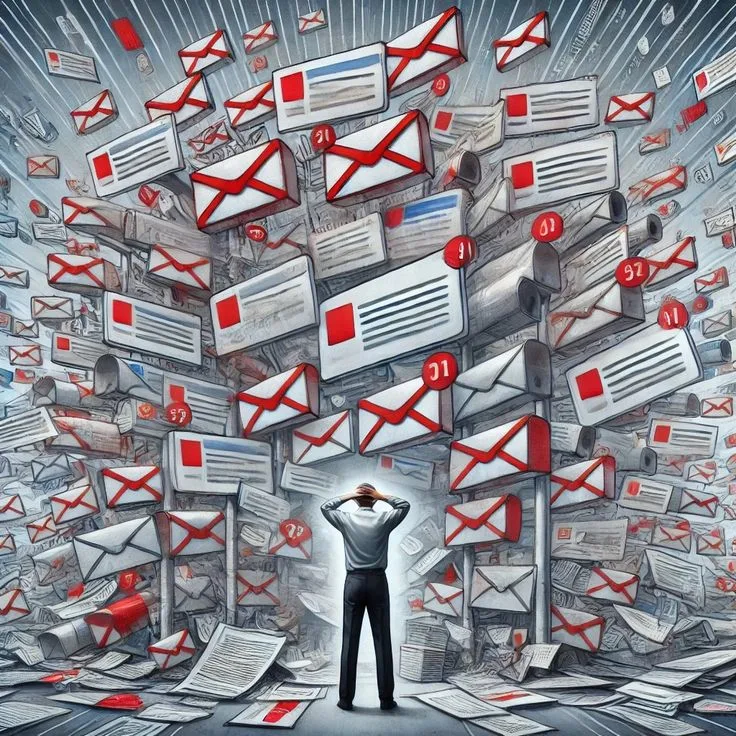
Always-on messaging can erase the boundary between working time and personal time, turning ordinary email into an expectation of constant availability. Examining email culture means considering how organisational norms and legal protections shape the right to disconnect after working hours.
In 2019, a French court fined a company 60,000 euros for requiring an employee to keep his phone on during evenings and weekends to respond to work emails.
The ruling was based on France's 2017 "right to disconnect" law, which established that employees have the legal right to ignore work communications outside of working hours.
The law was passed in response to what French legislators called the "always-on" culture created by email and messaging technology-a culture in which the boundary between work and personal life had been effectively erased by the expectation that employees would be perpetually available to respond to digital communications.
France is not alone in recognizing the problem. Italy, Spain, Portugal, Belgium, and Ireland have all enacted or proposed similar legislation. Germany's labor ministry issued guidelines discouraging after-hours email. Volkswagen programmed its servers to stop routing emails to employee phones between 6:15 PM and 7:00 AM.
Daimler created an auto-delete feature for vacation emails, allowing employees to have incoming messages automatically deleted with a notification directing senders to an alternative contact.
These responses-legislative, corporate, technological-reflect a recognition that email culture has become one of the most consequential and least examined aspects of modern work life. Email is not merely a tool.
It is a cultural system: a set of norms, expectations, and practices that shapes how people communicate, how they spend their time, how they experience work, and how organizations function.
Understanding email culture is essential for understanding why so many knowledge workers feel overwhelmed, fragmented, and unable to do their actual work.
What Is Email Culture?
Email culture is the set of norms, expectations, and practices, including response time expectations, CC habits, formality levels, and volume tolerance, that govern how email is used in professional environments. It shapes how quickly people are expected to reply, who gets copied and why, and how much communication is considered normal versus excessive.
Beyond the Inbox
Email culture encompasses the norms, expectations, and practices that govern how email is used in professional environments. It includes:
- Response time expectations: How quickly are you expected to respond? Within minutes? Hours? Days? The answer varies by organization, industry, seniority, and the specific relationship between sender and recipient-but the expectations are real, consequential, and often unspoken.
- CC and BCC practices: Who gets copied on emails, and why? Is CC'ing used to keep people informed, to create accountability trails, to signal transparency, or to cover the sender against future blame?
- Formality norms: What level of formality is expected? Full sentences and proper grammar? Casual abbreviations and emojis? The answer signals organizational culture and varies dramatically across industries, geographies, and generations. These norms are part of broader digital etiquette that governs professional online behavior.
- Volume expectations: How many emails per day is normal? Is receiving 200 emails per day a sign of importance or a sign of dysfunction?
- Content boundaries: What belongs in email? Is email for decisions, for information, for discussion, for delegation, or for all of these? The answer is often "all of these," which is part of the problem.
The Scale of the Problem
The numbers illustrate why email culture matters:
- The average office worker receives approximately 120-150 emails per day, according to research by the Radicati Group
- Knowledge workers spend approximately 28% of their workweek managing email, according to a McKinsey Global Institute study-roughly 2.6 hours per day
- A study by researchers at the University of California, Irvine found that it takes an average of 23 minutes and 15 seconds to return to a task after an email interruption
- The total number of business emails sent and received per day worldwide exceeded 300 billion by 2023
These numbers represent not just time but cognitive fragmentation: the constant switching between email and other work that prevents sustained concentration, deep thinking, and creative problem-solving.
"Email is a wonderful thing for people whose role in life is to be on top of things. But not for me; my role is to be on the bottom of things." - Donald Knuth
Why Does Email Create Overload?
Email creates overload because sending a message costs the sender almost nothing while reading and responding costs the recipient real time, and this cost asymmetry is worsened by CYA (Cover Your Ass) CC'ing, reply-all chains, and ambiguous action items that force every recipient to process messages that were not really meant for them.
The Zero Marginal Cost Problem
The fundamental driver of email overload is that sending email costs the sender almost nothing. Writing and sending an email takes seconds. Reading, processing, understanding, and responding to that email takes minutes.
When the cost of sending is near zero but the cost of receiving is significant, the system generates more communication than the recipients can effectively process.
This cost asymmetry is not present in most other communication media:
- Phone calls require the sender's time during the call, creating rough cost parity between sender and receiver
- In-person conversations require the sender to be physically present, limiting the volume of communication
- Written letters require effort to compose, print, and mail, making each communication a considered act
- Even text messages are typically shorter and more targeted than emails, creating a lighter processing burden
Email's near-zero sending cost combined with its one-to-many capability (CC lists, distribution groups, reply-all) means that a single sender can impose significant processing costs on dozens or hundreds of recipients with minimal effort.
This is the signal-to-noise problem at organizational scale: the ease of sending degrades the quality of what gets through.
CYA Culture
One of the most destructive aspects of email culture is CYA (Cover Your Ass) behavior: the practice of CC'ing additional people on emails to create a record that specific information was shared, specific warnings were given, or specific decisions were made.
CYA email serves several purposes:
- Blame distribution: If something goes wrong, the sender can point to the email and say "I informed everyone on the CC list." The email functions as an insurance policy against future blame.
- Accountability avoidance: By CC'ing a large group, the sender distributes responsibility across the group rather than assigning it to a specific individual. "I sent it to the team" becomes a substitute for "I ensured that a specific person took responsibility."
- Political protection: CC'ing a manager or executive on an email creates a witness to the communication. If a dispute arises later, the CC'd executive can confirm what was communicated.
The problem with CYA email is not that it is irrational-in organizational environments where blame is common and accountability is unclear, it is entirely rational. The problem is that it multiplies email volume dramatically. Every CYA CC adds a recipient who must process the email without being the intended audience.
When CYA culture is widespread, a significant portion of every employee's inbox consists of emails they were CC'd on for political rather than informational reasons.
"For most people, email has become a way of looking busy rather than a way of getting work done." - Cal Newport
The Reply-All Spiral
Reply-all behavior compounds email overload by broadcasting responses to entire recipient lists:
- Someone sends an email to a large group (a team, a department, an entire company)
- One recipient replies to all with a response, question, or comment
- Other recipients reply to all with their own responses
- Side conversations develop within the reply-all chain
- Recipients who have nothing to contribute receive dozens of messages they must at least scan to determine whether any require their attention
The reply-all spiral is so common and so destructive that organizations have taken technical measures to prevent it. Microsoft Outlook includes a "reply-all storm protection" feature that automatically limits reply-all messages to large distribution lists.
Some organizations have disabled reply-all for company-wide distribution lists. These measures address the symptom but not the underlying cause: the absence of clear norms about when email is the appropriate communication channel and who the appropriate audience is.
Ambiguous Action Items
Email overload is worsened by ambiguous action items: emails that do not clearly specify what action is requested, who is responsible for taking it, and when it should be completed.
A typical problematic email might read: "Hi team, please take a look at the attached proposal and let me know your thoughts." This email creates uncertainty for every recipient:
- Am I required to respond, or is this optional?
- How much time should I spend reviewing the proposal?
- What kind of feedback is expected-detailed edits, general impressions, approval?
- When is a response needed?
- Is anyone specifically responsible, or is this distributed to the whole team?
The ambiguity means that conscientious recipients will spend time on the email that less conscientious recipients will not, creating an unfair burden distribution. It also means that the sender may not receive the response they need, because recipients interpreted the request differently.
How Do Email Expectations Vary by Culture?
Email expectations vary by culture along response speed, formality, and after-hours availability. Fast-response cultures like US tech and startups favor brief, casual messages with quick replies and minimal CC, while deliberate-response cultures like Japan, Germany, and France favor formal, thorough messages, hierarchical CC'ing, and protected personal time.
Geographic and Cultural Variation
Email norms vary significantly across cultures, creating potential for misunderstanding in international business:
| Dimension | Fast-Response Cultures | Deliberate-Response Cultures |
|---|---|---|
| Response time | Within hours or same business day | Within 1-3 business days |
| Formality | Casual, first-name basis | Formal salutations, titles |
| Length | Brief, bullet points | Detailed, contextual |
| Directness | Direct requests and responses | Indirect, relationship-aware |
| After-hours | Expected to be available | Protected personal time |
| CC norms | Minimal CC | Extensive CC for hierarchy |
| Examples | US tech, startup culture | Japan, Germany, France |
American email culture (particularly in technology and startup environments) tends toward informality, brevity, and fast response expectations. Emails may consist of a single line or even a single word ("Done."). Response within hours is expected. CC'ing is relatively minimal.
Japanese email culture tends toward formality, thoroughness, and hierarchical awareness. Emails include formal greetings, contextual explanation, and careful attention to the recipient's status. CC'ing superiors is standard practice. Response may take longer because care is taken with composition.
German email culture values precision and thoroughness. Emails are detailed and specific, with clear action items and timelines. Formal salutations and closings are standard. After-hours email is discouraged by both cultural norm and, increasingly, by law.
These variations create friction in global organizations where teams from different cultural backgrounds must collaborate. An American employee may interpret a German colleague's two-day response time as disengagement; the German colleague may interpret the American's immediate, brief response as careless.
Generational Variation
Email norms also vary across generations:
- Baby Boomers and Generation X were the first professional generations to adopt email and often view it as the default professional communication channel. They may prefer email for its formality, documentation capability, and asynchronous nature.
- Millennials grew up with email but also with instant messaging, social media, and collaboration tools. They may use email for formal external communication while preferring chat tools (Slack, Teams) for internal coordination.
- Generation Z entered the workforce after the proliferation of real-time communication tools and may view email as slow, formal, and outdated. They may default to chat, voice messages, or video for communication that previous generations would conduct over email.
These generational differences create tension in multi-generational workplaces. Senior employees may perceive younger colleagues' preference for chat as unprofessional; younger employees may perceive older colleagues' reliance on email as inefficient.
What Problems Does Email Cause?
Email causes constant interruption that fragments deep work, creates an implicit expectation of round-the-clock availability that erodes personal time, and produces information overload because urgent requests, newsletters, and spam all arrive in the same undifferentiated stream with no built-in way to prioritize them.
Constant Interruption
Email creates a constant interruption environment that is fundamentally incompatible with the deep, focused work that many knowledge workers are hired to perform.
Research by Gloria Mark at the University of California, Irvine has documented the costs of interruption in detail:
- Workers check email an average of 77 times per day
- After each email interruption, it takes an average of 23 minutes and 15 seconds to return to the interrupted task
- Frequent email checking is associated with higher stress levels, as measured by heart rate variability
- Workers who were experimentally cut off from email for five days reported lower stress and higher productivity, though they also reported feeling disconnected
The interruption problem is not just about time. It is about the quality of cognitive work. Deep work-complex analysis, creative problem-solving, strategic thinking, writing, programming-requires sustained periods of uninterrupted concentration.
Email's constant interruptions fragment these periods, making it difficult or impossible to achieve the cognitive state required for high-quality knowledge work.
Cal Newport, in his book A World Without Email, argues that the fundamental problem is not email itself but the hyperactive hive mind workflow that email enables: a mode of coordination in which people communicate continuously through ad hoc messages rather than through structured processes.
This workflow is flexible and easy to set up but devastating to individual productivity and cognitive well-being.
Expectation of Availability
Email creates an implicit expectation of constant availability that extends work into personal time. This is partly a remote work culture problem: when the office is always accessible through a screen, the psychological boundary between work and rest collapses.
- Checking email in the morning before leaving for work
- Checking email during commutes
- Checking email in the evening after dinner
- Checking email on weekends
- Checking email on vacation
This expectation is rarely stated explicitly. Organizations rarely tell employees "you must respond to emails within one hour, including evenings and weekends." Instead, the expectation emerges from social norms: employees observe that colleagues respond quickly, that managers send emails at all hours, and that not responding is associated with disengagement or lack of commitment.
The norm is reinforced by the behavior of high-status individuals: when the CEO sends emails at 11 PM on Saturday, the message whether intended or not-is that availability is expected.
"Connectivity is productivity-except when it isn't. The always-on expectation has become one of the biggest hidden taxes on knowledge worker performance." - Leslie Perlow
Information Overload
Email creates information overload not just through volume but through the lack of structure and prioritization. The behavioral economics of inbox management is revealing: because emails arrive in a single undifferentiated stream, the brain defaults to treating recency as a proxy for importance.
- Emails arrive in a single stream that combines urgent requests, informational updates, meeting invitations, newsletters, automated notifications, and spam
- There is no built-in mechanism for distinguishing important emails from unimportant ones (beyond the "important" flag, which is rarely used effectively)
- Email does not support structured workflows: a request for approval, a status update, and a brainstorming discussion all arrive in the same format and compete for the same attention
- Search and retrieval are imperfect: finding a specific piece of information in an inbox of thousands of messages requires remembering when it was received, who sent it, and what the subject line was
What Are Alternatives to Email Overload?
The main alternative to email overload is channel-appropriate communication: routing real-time questions to chat tools, task assignments to project management software, reference material to wikis, and complex decisions to structured decision documents, so email is no longer the default channel for every kind of message.
Channel-Appropriate Communication
The most effective response to email overload is channel-appropriate communication: using different tools for different types of communication rather than routing everything through email. This is the core principle behind asynchronous communication design-matching the medium to the message's urgency, structure, and audience.
Real-time coordination (questions that need immediate answers, quick status checks, casual conversation): Chat tools (Slack, Microsoft Teams, Discord) provide real-time communication with lower formality and faster response than email. Messages are ephemeral rather than permanent, reducing the documentation burden.
Task management (assignments, deadlines, status tracking, project coordination): Project management tools (Asana, Jira, Monday, Linear, Trello) provide structured workflows that track tasks, assignments, deadlines, and status. They replace the ad hoc coordination that email handles poorly.
Knowledge management (documentation, procedures, reference information): Wikis and documentation platforms (Notion, Confluence, GitBook) provide structured, searchable repositories for information that would otherwise be buried in email chains.
Decision-making (proposals requiring input and approval): Decision documents (written proposals with structured feedback mechanisms) provide a more effective format than email threads for complex decisions that require input from multiple stakeholders.
Asynchronous updates (status reports, announcements, FYI information): Internal blogs, newsletters, or recorded video updates provide one-to-many communication without creating inbox burden.
Organizational Interventions
Organizations can implement structural changes to reduce email overload:
Email-free periods: Some organizations designate specific hours or days as email-free, giving employees uninterrupted time for focused work. Shopify CEO Tobi Lutke eliminated recurring meetings and implemented "no meeting Wednesdays" across the company.
Communication norms: Explicit norms about email usage (when to use email vs. chat, response time expectations, CC guidelines, subject line conventions) reduce ambiguity and inappropriate email use.
Meeting replacement: Many emails are sent because the information they contain was not communicated effectively in meetings-or because the meetings themselves were ineffective. Improving meeting culture (clear agendas, documented decisions, assigned action items) reduces the need for follow-up emails.
Manager modeling: The most powerful change lever is manager behavior. When managers stop sending emails after hours, stop CC'ing large groups, stop using email for real-time coordination, and start using channel-appropriate tools, the rest of the organization follows.
Why Is Email Hard to Escape?
Email is hard to escape because of network effects (everyone has an address and it works across every organization and platform), legal and compliance functions (it creates a timestamped, evidentiary record), and organizational habit and inertia built up over decades of infrastructure and workflow investment.
Network Effects
Email persists because of network effects: everyone has an email address, and email works across all organizations, platforms, and devices. No other communication tool has this universality.
Chat tools (Slack, Teams) work within organizations but not between them. Project management tools (Asana, Jira) require everyone to use the same platform. Video conferencing (Zoom, Teams) requires scheduling and simultaneous availability.
Only email provides universal, asynchronous, cross-organizational communication that works regardless of what tools the recipient uses.
This universality makes email extremely hard to replace for external communication-communication with clients, partners, vendors, regulators, and others outside the organization. Even organizations that have successfully reduced internal email use find that external communication remains email-dependent.
Legal and Compliance Functions
Email serves legal and compliance functions that other tools do not:
- Email is a legal record that can be produced in litigation and regulatory proceedings
- Many regulatory frameworks require specific communications to be in writing (which often means email)
- Email provides a timestamp, delivery confirmation, and audit trail that are important for compliance
- Legal departments often prefer email because they understand its evidentiary properties
These functions make email difficult to eliminate even when its communication functions could be better served by other tools.
Habit and Inertia
Email persists because of habit and organizational inertia:
- Knowledge workers have used email for decades and have developed workflows built around it
- Organizations have invested in email infrastructure (Exchange servers, Google Workspace, Outlook clients) and training
- Switching to alternative tools requires organizational change management: training, adoption campaigns, and the difficult work of changing established habits
- Email is "good enough" for most purposes, even if it is not optimal for any specific purpose. The cost of switching to better tools often exceeds the perceived benefit, especially when the costs of email culture (fragmentation, stress, reduced productivity) are diffuse and hard to quantify
"We don't use email because it's the best tool. We use it because everyone else uses it, and the coordination cost of switching is higher than the pain of staying." - Cal Newport
How Can Email Culture Be Improved?
Email culture can be improved through individual strategies like batching checks, writing clear subject lines and explicit action items, and using CC thoughtfully, combined with organizational strategies like communication audits, providing appropriate alternative tools, setting explicit norms, and leadership modeling the behavior it wants to see.
Individual Strategies
Individuals can improve their own email practices:
Batching: Process email in defined blocks (e.g., three times per day: morning, after lunch, end of day) rather than continuously. This preserves uninterrupted time for focused work.
Clear subject lines: Write subject lines that communicate the email's purpose and required action. "FYI: Q3 Revenue Report" tells the recipient that no action is required. "ACTION REQUIRED: Approve vendor contract by Friday" communicates urgency, action, and deadline.
Explicit action items: State clearly what you need from the recipient, who specifically should do it, and when it is needed. "Sarah, please review sections 2-3 and send feedback by Thursday EOD" is far more effective than "please take a look when you get a chance."
Thoughtful CC: Before adding someone to the CC line, ask: "Does this person need to see this email? Will they take action based on it? Will it help them do their job?" If the answer to all three is no, remove them.
Closing the loop: End email threads definitively rather than letting them trail off. "Thanks, this is resolved" or "No further action needed" signals that recipients can stop monitoring the thread.
Organizational Strategies
Organizations can improve email culture through deliberate intervention:
Communication audits: Periodically assess how email is being used (volume, response patterns, CC behavior) to identify specific problems and track improvement.
Tool provision: Provide and encourage the use of appropriate alternative tools (chat, project management, documentation platforms) so that email is not the default for every communication type.
Norm setting: Establish and communicate explicit norms about email usage. Some organizations publish "email charters" that specify expected response times, CC guidelines, subject line conventions, and appropriate use cases.
Leadership commitment: Lasting change in email culture requires leadership commitment. When senior leaders model the behaviors they want to see-batching email, using chat for quick coordination, respecting after-hours boundaries-the rest of the organization follows.
When leaders continue sending late-night emails while advocating for work-life balance, employees take the cue from the behavior, not the words.
Email is not going away. Despite predictions of its decline, email volume continues to grow year over year. But email culture-the norms, expectations, and practices that govern how email is used-can be deliberately shaped to reduce the harms of overload, interruption, and constant availability.
The organizations that thrive in the knowledge economy will be those that treat email not as an uncontrollable force of nature but as a cultural system that can be designed, managed, and improved.
What Research Shows About Email Culture
The empirical study of email culture has moved well beyond anecdotal observation to produce quantified findings about productivity costs, stress effects, and the consequences of different usage patterns.
Gloria Mark's longitudinal research at the University of California, Irvine has produced the most comprehensive empirical documentation of email's cognitive costs.
Mark and colleagues conducted direct behavioral observation studies across six organizations, following knowledge workers during their workdays with video cameras and physiological sensors.
Their landmark 2012 study, published in the ACM Conference on Human Factors in Computing Systems, found that employees who were experimentally disconnected from email for five days showed heart rate variability patterns indicating significantly lower sustained stress compared to their connected counterparts - the disconnected group's cortisol-equivalent measures dropped by an average of 8.4%.
The reconnected group's stress rebounded within 48 hours. A complementary 2016 study found that knowledge workers who checked email in batches three times per day rather than continuously reported 23% lower stress and 26% higher productivity on complex tasks, with no meaningful reduction in responsiveness measured by sender satisfaction.
Mark's research directly challenges the intuitive assumption that more frequent email checking produces better organizational outcomes: the data consistently shows the opposite.
Kostadin Kushlev and Elizabeth Dunn at the University of British Columbia conducted a randomized controlled trial published in Computers in Human Behavior (2015) in which 124 adults were randomly assigned to either check email frequently (keeping notifications on, checking as often as possible) or check email in designated batches (turning off notifications, limiting checks to three times per day).
After one week, groups switched conditions. The within-person comparison found that batched checking reduced daily stress by 16.4% and increased a composite measure of well-being by 8.2%.
Critically, batching did not reduce participants' sense that their email correspondence was managed effectively - perceived email competence was equivalent in both conditions.
The study's significance is its experimental design: unlike correlational research, the randomization allows causal inference. Email checking frequency itself, independent of email volume or content, causes measurable stress.
A 2019 study by Integra Life Sciences and Salary.com, surveying 2,300 employees across 34 industries, found that workers spent an average of 3.2 hours per workday managing email - 40% of their total work time.
When researchers asked workers to estimate the proportion of emails they received that were genuinely relevant to their core job responsibilities, the median estimate was 28%.
The remaining 72% consisted of CC'd messages, newsletters, automated notifications, and communications that required no response and prompted no action.
The cost of managing irrelevant email, aggregated across the organizations surveyed, represented approximately $34,000 per employee per year in lost productive time.
Organizations that had implemented clear email protocols - explicit guidance on CC practices, subject line conventions, and response time expectations - showed 34% lower email volume among their employees compared to unstructured organizations of equivalent size.
Maura Thomas's research on attention management, published in Harvard Business Review and her 2019 book Attention Management, documented an organizational pattern she called "email-driven culture drift": the process by which email norms established during a company's early growth period become embedded in workflow patterns that persist long after better alternatives exist.
Thomas analyzed 200 organizations that had attempted to reduce email volume and found that the primary barrier was not technology or individual behavior but what she called "email obligation norms" - the unwritten expectation that email constitutes an obligation that must be discharged, and that an unread email is a failure state.
Organizations where senior leaders visibly modeled batch email checking showed 41% faster adoption of alternative communication practices among their employees compared to organizations where email reduction policies were announced but leadership behavior was unchanged.
The research confirmed a fundamental principle of organizational behavior: in communication culture, behavior by senior leaders is more influential than stated policy.
Real-World Case Studies in Email Culture
Organizations that have deliberately redesigned their email culture provide some of the most concrete evidence about what is possible and what interventions actually produce measurable results.
Volkswagen's after-hours email restriction (2011-present) was one of the first corporate experiments in structurally limiting email access.
Beginning in 2011, Volkswagen's German works council negotiated an agreement with management to halt routing emails to employee smartphones between 6:15 PM and 7:00 AM for workers covered by collective agreements.
The policy applied to approximately 1,200 employees who were given company smartphones. A 2014 evaluation by the Volkswagen works council found that covered employees reported a 27% reduction in work-related stress during personal time and a 19% improvement in self-reported recovery quality during evenings.
Notably, job performance metrics for covered employees were statistically unchanged compared to the pre-policy period. Volkswagen subsequently extended similar policies to additional employee groups in multiple countries.
The case is significant because it demonstrated empirically what had been theoretical: after-hours email access, when removed, reduced employee stress without measurable productivity loss.
Daimler's vacation auto-delete system ("Mail on Holiday"), implemented in 2013, took a more radical approach than restriction: incoming emails sent to employees on vacation were automatically deleted, with senders receiving an auto-reply directing them to an alternative contact.
Unlike out-of-office auto-replies that create a growing backlog of unread messages, the deletion policy meant employees returned from vacation to empty inboxes.
Daimler's human resources data from 2013-2016 showed that voluntary attrition among employees who used the auto-delete feature was 14% lower than among employees who did not, controlling for department and tenure. Employee-reported satisfaction with vacation recovery was 31% higher in the auto-delete group.
The company attributed these effects to genuine psychological detachment during vacation: employees who knew email was being deleted rather than accumulating reported higher-quality rest and more complete recovery from work stress.
Basecamp's internal email abolition (ongoing since approximately 2012) represents the most sustained corporate experiment in eliminating internal email entirely.
Basecamp, a project management software company with approximately 60 employees across 30 countries, shifted all internal communication to its own project management platform, eliminating employee-to-employee email for internal coordination.
Co-founders Jason Fried and David Heinemeier Hansson documented the outcomes in their 2013 book Remote and subsequent writing: employee-reported satisfaction with communication quality increased substantially; decision traceability (the ability to find out why a decision was made) improved because written asynchronous discussions left searchable records; and new employee onboarding time decreased because institutional knowledge was documented rather than residing in email inboxes.
Basecamp's productivity - measured by software releases and customer growth - increased through the transition period. The case is most instructive as a proof of concept: internal email is not a technical necessity for knowledge-work coordination; it is a cultural default that organizations can deliberately replace.
France's "right to disconnect" legislation (2017-present) provides the most comprehensive national-level experiment in email boundary regulation.
The law, which applies to companies with more than 50 employees, requires organizations to negotiate agreements with employee representatives about after-hours digital communications, including email.
A 2020 evaluation by France's Ministry of Labour found that 61% of covered companies had negotiated formal agreements on after-hours communication within three years of the law's implementation.
Companies with formal agreements showed 18% lower employee-reported work-related stress than companies that implemented the law minimally. However, the evaluation also found that enforcement was highly variable: 39% of workers covered by agreements reported that in practice, their managers still expected after-hours email responses.
The French experience suggests that legislation creates the conditions for cultural change but does not guarantee it - leadership behavior remains the decisive variable in whether email boundary policies translate into actual boundary respect.
Sources & Further Reading
Newport, C. (2021). A World Without Email: Reimagining Work in an Age of Communication Overload. Portfolio. View source
Mark, G., Gudith, D. & Klocke, U. (2008). "The Cost of Interrupted Work: More Speed and Stress." Proceedings of CHI 2008, 107-110. DOI: 10.1145/1357054.1357072
Radicati Group. (2023). Email Statistics Report.
McKinsey Global Institute. (2012). "The Social Economy: Unlocking Value and Productivity Through Social Technologies."
Kushlev, K. & Dunn, E.W. (2015). "Checking Email Less Frequently Reduces Stress." Computers in Human Behavior, 43, 220-228. DOI: 10.1016/j.chb.2014.11.005
Perlow, L. (2012). Sleeping with Your Smartphone. Harvard Business Review Press.
Davenport, T.H. (2005). Thinking for a Living: How to Get Better Performance and Results from Knowledge Workers. Harvard Business School Press. View source
Jackson, T., Dawson, R. & Wilson, D. (2003). "Reducing the Effect of Email Interruptions on Employees." International Journal of Information Management, 23(1), 55-65. DOI: 10.1016/S0268-4012(02)00068-3
Mazmanian, M., Orlikowski, W.J. & Yates, J. (2013). "The Autonomy Paradox: The Implications of Mobile Email Devices for Knowledge Professionals." Organization Science, 24(5), 1337-1357. DOI: 10.1287/orsc.1120.0806
Newport, C. (2016). Deep Work: Rules for Focused Success in a Distracted World. Grand Central Publishing. View source
Barley, S.R., Meyerson, D.E. & Grodal, S. (2011). "E-mail as a Source and Symbol of Stress." Organization Science, 22(4), 887-906. DOI: 10.1287/orsc.1100.0573
Thaler, R.H. & Sunstein, C.R. (2008). Nudge: Improving Decisions About Health, Wealth, and Happiness. Yale University Press. View source