
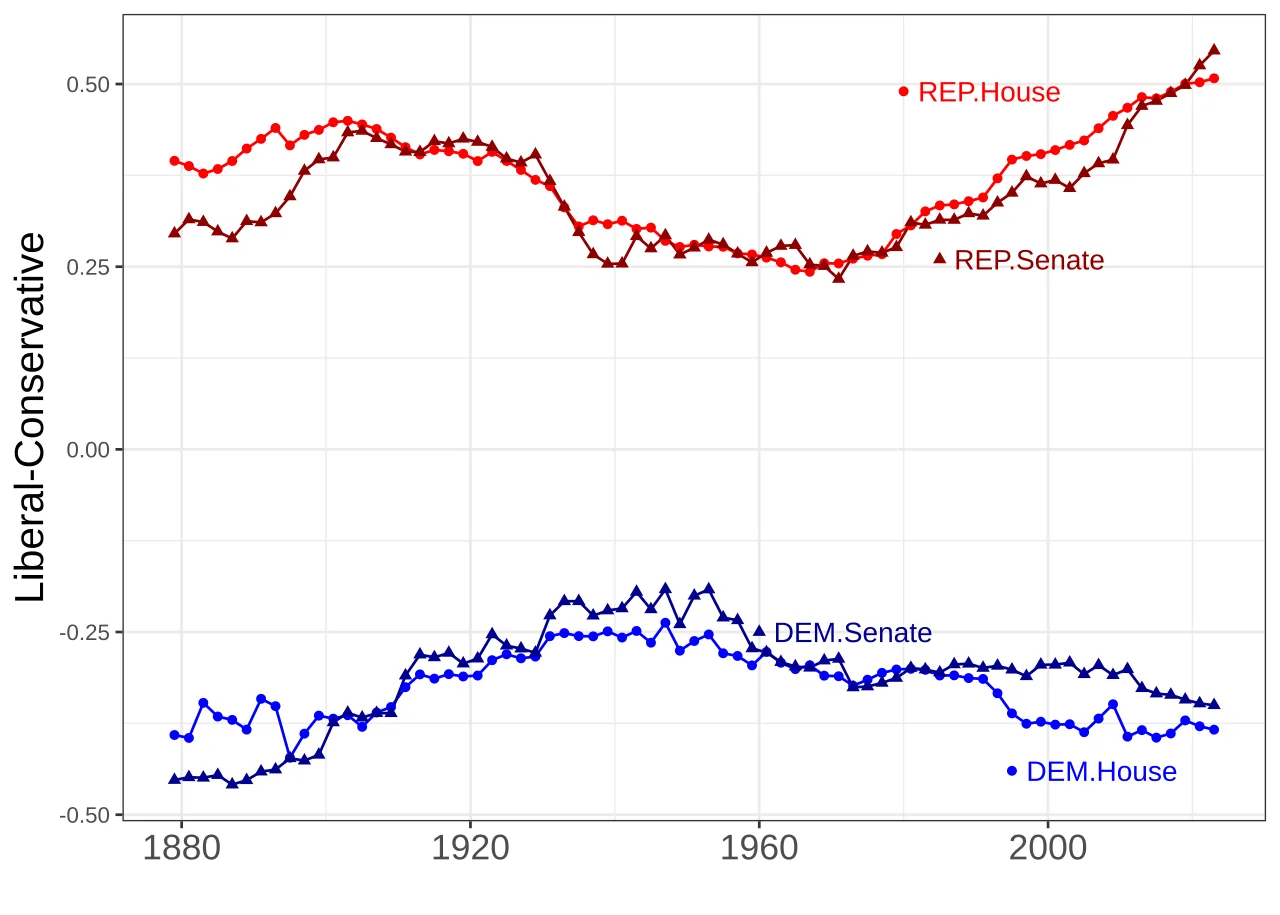
Political polarization increasingly reflects affective polarization, the social distance, distrust, and dislike between partisan groups, more than an equally large gap in ordinary voters' policy views. Partisan sorting aligns party identity with religion, race, education, geography, and culture, turning it into a broader moral identity. This dynamic makes opponents appear threatening and can damage relationships, hiring, neighborhoods, and democratic cooperation.
In 1960, pollster Samuel Lubell traveled the country asking Americans how they felt about their neighbors who voted differently. Most shrugged. The question seemed odd - almost quaint. Of course your neighbor voted for the other party. People did that.
It was a private matter, like church attendance or which baseball team you rooted for. The idea that a neighbor's partisan choice would generate hostility, suspicion, or a desire to put distance between families - this struck most of Lubell's respondents as an extreme reaction to a normal feature of democratic life.
By 2020, the question no longer seemed odd at all. Surveys found that approximately half of both Republicans and Democrats said they would be upset if their child married someone from the other party.
An experiment published in the American Journal of Political Science found that hiring managers discriminated against candidates from the opposing party at rates comparable to racial discrimination.
Neighborhoods sorted along partisan lines. Friendships dissolved. A poll by the American Psychological Association identified political disagreements as a leading source of stress for American adults.
Something had changed, and the change was not primarily about policy. Most Americans still held relatively moderate views on most issues. The distance between an average Republican voter and an average Democratic voter on healthcare, immigration, or fiscal policy was wide but not impassable.
What had widened dramatically was not the policy gap but the emotional and social gap: the degree of mutual dislike, distrust, contempt, and desire for separation between partisan identities.
Political scientists gave this phenomenon a name: affective polarization. Understanding why it increased - and why the standard explanations, including social media filter bubbles, are less adequate than they appear - requires examining the sociology, psychology, and institutional structures that produce it.
"Partisan identity has become a mega-identity with a moral component. People don't just identify with a party; they see the other side as a threat to everything they care about." - Lilliana Mason, Uncivil Agreement (2018)
Key Definitions
Ideological polarization: The distance between the actual policy positions of partisan groups; whether Democrats and Republicans have moved further apart in their preferred policies on substantive issues.
Affective polarization: The degree of mutual dislike, distrust, and social distance between partisan groups, independent of policy disagreement; how much partisans dislike and distrust the other party as a social group.
Partisan sorting: The increasing alignment of partisan identity with other social identities - religion, race, education, geography, cultural taste - such that partisan affiliation becomes a more comprehensive identity package.
Filter bubble: Eli Pariser's 2011 term for the algorithmic curation of personalized information environments that expose people primarily to content confirming their existing beliefs.
Selective exposure: The tendency to seek out and prefer information consistent with pre-existing views; a psychological process independent of algorithmic curation.
Motive attribution asymmetry: The tendency in intergroup conflict to perceive one's own group as motivated by love (for community, country, values) and the opposing group as motivated by hate; studied by Adam Waytz and colleagues.
Contact hypothesis: Gordon Allport's 1954 proposal that prejudice between groups can be reduced by contact under conditions of equal status, common goals, intergroup cooperation, and institutional support.
Deep canvassing: A conversation technique, studied by Broockman and Kalla (2016), involving sustained, empathic dialogue that asks people to reflect on their own experiences of being judged; has produced durable attitude change on contested social issues.
Two Kinds of Polarization
The conceptual distinction between ideological and affective polarization is not merely academic - it changes the diagnosis of what is happening and what might be done about it.
Shanto Iyengar at Stanford has been the most influential researcher on this distinction.[1]
His work with colleagues including Sean Westwood and Yphtach Lelkes, synthesized in a 2019 Annual Review of Political Science paper, documented that affective polarization in the United States has increased substantially since the 1980s, while ideological polarization at the mass (non-elite) level has increased much less and remains modest by historical standards.
Most Americans hold genuinely mixed views: they may prefer stricter border enforcement while supporting universal healthcare, or favor gun rights while supporting action on climate change.
The percentage of Americans who are consistent ideological liberals or conservatives - whose positions line up neatly across all issue domains - has increased but remains a minority.
What has increased dramatically is the degree to which ordinary Americans dislike and distrust the other party as a group, regardless of their actual policy views. This is affective polarization, and it is driven primarily by partisan sorting - the increasing alignment of partisan identity with a package of other social identities.
In the 1970s, the Democratic and Republican parties both contained significant internal diversity. The Democratic party included Southern conservatives and Northern liberals. The Republican party included Northeastern moderates and Southern religious conservatives.
Partisanship was one identity among several, and it did not cleanly sort with race, religion, education, or geography. That world has changed. The parties have become ideologically sorted at the elite level, and their coalitions have become more demographically homogeneous.[7]
Being a Democrat or Republican increasingly correlates with where you live, what religious tradition you belong to (or don't), your educational background, your race, your relationship to urban or rural culture.
Partisan identity has become what Lilliana Mason calls a "mega-identity" - a master social identity that encodes and expresses multiple other identities simultaneously.[6]
When partisan identity encodes this much, losing an election or feeling that the other party is powerful becomes an existential threat. The other party is not simply people with different policy preferences; they are a different kind of person who represents a threat to everything you are.
The Social Identity Architecture
Henri Tajfel and John Turner's social identity theory, developed in the 1970s through a series of elegant minimal group paradigm experiments, established that the mere act of being categorized into a group - even an arbitrary one, like preferring Klee over Kandinsky - produces in-group favoritism and outgroup derogation.
People want their group to do well, evaluate their own group more positively than outgroups, and under conditions of intergroup competition, are willing to harm their own outcomes to reduce the outgroup's relative standing.
Partisan identity activates these processes automatically and with force proportional to how deeply the identity is held.
In their 2015 American Journal of Political Science paper, Iyengar and Westwood found that partisan identity had become a stronger predictor of discriminatory behavior in simulated hiring and scholarship decisions than race.
Democratic and Republican evaluators favored in-party candidates over out-party candidates at rates exceeding racial in-group favoritism.
This was not because people had become more ideological; it was because partisan identity had become more central to self-concept.
Adam Waytz, Liane Young, and Jeremy Ginges' 2013 PNAS paper on motive attribution asymmetry added a crucial layer.[3] In conflicts between groups - Israeli-Palestinian, Republican-Democrat, Sunni-Shia - people consistently perceive their own group as motivated by love and the outgroup as motivated by hate.
This asymmetry is not a factual disagreement about specific actions; it is a systematic bias in how motivations are attributed.
The implication for political compromise is significant: if I see my own party's actions as motivated by love of country and the other party's actions as motivated by hatred of everything decent, then compromise appears to require capitulating to malice.
That is a very high psychological bar.
The Media Fragmentation Story
The narrative that media fragmentation caused polarization has a long pedigree and is not without foundation.
From roughly 1950 to 1980, American television was dominated by three broadcast networks - ABC, CBS, and NBC - that commanded enormous audiences and operated under the Fairness Doctrine requiring balanced presentation of controversial issues.
Political figures on all sides addressed roughly the same national audience. The norms of broadcast journalism, whatever their limitations, discouraged the most blatant partisan cheerleading.
The cable era fragmented this shared media environment. By the 2000s, Fox News and MSNBC had established explicitly ideologically flavored news products attracting partisan audiences. Talk radio had created an entire partisan genre. The internet further multiplied options.
Markus Prior's 2007 book Post-Broadcast Democracy documented the consequences: as the media environment expanded, audiences sorted.[8] People with strong political preferences sought out consonant information.
People who preferred entertainment largely disengaged from political news altogether. The political information environment fragmented along both interest and partisan lines.
But the media fragmentation story has limits that researchers have increasingly emphasized. Polarization trends preceded the internet and accelerated before social media became dominant.
The demographic groups with the lowest social media use - older Americans - show some of the largest increases in affective polarization, which Boxell, Gentzkow, and Shapiro documented in a cross-national analysis. If social media were the primary driver, you would expect the opposite pattern.
The Filter Bubble: More Complicated Than Claimed
Eli Pariser's 2011 book The Filter Bubble introduced a compelling idea: social media algorithms, by optimizing for engagement, would curate personalized feeds that showed each user content confirming their existing views, excluding challenges and contradictions.
Over time, each person would inhabit an increasingly narrow, self-confirming information bubble, never encountering ideas that challenged their partisan priors.
The idea was intuitively plausible and became enormously influential - cited in thousands of op-eds, regulatory discussions, and academic papers. The empirical evidence, however, has been more complicated.
Several large-scale studies have challenged the filter bubble narrative. Eytan Bakshy and colleagues' 2015 Science paper, analyzing Facebook's own news feed data, found that the algorithm did reduce cross-cutting content exposure somewhat, but that individual users' own choices to click on cross-cutting content when it appeared were a larger driver of ideological segregation than algorithmic curation.
A 2023 suite of studies published in Nature in collaboration with Meta, involving experimental manipulation of Facebook and Instagram feeds during the 2020 election, found that reducing algorithmic amplification and resharing did not measurably change political attitudes or affective polarization.
The more disturbing finding came from Chris Bail and colleagues' 2018 PNAS study.[2] In a randomized experiment, Twitter users were offered a financial incentive to follow bots that retweeted content from the opposing party's actual politicians and media figures - genuine cross-cutting exposure, not a filter bubble.
Republicans who received liberal content became significantly more conservative over the following month. Democrats showed a smaller effect in the same direction.
Cross-partisan exposure backfired. The mechanism is not fully understood, but one interpretation is that sustained exposure to the opposing party's actual content - which on partisan social media tends to reflect the most rhetorically aggressive positions - generates defensive identity reinforcement rather than perspective-taking.
Moral Emotion and Viral Outrage
William Brady, Julian Wills, John Jost, and colleagues' 2017 PNAS paper offered a different angle on how social media contributes to polarization without filter bubbles being the primary mechanism.
Analyzing 563,312 tweets about three politically contested topics, Brady found that the presence of moral-emotional language - words combining moral condemnation with emotional charge, such as "evil," "destroy," "corrupt," or "disgusting" - predicted tweet retweet rate within partisan networks.[4]
Each additional moral-emotional word increased the probability of retweet by approximately 20 percent.
Crucially, this effect was specific to partisan networks. Moral-emotional language increased spread within partisan communities but did not increase spread to cross-partisan audiences.
The incentive structure of social media, combined with partisan network structure, creates systematic pressure toward escalation: the content most rewarded with shares and engagement is morally charged, emotionally arousing, and partisan in framing.
This is a pressure applied by the engagement-optimization logic of platforms, but it operates through individual sharing decisions, not algorithmic filtering alone.
The result, aggregated across millions of users and posts, is an information environment in which the most visible political content is disproportionately outraged, morally condemnatory, and framing the opposing group as threatening.
This shapes the perception of what the other side is like - even by people who never deliberately seek out partisan media - and amplifies perceptions of outgroup extremism.
Perceived Extremism and Its Consequences
One of the most robust findings in polarization research is that partisans on both sides substantially overestimate the extremism of the other side.
Studies by Yanna Krupnikov, John Barry Ryan, and other political scientists have found that both Democrats and Republicans believe the other party holds more extreme views than its members actually report holding.
When people are shown accurate information about the distribution of the other side's views, affective polarization tends to decrease somewhat.
But the misperception is not random. It is systematically produced by the visibility and salience of extreme voices.
Social media, cable news, and partisan media all amplify the most rhetorically extreme representatives of each side because extreme voices are more emotionally engaging and more reliably generate the outrage responses that drive engagement.
The average Republican or Democrat sees the opposing party through a lens of its most extreme representatives, concludes that the entire party is like that, and adjusts their affective response accordingly.
This mechanism is sometimes called the "false extremism effect," and its correction offers one of the more tractable short-term interventions in polarization research.
When partisans learn that their perception of outgroup extremism was exaggerated, their hostility toward the outgroup declines. The effects are real but modest and may not persist without ongoing correction.
| Driver | Ideological effect | Affective effect | Evidence strength |
|---|---|---|---|
| Partisan sorting (identity alignment) | Moderate | Strong | Very strong |
| Media fragmentation / selective exposure | Moderate | Moderate | Strong |
| Social media / filter bubbles | Weak-moderate | Weak | Mixed, contested |
| Moral-emotional content virality | Moderate | Moderate | Good |
| Geographic sorting | Weak-moderate | Moderate | Good |
| Elite polarization signaling | Strong | Strong | Strong |
What Reduces Polarization
Gordon Allport's contact hypothesis proposed that prejudice between groups could be reduced by direct contact, provided that the contact occurred under four conditions: equal status between the groups, common goals, intergroup cooperation rather than competition, and support from authorities or institutions.
The subsequent seventy years of research has broadly supported this framework, while identifying important boundary conditions and moderators.
For political polarization, the contact hypothesis faces an obvious scaling problem. It is not feasible to engineer structured equal-status contact between millions of partisan Americans. But the research tradition has produced some promising directions.
James Fishkin's deliberative polling work has repeatedly found that small groups of randomly selected citizens, brought together for structured deliberation on policy questions and provided with balanced briefing materials, emerge more knowledgeable, more moderate, and more positive toward political opponents.
The effects are real and meaningful within the deliberative context. The challenge is that they do not persist well when participants return to their regular information environments, and the format cannot scale to national populations.
The most striking individual-level finding came from David Broockman and Joshua Kalla's 2016 Science paper on door-to-door canvassing about transgender acceptance in Florida.[5]
Trained canvassers had 10-minute conversations with voters using a technique called "deep canvassing," which involved asking people to share their own experiences of being judged or marginalized and then connecting those experiences to the experience of transgender people.
Attitude change produced by these conversations was large by the standards of political persuasion research and persisted through a three-month follow-up period - considerably more durable than typical persuasion effects.
The technique has since been tested in other contexts with generally supportive results, though the mechanisms are not fully understood and generalization beyond face-to-face conversation is unclear.
Institutional reforms are also discussed as structural interventions. Ranked choice voting, which allows voters to express preferences among multiple candidates, may reduce incentives for purely oppositional campaigning.
Nonpartisan primaries, in which all candidates compete in a single initial election regardless of party, reduce the selection pressure toward ideological extremism that partisan primaries with low turnout impose.
Evidence from jurisdictions that have adopted these reforms is promising but not yet sufficiently controlled to support strong causal claims.
The Honest Assessment
Affective polarization in the United States is real, has increased substantially over recent decades, and has consequences for democratic functioning, social cohesion, and individual wellbeing.
Its primary drivers appear to be structural and psychological rather than primarily technological: the increasing alignment of partisan identity with multiple other social identities, elite sorting and signaling, geographic clustering, and the systematic incentives of partisan media environments that reward moral outrage over measured analysis.
Social media contributes to the environment in which polarization operates but is probably not its primary driver, and cross-cutting exposure online may reinforce rather than reduce partisan identity under some conditions.
The interventions with the best empirical support - deep canvassing, deliberative forums, correcting misperceptions of outgroup extremism - are real but modest and face serious scaling challenges.
The analytic error that most distorts public understanding of polarization is conflating affective hostility with ideological divergence. Most Americans are not ideological extremists. Most are capable of cross-partisan friendship, cooperation, and compromise.
What has increased is the social and emotional cost of expressing that capacity - because partisan identity has become so comprehensively loaded with other identities that crossing partisan lines feels like a betrayal of multiple selves simultaneously.
Understanding this does not resolve the problem, but it correctly identifies where the problem actually lies.
Related Articles
Sources & Further Reading
- Iyengar, S., Lelkes, Y., Levendusky, M., Malhotra, N., & Westwood, S. J. (2019). The origins and consequences of affective polarization in the United States. Annual Review of Political Science, 22, 129-146. DOI: 10.1146/annurev-polisci-051117-073034
- Bail, C. A., Argyle, L. P., Brown, T. W., Bumpus, J. P., Chen, H., Hunzaker, M. B. F., ... & Volfovsky, A. (2018). Exposure to opposing views on social media can increase political polarization. PNAS, 115(37), 9216-9221. DOI: 10.1073/pnas.1804840115
- Waytz, A., Young, L. L., & Ginges, J. (2013). Motive attribution asymmetry for love vs. hate drives intractable conflict. PNAS, 110(38), 15687-15692. DOI: 10.1073/pnas.1314268110
- Brady, W. J., Wills, J. A., Jost, J. T., Tucker, J. A., & Van Bavel, J. J. (2017). Emotion shapes the diffusion of moralized content in social networks. PNAS, 114(28), 7313-7318. DOI: 10.1073/pnas.1618923114
- Broockman, D., & Kalla, J. (2016). Durably reducing transphobia: A field experiment on door-to-door canvassing. Science, 352(6282), 220-224. DOI: 10.1126/science.aad9713
- Mason, L. (2018). Uncivil Agreement: How Politics Became Our Identity. University of Chicago Press.
- Bishop, B. (2008). The Big Sort: Why the Clustering of Like-Minded America is Tearing Us Apart. Houghton Mifflin.
- Prior, M. (2007). Post-Broadcast Democracy: How Media Choice Increases Inequality in Political Involvement and Polarizes Elections. Cambridge University Press.