
In October 2004, a journalist named Chris Anderson published an article in Wired magazine with a title that sounds almost quaint now: "The Long Tail: Why the future of business is selling less of more."
The article described something that felt, at the time, like a profound insight into what the internet was actually doing to markets. The thesis was this: for most of commercial history, economics had forced businesses to focus on hits - the products popular enough to justify shelf space, broadcast slots, or retail inventory.
A bookstore could stock 40,000 titles. The average Barnes and Noble carried 100,000. But Amazon could offer millions, and it turned out there was real demand for nearly all of them.
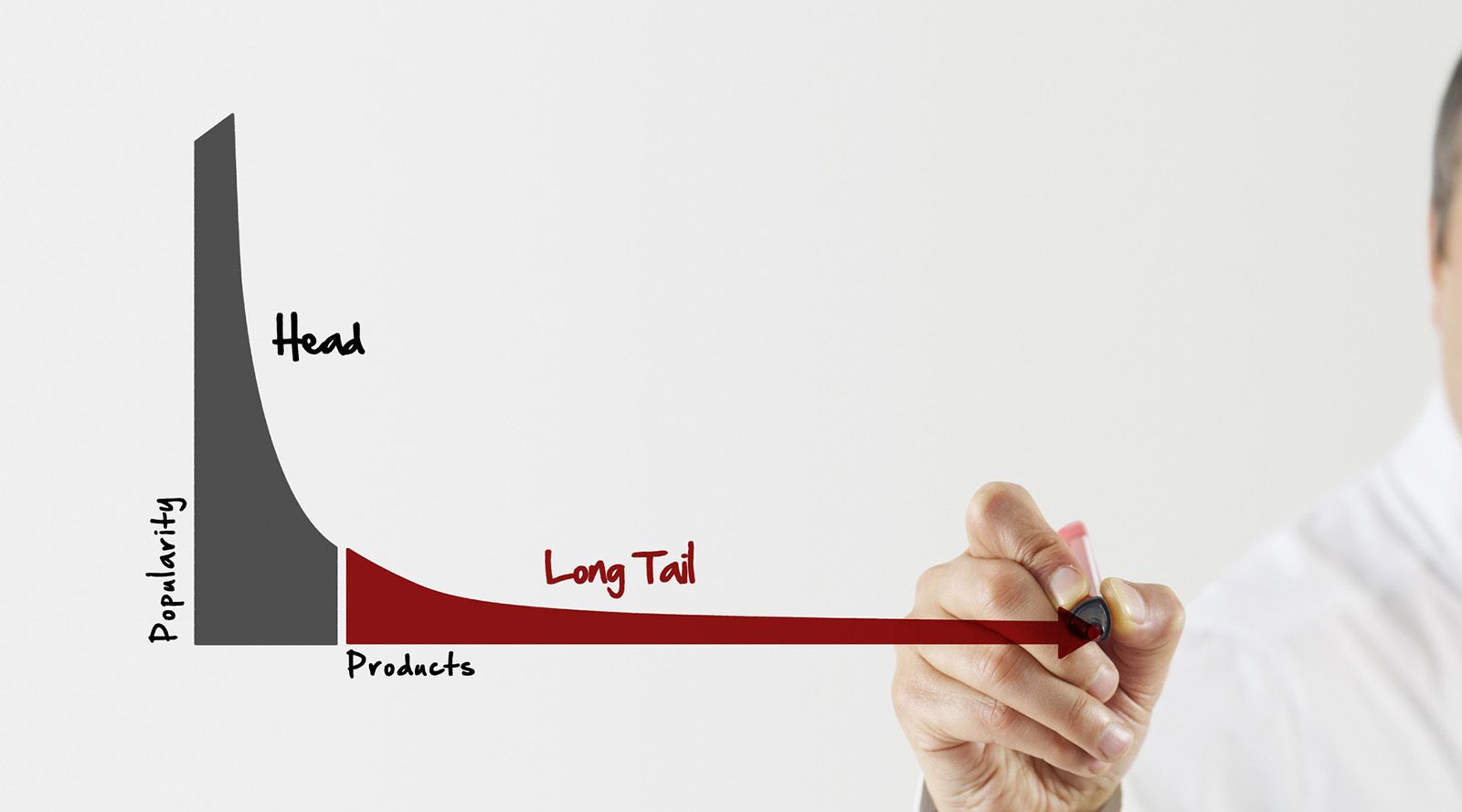
Anderson called the huge number of low-selling items the "long tail" of the demand distribution - a shape that looks like a steep mountain dropping quickly to a low ridge extending indefinitely to the right. The head is hits. The tail is everything else.
His argument was that the internet was making the tail economically viable for the first time, and that its aggregate revenue could rival - or exceed - that of the hits.
It was a theory with immediate intuitive appeal and significant practical implications for anyone who worked in media, retail, or technology. Anderson expanded the article into a book, The Long Tail, in 2006. It sold hundreds of thousands of copies and became one of the defining business texts of the Web 2.0 era.
It also generated one of the most interesting and instructive debates in business economics - because the evidence was not quite as clean as the story.
The Origins: Rhapsody, Amazon, and the Shape of Demand
The Statistical Foundation
The Long Tail theory rests on a well-established statistical pattern called a power law distribution (also called a Pareto distribution or, in some contexts, a Zipf distribution).
In a power law distribution, a small number of items account for a disproportionately large share of total activity, while a vast number of items each account for very little.
Power law distributions appear across an enormous range of natural and social phenomena. City populations follow a power law: a few cities are enormous, many more are mid-sized, and most are small.
Website traffic follows a power law: a handful of sites capture most of the traffic, and the vast majority capture very little. Wealth follows a power law: a small fraction of the population controls most of the assets.
In music, for most of the 20th century, a handful of albums sold millions of copies while most recorded music sold essentially nothing. In books, a small number of bestsellers dominated retail sales while the overwhelming majority of published books were found in very few libraries and sold to very few readers.
The curve, plotted on a chart, looks like this: a tall, steep head on the left (the hits), dropping rapidly to a long, nearly flat tail extending far to the right (the obscure items).
This underlying distribution is the same in the digital era as in the physical one. Anderson's observation was not that this shape exists - that was already well known - but that the internet was dramatically changing the economics of the tail.
In a physical store, only items above a certain sales threshold justified shelf space. The marginal item that sold two copies a year cost as much to stock and manage as one that sold 200. The tail was invisible in retail.
Online, the economics were different. The marginal cost of adding another item to an Amazon catalog or another song to a streaming service was close to zero. And if each of a million niche items sold even a handful of copies a month, the aggregate revenue could be substantial.
Anderson's Key Data Points
In his original 2004 article, Anderson cited data from Rhapsody (an early music streaming service) and Amazon that appeared to support his thesis. He noted that:
- Rhapsody offered more than 1.5 million tracks, and all of them had been requested at least once in the most recent month
- The average brick-and-mortar music retailer stocked around 25,000 titles
- The Rhapsody tracks that fell outside the top 25,000 - the "tail" - collectively accounted for approximately 40 percent of Rhapsody's total listening hours
- Amazon's book sales showed a similar pattern, with a substantial fraction of revenue coming from titles unavailable in a typical physical store
This was the striking finding: the tail was not negligible. Forty percent of consumption was happening in a zone that would have been entirely inaccessible in a physical store. If you added up all those obscure tracks, all those out-of-print books, all those niche products, you got a number that rivaled the contribution of the hits.
The Mechanism: Why the Long Tail Became Visible
The Collapse of Distribution Costs
The fundamental change the internet produced was a near-elimination of the cost of distribution for digital goods. Physical retail had a hard constraint: shelf space was finite, expensive, and geographically bounded.
A music store in Austin, Texas, could only carry songs that enough Austin residents would buy to justify the inventory and storage cost.
Eric Brynjolfsson at MIT's Sloan School of Management studied this cost structure in a 2003 paper with Hu and Smith, quantifying the economic efficiency gains from online retail's expanded catalog.
They found that the expanded product variety available on Amazon created consumer surplus well in excess of the price reductions associated with online retail - meaning that access to the long tail was itself enormously valuable, separate from any price advantage.
A streaming service has no physical shelf. Adding song number 15,000,001 to its catalog costs roughly the same as adding song number 1 - almost nothing. The constraint that forced commercial media to focus on hits was the constraint of physical distribution. Remove that constraint, and the entire demand curve becomes serviceable.
Aggregation and Discovery
The second mechanism was aggregated discovery: the ability of a single platform to serve people with dramatically different tastes. Before streaming, a niche music listener in a small city might have had genuine difficulty finding recordings of their preferred genre at local stores.
Online, that same person could find every recording ever made in that genre.
More importantly, online recommendation systems - Amazon's "customers who bought this also bought" engine, Spotify's algorithmic playlists, YouTube's related videos - could connect people with niche content they did not yet know they wanted.
The discovery infrastructure of the internet made the tail not just available but navigable. Without recommendation systems, a vast catalog is merely overwhelming. With them, it becomes a personalized pathway to the specific obscure items each user would most value.
"The long tail is only valuable if people can find what is in it. Recommendation systems and search are the infrastructure that makes the economics of the tail possible."
Reduced Search Costs
The third mechanism was a dramatic reduction in search costs - the time and effort required to find a specific product. Before search engines, finding a particular out-of-print book required visiting multiple used bookstores or calling specialty dealers.
Before music streaming, finding a particular recording required knowing which label it was on and whether any local store had ordered it.
Erik Brynjolfsson and colleagues estimated in Management Science (2003) that the value of the expanded variety available online to consumers was between $731 million and $1.03 billion per year for books alone - a number derived not from price savings but from the welfare gains of being able to find products consumers specifically wanted but couldn't access in physical retail.
Google, Amazon search, and streaming platform catalogs collapsed these search costs to near zero. This made it rational for consumers to pursue niche preferences they would have abandoned as too much effort to satisfy in the pre-internet era.
Applications of Long Tail Theory
E-Commerce and Retail
Amazon is the most widely cited example. Anderson reported that approximately 57 percent of Amazon's book sales came from titles not available in a typical brick-and-mortar store. These were not obscure books no one wanted - they were books with modest but genuine demand that physical retail economics had made inaccessible.
The pattern has extended to virtually every product category where digital distribution is feasible: software, films, music, podcasts, apps, specialty foods through online specialty retailers, replacement parts for discontinued products.
Etsy is a particularly clear illustration of Long Tail economics in physical goods. Individual artisans producing handmade goods at very small volumes would have had no viable market in pre-internet retail.
The fixed costs of establishing market presence - maintaining a physical retail presence, building wholesale distribution, advertising in a catalog - were prohibitive for low-volume producers.
On Etsy, those fixed costs effectively disappear. The platform provides the distribution infrastructure; the seller only needs to produce.
The result is a marketplace with millions of items, each with very small individual demand but with collective demand that sustained over $13 billion in gross merchandise sales in 2023.
Streaming Media
Netflix's original strategy was explicitly Long Tail: offer a catalog so deep that virtually every viewer could find something they wanted, even as the rental inventory of physical video stores was constrained by the economics of physical media.
The strategy worked in the DVD-by-mail era (where Netflix stocked approximately 100,000 unique titles versus Blockbuster's roughly 3,000 in-store) and then transitioned to streaming.
The irony is that Netflix's subsequent shift toward original content production pushed it back toward the head: producing a smaller number of expensive titles intended for mass audiences.
The pure Long Tail streaming strategy - wide catalog, limited originals - describes their early advantage over Blockbuster better than their current approach.
The pivot toward blockbuster originals reflects an emerging tension between Long Tail theory and the economics of attention - in a world where every streaming service has an enormous catalog, differentiation through hits may matter more than depth of catalog.
Spotify's approach navigates this tension differently. The platform maintains a catalog of over 100 million tracks while using algorithmic playlists like Discover Weekly to route individual listeners toward niche content matched to their specific tastes.
The result is a genuine Long Tail business at scale: the majority of streams go to relatively popular tracks, but the aggregate stream count across hundreds of millions of niche tracks is substantial, and Spotify's competitive advantage over radio (which could only serve a small head of popular tracks) is precisely the tail.
Search and Long Tail Keywords
In SEO (search engine optimization), "long tail keywords" are a direct application of the concept and one of its most practical descendants.
The idea is that the majority of search queries are unique or nearly unique - specific enough that individually they receive very little search volume but collectively they represent the majority of all searches.
Research by Ahrefs (2021) analyzing their keyword database of over 7 billion unique searches found that 94.74% of all keywords receive fewer than 10 searches per month. The vast majority of queries are what SEO practitioners call long tail. Collectively, however, these low-volume queries add up to the majority of total search volume.
A term like "running shoes" (a "head" or "short tail" keyword) might receive millions of searches per month, with enormous competition from major retailers and brands.
A term like "best stability running shoes for wide feet with plantar fasciitis" might receive a few hundred searches per month, with minimal competition, and convert at higher rates because the searcher has a very specific, well-defined need.
Long tail content strategy targets these specific queries: producing content that is precisely relevant to specific, lower-competition searches, with the understanding that aggregate traffic across many such pieces can exceed what a single high-competition article generates.
This strategy is explicitly Long Tail economics applied to organic search: the head keywords are dominated by major players, but the tail is an open market.
| Keyword Type | Example | Monthly Volume | Competition | Conversion Rate |
|---|---|---|---|---|
| Head / Short Tail | "running shoes" | 1,000,000+ | Very High | Low |
| Middle | "best running shoes for women" | 100,000+ | High | Medium |
| Long Tail | "best running shoes for flat feet over 50" | 500-2,000 | Low | High |
| Ultra-Long Tail | "best running shoes for nurses with bunions size 9 wide" | Under 100 | Very Low | Very High |
The Critique: Anita Elberse's Counterevidence
The Blockbuster Hypothesis
Anderson's thesis was not accepted without challenge. The most rigorous and methodologically serious critique came from Anita Elberse, Harvard Business School professor, published in the Harvard Business Review in 2008 and expanded in her 2013 book Blockbusters: Hit-making, Risk-taking, and the Big Business of Entertainment.
Elberse analyzed detailed sales data from Rhapsody and a video rental service, and her findings contradicted Anderson's on a key point: the tail was indeed longer in digital markets than in physical ones - more obscure items were available and purchased - but the hits were proportionally even more dominant, not less dominant, in digital markets.
Specifically, she found that in digital music:
- The number of tracks with zero plays was increasing faster than the overall catalog
- The share of total listening going to the top tracks was higher in streaming than in CD sales
- The "hits" were becoming more concentrated, not less
Her conclusion: digital distribution had extended the tail, but it had simultaneously made the head larger relative to the tail, not smaller. The superstar phenomenon - where top performers capture a wildly disproportionate share of attention and revenue - was intensifying, not diminishing.
Elberse's analysis drew on earlier economic theory by Sherwin Rosen, whose 1981 paper "The Economics of Superstars" in American Economic Review argued that technological improvements in distribution would naturally concentrate rewards among top performers, because they allow the best in a field to serve an unlimited market.
Before recorded music, a talented musician could only perform for as many people as could physically attend a concert.
Recordings allowed the best performers to reach everyone, making it rational for consumers to prefer the best over merely good local alternatives. Digital distribution extends this logic to its limit.
The Data Dispute
Anderson's response acknowledged some of Elberse's methodological points but disputed others. The debate turned partly on how to define and measure the "size" of the tail relative to the head - whether you measure by number of titles, by share of revenue, or by share of total consumption.
The practical resolution that most analysts have settled on: both things are true simultaneously. Digital distribution has made the tail economically viable in ways it never was before - there are genuine businesses built on niche audiences that could not have existed in physical retail.
And the hits in digital markets have become more powerful, more globally dominant, and more economically concentrated than their physical-market predecessors. The internet extended the tail while also making the winners take more.
This is not a contradiction but a consequence of scale: the same forces that make the tail accessible - global reach, zero marginal distribution cost, algorithmic recommendation - also make it possible for a hit to reach literally everyone on the planet simultaneously.
Taylor Swift's streaming numbers would have been impossible in a world of physical CDs and regional radio. The tail is longer and the head is taller - both at the same time.
The Long Tail and the Creator Economy
For individual content creators, the Long Tail has both an empowering and a cautionary lesson.
The Empowering Version
The Long Tail theory supports the possibility of sustainable niche media: a podcast with 10,000 dedicated listeners, a newsletter with 5,000 paying subscribers, a YouTube channel covering a specialty that would have been too small for broadcast television.
These are real and growing businesses. The infrastructure for finding and monetizing niche audiences - Substack, Patreon, Spotify, YouTube - represents the Long Tail distribution infrastructure that Anderson identified.
Kevin Kelly's concept of "1,000 True Fans", published in 2008, operationalized the Long Tail insight for individual creators.
Kelly argued that a creator who cultivated 1,000 genuinely dedicated fans - people who would buy everything the creator produced - could earn a sustainable living regardless of whether they ever achieved mass popularity.
The economics: if 1,000 fans each pay $100 per year for a creator's output (books, music, live events, merchandise), that generates $100,000 annually - a living wage in most markets.
Digital distribution platforms make it practical to find, reach, and monetize 1,000 dispersed fans globally rather than needing them concentrated in a geographic market.
The key insight for creators is that you do not need to compete for mass attention to build a viable audience. A deeply specific focus can generate more engaged, more loyal, and more monetizable attention than moderate success in a broad category.
The niche focus is not a consolation prize - it is a deliberate competitive strategy that avoids the head of the market where large-scale players have overwhelming advantages.
The Cautionary Version
Elberse's research and subsequent data from the streaming era suggests that attention in digital markets is not distributed democratically. The attention economy amplifies winners through algorithms, social sharing, and network effects in ways that can make obscurity even more difficult to escape than in the pre-internet era.
The discovery problem is the central challenge for Long Tail producers. In Anderson's original framing, recommendation systems and search would ensure that niche products found their audiences.
In practice, recommendation systems are designed to maximize engagement, which means recommending popular content to most users most of the time.
The algorithm that surfaces obscure tracks to users who would love them is, in practice, serving fewer such connections than the theory implies.
A YouTube algorithm that recommends the most-watched video in a category to every user in that category concentrates traffic at the head, not the tail.
The middle tier may be the most precarious position. Modest success in the head (not famous enough to dominate) combined with too broad a focus to build a loyal niche is a difficult business position.
The Long Tail economics favor clear positioning: either aim for scale at the head or go deep into a specific niche. The middle - where many creators naturally land - gets algorithmically squeezed from both sides.
A 2019 analysis by Spotify of their own royalty data found that the top 1.4% of artists earned 90% of all streaming royalties, with the bottom 90% earning very little.
This distribution is consistent with Elberse's findings: the tail exists and is longer than in physical distribution, but the economic rewards are radically concentrated at the head. The Long Tail is a real market structure but not an economic democracy.
Long Tail Theory Today
Twenty years after Anderson's original article, the Long Tail has proven to be a genuinely important observation - a real and permanent change in market structure - but not quite the complete story it initially seemed.
What has proven durable:
- Niche products and content can be commercially viable at a scale that was impossible before internet distribution
- Long tail SEO and content strategy work as described - low-volume, high-specificity keywords aggregate to meaningful traffic
- Niche communities around specific topics, hobbies, and interests exist and sustain media businesses that would not have survived in pre-internet distribution
- The aggregate value of the tail is economically real and the 1,000 True Fans model has been validated by thousands of creators on Patreon, Substack, and similar platforms
- Consumers benefit significantly from access to niche products and content - the welfare gains are real even when the producer economics are modest
What turned out to be more complicated:
- The head did not shrink in importance as Anderson suggested it might - in most digital markets, hits are more dominant than ever
- Superstar economics intensified rather than diminished, precisely because digital distribution allows top performers to serve global rather than local markets
- Algorithmic recommendation systems that power discovery also create feedback loops that concentrate attention on already-popular content
- Many creators and sellers in the tail earn very little; the economics are viable for platforms more than for individual producers
- The discovery infrastructure that was supposed to route consumers to niche content is itself governed by engagement optimization, which points toward popular content
The Long Tail remains an essential framework for understanding digital markets, but it is best understood not as a prediction that niche products will overtake hits but as an explanation of how the available space for niche products expanded dramatically - creating opportunities that still exist but require deliberate strategy to capture.
The practical lesson is a nuanced one: the Long Tail is real enough to build a business in, but you cannot assume that being in the tail means customers will find you.
The collapse of distribution costs made niche products findable in principle; capturing attention in practice still requires investment in content quality, community building, and search visibility. The tail is a market, not a guarantee.
Key Takeaways
- The Long Tail, introduced by Chris Anderson in Wired (2004) and developed in his 2006 book, describes how internet distribution makes niche products economically viable by eliminating physical shelf space constraints
- The theory rests on power law distributions: a small number of items dominate sales, but the aggregate of low-volume items can be economically significant
- Key mechanisms are near-zero marginal distribution costs (Brynjolfsson et al., 2003), reduced search costs, and algorithmic recommendation systems
- Anita Elberse's rigorous analysis (Harvard Business Review, 2008) found that hits became more dominant in digital markets, not less - the tail lengthened but the head grew proportionally larger, consistent with Rosen's (1981) superstar economics theory
- The honest synthesis: digital distribution expanded the viable space for niche products while simultaneously intensifying superstar concentration
- In content strategy, long tail keywords represent the practical application: Ahrefs data shows 94.74% of keywords get fewer than 10 monthly searches, but they collectively represent most search volume
- Kevin Kelly's "1,000 True Fans" (2008) operationalizes the Long Tail for creators: sustainable niche businesses are achievable without mass popularity
- For creators, the Long Tail supports niche business models but does not guarantee them; deliberate positioning, specific audience focus, and investment in discoverability matter more than simply being available