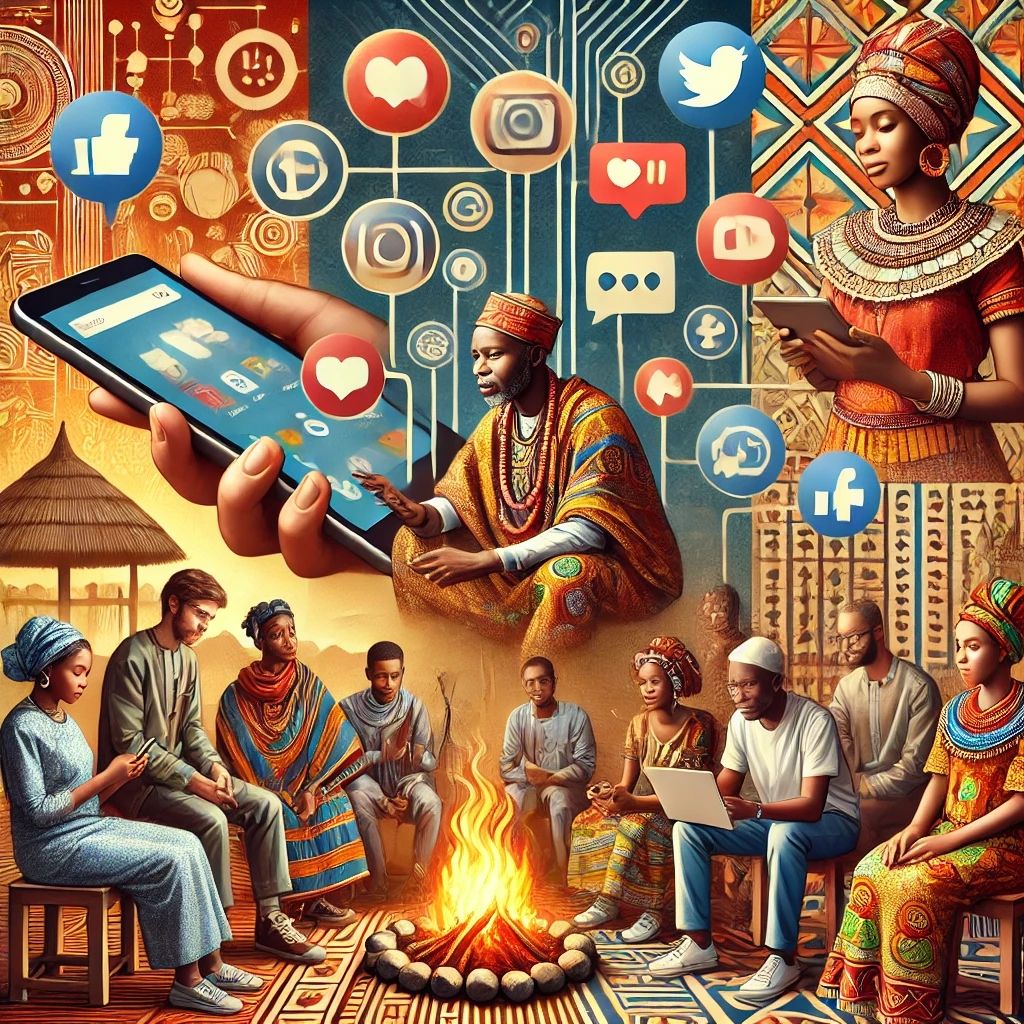
Digital: On any given day, a stranger's tweet about a minor topic whether pineapple belongs on pizza, whether a particular dress is blue or gold, whether a movie is brilliant or terrible-can split the internet into opposing camps of startling emotional intensity.
People who have never met and never will meet spend hours arguing, mocking, and attacking each other over questions that have no material consequence for any of them. The arguments escalate. Insults fly. Block lists grow. Each side becomes more convinced of its own righteousness and the other side's stupidity or bad faith.
This phenomenon looks trivial in its pizza-topping form. But the same dynamics-intensified by orders of magnitude-drive the fracturing of political discourse, the radicalization of extremist movements, the erosion of shared factual ground, and the growing sense that people on "the other side" of any issue are not merely mistaken but morally defective.
Digital tribalism-the tendency for online interactions to sort people into tightly bonded in-groups defined largely by their opposition to out-groups-is one of the most consequential social dynamics of the internet age.
Digital tribalism is not a bug in human psychology accidentally amplified by technology. It is the predictable result of applying ancient social instincts-evolved for small-group survival in environments of real physical danger-to a technological environment that operates at unprecedented scale, speed, and abstraction.
Understanding how digital tribalism works, why it is so powerful, and what (if anything) can be done about it requires examining both the evolutionary psychology that makes humans tribal and the platform dynamics that supercharge tribal behavior online.
The Evolutionary Roots: Why Humans Are Tribal by Default
Tribalism is not a character flaw or a failure of education. It is a deep feature of human social cognition shaped by hundreds of thousands of years of evolution in environments where group membership was literally a matter of life and death.
"The human mind is a story processor, not a logic processor."
Jonathan Haidt
The Ancestral Environment
For most of human evolutionary history, survival depended on belonging to a cooperative group. Isolated individuals could not hunt large game, defend against predators, care for infants, or share knowledge effectively. Being expelled from the group was effectively a death sentence.
This created enormous evolutionary pressure to develop psychological mechanisms for:
- In-group identification: Rapidly determining who is "us" and feeling loyalty, trust, and empathy toward them
- Out-group detection: Rapidly identifying who is "them" and feeling wariness, suspicion, or hostility toward them
- Norm enforcement: Monitoring group members' behavior and punishing deviations that threaten group cohesion
- Status signaling: Demonstrating loyalty and commitment to the group to maintain standing and avoid expulsion
- Coalition building: Forming alliances within the group and defending them against internal and external threats
These mechanisms are not optional cognitive modules that people can switch off through education or willpower. They are foundational features of human social cognition that activate automatically in response to social cues about group membership.
Research in social psychology has demonstrated that tribal psychology activates with astonishing ease-even arbitrary group assignments (the "minimal group paradigm," where people are sorted into groups based on coin flips) produce measurable in-group favoritism and out-group derogation within minutes.
From Physical Tribes to Digital Ones
In ancestral environments, tribal boundaries were physically enforced by geography, kinship, and daily face-to-face interaction. Your tribe was the people you saw every day, shared food with, and depended on for survival.
The number of people in your tribe was limited by physical proximity-typically 50 to 150 individuals (Dunbar's number).
The internet removes every one of these physical constraints:
- Geography is irrelevant: Your digital tribe can include people on every continent
- Group size is unlimited: Digital tribes can number in the millions
- Interaction is constant: Tribal boundary maintenance happens 24/7 through feeds and notifications
- Identity is chosen: You select which tribes to join rather than being born into them
- Exit costs are low: Leaving one tribe and joining another requires only a few clicks
These changes do not eliminate tribal psychology-they redirect it. The same instincts that once bound people to kin groups now bind them to Twitter factions, subreddit communities, fandom identities, political movements, and ideology-based online collectives. The instincts are identical; the scale and dynamics are radically different.
"We are living through a great rewiring of humanity."
Jonathan Haidt
How Digital Tribes Form and Solidify
Digital tribes do not emerge randomly. They form through specific mechanisms that platforms facilitate and often actively encourage.
Stage 1: Aggregation Around Shared Interest or Identity
Digital tribes typically begin as communities of shared interest-people drawn together by a common enthusiasm, belief, identity, or grievance. Gaming communities, political forums, fandoms, professional networks, and hobby groups all start as loose aggregations of people with something in common.
At this stage, the community is relatively open, diverse in its internal views, and focused on the shared interest rather than on group identity. A gaming community discusses games. A political forum discusses policy. A fandom discusses the source material.
Stage 2: Development of Shared Language and Norms
As the community stabilizes, it develops the cultural markers that transform a loose aggregation into a recognizable group:
- Specialized vocabulary: Terms, acronyms, and jargon that insiders understand and outsiders do not (e.g., "based," "ratio'd," "touch grass," "copium"), forming the basis of internet culture
- Inside jokes and memes: Humor that references shared experiences and signals membership
- Behavioral norms: Expectations about how members should interact, what views are acceptable, and what topics are off-limits, effectively creating platform-specific social norms
- Status hierarchies: Recognition systems (karma, follower counts, moderator roles) that create internal stratification
- Shared narratives: Origin stories, key events, and collective memories that bind the group
These cultural elements serve a dual function: they create belonging for insiders and exclude outsiders.
A newcomer who does not understand the vocabulary, references, and norms is immediately identifiable as an outsider, and their participation is either guided (socialization) or resisted (gatekeeping), depending on the community's openness.
Stage 3: Boundary Hardening Through Opposition
The critical transition from community to tribe occurs when group identity becomes defined primarily through opposition to out-groups. This shift is not inevitable, but it is extremely common in online environments for several reasons:
- Conflict generates engagement, which algorithms reward with greater visibility
- External threats (real or perceived) accelerate in-group bonding
- Moral outrage at out-group behavior provides an emotionally satisfying form of group participation
- "Us vs. them" framing simplifies complex issues into easily processed narratives
"People don't adopt ideologies because they are persuaded by arguments. They adopt ideologies that express their social identity."
Lilliana Mason
Once a community's identity is substantially defined by what it opposes, tribal dynamics take hold:
- Criticism of the in-group becomes indistinguishable from attacks on it
- Nuanced positions that acknowledge valid points on "both sides" are treated as disloyalty
- Members who express sympathy for the out-group are pressured to conform or expelled
- The out-group is increasingly dehumanized, caricatured, and attributed malicious intent
Stage 4: Echo Chamber Consolidation
As tribal boundaries harden, echo chambers form-information environments where members are primarily exposed to views that confirm the group's beliefs and rarely encounter substantive challenges:
- Members curate their feeds to follow in-group voices and mute or block out-group voices
- Algorithms detect engagement patterns and serve more content from similar sources, creating self-reinforcing feedback loops
- Moderators enforce community norms by removing dissenting perspectives
- Social rewards (likes, shares, supportive comments) flow to content that reinforces group orthodoxy
- Social punishments (criticism, ostracism, banning) fall on content that challenges it
The echo chamber is not merely a filter bubble (an algorithmic phenomenon). It is a socially enforced information environment where the community actively maintains ideological coherence by controlling what information is admitted and how it is interpreted.
The Mechanics of Online Tribal Conflict
When digital tribes with opposing identities encounter each other, conflict follows a predictable escalatory pattern.
The Outrage Cycle
- Trigger event: Something happens that activates tribal identity (a public statement, a news event, a viral post)
- Framing competition: Each tribe frames the event in terms that confirm its worldview and cast the other tribe in the worst possible light
- Mobilization: Members share, comment, and engage with their tribe's framing, generating visibility
- Escalation: Engagement algorithms amplify the most intense, emotional, and combative content from both sides
- Dehumanization: The other tribe is characterized in increasingly extreme terms ("they're fascists," "they're destroying society," "they hate freedom")
- Exhaustion or displacement: Attention eventually moves to the next trigger event, but residual hostility accumulates
Why Online Tribal Conflict Is More Intense Than Offline
Several features of online environments make tribal conflict more intense than equivalent offline dynamics:
| Feature | Offline | Online |
|---|---|---|
| Anonymity | You are accountable to people who know you | You can be hostile without personal consequences |
| Audience | Conflict occurs in small groups | Conflict plays out before potential audiences of millions |
| Speed | Conflicts develop over days or weeks | Conflicts escalate in hours |
| Permanence | Comments are forgotten | Screenshots and archives preserve everything |
| Decontextualization | You know the person's full context | You know only the statement that triggered the conflict |
| Feedback loops | Natural social friction limits escalation | Algorithms reward and amplify escalation |
| Embodiment | Physical presence creates empathy and risk | Digital abstraction removes empathy and risk |
| Nuance | Face-to-face communication conveys tone and intent | Text-based communication strips nuance |
The combination of these features creates an environment where tribal conflict is cheaper to initiate, harder to de-escalate, and more likely to cause lasting damage than equivalent offline conflicts.
The Platforms' Role: How Design Choices Fuel Tribalism
Digital tribalism is not solely a product of human psychology. It is significantly amplified by platform design choices made for commercial reasons.
Engagement Optimization
Social media platforms generate revenue by selling advertising against user attention. More engagement means more advertising inventory means more revenue. Tribal conflict is extraordinarily engaging-people who feel their group identity is under attack will spend far more time on a platform than people casually browsing.
This creates a structural incentive for platforms to facilitate tribal dynamics, even if no individual at the company consciously intends this.
The Recommendation Engine
Recommendation algorithms learn that users who engage with content from one political or cultural tribe will engage even more with content that is more extreme, more combative, and more explicitly tribal. This is a powerful form of social influence mediated by technology rather than direct human interaction.
The algorithm follows the engagement signal, progressively serving content that reinforces tribal identity and opposition to out-groups. Users experience this as the algorithm "understanding them"-showing them content they find compelling and important.
The algorithm is not understanding them; it is optimizing them for engagement.
Metrics as Tribal Scoreboards
Platform metrics-likes, shares, retweets, follower counts-function as tribal scoreboards that quantify group strength:
- A tweet from your tribe going viral = the tribe is winning
- An out-group figure losing followers = the tribe is winning
- A ratio (more negative replies than positive engagement) = the tribe is winning
- A hashtag trending = the tribe is winning
These metrics transform abstract ideological conflicts into gamified competitions with visible scores, increasing investment and emotional intensity.
Friction Reduction
Platforms are designed to minimize friction-to make it as easy as possible to post, share, and respond. This design principle, intended to increase engagement, also reduces the natural cooling-off periods that limit conflict escalation offline.
In a face-to-face argument, you have to look at the other person, read their emotional state, and feel the social tension of conflict. Online, you type a hostile reply in seconds and move on without absorbing any social cost.
The Consequences: What Digital Tribalism Does to Society
Political Polarization
The most widely discussed consequence of digital tribalism is political polarization-the increasing tendency for people to view political opponents not as fellow citizens with different views but as enemies with evil intentions.
Research by the political scientists Shanto Iyengar and Sean Westwood found that affective polarization (how much members of one party dislike members of the other party) has increased dramatically in the United States since the mid-2000s, roughly tracking the rise of social media.
Notably, this increase in emotional polarization has occurred even without a comparable increase in ideological polarization on most policy issues-Americans' actual policy positions have not diverged as dramatically as their feelings about each other have.
This pattern-intensifying hostility without proportional ideological divergence-is exactly what tribal dynamics predict. Tribalism is not primarily about beliefs; it is about group identity and loyalty. You can hate the out-group intensely without knowing or caring what their actual policy positions are.
What matters is that they are them and you are us. The phenomenon is closely related to a range of cognitive biases that distort how people process information about in-groups and out-groups.
Epistemic Fragmentation
Digital tribalism erodes shared epistemic ground-the common factual basis that productive disagreement requires.
Developing media literacy - the ability to evaluate sources, detect bias, and distinguish information from manipulation - is one of the most effective individual defenses against this dynamic. When information is filtered through tribal identity, facts become weapons:
"A society in which people cannot agree on basic facts cannot sustain democratic self-governance."
Cass Sunstein
- Facts that support the in-group narrative are amplified and celebrated
- Facts that challenge the in-group narrative are dismissed, reframed, or attributed to out-group manipulation
- The credibility of information sources is determined by tribal affiliation rather than journalistic or scientific standards
- "Doing your own research" means finding sources that confirm what your tribe already believes
The result is not just disagreement about interpretation (which is normal and healthy) but disagreement about basic facts (which makes productive discourse impossible).
Radicalization
Digital tribalism creates radicalization pathways by normalizing increasingly extreme positions within echo chambers. The mechanism:
- Moderate members who express discomfort with extreme positions face social pressure or leave-a dynamic also visible in cancel culture
- The remaining community's center of gravity shifts toward the extreme
- New members are socialized into the shifted norm
- What was extreme becomes mainstream within the community
- New, more extreme positions emerge at the boundary
- The cycle repeats
This ratchet effect means that digital tribes tend to become more extreme over time, not less. The process is gradual-no single step feels radical to participants-but the cumulative effect can transform a mainstream political community into an extremist one over months or years.
Is Digital Tribalism Always Bad?
It would be misleading to characterize digital tribalism as purely destructive. The same tribal instincts that drive polarization and conflict also produce genuine benefits:
Positive Functions of Digital Tribes
- Belonging and identity: For people who are isolated, marginalized, or geographically dispersed, online tribes provide genuine community, support, and sense of belonging. The construction of online identity is often inseparable from tribal affiliation
- Collective action: Tribal mobilization enables social movements, mutual aid, and political organizing that could not occur without group cohesion
- Support networks: Communities organized around shared challenges (chronic illness, addiction recovery, discrimination, grief) provide material and emotional support
- Cultural creation: Tribes produce creative output-memes, art, music, writing, humor-that enriches online culture
- Knowledge sharing: Specialized communities develop and share expertise that benefits members and sometimes the broader public
The challenge is that the same dynamics that produce belonging also produce exclusion, that collective action can be directed toward destructive as well as constructive goals, and that the line between healthy community and toxic echo chamber is often crossed gradually and without recognition.
Reducing Digital Tribalism: What Actually Helps
Individual Strategies
- Diversify your information diet. Deliberately follow people and sources from outside your tribe, including those you disagree with. The goal is not to agree with them but to understand how they think.
- Notice tribal activation. When you feel a surge of righteous anger at an out-group, pause and ask: "Am I responding to the actual content, or am I responding to tribal cues?"
- Resist dehumanization. When you catch yourself characterizing an entire group in monolithic terms ("they all think X," "they're all Y"), recognize this as a tribal distortion.
- Engage with the strongest version of opposing arguments. The internet makes it easy to find and mock the weakest, most extreme, most ridiculous version of the other tribe's views. This is satisfying but intellectually dishonest. Practice engaging with the most thoughtful, reasonable version instead.
- Maintain cross-tribal relationships. The single most effective counter to tribal dehumanization is knowing actual human beings on "the other side." Personal relationships introduce nuance that tribal narratives suppress.
Platform-Level Changes
- Reduce engagement optimization or supplement it with diversity and quality metrics
- Introduce friction before sharing inflammatory content (e.g., reading prompts, cooling-off periods)
- Reduce the visibility of tribal metrics (hide like counts, reduce follower count prominence)
- Improve content moderation to limit coordinated harassment and targeted pile-ons
- Design for bridging rather than bonding-algorithms that expose people to cross-cutting perspectives rather than reinforcing existing tribal affiliations
Societal Approaches
- Media literacy education that teaches people to recognize tribal dynamics, engagement manipulation, and echo chamber formation
- Support for cross-cutting institutions (civic organizations, community groups, interfaith initiatives) that bring people together across tribal lines
- Regulation of platform design to require transparency about algorithmic amplification and to limit the most manipulative engagement tactics
"The internet does not simply reflect human nature; it amplifies particular aspects of it while suppressing others."
Zeynep Tufekci
Digital tribalism will not disappear. The psychological foundations are too deep and the platform incentives too strong for any intervention to eliminate it. But understanding how it works-recognizing the evolutionary triggers, the platform amplifiers, and the escalatory dynamics-provides a foundation for managing it more wisely.
The goal is not a post-tribal internet (which is neither possible nor entirely desirable) but an internet where tribal dynamics are understood, moderated, and balanced by countervailing forces that maintain the shared ground on which productive social life depends.
What Empirical Research Actually Shows: Separating Myth from Evidence
The narrative that social media directly causes political polarization through filter bubbles and echo chambers has become conventional wisdom, but the empirical evidence is considerably more complicated.
A landmark 2019 study by political scientists Christopher Bail and colleagues at Duke University produced a striking counterintuitive finding: when they paid Twitter users to follow a bot that retweeted messages from politicians and opinion leaders of the opposite party for one month, Republican participants became more conservative rather than more moderate.
Exposure to out-group views, without the relational context that makes such views credible, appears to intensify tribal reactions rather than reduce them.
Bail's research suggests that the problem is not simply information segregation but identity threat. When people encounter out-group views as a mass of alien opinion rather than through trusted personal relationships, the tribal defensive response is activated rather than the reflective reasoning that might update beliefs.
This finding has significant implications for platform interventions that assume feeding people diverse content will reduce polarization.
A separate strand of research by sociologist Brooke Foucault Welles and colleagues found that the most extreme political content on Facebook was shared primarily by a very small subset of users-approximately 5% of users produced the majority of extreme content.
This challenges the framing of digital tribalism as a mass phenomenon driven equally by all users and points instead toward a more concentrated dynamic where a small group of high-intensity tribal participants shapes the information environment for much larger, more passive audiences.
The most comprehensive empirical intervention to date was Meta's 2023 experiment, conducted in collaboration with academic researchers including Hunt Allcott and Levi Boxell, which temporarily reduced algorithmic content amplification for 4 billion posts in the lead-up to the 2020 U.S. election. The findings were sobering: reducing algorithmically amplified content had measurable effects on time spent and engagement, but produced no detectable changes in political attitudes, polarization measures, or vote choice.
The implication is that tribal political behavior is more deeply rooted than platform mechanics, and that changing feed algorithms is a less powerful intervention than intuition suggests.
Case Studies in Tribal Dynamics: How It Actually Unfolds
The Gamergate controversy of 2014 provides one of the most extensively documented case studies of digital tribal mobilization.
What began as targeted harassment of a small number of women in game development escalated into a months-long coordinated campaign that involved thousands of participants across 4chan, Reddit, Twitter, and YouTube.
Researchers Whitney Phillips and Ryan Milner, studying the event in their work on media manipulation, identified several features that distinguish it from ordinary tribal conflict: the use of decentralized coordination through anonymous platforms, the adoption of a pseudo-journalistic frame ("ethics in games journalism") that gave tribal attacks a legitimizing narrative, and the rapid exploitation of platform affordances to evade moderation while sustaining coordinated action.
Gamergate demonstrated that digital tribal conflict has qualitatively different properties from offline group conflict: it is persistent (attacks continue around the clock without the natural pauses that face-to-face interaction requires), scalable (a single target can face thousands of simultaneous hostile actors), and archival (past statements are researched and weaponized).
The event led directly to the development of academic fields studying online harassment and to platform policy changes at Twitter and Reddit, both of which had been used as coordination hubs.
The dynamics of fan communities during what is sometimes called "shipping wars" (disputes over romantic pairings in fiction) offer a lower-stakes but analytically clear case study because they involve tribes forming and escalating around stakes that have no external consequence.
Researcher Kristina Busse at the University of South Alabama has documented how fan communities that begin as collaborative creative spaces can develop rigid tribal orthodoxies, expel members for ideological deviation, and escalate into harassment campaigns against both other fans and the content creators themselves.
The absence of real-world stakes makes the psychological mechanism unusually visible: people are defending purely symbolic territory with the same intensity that evolution designed for protecting physical survival, illustrating how completely decoupled modern tribal behavior is from the evolutionary context that produced it.
Neuroscience and Evolutionary Psychology: The Biological Substrate of Digital Tribalism
The intensity of tribal behavior online is not simply a product of poor reasoning or weak character. It reflects deep neurobiological systems that evolved for small-group survival and are now operating in environments radically different from those that shaped them.
Psychologist Jay Van Bavel at New York University's Social Identity and Morality Lab has conducted extensive research on the neuroscience of in-group identification.
In a landmark 2012 fMRI study published in Psychological Science, Van Bavel and colleagues found that even when people were assigned to arbitrary groups (told only that they were either "Tigers" or "Lions"), medial prefrontal cortex activation - a region associated with self-referential processing and social identity - showed stronger responses to in-group faces than out-group faces within 20 minutes of group assignment.
The study demonstrated that the brain begins encoding tribal identity at the neural level almost instantaneously, far faster than conscious reasoning can intervene.
Van Bavel's subsequent work has focused specifically on how social media amplifies this dynamic by exposing people to thousands of tribal signals per day, effectively running the neural in-group/out-group calculation at unprecedented frequency.
Henri Tajfel and John Turner's Social Identity Theory, first published in 1979 and subsequently the most-cited framework in social psychology, established through dozens of experiments that people derive significant self-esteem from the status of their group relative to comparison groups.
A crucial finding for understanding digital tribalism is that this status-seeking is competitive: people seek positive distinctiveness for their group, not merely positive self-evaluation in absolute terms.
This competitive dimension explains why digital tribal conflict is so persistent - even when in-group members "win" a confrontation, the relative nature of social identity means the next challenge to group status generates renewed motivation for conflict.
In a digital environment that constantly surfaces out-group challenges through algorithmic feeds, the status threat that drives tribal defensiveness never fully resolves.
Evolutionary psychologist Robert Sapolsky at Stanford, in his 2017 book Behave: The Biology of Humans at Our Best and Worst, synthesized evidence from neuroscience, primatology, and behavioral economics showing that the us/them distinction activates the amygdala (the brain's threat-detection system) faster than conscious categorization occurs.
Sapolsky documented that exposure to out-group faces activates amygdala responses in as little as 30 milliseconds - well before any conscious evaluation of the individual.
In digital environments, where profile pictures and usernames serve as rapid tribal markers, this pre-conscious categorization means that much online discourse begins from a neurological posture of threat response rather than neutral evaluation.
Sapolsky notes, however, that the same research shows the us/them boundary is "psychologically real but malleable" - with the right contextual cues, the brain can reclassify previous out-group members as in-group with dramatic effects on subsequent behavior.
Measured Interventions and What Actually Reduces Digital Tribalism
The research base on effective interventions for digital tribalism has grown substantially since 2018, producing findings that challenge both optimistic technological solutionism and fatalistic accounts of irreversible polarization.
The Bridging Systems Group at MIT Media Lab, led by researchers including Deb Roy, has developed and tested what they call "bridging algorithms" - recommendation systems designed to maximize exposure to content that achieves engagement across different ideological communities rather than maximizing within-community engagement.
In a 2023 pilot study conducted with Twitter (prior to its acquisition by Elon Musk), the bridging algorithm approach was applied to content shown to 200,000 users in the United States.
Preliminary findings, presented at the ACM Web Science Conference, showed that bridging-optimized content recommendations reduced the rate at which users unfollowed accounts with opposing political views by approximately 20%, and increased cross-partisan engagement (replies to people with different apparent political alignment) by 15%.
The effect sizes were modest but consistent, and the researchers argued they demonstrated proof of concept that algorithmic design choices can meaningfully influence tribal dynamics at scale.
More Than Mean, a nonprofit organization that trains people to intervene in online harassment, conducted a randomized controlled study in 2019 testing whether "bystander intervention" - brief, non-confrontational responses from observers expressing disagreement with harassment - reduced the duration and intensity of dogpile events.
Analyzing 3,400 Twitter pile-on events with and without bystander intervention, the study found that a single bystander comment expressing calm disagreement reduced subsequent pile-on intensity by an average of 23%, and that multiple bystander comments had compounding effects.
The finding has significant implications for individuals: even one person articulating a different view visibly can measurably change the social dynamic, because subsequent participants encounter social proof that not everyone in the thread shares the pile-on's framing.
Researchers Juliana Schroeder at Berkeley's Haas School of Business and Nick Epley at the University of Chicago have studied what they call the "mere listener effect" in the context of online conflict.
Their 2021 work found that people who listen to (rather than read) statements from political opponents update their views on the speaker's humanity significantly more than people who read identical content as text.
The difference was large enough that they proposed voice-based communication features as a structural design change that could reduce dehumanization in online debate.
The finding points to a fundamental limitation of text-based social platforms: the reduction of communication to text strips the prosodic and emotional cues that signal common humanity, making tribal dehumanization substantially easier.
Platforms that have introduced voice features (Twitter Spaces, Reddit Talk) represent natural experiments in this hypothesis, though rigorous outcome studies on their effects on tribal dynamics remain limited as of 2025.
Sources & Further Reading
Greene, J. (2013). Moral Tribes: Emotion, Reason, and the Gap Between Us and Them. Penguin Press.
Iyengar, S. & Westwood, S.J. (2015). "Fear and Loathing Across Party Lines: New Evidence on Group Polarization." American Journal of Political Science, 59(3), 690-707. DOI: 10.1111/ajps.12152
Sunstein, C. (2017). #Republic: Divided Democracy in the Age of Social Media. Princeton University Press. View source
Tajfel, H. & Turner, J.C. (1979). "An Integrative Theory of Intergroup Conflict." In The Social Psychology of Intergroup Relations. View source
Bail, C.A. (2021). Breaking the Social Media Prism: How to Make Our Platforms Less Polarizing. Princeton University Press. View source
Haidt, J. (2012). The Righteous Mind: Why Good People Are Divided by Politics and Religion. Vintage Books. View source
Dunbar, R. (2010). How Many Friends Does One Person Need? Dunbar's Number and Other Evolutionary Quirks. Harvard University Press. View source
Pariser, E. (2011). The Filter Bubble: How the New Personalized Web Is Changing What We Read and How We Think. Penguin Press. View source
Tufekci, Z. (2017). Twitter and Tear Gas: The Power and Fragility of Networked Protest. Yale University Press. View source
Mason, L. (2018). Uncivil Agreement: How Politics Became Our Identity. University of Chicago Press. View source