
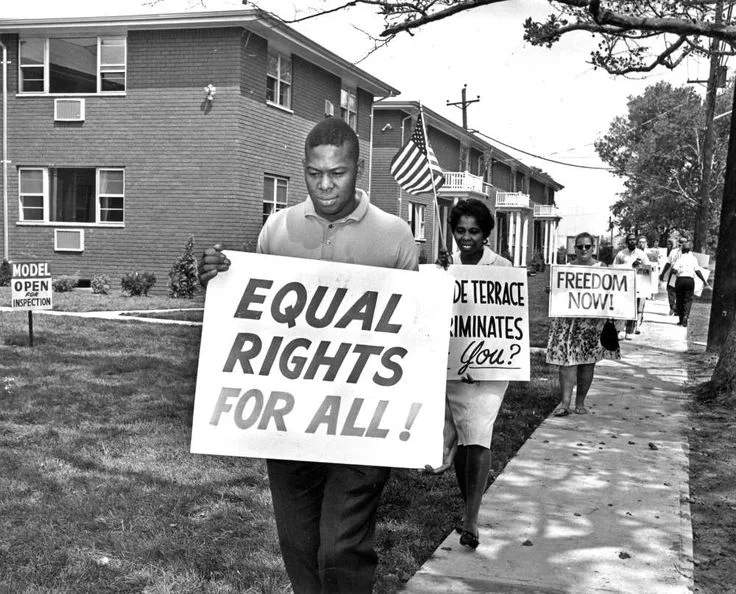
History: On a December evening in 1955, a seamstress and NAACP secretary named Rosa Parks boarded a city bus in Montgomery, Alabama, sat in the section designated for Black passengers, and, when ordered to give up her seat to a white passenger, declined.[8]
She was arrested for violating the city's segregation ordinance. Within days, the Black community of Montgomery, organized by a network of churches and civic associations and led by a 26-year-old Baptist minister new to the city, launched a boycott of the bus system that would last 381 days, end in a Supreme Court victory, and inaugurate the most transformative domestic political movement in 20th-century American history.
The civil rights movement was a sustained, organized campaign to dismantle the legal and social system of racial apartheid that governed American life, particularly in the South, from the end of Reconstruction in the 1870s through the 1960s.
It drew on the resources of the Black church, the legal strategy of the NAACP, the tactical innovation of nonviolent direct action, and the courage of tens of thousands of ordinary people willing to face violence, imprisonment, and economic ruin for the principle that equal citizenship was their right.
Between 1954 and 1968, it produced the most significant rewriting of American law since Reconstruction, including the Civil Rights Act of 1964, the Voting Rights Act of 1965, and the Fair Housing Act of 1968.
To tell the story of the civil rights movement is also to confront the gap between its legal achievements and the persistence of racial inequality in American life half a century later: a gap that makes the movement's history not a closed chapter but an ongoing argument.
"Injustice anywhere is a threat to justice everywhere. We are caught in an inescapable network of mutuality, tied in a single garment of destiny. Whatever affects one directly, affects all indirectly."
- Martin Luther King Jr., Letter from Birmingham Jail, April 16, 1963
| Tactic | Description | Key Example |
|---|---|---|
| Nonviolent direct action | Deliberate law-breaking to expose injustice | Sit-ins, Freedom Rides |
| Legal litigation | Challenging segregation in courts | NAACP Legal Defense Fund, Brown v. Board |
| Economic pressure | Boycotts to impose financial costs | Montgomery Bus Boycott |
| Mass demonstration | Public gatherings to show support and apply pressure | March on Washington (1963) |
| Voter registration | Expanding Black political participation | Freedom Summer (1964) |
| Coalition building | Alliances with labor, religious, and white liberal groups | Leadership Conference on Civil Rights |
Key Definitions
Jim Crow: The system of laws, customs, and violence that enforced racial segregation and Black disenfranchisement in the American South from the 1870s through the 1960s.
Separate but equal: The constitutional doctrine established by Plessy v. Ferguson (1896) holding that racially segregated facilities were constitutional if theoretically equal, a doctrine overturned by Brown v. Board of Education (1954).
Nonviolent direct action: The tactic, drawing on Gandhian civil disobedience and developed in the civil rights context by King and others, of deliberately violating unjust laws while accepting the legal consequences, in order to expose the violence of the system and build moral pressure for change.
NAACP: The National Association for the Advancement of Colored People, founded in 1909, which pursued a legal strategy challenging segregation through the courts.
SNCC: The Student Nonviolent Coordinating Committee, founded by student activists in 1960 at the initiative of Ella Baker, which organized the sit-ins and Freedom Rides and later developed a more radical political orientation.
SCLC: The Southern Christian Leadership Conference, founded in 1957 under King's leadership, which organized major campaigns including Montgomery, Birmingham, and Selma.
Preclearance: A requirement in the Voting Rights Act of 1965 that jurisdictions with histories of voting discrimination obtain federal approval before changing their voting laws.
The World the Civil Rights Movement Confronted
Jim Crow's Legal Architecture
The Reconstruction amendments to the Constitution, ratified between 1865 and 1870, had seemed to settle the question. The Thirteenth Amendment abolished slavery. The Fourteenth Amendment guaranteed equal protection and due process and made all persons born in the United States citizens.
The Fifteenth Amendment prohibited denying the right to vote on account of race. For a decade during Reconstruction, African Americans voted in large numbers, held political office, and participated in public life across the South.
Reconstruction ended in 1877 through a political bargain that withdrew federal troops from the South and left formerly enslaved people to the mercy of the state governments and private violence that had been temporarily restrained. The subsequent decades saw the systematic construction of a racial caste system enforced by law and terror.
The Jim Crow system, fully consolidated by the early 20th century, required racial segregation in schools, public transportation, restaurants, theaters, waiting rooms, hospitals, parks, swimming pools, and cemeteries.
Marriage between races was criminalized. Black voters were systematically excluded through literacy tests administered selectively, poll taxes, grandfather clauses, and the white primary, which declared party primaries (the only competitive elections in the one-party South) private organizations not subject to the Fifteenth Amendment.
Plessy's Shadow
The Supreme Court provided Jim Crow's constitutional foundation in the 1896 case Plessy v. Ferguson.
Homer Plessy, who was seven-eighths white by ancestry but legally classified as Black under Louisiana's racial classification laws, had deliberately violated the state's Separate Car Act by sitting in a whites-only railroad car in order to create a test case.
The Court upheld the law in a seven-to-one decision written by Justice Henry Billings Brown, holding that the Fourteenth Amendment was not intended to enforce social equality of the races and that separate but equal accommodations were constitutional.
Justice John Marshall Harlan, the lone dissenter, wrote that the Constitution is color-blind and neither knows nor tolerates classes among citizens. Harlan's dissent would be vindicated 58 years later.
The violence beneath Jim Crow was not incidental but systematic. Lynching, the extrajudicial killing of Black Americans primarily for alleged transgressions of racial hierarchy, was a mechanism of social control. The Tuskegee Institute documented 3,446 lynchings of Black people between 1882 and 1968.
The perpetrators were rarely prosecuted. Congress repeatedly failed to pass federal anti-lynching legislation, most recently in 1938, when Southern Democratic senators successfully filibustered a bill for the third time. The message was clear and intentional: Black Americans could not look to law for protection from racial violence.
The NAACP Legal Strategy
Chipping Away at Separate but Equal
The NAACP's legal strategy, developed over three decades under the leadership of Charles Hamilton Houston and then Thurgood Marshall, was patient, methodical, and ultimately revolutionary.
Houston, dean of Howard University Law School and the architect of the strategy, understood that a direct assault on Plessy would fail in the courts of the 1930s.
Instead, the NAACP would hold the South to its own standard, demanding the equality half of the separate but equal doctrine and demonstrating through case after case that genuinely equal separate facilities did not exist and could not exist.
In graduate and professional education, the strategy found its most promising ground. States that spent millions on their white universities typically offered nothing at all to Black graduate students, sometimes offering to pay tuition at out-of-state institutions.
In Missouri ex rel. Gaines v. Canada (1938), the Supreme Court ruled that Missouri could not satisfy equal protection by offering to pay Lloyd Gaines's tuition at an out-of-state law school; it must either admit him to the University of Missouri Law School or create an equal in-state facility.
In Sweatt v. Painter (1950), the Court ordered the University of Texas Law School to admit Heman Sweatt, finding that a hastily created Black law school was palpably not equal to the established institution in its facilities, faculty, or the intangible qualities that make a law school great.
Brown v. Board of Education
By the early 1950s, Marshall was ready to challenge separate but equal directly in public elementary and secondary education. The litigation consolidated cases from five states: Kansas, South Carolina, Virginia, Delaware, and the District of Columbia. The Kansas case, Linda Brown et al. v.
Board of Education of Topeka, gave the consolidated litigation its name.
Chief Justice Earl Warren, appointed by Eisenhower in 1953 and confirmed after the oral arguments in Brown, worked to achieve the unanimous opinion that he believed essential for the decision's legitimacy.
The opinion, handed down on May 17, 1954, held simply and directly that in the field of public education the doctrine of separate but equal has no place.
Separate educational facilities are inherently unequal. Warren cited psychological evidence, including Kenneth and Mamie Clark's doll experiments demonstrating that Black children in segregated environments internalized racial inferiority, alongside the straightforward judgment that segregation generated a sense of inferiority with consequences for children's motivation and sense of themselves.
The Southern reaction was fierce. In March 1956, 101 Southern members of Congress signed the Southern Manifesto, declaring Brown an abuse of judicial power and pledging resistance to its implementation. State governments passed interposition resolutions.
The implementation decision issued in 1955, Brown II, directed desegregation to proceed with all deliberate speed, a phrase that invited delay and was exploited for it.
Mass Action: Montgomery to Birmingham
The Boycott and King's Emergence
The Montgomery Bus Boycott worked because of community organizing that had been building for years before Parks's arrest. The Women's Political Council, led by Jo Ann Robinson, had already prepared leaflets calling for a boycott in anticipation of an eventual test case.
The Black community's economic dependence on the bus system was real but so was the bus system's economic dependence on Black riders, who constituted the majority of its passengers.
The boycott's success required 381 days of logistical improvisation: a carpool system organized through churches and community networks, economic sacrifice by workers who walked miles to work or paid more for taxis, and sustained discipline against provocations including bombings of King's home.[1]
King's emergence as the movement's national voice owed much to his personal gifts, including a capacity to translate the movement's moral claims into language that could speak across racial and regional lines, drawing simultaneously on the prophetic tradition of the Black Baptist church and on the constitutional and democratic vocabulary of American civic life.
It owed also to timing: he was new to Montgomery, without the local entanglements that made other prominent ministers cautious, and young enough to take risks that more established figures declined.
Sit-Ins and the Birth of SNCC
The Greensboro sit-ins of February 1960 spread across the South within weeks in a demonstration of the latent readiness for confrontation that existed among young Black Southerners who had grown up with Brown but seen no change in their daily lives.
The student movement organized itself as the Student Nonviolent Coordinating Committee in April 1960, at a conference at Shaw University in Raleigh organized by Ella Baker, the SCLC's executive director, who was already skeptical of the movement's dependence on charismatic male leadership and who actively encouraged the students to develop their own independent organization.[9]
SNCC would become the most consistently radical of the major civil rights organizations and the one most willing to challenge not only legal segregation but the economic and political structures underlying racial inequality.
It also attracted some of the movement's most courageous organizers, including Fannie Lou Hamer, John Lewis, Diane Nash, and Bob Moses, who went into the most dangerous rural counties of Mississippi and Alabama to register voters at risk of their lives.[7]
Birmingham and the Letter from Jail
Project C
The Birmingham Campaign of 1963 was a deliberate strategic choice. Fred Shuttlesworth, who had led a civil rights organization in Birmingham for years despite bombings of his home and church, invited King and the SCLC to launch a campaign in the city.[5]
King and his advisers chose Birmingham partly because Bull Connor was predictably likely to respond with the kind of violence that would generate the dramatic confrontation that could force the federal government's hand.
The campaign began in April 1963 with lunch counter sit-ins and marches into downtown Birmingham.[2] Early enthusiasm was tempered by relatively small turnout and the constraint that many adult participants feared losing their jobs.
The organizers' decision to recruit high school students, and then even younger children, from Birmingham's Black schools produced the Children's Crusade of May 2 and subsequent days.
Over a thousand young people marched from Sixteenth Street Baptist Church, were arrested, and filled the jails.
Connor ordered fire hoses turned on demonstrators. The footage of young people knocked down by the force of fire hoses and police dogs went around the world within hours.
The Letter
King was arrested on Good Friday, April 12, and held in Birmingham city jail, where he was initially kept in solitary confinement.
On April 16, he read a newspaper statement signed by eight white Alabama clergymen who described the demonstrations as untimely and provocative and called on local Black leaders to use the courts rather than the streets.
King's response, written in the margins of the newspaper and on scraps of paper smuggled out by his lawyers, became one of the foundational documents of American political thought.
King addressed the charge of poor timing directly. One has not only a legal but a moral responsibility to obey just laws, he wrote, but conversely one has a moral responsibility to disobey unjust laws.[4] A just law is a man-made code that squares with the moral law or the law of God.
An unjust law is a code that is out of harmony with the moral law. He turned specifically to the critique from white moderates: I have almost reached the regrettable conclusion that the Negro's great stumbling block in his stride toward freedom is not the White Citizen's Councilor or the Ku Klux Klanner, but the white moderate, who is more devoted to order than to justice, who prefers a negative peace which is the absence of tension to a positive peace which is the presence of justice.
Legislation and Its Limits
The Civil Rights Act of 1964
The March on Washington on August 28, 1963 was the culmination of the movement's moral offensive. Organized by Bayard Rustin and A. Philip Randolph, the march drew between 200,000 and 250,000 people to the National Mall. King's prepared speech was powerful but conventional.
When gospel singer Mahalia Jackson called from nearby, tell them about the dream, Martin, King set aside his text and delivered the improvised peroration that has since defined his public legacy, drawing on imagery and rhetoric he had used before in smaller settings and that expressed the movement's most fundamental aspiration: that the nation would live up to the promise of its founding documents.
Kennedy's civil rights bill was moving slowly through Congress when he was assassinated in November 1963.
Lyndon Johnson, who as Senate Majority Leader had blocked civil rights legislation repeatedly during the 1950s, transformed himself into the bill's most powerful champion, motivated by a complex mixture of political calculation, genuine conviction about justice, and the imperative of honoring Kennedy's memory.
The Civil Rights Act of 1964, signed on July 2, prohibited discrimination in public accommodations, outlawed employment discrimination on the basis of race, color, religion, sex, or national origin, and created the Equal Employment Opportunity Commission to enforce the employment provisions.
The Voting Rights Act of 1965, signed on August 6 following the Selma confrontations, was the movement's other great legislative achievement.
The act prohibited discriminatory voting practices, provided for federal examiners to register voters directly in recalcitrant counties, and crucially established the preclearance requirement of Section 5, which required jurisdictions with histories of voting discrimination to obtain federal approval before changing any voting law or procedure.
The Shelby County Decision
The Voting Rights Act's preclearance requirement transformed Black political participation across the South within years of its passage. By 1970, Black voter registration in Mississippi had risen from under seven percent to over sixty percent.[6]
Black elected officials multiplied across the region. The structural change to Southern politics was real and durable.
But in Shelby County v. Holder (2013), the Supreme Court struck down the formula used to determine which jurisdictions were subject to preclearance, effectively gutting the requirement.
Chief Justice Roberts's majority opinion held that the coverage formula was based on forty-year-old data and no longer reflected current conditions, ignoring the abundant evidence that the preclearance requirement was actively preventing discriminatory voting changes that jurisdictions continued to attempt.
Within hours of the decision, states and counties began implementing voting restrictions that had previously been blocked under preclearance. The decision illustrated that the movement's legal achievements, however real, remained contingent on political and judicial conditions that could change.
Black Power and the Movement's Transformation
The civil rights movement of the early 1960s had operated within a framework of nonviolence, integration, and appeal to American democratic ideals. By the mid-1960s, this framework was under internal pressure from multiple directions.
SNCC workers who had faced brutal violence in rural Mississippi and Alabama, who had watched murders of civil rights workers go unprosecuted, and who had been betrayed by the Democratic Party at the 1964 Atlantic City convention were moving toward a more confrontational politics.
Stokely Carmichael's call for Black Power in June 1966 crystallized this shift.[10]
The slogan meant different things to different people, but it implied a rejection of the integrationist goal in favor of Black economic and political self-determination, a more skeptical view of white allies, and an insistence on Black cultural pride and identity rather than assimilation to white standards.
The Black Panther Party, founded in Oakland in 1966 by Huey Newton and Bobby Seale, went further, advocating armed self-defense and a ten-point program that included demands for full employment, decent housing, education, and an end to police brutality.
King himself was deeply ambivalent about the direction the movement was taking, understanding the emotional appeal of Black Power while criticizing the slogan as counterproductive.
In the last years of his life he was broadening his focus beyond formal civil rights to address poverty, economic inequality, and the Vietnam War, which he publicly opposed beginning in 1967 despite enormous pressure from the Johnson administration and moderate civil rights leaders.[3]
His assassination on April 4, 1968, in Memphis, where he was supporting a sanitation workers' strike, cut short this phase of his work and with it the movement's most coherent national voice.
Legacy and Unfinished Business
The civil rights movement's achievements were real, substantial, and hard-won. The legal structure of Jim Crow was dismantled. Black voter registration and political representation increased dramatically. Formal discrimination in public accommodations, employment, and housing was prohibited by law.
The integration of public institutions, while incomplete and contested, proceeded significantly. The country's political culture was changed in ways that made openly expressed white supremacist ideology less socially acceptable in mainstream discourse.
What the movement did not achieve was racial economic equality. The median Black family wealth remains a fraction of median white family wealth, a gap rooted in decades of exclusion from wealth-building through homeownership that the Fair Housing Act did not undo.
Residential segregation persists in most American cities, maintained by economic mechanisms rather than legal ones. Mass incarceration, which grew dramatically from the 1970s onward, has fallen disproportionately on Black Americans in ways that have undermined the political gains of the voting rights legislation.[11]
Educational segregation has resegregated in many metropolitan areas through the interaction of residential patterns and school district boundaries.
The civil rights movement also connected to the global wave of decolonization that reshaped the world in the same decades.
King and other movement leaders drew explicit connections between the struggle against Jim Crow and the liberation movements in Africa and Asia, and the Cold War context made American racial apartheid an international embarrassment that amplified the movement's leverage on the federal government.
What happened in Birmingham in 1963 was photographed and broadcast around the world within hours.
The American government's concern for its international image, during a competition with the Soviet Union for the allegiance of newly decolonizing nations, was a factor, one among many, that made legislative action possible.
See Also
- What Was Reconstruction?
- What Is Racial Justice?
- What Was the Harlem Renaissance?
- What Was the March on Washington?
- What Is Nonviolent Resistance?
Sources & Further Reading
- Branch, Taylor. Parting the Waters: America in the King Years, 1954-63. Simon and Schuster, 1988.
- Branch, Taylor. Pillar of Fire: America in the King Years, 1963-65. Simon and Schuster, 1998.
- Branch, Taylor. At Canaan's Edge: America in the King Years, 1965-68. Simon and Schuster, 2006.
- King, Martin Luther Jr. Letter from Birmingham Jail. 1963.
- Garrow, David J. Bearing the Cross: Martin Luther King, Jr., and the Southern Christian Leadership Conference. William Morrow, 1986.
- Payne, Charles M. I've Got the Light of Freedom: The Organizing Tradition and the Mississippi Freedom Struggle. University of California Press, 1995.
- Lewis, John, with Michael D'Orso. Walking with the Wind: A Memoir of the Movement. Simon and Schuster, 1998.
- Theoharis, Jeanne. The Rebellious Life of Mrs. Rosa Parks. Beacon Press, 2013.
- Halberstam, David. The Children. Random House, 1998.
- Carmichael, Stokely, and Charles V. Hamilton. Black Power: The Politics of Liberation in America. Vintage Books, 1967.
- Alexander, Michelle. The New Jim Crow: Mass Incarceration in the Age of Colorblindness. The New Press, 2010.