
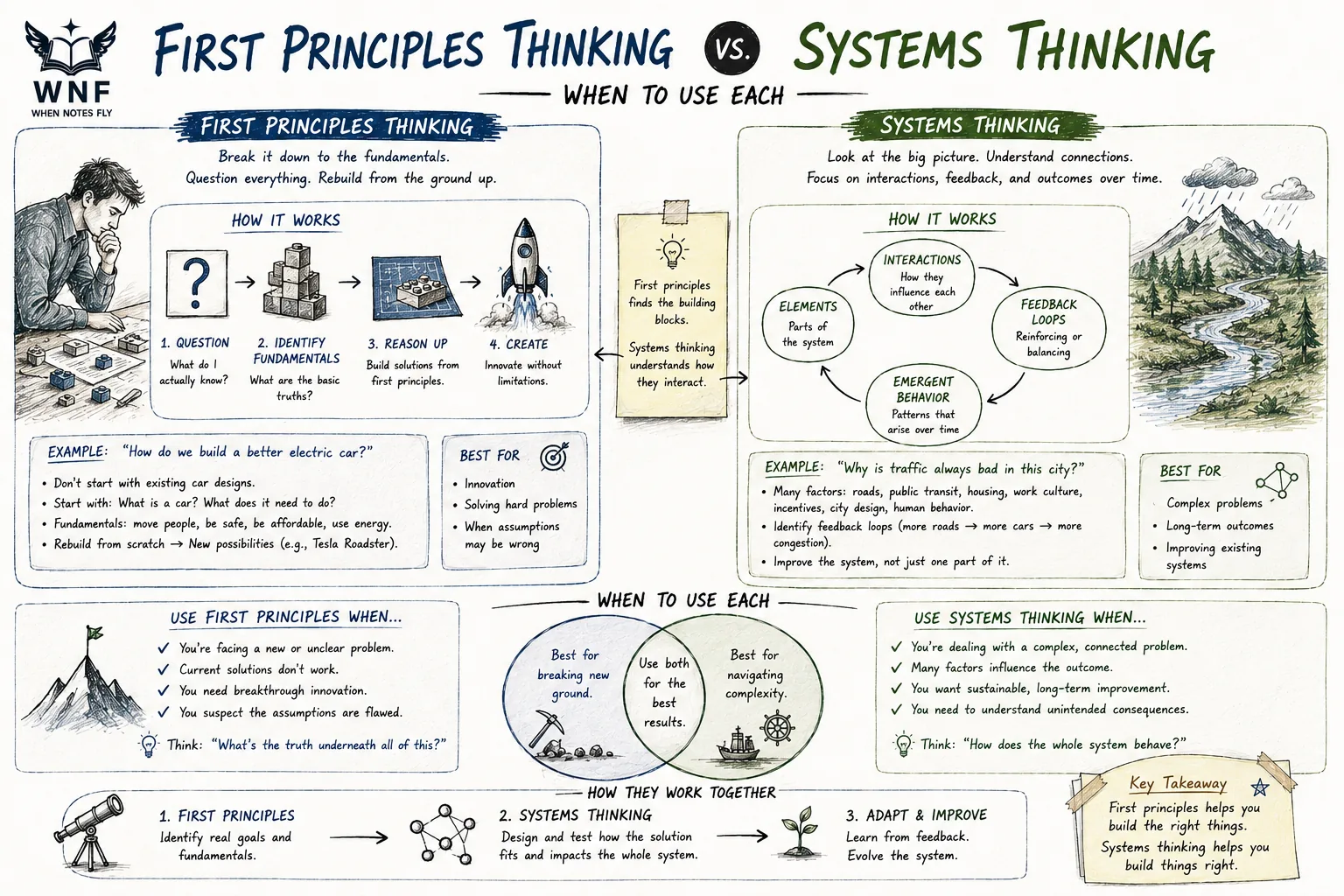
Two Lenses for Different Problems
First principles thinking and systems thinking are two of the most widely cited mental models in decision-making literature. They are frequently presented as competitors. They are not. They are complementary tools for different classes of problem.
First principles thinking strips a problem down to its most fundamental, verifiable assumptions and rebuilds from there. It asks: what do we actually know, and what have we been assuming?
Systems thinking maps the interactions among parts of a system, revealing feedback loops, delays, and emergent behaviors. It asks: how do the parts influence each other, and what patterns arise over time?
The first is reductive. The second is relational. The distinction determines when each is the right tool.
"Boil things down to their fundamental truths and reason up from there."
- Elon Musk, on first principles reasoning, multiple interviews
"You cannot understand the behavior of a complex system by understanding its parts. You must understand the relationships."
- Donella Meadows, Thinking in Systems, 2008
What First Principles Thinking Actually Is
The phrase traces back to Aristotle, who used it to describe the foundational propositions or assumptions from which other knowledge could be derived. In modern usage, the phrase was popularized in the last decade by Elon Musk, Naval Ravikant, and business strategy writers who contrasted it with reasoning by analogy.
Reasoning by analogy: we do it this way because that is how it is usually done, or because a similar company did it this way.
Reasoning from first principles: what are the actual physical, economic, or logical constraints, and what do they allow?
Musk's famous example is battery costs. The conventional wisdom in the early 2010s was that battery packs cost around $600 per kilowatt-hour and would come down slowly. Musk's first principles question was: what are batteries made of?
Cobalt, nickel, aluminum, carbon, some polymers, a steel can. What do those raw materials cost on the London Metal Exchange? Around $80 per kilowatt-hour. The question became: why is there a 7.5x markup between materials and finished pack? The answer drove Tesla's vertical integration strategy.
The process in structured form:
- Identify the conclusion or assumption under examination.
- List every premise the conclusion rests on.
- For each premise, ask: do I know this is true independently, or am I accepting it because others accept it?
- For assumptions that are not verified, trace them to their source.
- Rebuild the conclusion from only the premises that survive.
The process is cognitively expensive. Most decisions do not warrant it. It pays when the conventional answer feels wrong, when the stakes are high, or when you suspect a bottleneck is actually an artifact rather than a constraint.
What Systems Thinking Actually Is
Systems thinking emerged from the work of Jay Forrester at MIT in the 1950s, Peter Senge in The Fifth Discipline (1990), and Donella Meadows, whose Thinking in Systems (2008) remains the most accessible primer.
The core insight: many problems are not caused by any single part of a system but by the interactions among parts. Individual parts may be functioning correctly and the system may still produce unwanted outcomes. Conversely, fixing a single part may not improve the system if the interactions are the real driver.
Key concepts:
- Stocks and flows. A stock is an accumulated quantity (water in a bathtub, customers in a subscription base, CO2 in the atmosphere). A flow is the rate of change (faucet adding water, customers subscribing or canceling, emissions adding carbon). Most systems mistakes come from confusing flow changes with stock changes.
- Feedback loops. Reinforcing loops amplify change (compound interest, viral growth). Balancing loops resist change (thermostats, market equilibrium). Most systems behavior is driven by feedback structure.
- Delays. The time between a change and its effect often causes overshoot, oscillation, and misdiagnosis.
- Emergent properties. Properties that arise from interactions but are not present in any single part (traffic jams, market crashes, culture).
- Leverage points. Places in a system where small changes produce disproportionate outcomes. Meadows famously ranked 12 types of leverage points from weakest (changing numbers) to strongest (changing the paradigm the system is built on).[2]
The process in systems thinking:
- Map the stocks, flows, and feedback structure of the problem.
- Identify which parts are coupled and how.
- Look for delays, nonlinearities, and emergent behaviors.
- Identify leverage points where intervention produces outsized effect.
- Anticipate second and third order consequences of intervention.
Systems thinking is slower than first principles for local problems but is often the only approach that works for chronic, recurring, or complex systemic issues.
Side-by-Side Comparison
| Dimension | First Principles Thinking | Systems Thinking |
|---|---|---|
| Primary question | What are the actual constraints? | How do the parts interact? |
| Approach | Reductive | Relational |
| Best for | New problems, breaking assumptions | Complex, recurring, or chronic problems |
| Time horizon | Immediate to short term | Medium to long term |
| Key risk | Ignoring emergent effects | Analysis paralysis |
| Required baseline | Domain knowledge of fundamentals | Understanding of feedback structure |
| Output | Reconstructed solution | Mapped system with leverage points |
| Examples | Tesla battery cost, SpaceX rocket cost | Traffic systems, climate policy, corporate culture |
| Failure mode | Reinventing solved problems | Overcomplicating simple problems |
| Cognitive cost | High | Very high |
The table makes the boundary visible. First principles is sharp and reductive. Systems thinking is comprehensive and relational. Choose based on whether the problem is bounded or interconnected.
When to Use First Principles Thinking
First principles reasoning produces the highest returns when:
The conventional answer feels suspicious. When everyone agrees something is impossible or that a cost is inherent, first principles is the tool for checking whether the consensus is based on physics or on inertia.
A market has been static for a long time. Static markets often have static assumptions. Fresh first principles analysis can reveal that entrenched players have been optimizing around a constraint that no longer exists.
The stakes justify the effort. First principles analysis is expensive. Reserve it for decisions that matter: new ventures, major investments, strategic pivots, or research directions.
You suspect an analogy is misleading. When a proposed solution is justified by reference to another company's success, first principles is the check: is the analogy sound, or is it a pattern match that breaks under closer inspection?
The problem is bounded and physical. First principles works best when the constraints are countable: cost components, thermodynamic limits, mathematical properties. It works less well for problems dominated by social feedback.
When to Use Systems Thinking
Systems thinking produces the highest returns when:
The problem keeps recurring despite individual fixes. Chronic problems usually have systemic causes. Fixing symptoms without understanding structure produces a cycle of recurrence.
Interventions have had unintended consequences. When solutions to one problem reliably create different problems, the system structure is doing the work.
Multiple parts appear to be in tension. Systems thinking reveals where parts are linked through feedback, which is often invisible when examining parts in isolation.
The time scale is long. Systems behaviors emerge over months to decades. First principles reasoning snapshot-freezes the current state, which misses the dynamics.
The stakeholders disagree about causes. Different mental models of a system produce different diagnoses. Making the system explicit reveals where the disagreements actually live.
Combined Use: The Hybrid Approach
Most real decisions benefit from using both lenses in sequence.
Step 1: First Principles to Clarify Assumptions
Start by questioning the premises. What do we actually know? What are we assuming? What are the hard constraints?
Step 2: Systems Thinking to Map Dynamics
Once the premises are clarified, map how they interact. What are the feedback loops? Where are the delays? What emergent behaviors are likely?
Step 3: First Principles to Identify Interventions
At the leverage points identified by systems thinking, apply first principles again to question what intervention is actually required versus what is conventional.
Step 4: Systems Thinking to Anticipate Consequences
Any intervention in a connected system has second and third order effects. Systems thinking is the forecast tool.
Example: Tesla's Battery Strategy
Musk applied first principles to battery materials cost, identifying a 7.5x markup between raw materials and finished packs. Systems thinking then identified the leverage points: vertical integration of cell manufacturing, scale economies on cathode and anode production, and coupling with vehicle demand through Gigafactory capacity.
First principles reappeared for specific chemistry choices (lithium iron phosphate vs nickel-rich chemistries) based on actual material constraints.
Systems thinking reappeared for strategic sequencing (Roadster to Model S to Model 3 to Model Y, each expanding the production base for the next). The hybrid produced a strategy neither lens could have generated alone.
Research and Theoretical Support
First Principles Research
The concept has philosophical rather than empirical foundations. Aristotle's Posterior Analytics introduced the distinction between derived knowledge and foundational knowledge. René Descartes's Discourse on the Method (1637) formalized first principles reasoning as a method of systematic doubt.
Modern research on expert decision making, particularly Gary Klein's work on naturalistic decision making, shows that experts often reason from first principles when facing novel situations and reason by analogy when facing familiar ones.[7] The balance depends on the frequency and stakes of the situation.
Farnam Street's analysis of first principles reasoning, drawing on Charlie Munger's work, argues that first principles thinking is one element of a latticework of mental models rather than a standalone tool.[5]
Systems Thinking Research
Systems thinking has a stronger empirical foundation. Jay Forrester's System Dynamics group at MIT, active since the 1950s, has produced hundreds of studies modeling real-world systems from supply chains to urban dynamics to climate.[4]
Donella Meadows's 12 leverage points framework, published in 1999, synthesized decades of systems research into a ranked taxonomy of where interventions produce the most change. The paper has been cited in thousands of subsequent works across disciplines.
Peter Senge's work at MIT's Organizational Learning Center applied systems thinking to corporate strategy and culture, producing measurable outcomes in organizational learning and adaptation.[3]
Cynefin framework (Dave Snowden), while distinct from classical systems thinking, provides a decision aid for when to use systems approaches versus simpler heuristics.
"A small shift in one thing can produce big changes in everything."
- Donella Meadows, Leverage Points, 1999
Common Misuses
Misuses of First Principles
Reinventing solved problems. First principles applied to every decision wastes time. Most decisions are routine and solved. The tool is for high-stakes or suspected-wrong situations.
Ignoring social reality. Physical and economic first principles may say a solution is optimal, while social dynamics (regulation, trust, coordination) make it infeasible. First principles that ignore social reality produce technically correct, practically useless answers.
Premature reduction. Some problems cannot be decomposed without losing their essential nature. Human relationships, cultural dynamics, and emergent market behaviors are poor first principles targets.
Misuses of Systems Thinking
Analysis paralysis. Systems are infinitely decomposable. The map can always be more detailed. Practitioners who never move from mapping to action produce no outcomes.
Faux complexity. Some problems are simple and admit simple solutions. Systems framing can make them look complex, which delays action.
Overweighting feedback. Not every problem has significant feedback structure. Linear cause-and-effect problems exist, and treating them as systems problems wastes effort.
Applications by Domain
In Engineering and Product Development
First principles dominates the early phase of design. What are the actual physical and cost constraints? What assumptions are inherited from legacy solutions?
Once the design space is mapped, systems thinking takes over for integration: how do the subsystems interact, what failure modes emerge at boundaries, how does the system behave over its lifecycle.
In Business Strategy
Systems thinking is typically the dominant lens. Competitive dynamics, customer behavior, supply chain resilience, and organizational culture are all feedback-driven systems. First principles appears in unit economics analysis, pricing decisions, and market sizing.
In Personal Career Planning
First principles questions: what skills compound with experience? What markets have persistent demand? What work do I find intrinsically rewarding? Systems thinking questions: how do skill acquisition, reputation, and network effects interact over a career?) and systems thinking to career capital accumulation over time.
In Public Policy
Systems thinking dominates. Social systems are dense with feedback, delay, and emergence. First principles is useful for constitutional, economic, and scientific premises, but policy design without systems thinking routinely produces unintended consequences at scale.
In Entrepreneurship
Both are essential. First principles questions current market assumptions. Systems thinking anticipates how customer behavior, competitor response, and operational realities will interact.
In Writing and Research
First principles clarifies the core argument. Systems thinking structures the argument's dependencies.
Frequently Asked Questions
Which is harder to learn?
Systems thinking takes longer. First principles can be practiced in a single decision. Systems thinking requires learning the vocabulary of stocks, flows, feedback, delays, and leverage points, and developing the pattern recognition to see them.
Can I use systems thinking on personal life?
Yes. Habits, relationships, finances, and health are all systems with feedback structure. Meadows's Thinking in Systems includes personal examples alongside large-scale ones.[1]
Is first principles thinking the same as deductive reasoning?
Not exactly. Deductive reasoning derives conclusions from accepted premises. First principles reasoning questions the premises themselves, then reasons from the ones that survive. It includes a skeptical step that deduction does not require.
Are there situations where neither tool applies?
Yes. Rapid decisions, familiar situations, and emotionally charged moments often benefit from intuition or heuristics rather than formal analysis. The tools have overhead that is not justified for every decision.
Which tool is better for forecasting?
Systems thinking. First principles can forecast physical constraints but struggles with dynamic behavior. Systems thinking explicitly models the dynamics.
Can these tools be combined with probability thinking?
Yes, and the combination is powerful. First principles identifies the constraints. Systems thinking maps the dynamics. Probability thinking weights the possible trajectories. The three together form the core of rigorous strategic decision making.
What books teach these tools best?
For first principles: Charlie Munger's Poor Charlie's Almanack, Shane Parrish's The Great Mental Models (Volume 1).[6] For systems thinking: Donella Meadows's Thinking in Systems, Peter Senge's The Fifth Discipline. For the combination: Nassim Taleb's Antifragile, Morgan Housel's The Psychology of Money.[8]
Sources & Further Reading
Meadows, D. H. (2008). Thinking in Systems: A Primer. Chelsea Green Publishing.
Meadows, D. H. (1999). Leverage Points: Places to Intervene in a System. The Sustainability Institute. View source
Senge, P. M. (1990). The Fifth Discipline: The Art and Practice of the Learning Organization. Doubleday.
Forrester, J. W. (1961). Industrial Dynamics. MIT Press.
Munger, C. T. (2005). Poor Charlie's Almanack: The Wit and Wisdom of Charles T. Munger. Donning Company Publishers.
Parrish, S. (2019). The Great Mental Models, Volume 1: General Thinking Concepts. Farnam Street. View source
Klein, G. (1998). Sources of Power: How People Make Decisions. MIT Press.
Taleb, N. N. (2012). Antifragile: Things That Gain from Disorder. Random House.