
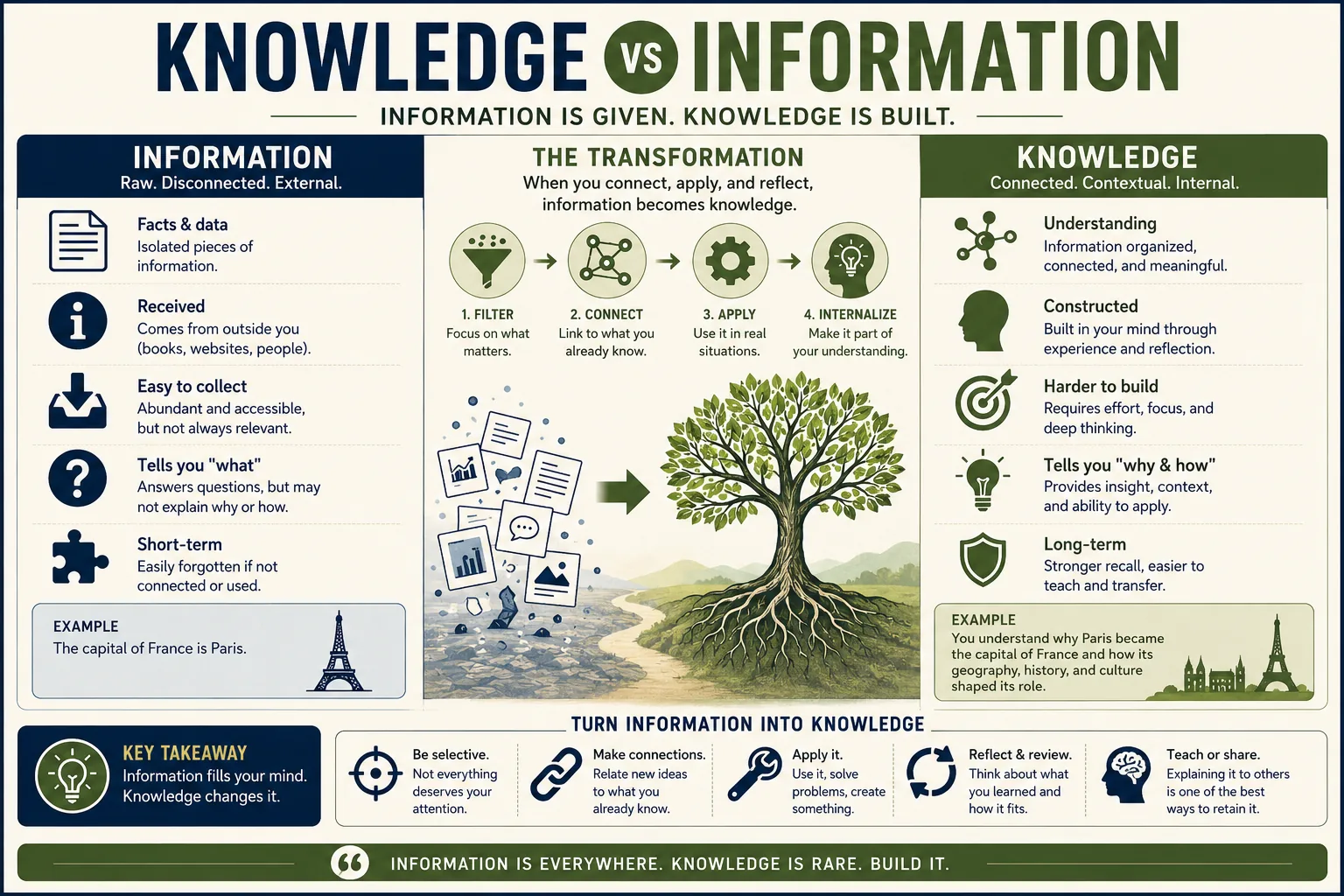
Knowledge: On October 3, 1995, a Los Angeles jury acquitted O.J. Simpson of double murder after nine months of one of the most evidence-saturated criminal trials in American history. The prosecution had presented 488 witnesses, 857 pieces of physical evidence, and forensic DNA analysis that experts called overwhelming.
Every piece of evidence was information. The jury saw and heard all of it. Yet the prosecution lost because they failed to convert information into knowledge - into an organized, coherent account that a jury could understand, believe, and act on.
The defense, led by Johnnie Cochran, understood the difference. They did not have more evidence. They had a narrative - a structured account that organized selective information into meaningful knowledge: the police were racist, the evidence was contaminated, the glove did not fit.
Whether true or false, this was knowledge - information organized into a coherent interpretive framework that connected to what the jury already knew about the Los Angeles Police Department and told them what to conclude.
The gap between information and knowledge is not merely academic. It determines what can be learned, what can be acted upon, what can be transferred, and what actually changes behavior.
In an era when information is effectively unlimited - when every smartphone carries access to the complete recorded knowledge of human civilization - understanding why most people know less than they think they do, and why having access to information is a poor substitute for actually having knowledge, is one of the most practically important distinctions in cognitive science.
"We can know more than we can tell." - Michael Polanyi, The Tacit Dimension (1966). This is the foundational insight of tacit knowledge: expertise is not fully articulable, which means information transmission cannot substitute for experience.
The DIKW Hierarchy
| Level | Definition | Answers | Example | Can Be Transmitted By |
|---|---|---|---|---|
| Data | Raw, uninterpreted signals | (Nothing without context) | "37.8" | Storage, database |
| Information | Data with context and meaning | What? When? | "Body temperature is 37.8 degrees Celsius" | Documents, communication |
| Knowledge | Information integrated with causal understanding | Why? What to do? | "Fever indicates infection; fever is a defense mechanism" | Education, coaching, guided practice |
| Wisdom | Knowledge + judgment about when and how to apply it | When? Should I? | "Do not prescribe antibiotics for this viral infection" | Only through extensive experience and reflection |
The Data-Information-Knowledge-Wisdom Hierarchy
The most widely used framework for understanding these distinctions is the DIKW pyramid: Data, Information, Knowledge, Wisdom.[10] Each level represents a different stage in the transformation of raw signals into actionable understanding.
Data are raw, uninterpreted signals: numbers, measurements, observations stripped of context. "37.8" is data. "The temperature is 37.8 degrees Celsius" is information - data with context that tells you what the measurement represents.
Information is data with context and meaning: it answers "what" and "when" but not necessarily "why" or "what to do." Information can be stored in databases, transmitted between systems, published in books, and absorbed from reading.
Information is abundant, easily copied, and rapidly increasing in volume. The global information supply roughly doubles every two years by most estimates.
Knowledge is information integrated with understanding: it connects facts to each other, embeds them in causal and explanatory frameworks, and enables both explanation and prediction.
"The patient has a fever of 37.8 degrees Celsius because they have a bacterial infection, which causes the immune system to elevate body temperature as a defense mechanism" is knowledge - information connected to causal understanding.
Wisdom is knowledge combined with judgment about when, how, and whether to apply it - knowing not just what works but what works in specific contexts, what values should guide application, and when the knowledge itself is uncertain or incomplete.
The physician who knows that antibiotics treat bacterial infections but also knows when not to prescribe them (viral infections, antibiotic-resistant strains, patients with contraindications) is exercising wisdom.
The pyramid is useful but incomplete. The distinction that matters most in practice is between the first two levels (data and information) and the last two (knowledge and wisdom), because the transformation across that boundary requires something that transmission and storage cannot provide: integration through understanding.
Why Information Does Not Automatically Become Knowledge
The most dangerous illusion in modern learning is that consuming information produces knowledge. It does not. The transformation from information to knowledge requires active cognitive work that reading, watching, or listening does not automatically provide.
The cognitive science is clear: information absorbed without active processing enters what researchers call shallow processing - it is briefly available in working memory, may be recognized when seen again, but is not integrated into the long-term memory structures that allow retrieval, flexible application, and connection to other knowledge.
The processing depth framework, developed by Fergus Craik and Robert Lockhart in 1972, demonstrated that memory strength is determined by the depth of processing at encoding, not the amount of time spent with material.[3]
Reading a fact once while actively trying to understand its implications produces stronger and more flexible memory than reading it ten times without active engagement.
*Example*: A medical student who reads a textbook chapter on cardiac pharmacology has access to the information.
A resident who has treated 200 patients with cardiac conditions and has applied that pharmacology under supervision, seen what works and what does not, received feedback from attending physicians, and connected the pharmacology to clinical outcomes - has knowledge.
If both are tested immediately after study, the student may outperform the resident on straightforward recall.
But if both encounter an unusual presentation or a treatment failure, the resident's knowledge allows flexible response while the student's information provides no guidance.
The Tacit Dimension: What Cannot Be Written Down
The philosopher Michael Polanyi articulated one of the most profound insights about knowledge in his 1966 work The Tacit Dimension: "We can know more than we can tell." Tacit knowledge is the understanding embedded in skilled performance that cannot be fully captured in explicit instructions.[1]
A master carpenter knows how to read wood grain - how it will respond to the plane, where it is likely to split, how to adjust technique for different species. This knowledge was built through thousands of hours of working with wood.
It cannot be fully transmitted by reading a manual because it is encoded in perceptual-motor patterns that are not accessible to verbal introspection.
The carpenter cannot fully articulate what they know; they can demonstrate it, and they can teach it - but only through demonstration, supervised practice, and feedback, not through verbal instruction alone.
Tacit knowledge pervades expertise in every domain:
Sports: The timing sense of a tennis player returning serve - knowing when to start the swing before the ball has traveled half its distance - cannot be taught through verbal instruction. It is built through tens of thousands of repetitions with feedback.
Science: The experimental intuition of an experienced laboratory scientist - knowing which protocols are worth trying, which results are meaningful versus artifactual, which hypotheses are worth pursuing - is tacit knowledge built through extended experimental work, not through reading the literature.
Management: The organizational judgment of an experienced manager - knowing which team members will perform under pressure, which political dynamics are likely to surface, which problems will resolve themselves - is tacit knowledge that cannot be acquired from management books.
The practical implication is profound: building expertise requires experience with real domain problems, with feedback, and under conditions that allow tacit knowledge to develop. Reading about carpentry does not make a carpenter. Reading about management does not make a manager.
Information is accessible; knowledge requires the additional work that information alone cannot provide.
The Knowledge Illusion: Knowing Less Than You Think
Cognitive psychologists Steven Sloman and Philip Fernbach documented a systematic bias they called the knowledge illusion: people consistently overestimate how well they understand complex systems.[2]
In their research, published in their 2017 book The Knowledge Illusion, they found that people who believed they understood how common objects worked - toilets, zippers, bicycles, helicopter blades - were unable to provide coherent explanations when asked to do so.
The mere experience of being in a world that works reliably creates a sense of understanding that is not justified by actual knowledge.
The knowledge illusion is particularly dangerous in information-rich environments.
When you have access to information on demand - through search engines, expert consultation, or reference systems - the availability of information creates a sense of having knowledge, even when the information has not been integrated into actual understanding.
This is the Google effect documented by psychologist Betsy Sparrow and colleagues in 2011: people shown information they expect to be able to find online later remember it less well than information they believe will not be available.[5] Knowing that you can access information reduces the cognitive work of integrating it into knowledge.
*Example*: A manager who has read McKinsey analyses of strategic positioning, attended a business school strategy course, and followed industry commentary for ten years has access to substantial information about strategy.
But when asked to analyze a new strategic situation from scratch - without the specific frameworks, specific prior analyses, or access to reference materials - may find that the information has not consolidated into usable strategic knowledge.
The test of knowledge versus information is performance in novel situations where the information is not available for lookup.
How Information Becomes Knowledge: The Integration Process
The transformation from information to knowledge requires specific cognitive processes that most learning contexts underestimate:
Elaborative Encoding
Elaborative encoding means connecting new information to existing knowledge structures - asking not just "what does this mean?" but "how does this relate to what I already know?", "what predictions does this generate?", "what would this look like in a context I'm familiar with?".
Elaboration creates multiple retrieval pathways and integrates new information into the network of existing knowledge, making it accessible from multiple starting points.
Research by Mark McDaniel and colleagues has consistently shown that elaborative encoding produces substantially better retention and transfer than shallow reading. The elaborative question - "why does this make sense?" - is one of the most powerful tools for converting information to knowledge.
Retrieval Practice
Retrieval practice - actively recalling information without looking at it, which is what testing and practice problems require - is one of the most robust findings in memory research.
The "testing effect" (also called the "retrieval practice effect") shows that retrieving information from memory strengthens it far more than re-reading does.
Henry Roediger and Jeffrey Karpicke's landmark 2006 study showed that students who studied material once and tested themselves three times retained it far better a week later than students who studied the material four times without testing.[4]
The reason is mechanistic: the act of retrieving information from memory is different from the act of recognizing or re-reading it. Retrieval requires reconstructing the knowledge from partial cues, which strengthens the retrieval pathway and identifies gaps where the information is held weakly.
Re-reading provides the information without requiring reconstruction and gives an illusion of learning that retrieval would expose as incomplete.
Application and Transfer
Knowledge differs from information in its capacity to transfer - to be applied in situations structurally similar to but not identical with the original learning context.
Information memorized for a specific context (a test, a specific task) may not transfer; knowledge integrated into a conceptual framework transfers across contexts that share the framework's structure.
The challenge is that transfer is harder than learners expect. Research by David Perkins and Gavriel Salomon identified two types of transfer: near transfer (application to situations very similar to the learning context) and far transfer (application to situations that differ substantially from the learning context).[6]
Near transfer can be achieved with information; far transfer requires genuine knowledge - flexible understanding of underlying principles that can be recognized in surface-diverse situations.
*Example*: A physics student who learns Newton's second law (F = ma) as a formula for calculating forces in specific problem types has information.
A student who understands force, mass, and acceleration as a relationship between how hard you push something, how heavy it is, and how fast it changes speed - and who can recognize this relationship in diverse contexts (why heavy trucks stop slowly, why harder throws travel faster, why it is harder to turn a loaded shopping cart) - has knowledge.
The latter student can apply the principle to novel situations; the former can execute familiar problem types.
The Social Dimension of Knowledge
Knowledge is not only individual. Substantial knowledge exists in distributed form - spread across teams, organizations, institutions, and cultural practices in ways that no individual holds entirely.
This observation has a disturbing corollary: individual actors routinely act on knowledge that is not actually in their heads.
Teams, departments, organizations, and professions have collective knowledge about how to do things that is distributed across roles, relationships, and practices - and individuals act effectively because they are embedded in these systems, not because they individually possess all the relevant knowledge.[9]
The sociologist Harry Collins, building on Polanyi's work, identified interactional expertise (knowledge sufficient to participate intelligently in a domain without being able to practice it) and contributory expertise (knowledge sufficient to contribute to a domain's development).[7]
Between these sits a third category: relational knowledge - knowing who knows what, how to access relevant expertise, how to evaluate claims from domain experts. In a world of distributed knowledge, relational knowledge is often more valuable than any specific piece of domain knowledge.
The Practical Test: Can You Apply It?
The definitive test of whether you have knowledge versus information is whether you can apply it to novel problems without reference materials. This test is harder than it sounds and more revealing than most learning assessment.
For any domain you believe you understand, try these three tests:
Explanation without preparation: Can you explain the core concept to someone unfamiliar with it, from scratch, without consulting notes or references? The inability to do this reveals information held at recognition level, not knowledge held at understanding level.
Application to novel cases: Given a new situation you have not encountered before, can you apply your understanding to analyze it? Novel cases distinguish knowledge (flexible, principle-based) from information (context-specific, pattern-matching).
Prediction and anomaly detection: Can you predict what would happen in various scenarios? And can you identify when something in a domain is wrong or anomalous, even without knowing what specifically is wrong?
Experts can often detect that something is off before they can articulate what; this capacity for anomaly detection is a hallmark of genuine knowledge.
Most people, when honestly applying these tests, find their knowledge narrower and shallower than they believed.
This is not a moral failing but a structural feature of how information-to-knowledge conversion actually works: it requires more deliberate effort than information consumption provides, and modern information environments make information so accessible that the effort is easily bypassed.
Implications for Learning in Information-Rich Environments
The distinction between knowledge and information has become more important, not less, as information has become more accessible. When information was scarce, acquiring it was valuable.
When information is abundant, the ability to convert it to knowledge - through elaborative processing, retrieval practice, application, and integration - becomes the critical skill.
Curation over consumption: The effective learner in an information-rich environment is not the one who consumes the most but the one who processes a smaller amount more deeply. Reading ten books superficially produces weaker knowledge than reading three books intensively with active engagement and application.
Application as the unit of learning: Rather than measuring learning by information consumed (pages read, videos watched, courses completed), the effective measure is knowledge applied - problems solved, explanations produced, novel situations navigated. Application is what converts information to knowledge, not consumption.
Spacing and return: Information reviewed once and not revisited decays rapidly. Knowledge maintained through spaced retrieval - returning to material after delays, at intervals that challenge but do not exceed memory - persists and strengthens.
The learning science of spaced practice is clear: distributed practice over time beats massed practice in a single session for long-term retention.[8]
The information age has produced an unprecedented quantity of accessible information. It has not produced equivalent knowledge. The transformation requires the cognitive work that information systems cannot do: the elaboration, retrieval, application, and integration that turn what you have been exposed to into what you actually know.
What Research Reveals About the Information-to-Knowledge Gap
Cognitive scientists have quantified the gap between possessing information and having usable knowledge across multiple domains, with results that challenge assumptions about how learning and expertise work.
Stellan Ohlsson at the University of Illinois at Chicago spent three decades studying representational change - the process by which people move from surface-level information toward genuine conceptual understanding.
His 1992 framework identified a key obstacle: people who have absorbed information without understanding typically apply familiar patterns to new problems even when those patterns do not fit.
Ohlsson called this "impasse" - the experience of trying to apply stored information to a novel situation and finding it does not work.
His research showed that genuine conceptual learning requires reaching impasse, recognizing the failure, and restructuring the representation. Students who reviewed information without being pushed to application did not develop the restructured representations that enable transfer.
In experiments comparing students who received additional reading time against students who encountered well-designed problems that created impasse, the problem group showed 40-60% better transfer to novel situations despite spending equivalent total time.
John Sweller at the University of New South Wales developed cognitive load theory in the late 1980s, which provides a mechanistic account of why information does not automatically become knowledge.
Sweller distinguished between intrinsic cognitive load (the inherent complexity of content), extraneous cognitive load (demands imposed by poor presentation), and germane cognitive load (the mental effort of building schemas - what he called the cognitive work of knowledge formation).
Sweller's 1988 experiments demonstrated that conventional problem-solving in mathematics - receiving information about a procedure and practicing problems - actually imposed high extraneous load that crowded out the germane processing required for schema formation.
Students who solved more problems showed worse transfer than students who studied worked examples that directed attention toward the underlying schema.
The finding illuminated why information exposure, even extended and repeated, fails to produce the schema-based knowledge that transfers: the processing mode required for information consumption crowds out the processing required for knowledge construction.
His subsequent 1994 paper in Learning and Instruction showed that this "worked example effect" reversed as expertise developed - advanced learners needed problem-solving, not worked examples.
The reversal, which he called the expertise reversal effect, revealed that information and knowledge require different instructional approaches depending on where the learner is in the knowledge-construction process.
Philip Tetlock at the University of Pennsylvania ran the most rigorous large-scale study of the gap between information and knowledge in professional forecasting.
His 20-year study of 284 professional forecasters - experts who consumed political, economic, and geopolitical information professionally and who regularly made confident predictions - found that they performed barely better than chance on political and economic forecasts, and significantly worse than simple statistical models.
Published in his 2005 book Expert Political Judgment, the finding was that consuming vast amounts of relevant information did not translate into superior predictive knowledge.
The experts who performed best - a group Tetlock called "foxes," drawing on Isaiah Berlin's framework - were distinguished not by more information but by a different cognitive orientation: they integrated information from multiple frameworks, maintained uncertainty actively, and updated beliefs when evidence shifted.
The foxes' advantage was not information quantity but information architecture - they organized what they knew into structures that generated accurate predictions.
The "hedgehogs" - experts who consumed equivalent information but organized it around a single governing framework - performed worst, demonstrating that the relationship between information consumed and knowledge quality is not just weak but can be negative when information is filtered through a distorting framework.
Michelene Chi at Arizona State University conducted detailed protocol studies in which she had students think aloud while working through physics problems, comparing novices with minimal subject exposure against students who had completed introductory physics courses - who had received all the relevant information - against genuine experts.
Chi's 1981 analysis, published in Cognitive Science, found that novices and information-holding students categorized physics problems similarly (by surface features - "this is a pulley problem," "this is an inclined plane problem"), while experts categorized by underlying principle ("this is a conservation of energy problem," "this is a Newton's second law problem").
Students who had received all the course information were functionally closer to novices than to experts in their knowledge structure, because the information had not been organized into the principle-based schemas that characterize knowledge.
Chi's subsequent research showed that self-explanation - prompting students to articulate why each step of a worked example followed from principles - dramatically accelerated the transition from information to structured knowledge.
Students who self-explained during worked-example study showed 57% better performance on transfer problems than students who studied the same examples without self-explanation.
Case Studies: When Information Without Knowledge Fails
Several high-stakes domains provide documented evidence of the consequences when information is mistaken for knowledge.
Aviation crew resource management failures investigated by Robert Helmreich at the University of Texas at Austin revealed a consistent pattern: flight crews involved in accidents frequently possessed all the technical information relevant to the emergency they encountered.
Cockpit voice recorder analyses showed that crew members had information about the malfunction, information about relevant procedures, and information about the aircraft's status - but failed to integrate this information into knowledge of what was actually happening and what needed to be done.
Helmreich's analysis of 37 commercial aviation accidents between 1978 and 1990, published in the International Journal of Aviation Psychology, found that 70% involved failures of crew coordination - specifically, failures to apply possessed information in an integrated way to the actual situation.
The accidents were not information failures; they were knowledge failures. Following this research, the aviation industry adopted crew resource management training that specifically targeted the transformation of procedural information into applicable knowledge through scenario-based simulation.
After widespread CRM adoption, commercial aviation's fatal accident rate declined by approximately 65% between 1990 and 2010, a reduction the National Transportation Safety Board has partially attributed to CRM training effectiveness.
Medical diagnostic error research by Mark Graber at the State University of New York at Stony Brook documented what happens when medical practitioners have relevant information but fail to convert it into diagnostic knowledge.
Graber's 2005 study published in the Archives of Internal Medicine examined 100 documented cases of diagnostic error in internal medicine.
In 74% of cases, the error was not an information failure - the correct diagnosis was within the information the physician had received, or would have been available from standard tests that were not ordered.
The errors were cognitive: premature closure (settling on an explanation before gathering sufficient information), anchoring (overweighting initial information), and availability bias (overweighting diagnoses that came readily to mind).
The physicians possessed diagnostic information; they lacked the organized knowledge structures that would have triggered appropriate information-seeking and synthesis.
Graber's subsequent work with Pat Croskerry at Dalhousie University developed the concept of "diagnostic reasoning" training - explicitly teaching medical students the schema-based knowledge structures that distinguish expert from novice diagnosis, rather than merely transmitting clinical information.
Programs implementing this training at the University of Toronto and Duke University Medical School showed 23-31% reductions in diagnostic error rates in simulated cases.
Financial regulation provides a documented institutional example. The 2008 financial crisis postmortem conducted by the Financial Crisis Inquiry Commission (2011) found that regulatory agencies had access to virtually all the information required to identify the mortgage-backed securities risk that precipitated the crisis.
The SEC, Federal Reserve, and Office of Thrift Supervision had data on mortgage origination rates, delinquency trends, and leverage ratios in financial institutions.
What they lacked was integrated knowledge - the schemas that would have organized this information into an understanding of systemic risk.
Regulators examined information within their institutional domain (banking soundness, securities disclosure) without the conceptual framework that would have connected these domains into knowledge of system-wide fragility.
The commission's finding was that the crisis was "avoidable" given available information - which is precisely the condition when information-knowledge gaps have maximum consequence.
Following the crisis, financial regulation was redesigned to include systemic risk functions specifically charged with building cross-domain knowledge structures, not merely collecting cross-domain information.
The Office of Financial Research, established by the Dodd-Frank Act in 2010 under Richard Berner as its first director, was explicitly mandated to convert financial system information into integrated knowledge about systemic vulnerability.
The Apollo 13 mission (April 1970) provides a positive case study of information-to-knowledge conversion under extreme time pressure. When oxygen tank 2 exploded 56 hours into the lunar mission, NASA flight controllers had instruments showing dozens of anomalous readings simultaneously.
Gene Kranz and his team at Mission Control possessed all the information available from the spacecraft's telemetry - but the information, taken individually, was ambiguous and potentially contradictory.
The team's response, documented in extensive post-mission analysis, was to rapidly construct an integrated knowledge structure: what had happened (oxygen tank failure), what consequences this implied (service module power loss, abort of lunar landing), and what the constraints were on possible recovery actions (available oxygen, water, electricity, and propellant in the lunar module).
This schema-building from raw telemetry - in under 30 minutes - enabled the crew survival decisions that followed.
NASA subsequently built this knowledge-construction process into mission control training: controllers are specifically trained in the schema-first approach (build the model, then populate it with data) rather than the information-first approach (accumulate data, then attempt to make sense of it).
The Apollo 13 outcome is studied in aerospace engineering programs as a demonstration that knowledge - organized, model-based understanding - is the operational resource in complex systems management, not information.
Sources & Further Reading
- Polanyi, M. The Tacit Dimension. Anchor Books, 1966. View source
- Sloman, S. & Fernbach, P. The Knowledge Illusion: Why We Never Think Alone. Riverhead Books, 2017.
- Craik, F.I.M. & Lockhart, R.S. "Levels of Processing: A Framework for Memory Research." Journal of Verbal Learning and Verbal Behavior, 11(6), 671-684, 1972. DOI: 10.1016/S0022-5371(72)80001-X
- Roediger, H.L. & Karpicke, J.D. "Test-Enhanced Learning: Taking Memory Tests Improves Long-Term Retention." Psychological Science, 17(3), 249-255, 2006. DOI: 10.1111/j.1467-9280.2006.01693.x
- Sparrow, B., Liu, J. & Wegner, D.M. "Google Effects on Memory: Cognitive Consequences of Having Information at Our Fingertips." Science, 333(6043), 776-778, 2011. DOI: 10.1126/science.1207745
- Perkins, D. & Salomon, G. "Teaching for Transfer." Educational Leadership, 46(1), 22-32, 1988. View source
- Collins, H. The Shape of Actions: What Humans and Machines Can Do. MIT Press, 1998. View source
- Brown, P., Roediger, H. & McDaniel, M. Make It Stick: The Science of Successful Learning. Harvard University Press, 2014. View source
- Davenport, T. & Prusak, L. Working Knowledge: How Organizations Manage What They Know. Harvard Business School Press, 1998. View source
- Ackoff, R.L. "From Data to Wisdom." Journal of Applied Systems Analysis, 16, 3-9, 1989. View source
This article is part of How Learning Works: A Research Guide to Learning Science - our complete guide to the evidence on how people actually learn.