
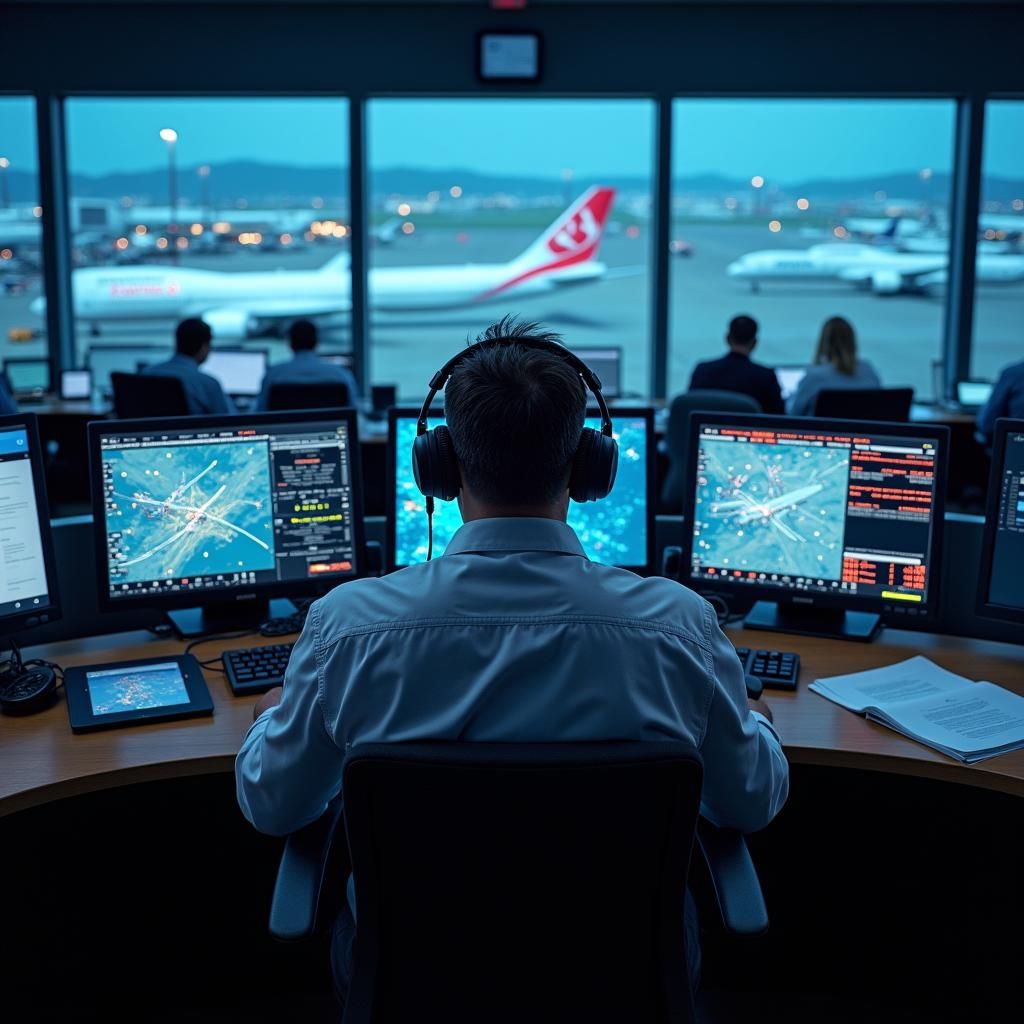
Air traffic controllers manage the safe, orderly, and efficient flow of aircraft in controlled airspace and at airports. This involves issuing takeoff, landing, and routing instructions to pilots, managing separation between aircraft, coordinating with adjacent control sectors, and responding to emergencies in real time. The role splits across three position types: tower, approach, and en route control.
On a busy Friday afternoon at Chicago's O'Hare International Airport - consistently one of the world's busiest airports by total operations - the approach control team is managing more than 100 aircraft simultaneously in the airspace within 60 miles of the field.
Each controller in the facility is responsible for a sector of that airspace, issuing clearances to a dozen or more aircraft at once, maintaining legally required separation standards between every pair of aircraft in their sector, coordinating handoffs to adjacent sectors, and managing the flow of arriving and departing traffic in real time.
If two of those aircraft get too close, the consequences are catastrophic and irreversible.
No other civilian profession combines the cognitive demands of simultaneous multitasking, the consequences of error, the physical constraints of shift work, and the extended periods of intense concentration that air traffic control requires.
The mandatory retirement age of 56 in the United States - unusual in any professional field - exists specifically because research has documented that the cognitive performance required to manage modern air traffic declines at rates that make continued safe performance unreliable beyond that age.
This is not a reflection of general cognitive decline; it is a precise acknowledgement of how demanding the job actually is.
This guide explains what air traffic controllers actually do across the three types of control positions (tower, approach, and en route), how the training and certification process works, why the role is considered one of the most stressful in any field, salary and compensation data, and what the path to becoming a controller looks like in the United States and comparable countries.
"Air traffic control is the only profession where, if you make a serious mistake, you may not be around to learn from it." - Paraphrase widely attributed to FAA training instructors
Key Definitions
Separation standards: The minimum distances (horizontal and vertical) that must be maintained between aircraft to prevent collision. In controlled airspace, responsibility for maintaining these standards belongs to the controller. Standard en route separation is 5 nautical miles horizontally or 1,000 feet vertically.
Sector: A defined volume of airspace assigned to a controller team. Controllers are responsible for all traffic within their sector and coordinate with adjacent sectors when aircraft transition from one sector to another.
Handoff: The formal process of transferring control responsibility for an aircraft from one controller to another as the aircraft moves from one sector to the next. The transferring controller must ensure the receiving controller has accepted the aircraft before it enters the new sector.
TRACON (Terminal Radar Approach Control): The ATC facility that manages aircraft arriving and departing from one or more airports within a terminal area, typically from 3,000-17,000 feet and within 30-50 miles of the airport.
ARTCC (Air Route Traffic Control Centre): Also called Centre or en route, the facility that manages aircraft in cruise flight at higher altitudes along airways between terminal areas. There are 22 ARTCCs in the United States, 20 of which are in the continental US (the other two being Anchorage and Honolulu).
Loss of Separation (LOS): An incident in which aircraft come closer than the legally mandated separation minimums. Not all LOS events result in accidents or near-collisions, but each is investigated and documented.
The FAA reported approximately 1,800 reported operational errors in the fiscal year 2022 data cycle, with a subset classified as more serious events.
What Air Traffic Controllers Do: The Three Positions
Tower Controllers
Tower controllers work in the control tower cab at the airport, with a direct line of sight to the runways and taxiways below. The tower position is actually several distinct roles.
Ground controllers are responsible for aircraft moving on the ground - taxiways, ramps in some facilities, and runways when not occupied for takeoff or landing. They issue taxi clearances, sequence aircraft for departure, and coordinate runway crossings.
Local controllers (runway controllers) manage the runway itself. They issue takeoff and landing clearances, maintain separation between aircraft on the same runway, and coordinate with approach control for landing sequencing.
A busy runway may handle 40-50 operations per hour - one aircraft taking off or landing every 72-90 seconds. Local controllers at these facilities are working at a continuous pace with almost no idle time.
The tower environment is visually based - controllers at uncomplicated airports can see what they are managing - but also relies heavily on radar displays and communication. Weather, visibility restrictions, and equipment failures add complexity to what might otherwise seem like a manageable situational picture.
Clearance delivery controllers handle pre-departure ATC clearances, assigning routes, altitudes, and transponder codes to aircraft preparing to taxi. At the busiest facilities, this is a full-time dedicated position. At smaller towers, one controller handles multiple functions simultaneously.
Approach Control (TRACON)
Approach controllers work in a darkened room (to optimise radar display visibility) away from the airport, managing aircraft in the terminal area on radar. Unlike tower controllers, approach controllers cannot see the aircraft they are managing - they work entirely from radar returns, voice communications, and aircraft transponder data.
The approach environment requires managing the complex geometry of multiple arrival and departure streams simultaneously. Arrivals must be sequenced onto the final approach course with appropriate spacing, adjusting speeds and routes in real time as the traffic picture evolves.
Departures must be routed clear of arriving traffic while complying with noise abatement procedures, departure fix crossing restrictions, and handoff requirements to the en route centre.
A single approach controller might manage 15-20 aircraft simultaneously during a busy arrival push, each at different altitudes, speeds, and positions, all converging toward the same runway.
The mental model the controller must maintain - the three-dimensional picture of where every aircraft is and where it will be in the next several minutes - is what cognitive psychologists who study ATC call the "traffic picture" and what experienced controllers describe as the central challenge of the job.
At the Southern California TRACON (SoCal TRACON), one of the busiest approach control facilities in the world, controllers manage traffic feeding multiple major airports simultaneously: LAX, John Wayne, Long Beach, Burbank, and Ontario, among others.
The complexity of managing converging arrival streams for airports with crossing traffic flows while avoiding the restricted airspace around Edwards Air Force Base and the Los Angeles military operating areas requires sustained concentration at levels few other workplaces demand.
En Route (Centre) Controllers
En route controllers manage aircraft in cruise flight at high altitudes along airways between cities. They work in large buildings away from airports, monitoring radar displays that can cover areas of hundreds of thousands of square miles.
An individual en route sector might be responsible for a volume of airspace hundreds of miles wide and thousands of feet deep.
The pace of en route control is generally less intensive than approach control - aircraft are flying faster, there are typically fewer complex manoeuvres, and the time scale of events is longer.
However, the mental demands remain high, particularly in complex airspace near major hub airports or at busy intersections of multiple arrival and departure routes.
En route controllers also manage weather - rerouting aircraft around storm systems, coordinating with adjacent centres and military facilities, and adjusting to the dynamic real-time changes in the national airspace system.
The 22 ARTCCs in the US handle an extraordinary volume of traffic. FAA data from 2023 reported approximately 45,000 flights operating in US airspace on a typical day, a figure that includes commercial airline, cargo, general aviation, and military traffic.[15]
En route controllers coordinate the movement of the large majority of those flights during the cruise phase of every flight.
The Physical and Psychological Demands
The Stress Problem
Air traffic control is consistently listed among the highest-stress occupations in occupational health research.
A landmark study published in the International Journal of Aviation Psychology by Farmer, Belyavin, Jordan, Bunting, and Tattersall documented that ATC work produces measurable physiological stress responses - elevated cortisol levels, increased heart rate variability - during busy periods, with limited recovery time between stressful events.[5]
The sources of stress are structural, not incidental. Controllers are legally responsible for the safety of aircraft in their sector. They cannot delegate that responsibility; they cannot take a break when traffic is complex; and they cannot revise a decision after the fact when the situation has changed.
The combination of high-stakes consequence, time pressure, and irreversibility is precisely the profile that occupational psychologists associate with the highest stress loads.
Research by Wickens and Hollands (2000) on attention and workload in aviation environments demonstrated that ATC demands dual-task performance - simultaneous management of a spatial mental model and verbal communication - at levels that exceed virtually any other civilian profession.[13]
The cognitive challenge is not merely knowing what to do; it is maintaining an accurate, constantly-updated mental simulation of a three-dimensional airspace with multiple simultaneous actors.[12]
Communication Under Pressure
Air traffic control communication operates on its own standardised vocabulary and phraseology specifically engineered to reduce ambiguity. Controllers and pilots use the ICAO (International Civil Aviation Organization) standard phraseology that defines exactly how clearances, instructions, and acknowledgements are worded.
The phrase "cleared to land" means something legally and operationally precise; improvisation in ATC communication is a deviation from procedure, not a sign of competence.
At busy facilities, controllers may be speaking nearly continuously - issuing clearances, taking readbacks, coordinating with adjacent sectors, and communicating with supervisors - while simultaneously monitoring the radar picture, updating flight progress information, and planning the next sequence of moves.[10]
The cognitive division of attention required is one of the primary reasons ATC selection tests for specific aptitudes that are not easily trained.
Shift Work and Health
Air traffic facilities operate 24 hours a day, requiring shift work including overnight shifts and rotating schedules.
Research consistently documents that extended shift work - particularly rotating shifts that disrupt circadian rhythm - is associated with higher rates of cardiovascular disease, metabolic disorders, and sleep disturbance.
The FAA requires a minimum rest period of 9 hours between shifts, but studies including a 2012 NASA-funded study led by Alexander Caldwell found that shift workers at high-traffic facilities were operating with chronic sleep debt that affected cognitive performance even when individual pre-shift rest periods appeared adequate.[4]
Burnout and Retirement
The mandatory retirement age of 56 (or 25 years of service, whichever is later) reflects formal recognition that the cognitive demands of ATC are not sustainable indefinitely. Controllers who leave the operational workforce before mandatory retirement often report burnout as a primary factor.
The National Air Traffic Controllers Association (NATCA) has documented that understaffing - a persistent problem at FAA facilities - means controllers often work extended periods of mandatory overtime at busy facilities, compounding the stress and fatigue load.[3]
As of 2024, the FAA reports approximately 10,800 certified professional controllers (CPCs) against a target staffing level of 12,000+.
This shortfall of nearly 1,200 controllers has been attributed to the wave of retirements among controllers hired in the post-1981 rebuild following the PATCO strike, combined with a training pipeline that produces CPCs over a 4-7 year timeline, preventing rapid staffing recovery.
The practical consequence is elevated mandatory overtime at the most understaffed facilities.
The Technology Behind Air Traffic Control
Radar and Surveillance Systems
Modern ATC relies on multiple complementary surveillance systems. Primary radar bounces radio signals off aircraft surfaces and detects returns, providing position without requiring aircraft cooperation.
Secondary surveillance radar (SSR) interrogates aircraft transponders, which respond with the aircraft's identification code and altitude, providing more precise position and altitude data.
ADS-B (Automatic Dependent Surveillance-Broadcast) represents the current generation of surveillance technology. Aircraft equipped with ADS-B transmit their GPS position, altitude, speed, and identification continuously, providing controllers with real-time precise position data without ground-based radar interrogation.
The FAA mandated ADS-B Out equipment for aircraft operating in most controlled airspace from January 2020. The technology allows more precise separation standards and, in the long term, may support higher traffic density than traditional radar-based separation.[6]
TCAS and Conflict Detection
TCAS (Traffic Collision Avoidance System) is an independent onboard system that alerts pilots to potential conflicts and, at critical ranges, issues Resolution Advisories (RAs) directing the pilot to climb or descend to avoid collision.
TCAS operates independently of ATC - it is an aircraft-level backstop against the consequences of controller error or missed communication.
The Ueberlingen mid-air collision of 2002, in which a TCAS RA was issued but one crew followed ATC instructions instead, killing 71 people, led to ICAO mandating that crews follow TCAS RAs rather than conflicting ATC instructions.[14]
The incident illustrates both the backup function of TCAS and the tragic consequences of procedural violation in high-stakes aviation environments.[16]
Salary and Compensation
The following figures are based on BLS data (2023) and FAA pay schedules.
United States (FAA)
Air traffic controllers in the US are federal employees paid on the FAA Core Compensation Plan, which differs from the standard GS federal pay scale.[7] Pay level is primarily determined by the complexity of the facility - busier facilities are assigned higher pay bands.
| Level | Annual Salary (USD) |
|---|---|
| Developmental (in training) | $45,000 - $70,000 |
| Certified Professional Controller (CPC), lower-complexity facility | $80,000 - $120,000 |
| CPC, medium-complexity facility | $110,000 - $150,000 |
| CPC, high-complexity (major hub TRACON or Centre) | $140,000 - $185,000 |
| Supervisory and management roles | $120,000 - $200,000+ |
BLS data (May 2022) reports a median annual wage of $137,380 for air traffic controllers, with the top 10% earning over $184,000.[1]
Total compensation also includes federal employee benefits: the Federal Employees Retirement System (FERS) pension, Federal Employee Health Benefits, Thrift Savings Plan with employer matching, and life insurance - a benefits package that adds substantial value on top of base salary.[11]
United Kingdom (NATS): UK controllers employed by NATS (National Air Traffic Services) earn GBP 45,000-95,000, with controllers at Heathrow ATCC and Swanwick receiving the highest pay levels.[8]
Australia (Airservices Australia): ATC salaries range from AUD 90,000 for developmental controllers to AUD 150,000-180,000 for experienced CPCs at major facilities.
Canada (NAV CANADA): The Canadian ATC privatised authority pays controllers CAD 80,000-160,000 depending on facility level and experience.[17] NAV CANADA controllers at Toronto Area Control Centre and Vancouver TRACON are among the best-compensated in the country.
Germany (DFS Deutsche Flugsicherung): German controllers earn EUR 60,000-110,000, with senior controllers at Frankfurt or Munich centres at the upper end of this range.
International Comparison: ATC Across Aviation Systems
Different countries organise air traffic services differently. The US uses a government-operated model through the FAA; the UK uses NATS, a public-private partnership; Australia and Canada use corporatised entities that operate independently of government.
Eurocontrol, the European organisation for the safety of air navigation, coordinates ATC across 41 member states and manages the upper airspace over Europe through the Network Manager function.[18]
Eurocontrol's 2023 Performance Review Commission found that en route ATC costs varied substantially across member states, with the most cost-effective providers (including the UK, Netherlands, and Switzerland) achieving significantly better cost efficiency than average.[9]
The Single European Sky initiative - a long-standing political project to rationalise European airspace into fewer, more efficient functional airspace blocks - has progressed slowly due to national sovereignty concerns and labour opposition from ATC unions.
The potential efficiency gains from reduced fragmentation are estimated at 15-20% reduction in flight distance and 10-15% reduction in CO2 emissions for European aviation.
How to Become an Air Traffic Controller
Becoming an air traffic controller generally means passing a medical and background screening, clearing an aptitude exam such as the FAA's AT-SA, and completing initial training, followed by months to years of on-the-job certification at a live facility before working traffic independently. Exact age limits, citizenship rules, and training paths vary by country; the sections below cover the US process and how it compares internationally.
United States
Eligibility requirements: US citizenship; age under 31 at the time of appointment to the FAA Academy (with exceptions for veterans); pass a dedicated FAA air traffic control specialist medical examination; pass the AT-SA (Air Traffic Skills Assessment) aptitude examination, which assesses spatial reasoning, multitasking ability, and other ATC-relevant cognitive skills; and pass a background investigation.
The AT-CTI (Air Traffic Collegiate Training Initiative) pathway: The FAA has partnerships with approximately 36 colleges and universities offering approved aviation programmes. Graduates of these programmes are given hiring priority and may bypass some Academy screening.
Prominent AT-CTI schools include Embry-Riddle Aeronautical University, University of North Dakota, and Purdue University.
The Academy: Selected candidates attend the FAA Academy in Oklahoma City, Oklahoma, for 3-5 months of classroom and simulator training.[2] Completion is not guaranteed - candidates must pass written examinations at each stage. Failure to pass results in termination of the hiring process.
Facility training (OJT): Academy graduates report to their assigned facility for on-the-job training, working under the supervision of a certified controller. This phase takes 2-5 years depending on facility complexity.
During this period the developmental controller works progressively toward full certification on each position at their facility. Failing to certify within the allowed training time results in termination.
The total timeline from beginning the application process to earning a full CPC (Certified Professional Controller) certification is typically 4-7 years.
Selection and Washout Reality
The selection process is genuinely competitive and the cognitive tests are hard to game. The biographical questionnaire used in FAA hiring from 2014 onward was designed to assess leadership, teamwork, and stress tolerance using a validated psychometric instrument.
Pass rates on the full hiring pipeline - from application to Academy acceptance to CPC certification - have historically run below 10% of original applicants.
The washout rate at the FAA Academy is non-trivial: the FAA has not published precise figures, but NATCA and controller community sources suggest that 15-25% of Academy trainees do not pass all required checkrides.
Facility-level washout is additional: developmental controllers who cannot meet facility certification requirements within the training timeline are released from the programme.
This means the meaningful credential in ATC is not acceptance to the Academy - it is earning and maintaining CPC certification at your facility. Many people try and do not get there; the ones who do are among the best-paid non-management federal employees.
Pros and Cons
Pros: Among the highest salaries of any non-management federal job; strong union representation through NATCA; early retirement eligibility; genuine job security once certified; genuine intellectual challenge and engagement; strong sense of purpose (keeping people safe).
Cons: Extremely demanding training process with high washout rates; shift work including nights and weekends throughout a career; mandatory overtime during staffing shortages; the stress load is real and chronic; mandatory retirement at 56 ends the career at a point where many professionals are at their peak earning years.
Career Limitations and Second Acts
The mandatory retirement at 56 creates a specific career planning challenge that employees in most other fields do not face. A controller who enters the profession at 22 and retires at 56 has a full career of 34 years - comparable to most professions.
But unlike most professionals who peak in their late 50s, controllers peak in their mid-40s and face a hard stop before they can move into the senior advisory and management roles that extend careers elsewhere.
Many retired controllers transition to:
- FAA management and regulatory roles (exempt from the mandatory operational retirement age)
- Aviation consulting and safety management
- Simulator instructor and training development roles
- Airline dispatcher roles (which have different certification requirements and a higher retirement age)
- Academic and research positions in human factors and aviation psychology
The FERS pension and Social Security benefits available to retiring controllers typically provide a meaningful retirement income floor, making the financial transition less abrupt than in private-sector careers without defined benefit pensions.
Practical Takeaways
Air traffic control is one of the best-compensated roles accessible without a four-year degree, but it demands exceptional cognitive ability, stress tolerance, and willingness to commit to a demanding training pipeline with uncertain completion.
The FAA screening process is genuinely selective - the AT-SA tests cognitive skills that are not easily trained, and the aptitude requirements are real.
If you are considering this path, research the AT-CTI programme at accredited schools in your area. The collegiate pathway significantly improves hiring prospects and provides structured preparation.
Practice spatial reasoning and multitasking exercises - these are the core aptitudes the selection process measures, and there is evidence that deliberate practice on these specific cognitive tasks improves performance on the AT-SA.
If the profile matches your abilities and tolerance for the demands described, it is one of the most genuinely important civilian jobs available - and compensation reflects that importance.
Sources & Further Reading
- Bureau of Labor Statistics. "Occupational Outlook Handbook: Air Traffic Controllers." BLS.gov, 2023-24 edition.
- FAA. "Air Traffic Controller Hiring and Qualifications." Federal Aviation Administration, faa.gov, 2024.
- NATCA. "National Air Traffic Controllers Association Workforce Report." NATCA, 2023.
- Caldwell, J. A., & Caldwell, J. L. "Fatigue in Aviation: A Guide to Staying Awake at the Stick." Ashgate, 2003.
- Farmer, E., Belyavin, A., Jordan, C., Bunting, A., & Tattersall, A. "Stress in Air Traffic Control." International Journal of Aviation Psychology, 1999.
- Seamster, T. L., Boehm-Davis, D. A., Holt, R. W., & Schultz, K. "Developing Advanced Automation for Air Traffic Control." International Journal of Aviation Psychology, 8(3), 1998.
- FAA. "FAA Core Compensation Plan: Air Traffic Organization." FAA, 2023.
- NATS. "Air Traffic Controller Careers." nats.aero, 2024.
- Eurocontrol. "Air Traffic Management Cost-Effectiveness." Eurocontrol Performance Review Unit, 2023.
- Stager, P., & Hameluck, D. "Ergonomics in Air Traffic Control." Ergonomics, 33(4), 493-499, 1990.
- Office of Personnel Management. "Federal Employee Retirement Benefits Overview." OPM.gov, 2024.
- Wickens, C. D. "Attention to Safety and the Psychology of Surprise." Proceedings of the 22nd Annual Aviation Psychology Symposium, 2003.
- Wickens, C. D., & Hollands, J. G. (2000). Engineering Psychology and Human Performance (3rd ed.). Prentice Hall.
- ICAO. (2010). Rules of the Air: Annex 2 to the Convention on International Civil Aviation (10th ed.). International Civil Aviation Organization.
- FAA. (2024). Air Traffic Activity Data System (ATADS). Federal Aviation Administration, FAA.gov.
- Bundesstelle fuer Flugunfalluntersuchung (BFU). (2004). Investigation Report AX001-1-2/02: Ueberlingen mid-air collision. German Federal Bureau of Aircraft Accident Investigation.
- NAV CANADA. (2024). Career opportunities: Air traffic controller. NAV CANADA, navcanada.ca.
- Eurocontrol Performance Review Commission. (2023). Performance Review Report 2022. Eurocontrol, Brussels.