
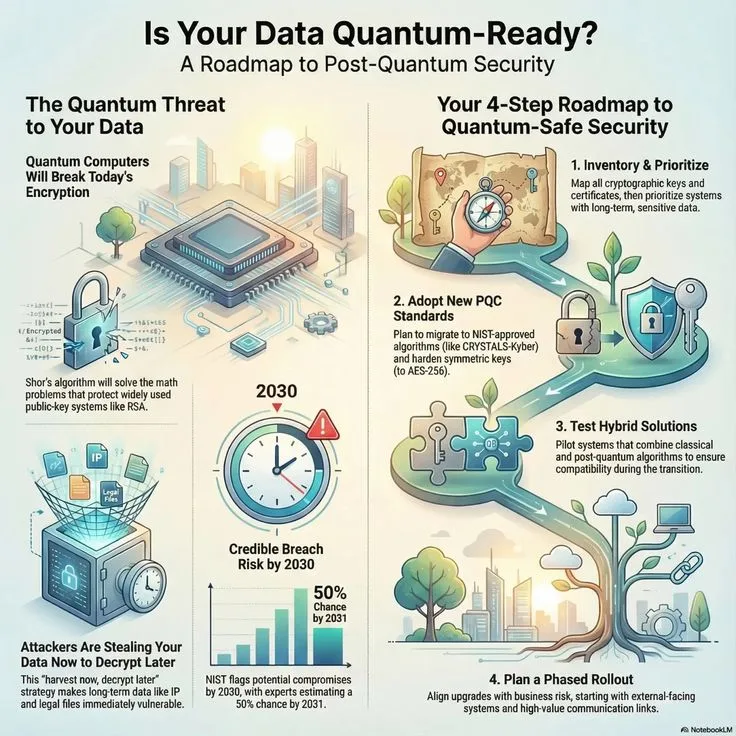
Encryption transforms data so only a party with the right key can read it, making secure digital communication and storage possible. How encryption protects data depends on public algorithms and secret keys, not hidden methods. Symmetric and asymmetric systems, digital signatures, key exchange, and TLS address different needs, while effective security also requires careful key management and preparation for future threats.
In 49 BC, Julius Caesar needed to send sensitive military orders to his generals across hostile territory. His solution was deceptively simple: shift every letter in the message by a fixed number of positions in the alphabet. An "A" became a "D," a "B" became an "E," and so on.
If a courier was captured and the message intercepted, the text appeared as meaningless gibberish to anyone who did not know the shifting rule.
This technique, now known as the Caesar cipher, is arguably the earliest documented encryption system in Western history - and while it would be trivially broken by a modern child with a pencil and ten minutes of patience, the core principle it embodies remains identical to the one protecting your bank transactions, medical records, and private messages today: transform information so that only authorized parties can read it.
Encryption is the mathematical discipline of rendering data unintelligible to anyone who lacks the correct key to reverse the transformation. It is not a single technology but a vast ecosystem of algorithms, protocols, and practices that together form the backbone of digital security.
Every time you visit a website over HTTPS, send an encrypted message on Signal or WhatsApp, store files in an encrypted cloud drive, or authenticate with a password, encryption is doing invisible, essential work.
Without it, the internet as a medium for commerce, communication, and governance would be fundamentally impossible - every packet traversing the network would be an open postcard, readable by any intermediary.
Yet for all its importance, encryption remains widely misunderstood. Many people equate it with "scrambling" data, which, while not wrong, is like describing a jet engine as "something that makes air go fast." The reality is far richer.
Modern cryptographic systems rest on deep results in number theory, abstract algebra, and computational complexity. They solve problems that sound almost paradoxical: How can two parties who have never met establish a shared secret over a channel that an adversary is monitoring?
How can you prove you authored a document without revealing your private key? How can a server demonstrate its identity to your browser before any encrypted data is exchanged?
This article answers those questions and many more. It traces the evolution of encryption from ancient substitution ciphers through the electromechanical Enigma machine to the mathematical frameworks that protect billions of devices today.
It explains how symmetric and asymmetric encryption work at the algorithm level, how TLS secures web traffic, how end-to-end encryption protects messaging, how keys are managed across their lifecycle, and what the emerging threat of quantum computing means for the future of cryptography.
Whether you are a developer implementing security controls, an IT professional making architecture decisions, or a curious reader who wants to understand the technology that guards your digital life, this article is written for you.
From Caesar to Enigma: A Brief History of Encryption
Ancient and Classical Ciphers
The Caesar cipher was a substitution cipher - it replaced each letter with another letter according to a fixed rule. Its key was the shift value: Caesar reportedly used a shift of three.
The key space - the total number of possible keys - was only 25 (for the Latin alphabet), making it vulnerable to simple trial-and-error, or what cryptographers call a brute-force attack.
Over the following centuries, substitution ciphers grew more sophisticated:
- The Atbash cipher (Hebrew origin, circa 500 BC): reversed the alphabet so that the first letter mapped to the last, the second to the second-to-last, and so on
- The Vigenere cipher (1553): used a keyword to determine multiple shifting values, creating a polyalphabetic substitution that resisted simple frequency analysis for nearly 300 years until Charles Babbage and Friedrich Kasiski independently broke it in the 19th century
- The Playfair cipher (1854, popularized by Lord Playfair): encrypted pairs of letters (digraphs) rather than individual letters, increasing complexity
The fundamental weakness of all these systems was the same: they relied on the secrecy of the method as much as the secrecy of the key. In 1883, the Dutch cryptographer Auguste Kerckhoffs articulated a principle that remains foundational to modern cryptography:
"A cryptographic system should be secure even if everything about the system, except the key, is public knowledge."
This is known as Kerckhoffs' principle, and it stands in direct opposition to "security through obscurity." Every reputable modern encryption algorithm - AES, RSA, ChaCha20, the entire TLS protocol suite - is publicly documented.
Their security derives not from hidden methods but from the mathematical intractability of reversing the encryption without the key.
The Enigma Machine and the Birth of Modern Cryptanalysis
The most famous encryption device in history is the Enigma machine, used by Nazi Germany during World War II. Enigma was an electromechanical device consisting of a keyboard, a set of rotating cipher wheels (rotors), a reflector, and a plugboard.
Each keypress sent an electrical signal through the rotors and plugboard, producing a different substitution for each character. The rotors advanced with each keypress, meaning the substitution changed continuously - creating a polyalphabetic cipher of staggering complexity.
The theoretical key space of a military Enigma configuration was approximately 158 quintillion (1.58 x 10^20) possible settings.
Yet the machine was broken, first by Polish mathematicians Marian Rejewski, Jerzy Rozycki, and Henryk Zygalski in the 1930s, and later by the British team at Bletchley Park led by Alan Turing and Gordon Welchman.
Their success rested on exploiting procedural weaknesses in how the Germans used the machine - repeated message headers, known plaintext patterns, and operator habits - rather than brute-forcing the key space.
The Enigma story carries two enduring lessons for modern cryptography:
- Mathematical strength alone is insufficient. Implementation flaws, protocol weaknesses, and human error can undermine even theoretically secure systems.
- Cryptanalysis drives cryptographic progress. The techniques developed at Bletchley Park - including Turing's Bombe machine, an early special-purpose computer - laid the intellectual groundwork for modern computing and, by extension, modern cryptography.
The Modern Era: From DES to AES
The modern era of civilian cryptography began in 1976 with two landmark developments. First, Whitfield Diffie and Martin Hellman published New Directions in Cryptography, introducing the concept of public-key cryptography and the Diffie-Hellman key exchange protocol.
Second, the U.S. National Bureau of Standards (now NIST) adopted the Data Encryption Standard (DES), a block cipher designed by IBM with input from the NSA.
DES used a 56-bit key, which was sufficient for the hardware constraints of the 1970s but became vulnerable to brute-force attacks as computing power grew. In 1998, the Electronic Frontier Foundation built a purpose-built machine called Deep Crack that broke DES in 56 hours.
Triple DES (3DES) extended the algorithm's life by applying DES three times with different keys, but the performance penalty was severe.
In 2001, NIST selected the Advanced Encryption Standard (AES), based on the Rijndael algorithm designed by Belgian cryptographers Joan Daemen and Vincent Rijmen, as the replacement for DES.
AES remains the dominant symmetric encryption algorithm worldwide a quarter-century later and is expected to remain secure against classical computers for the foreseeable future.
Fundamental Concepts: The Language of Cryptography
Before diving into specific algorithms, it is essential to define the core vocabulary that underpins all of cryptography.
Plaintext is the original, readable data - the message, file, or data stream you want to protect. Ciphertext is the encrypted output, the unintelligible form that results from applying an encryption algorithm to plaintext. The process of converting plaintext to ciphertext is encryption; the reverse process is decryption.
A key is a piece of information - typically a string of bits - that parameterizes the encryption algorithm. The same algorithm with different keys produces different ciphertext from the same plaintext.
The key space is the set of all possible keys for a given algorithm: for a 128-bit key, the key space contains 2^128 (approximately 3.4 x 10^38) possible keys.
Entropy measures the randomness or unpredictability of a key or data source. A key with high entropy is genuinely random and therefore resistant to guessing. A key derived from a predictable source - a short password, a timestamp, or a poorly seeded random number generator - has low effective entropy regardless of its bit length.
Cryptographic security fundamentally depends on key entropy; the most sophisticated algorithm in the world cannot protect data if the key is predictable.
An algorithm (or cipher) is the mathematical procedure that performs the encryption and decryption transformations.
A protocol is a higher-level specification that defines how algorithms are combined and sequenced to achieve a security goal - TLS, for example, is a protocol that orchestrates key exchange, authentication, and bulk encryption using multiple underlying algorithms.
| Concept | Definition | Example |
|---|---|---|
| Plaintext | Original readable data | "Transfer $500 to account 7291" |
| Ciphertext | Encrypted, unintelligible output | "a7f3e2b1c8d9...4e2f" |
| Key | Secret parameter for the algorithm | A 256-bit random value |
| Key space | Total possible keys | 2^256 for AES-256 |
| Entropy | Measure of key randomness | 256 bits for a truly random 256-bit key |
| Cipher | Mathematical encryption procedure | AES, RSA, ChaCha20 |
| Protocol | Combination of ciphers for a goal | TLS 1.3, Signal Protocol |
So what is encryption at a fundamental level? It is the application of a mathematical transformation, governed by a secret key, that converts readable data into a form that is computationally infeasible to reverse without knowledge of that key.
The data itself might be a text message, a financial transaction, a medical record, or an entire hard drive - the principle is the same. The strength of the encryption depends on the algorithm's mathematical properties, the key's length and randomness, and the correctness of the implementation.
Symmetric Encryption: One Key to Rule Them All
How Symmetric Encryption Works
Symmetric encryption - also called secret-key or shared-key encryption - uses the same key for both encryption and decryption. If Alice encrypts a message with key K and sends the ciphertext to Bob, Bob must possess the same key K to decrypt it.
The term "symmetric" reflects this symmetry: the same secret is used on both sides of the communication.
Symmetric algorithms are fast and computationally efficient, making them the workhorse of bulk data encryption. When you encrypt a file, a database, a disk drive, or the payload of an HTTPS connection, the heavy lifting is almost always done by a symmetric cipher.
The principal challenge of symmetric encryption is not speed but key distribution: how do Alice and Bob securely agree on a shared key without an eavesdropper intercepting it? This problem, known as the key distribution problem, remained unsolved for millennia until the invention of asymmetric cryptography (discussed in the next section).
Symmetric ciphers fall into two broad categories: block ciphers and stream ciphers.
Block Ciphers
A block cipher encrypts data in fixed-size blocks - typically 128 bits (16 bytes) for modern algorithms. Each block of plaintext is transformed into a block of ciphertext of the same size. If the data is longer than one block, a mode of operation determines how successive blocks are processed.
The dominant block cipher in use today is the Advanced Encryption Standard (AES), which operates on 128-bit blocks and supports key sizes of 128, 192, or 256 bits. AES-256, with its key space of 2^256, is approved by the U.S. government for protecting classified information up to the TOP SECRET level.
Stream Ciphers
A stream cipher encrypts data one bit or byte at a time, generating a keystream from the key and combining it with the plaintext using the XOR operation. Stream ciphers are generally faster than block ciphers for certain use cases and can operate on data of arbitrary length without padding.
The most widely used modern stream cipher is ChaCha20, designed by Daniel Bernstein. ChaCha20, often paired with the Poly1305 authenticator (as ChaCha20-Poly1305), is used in TLS, SSH, and many VPN implementations. It is favored on platforms lacking hardware AES acceleration because its performance in software is excellent.
Modes of Operation
Block ciphers by themselves can only encrypt a single block. To encrypt messages longer than one block, you need a mode of operation that defines how blocks are chained or processed. The choice of mode profoundly affects security:
ECB (Electronic Codebook): The simplest mode - each block is encrypted independently with the same key. This is insecure for most purposes because identical plaintext blocks produce identical ciphertext blocks, revealing patterns.
The famous "ECB penguin" demonstration shows how encrypting an image in ECB mode preserves the outline of the original image in the ciphertext.
CBC (Cipher Block Chaining): Each plaintext block is XORed with the previous ciphertext block before encryption. An Initialization Vector (IV) - a random value unique to each encryption operation - is used for the first block.
CBC conceals patterns but is vulnerable to certain attacks (notably the padding oracle attack demonstrated against TLS in 2002) and cannot be parallelized for encryption.
CTR (Counter): Turns a block cipher into a stream cipher by encrypting a sequence of counter values and XORing the resulting keystream with the plaintext. CTR mode is parallelizable (each block can be encrypted independently once the counter values are known) and does not require padding.
GCM (Galois/Counter Mode): Combines CTR-mode encryption with a Galois field-based authentication tag, providing both confidentiality and integrity in a single operation. GCM is the most widely used mode in modern TLS connections and is the recommended choice for new implementations.
It is an authenticated encryption with associated data (AEAD) mode, meaning it can protect additional unencrypted data (like packet headers) against tampering while encrypting the payload.
Modern best practice is to always use an AEAD mode like GCM or ChaCha20-Poly1305. Encrypting data without authentication is a recipe for subtle but devastating vulnerabilities - an attacker who cannot read your data may still be able to modify it undetected.
AES: Inside the Algorithm
The AES (Advanced Encryption Standard) algorithm, formally known as Rijndael, processes data through multiple rounds of four distinct transformations. For AES-128, there are 10 rounds; for AES-192, 12 rounds; for AES-256, 14 rounds. Each round applies the following operations to a 4x4 byte matrix called the state:
SubBytes: Each byte in the state is replaced with a corresponding byte from a fixed lookup table called the S-box (substitution box). The S-box is derived from the multiplicative inverse in the Galois field GF(2^8), followed by an affine transformation.
This step introduces non-linearity, which is critical for security - without it, the cipher would be a system of linear equations that could be solved algebraically.
ShiftRows: The rows of the state matrix are cyclically shifted by different offsets. The first row is not shifted, the second row shifts left by one byte, the third by two, and the fourth by three. This step provides diffusion across columns, ensuring that each byte of the output depends on bytes from multiple columns of the input.
MixColumns: Each column of the state is treated as a polynomial over GF(2^8) and multiplied by a fixed polynomial. This is the most computationally intensive step and provides diffusion across rows, ensuring that a change in one byte of the input affects all four bytes in the column. This step is omitted in the final round.
AddRoundKey: The state is XORed with a round key derived from the original encryption key through a process called the key schedule. Each round uses a different round key, so this step is where the secret key actually enters the computation.
These four operations, repeated across all rounds, ensure that after just a few rounds, every bit of the ciphertext depends on every bit of the plaintext and every bit of the key - a property called the avalanche effect. Changing a single bit of the plaintext or key causes, on average, half of the ciphertext bits to change.
AES is so widely used that Intel, AMD, and ARM have added dedicated AES-NI hardware instructions to their processors.
With hardware acceleration, AES can encrypt data at speeds exceeding 10 gigabytes per second on modern CPUs, making it suitable for encrypting network traffic at line rate, full-disk encryption, and database encryption with negligible performance impact.
Asymmetric Encryption: The Key Distribution Revolution
The Problem Symmetric Encryption Cannot Solve
Symmetric encryption is fast and secure, but it carries an inherent chicken-and-egg problem: before two parties can communicate securely, they must already share a secret key.
If Alice wants to send an encrypted message to Bob, she needs to get the key to Bob first - but how does she send the key securely without already having a secure channel?
This is the key distribution problem, and for most of human history, it had no good solution. Keys were exchanged in person, through trusted couriers, or via pre-distributed codebooks - none of which scale to a world where millions of strangers need to communicate securely over the internet.
Public-Key Cryptography
In 1976, Whitfield Diffie and Martin Hellman proposed a radical idea: what if encryption and decryption used different keys? One key - the public key - could be freely published and shared with the world. The other - the private key - would be kept secret by its owner.
Data encrypted with the public key could only be decrypted with the corresponding private key, and vice versa. This concept, called asymmetric encryption or public-key cryptography, shattered the key distribution problem entirely.
"Cryptography is the ultimate form of non-violent direct action." - Julian Assange
What makes asymmetric encryption different from symmetric encryption is precisely this separation of keys. Instead of a single shared secret, each party generates a mathematically linked key pair.
Anyone can encrypt a message to you using your public key - which you can post on your website, include in your email signature, or upload to a key server - and only you can decrypt it with your private key, which never leaves your possession. No prior secure channel is needed.
No key exchange ceremony. The mathematics guarantee that knowing the public key does not reveal the private key, assuming the underlying mathematical problem is computationally hard.
RSA: Prime Factorization
The first practical public-key cryptosystem was RSA, published in 1977 by Ron Rivest, Adi Shamir, and Leonard Adleman. RSA's security rests on the difficulty of integer factorization - specifically, the computational intractability of factoring the product of two very large prime numbers.
The algorithm works as follows:
Key generation: Choose two large prime numbers, p and q (each typically 1024 bits or larger). Compute their product n = p x q. This product n is part of the public key. Also compute the totient function and select a public exponent e (commonly 65537).
The private key d is computed as the modular multiplicative inverse of e modulo the totient.
Encryption: To encrypt a message m, compute the ciphertext c = m^e mod n. This can be done by anyone who knows the public key (e, n).
Decryption: To decrypt, compute m = c^d mod n. This requires knowledge of the private key d, which in turn requires knowing the factorization of n (i.e., knowing p and q).
The security assumption is that while multiplying two large primes is trivial, factoring their product is extraordinarily difficult. The best known classical algorithm for factoring large integers - the General Number Field Sieve - has sub-exponential but super-polynomial time complexity.
For a 2048-bit RSA key (the current minimum recommendation), factoring the modulus with current technology would require more computational effort than is physically feasible.
However, RSA has drawbacks: it is slow compared to symmetric encryption (roughly 1,000 times slower for equivalent data sizes), and its key sizes must be much larger than symmetric keys to achieve comparable security levels. A 2048-bit RSA key provides security roughly equivalent to a 112-bit symmetric key.
Elliptic Curve Cryptography (ECC)
Elliptic Curve Cryptography, proposed independently by Neal Koblitz and Victor Miller in 1985, achieves equivalent security to RSA with dramatically smaller key sizes. ECC is based on the algebraic structure of elliptic curves over finite fields and the difficulty of the Elliptic Curve Discrete Logarithm Problem (ECDLP).
An elliptic curve, in this context, is defined by an equation of the form y^2 = x^3 + ax + b over a finite field. Points on the curve form a mathematical group under a defined addition operation. Given a point G on the curve and a scalar k, computing k * G (adding G to itself k times) is straightforward.
But given G and the result k * G, recovering k - the discrete logarithm - is computationally infeasible for large curves.
The practical advantage is significant:
| Algorithm | Key Size for ~128-bit Security | Key Size for ~256-bit Security |
|---|---|---|
| RSA | 3,072 bits | 15,360 bits |
| ECC | 256 bits | 512 bits |
| AES (symmetric) | 128 bits | 256 bits |
ECC's smaller key sizes translate to faster computations, lower bandwidth requirements, and reduced storage - all critical for constrained environments like mobile devices, IoT sensors, and smart cards.
The Elliptic Curve Diffie-Hellman (ECDH) key exchange and the Elliptic Curve Digital Signature Algorithm (ECDSA) are now the dominant key exchange and signature algorithms in TLS, SSH, and many other protocols.
Digital Signatures and Certificates
How Digital Signatures Work
Asymmetric cryptography enables not only encryption but also digital signatures - a mechanism for proving the authenticity and integrity of data. A digital signature is created by encrypting a hash of the message with the signer's private key. Anyone with the signer's public key can verify the signature, confirming two things:
- Authenticity: The message was signed by the holder of the private key corresponding to the known public key.
- Integrity: The message has not been altered since it was signed - any change to the message would produce a different hash, and the signature verification would fail.
Digital signatures are used in software distribution (signing code and packages), email (PGP/GPG), financial transactions, legal documents, and the certificate system that underpins TLS.
Certificate Authorities and the Trust Chain
A public key is only useful if you can trust that it genuinely belongs to the entity it claims to represent. If an attacker could substitute their own public key for a legitimate server's key, they could intercept and decrypt all traffic - a man-in-the-middle attack.
The solution is the Public Key Infrastructure (PKI) system, anchored by Certificate Authorities (CAs).
A CA is a trusted third party that verifies the identity of an entity (a website, an organization, an individual) and issues a digital certificate binding that entity's identity to their public key. The certificate is signed by the CA's own private key.
Your browser and operating system ship with a pre-installed set of root CA certificates - the public keys of CAs that the software vendor has vetted and chosen to trust. When a website presents its certificate during a TLS handshake, your browser verifies the signature chain:
- The website's certificate is signed by an intermediate CA
- The intermediate CA's certificate is signed by a root CA
- The root CA's certificate is in the browser's trusted root store
This chain of signatures - the certificate chain or trust chain - allows trust to flow from the root CAs (which you implicitly trust by using the software) down to individual websites.
If any link in the chain is broken - an expired certificate, a revoked intermediate CA, a signature that does not verify - the browser rejects the connection and displays a security warning.
Organizations like Let's Encrypt have democratized the certificate system by issuing certificates at no cost through an automated process, enabling HTTPS adoption to grow from approximately 40% of web traffic in 2016 to over 95% today.
TLS/SSL: Securing the Web
The TLS Handshake in Detail
Transport Layer Security (TLS) - the successor to the older Secure Sockets Layer (SSL) protocol - is the mechanism by which HTTPS encrypts web traffic. Understanding how HTTPS and TLS use encryption requires tracing the TLS handshake, the negotiation process that occurs before any application data is exchanged.
TLS 1.3, the current version (finalized in 2018 as RFC 8446), streamlined the handshake from two round-trips to one. Here is the process step by step:
Step 1: ClientHello
The client (your browser) sends a ClientHello message containing:
- The TLS version it supports
- A list of supported cipher suites (combinations of key exchange, encryption, and hashing algorithms)
- A random number (the client random)
- Key shares for one or more key exchange algorithms (in TLS 1.3, the client speculatively sends key shares in the first message to save a round-trip)
Step 2: ServerHello and Server Parameters
The server responds with:
- The selected cipher suite
- Its own random number (the server random)
- Its key share for the selected key exchange algorithm
- Its digital certificate (containing its public key, signed by a CA)
- A CertificateVerify message (a signature over the handshake transcript using the server's private key, proving it possesses the private key corresponding to the certificate)
- A Finished message (a MAC over the entire handshake transcript, providing handshake integrity)
Step 3: Key Derivation
Both client and server now independently compute the session keys using:
- The shared secret from the key exchange (e.g., ECDHE - Elliptic Curve Diffie-Hellman Ephemeral)
- The client random and server random
- A key derivation function (HKDF, based on HMAC-SHA-256 or HMAC-SHA-384)
This produces separate keys for client-to-server and server-to-client encryption, plus keys for computing message authentication codes.
Step 4: Client Finished
The client verifies the server's certificate against its trusted root store, verifies the CertificateVerify signature, and sends its own Finished message. From this point forward, all communication is encrypted with the derived session keys using the negotiated symmetric cipher (typically AES-256-GCM or ChaCha20-Poly1305).
The critical insight is that TLS uses asymmetric encryption only during the handshake - for key exchange and authentication. The actual data transfer uses symmetric encryption, which is orders of magnitude faster.
This hybrid approach combines the key-distribution advantages of asymmetric cryptography with the performance of symmetric cryptography.
Forward Secrecy
Modern TLS configurations use ephemeral key exchange (ECDHE or DHE), meaning a fresh key pair is generated for each session. Even if the server's long-term private key is later compromised, past session keys cannot be recovered because they were derived from ephemeral key pairs that have been discarded.
This property is called forward secrecy (or perfect forward secrecy), and it is one of the most important security properties of TLS 1.3, which mandates it for all connections.
Hashing vs. Encryption: Related but Distinct
Encryption is a reversible transformation - given the ciphertext and the key, you can recover the plaintext. Hashing is a one-way function: it takes input of any size and produces a fixed-size output (the hash or digest) from which the original input cannot be recovered. There is no key; the same input always produces the same hash.
Cryptographic hash functions like SHA-256 (Secure Hash Algorithm, 256-bit output) are designed to have three properties:
- Pre-image resistance: Given a hash value h, it is computationally infeasible to find any input m such that hash(m) = h
- Second pre-image resistance: Given an input m1, it is computationally infeasible to find a different input m2 such that hash(m1) = hash(m2)
- Collision resistance: It is computationally infeasible to find any two distinct inputs m1 and m2 such that hash(m1) = hash(m2)
Hashing is used for data integrity verification (detecting whether data has been modified), digital signatures (you sign the hash of a document, not the document itself), and password storage.
Password Hashing: A Special Case
Storing passwords in plaintext is a catastrophic security failure. Storing them as simple SHA-256 hashes is better but still inadequate - attackers can precompute hashes of common passwords (rainbow tables) or brute-force them rapidly because SHA-256 is designed to be fast.
Password hashing functions like bcrypt, scrypt, and Argon2 are deliberately slow and memory-intensive. Bcrypt, for example, includes a configurable work factor (also called cost factor) that determines how many iterations of the underlying Blowfish cipher are applied.
Increasing the work factor by one doubles the computation time. A typical work factor of 12 requires roughly 250 milliseconds per hash on modern hardware - negligible for a single legitimate login but devastating for an attacker trying millions of password candidates.
- bcrypt: Based on the Blowfish cipher; mature and widely used; adjustable work factor
- scrypt: Adds memory-hardness, making it resistant to attacks using GPUs or custom hardware (ASICs)
- Argon2: Winner of the 2015 Password Hashing Competition; the current best practice recommendation; configurable for time, memory, and parallelism
End-to-End Encryption: Trust No Intermediary
What End-to-End Encryption Means
End-to-end encryption (E2EE) is a communication model in which data is encrypted on the sender's device and can only be decrypted on the recipient's device.
No intermediary - not the messaging service provider, not the internet service provider, not a government agency with a warrant served to the provider - can read the content. The encryption keys exist only on the endpoints.
This stands in contrast to transport encryption (like standard TLS), where data is encrypted between your device and the server, but the server decrypts it for processing and storage. With transport encryption, the service provider can read your data. With E2EE, they cannot.
End-to-end encryption is the gold standard for private communication, used by applications like Signal, WhatsApp, iMessage, and increasingly, email services like ProtonMail. It is also the subject of intense policy debate, as law enforcement agencies argue that E2EE can shield criminal communications from lawful interception.
The Signal Protocol
The most influential E2EE implementation is the Signal Protocol, developed by Moxie Marlinspike and Trevor Perrin at Open Whisper Systems (now the Signal Foundation). The Signal Protocol is used by Signal, WhatsApp (for all personal messages), Google Messages (in RCS conversations), and Facebook Messenger (in encrypted conversations).
The protocol combines several cryptographic techniques:
Extended Triple Diffie-Hellman (X3DH): Used for the initial key exchange when two users first communicate. X3DH allows asynchronous key agreement - Alice can initiate an encrypted conversation with Bob even if Bob is offline, using pre-uploaded key material (called prekeys) stored on the server.
Double Ratchet Algorithm: After the initial key agreement, the Double Ratchet derives new encryption keys for every single message. It combines two ratcheting mechanisms:
- A Diffie-Hellman ratchet that generates new shared secrets whenever both parties are online and exchanging messages
- A symmetric-key ratchet (using a key derivation function) that advances the key for each successive message between DH ratchet steps
Sesame Protocol: Manages sessions across multiple devices, ensuring that a user's messages are encrypted separately for each of their devices.
The Double Ratchet provides two critical security properties:
- Forward secrecy: If a current message key is compromised, past messages remain secure because their keys have been deleted
- Post-compromise security (self-healing): If a key is compromised, future keys will become secure again after the next DH ratchet step, because the attacker cannot predict the new ephemeral DH key pairs
This means that even if an attacker briefly gains access to your device's key material, the window of vulnerability is limited to a small number of messages.
Encryption at Rest vs. Encryption in Transit
Data exists in two primary states that require encryption: at rest (stored on a disk, in a database, or in cloud storage) and in transit (traveling across a network).
Encryption in Transit
Encryption in transit protects data as it moves between systems. The most common implementations are:
- TLS/HTTPS: Protects web traffic, API calls, and increasingly all internet communication
- SSH: Encrypts remote terminal sessions and file transfers (SCP, SFTP)
- VPN tunnels: IPsec and WireGuard encrypt all traffic between two network endpoints
- Wireless encryption: WPA3 encrypts Wi-Fi traffic between devices and access points
Without encryption in transit, any intermediary on the network path - a Wi-Fi access point operator, an ISP, a backbone router, a state surveillance apparatus - can read the data in plaintext.
Encryption at Rest
Encryption at rest protects stored data against unauthorized access, particularly if the storage medium is lost, stolen, or accessed by an attacker who has breached the perimeter. Common implementations include:
- Full-disk encryption: BitLocker (Windows), FileVault (macOS), and LUKS (Linux) encrypt the entire disk. The encryption key is typically protected by a password, a TPM (Trusted Platform Module), or both.
- File-level encryption: Tools like VeraCrypt or the
gpgcommand encrypt individual files or containers. - Database encryption: Transparent Data Encryption (TDE) encrypts database files on disk. Column-level encryption encrypts specific sensitive fields (credit card numbers, social security numbers) within the database.
- Cloud storage encryption: Cloud providers typically encrypt all stored data with keys they manage (server-side encryption). Client-side encryption - encrypting data before uploading - provides stronger protection because the cloud provider never sees the plaintext.
A comprehensive security architecture uses both: encryption in transit to protect the data as it moves, and encryption at rest to protect it where it lives.
Key Management: The Hardest Problem in Cryptography
The most common cause of encryption failures is not a weakness in the algorithm but a failure in key management - the lifecycle of generating, distributing, storing, rotating, and destroying cryptographic keys.
"Amateurs hack systems; professionals hack people." - Bruce Schneier
Key Generation
Keys must be generated from a cryptographically secure pseudorandom number generator (CSPRNG). Operating systems provide these through interfaces like /dev/urandom (Linux), CryptGenRandom (Windows), or SecRandomCopyBytes (macOS/iOS).
Using a predictable source - Math.random() in JavaScript, the current timestamp, or a weak seed - produces keys that can be guessed or reproduced, rendering the encryption worthless.
Key Storage
Storing encryption keys in plaintext alongside the encrypted data is equivalent to locking a door and taping the key to the doorframe. Best practices include:
- Hardware Security Modules (HSMs): Dedicated, tamper-resistant hardware devices that store keys and perform cryptographic operations internally, never exposing keys to software
- Key Management Services (KMS): Cloud services (AWS KMS, Azure Key Vault, Google Cloud KMS) that centralize key storage with access controls and audit logging
- Key wrapping: Encrypting keys with another key (a Key Encryption Key or KEK), creating layers of protection
- Secure enclaves: Hardware-isolated execution environments (Intel SGX, ARM TrustZone, Apple Secure Enclave) that protect keys even from a compromised operating system
Key Rotation
Keys should be rotated - replaced with new keys - on a regular schedule and immediately after any suspected compromise. Key rotation limits the amount of data encrypted under any single key (reducing the impact if that key is compromised) and provides a mechanism for phasing out older algorithms as they age.
Key Destruction
When a key is no longer needed, it must be securely destroyed - not just deleted from a file system (which may leave recoverable copies) but overwritten in memory and storage.
Proper key destruction is the foundation of forward secrecy: if the session keys from a past TLS connection have been securely destroyed, that session's traffic cannot be decrypted even if the server's long-term private key is later compromised.
The Computational Limits on Cracking Encryption
A natural question arises: why cannot an attacker simply try every possible key until finding the right one? The answer lies in the sheer size of the key space and the physical limitations of computation.
For AES-256, the key space contains 2^256 possible keys. To appreciate this number:
- 2^256 is approximately 1.16 x 10^77
- The estimated number of atoms in the observable universe is approximately 10^80
- If every atom in the universe were a computer, and each computer could test one billion (10^9) keys per second, and they had been running since the Big Bang (approximately 4.3 x 10^17 seconds), the total number of keys tested would be approximately 10^80 x 10^9 x 4.3 x 10^17 = 4.3 x 10^106 - far exceeding the 10^77 key space, so this purely hypothetical scenario would succeed. However, this thought experiment requires marshaling every atom in the universe, which is rather impractical.
A more practical framing: the fastest supercomputers today can perform roughly 10^18 floating-point operations per second.
Even if we assume each operation tests one key (an extremely generous assumption), exhausting the AES-256 key space would take approximately 10^77 / 10^18 = 10^59 seconds, or roughly 3 x 10^51 years - billions of trillions of trillions of times longer than the current age of the universe.
This is why cryptographers say that AES-256 is secure against brute-force attacks: not because it is literally impossible to guess the key, but because the computational resources required to do so exceed anything that could physically exist.
The security of asymmetric algorithms like RSA and ECC rests not on brute-force resistance but on the difficulty of specific mathematical problems:
- RSA: The best known classical factoring algorithm (General Number Field Sieve) has sub-exponential complexity. Factoring a 2048-bit RSA modulus is estimated to require more than 10^20 years of computation on current hardware.
- ECC: The best known classical attack on ECDLP (Pollard's rho algorithm) has complexity proportional to the square root of the group order. For a 256-bit elliptic curve, this gives approximately 2^128 operations - equivalent to brute-forcing a 128-bit symmetric key.
The security of modern encryption does not rely on the impossibility of cracking it in an absolute mathematical sense. It relies on the computational infeasibility of doing so with any technology that exists or could plausibly exist within the lifetime of the protected data.
Quantum Computing and Post-Quantum Cryptography
The Quantum Threat
Quantum computers exploit the principles of quantum mechanics - superposition and entanglement - to perform certain computations exponentially faster than classical computers. In 1994, mathematician Peter Shor developed a quantum algorithm that can factor large integers and compute discrete logarithms in polynomial time.
If a sufficiently powerful quantum computer is built, Shor's algorithm would break RSA, ECC, and all currently deployed asymmetric cryptosystems.
Symmetric algorithms and hash functions are less affected. Grover's algorithm (1996) provides a quadratic speedup for brute-force search, effectively halving the security level: AES-256 would offer 128-bit security against a quantum attacker, and AES-128 would offer only 64-bit security (which is insufficient).
The straightforward mitigation is to double symmetric key sizes - AES-256 remains secure against quantum attacks.
The timeline for a "cryptographically relevant quantum computer" (CRQC) - one with enough stable qubits to factor a 2048-bit RSA key - is uncertain.
Estimates range from 10 to 30+ years, but the threat is taken seriously because of the "harvest now, decrypt later" attack: adversaries can intercept and store encrypted traffic today, then decrypt it years later when quantum computers become available.
For data that must remain confidential for decades - state secrets, medical records, corporate intellectual property - the quantum threat is already actionable.
Post-Quantum Cryptography (PQC)
Post-quantum cryptography refers to cryptographic algorithms that are believed to be secure against both classical and quantum computers. These algorithms are based on mathematical problems that are not known to be solvable efficiently by quantum computers.
In 2024, NIST finalized its first set of post-quantum cryptographic standards after an eight-year evaluation process:
- ML-KEM (Module-Lattice-Based Key Encapsulation Mechanism), based on CRYSTALS-Kyber: A key encapsulation mechanism for establishing shared secrets, intended to replace ECDH in protocols like TLS
- ML-DSA (Module-Lattice-Based Digital Signature Algorithm), based on CRYSTALS-Dilithium: A digital signature algorithm intended to replace ECDSA and RSA signatures
- SLH-DSA (Stateless Hash-Based Digital Signature Algorithm), based on SPHINCS+: A hash-based signature scheme that provides an alternative security foundation (hash functions rather than lattice problems)
These algorithms generally require larger key sizes and produce larger signatures or ciphertexts than their classical counterparts, but ongoing optimization is reducing the performance gap.
Major technology companies and standards bodies are already deploying hybrid key exchange mechanisms that combine classical ECDH with post-quantum algorithms, ensuring security against both classical and quantum adversaries during the transition period.
Google Chrome began experimenting with post-quantum key exchange (using Kyber/ML-KEM combined with X25519) in TLS connections in 2023, and the IETF has published standards for hybrid key exchange in TLS 1.3.
The migration to post-quantum cryptography is one of the largest cryptographic transitions in history, comparable to the move from DES to AES, but touching far more systems.
Real-World Encryption in Practice
When You Visit a Website (HTTPS)
When you navigate to https://yourbank.com:
- Your browser initiates a TLS 1.3 handshake, sending supported cipher suites and key shares
- The bank's server responds with its certificate (signed by a trusted CA), its key share, and negotiation parameters
- Your browser verifies the certificate chain up to a trusted root CA
- Both sides derive symmetric session keys using ECDHE
- All subsequent traffic - login credentials, account balances, transaction details - is encrypted with AES-256-GCM
- When you close the tab, the ephemeral session keys are destroyed, providing forward secrecy
When You Send an Encrypted Message (Signal/WhatsApp)
When you send a message to a contact on Signal:
- If this is your first conversation, the X3DH protocol establishes a shared secret using prekeys stored on Signal's server
- The Double Ratchet derives a unique encryption key for this specific message
- The message is encrypted with AES-256-CBC (with HMAC-SHA256 authentication, in Signal's implementation) on your device
- The ciphertext is sent through Signal's servers, which cannot decrypt it
- The recipient's device derives the same message key and decrypts it
- Both devices delete the used message keys
When You Encrypt a Hard Drive (BitLocker/FileVault)
When you enable full-disk encryption:
- The system generates a random Volume Master Key (VMK) or equivalent
- The VMK is used to encrypt a Full Volume Encryption Key (FVEK) that actually encrypts the disk sectors using AES-XTS (a mode designed for disk encryption)
- The VMK is itself encrypted (or sealed) using your password, a TPM chip, a recovery key, or a combination
- When you boot and authenticate, the VMK is decrypted, which enables decryption of the FVEK, which enables on-the-fly decryption of disk sectors as they are read
- If the drive is stolen without the authentication factor, the encrypted sectors are computationally inaccessible
When a Password Is Stored
When you create an account on a well-designed website:
- Your password is combined with a random salt (a unique value per user, stored alongside the hash)
- The salted password is processed through a password hashing function like Argon2 with carefully chosen parameters (time cost, memory cost, parallelism)
- The resulting hash is stored in the database
- When you log in, your entered password is hashed with the same salt and parameters, and the result is compared to the stored hash
- Even if the database is breached, the attacker obtains only hashes, not passwords, and the computational cost of reversing them is enormous
Common Encryption Pitfalls and Vulnerabilities
Even the strongest algorithms fail when implemented incorrectly. Understanding common pitfalls is as important as understanding the algorithms themselves:
Using ECB mode: As discussed, ECB preserves patterns in plaintext. Never use ECB for encrypting data larger than a single block.
Reusing nonces or IVs: Many modes of operation (GCM, CTR, CBC) require a unique nonce or IV for each encryption operation. Reusing a nonce with the same key in GCM mode, for example, completely destroys both confidentiality and authenticity.
The catastrophic PlayStation 3 ECDSA key compromise in 2010 resulted from Sony reusing a random number that should have been unique for each signature.
Not authenticating ciphertext: Encrypting without authenticating allows an attacker to modify the ciphertext in ways that produce predictable changes in the plaintext. Always use authenticated encryption (AEAD) modes.
Rolling your own crypto: Designing a new cryptographic algorithm or protocol without deep expertise almost always produces a system with subtle but fatal flaws. Use well-vetted, peer-reviewed, and widely deployed algorithms and libraries.
Poor key management: Hardcoding keys in source code, storing them in version control, transmitting them over unencrypted channels, failing to rotate them, or using weak random number generators for key generation.
Side-channel attacks: Implementations that take different amounts of time, consume different amounts of power, or produce different electromagnetic emanations depending on the key or plaintext can leak information to a sophisticated attacker. Constant-time implementations are essential for cryptographic code.
Padding oracle attacks: Certain implementations of CBC mode that reveal whether decrypted padding is valid allow an attacker to decrypt the entire ciphertext one byte at a time. This was demonstrated against TLS (the POODLE attack against SSL 3.0) and against many web frameworks.
The Regulatory and Ethical Landscape
Encryption exists at the intersection of technology, law, and civil liberties. Several ongoing tensions shape its deployment:
Export controls: Historically, the U.S. classified strong encryption as a munition and restricted its export.
The "Crypto Wars" of the 1990s saw these restrictions challenged and largely relaxed, but some export controls remain, and several countries (Russia, China, India) impose domestic regulations on encryption use and import.
Lawful access debate: Law enforcement agencies in many countries have argued for mechanisms - variously called "key escrow," "backdoors," or "exceptional access" - that would allow authorized interception of encrypted communications.
Cryptographers have consistently argued that any such mechanism fundamentally weakens the system for everyone, as there is no technical way to create a backdoor accessible only to the "good guys." A backdoor is a vulnerability, and vulnerabilities are eventually discovered and exploited by adversaries.
Data protection regulations: Regulations like the GDPR (EU), CCPA (California), and HIPAA (U.S. healthcare) increasingly mandate encryption as a technical safeguard for personal data.
Encryption can serve as a safe harbor: under GDPR, for example, a breach of encrypted data may not require notification if the encryption is sufficiently strong and the keys were not compromised.
Looking Forward: The Evolving Encryption Landscape
The field of cryptography is not static. Several developments are shaping its near-term future:
Post-quantum migration: The most consequential transition, as discussed above. Organizations are beginning to inventory their cryptographic dependencies and plan migration timelines.
Homomorphic encryption: A long-sought capability that allows computation on encrypted data without decrypting it.
Fully homomorphic encryption (FHE) has made dramatic performance improvements in recent years, with practical applications emerging in privacy-preserving machine learning, encrypted database queries, and secure multi-party computation.
Zero-knowledge proofs: Cryptographic proofs that allow one party to demonstrate knowledge of a fact (e.g., "I know a password that hashes to this value" or "I am over 18") without revealing the fact itself.
Zero-knowledge proofs are foundational to many blockchain privacy systems and are finding applications in identity verification and access control.
Secure enclaves and confidential computing: Hardware-based trusted execution environments that protect data and code even from the host operating system and hypervisor. Combined with encryption, these technologies enable processing sensitive data in untrusted cloud environments.
Widespread adoption of encrypted DNS: DNS over HTTPS (DoH) and DNS over TLS (DoT) encrypt DNS queries, closing one of the last major plaintext channels in typical internet usage.
The trajectory is clear: more encryption, applied to more data, in more contexts, with stronger algorithms.
The fundamental insight that drives this trend is as old as cryptography itself - in a world where adversaries are sophisticated, persistent, and well-resourced, the mathematical guarantees of encryption are one of the few reliable defenses available.
What Research and Industry Reports Show
The research record on encryption effectiveness, adoption, and impact is extensive, drawing from cryptographic science, security incident analysis, and policy studies.
Whitfield Diffie and Martin Hellman's 1976 Paper: The foundational document of modern public-key cryptography, "New Directions in Cryptography," published in IEEE Transactions on Information Theory, solved a problem that had constrained encrypted communication for millennia: how do two parties who have never met share a secret key without a pre-established secure channel?
Diffie and Hellman's public-key exchange concept - that two parties could derive a shared secret from public information that an eavesdropper cannot reconstruct - made secure communication over open networks possible.
This single paper enabled HTTPS, SSH, PGP, and every other encrypted internet protocol in use today. Diffie and Hellman received the Turing Award in 2015 for this contribution.
Bruce Schneier's Applied Cryptography Research: Bruce Schneier's Applied Cryptography (1994) and its successor Cryptography Engineering (with Niels Ferguson and Tadayoshi Kohno, 2010) synthesized the academic cryptographic literature into practical engineering guidance.
Schneier's research established the principle that the security of a cryptographic system should rest entirely on the secrecy of the key, not the secrecy of the algorithm - Kerckhoffs's principle - and demonstrated through analysis of deployed systems that violations of this principle consistently led to catastrophic failures.
His analysis of DES's weaknesses in the 1990s contributed to the development of AES.
Schneier's consistent finding, validated by decades of incident analysis, is that cryptographic failures in deployed systems almost never result from attacks on well-implemented standard algorithms, but from implementation errors, key management weaknesses, protocol flaws, and systems using deprecated algorithms.
NIST's Cryptographic Standards Program: The National Institute of Standards and Technology has served as the primary source of cryptographic standards for the US government and much of the world since the 1970s.
NIST's AES competition (1997-2001), which selected Rijndael over 14 competing designs through an open international competition, established a model for transparent, research-grounded cryptographic standardization.
The current post-quantum cryptography standardization effort, which began in 2016 and published its first standards (FIPS 203, 204, and 205) in 2024, reflects NIST's systematic approach to preparing for the cryptographic challenges that quantum computing will eventually create.
The Verizon DBIR on Encryption Failures: The Verizon Data Breach Investigations Report consistently identifies failures in encryption implementation and deployment as contributing factors in data breaches.
The 2023 DBIR found that a significant proportion of data disclosure incidents involved data that was accessible because it was stored or transmitted without encryption, or because encryption keys were accessible to attackers who had compromised other systems.
The DBIR's finding that 74 percent of breaches involve the human element is relevant to encryption: key management failures (weak passphrases protecting private keys, keys stored in accessible locations, keys emailed or stored in code repositories) consistently undermine otherwise sound cryptographic implementations.
IBM Cost of a Data Breach on Encryption's Financial Impact: IBM's 2023 Cost of a Data Breach Report found that organizations with high levels of encryption across data stores and in transit had breach costs 29 percent lower than those with low encryption levels.
The study also found that encryption was one of the few technology investments with a clear, measurable negative correlation with breach cost - each additional percentage of data stores encrypted correlated with reduced total breach cost.
Notably, GDPR and other privacy regulations that create "safe harbor" provisions for encrypted data - where regulators may waive notification requirements if stolen data was encrypted and keys were not compromised - create additional financial incentives for encryption adoption.
Real-World Case Studies
The Yahoo Data Breaches (2013-2016): Yahoo experienced two separate data breaches: the 2013 breach affected all 3 billion user accounts and the 2014 breach affected about 500 million accounts - at the time the largest breaches in history.
The 2013 breach, not publicly disclosed until 2016, stored passwords using MD5 hashing - a hashing algorithm that, by 2013, was known to be severely weakened by rainbow table attacks and GPU-accelerated cracking.
Security researchers demonstrated that the majority of MD5-hashed passwords from the breach could be cracked within hours using commodity hardware.
The 2014 breach (disclosed in 2016) affected 500 million accounts with bcrypt-hashed passwords - a computationally intensive algorithm designed for password storage that remained practically uncrackable even after exposure.
The contrast between the two incidents illustrates a core lesson from encryption research: algorithm selection and implementation quality matter as much as the decision to encrypt. Yahoo agreed to a $350 million reduction in the price of its acquisition by Verizon following the breach disclosures.
WannaCry and Encryption as a Weapon (2017): The WannaCry ransomware attack, attributed to North Korea's Lazarus Group, infected over 230,000 systems in 150 countries in May 2017, causing an estimated $4 to 8 billion in damages.
WannaCry encrypted victims' files using AES-128 with the AES keys protected by RSA-2048 - the same algorithms that protect banking transactions and medical records.
This incident demonstrated that cryptographic strength is independent of purpose: the same mathematics that protects legitimate data also enables ransomware.
The attack was defeated not by breaking WannaCry's encryption but by Marcus Hutchins, a 22-year-old security researcher, who discovered and registered an unregistered domain name that served as a kill switch in the malware's code - an accident of WannaCry's design.
The lesson for defenders is that ransomware preparedness must assume that the encryption cannot be broken; offline backups and recovery capability are the only reliable defenses.
The Heartbleed OpenSSL Vulnerability (2014): The Heartbleed vulnerability (CVE-2014-0160) in the OpenSSL library demonstrated that cryptographic algorithms can be sound while their implementation is catastrophically flawed.
Heartbleed was a bounds-checking error in OpenSSL's implementation of the TLS heartbeat extension that allowed attackers to read 64 kilobytes of server memory per request - repeatedly.
Over multiple requests, an attacker could read private keys, session tokens, user passwords, and any other data that happened to be in the server's memory.
The vulnerability affected an estimated 500,000 servers and was present in OpenSSL for over two years before discovery.
The Heartbleed case is the strongest argument for the ongoing security auditing of cryptographic libraries and for using hardware security modules (HSMs) to store private keys in memory-isolated hardware that prevents this class of attack.
Signal Protocol and End-to-End Encryption Adoption: The Signal protocol, developed by Moxie Marlinspike and Trevor Perrin at Open Whisper Systems (now the Signal Foundation), represents the most widely deployed implementation of modern end-to-end encrypted messaging.
The protocol combines X3DH (Extended Triple Diffie-Hellman) key agreement for initial key exchange with the Double Ratchet algorithm for forward-secrecy message encryption.
Signal's design was motivated by Marlinspike's research finding that existing encrypted messaging systems preserved metadata even when message content was encrypted, and that most implementations had key management vulnerabilities.
The Signal protocol is now used by WhatsApp (2 billion users), Signal itself, and is implemented in numerous other messaging platforms. Its widespread adoption represents one of the most significant encryption deployments in history, driven by research-grounded design rather than regulatory mandate.
Key Security Metrics and Evidence
Concrete data on encryption adoption, effectiveness, and failure modes provides benchmarks for organizations assessing their cryptographic posture.
HTTPS Adoption Trajectory: Google's Transparency Report, which tracks HTTPS adoption based on Chrome browser telemetry, shows that HTTPS usage grew from approximately 40 percent of page loads in 2014 to over 95 percent in 2023 - a transformation driven by the introduction of free TLS certificates through Let's Encrypt (2015), Google's decision to rank HTTPS sites higher in search results (2014), and browser UI changes that label HTTP sites as "Not Secure." The remaining 5 percent of unencrypted traffic is disproportionately concentrated in legacy systems and internal applications, representing a declining but still significant exposure.
Password Storage Failure Rates: Analysis of major breach disclosures consistently finds that a substantial proportion of affected organizations stored passwords in inadequate formats.
Troy Hunt's Have I Been Pwned database analysis of breaches from 2013 to 2023 found that approximately 30 percent of credentials from breached databases were stored in plaintext or with reversible encryption, and another 25 percent used MD5 or SHA-1 without salting - formats crackable in minutes with modern hardware.
Only 45 percent used bcrypt, scrypt, Argon2, or other deliberately slow hashing algorithms appropriate for password storage. These figures, aggregated across hundreds of breaches, indicate that password storage best practices remain far from universal despite being well-established for over a decade.
Key Length and Cracking Economics: The RSA Factoring Challenge provides concrete data on the computational cost of breaking RSA keys of different lengths. RSA-512 (512-bit keys, now considered completely broken) was factored in 1999 using 292 computers.
RSA-768 was factored in 2009 using a distributed computation equivalent to 2,000 years of single-CPU computing. RSA-1024 has not been publicly factored but is considered within reach of nation-state resources.
RSA-2048 is estimated to require resources several orders of magnitude beyond RSA-768, and is the current minimum recommended key length. This progression provides a data-grounded reason for key length recommendations and for the 10-to-15-year migration planning horizon that cryptographers recommend for post-quantum transitions.
TLS Version Deprecation Impact: After browser vendors deprecated TLS 1.0 and 1.1 in 2020 (citing known attacks like BEAST and POODLE that exploit these protocols' weaknesses), Cloudflare's network data showed that TLS 1.2 became standard within months and TLS 1.3 adoption (which provides significant security improvements including forward secrecy by default) grew from under 20 percent to over 60 percent of TLS connections within two years.
The rapid transition demonstrates that deprecation policies enforced by browser vendors are an effective mechanism for driving adoption of stronger cryptographic protocols across the internet.
Sources & Further Reading
Katz, J. and Lindell, Y. (2020). Introduction to Modern Cryptography, 3rd Edition. CRC Press.A rigorous yet accessible textbook covering the theoretical foundations of modern cryptography.View source
Ferguson, N., Schneier, B., and Kohno, T. (2010). Cryptography Engineering: Design Principles and Practical Applications. Wiley.Practical guidance on implementing cryptographic systems correctly.View source
NIST FIPS 197: Advanced Encryption Standard (AES). The official specification of the AES algorithm.View source
Rescorla, E. (2018). RFC 8446: The Transport Layer Security (TLS) Protocol Version 1.3. IETF.The definitive specification for TLS 1.3.View source
Marlinspike, M. and Perrin, T. (2016). The X3DH Key Agreement Protocol. Signal Foundation.Technical specification of the key agreement protocol used by Signal.View source
Marlinspike, M. and Perrin, T. (2016). The Double Ratchet Algorithm. Signal Foundation.Technical specification of the Double Ratchet used for ongoing message encryption in Signal.View source
Bernstein, D.J. and Lange, T. (2017). Post-Quantum Cryptography. Nature, 549, 188-194.An overview of the quantum threat to cryptography and the landscape of post-quantum alternatives.View source
NIST Post-Quantum Cryptography Standardization Project. NIST's multi-year effort to standardize post-quantum cryptographic algorithms.View source
Singh, S. (1999). The Code Book: The Science of Secrecy from Ancient Egypt to Quantum Cryptography. Anchor Books.An engaging popular history of cryptography from antiquity to modern times.View source
Diffie, W. and Hellman, M. (1976). New Directions in Cryptography. IEEE Transactions on Information Theory, 22(6), 644-654.The landmark paper introducing public-key cryptography and the Diffie-Hellman key exchange.View source
Rivest, R.L., Shamir, A., and Adleman, L. (1978). A Method for Obtaining Digital Signatures and Public-Key Cryptosystems. Communications of the ACM, 21(2), 120-126.The original RSA paper describing the first practical public-key cryptosystem.View source
Biryukov, A. and Khovratovich, D. (2015). Tradeoff Cryptanalysis of Memory-Hard Functions. Advances in Cryptology - ASIACRYPT 2015.Analysis of password hashing functions and memory-hardness properties relevant to Argon2.View source
Boneh, D. and Shoup, V. (2023). A Graduate Course in Applied Cryptography.A comprehensive and freely available textbook covering modern cryptographic theory and practice.View source
Schneier, B. (1996). Applied Cryptography: Protocols, Algorithms, and Source Code in C, 2nd Edition. Wiley.
Turing, A.M. (1936). "On Computable Numbers, with an Application to the Entscheidungsproblem." Proceedings of the London Mathematical Society, 42(1), 230-265.
Coppersmith, D. (1994). "The Data Encryption Standard (DES) and Its Strength Against Attacks." IBM Journal of Research and Development, 38(3), 243-250.
Bernstein, D.J. (2008). "ChaCha, a Variant of Salsa20." Workshop Record of SASC 2008.
Nist, P. (2024). Federal Information Processing Standards Publication 203: Module-Lattice-Based Key-Encapsulation Mechanism Standard. NIST.
Singh, S. (1999). The Code Book: The Science of Secrecy from Ancient Egypt to Quantum Cryptography. Fourth Estate.
Goldreich, O. (2001). Foundations of Cryptography, Volume 1: Basic Tools. Cambridge University Press.
Barker, E. (2020). NIST Special Publication 800-57: Recommendation for Key Management. NIST.
Paar, C. and Pelzl, J. (2010). Understanding Cryptography: A Textbook for Students and Practitioners. Springer.