
Organisations can gain knowledge and adapt from experience, but they can also repeat mistakes, ignore evidence, and resist change. The history of organizational learning follows the development of ideas about why collective learning succeeds or fails over time in practice.
Organizations, like individuals, can learn. They can acquire new knowledge, develop new capabilities, adapt their behavior based on experience, and improve their performance over time.
But they can also fail to learn: repeating mistakes, ignoring evidence, clinging to obsolete practices, and resisting the very changes that their survival requires.
The study of how organizations learn, and why they so often fail to learn, has been one of the most productive and practically important research programs in management and organizational theory over the past six decades.
The concept of organizational learning is deceptively simple. Of course organizations learn; we see evidence of it everywhere. A hospital that reduces its infection rates after implementing a new protocol has learned. A software company that ships products faster after adopting agile methods has learned.
A military unit that adjusts its tactics after an engagement has learned. But dig beneath the surface and difficult questions emerge. Where does organizational knowledge reside?
How does individual learning become organizational learning? Why do organizations sometimes learn the wrong lessons? How can learning in one part of an organization be transferred to other parts? What distinguishes organizations that learn effectively from those that do not?
These questions have been addressed by a diverse intellectual community spanning organizational theory, management science, psychology, sociology, economics, and engineering.
The resulting body of work, while not always internally consistent, provides a rich and practically useful framework for understanding how organizations build, maintain, and sometimes lose their capacity for collective learning.
The Intellectual Roots: From Behavioral Theory to Cybernetics
The formal study of organizational learning has roots in two intellectual traditions that emerged in the mid-twentieth century: the behavioral theory of the firm and cybernetics. Together, these traditions established the foundational concepts that all subsequent work on organizational learning would build upon.
Cyert and March: Organizations as Adaptive Systems
Richard Cyert and James March published A Behavioral Theory of the Firm in 1963, proposing a model of organizational decision-making that broke radically with the economic assumption that firms are rational profit maximizers.
Cyert and March argued that organizations are coalitions of individuals and groups with different goals, different information, and different interpretations of the organization's situation.
Organizational behavior emerges not from rational optimization but from standard operating procedures (routines that embody past learning), sequential attention to goals (attending to different objectives at different times rather than optimizing all simultaneously), and problemistic search (searching for solutions only when performance falls below aspirations).
The learning mechanism in Cyert and March's model was adaptation through experience.
Organizations adjust their goals based on past performance (lowering aspirations after failure, raising them after success), adjust their search procedures based on what has worked before (searching in familiar areas first), and adjust their standard operating procedures based on experience with what produces acceptable outcomes.
This adaptive behavior is not centrally planned or strategically directed; it emerges from the accumulated decisions of many organizational actors operating under uncertainty with limited information.
Cybernetics and Feedback
Norbert Wiener's cybernetics (1948) provided a complementary framework by formalizing the concept of feedback as the mechanism through which systems regulate their behavior and learn from experience.
In cybernetic terms, organizational learning is the process by which organizations detect discrepancies between desired and actual outcomes (error detection), identify the causes of those discrepancies (diagnosis), and modify their behavior to reduce them (correction).
The cybernetic framework introduced a crucial distinction that would later become central to organizational learning theory: the distinction between single-loop and double-loop learning.
In cybernetic terms, single-loop learning is like a thermostat: the system detects a deviation from the set point and corrects it without questioning whether the set point is appropriate. Double-loop learning involves questioning and potentially changing the set point itself.
This distinction, while not explicitly named by Wiener, was implicit in his framework and would be explicitly developed by Chris Argyris and Donald Schon in the 1970s.
Argyris and Schon: Single-Loop and Double-Loop Learning
Chris Argyris and Donald Schon developed the most influential conceptual framework in organizational learning theory through a series of publications spanning the 1970s through the 1990s.
Their central contribution was the formal distinction between single-loop learning and double-loop learning, a distinction that has become one of the most widely cited concepts in management theory.
What Is Single-Loop vs Double-Loop Learning?
Single-loop learning occurs when an organization detects and corrects errors without questioning or altering the underlying values, assumptions, policies, or objectives that gave rise to the errors. The organization improves its performance within its existing framework but does not examine whether the framework itself is appropriate.
A manufacturing company that discovers a quality defect, traces it to a machine calibration error, and recalibrates the machine has engaged in single-loop learning. The error was detected and corrected, but the underlying system (the manufacturing process, the quality standards, the calibration procedures) was not questioned.
Single-loop learning is essential for organizational functioning; without it, organizations could not maintain consistent performance or correct routine errors. Most organizational learning is single-loop.
Double-loop learning occurs when error detection leads to questioning and modification of the underlying values, assumptions, policies, or objectives. The organization does not merely correct the error within the existing framework; it examines whether the framework itself needs to change.
The same manufacturing company, upon discovering recurring quality defects, might question whether its quality standards are appropriate, whether its manufacturing process is fundamentally flawed, whether its product design creates inherent quality vulnerabilities, or whether its incentive system encourages corner-cutting.
This deeper questioning, which challenges assumptions and potentially leads to fundamental changes in how the organization operates, is double-loop learning.
Why Organizations Resist Double-Loop Learning
Argyris argued that most organizations are structurally resistant to double-loop learning because of defensive routines, organizational practices that protect individuals and groups from embarrassment and threat while simultaneously preventing the organization from learning from its mistakes.
Defensive routines include avoiding difficult conversations, attributing problems to external factors rather than internal flaws, shooting the messenger who brings bad news, and treating assumptions as facts that cannot be questioned.
"The ability to learn faster than your competitors may be the only sustainable competitive advantage." - Arie de Geus
Argyris identified a fundamental paradox: the defensive routines that prevent double-loop learning are themselves undiscussable.
Organizations develop norms that make it inappropriate to point out that the organization is not learning, creating a self-reinforcing cycle of defensive behavior that Argyris called "organizational defensive patterns." These patterns are so deeply embedded in organizational culture that they persist even when senior leaders genuinely want to promote learning and openness.
The psychological roots of defensive routines, Argyris argued, lie in what he called Model I theory-in-use: a set of deeply held assumptions that govern individual behavior in organizations.
Model I values include maintaining unilateral control, maximizing winning, suppressing negative feelings, and behaving rationally (which Argyris defined as suppressing emotion and appearing objective).
These values lead to communication patterns that are defensive, self-sealing, and anti-learning: people advocate their positions without inquiring into others' views, make attributions about others' motives without testing them, and protect themselves from embarrassment at the cost of organizational learning.
The alternative, which Argyris called Model II theory-in-use, involves valid information sharing, free and informed choice, and internal commitment to decisions.
Model II behavior includes openly testing assumptions, inviting disconfirmation, combining advocacy with inquiry, and treating errors as opportunities for learning rather than occasions for blame.
Argyris spent decades trying to help organizations shift from Model I to Model II and found it extraordinarily difficult; the defensive patterns are deeply ingrained and self-reinforcing.
Peter Senge and the Learning Organization
The concept of organizational learning gained its widest popular audience through Peter Senge's 1990 book The Fifth Discipline: The Art and Practice of the Learning Organization.
Senge synthesized ideas from systems dynamics, cognitive psychology, and organizational theory into an accessible framework that inspired thousands of organizations to aspire to become "learning organizations."
How Did Peter Senge Define Learning Organizations?
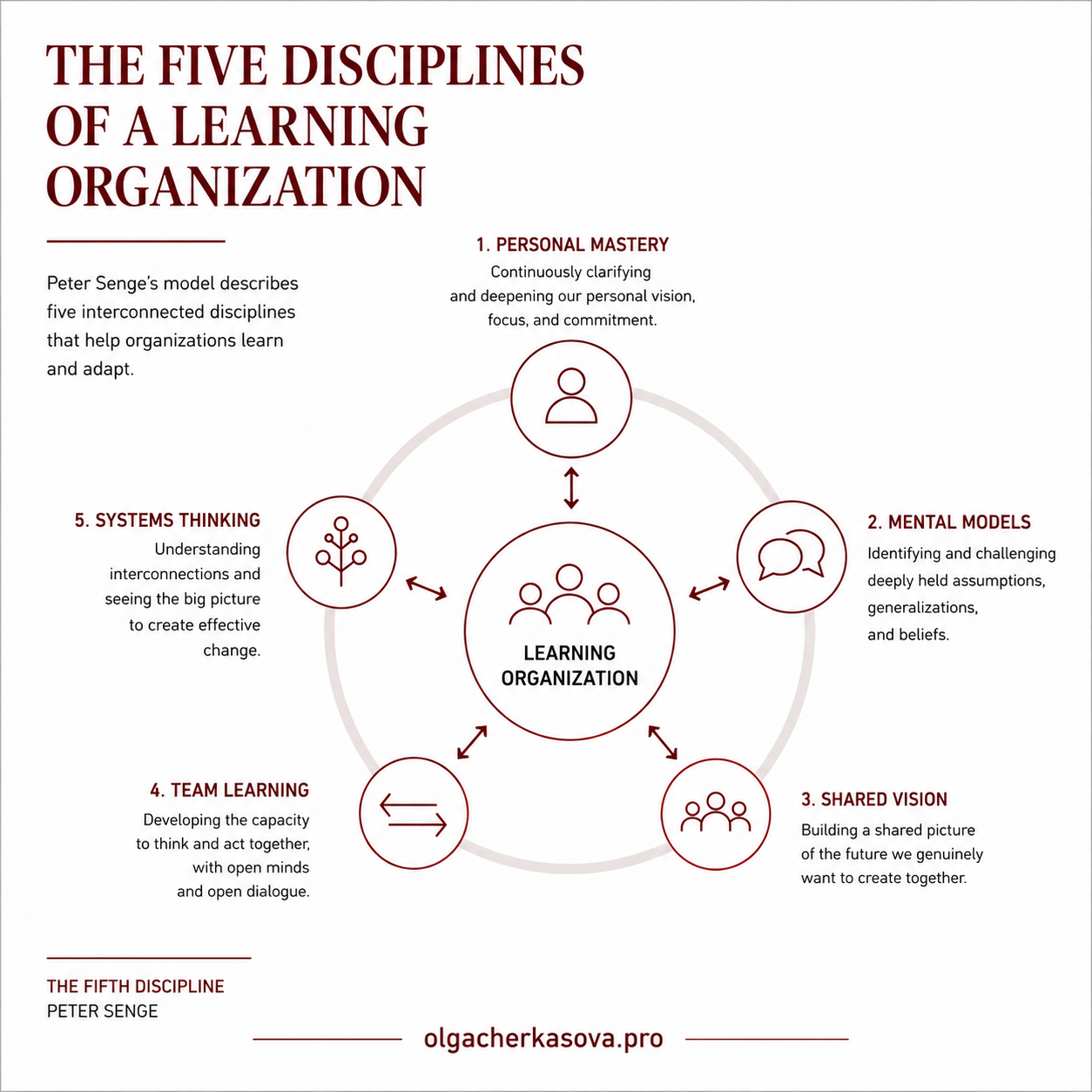
Senge defined a learning organization as one "where people continually expand their capacity to create the results they truly desire, where new and expansive patterns of thinking are nurtured, where collective aspiration is set free, and where people are continually learning how to learn together." He identified five disciplines that characterize learning organizations:
Systems thinking is the "fifth discipline" that gives Senge's book its title. Systems thinking involves understanding how the components of an organization interact, how feedback loops drive organizational behavior, and how interventions in one part of the system can produce unintended consequences in other parts.
Senge drew heavily on Jay Forrester's system dynamics methodology, which uses computer simulation to model the feedback structures that drive organizational behavior over time.
Systems thinking, Senge argued, is the discipline that integrates the other four because it provides the conceptual framework for understanding how the other disciplines interact.
Personal mastery involves individual commitment to lifelong learning, clarifying personal vision, and developing patience and objectivity.
Senge argued that organizational learning cannot exceed the learning capacity of its individual members, and that organizations should support and encourage individual learning as a foundation for collective learning.
Mental models are the deeply held assumptions, generalizations, and images that shape how individuals understand the world and take action.
Senge argued that surfacing, testing, and revising mental models is essential for organizational learning because unexamined mental models often contain flawed assumptions that lead to ineffective action.
This discipline draws directly on Argyris's work on defensive routines and the gap between espoused theories and theories-in-use.
Shared vision involves building a sense of commitment in a group by developing shared images of the future that the organization seeks to create. Senge argued that genuine commitment (as opposed to compliance) requires a vision that people care about, not merely a vision imposed by leadership.
Team learning involves the capacity of teams to think and learn together, which Senge argued requires both dialogue (exploring complex issues through open, non-defensive conversation) and discussion (converging on decisions through structured debate).
Team learning is the process through which individual learning becomes organizational learning, the critical bridge that many organizations fail to build.
"The only sustainable competitive advantage is an organization's ability to learn faster than the competition." - Peter Senge
The Learning Organization in Practice
Senge's framework was enormously influential in management practice. Organizations worldwide created learning initiatives, appointed chief learning officers, established communities of practice, and invested in systems thinking training.
The concept of the learning organization became a standard element of management vocabulary and corporate aspiration.
However, the practical results were mixed. A recurring criticism was that the learning organization concept, while inspiring as an aspiration, provided insufficient guidance for implementation.
David Garvin at Harvard Business School argued in a 1993 article that "the learning organization remains largely an ideal, even its most ardent proponents are hard-pressed to point to actual examples." Garvin proposed a more pragmatic framework for building learning organizations, emphasizing concrete activities like systematic problem solving, experimentation, learning from past experience, learning from others, and transferring knowledge throughout the organization.
Japanese Quality Management and Organizational Learning
While Western scholars were developing theoretical frameworks for organizational learning, Japanese manufacturers were building some of the most effective learning organizations in history.
The Japanese approach to organizational learning, embedded in quality management practices like kaizen (continuous improvement) and the Toyota Production System, provided a powerful practical complement to the theoretical work.
What Role Did Quality Management Play?
Japanese quality management treated every worker as a potential source of learning and improvement. Quality circles, small groups of workers who meet regularly to identify and solve quality problems, engaged front-line employees in systematic problem-solving.
Kaizen events, focused improvement activities targeting specific processes, provided structured frameworks for experiential learning. The Plan-Do-Check-Act (PDCA) cycle, adapted from Deming's statistical quality methods, institutionalized iterative learning as a routine organizational practice.
The Toyota Production System exemplified organizational learning at its most systematic.
Toyota's production lines were designed to make problems visible immediately: when a defect occurred, the production line stopped (through the andon cord system), and the entire team worked together to identify the root cause and implement a permanent fix.
This practice, which would seem catastrophically inefficient to a scientific management adherent (stopping the line costs money!), was actually a highly efficient learning mechanism because it prevented the same defect from recurring and gradually improved the system's overall performance.
Toyota's A3 problem-solving method, named for the A3-sized paper on which the analysis was documented, provided a structured framework for organizational learning from problems.
An A3 document captures the problem definition, current situation analysis, root cause analysis, proposed countermeasures, implementation plan, and follow-up verification on a single sheet of paper, creating a concise learning artifact that can be shared across the organization.
"Data is of course important in manufacturing, but I place the greatest emphasis on facts." - Taiichi Ohno
Tacit Knowledge and Knowledge Creation
A critical question for organizational learning theory is: what kind of knowledge do organizations learn? Ikujiro Nonaka and Hirotaka Takeuchi, in their 1995 book The Knowledge-Creating Company, proposed a framework for understanding organizational knowledge creation that has become one of the most cited works in the field.
How Does Tacit Knowledge Relate to Organizational Learning?
Nonaka and Takeuchi drew on Michael Polanyi's distinction between tacit knowledge (personal, context-specific, hard to formalize and communicate, embodied in skills and intuitions) and explicit knowledge (codified, formal, systematic, easily communicated in words and numbers).
They argued that organizational knowledge creation involves the continuous conversion between tacit and explicit knowledge through four processes, known as the SECI model:
Socialization (tacit to tacit): knowledge transfer through shared experience, observation, and practice. An apprentice learns from a master not primarily through verbal instruction but through watching, imitating, and practicing alongside the master.
Organizational socialization occurs when new employees absorb the organization's tacit cultural knowledge through immersion in its practices and relationships.
Externalization (tacit to explicit): articulating tacit knowledge in explicit concepts, models, metaphors, or analogies.
When a skilled craftsperson explains their technique in a manual, when a successful salesperson codifies their approach in a training program, or when a team captures its project learnings in a retrospective document, externalization occurs.
This is the most valuable and most difficult knowledge conversion process because tacit knowledge resists explicit formulation.
Combination (explicit to explicit): combining, categorizing, and synthesizing existing explicit knowledge to create new explicit knowledge. Databases, reports, research reviews, and strategic plans all involve combination.
This process is well-supported by information technology and is the type of knowledge management that organizations find easiest to implement.
Internalization (explicit to tacit): embodying explicit knowledge in tacit knowledge through practice and experience. When a trainee reads a manual and then develops intuitive skill through practice, internalization has occurred.
Organizational internalization happens when organizational procedures and policies become habitual practice that employees perform automatically.
Nonaka and Takeuchi argued that organizational knowledge creation is a spiral process in which knowledge continuously moves through the four SECI modes, expanding from individual to group to organizational to inter-organizational levels.
The most innovative organizations are those that manage this spiral effectively, creating conditions that facilitate each type of knowledge conversion and each level of expansion.
What Challenges Do Learning Organizations Face?
Despite decades of research and practice, most organizations struggle to learn effectively. Several persistent barriers have been identified.
Defensive Routines and Psychological Safety
As Argyris documented extensively, organizational defensive routines create powerful barriers to learning. These routines are reinforced by the absence of what Amy Edmondson at Harvard Business School has called "psychological safety," the shared belief that the team is safe for interpersonal risk-taking.
In teams with low psychological safety, members are reluctant to ask questions, admit mistakes, offer dissenting opinions, or raise concerns, all of which are essential for organizational learning.
Edmondson's research on medical teams, first published in 1999, found a counterintuitive result: teams that reported more errors actually performed better, not because they made more errors but because they were more willing to report and discuss errors, which enabled learning and improvement.
Teams that reported fewer errors were actually suppressing error reporting, which prevented learning and allowed the same errors to recur.
Google's "Project Aristotle," a large-scale study of team effectiveness launched in 2012, found that psychological safety was the single most important factor distinguishing high-performing teams from low-performing ones, more important than team composition, resources, or structure.
This finding converged with Edmondson's research and with Argyris's earlier theoretical work, confirming that the interpersonal environment is a critical determinant of organizational learning.
Siloed Structures and Knowledge Fragmentation
Organizations are typically structured into functional departments, business units, or geographic divisions that create boundaries between groups.
These boundaries impede the flow of knowledge across the organization, creating knowledge silos where learning in one part of the organization does not transfer to other parts that could benefit from it.
The silo problem is particularly severe for tacit knowledge, which cannot be transferred through documents or databases and requires direct personal interaction for transmission.
A maintenance team that has developed an efficient diagnostic technique cannot share that technique across the organization simply by writing a memo; the technique is embodied in tacit skills that require demonstration, practice, and feedback for transfer.
When organizational structures prevent this direct interaction (because teams are in different locations, different divisions, or different levels of the hierarchy), tacit knowledge remains trapped in local silos.
Time Pressure and Short-Term Orientation
Organizational learning requires investment in activities, including reflection, experimentation, knowledge sharing, and training, that do not produce immediate results.
Organizations under time pressure, performance pressure, or competitive pressure often cut these activities first because their benefits are long-term and difficult to measure, while their costs (time, attention, resources) are immediate and visible.
This creates a learning trap: organizations that most need to learn (because they are struggling) are least able to invest in learning (because they lack slack resources), while organizations that are performing well (and have resources for learning) feel least urgency to learn (because current practices seem adequate).
The trap is reinforced by management accounting systems that treat learning activities as costs rather than investments and by incentive systems that reward short-term performance over long-term capability building.
Competency Traps and Superstitious Learning
Competency traps occur when an organization becomes so proficient at existing practices that it has no incentive to explore alternatives, even when alternatives might be superior.
The organization's very success at current practices creates a barrier to learning new ones because the new practices will initially perform poorly compared to the well-practiced existing ones.
This leads to what James March called the exploitation-exploration trade-off: organizations must balance exploiting existing capabilities (which produces reliable short-term returns) against exploring new possibilities (which produces uncertain but potentially transformative long-term returns).
Superstitious learning occurs when organizations draw incorrect causal conclusions from experience.
If an organization implements a new strategy and performance improves, the organization may attribute the improvement to the strategy even if the actual cause was an external factor (improving market conditions, a competitor's mistake, random variation).
The organization "learns" that the strategy works and continues to apply it, even though the causal inference is wrong.
Superstitious learning is particularly common when sample sizes are small, feedback is delayed, or multiple factors change simultaneously, conditions that characterize most organizational situations.
| Barrier to Learning | Mechanism | Countermeasure |
|---|---|---|
| Defensive routines | Fear of embarrassment prevents open discussion | Psychological safety, Model II behavior |
| Knowledge silos | Structural boundaries block knowledge flow | Cross-functional teams, communities of practice |
| Time pressure | Learning activities sacrificed for immediate demands | Protected learning time, after-action reviews |
| Competency traps | Success at current practices prevents exploration | Dedicated exploration budgets, strategic experiments |
| Superstitious learning | Incorrect causal inferences from experience | Controlled experiments, systematic analysis |
| Employee turnover | Knowledge walks out the door | Knowledge management systems, mentoring programs |
From Organizational Learning to Knowledge Management
The 1990s saw the emergence of knowledge management as a distinct field, driven by the recognition that knowledge had become the most strategically important organizational resource and by the availability of information technology that promised to make organizational knowledge more accessible and transferable.
Knowledge management initially focused on technology-driven approaches: building databases, intranets, expert systems, and knowledge repositories that captured explicit knowledge and made it searchable across the organization.
Major consulting firms like McKinsey, Accenture, and Ernst & Young invested heavily in knowledge management systems that stored project reports, best practices, and expertise directories.
These technology-driven approaches achieved some successes but also encountered significant limitations. The most important limitation was that the most valuable organizational knowledge is often tacit, embodied in people's skills, intuitions, and relationships, and cannot be effectively captured in databases.
This recognition led to a second wave of knowledge management that emphasized people-centered approaches: communities of practice (informal groups of practitioners who share a common interest and learn from each other), mentoring programs, job rotation, storytelling, and other mechanisms for transferring tacit knowledge through social interaction.
Etienne Wenger's concept of communities of practice (CoPs) became one of the most influential ideas in knowledge management.
Wenger defined CoPs as "groups of people who share a concern or a passion for something they do and learn how to do it better as they interact regularly." CoPs are not formal organizational units; they are self-organizing social structures that cut across organizational boundaries and are held together by shared practice rather than by formal authority.
Wenger argued that learning is fundamentally a social activity and that the primary mechanism of organizational learning is participation in communities of practice.
"Learning is not the product of teaching. Learning is the product of the activity of learners." - John Holt
The Contemporary Landscape
Organizational learning research continues to evolve, driven by changes in the nature of work, the structure of organizations, and the technological environment.
Digital transformation has created new opportunities and challenges for organizational learning. Digital platforms enable unprecedented access to information and connection to expertise, but they also create information overload that can impede learning.
Machine learning and artificial intelligence are beginning to augment organizational learning by identifying patterns in data that human analysis would miss, but they also raise questions about what happens to organizational learning when key knowledge is embedded in algorithms rather than in people.
Agile and lean methods have operationalized many organizational learning principles by embedding learning loops into routine work processes. Sprint retrospectives, daily standups, continuous integration, and rapid prototyping all create structured feedback mechanisms that promote learning from experience.
These practices bring organizational learning out of the realm of aspiration and into the realm of daily practice, making learning a routine activity rather than a special initiative.
Psychological safety research has provided actionable guidance for creating the interpersonal conditions that organizational learning requires.
Edmondson's work, Google's Project Aristotle, and related research have shown that psychological safety can be deliberately cultivated through leader behavior (modeling vulnerability, responding constructively to errors, inviting input), team norms (treating disagreement as valuable, celebrating learning from failure), and organizational systems (blame-free reporting systems, learning-oriented performance reviews).
The history of organizational learning research reveals a field that has accumulated genuine insight while struggling to close the gap between theory and practice. The theoretical frameworks are sophisticated and well-supported by evidence.
The practical challenges, building organizations that actually learn from experience rather than merely aspiring to do so, remain as formidable as ever. But the accumulated knowledge provides a rich resource for anyone seeking to build more adaptive, more intelligent, and more resilient organizations.
Key Researchers and Their Contributions
Organizational learning theory was built by a relatively small community of scholars who often knew one another, debated one another's ideas, and built directly on each other's work.
Chris Argyris (1923-2013) completed his doctorate in organizational behavior at Cornell in 1951 and spent most of his career at Harvard Business School, where he was the James B. Conant Professor.
Argyris's early work focused on the tension between individual personality development and the demands of formal organizations; his 1957 book Personality and Organization argued that bureaucratic structures inherently thwart human growth and create passive, defensive employees.
His collaboration with Donald Schon began in the 1970s and produced Organizational Learning (1978) and Theory in Practice (1974).
What distinguished Argyris from most organizational theorists was his willingness to engage directly with practicing managers and executives, running what he called "interventions" that confronted defensive routines in real organizations.
His 1991 Harvard Business Review article "Teaching Smart People How to Learn" argued that the most defensively resistant people in organizations are often the most talented, because they have never experienced failure and have never developed the capacity to learn from it.
Donald Schon (1930-1997) had an unusual intellectual background that bridged philosophy, urban planning, and management theory. After completing his doctorate in philosophy at Harvard studying John Dewey's theory of inquiry, he worked at the consulting firm Arthur D. Little and at the U.S. Department of Commerce before joining MIT's urban studies and planning program.
His book The Reflective Practitioner (1983), which examined how professionals in fields from architecture to psychotherapy actually think and learn during practice rather than from theory, became a foundational text in professional education across medicine, law, engineering, and teaching.
Schon's concept of "reflection-in-action," the ability to think about and revise one's approach while in the midst of a situation rather than only afterward, provided a descriptive counterpart to Argyris's normative prescriptions.
James March (1928-2018) spent most of his career at Stanford University, where he joined the Graduate School of Business and the School of Education in 1970 after earlier positions at Carnegie Mellon.
March was one of the most wide-ranging organizational theorists of his generation, working on decision-making, leadership, organizational change, and learning.
His 1991 paper "Exploration and Exploitation in Organizational Learning" in Organization Science identified what has become one of the most studied tradeoffs in organizational theory: the tension between exploiting existing capabilities (which produces reliable short-term returns) and exploring new possibilities (which produces uncertain but potentially transformative long-term returns).
March's influence extended through his collaborations with Herbert Simon at Carnegie Mellon, producing Organizations (1958), and with Johan Olsen at the University of Bergen, producing work on institutional theory and the "garbage can model" of organizational decision-making.
Herbert Simon (1916-2001) was equally important to organizational learning theory and to behavioral economics, reflecting his insistence on treating organizations as cognitive systems whose behavior depends on how their members process information and make decisions.
His Carnegie Mellon career, spanning from 1949 until his death, produced foundational work across organizational theory, economics, cognitive science, and artificial intelligence.
His concept of bounded rationality provided the theoretical justification for the practical strategies organizations use to make decisions under uncertainty, and his analysis of how organizations encode learning in standard operating procedures anticipated the knowledge management concerns that would preoccupy organizational theorists in the 1990s.
Ikujiro Nonaka (born 1935) completed his doctorate at the University of California, Berkeley in 1972 and built a career at Hitotsubashi University and later the Haas School of Business at Berkeley.
His book The Knowledge-Creating Company (1995), co-authored with Hirotaka Takeuchi, drew on his research into Japanese manufacturing companies to propose the SECI model of knowledge creation.
Nonaka's work was important for making organizational learning theory accessible to the practical concerns of knowledge management and product innovation; his case studies of Honda, Canon, and NEC showed how successful companies continuously converted tacit knowledge embedded in individual expertise into explicit knowledge that could be shared and recombined across the organization.
Amy Edmondson (born 1959) completed her doctorate at Harvard under Richard Hackman and joined the Harvard Business School faculty in 1996. Her 1999 paper on psychological safety in medical teams, published in Administrative Science Quarterly, has become one of the most cited papers in organizational behavior.
Edmondson's research used a mixed-methods design, combining surveys of team psychological safety with observation of actual medication error reporting rates, and her counterintuitive finding that safer teams reported more errors rather than fewer challenged prevailing assumptions about error reporting and team performance.
Her subsequent book The Fearless Organization (2018) extended the psychological safety concept to innovation, learning, and organizational change.
Historical Case Studies That Changed the Field
Several specific research projects and organizational experiments provided the empirical grounding for organizational learning theory.
The Hawthorne Studies (1924-1932). Though predating formal organizational learning theory, the Hawthorne Studies at Western Electric's Hawthorne Works in Chicago established the research foundation on which later work built.
Elton Mayo and Fritz Roethlisberger from Harvard studied the effects of working conditions on worker productivity and found, unexpectedly, that productivity increased when workers were observed regardless of the specific changes made to working conditions.
The "Hawthorne effect" (that observation itself changes behavior) has been widely cited and frequently mischaracterized; more important for organizational learning were the interview programs Mayo and Roethlisberger conducted, which revealed how extensively workers' informal social relationships, interpretations of management decisions, and emotional states affected their work.
These findings challenged the purely mechanistic view of organizations inherited from Frederick Taylor's scientific management.
The Action Science Interventions at Xerox and Other Firms (1970s-1990s). Argyris and his colleagues at Harvard conducted intensive organizational interventions at companies including Xerox, IBM, and several management consulting firms over several decades.
These interventions involved detailed analysis of actual conversations, decisions, and interactions, typically using transcripts that revealed the gap between what participants said they were doing (their "espoused theory") and what their behavior actually revealed (their "theory in use").
The findings were consistently uncomfortable: managers who described themselves as open to learning and feedback were revealed through transcript analysis to be systematically avoiding difficult conversations, attributing problems to others' faults, and protecting themselves from disconfirming information.
Argyris documented these interventions in Strategy, Change and Defensive Routines (1985) and Overcoming Organizational Defenses (1990).
Toyota's Development of the A3 Process (1960s-1980s). The Toyota Production System, developed primarily by Taiichi Ohno and Shigeo Shingo at Toyota from the 1950s through the 1980s, embodied many organizational learning principles in practical production routines.
The A3 problem-solving process, named for the A3 paper size on which the analysis fits, requires that any significant quality problem be analyzed through a structured process that includes documenting the current situation, conducting root cause analysis (typically using the "five whys" technique of repeatedly asking why a problem occurred until a root cause is reached), proposing countermeasures, establishing an implementation plan, and following up to verify results.
Toyota's success in continuously improving quality and productivity while U.S. manufacturers struggled attracted intensive research attention in the 1980s; James Womack, Daniel Jones, and Daniel Roos published The Machine That Changed the World in 1990, documenting Toyota's practices and coining the term "lean production." Toyota's subsequent expansion and quality problems in the 2000s provided equally valuable lessons about the conditions under which organizational learning practices can deteriorate.
Google's Project Aristotle (2012-2015). Google's People Operations team launched Project Aristotle in 2012 to identify the factors that distinguish high-performing teams from low-performing ones.
The project analyzed data from 180 Google teams over two years, combining internal performance ratings with surveys measuring team dynamics, skills, and attitudes.
The analysis, led by Julia Rozovsky and Abeer Dubey, found that team psychological safety was the single strongest predictor of team performance, more important than team composition, individual expertise, or management quality.
The project's findings were published in the New York Times in 2016 and received widespread attention; Google subsequently incorporated psychological safety into its manager training programs and made its tools and frameworks publicly available, accelerating the adoption of Edmondson's concepts in industry.
The Columbia Space Shuttle Investigation (2003). NASA's Columbia Accident Investigation Board, which investigated the February 2003 breakup of Space Shuttle Columbia that killed all seven crew members, produced one of the most detailed analyses ever conducted of organizational learning failure.
The board, chaired by Admiral Harold Gehman, found that the immediate cause (foam debris striking the wing during launch) was secondary to the organizational cause: NASA's culture had developed systematic mechanisms for suppressing uncertainty, dismissing safety concerns raised by junior engineers, and treating known risks as acceptable because they had not produced disasters in the past.
The report drew explicitly on organizational learning theory, particularly Argyris's work on defensive routines, and recommended restructuring NASA's communication and decision-making systems to create space for dissenting voices.
The investigation paralleled an earlier analysis of the 1986 Challenger disaster by sociologist Diane Vaughan, whose 1996 book The Challenger Launch Decision introduced the concept of "the normalization of deviance" to describe how organizations gradually come to accept unsafe practices as normal.
How These Ideas Are Applied Today
Organizational learning concepts have been institutionalized across healthcare, military, technology, and education sectors.
Healthcare Patient Safety. The publication of the Institute of Medicine's report To Err is Human in 1999, which estimated that between 44,000 and 98,000 Americans die annually from preventable medical errors, triggered a patient safety movement that explicitly applied organizational learning concepts to healthcare.
The Leapfrog Group, a nonprofit consortium of large employers, developed hospital quality standards based on organizational learning principles including standardized protocols, simulation training, and intensive care unit staffing.
The Agency for Healthcare Research and Quality (AHRQ) funded development of TeamSTEPPS, a team training program grounded in psychological safety and communication research, which has been implemented in over 2,000 U.S. hospitals.
The UK's National Reporting and Learning System collects over 2 million incident reports annually from NHS organizations, creating a systematic organizational learning mechanism across the entire health system.
Military After Action Reviews and Organizational Adaptation. The U.S. Army's Center for Army Lessons Learned (CALL), established in 1985, institutionalizes organizational learning across the Army through systematic collection, analysis, and distribution of lessons from operations and training exercises.
CALL publishes handbooks, bulletins, and newsletters that codify lessons learned from specific operations and distribute them to commanders who will face similar situations.
The broader military approach to "lessons learned" has been adopted by NATO allies and studied extensively by organizational theorists; research by James March and colleagues found that military organizations with strong lessons-learned systems showed better performance in subsequent operations, though the relationship was complicated by the tendency to learn wrong lessons from ambiguous evidence.
Knowledge Management in Professional Services. Management consulting firms including McKinsey, Deloitte, Accenture, and Boston Consulting Group have invested heavily in knowledge management systems designed to capture and distribute the organizational knowledge created through client engagements.
McKinsey's Practice Development Network, which began in the 1980s, created communities of practice around specific industry and functional expertise; consultants working on related engagements are connected to one another and to relevant prior work through electronic systems and personal networks.
The effectiveness of these systems has been studied extensively; research by Morten Hansen at INSEAD found that the most effective knowledge-sharing in professional services firms occurred through strong personal networks rather than electronic repositories, confirming Nonaka's argument that tacit knowledge transfer requires social interaction.
Agile Software Development. The Agile Manifesto, published in 2001 by 17 software developers meeting in Snowbird, Utah, institutionalized organizational learning principles in software development practice.
Agile methods including Scrum, Extreme Programming, and Kanban embed feedback loops into the development process through daily standups (which surface problems quickly), sprint reviews (which demonstrate working software to stakeholders for immediate feedback), and retrospectives (which apply structured reflection to team processes).
The retrospective, in which the team discusses what went well, what went poorly, and what should change in the next sprint, is an institutionalized form of single-loop and double-loop learning.
Empirical research on Agile adoption, including surveys by the Scrum Alliance and VersionOne, consistently finds that teams using Agile methods report faster response to changing requirements and higher product quality, though separating Agile-specific effects from other organizational factors is methodologically difficult.
Empirical Research That Quantified Organizational Learning Effects
Organizational learning theory for decades relied heavily on case studies and qualitative methods. A second generation of researchers introduced rigorous quantitative methods that produced precise estimates of learning rates and identified the conditions under which learning accelerates or stalls.
Linda Argote's Learning Curve Research in Shipbuilding and Other Industries (1990-2013). Linda Argote at Carnegie Mellon, building on the World War II-era discovery that aircraft manufacturing costs fell predictably as cumulative production doubled (the "learning curve" or "experience curve"), conducted a systematic quantitative program examining learning curves across dozens of industries.
Her 1993 paper with Epple/Beckman and related work analyzing data from 16 U.S. Liberty ship builders during World War II, found that shipyards with higher output learned faster, consistent with the learning curve theory, but also found enormous variation in how much knowledge was retained when production levels dropped - some yards "forgot" rapidly while others maintained performance gains.
A key finding from Argote and Dennis Epple's 1990 Science paper, reviewing learning curves across multiple industries, was that organizational learning rates varied by a factor of ten or more across organizations doing the same work, even after controlling for technology and workforce differences.
Argote's subsequent research identified mechanisms underlying this variation: organizations that embedded learning in routines and tools retained it better than those that relied on individuals carrying knowledge.
This finding had direct practical implications: organizations that encode best practices into shared protocols and tools, rather than relying on the skill improvement of individuals, tend to retain and spread performance gains more reliably.
Amy Edmondson's Medical Team Research and the Psychological Safety Findings (1996-1999). Amy Edmondson's dissertation research at Harvard, later published as a landmark 1999 paper in Administrative Science Quarterly, investigated medication error reporting across nursing teams in a Boston hospital.
Edmondson's initial hypothesis was that higher-performing teams would report fewer errors. Her surveys and observation produced a counterintuitive reversal: teams whose managers were rated as more supportive and psychologically safe reported significantly more errors.
After ruling out the explanation that these teams were simply making more errors, Edmondson concluded that the difference was in reporting rather than occurrence: psychologically safe teams reported errors that all teams made; others concealed them.
The finding was practically important because error reporting is the organizational learning mechanism for preventing recurrence - organizations that suppress error reporting cannot learn from them.
Edmondson, Bohmer and Pisano conducted a follow-up study tracking 16 hospital cardiac surgery teams as they learned to perform minimally invasive cardiac surgery, a demanding new technique.
Teams with higher psychological safety learned the new procedure more successfully. The study (Edmondson, Bohmer & Pisano) was published in Administrative Science Quarterly in 2001 and became a foundational reference for the patient safety movement.
The Joint Commission, which accredits U.S. hospitals, subsequently incorporated psychological safety requirements into its leadership standards.
Diego Gambetta and the Sicilian Mafia as a Knowledge-Sharing Problem (1993). Diego Gambetta's The Sicilian Mafia: The Business of Private Protection (1993) used organizational learning theory in an unexpected domain to reveal insights about trust and knowledge transfer that generalized well beyond the original context.
Gambetta studied how Sicilian Mafia clans solved the fundamental problem of establishing trust and credibility among criminals who could not rely on legal enforcement of contracts.
His analysis showed that Mafia organizations had developed elaborate signaling systems, rituals, and reputation mechanisms that served the same function as formal credentialing systems in legitimate organizations - they created shared knowledge about who could be trusted and what they had done.
Gambetta's finding that criminal organizations could sustain sophisticated knowledge-sharing and coordination mechanisms challenged the assumption, common in organizational learning theory, that hierarchical authority or formal communication systems were necessary for effective organizational learning.
The book influenced subsequent work on trust in organizational learning by scholars including Morten Hansen at INSEAD, who found in a 2002 Management Science paper studying 120 sales teams that strong interpersonal trust was the primary predictor of tacit knowledge sharing across team boundaries, more than formal knowledge management systems.
Organizational Learning Failures and What They Revealed
Some of the field's most instructive findings came from situations where organizational learning conspicuously failed, often with catastrophic consequences.
The Ford Pinto Fuel Tank Crisis and Suppressed Internal Learning (1968-1978). The Ford Pinto safety controversy illuminated a specific pathology of organizational learning: the deliberate suppression of internal learning to avoid costly corrections.
Ford engineers discovered during testing in 1968-1970 that the Pinto's fuel tank design was vulnerable to rupture in rear-end collisions, which could cause fires.
Internal cost-benefit analysis, which became public during litigation in the 1970s, showed that Ford calculated the cost of vehicle modifications at $11 per car (about $137 million total) versus the estimated value of deaths and injuries prevented at $49.5 million total - roughly $4 per car.
Based on this analysis, Ford decided not to modify the design. The Grimshaw v. Ford Motor Company verdict in 1978, which included $125 million in punitive damages (later reduced to $3.5 million on appeal), established that the cost-benefit calculation was not just morally wrong but legally actionable.
The Pinto case became a foundational example in business ethics curricula and in organizational learning research, illustrating how financial metrics can function as defensive routines that prevent safety learning from being acted upon.
James Reason, who developed the influential "Swiss cheese model" of organizational accident causation in his 1990 book Human Error, used the Pinto case to argue that organizational accidents have multiple contributing causes distributed across the system rather than a single human error, and that effective organizational learning requires examining all layers simultaneously.
NASA's Return to Flight After Columbia: Organizational Learning Applied (2003-2005). The Columbia Accident Investigation Board's 2003 report included specific recommendations for organizational change at NASA designed to institutionalize the double-loop learning that Argyris had theorized.
The board recommended establishing an independent technical authority to override program management on safety decisions, creating a dedicated safety reporting system with whistleblower protections, and restructuring NASA's internal communication to ensure that dissenting technical opinions reached senior decision-makers.
NASA's subsequent Return to Flight program, which led to the successful STS-114 mission in July 2005, provided a documented case study of organizational learning implementation under public scrutiny.
Eduardo Salas at the University of Central Florida and his colleagues conducted an evaluation of NASA's Return to Flight training programs, published in Human Factors in 2006, and found that teams that participated in structured debriefing exercises showed a 25% improvement in error detection and communication effectiveness compared to teams trained without structured reflection - consistent with Senge's argument that learning disciplines must be practiced, not merely understood.
The NASA case was subsequently analyzed in over 40 academic papers on high-reliability organizations and became a reference point for other industries, including aviation and nuclear power, seeking to institutionalize learning from near-misses and actual failures.
Sources & Further Reading
Senge, P. M. (1990). The Fifth Discipline: The Art and Practice of the Learning Organization. Doubleday. View source
Argyris, C. & Schon, D. A. (1978). Organizational Learning: A Theory of Action Perspective. Addison-Wesley. View source
Nonaka, I. & Takeuchi, H. (1995). The Knowledge-Creating Company. Oxford University Press. View source
Cyert, R. M. & March, J. G. (1963). A Behavioral Theory of the Firm. Prentice-Hall. View source
Edmondson, A. C. (2019). The Fearless Organization: Creating Psychological Safety in the Workplace. Wiley. View source
Garvin, D. A. (1993). Building a learning organization. Harvard Business Review, 71(4), 78-91. View source
March, J. G. (1991). Exploration and exploitation in organizational learning. Organization Science, 2(1), 71-87. DOI: 10.1287/orsc.2.1.71
Wenger, E. (1998). Communities of Practice: Learning, Meaning, and Identity. Cambridge University Press. DOI: 10.1017/CBO9780511803932
Levitt, B. & March, J. G. (1988). Organizational learning. Annual Review of Sociology, 14, 319-340. DOI: 10.1146/annurev.so.14.080188.001535
Argyris, C. (1990). Overcoming Organizational Defenses. Allyn & Bacon. View source
Liker, J. K. (2004). The Toyota Way: 14 Management Principles from the World's Greatest Manufacturer. McGraw-Hill. View source
Polanyi, M. (1966). The Tacit Dimension. University of Chicago Press. View source
Huber, G. P. (1991). Organizational learning: The contributing processes and the literatures. Organization Science, 2(1), 88-115. DOI: 10.1287/orsc.2.1.88
Edmondson, A. C. (1999). Psychological safety and learning behavior in work teams. Administrative Science Quarterly, 44(2), 350-383. DOI: 10.2307/2666999
de Geus, A. (1997). The Living Company: Habits for Survival in a Turbulent Business Environment. Harvard Business School Press.
Ohno, T. (1988). Toyota Production System: Beyond Large-Scale Production. Productivity Press.
Wiener, N. (1948). Cybernetics: Or Control and Communication in the Animal and the Machine. MIT Press.
Holt, J. (1964). How Children Fail. Pitman Publishing.
Crossan, M. M., Lane, H. W., & White, R. E. (1999). An organizational learning framework: From intuition to institution. Academy of Management Review, 24(3), 522-537.
Zollo, M. & Winter, S. G. (2002). Deliberate learning and the evolution of dynamic capabilities. Organization Science, 13(3), 339-351.