
What Is the Learning by Doing vs Studying Debate?
The learning by doing vs. studying debate concerns which approach to acquiring knowledge and skill is more effective: direct experience and practice (experiential learning) or structured study of theory, principles, and existing knowledge (formal study).
Learning by doing - also called experiential or hands-on learning - builds procedural skill and pattern recognition through repeated practice and feedback. Formal study builds declarative knowledge and conceptual understanding through exposure to organized information.
Research and practical evidence consistently show that neither approach alone is optimal; the most effective learners integrate both, using theory to guide practice and practice to test and deepen theoretical understanding.
In 1903, Wilbur and Orville Wright achieved powered human flight at Kitty Hawk, North Carolina. They had no formal engineering education. They had never attended a university. They were bicycle mechanics from Dayton, Ohio, who had taught themselves aerodynamics through a combination of voracious reading and relentless experimentation.
They read everything available on flight-Otto Lilienthal's data tables, Octave Chanute's compilations of aeronautical research, Samuel Langley's publications on atmospheric physics-and then they built things.
They built kites. They built gliders. They built a wind tunnel. They tested over 200 wing shapes in their wind tunnel, methodically varying camber, aspect ratio, and angle of attack. They crashed their gliders repeatedly, each crash teaching them something that books could not.
The Wrights' competitor, Samuel Langley, was the Secretary of the Smithsonian Institution, a distinguished physicist, and the most credentialed aeronautical researcher in America.
Langley had access to $50,000 in War Department funding (over $1.5 million in today's dollars), a professional engineering team, and decades of theoretical research.
He studied flight exhaustively but tested his designs infrequently-and when he did test, his Aerodrome plunged into the Potomac River on both attempts, nine days before the Wrights succeeded at Kitty Hawk.
The Wright brothers' triumph over Langley is often cited as evidence that hands-on learning defeats book learning.
But this framing misses the critical detail: the Wrights did both. They studied theory extensively (correcting errors in Lilienthal's data through their own experiments) and practiced extensively (hundreds of glider flights before attempting powered flight).
What made them successful was not that they chose doing over studying but that they integrated both approaches, using study to guide their practice and practice to correct and deepen their understanding.
"For the things we have to learn before we can do them, we learn by doing them." - Aristotle
The debate between learning by doing and learning by studying is among the oldest in education. Aristotle distinguished between episteme (theoretical knowledge) and techne (practical skill). John Dewey argued in the early 20th century that education should be grounded in experience.
The progressive education movement he inspired was later challenged by traditionalists who argued that direct instruction in structured knowledge was more efficient. This debate continues today in every domain where learning matters-schools, workplaces, professional development programs, and self-education.
The resolution is not to choose one approach over the other but to understand when each is most effective, what each contributes that the other cannot, and how to combine them for optimal learning.
What Is Learning by Doing?
What is learning by doing? Learning by doing-also called experiential learning, practice-based learning, or hands-on learning-is the process of acquiring knowledge and skill through direct experience, practice, trial-and-error, and application in real or realistic contexts.
It builds procedural knowledge (knowing how) and pattern recognition (the ability to recognize situations and retrieve appropriate responses) through repeated engagement with the domain.
How Experiential Learning Works
David Kolb's Experiential Learning Theory describes learning by doing as a four-stage cycle:
- Concrete Experience: The learner engages in an activity or experience.
- Reflective Observation: The learner reflects on the experience what happened, what worked, what did not, what was surprising.
- Abstract Conceptualization: The learner draws conclusions, formulates principles, or updates mental models based on the reflection.
- Active Experimentation: The learner tests the new understanding by applying it in new situations, generating new concrete experiences, and continuing the cycle.
The critical insight of Kolb's model is that experience alone is not sufficient for learning. Experience without reflection produces repetition, not learning. A person who makes the same mistake a hundred times has had one experience repeated a hundred times, not a hundred learning experiences.
The reflection stage-pausing to analyze what happened and why-converts raw experience into understanding that can be applied to future situations.
The Strengths of Learning by Doing
Builds procedural skill. Many skills cannot be learned through study alone. You cannot learn to ride a bicycle by reading about it. You cannot learn to write well by reading about writing. You cannot learn to negotiate effectively by studying negotiation theory.
These skills require the development of motor patterns, cognitive routines, and situational responses that are built only through practice.
Cognitive psychologists distinguish between declarative knowledge (knowing that-facts, concepts, principles) and procedural knowledge (knowing how-skills, techniques, routines). Study builds declarative knowledge. Practice builds procedural knowledge.
Develops pattern recognition and intuition. As discussed in the context of intuitive decision-making, expertise in any domain involves the development of pattern recognition that operates below conscious awareness. A master chess player "sees" the right move.
An experienced surgeon "feels" when tissue is abnormal. A veteran programmer "senses" that a codebase has architectural problems. This pattern recognition develops only through extensive practice-there is no shortcut through study alone.
Herbert Simon estimated that chess mastery requires the storage of approximately 50,000 to 100,000 board patterns, each acquired through playing and studying actual games.
Provides immediate feedback. When you attempt something and fail, the failure itself provides information about what does not work. When you attempt something and succeed, the success reinforces the approach. This feedback loop-attempt, observe result, adjust-is the engine of skill development.
Feedback from doing is immediate and concrete, while feedback from studying is delayed and abstract.
Creates embodied understanding. Some forms of knowledge are inherently experiential. A carpenter who has sanded thousands of boards has a physical feel for the wood-how different grains respond to different pressures, how moisture affects sanding, how to detect imperfections by touch.
This embodied knowledge is real, valuable, and impossible to acquire through reading. Michael Polanyi called this tacit knowledge-knowledge that the knower cannot fully articulate but that profoundly influences their performance.
"We can know more than we can tell." - Michael Polanyi
Develops judgment under uncertainty. Real-world situations are messy, ambiguous, and uncertain. They rarely conform to the clean categories and clear distinctions of textbook descriptions.
Learning by doing builds the ability to operate in this messiness-to make decisions with incomplete information, to adapt when plans encounter unexpected obstacles, and to improvise when pre-planned responses do not fit the situation.
Motivates through engagement. Learning by doing is generally more engaging than passive studying. Active engagement-manipulating materials, solving problems, creating artifacts, interacting with others-activates motivational circuits that passive reception does not.
Research consistently finds that active learning produces higher engagement, better retention, and more positive attitudes toward the subject matter than passive lectures.
The Limitations of Learning by Doing
Can you learn entirely by doing? No-learning entirely through doing has significant limitations:
Inefficient for acquiring conceptual frameworks. A person who tries to learn physics entirely through experimentation will take far longer to discover Newton's laws than a person who studies them in a textbook.
The accumulated knowledge of humanity-scientific principles, mathematical relationships, historical patterns, logical frameworks-represents centuries of collective learning that would be impossibly time-consuming to rediscover individually through experience.
Risk of repeating known mistakes. Without studying what others have learned, a learner is likely to make mistakes that have been thoroughly documented and could have been avoided.
A first-time manager who does not study management principles will make errors (micromanaging, failing to delegate, avoiding difficult conversations) that management research has long identified and that books could have warned about.
Learning from your own mistakes is valuable, but learning from other people's mistakes is more efficient.
May not generalize beyond specific cases. Experience-based learning can produce knowledge that is tightly bound to the specific context in which it was acquired.
A person who learned to program in one language may struggle to transfer that knowledge to a different language because the learning was encoded as specific procedures rather than general principles.
Study helps learners abstract general principles from specific cases, enabling transfer to new contexts.
Incomplete without conceptual scaffolding. Experiential learning is most effective when the learner has a conceptual framework that helps organize and interpret the experience.
A medical student who observes patient examinations without any prior knowledge of anatomy, physiology, or pathology will learn very little because they lack the conceptual scaffolding to make sense of what they are observing.
The same student, after studying anatomy and pathology, will learn enormously from the same observations because they have a framework for interpreting what they see.
Expensive or dangerous in some domains. Some domains have high costs for learning through trial and error. An aspiring pilot cannot learn to fly by trial and error-the errors are fatal. A student surgeon cannot learn by experimenting on patients.
A nuclear engineer cannot learn reactor management by triggering meltdowns. In these domains, theoretical study, simulation, and carefully supervised practice are necessary to build competence before independent practice begins.
Prone to survivorship bias. When we celebrate people who succeeded through hands-on learning (the Wright brothers, Steve Jobs, college dropouts who founded tech companies), we ignore the far larger number who attempted the same approach and failed.
The stories of successful experiential learners are highly visible; the stories of unsuccessful ones are invisible. This survivorship bias can create a misleading impression that experiential learning is a reliable path to success when it is actually a high-variance approach that works spectacularly for some and poorly for many.
What Is Learning by Studying?
What is learning by studying? Learning by studying-also called theoretical learning, explicit instruction, or book learning-is the process of acquiring knowledge through reading, lectures, observation, and formal instruction.
It builds declarative knowledge (facts, concepts, principles, frameworks) and explicit understanding (the ability to articulate what you know and why it works).
The Strengths of Studying
Efficient transmission of accumulated knowledge. The most powerful advantage of studying is that it leverages the accumulated learning of countless predecessors. A physics student who reads a textbook absorbs knowledge that took humanity centuries to develop-in a few months.
A medical student who studies pathology learns from thousands of clinical cases documented by generations of physicians. This efficiency is the fundamental value proposition of formal education: you do not have to rediscover everything through personal experience.
Builds conceptual frameworks. Study develops the mental models and conceptual frameworks that organize raw experience into coherent understanding. A person who has studied economics sees patterns in business behavior that a person without that framework would miss.
A person who has studied psychology recognizes cognitive biases in their own thinking that a person without that knowledge would not detect. These frameworks function as lenses that make the world more legible.
Prevents known mistakes. One of the most valuable functions of studying is learning what does not work.
Reading about common startup mistakes before starting a company, studying common management failures before becoming a manager, learning about cognitive biases before making important decisions-these forms of study can prevent errors that experiential learners would have to make personally (and perhaps repeatedly) before discovering the same lessons.
Enables learning from others' experience. You cannot personally experience everything relevant to your work. You will not face every type of crisis, encounter every type of problem, or work in every type of organization.
But through study-case studies, biographies, research findings, historical analysis-you can learn from others who have faced situations you have not, dramatically expanding the range of experiences that inform your understanding.
Provides systematic coverage. Experiential learning tends to be patchy-you learn about the things you happen to encounter. Study can be systematic-a textbook covers a subject comprehensively, ensuring that the learner encounters all important concepts, including those they might never encounter in practice.
A medical student who studies parasitology may never encounter a tropical parasite in clinical practice, but the knowledge exists if they ever do.
Scales efficiently. One author's book can teach millions of readers. One lecturer's course can educate thousands of students. One research paper can inform the practice of an entire profession.
This scalability means that the cost per learner of study-based education is far lower than the cost per learner of experiential education.
The Limitations of Studying
Can you learn entirely by studying? Also limited-studying without practice produces several problems:
The knowing-doing gap. Jeffrey Pfeffer and Robert Sutton coined the term "knowing-doing gap" to describe the pervasive organizational phenomenon of knowing what should be done but failing to do it. The gap between knowing and doing is not a failure of knowledge-it is a failure of practice.
A person who has read ten books about public speaking but has never given a speech does not know how to speak publicly. They know about speaking publicly-a very different thing.
"Knowing is not enough; we must apply. Willing is not enough; we must do." - Johann Wolfgang von Goethe
Overestimation of understanding. Study creates a sense of familiarity with a subject that can be mistaken for understanding. After reading a chapter on negotiation, a student feels they understand negotiation.
But the first time they negotiate a real deal-with an adversary who does not follow the textbook's script, under time pressure, with emotional stakes-they discover that their "understanding" was shallow.
Psychologists call this the illusion of explanatory depth: the feeling of understanding a complex phenomenon that dissolves when you try to explain it in detail or apply it in practice.
Missing tacit knowledge. Much of the knowledge that makes experts effective is tacit-impossible to fully articulate in words.
A chef's sense of when a sauce is properly reduced, a therapist's feel for when to push and when to back off, a detective's sense for when a witness is lying-these forms of knowledge are transmitted through apprenticeship, observation, and practice, not through textbooks.
Study can describe what experts do, but it cannot fully transmit the experiential foundation that enables them to do it.
Passive consumption. Studying can be a passive activity-reading without engaging, listening without thinking, highlighting without processing. Research on learning consistently finds that passive consumption produces poor retention and limited transfer.
The testing effect (retrieval practice), spacing effect (distributed practice), and generation effect (producing answers rather than recognizing them) all demonstrate that active engagement with material produces far superior learning compared to passive reading or listening.
Disconnection from context. Knowledge acquired through study is often decontextualized-abstracted from the messy, specific situations where it must be applied.
A student who has learned the principles of project management from a textbook may struggle to apply those principles in an actual project where politics, personalities, resource constraints, and unexpected events create conditions far messier than any textbook scenario.
Which Is More Effective?
Which is more effective? It depends fundamentally on what you are trying to learn. Procedural skills (how to do something) require practice. Conceptual knowledge (understanding why something works) benefits from study. Most real-world competencies involve both dimensions, which is why the most effective approach combines both.
Research provides clear guidance about the relative effectiveness of each approach for different types of learning:
| Learning Goal | Study More Effective | Doing More Effective | Both Needed |
|---|---|---|---|
| Factual knowledge (dates, definitions, formulas) | Yes | ||
| Conceptual understanding (principles, theories, models) | Yes | Sometimes (complex concepts) | |
| Procedural skill (how to perform a task) | Yes | ||
| Motor skill (physical performance) | Yes | ||
| Pattern recognition (expert intuition) | Yes | ||
| Problem-solving (applying knowledge to novel problems) | Yes | ||
| Judgment under uncertainty (real-world decision-making) | Yes | ||
| Communication (writing, speaking, negotiating) | Yes | ||
| Leadership (motivating, directing, inspiring) | Yes | ||
| Creative work (design, art, innovation) | Yes |
Notice that most of the goals that matter in professional life-problem-solving, judgment, communication, leadership, creativity-require both study and practice. These competencies cannot be fully developed through either approach alone.
How Should You Combine Both?
How should you combine both? The most effective learning sequences alternate between study and practice, using study to understand principles and practice to develop skills, with each informing and enriching the other. Several specific strategies have strong research support:
Strategy 1: Study First, Then Practice
Begin with study to build a conceptual foundation, then practice to develop procedural skill within that framework. This approach is most effective when:
- The domain has a substantial body of formal knowledge (medicine, law, engineering, science)
- Mistakes during practice are costly or dangerous
- The conceptual framework is complex and would be difficult to discover through practice alone
Example: Medical education follows this pattern. Students study anatomy, physiology, and pathology for two years before beginning clinical rotations. The theoretical foundation makes clinical experience far more valuable because students have the conceptual scaffolding to interpret what they observe.
Strategy 2: Practice First, Then Study
Begin with hands-on engagement to build familiarity and generate questions, then study to answer those questions and deepen understanding. This approach is most effective when:
- The domain is best understood through direct experience
- Initial practice is low-cost and low-risk
- Motivation comes from engagement rather than abstraction
Example: Many successful programmers learned by first writing code (practice), encountering problems, then reading documentation and computer science concepts (study) to solve those problems. The practice generates specific, concrete questions that study answers.
The motivation to study is driven by practical need rather than abstract curriculum requirements.
Strategy 3: Interleaved Study and Practice
Alternate between short periods of study and short periods of practice throughout the learning process. This approach is most effective when:
- The skill has both conceptual and procedural components
- Feedback from practice can immediately inform study focus
- The domain evolves rapidly, requiring continuous learning
Example: Musicians often practice a passage (doing), consult the score or a teacher for guidance (study), practice again with the new understanding (doing), and continue this rapid cycle throughout their development. Each cycle of study-informed practice and practice-informed study produces deeper learning than either alone.
Strategy 4: Study Others' Experience as Proxy for Doing
When practice is expensive, dangerous, or slow, studying others' experiences-case studies, post-mortems, biographies, simulations-provides a form of vicarious experience that partially substitutes for direct practice. This approach is most effective when:
- Personal practice is limited by opportunity, cost, or risk
- Rich case material is available from others' experiences
- The learner has enough foundational knowledge to learn from the cases
Example: Business school case studies are designed to provide vicarious experience in business decision-making. Students analyze real situations, make decisions, and compare their reasoning with what actually happened.
While not equivalent to actually running a company, case analysis builds judgment-like competencies more effectively than pure theory.
Strategy 5: Deliberate Practice with Theoretical Grounding
Use study to identify specific weaknesses, then design practice activities specifically targeted at those weaknesses. This approach-essentially Ericsson's deliberate practice model-is most effective when:
- The learner has progressed beyond the beginner stage
- Specific performance gaps have been identified
- Targeted practice activities can be designed to address those gaps
Example: A chess player who studies their game records (theory/analysis), identifies a weakness in endgame play (assessment), and then practices endgame scenarios specifically (targeted doing) improves faster than a player who simply plays more games without targeted analysis.
Common Mistakes in Balancing Study and Practice
Mistake 1: All Theory, No Practice
The student who reads ten books about entrepreneurship but never starts a business. The aspiring writer who takes writing workshops endlessly but never publishes anything. The manager who attends leadership seminars but does not apply the principles to their team.
Endless study without practice produces theoretical knowledge that never converts to practical capability. At some point, you have to stop reading about swimming and get in the pool.
Mistake 2: All Practice, No Theory
The programmer who writes code for years without studying computer science fundamentals, then hits a ceiling when problems require algorithmic knowledge they never acquired. The manager who learns entirely through experience, repeating mistakes that a management textbook would have warned about.
The athlete who practices intensely but without understanding of biomechanics, nutrition, or training science, eventually plateauing or getting injured. Practice without theoretical grounding is inefficient at best and dangerous at worst.
Mistake 3: Studying as Procrastination
Study can function as a comfortable substitute for the more difficult, more uncomfortable work of practice. Reading another book about writing is easier than writing. Watching another tutorial about programming is easier than writing code.
Attending another course on management is easier than having a difficult conversation with an underperforming employee. When study is motivated by avoidance of practice rather than by genuine knowledge needs, it becomes procrastination.
Mistake 4: Practicing Without Reflection
Kolb's experiential learning cycle requires reflection-pausing to analyze what happened and why. Practice without reflection is mere repetition. A salesperson who makes 100 calls without analyzing which approaches worked and which did not will improve slowly if at all.
The same salesperson who makes 50 calls with careful reflection after each batch will improve faster because the reflection converts experience into learning.
Mistake 5: Mismatching Approach to Learning Stage
Beginners often benefit more from study (building the conceptual foundation) while advanced learners benefit more from practice (refining procedural skill).
Applying the wrong approach at the wrong stage is inefficient: a complete beginner thrown into practice without any conceptual foundation is overwhelmed and learns chaotically. An advanced practitioner sent to a classroom to learn basics they mastered years ago is bored and unstimulated.
What Research Says About Optimal Learning
The learning sciences have produced robust findings about how people learn most effectively. These findings consistently support the integration of study and practice:
Active learning outperforms passive learning. A meta-analysis by Freeman and colleagues, published in the Proceedings of the National Academy of Sciences, analyzed 225 studies and found that active learning (problem-solving, discussion, application) increased examination scores by approximately half a standard deviation compared to traditional lecturing.
Students in traditional lecture courses were 1.5 times more likely to fail than students in active learning courses.
"Tell me and I forget, teach me and I may remember, involve me and I learn." - Benjamin Franklin
Retrieval practice outperforms re-reading. Testing yourself on material (retrieval practice) produces far better long-term retention than re-reading the same material.
This finding, replicated across hundreds of studies, demonstrates that the active effort of retrieving information from memory strengthens the memory more than the passive activity of re-exposing yourself to information.
Spaced practice outperforms massed practice. Distributing practice over time (studying a topic on Monday, Wednesday, and Friday) produces better retention than concentrating the same amount of practice in a single session (studying for three hours on Monday). This spacing effect is among the most robust findings in learning science.
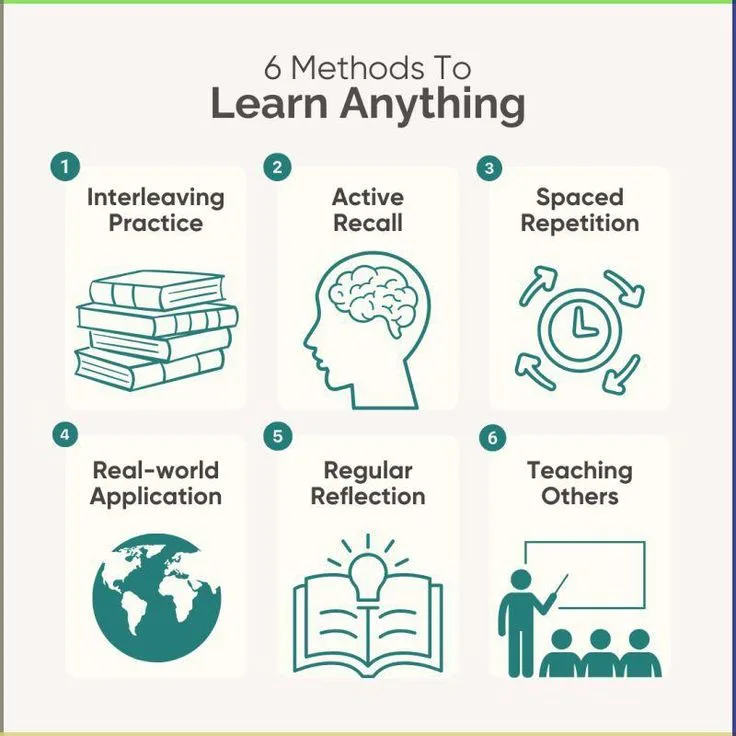
Interleaving outperforms blocking. Practicing different types of problems in mixed sequence (interleaving) produces better learning than practicing one type of problem until mastery before moving to the next (blocking).
Interleaving is harder and feels less productive in the moment, but it builds the discrimination and transfer abilities that make knowledge useful in the real world, where problems do not arrive sorted by type.
Feedback is essential. Practice without feedback is dramatically less effective than practice with feedback. The feedback does not need to be immediate (slightly delayed feedback actually produces better learning in some contexts), but it must be available and attended to.
This finding underscores why experiential learning in environments with clear feedback (sports, music, surgery) produces reliable expertise, while experiential learning in environments with delayed or absent feedback (management, investing, political judgment) does not.
These findings converge on a clear prescription: the most effective learning involves active engagement with material, frequent testing of understanding, distributed practice over time, varied practice conditions, and timely feedback. This prescription requires both study (to acquire the material) and practice (to engage with it actively), combined in ways that leverage the strengths of each.
The Active Learning Evidence Base: What 225 Studies Found
The most comprehensive meta-analysis of active versus passive learning was conducted by Scott Freeman and colleagues at the University of Washington, published in the Proceedings of the National Academy of Sciences in 2014.
The study analyzed 225 independent studies comparing active learning (problem-solving, discussion, peer instruction, hands-on application) with traditional lecture instruction across science, technology, engineering, and mathematics courses.
Key quantitative findings:
- Students in traditional lecture courses were 1.5 times more likely to fail than students in active learning courses (33.8 percent failure rate versus 21.8 percent).
- Active learning increased examination scores by an average of 6 percentage points (approximately half a standard deviation).
- The active learning advantage was larger for smaller classes (50 or fewer students), though active learning still outperformed lecturing in larger classes.
Freeman's team analyzed what specifically constituted "active learning" in the highest-performing studies.
The most effective interventions combined brief study inputs with immediate application tasks: reading a passage then solving a problem, watching a demonstration then attempting to replicate it, listening to an explanation then teaching it to a peer.
This structure-study input followed by immediate doing-is the interleaved approach described in the article's strategy section.
Carl Wieman, Nobel laureate physicist, along with colleagues Louis Deslauriers and Ellen Schelew, conducted a controlled experiment at the University of British Columbia, where Wieman was based at the time (published in Science, 2011), testing active learning in a physics class of 267 students.
One section received a week of traditional lecture on electromagnetic fields from an experienced professor.
The other received the same material over the same period through structured active learning facilitated by less experienced instructors. The active learning group scored roughly 74% versus 41% on a post-instruction assessment and reported higher engagement.
Wieman's conclusion-that for building problem-solving competence, even inexperienced facilitators of active learning outperform expert lecturers-is the strongest evidence that doing is not merely a supplement to studying but is often the primary vehicle for the kind of learning that transfers to real problems.
Surgical Training Research: The Measurable Cost of Insufficient Practice
Medical and surgical training provides the highest-stakes domain for studying the learning-by-doing versus studying debate, because errors in training transfer directly to patient harm. Research here has produced unusually precise measurements of the competence gap between study-only and practice-integrated training.
Dreyfus and Dreyfus skill acquisition research (1980s, extended by Patricia Benner in nursing): Hubert and Stuart Dreyfus, researchers at UC Berkeley, proposed a five-stage model of skill acquisition (novice, advanced beginner, competent, proficient, expert) based on studies of chess players, pilots, and military personnel.
The critical finding was that transition from "competent" to "proficient" requires a qualitative shift from conscious rule-following to pattern recognition that emerges only from sufficient real-world case experience, typically described as taking several years of active practice, though neither the original Dreyfus model nor Benner's later work ties this to a single precise figure.
Patricia Benner applied the Dreyfus model to nursing in her landmark 1984 study From Novice to Expert, describing nurses at the "proficient" level (commonly cited as roughly 3 to 5 years experience) made clinical decisions differently from competent nurses (1 to 2 years)-not using better rules, but using different cognitive processes rooted in accumulated case recognition.
The Halsted surgical training legacy and its limits: William Halsted established the US residency training model in the 1890s, based on the principle that surgeons needed thousands of repetitions to develop manual and perceptual expertise.
His model held that technical skill was primarily acquired through doing, with studying serving to provide conceptual frameworks for interpreting what was observed and done.
Research on surgical learning curves has generally found that patient outcomes for complex procedures improve with surgeon experience up to a point, after which improvement rates level off, and that outcomes for very inexperienced operators on complex procedures tend to be measurably worse than for more experienced ones - evidence consistent with the idea that study alone, however thorough, does not substitute for procedural repetition in building surgical competence.
The simulation revolution: Following 2003 reforms to US residency work hours that reduced surgical residents' training time by approximately 25 percent, medical schools invested heavily in high-fidelity simulation as a complement to operating room experience.
Dimitrios Stefanidis and other surgical education researchers have published extensively on proficiency-based simulation training in the Journal of the American College of Surgeons and related venues, generally finding that residents who train with simulation alongside operating room cases reach proficiency benchmarks more efficiently than those trained through operating room cases alone, with comparable patient outcomes once proficiency is reached.
The finding illustrates the article's point about studying others' experience as proxy for doing: well-designed simulation creates sufficiently realistic experiential learning that brain and muscle encoding proceeds as with real cases, while eliminating the patient risk.
- Willingham, D.T. (2009). Why Don't Students Like School? A Cognitive Scientist Answers Questions About How the Mind Works and What It Means for the Classroom. Jossey-Bass.
Sources & Further Reading
Kolb, D.A. (1984). Experiential Learning: Experience as the Source of Learning and Development. Prentice Hall. View source
Ericsson, A. & Pool, R. (2016). Peak: Secrets from the New Science of Expertise. Houghton Mifflin Harcourt. View source
Dewey, J. (1938). Experience and Education. Kappa Delta Pi. View source
Polanyi, M. (1966). The Tacit Dimension. University of Chicago Press. View source
Pfeffer, J. & Sutton, R.I. (2000). The Knowing-Doing Gap: How Smart Companies Turn Knowledge into Action. Harvard Business School Press.
Freeman, S. et al. (2014). "Active Learning Increases Student Performance in Science, Engineering, and Mathematics." Proceedings of the National Academy of Sciences, 111(23), 8410-8415. DOI: 10.1073/pnas.1319030111
Roediger, H.L. & Butler, A.C. (2011). "The Critical Role of Retrieval Practice in Long-Term Retention." Trends in Cognitive Sciences, 15(1), 20-27. DOI: 10.1016/j.tics.2010.09.003
Cepeda, N.J. et al. (2006). "Distributed Practice in Verbal Recall Tasks." Review of Educational Research, 76(3), 354-380. DOI: 10.3102/00346543076003354
Rohrer, D. & Taylor, K. (2007). "The Shuffling of Mathematics Problems Improves Learning." Instructional Science, 35(6), 481-498. DOI: 10.1007/s11251-007-9015-8
McCullough, D. (2015). The Wright Brothers. Simon & Schuster. View source
Simon, H.A. & Chase, W.G. (1973). "Skill in Chess." American Scientist, 61(4), 394-403. DOI: 10.1511/2014.111.394
Schon, D.A. (1983). The Reflective Practitioner: How Professionals Think in Action. Basic Books. View source
Brown, P.C., Roediger, H.L. & McDaniel, M.A. (2014). Make It Stick: The Science of Successful Learning. Harvard University Press. View source
Dreyfus, H.L. & Dreyfus, S.E. (1986). Mind Over Machine: The Power of Human Intuition and Expertise in the Era of the Computer. Free Press. View source
Aristotle. (circa 350 BCE). Nicomachean Ethics. Trans. W.D. Ross. Oxford University Press, 1925. View source
Bandura, A. (1977). "Self-Efficacy: Toward a Unifying Theory of Behavioral Change." Psychological Review, 84(2), 191-215. DOI: 10.1037/0033-295X.84.2.191
Karpicke, J.D. & Blunt, J.R. (2011). "Retrieval Practice Produces More Learning Than Elaborative Studying with Concept Mapping." Science, 331(6018), 772-775. DOI: 10.1126/science.1199327
Bransford, J.D., Brown, A.L. & Cocking, R.R. (Eds.) (2000). How People Learn: Brain, Mind, Experience, and School. National Academy Press. View source
Ambrose, S.A. et al. (2010). How Learning Works: Seven Research-Based Principles for Smart Teaching. Jossey-Bass. View source
Tough, P. (2012). How Children Succeed: Grit, Curiosity, and the Hidden Power of Character. Houghton Mifflin Harcourt.