
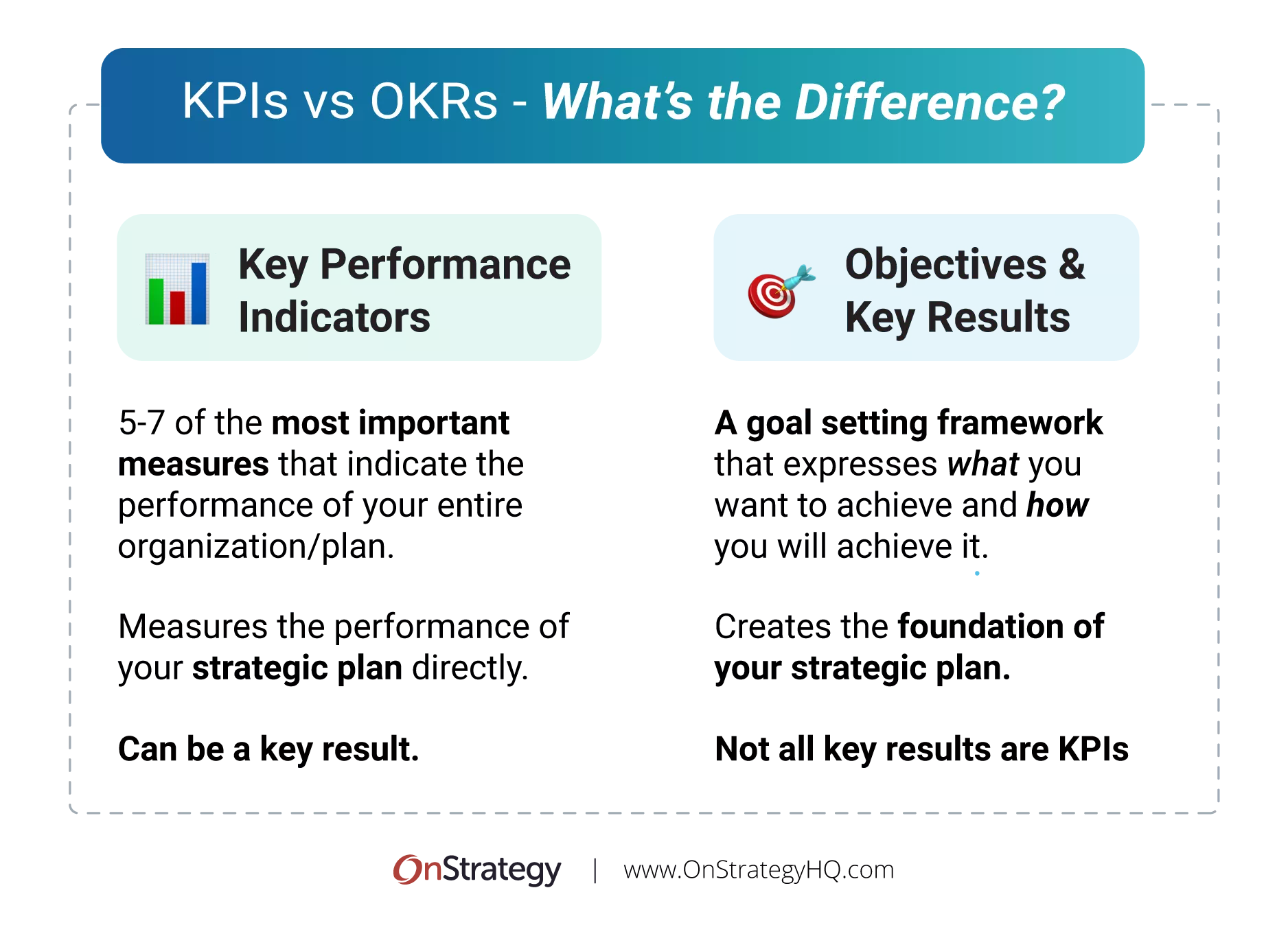
KPIs vs OKRs is a distinction between monitoring and change. KPIs are stable, ongoing measures of operational health, such as revenue, uptime, or churn; OKRs pair a time-bound objective with measurable results to drive an ambitious improvement. Organizations need both when they want to detect deviations while also focusing teams on a defined shift in performance.
What Are KPIs and OKRs?
KPIs (Key Performance Indicators) are ongoing numerical metrics that monitor the operational health of a business or function - revenue, churn rate, system uptime - measured continuously to detect deviations from expected performance.
OKRs (Objectives and Key Results) are a goal-setting framework in which an ambitious qualitative objective is paired with a small number of measurable key results that define what success looks like within a specific timeframe, typically a quarter.
The two frameworks serve fundamentally different purposes: KPIs monitor the steady state of a system, while OKRs drive specific, time-bound improvements - and conflating them produces measurement systems that do neither well.
In 1999, venture capitalist John Doerr walked into a conference room at Google's Mountain View offices and pitched a management framework to Larry Page and Sergey Brin. Google had fewer than 40 employees at the time. Doerr, who had learned the framework from Andy Grove at Intel in the 1970s, called it Objectives and Key Results-OKRs.
The framework was simple: define what you want to achieve (the objective) and how you will measure whether you achieved it (the key results). Set them quarterly. Make them ambitious. Grade them transparently.
"The biggest risk of all is not taking one. Set goals that scare you a little and excite you a lot." - John Doerr
Google adopted OKRs and has used them continuously for more than two decades. By the time Google went public in 2004, OKRs had become central to how the company set priorities, aligned teams, and measured progress.
The framework spread to other Silicon Valley companies-LinkedIn, Twitter, Spotify, Airbnb-and eventually to organizations worldwide.
Meanwhile, for decades before OKRs became fashionable, organizations had been using a different measurement framework: Key Performance Indicators, or KPIs.
KPIs tracked ongoing operational metrics-revenue, customer retention, production quality, response times-that reflected the health of the business. By the time OKRs arrived, most organizations already had extensive KPI dashboards.
The proliferation of both frameworks has created persistent confusion. Are KPIs and OKRs the same thing with different names? Are they competitors? Should an organization use one or the other? Should it use both?
The confusion is compounded by consulting firms and software vendors who use the terms interchangeably, by organizations that implement one framework using the other's terminology, and by the many hybrid approaches that blur the distinction.
The distinction between KPIs and OKRs is not academic. It reflects a fundamental difference in what you are trying to accomplish with measurement: monitoring the ongoing health of a system versus driving specific improvements within a defined timeframe. Conflating the two leads to measurement systems that do neither well.
What Are KPIs?
What are KPIs? Key Performance Indicators are ongoing metrics that measure the health of business functions-revenue, customer churn, employee turnover, system uptime, average response time, defect rate, net promoter score. KPIs are the vital signs of an organization.
Just as a doctor monitors heart rate, blood pressure, and temperature to assess a patient's health, organizations monitor KPIs to assess operational health.
KPIs have several defining characteristics:
They are ongoing, not time-bound. A KPI does not have a start date and an end date. Monthly revenue is a KPI that is monitored every month, indefinitely. Customer churn rate is measured continuously. System uptime is tracked always. KPIs persist because the underlying business function they measure persists.
They measure steady-state performance. KPIs answer the question: "How is this aspect of our business performing right now, relative to our standard?" The standard might be a historical baseline (last quarter's performance), an industry benchmark (average for companies our size), or an internal target (the level we consider acceptable).
KPIs detect deviations from the standard-telling you when something is going wrong (or unusually right) so you can investigate and respond.
They are typically set by function. Finance has its KPIs (revenue growth, gross margin, cash flow). Sales has its KPIs (pipeline value, win rate, average deal size). Engineering has its KPIs (deployment frequency, bug escape rate, system availability).
Customer support has its KPIs (first response time, resolution time, satisfaction score). Each function monitors the metrics most relevant to its operational health.
They are meant to be stable. Good KPIs do not change frequently. The metrics that indicate the health of a sales function this quarter are likely the same metrics that will indicate its health next quarter.
KPI stability enables trend analysis: you can see whether performance is improving, declining, or holding steady over months and years.
When Do KPIs Work Well?
KPIs work well when you need to:
- Monitor operational health across multiple business functions simultaneously
- Detect problems early by identifying metrics that are trending away from acceptable ranges
- Benchmark performance against historical baselines, industry standards, or competitor data
- Report on business health to stakeholders, investors, or board members who need a dashboard view
- Maintain accountability for ongoing performance within functional teams
When do KPIs fail? KPIs fail when they measure the wrong things, when too many are tracked (diluting focus), when gaming occurs (people optimize the metric at the expense of the underlying objective), or when they are used alone without improvement goals.
A company that monitors 200 KPIs monitors nothing effectively. A company that tracks customer satisfaction as a KPI but takes no action when it declines has a decorative measurement system.
KPIs also fail when they become targets in a punitive management system. Charles Goodhart's famous observation-"When a measure becomes a target, it ceases to be a good measure"-applies directly.
A call center that uses "calls handled per hour" as a KPI and then ties employee bonuses to it will see call handling times decrease, but customer satisfaction may also decrease as agents rush callers off the line to hit their numbers.
"Goodhart's Law is a reminder that metrics are proxies for what we care about, not the thing itself. Once you mistake the proxy for the reality, you have lost both." - Marilyn Strathern
What Are OKRs?
What are OKRs? Objectives and Key Results are time-bound goals with measurable outcomes, typically set quarterly, that drive change toward ambitious targets. OKRs consist of two components:
The Objective answers: "What do we want to achieve?" It should be qualitative, inspiring, and actionable. "Delight our enterprise customers" is an objective. "Achieve 95% customer satisfaction score" is not an objective-it is a key result.
The Key Results answer: "How will we know we achieved it?" They should be quantitative, specific, and measurable. Each objective typically has three to five key results that, if all achieved, would constitute achieving the objective.
Example OKR:
Objective: Build the most reliable infrastructure in the industry.
Key Results:
- Achieve 99.99% uptime across all production services (up from 99.95%)
- Reduce mean time to recovery from outages to under 15 minutes (down from 45 minutes)
- Complete automated disaster recovery testing for all critical systems
OKRs have defining characteristics that distinguish them from KPIs:
They are time-bound. OKRs have a start and end date, typically a quarter. At the end of the quarter, they are graded and replaced with new OKRs. This time-boxing creates urgency and forces regular reassessment of priorities.
They drive change, not maintenance. OKRs are not about maintaining current performance. They are about improving, transforming, or creating something new. If a metric is already at an acceptable level and the goal is to keep it there, that is a KPI. If the goal is to significantly improve it, that becomes an OKR.
They should be ambitious. In the OKR framework as practiced at Google and Intel, achieving 70 percent of a key result is considered success. If you consistently achieve 100 percent of your key results, your OKRs are not ambitious enough.
This approach-sometimes called "stretch goals" or "moonshot OKRs"-is designed to push teams beyond what they believe is achievable.
"If you set a crazy, ambitious goal and miss it, you'll still achieve something remarkable." - Larry Page
They are transparent and aligned. OKRs are typically visible across the organization. Individual and team OKRs should align with company-level OKRs, creating a cascade of goals where every team's work connects to organizational priorities.
When Do OKRs Fail?
When do OKRs fail? OKRs fail in several predictable ways:
When treated as KPIs. If OKRs are set at the level of current performance ("maintain 99% uptime") rather than at an improvement level ("improve from 99% to 99.99%"), they function as KPIs with extra administrative overhead. The quarterly reset adds no value if the goals are the same every quarter.
When used for performance reviews. Andy Grove and John Doerr explicitly warned against tying OKR achievement to compensation or performance evaluations. When OKR grades affect bonuses, employees set conservative OKRs they are confident of achieving.
This destroys the "ambitious stretch" quality that makes OKRs valuable for driving change. Google has historically separated OKR achievement from performance reviews.
"The two key concepts I learned from Andy Grove were focus and commitment. An OKR that is tied to a bonus is not an OKR - it is a performance target." - John Doerr
When set too conservatively. OKRs that are certain to be achieved are not OKRs-they are commitments. The value of OKRs lies in their ability to redirect attention and effort toward ambitious goals. Conservative OKRs provide a false sense of accomplishment without driving genuine improvement.
When the organization lacks execution discipline. OKRs are a goal-setting framework, not an execution framework. Setting ambitious quarterly objectives is the easy part. Actually changing work patterns, allocating resources, making trade-offs, and maintaining focus on the objectives throughout the quarter is the hard part.
Organizations that adopt OKRs without the execution discipline to pursue them generate a cycle of ambitious goal-setting followed by disappointing results.
The Core Differences
What's the main difference? KPIs measure steady-state performance; OKRs drive change toward aspirational goals. KPIs are ongoing; OKRs are time-boxed.
| Dimension | KPIs | OKRs |
|---|---|---|
| Purpose | Monitor ongoing health | Drive specific improvements |
| Time horizon | Ongoing, no end date | Time-bound (typically quarterly) |
| Nature | Maintenance-oriented | Change-oriented |
| Ambition level | Realistic targets | Ambitious stretch goals |
| Achievement expectation | 100% (meeting target is baseline) | 70% (full achievement means targets too easy) |
| Stability | Metrics stay consistent over time | Change each quarter as priorities shift |
| Scope | Function-specific | Typically cross-functional, aligned to company goals |
| Number | 5-10 per business area | 3-5 objectives with 3-5 key results each |
| Failure signal | Metric below threshold = problem | Not achieving 70% = execution issue; achieving 100% = not ambitious enough |
The distinction is easiest to see with an example. Suppose a SaaS company has a customer churn rate of 8 percent monthly:
- KPI approach: Track monthly churn rate. Set an acceptable range (e.g., below 10%). If churn exceeds the range, investigate and take corrective action. Continue monitoring indefinitely.
- OKR approach: Objective: "Dramatically improve customer retention." Key Results: "Reduce monthly churn from 8% to 4% by end of Q2." "Increase Net Promoter Score from 32 to 50." "Launch customer success program covering top 100 accounts."
The KPI tells you how you are doing. The OKR tells you where you are going and how you will get there.
Should You Use Both?
Should you use both? Yes-KPIs monitor business health, OKRs drive improvement. They serve different purposes and complement each other. Using only KPIs gives you a dashboard of how things are going but no mechanism for driving improvement.
Using only OKRs focuses on change but may neglect the ongoing operational metrics that keep the business running.
The relationship between KPIs and OKRs is analogous to the relationship between vital signs monitoring and treatment plans in medicine. A patient in a hospital has vital signs monitored continuously (KPIs): heart rate, blood pressure, temperature, oxygen saturation.
The treatment plan (OKRs) specifies what interventions will be performed to improve the patient's condition, with specific targets and timelines. Both are necessary. Monitoring without a treatment plan is passive observation. A treatment plan without monitoring is blind intervention.
Can KPIs become OKRs? Yes-if improving a KPI becomes a priority goal. If your customer churn rate (a KPI) has been steadily increasing and is now at a level that threatens the business, "reduce churn to X%" becomes an OKR.
The metric is the same; the intent changes from "monitor this" to "improve this significantly within a defined timeframe."
How to Use Them Together
Level 1: Company-level OKRs set the strategic direction for the quarter. These are the three to five most important things the company is trying to achieve or change.
Level 2: Team-level OKRs align with company OKRs. Each team identifies how its work contributes to the company's quarterly objectives and sets its own OKRs accordingly.
Level 3: KPIs at every level monitor ongoing operational health. These run in the background, providing the baseline against which OKR progress is measured and ensuring that operational excellence is maintained while change efforts are pursued.
The interaction works like this: KPIs identify where improvement is needed (churn is too high), OKRs define the improvement target and timeline (reduce churn to X% by end of Q2), and KPIs confirm whether the improvement was achieved and sustained (churn monitoring continues after the OKR period ends).
How Many of Each Should You Have?
How many of each should you have? KPIs: 5-10 per business area. OKRs: 3-5 objectives with 3-5 key results each, per quarter. These numbers are guidelines, not rules, but they reflect hard-won experience about human cognitive limits and organizational focus.
For KPIs, the constraint is attention. A dashboard with 50 KPIs is a dashboard that nobody reads carefully. The discipline of selecting the 5-10 most important metrics for each business function forces clarity about what actually matters.
Amazon famously tracks a huge number of operational metrics but distinguishes between "input metrics" (the controllable activities that drive outcomes) and "output metrics" (the outcomes themselves), focusing management attention on the inputs.
For OKRs, the constraint is execution capacity. An organization that sets 20 objectives per quarter will make meaningful progress on none of them. Intel under Andy Grove, the birthplace of OKRs, typically set three to five company-level objectives per quarter.
Google follows a similar pattern. The discipline of selecting only three to five objectives forces the difficult prioritization conversations that many organizations avoid: not "what should we work on?" but "what will we not work on this quarter?"
Within each objective, three to five key results provide sufficient specificity to guide execution without becoming an exhaustive project plan. Each key result should represent a measurable outcome that contributes to the objective. If an objective requires more than five key results, the objective may be too broad and should be split.
Implementation Pitfalls
The KPI Proliferation Problem
Organizations accumulate KPIs the way houses accumulate possessions: one at a time, each seeming reasonable in the moment, until the accumulated mass becomes unmanageable. Each new initiative generates new KPIs. Each management request adds metrics to the dashboard.
But KPIs are rarely removed because removing a metric feels like declaring it unimportant, which is politically difficult.
The result is dashboard bloat: reporting systems that track hundreds of metrics, most of which nobody acts on. The effort of collecting, cleaning, and reporting all these metrics consumes significant analytical resources while the sheer volume ensures that no individual metric receives adequate attention.
The remedy is regular KPI auditing: periodically reviewing each KPI and asking, "If this metric changed significantly, would we take action?" If the answer is no, the metric is not a KPI-it is trivia. Remove it.
The OKR Bureaucracy Problem
OKRs can also degenerate into bureaucratic overhead. When OKR-setting becomes a multi-week process involving dozens of alignment meetings, extensive documentation, and elaborate grading rubrics, the framework consumes more organizational energy than it generates.
At their best, OKRs are lightweight: a team can set quarterly OKRs in a single focused meeting and grade them in fifteen minutes at the end of the quarter.
The companies that use OKRs most effectively treat them as communication tools, not management systems.
OKRs communicate priorities ("this is what matters most this quarter"), create alignment ("here is how our team's work connects to the company's goals"), and enable autonomy ("you decide how to achieve these results; the key results tell you what success looks like").
When OKRs become compliance exercises-bureaucratic forms that must be filled out to satisfy management requirements-they lose their value.
The Measurement Theater Problem
Both KPIs and OKRs can become what organizational theorists call measurement theater: the performance of measurement without the substance of management. An organization that maintains a beautiful KPI dashboard but takes no action when metrics decline is performing measurement theater.
An organization that sets ambitious OKRs every quarter but does not change how it allocates resources, makes trade-offs, or prioritizes work is performing measurement theater.
"Not everything that can be counted counts, and not everything that counts can be counted." - William Bruce Cameron
The test for both frameworks is the same: Does this measurement influence decisions? If a KPI changes, does the responsible team investigate and respond? If an OKR is off-track at mid-quarter, does the team adjust its approach? If the answer is consistently no, the measurement system is decorative rather than functional.
Choosing the Right Framework for Your Organization
Not every organization needs OKRs. Not every organization benefits from formal KPI dashboards. The right approach depends on organizational size, maturity, and the nature of the challenges being faced.
Startups (under 50 people) often benefit more from OKRs than KPIs. The primary challenge for startups is not monitoring steady-state performance (there is not much steady state to monitor) but driving rapid progress toward product-market fit, customer acquisition, and sustainable growth.
OKRs provide focus and alignment when resources are scarce and priorities are shifting.
Growth-stage companies (50-500 people) typically need both. As the organization scales, operational consistency becomes important (requiring KPIs), while the need for ambitious growth continues (requiring OKRs). This is often the stage where the two frameworks begin to interact and where confusion between them creates the most problems.
Large enterprises (500+ people) usually have mature KPI systems but may adopt OKRs to drive specific transformation initiatives. The challenge for large organizations is not implementing the frameworks but preventing them from becoming bureaucratic exercises that add overhead without adding value.
The most important thing is not which framework you use but whether you use it honestly. An organization with three genuine KPIs that it monitors and acts on will outperform an organization with 200 KPIs that exist on a dashboard nobody reads.
An organization with one meaningful OKR that actually drives quarterly priorities will outperform an organization with elaborate OKRs that are set, filed, and forgotten.
Measurement frameworks are tools. Like all tools, their value depends not on their sophistication but on whether they are used for their intended purpose by people who understand what they are doing and why.
What Research Shows About OKRs and KPIs
Andy Grove developed the OKR framework at Intel in the 1970s, building on Peter Drucker's Management by Objectives (MBO) concept while addressing its central failure.
Drucker's MBO, introduced in The Practice of Management (1954), proposed that managers and employees jointly set objectives, and employees were evaluated on whether they achieved them.
Grove's critique, documented in his 1983 book High Output Management, was that MBO conflated the goal (the objective) with the proof of achievement (the results), leaving both vague.
Grove's innovation was to require that every objective be accompanied by specific, measurable key results that would constitute unambiguous evidence of achievement.
The separation of "what we want to achieve" from "how we will know we achieved it" was the structural insight that made OKRs work where MBO frequently failed.
John Doerr's introduction of OKRs to Google in 1999 has been studied as a case in framework adoption.
Doerr has noted that Larry Page and Sergey Brin adopted OKRs not because of abstract management theory but because the framework solved a specific problem: with a small team and unlimited potential directions, Google needed a mechanism for focusing effort and aligning diverse people around shared priorities.
The quarterly cadence - setting OKRs every three months - was itself a design choice based on Grove's experience at Intel that annual planning cycles were too slow for the pace of change in technology businesses.
Edwin Locke and Gary Latham's Goal-Setting Theory, developed through decades of laboratory and field research published from the 1960s onward, provides the empirical foundation for why structured goal frameworks like OKRs work.
Their meta-analysis of 400 studies found that specific, challenging goals consistently outperform vague goals ("do your best") or no goals across a wide range of tasks and organizational contexts.
The OKR framework implements Locke and Latham's findings: objectives should be specific (the key results make them so), challenging (the 70% achievement expectation makes stretch goals legitimate), and accompanied by feedback (the quarterly grading cycle).
Locke and Latham also identified the conditions under which challenging goals produce negative outcomes - when people lack the skills or resources to achieve them, when goals conflict with each other, when the task is too complex to be captured by simple goal metrics, and when people are not committed to the goals.
Each of these conditions is a failure mode that practitioners of OKRs and KPIs regularly encounter and that the theoretical framework helps diagnose.
Real-World Case Studies: OKRs and KPIs in Practice
Intel's experience under Andy Grove is the origin case for OKRs. Grove described his management philosophy in High Output Management through the concept of "leverage" - a manager's output is measured not by what they personally produce but by the output of the people and systems they influence.
OKRs were Grove's mechanism for achieving leverage: by ensuring that every team's key results were quantified and time-bound, Grove could assess leverage directly.
Intel's use of OKRs contributed to its sustained performance dominance in the semiconductor industry through the 1980s and into the 1990s. Grove's approach to OKRs was deliberately un-bureaucratic: the framework was supposed to take one afternoon to set and fifteen minutes to grade at quarter's end. Complexity was the enemy.
LinkedIn's adoption of OKRs provides a more recent case study in scaling the framework. Jeff Weiner, CEO from 2008 to 2020, described in public interviews how LinkedIn used OKRs to maintain strategic alignment as the company grew from 338 to over 16,000 employees.
The key design decision was requiring that individual and team OKRs visibly connect to company-level OKRs - creating a traceable alignment from each employee's quarterly work to the company's strategic priorities.
Weiner noted that this alignment function - helping employees understand how their work connects to organizational goals - was as valuable as the goal-setting function itself.
Spotify's evolution of its measurement systems illustrates the KPI-to-OKR relationship in practice. As a streaming service, Spotify tracked numerous KPIs: monthly active users, subscriber conversion rates, stream counts, artist payout accuracy, infrastructure uptime.
These KPIs provided the operational health monitoring needed to run a service at scale.
But when Spotify identified specific strategic challenges - breaking into new geographic markets, improving podcast discovery, reducing churn in the first 30 days of subscription - these became OKRs: time-bound, specific, ambitious targets attached to named teams with quarterly accountability.
The KPIs continued running; the OKRs drove specific change. Spotify's public engineering blog has documented multiple instances of this two-system operation.
The Science Behind Goal Frameworks and Performance
Teresa Amabile's research at Harvard Business School on the "progress principle," published in a 2011 Harvard Business Review article and book, identified a finding that complicates pure OKR advocacy.
Amabile tracked knowledge workers' daily progress diaries and found that the single most important factor in motivation and creativity was making progress on meaningful work - small wins mattered enormously.
OKR frameworks that set quarterly goals without milestones within the quarter can inadvertently reduce the frequency of progress experiences, undermining the motivation mechanism.
Well-designed OKRs include mid-quarter check-ins and interim milestones precisely to preserve the progress experiences that maintain motivation.
Research by Sim Sitkin at Duke University on "near failures" and organizational learning found that goals that are too challenging produce a different pathology than goals that are too easy.
When teams consistently fail to achieve their targets by large margins, they eventually stop taking targets seriously - the targets become aspirational fiction rather than action-guiding commitments.
Sitkin's "small wins" theory argues that effective goal systems calibrate challenge carefully: targets that stretch performance without exceeding the organization's realistic aspiration level.
The OKR convention of expecting 70% achievement is a practical implementation of this finding - setting the threshold low enough that partial achievement is normalized rather than experienced as failure.
The research on KPI system decay by Ittner and Larcker, summarized in their 2003 Harvard Business Review article "Coming Up Short on Nonfinancial Performance Measurement," found that most KPI systems degrade over time in a consistent pattern: initial implementation produces genuine focus and performance improvement; over 18-24 months, the number of metrics proliferates as each new initiative adds its own KPIs; dashboard overload sets in; attention disperses; the metrics become reporting obligations rather than decision tools.
The researchers found that organizations that maintained effective KPI systems had one practice in common: they treated their KPI list as a decision requiring the same governance as any other strategic decision, with regular pruning as discipline.
Sources & Further Reading
Doerr, J. (2018). Measure What Matters: How Google, Bono, and the Gates Foundation Rock the World with OKRs. Portfolio/Penguin. View source
Grove, A.S. (1983). High Output Management. Random House. View source
Parmenter, D. (2015). Key Performance Indicators: Developing, Implementing, and Using Winning KPIs. 3rd ed. Wiley.
Niven, P.R. & Lamorte, B. (2016). Objectives and Key Results: Driving Focus, Alignment, and Engagement with OKRs. Wiley. View source
Goodhart, C.A.E. (1984). "Problems of Monetary Management: The U.K. Experience." In Monetary Theory and Practice. Palgrave. View source
Wodtke, C. (2016). Radical Focus: Achieving Your Most Important Goals with Objectives and Key Results. Cucina Media. View source
Kaplan, R.S. & Norton, D.P. (1996). The Balanced Scorecard: Translating Strategy into Action. Harvard Business School Press. View source
Marr, B. (2012). Key Performance Indicators: The 75 Measures Every Manager Needs to Know. FT Publishing. View source
Stringer, E.A. (2014). "OKRs at Google." re:Work with Google. View source
Drucker, P.F. (1954). The Practice of Management. Harper & Row.
Locke, E.A. & Latham, G.P. (2002). "Building a Practically Useful Theory of Goal Setting and Task Motivation." American Psychologist, 57(9), 705-717. DOI: 10.1037/0003-066X.57.9.705
Kerr, S. (1975). "On the Folly of Rewarding A, While Hoping for B." Academy of Management Journal, 18(4), 769-783. DOI: 10.2307/255378
Strathern, M. (1997). "'Improving Ratings': Audit in the British University System." European Journal of Education, 32(3), 305-321. DOI: 10.1111/1467-3435.00019
Doran, G.T. (1981). "There's a S.M.A.R.T. Way to Write Management's Goals and Objectives." Management Review, 70(11), 35-36.
Lencioni, P. (2012). The Advantage: Why Organizational Health Trumps Everything Else in Business. Jossey-Bass.
Sull, D. & Sull, C. (2018). "With Goals, FAST Beats SMART." MIT Sloan Management Review, 59(4). View source
Amabile, T. & Kramer, S. (2011). The Progress Principle: Using Small Wins to Ignite Joy, Engagement, and Creativity at Work. Harvard Business Review Press. View source