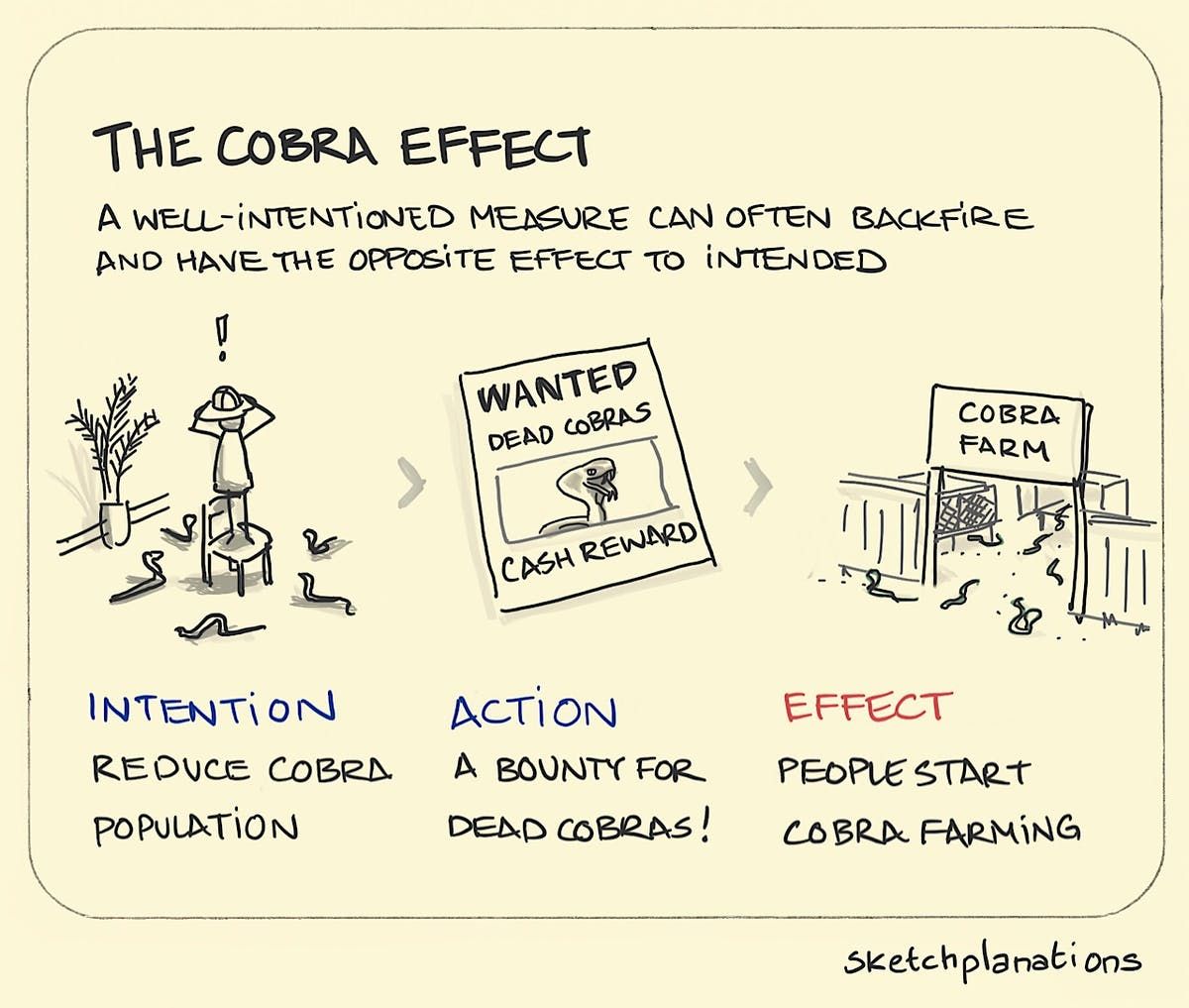
The cobra effect occurs when an intervention worsens the problem it was intended to solve by creating perverse incentives. Drug prohibition illustrates the pattern: enforcement raises prices and risk, but inelastic demand and artificial scarcity sustain criminal profits. Suppliers also favor smaller, more concentrated, potent products that are easier to traffic, so intensified prohibition can shift markets toward more dangerous substances rather than simply reducing use.
In colonial India, the British administration grew alarmed by the number of cobras in Delhi. Their solution: offer a bounty for every dead cobra brought in. The plan worked initially, people caught and killed cobras.
Then enterprising locals realized it was more efficient to breed cobras, collect the bounty, and release the excess snakes.
When the British discovered the scheme and cancelled the bounty, the breeders released their now-worthless snakes. Delhi ended up with more cobras than before the program began.
The cobra effect describes any policy intervention that makes the problem it was designed to solve measurably worse through perverse incentives. Few policy domains illustrate this dynamic more consistently than drug prohibition.
Over a century of international prohibition efforts, beginning with the Harrison Narcotics Tax Act of 1914 in the United States, consolidated globally through the 1961 UN Single Convention on Narcotic Drugs, have generated a natural experiment of enormous scale.
The results of that experiment are now documented in enough detail to draw conclusions. Those conclusions are not politically simple, but they are analytically clear.
The Core Problem with Prohibition
Prohibition's theory is intuitive: restrict supply, raise the price, reduce use. And it does, to some extent, raise prices and reduce convenience. But the theory collapses when it encounters the economic and behavioral realities of illegal markets.
Drug markets are not like markets for legal goods. Sellers face catastrophic legal risk. Buyers cannot evaluate product quality through normal channels. Violence substitutes for contract enforcement.
And perhaps most importantly, enforcement pressure selects for the most economically efficient form of the prohibited substance, which consistently means the most potent and concentrated form.
This is the cobra effect operating at scale.
Economist Jeffrey Miron, a professor at Harvard and a leading analyst of drug policy economics, has documented in multiple papers since the 1990s that drug prohibition raises prices substantially, estimates suggest illicit drugs cost three to ten times more than they would in regulated markets, but that this price increase does not translate into proportional reductions in consumption.
The price elasticity of demand for many addictive substances is relatively inelastic, meaning consumers reduce use only modestly in response to higher prices (Miron, 2003).
Meanwhile, the enormous profit margins that prohibition creates attract organized criminal enterprise and generate all of the attendant social harms that come with unregulated, violence-enforced markets.
The fundamental economic paradox of prohibition is this: it is designed to reduce the profitability of drug supply, but by creating artificial scarcity and eliminating legal competition, it actually makes drug supply extraordinarily profitable for those willing to accept the risks.
The risk premium embedded in the price of illicit drugs funds the organized criminal enterprises that prohibition is supposed to suppress.
The Iron Law of Prohibition
In 1986, cannabis activist Richard Cowan articulated what he called the iron law of prohibition: as law enforcement intensifies, the potency of the prohibited substance increases.
The logic is straightforward. When trafficking in a substance is dangerous, volume becomes the enemy. Every unit of volume increases detection risk, seizure risk, and criminal penalty. Rational suppliers therefore concentrate their product, extracting more effect per gram, per pill, per shipment.
This is not a novel insight. It is the same process that made distilled spirits the dominant alcohol product during US Prohibition. Brewing beer requires large volumes of fermented grain; producing gin or whiskey concentrates the psychoactive ingredient into far smaller packages that are easier to hide, transport, and sell.
The shift from beer to spirits during Prohibition was not driven by changing consumer taste, it was driven by supplier economics in the face of enforcement risk.
The historical record of prohibition-driven potency escalation is consistent and striking:
| Prohibition Context | The Potency Shift | Key Mechanism |
|---|---|---|
| US Alcohol Prohibition (1920-1933) | Spirits production surged; beer and wine declined due to volume disadvantage | Distillation concentrates alcohol 4-10x per unit volume |
| Crack cocaine emergence (1980s) | Enforcement on powder cocaine created incentives for crack, 3-4x more potent per dose | Crack is more efficient to traffic and more immediately addictive |
| Heroin to fentanyl (2010s-present) | Fentanyl is 50-100x more potent than morphine; a lethal dose is invisible to the naked eye | Trafficking risk per equivalent dose reduced by orders of magnitude |
| MDMA adulterants | Enforcement drives replacement with novel psychoactive substances with unknown safety profiles | Novel compounds escape scheduling; safety profiles unknown |
| Cannabis potency trend | Average THC content rose from ~4% in 1990s to over 12% by 2019 in US samples | Consumers demand value per unit; producers select for potency |
| Methamphetamine | Shift from "biker meth" produced locally to high-purity cartel crystal meth | Industrial production achieves higher purity; risk concentrated at border |
The fentanyl crisis is the most lethal current demonstration of the iron law. A decade of intensified opioid enforcement, pill mill crackdowns, prescription monitoring programs, coordinated heroin supply disruption, drove users toward fentanyl and fentanyl analogs.
These substances are so potent that micrograms determine the difference between a high and an overdose. Drug-checking services regularly find that street drugs sold as heroin, cocaine, or counterfeit prescription pills are laced with fentanyl by suppliers who have maximized potency per unit volume.
"We have spent fifty years making drugs more dangerous in the name of making them less available. The iron law doesn't negotiate."
The potency escalation documented in cannabis provides a particularly well-measured case study. Research by ElSohly and colleagues (2021) in Biological Psychiatry analyzed cannabis samples from the Drug Enforcement Administration's domestic monitoring program over nearly five decades.
Average delta-9-THC concentration in confiscated cannabis rose from approximately 4% in the early 1990s to over 12% by 2019, with some products, particularly concentrated extracts entering the market through both legal and illegal channels, reaching 80% to 90% THC.
This is not primarily a story about consumer preference; it is a story about what types of cannabis survive in a high-enforcement market, where small, potent packages outcompete large, mild ones.
The Balloon Effect: Squeezing the Supply
The balloon effect is the geographic counterpart to the iron law. When enforcement suppresses drug production or trafficking in one location, it does not eliminate the market, it displaces it. Like squeezing a balloon, pressure in one place creates a bulge somewhere else.
The US government's multi-decade efforts to eradicate coca cultivation in the Andes illustrate this precisely:
- Plan Colombia (2000-2015) spent approximately $10 billion on aerial eradication, military aid, and crop substitution programs
- Colombian coca cultivation declined during peak eradication years between 2001 and 2007
- Production shifted substantially to Peru and Bolivia during those years, then rebounded sharply in Colombia after 2013
- Total Andean coca cultivation in 2020 reached record levels despite three decades of US-funded eradication efforts, with the UN Office on Drugs and Crime reporting approximately 245,000 hectares under cultivation across the three countries
The UNODC's own annual World Drug Reports show that global cocaine supply has not declined in any sustained way across the entire history of eradication efforts. The supply is elastic and adaptive. Trafficking routes shift from the Caribbean to Mexico when interdiction concentrates in one corridor.
Production shifts between countries when enforcement concentrates in one region. Colombian traffickers who were disrupted in the 1980s were replaced by Mexican cartels that proved far more organizationally sophisticated and durable.
The same pattern plays out at the street level. Research by Ralphs and colleagues (2017) documented what is known as cuckooing in the UK context: when enforcement pressure on open-air drug markets intensifies, suppliers shift to exploiting vulnerable people's homes as distribution points, concentrating activity in places that are harder to police and creating new victims in the process.
The drug market does not disappear, it migrates, often becoming harder to monitor and more dangerous.
A pivotal natural experiment occurred in Australia between 2000 and 2002. Heroin supply collapsed dramatically, likely due to a combination of law enforcement success in Southeast Asia and disruption of key trafficking networks. Researchers Dietze, Jolley, and colleagues documented what happened: heroin users did not stop using drugs.
They transitioned rapidly to methamphetamine and other stimulants, many of which carried their own serious health risks.
Overdose deaths from heroin fell temporarily, but were partially replaced by deaths from other substances.
The heroin shortage caused genuine disruption and some positive outcomes for some users who accessed treatment during the shortage, but it did not reduce addiction or overall drug harm in the way prohibition theory would predict (Dietze et al., 2004, Drug and Alcohol Review).
Prohibition and the Violence Premium
One of prohibition's most consistently documented effects is the generation of violence. Legal markets resolve disputes through contracts and courts. Illegal markets resolve them through violence.
This is not a moral claim about drug users or dealers. It is a structural observation: in the absence of legal institutions, coercion is the mechanism of enforcement. Territory cannot be protected by lawyers. Debts cannot be collected through the courts. Fraud cannot be reported to regulators.
Quality cannot be guaranteed by health inspectors.
The result is predictable: prohibition creates a violence premium. The most successful participants in prohibited markets are those most willing and able to use violence as a competitive tool. Peaceful operators are disadvantaged; violent ones thrive and expand.
Economist Mark Kleiman and colleagues estimated in Marijuana Legalization: What Everyone Needs to Know (2016) that between 30% and 60% of the retail price of drugs in prohibition markets represents a risk premium, compensation for the legal risk of arrest, prosecution, and imprisonment.
This premium is not distributed to workers or invested in legitimate economic activity. It accrues to criminal organizations that use it to purchase weapons, corrupt officials, and expand territorial control.
Alcohol prohibition in the United States produced Al Capone and the era of organized crime, an era that effectively ended when Prohibition was repealed. Drug prohibition has produced the Sinaloa Cartel, the CJNG, and tens of thousands of deaths each year in production and transit countries.
Mexico has experienced over 300,000 homicides since 2006, a period that corresponds to a significant escalation in the Mexican government's military-style campaign against drug cartels, a campaign encouraged and substantially funded by the United States through the Merida Initiative.
"The black market is the prohibition's way of enforcing itself. You can't have prohibition without the black market, and you can't have the black market without the violence.", Mark Kleiman, public policy professor, UCLA
When prohibition ends, as it did for alcohol in 1933, the violence premium evaporates remarkably quickly, because peaceful competitors can undercut violent ones in an open market. The lessons of alcohol repeal should inform analysis of drug prohibition, but they rarely do in policy discourse.
Mass Incarceration Without Mass Effect
The United States has conducted the world's most expensive experiment in drug prohibition enforcement. The results are documented with unusual clarity.
Drug arrests in the United States peaked at approximately 1.85 million in 2006 and have declined somewhat since then, but remained at approximately 1.25 million in 2022 (FBI Uniform Crime Reports). The vast majority of these arrests, roughly 85-90% across the period, are for possession rather than trafficking.
The United States incarcerates approximately 450,000 people on drug charges at any given time across federal, state, and local facilities.
| Metric | Data |
|---|---|
| Drug arrests in the US (2022) | ~1.25 million |
| Drug offenders in federal prison (% of total) | Approximately 45% |
| US drug use rates vs. international peers | Among the highest in the world |
| Cost of incarcerating one federal drug offender per year | ~$40,000+ |
| Total drug war spending since 1971 | Estimated $1 trillion+ |
| Black Americans arrested for drug offenses vs. white Americans | 3-4x higher rate despite equivalent use rates |
| Drug overdose deaths, 2021 | 107,622 (CDC), highest recorded year |
Despite this sustained investment in enforcement and incarceration, the United States has among the world's highest rates of illicit drug use.
The European Monitoring Centre for Drugs and Drug Addiction (EMCDDA) data consistently shows that US drug use rates equal or exceed those of European countries with far less punitive drug policies, including Portugal, the Netherlands, and Germany.
Past-year cannabis use among US adults is approximately twice the EU average. Heroin and opioid use rates are substantially higher in the US than in any EU member state.
The evidence does not show that prohibition reduces use to levels below what would exist under regulated alternatives. What it does show is that prohibition imposes enormous costs, fiscal, human, social, that fall disproportionately on low-income communities and communities of color.
Sociologist Michelle Alexander's book The New Jim Crow (2010) documented in detail how drug prohibition enforcement has functioned as a mechanism of racialized social control.
Black Americans are arrested for drug offenses at rates 3-4 times higher than white Americans despite roughly equivalent rates of use, according to ACLU analysis of FBI data.
A felony drug conviction creates permanent civil disabilities, loss of voting rights in many states, ineligibility for public housing and federal student loans, barriers to employment, that compound the harms of incarceration and create cascading disadvantages that persist across generations.
Economist Glenn Loury at Brown University has argued that the racial disparities in drug enforcement cannot be separated from the history of racial politics in the United States, and that the drug war has served functions in American political economy that have little to do with its stated public health goals (Loury, 2008).
The Fentanyl Crisis: The Iron Law at Its Most Lethal
The contemporary opioid overdose crisis offers the clearest and most tragic illustration of the iron law's mechanism in real time. Understanding its stages reveals how each enforcement intervention generated the next phase of the crisis.
Stage 1: Prescription Opioid Proliferation (1990s-2000s). Following OxyContin's 1996 launch, aggressive marketing by Purdue Pharma, later the subject of multi-billion dollar litigation and a federal criminal conviction, led to massive increases in opioid prescribing.
By 2012, enough opioid prescriptions were being written to give every American adult a bottle of pills. Many patients developed dependence.
Stage 2: Prescription Crackdowns Drive Users to Heroin (2010-2013). Regulatory and enforcement action on "pill mills" and prescription monitoring programs successfully reduced prescription opioid availability.
Research by Cicero, Ellis, and Surratt (2012) in JAMA Psychiatry found that 75% of people entering treatment for heroin addiction in the 2010s had initiated opioid use with prescription pills.
When their pill supply was disrupted, significant numbers transitioned to heroin, which was cheaper and readily available.
Stage 3: Heroin Supply Disruption Drives Fentanyl Dominance (2013-present). Enforcement targeting heroin trafficking created conditions in which fentanyl, vastly more potent and vastly easier to traffic in small quantities, became attractive to suppliers.
A kilogram of heroin contains roughly 4,000 doses; a kilogram of fentanyl contains roughly 500,000. From a trafficking risk perspective, fentanyl is overwhelmingly more efficient. By 2016, fentanyl had become the dominant drug in overdose deaths. By 2021, synthetic opioids were present in approximately 87% of all opioid overdose deaths.
The CDC reported 80,411 opioid overdose deaths in the United States in 2021, with total drug overdose deaths (including stimulants and other substances) reaching a record 107,622. Deaths from drug overdose in 2021 exceeded total US combat deaths in the Vietnam War, the Korea War, and the Gulf War combined, in a single year.
Each enforcement intervention in this chain was designed to reduce harm. Each one, consistent with the iron law, made the drugs available to users more dangerous. The enforcement interventions that created the conditions for fentanyl's dominance were not designed to kill people.
They were designed to reduce drug availability. The cobra effect operated on a lethal scale.
The public health response with the strongest evidence base, naloxone distribution, drug checking services, supervised consumption sites, medication-assisted treatment, addresses the harm created by potent drugs in unregulated markets.
Crucially, the most effective responses operate independently of the enforcement logic that created the crisis. This is not coincidental.
The Portugal Case Study
In 2001, Portugal made a decision that most international observers described as radical: it decriminalized personal possession of all drugs, including heroin and cocaine. Possession of up to a ten-day personal supply was reclassified from a criminal offense to an administrative violation.
Users caught with drugs were referred to "Dissuasion Commissions", panels including social workers, lawyers, and medical professionals, rather than criminal courts.
Critically, decriminalization was paired with substantial new investment in treatment, harm reduction, and social reintegration programs. The policy explicitly treated drug dependence as a health issue rather than a moral failing.
The results have been studied extensively by researchers from multiple countries and political perspectives, with findings published in peer-reviewed journals including British Medical Journal, Lancet, and Drug and Alcohol Review.
The evaluations have been conducted by researchers with no stake in validating the Portuguese approach, including teams funded by the European Monitoring Centre for Drugs and Drug Addiction.
| Outcome | Before Decriminalization (1999-2001) | After Decriminalization (by 2015) |
|---|---|---|
| Drug-related HIV among PWID | 52% of new HIV cases | Approximately 7% of new HIV cases |
| Drug-induced mortality rate | Among highest in EU | Below EU average |
| Drug use rates, adults | Below EU average | Below EU average (remained stable) |
| People in treatment | ~6,000 | ~24,000 |
| Drug-related imprisonment | ~44% of prison population | ~24% of prison population |
Drug-related HIV infections among people who inject drugs fell from 52% of new HIV cases in 2000 to approximately 7% by 2015, one of the most dramatic reductions in HIV transmission recorded in any country in any comparable period.
Drug use rates did not spike. Cannabis and other drug use rates in Portugal are below EU averages for most substances. The feared "honeypot effect", the concern that decriminalization would attract drug tourism and normalize use, did not materialize in the data.
Treatment uptake increased substantially, as the removal of criminal stigma made it safer for users to seek help. The number of people in drug treatment nearly quadrupled over the decade following decriminalization.
Criminologist Caitlin Hughes and Alex Stevens published a detailed comparative evaluation in 2010 in British Journal of Criminology that remains the most cited academic analysis of the Portuguese experience.
Their conclusion was that decriminalization, combined with investment in health services, produced significant improvements in drug-related health outcomes without measurable increases in drug use.
The Portuguese model is sometimes mischaracterized as legalization. It is not. Drug trafficking remains illegal; production and sale remain criminal. What changed is that users are treated as people with health issues rather than criminals deserving punishment. The evidence suggests this distinction matters enormously for outcomes.
Portugal's success has influenced drug policy reform in several European countries, including the Czech Republic, which decriminalized personal possession in 2010, and Germany, which decriminalized cannabis possession in 2024. The European evidence base now extends well beyond the single Portuguese case study.
What Harm Reduction Evidence Shows
Harm reduction is an umbrella term for interventions that aim to reduce the negative consequences of drug use without requiring abstinence as a precondition. The evidence base for harm reduction is now among the most robust in public health, spanning several decades of research across dozens of countries.
Needle and syringe programs reduce HIV and hepatitis C transmission among people who inject drugs without increasing injection rates.
A 2013 systematic review by Aspinall and colleagues in International Journal of Epidemiology found that needle and syringe programs were associated with an approximately 50% reduction in HIV incidence among people who inject drugs.
Every major public health organization, including the World Health Organization, the CDC, and the American Medical Association, endorses them. Despite this, US federal funding for needle exchange programs was banned for most of the period from 1988 to 2016.
Naloxone distribution to users, families, and first responders reverses opioid overdoses. In jurisdictions with broad naloxone availability, overdose death rates have declined.
A 2019 study by Walley and colleagues found that high-dose naloxone distribution programs were associated with a 46% reduction in opioid overdose death rates in Massachusetts communities.
Naloxone is now available without a prescription in most US states, representing one of the most consequential harm reduction policy changes of the past decade.
Supervised consumption sites (operating legally in Canada, Switzerland, the Netherlands, Spain, and elsewhere) allow users to consume pre-obtained drugs in a medical setting where staff can respond to overdoses and connect users to services.
Evidence reviews covering sites across multiple countries have found that they have reversed hundreds of overdoses and have not had an overdose death occur on-site in the entire history of their operation.
A 2011 study of Vancouver's Insite facility published in The Lancet by Wood, Kerr, and colleagues found that the supervised injection site was associated with a 35% reduction in overdose mortality in the surrounding area, alongside increases in referral to detoxification services.
Insite's continued operation was upheld by the Canadian Supreme Court in 2011 in Canada (Attorney General) v. PHS Community Services Society.
Drug checking services analyze the content of street drugs and provide users with information about dangerous adulterants. Given the pervasiveness of fentanyl contamination, drug checking can directly prevent death.
A 2019 study by Wallace and colleagues in the International Journal of Drug Policy found that drug checking results changed intended drug use behavior: a significant proportion of festival attendees who received positive fentanyl results modified their planned use, often discarding the substance or deciding not to use it at all.
None of these interventions increase drug use at the population level. The evidence on this point is consistent across dozens of studies in multiple countries, conducted by researchers from across the political spectrum.
The Global Landscape: What Other Countries Have Learned
The United States is not the only country to have conducted large-scale drug prohibition. But the comparative international data now allows for controlled comparisons that would have been impossible in earlier periods.
The Swiss heroin-assisted treatment (HAT) program, begun experimentally in the 1990s and made permanent in 2008, provides pharmaceutical-grade heroin to people with severe heroin dependence who have not responded to other treatments.
Evaluations by Haasen and colleagues (2007) in The Lancet found that HAT produced significant reductions in illicit drug use, criminal activity, and health harms compared to methadone maintenance, in a population that had failed repeated prior treatment.
Switzerland's approach transformed what had been an open-air drug scene in Zurich's Platzspitz park, a public health and public order crisis, into a managed clinical caseload.
The Czech Republic, with one of Europe's longest-running personal decriminalization regimes, consistently shows drug use rates comparable to or below neighboring countries with stricter enforcement (EMCDDA, annual reports).
The Netherlands, often cited as an example of liberal drug policy, has lower rates of cannabis use than the United States and several other European countries with stricter enforcement, despite (or perhaps because of) tolerating regulated cannabis sales through coffee shops.
Germany's Cannabis Act (2024) legalized personal possession of up to 25 grams for adults and allowed home cultivation, joining a growing cohort of jurisdictions, Canada, Uruguay, and numerous US states, that have moved toward regulated cannabis markets.
The policy results from legal US cannabis markets are mixed but illuminating: the illicit market has not disappeared, particularly for products at the highest potency/price spectrum, but tax revenues have been substantial, criminal justice impacts have been significant, and the predicted social harms have largely not materialized (Caulkins et al., 2023).
Why Prohibition Persists
Given the accumulated evidence, a reasonable question is why prohibition-based approaches remain dominant in most countries. Several factors are analytically relevant:
Moral framing: Drug use is coded in many cultures as a moral failing rather than a health issue. This framing, deeply embedded in religious and social conservative traditions, makes prohibition feel appropriate even when it demonstrably fails on practical terms.
The moral dimension of the debate is not irrational; the concern about addiction and drug harm is genuine. But the moral framing often prevents an instrumental evaluation of which policies actually reduce those harms.
Political incentives: "Tough on drugs" messaging has been reliably effective political positioning for decades, regardless of empirical results.
Politicians who support harm reduction face attacks as being "soft" on crime or "pro-drug." The political geography of drug enforcement, where the costs (incarceration, violence, health harms) fall on politically marginalized communities while the benefits (electoral positioning, institutional funding) accrue to enforcement agencies and politicians, creates durable incentives for the status quo.
Institutional inertia: The law enforcement, prison, and treatment industries built around drug prohibition represent enormous economic interests measured in the hundreds of billions of dollars annually. The DEA's budget was approximately $3.1 billion in fiscal year 2022.
State and local drug enforcement represents additional tens of billions. Prison guard unions, private prison companies, and related contractors have documented histories of lobbying against reform.
Measurement problems: Success in prohibition is conventionally measured in arrests, seizures, and asset forfeitures, inputs controlled by law enforcement, rather than in health outcomes, use rates, or social costs, which would reveal the policy's limitations.
An agency that arrests more people and seizes more drugs is considered successful regardless of whether drug availability or harm has decreased.
Optimism bias and unfalsifiability: Proponents of stricter enforcement consistently argue that existing approaches have failed because they have not been applied rigorously enough, rather than because they are fundamentally counterproductive.
This reasoning makes the policy unfalsifiable: no evidence of failure can demonstrate that the policy is wrong, only that it needs more resources and stricter application. The cobra effect, by definition, cannot be acknowledged within this frame.
What the Evidence Actually Supports
The accumulated evidence does not support the conclusion that drugs are harmless or that all restrictions are counterproductive. Some substances cause serious harm; some regulation of availability, particularly for youth, is supported by evidence.
The question is whether criminal prohibition is the right tool for achieving these goals, or whether it is a cobra-effect policy making the underlying problems consistently worse.
The evidence is clearest on the following points:
- Criminalization does not reliably suppress use at the population level, US use rates are among the world's highest despite the world's most intensive enforcement
- Enforcement pressure increases potency, making drugs more dangerous per dose, the entire arc from powder cocaine to crack to heroin to fentanyl follows this logic
- Geographic enforcement creates displacement, not elimination, the balloon effect operates consistently across contexts
- Criminal records harm users more than many of the drugs they were arrested for, through cascading civil penalties that persist for life
- Treatment and harm reduction work and are substantially more cost-effective than incarceration, RAND Corporation analysis estimates that treatment is seven times more cost-effective than enforcement in reducing cocaine consumption
- Decriminalization does not cause use increases when implemented alongside health investment, as Portugal and multiple other jurisdictions have demonstrated
The cobra effect operates throughout prohibition's logic. The policy designed to protect people from drugs has consistently produced more dangerous drugs, more violence, more incarceration, and more disease than the alternatives. Naming this dynamic clearly is not an argument for indifference to drug harm.
It is not a claim that any particular drug is safe, or that legalization is the answer to every drug problem. It is the beginning of a serious, evidence-based conversation about what tools actually reduce harm, what tools reliably make it worse, and why a century of cobra-effect policy remains so difficult to reform.
"If you want to understand the drug problem, understand who benefits from the drug war.", Ethan Nadelmann, founder, Drug Policy Alliance
The answer to that question, who benefits, is not the people prohibition is designed to protect. They are the ones who absorb the costs.
Further Reading and Key Sources
- Cowan, R. (1986). "How the Narcs Created Crack." National Review.
- Alexander, M. (2010). The New Jim Crow: Mass Incarceration in the Age of Colorblindness. New Press.
- Hughes, C., & Stevens, A. (2010). "What Can We Learn From the Portuguese Decriminalization of Illicit Drugs?" British Journal of Criminology.
- Miron, J. (2003). "The Effect of Drug Prohibition on Drug Prices." Review of Economics and Statistics.
- Wood, E., Kerr, T., et al. (2006). "Impact of a medically supervised safer injecting facility on drug dealing and other drug-related crime." Substance Abuse Treatment, Prevention, and Policy.
- ElSohly, M. et al. (2021). "Changes in Cannabis Potency Over the Last Two Decades (1995-2014)." Biological Psychiatry.
- UNODC. (Annual). World Drug Report. United Nations Office on Drugs and Crime.
Frequently Asked Questions
What is the cobra effect in drug policy?
The cobra effect refers to an incentive structure that makes a problem worse. In drug policy, prohibition drives drug production underground, which creates incentives to produce more potent, compact, and profitable substances. This is why crack cocaine emerged from powder cocaine, and why fentanyl replaced heroin, enforcement pressure consistently shifts markets toward more dangerous, concentrated drugs.
What is the iron law of prohibition?
The iron law of prohibition, coined by activist Richard Cowan in 1986, states that the more intense the law enforcement, the more potent the prohibited substance becomes. When enforcement makes volume dangerous to transport, producers concentrate their product. This is why alcohol prohibition produced spirits rather than beer, and why the opioid crisis shifted from heroin to fentanyl.
What is the balloon effect in drug enforcement?
The balloon effect describes how suppressing drug supply in one geographic area simply pushes it to another, like squeezing a balloon. The US has spent billions suppressing cocaine production in Colombia and Peru; production consistently moved or rebounded elsewhere. Trafficking routes similarly shift when enforcement concentrates in one corridor, distributing the problem rather than solving it.
What happened in Portugal after drug decriminalization?
Portugal decriminalized personal possession of all drugs in 2001. Rather than increasing drug use, the policy, combined with major investment in treatment and harm reduction, led to significant declines in HIV infections among drug users, reduced drug-related deaths, and stable or declining rates of drug use compared to EU neighbors. Portugal’s approach is now widely studied as evidence that harm reduction outperforms criminalization.
Does drug prohibition reduce drug use?
Decades of research show little reliable relationship between the severity of drug laws and rates of drug use. Countries with strict prohibition do not consistently show lower use rates than those with more permissive policies. The US, which has among the world’s most punitive drug enforcement regimes, also has among the world’s highest rates of drug use, suggesting that criminalization is a poor predictor of consumption levels.