
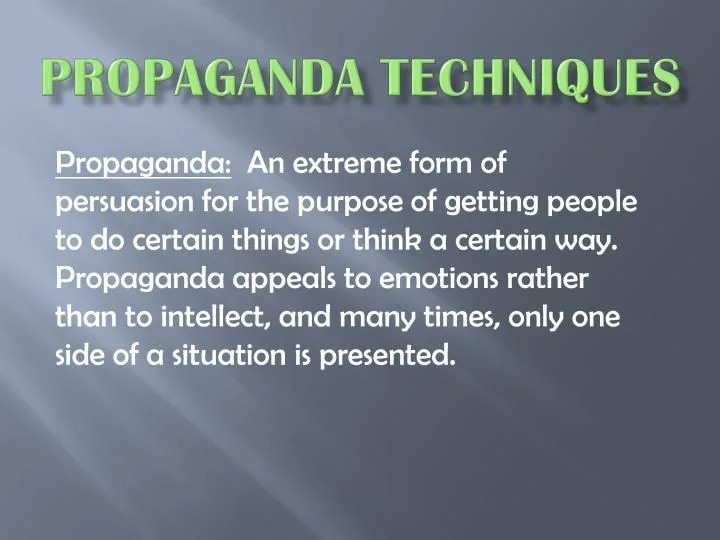
Propaganda explained is the systematic manipulation of collective attitudes through symbols, narratives, images, and emotion, usually for a political agenda and at the audience's expense. It differs from education and legitimate persuasion by exploiting vulnerabilities, withholding relevant evidence, or obscuring its source. White, gray, and black propaganda vary in source transparency, while pre-bunking seeks to build resistance before misleading messages arrive.
When the United States entered the First World War in April 1917, the Wilson administration faced a problem that democratic governments had never confronted at industrial scale: how to rapidly convert a largely pacifist, ethnically diverse, and politically skeptical public into a unified, motivated, war-fighting nation.
The answer was the Committee on Public Information - the first centralized government propaganda apparatus in American history - and its success in the following 18 months permanently changed both the practice of political communication and the theory of democratic consent.
George Creel, the journalist Wilson appointed to lead it, later claimed with some justification that the CPI had fought the war on the "propaganda front" as surely as armies fought it on the Western Front.
Within two years, the CPI had produced thousands of posters, distributed tens of millions of pamphlets, coordinated 75,000 volunteer speakers, and made the emotional case for American war aims to every demographic in every region of the country.
It had also, through its alumni - most notably Edward Bernays - permanently altered the relationship between mass communication, public opinion, and political power.
Bernays would go on to reflect that the war had demonstrated the possibility of manufacturing consent in a democracy, a phrase that Walter Lippmann used in his 1922 book of that name and that Noam Chomsky and Edward Herman would later turn into one of the most influential critiques of media power.
Propaganda is as old as organized political power, but it became the subject of systematic analysis only in the 20th century, when the combination of mass literacy, mass media, and industrial warfare created both the infrastructure for unprecedented influence over public belief and the political stakes that made such influence urgently consequential.
Understanding how propaganda works - its techniques, its psychology, and its historical forms - is not an academic luxury but a practical requirement for navigating an information environment in which manufactured consensus remains a primary instrument of political control.
"Propaganda is the management of collective attitudes by the manipulation of significant symbols." - Harold Lasswell, Propaganda Technique in the World War (1927)
Key Definitions
Propaganda: The systematic manipulation of collective attitudes, beliefs, and behaviors through the strategic use of symbols, narratives, images, and emotion - typically in service of a political agenda and typically at the expense of the audience's capacity for independent judgment.
White propaganda: Propaganda whose source is accurately identified - official government communications, for instance, where the audience knows who is speaking.
| Propaganda Type | Source Transparency | Example |
|---|---|---|
| White propaganda | Clearly identified | Official government wartime communications |
| Gray propaganda | Ambiguous or uncertain | Anonymous pamphlets with unclear origin |
| Black propaganda | Deliberately falsified | Content made to appear from enemy or neutral party |
Gray propaganda: Propaganda whose source is ambiguous or uncertain - neither confirmed nor denied.
Black propaganda: Propaganda that falsely attributes its source, appearing to originate from a different country, group, or individual than it actually does.
Disinformation: False or misleading content created and distributed with intent to deceive.
Misinformation: False or misleading content spread without intent to deceive - the spreader believes it to be true.
Malinformation: Accurate content deployed with intent to harm - such as the strategic release of true private information to damage an individual or group.
Active measures: Soviet and Russian term for covert information operations including forgeries, front organizations, agent-of-influence operations, and the injection of disinformation into public discourse.
Pre-bunking: Inoculating audiences against propaganda by exposing them in advance to weakened forms of misleading arguments along with refutations, building psychological resistance before exposure to actual propaganda.
What Makes Propaganda Distinct from Persuasion?
Harold Lasswell's 1927 definition established propaganda as the management of collective attitudes through manipulation of significant symbols - words, images, and narratives that carry emotional and social weight beyond their literal meaning.[1]
This definition emphasizes the systematic and intentional character of propaganda, distinguishing it from the incidental influence that all communication exercises.
The distinction between propaganda and legitimate persuasion turns on several related questions. Education presents evidence, acknowledges uncertainty, and aims to develop the audience's independent capacity for judgment - it is transparent about its methods and invites criticism.
Persuasion operates within norms that prohibit systematic deception, suppression of relevant evidence, and exploitation of cognitive vulnerabilities.
Propaganda departs from these norms: it exploits known psychological weaknesses, withholds or distorts information that would undermine its conclusions, deploys emotional manipulation divorced from evidence, and - crucially - serves the interests of the propagandist at the expense of the audience it purports to address.
Jacques Ellul offered a more radical analysis in "Propaganda: The Formation of Men's Attitudes" (1965). Ellul argued that propaganda should not be understood as a specific technique employed by governments on specific occasions but as a pervasive feature of modern mass society.
Modern propaganda is sociological rather than merely political: it operates through the entire institutional apparatus of mass communication, education, advertising, and entertainment, creating a permanently pre-propagandized population whose beliefs and values have already been substantially shaped before any specific political message arrives.
Crucially, Ellul argued that educated, media-consuming people are more susceptible to propaganda than the less educated, because they consume more media and are therefore more thoroughly enveloped in its systematic framing.[2]
Propaganda requires "pre-propaganda" - the prior shaping of attitudes and information habits that makes specific propaganda messages credible and effective.
World War One: The Industrialization of Political Communication
The Creel Committee and the Manufacturing of Consent
The Committee on Public Information, established by executive order on April 14, 1917, was unprecedented in its scope and ambition. Its Division of Pictorial Publicity produced thousands of posters in collaboration with leading commercial illustrators - including James Montgomery Flagg's iconic 'I Want YOU for U.S.
Army' (1917), for which Flagg used himself as the model for Uncle Sam. Its Division of Films coordinated with Hollywood studios.
Its Foreign Section managed the flow of American news to international audiences. Its News Division distributed daily official summaries to 20,000 newspapers.
The Four Minute Men were the CPI's most distinctive innovation: 75,000 volunteer speakers who delivered coordinated four-minute speeches in cinemas (during the time required to change reels), churches, labor halls, and public spaces nationwide.
Their scripts were centrally provided, but their delivery was local - neighbors persuading neighbors, not distant government officials issuing directives. The technique exploited the social proof effect: the message arrived through trusted community members rather than impersonal mass media.
Edward Bernays, who served on the CPI, drew the lesson explicitly. In "Propaganda" (1928), he argued that the "conscious and intelligent manipulation of the organized habits and opinions of the masses" was a necessary feature of democratic governance - a task that would inevitably be performed by experts capable of understanding and shaping public psychology.
The manipulation was real but, in Bernays's framing, benevolent: experts persuading publics toward correct conclusions that the publics themselves could not independently reach.[3]
British Atrocity Propaganda and the Fabrication Problem
British propaganda targeting neutral American opinion during 1914-17 was among the most sophisticated and consequential propaganda operations of the war.
The Bryce Report of 1915, authored by a commission headed by Viscount James Bryce - a widely respected jurist and former British Ambassador to the United States - documented alleged German atrocities in Belgium with vivid specificity, including claims that German soldiers had bayoneted infants.
Later historical investigation found that many of the specific incidents described were fabricated or unverifiable, though genuine German atrocities in Belgium, including the killing of approximately 6,500 Belgian and French civilians during the war's first months, were well documented.
The Bryce Report's credibility depended on Bryce's personal reputation and the official imprimatur of a named commission, illustrating how propaganda typically needs an institutional framework to be maximally effective.
The fabricated atrocity stories created a lasting problem: when German gas attacks and submarine warfare produced genuine atrocities, many Americans were skeptical, having been taught - by the postwar debunking of WWI propaganda - to distrust all atrocity claims as manipulation.
The boy who-cried-wolf dynamic produced by demonstrated propaganda fabrications extends well beyond its immediate subject.
Nazi Propaganda: Total Control and Totalitarian Mobilization
Goebbels and the Reich Chamber of Culture
Joseph Goebbels, appointed Reich Minister of Public Enlightenment and Propaganda on March 13, 1933 - six weeks after Hitler became Chancellor - understood propaganda as the primary instrument of political power, not a supplement to it.
His Reich Chamber of Culture required all cultural workers - journalists, writers, filmmakers, musicians, visual artists, broadcasters - to be registered members, effectively giving the Ministry veto power over all cultural production.
Non-members were prohibited from professional practice; the Chamber excluded Jews and political opponents.
The Volksempfänger (people's receiver), introduced in 1933 at a price point affordable to working-class families, brought Nazi radio into 70 percent of German homes by 1939.[7]
Radio was strategically essential: it was the most intimate and emotionally direct mass medium, delivering the human voice - Hitler's voice, most powerfully - directly into living rooms.
The radio also differed from print in being inherently non-analytical: it addresses listeners in real time, without the opportunity for reflection and checking that even minimal literacy affords.
Leni Riefenstahl's "Triumph of the Will" (1935), filmed at the sixth Nuremberg rally in September 1934, remains the most analytically interesting product of the Nazi propaganda machine precisely because Riefenstahl insisted on treating it as film art rather than mere documentation.
The formal techniques she deployed - aerial photography, low camera angles that made human masses appear as moving architecture, the systematic rhyming of visual motifs across the film - demonstrated that propaganda could work through aesthetics as powerfully as through explicit argument.
Hannah Arendt on Totalitarian Propaganda
Hannah Arendt's analysis in "The Origins of Totalitarianism" (1951) drew a fundamental distinction between totalitarian propaganda and ordinary political manipulation.[4]
Ordinary propaganda - including the wartime propaganda of liberal democracies - aims to persuade a passive audience toward beliefs that serve the propagandist's interests. It assumes that the audience retains the capacity for independent judgment, which is why it needs to be managed.
Totalitarian propaganda has a different objective: it aims to produce a population that does not merely believe the propaganda but actively participates in it, becoming co-authors of the ideological reality the totalitarian system requires.
This distinction explains several features of Nazi propaganda that seem, from the outside, counter-productive.
The demands for public demonstrations of loyalty, the theatrical rituals of the Nuremberg rallies, the requirement that ordinary citizens denounce neighbors and family members - these were not just surveillance mechanisms but transformative processes that implicated the population in the system.
Arendt's insight was that participation was the point: a population that has performed its adherence cannot easily distance itself from what it has endorsed.
Cold War Propaganda: Culture as Weapon
Voice of America, Radio Free Europe, and Cultural Warfare
The Cold War propaganda contest operated simultaneously at the level of official state communication and covert cultural influence.
Voice of America, established in 1942 and formalized by the US Information and Educational Exchange Act (Smith-Mundt Act) of 1948, broadcast in dozens of languages to audiences behind the Iron Curtain, representing official US government positions.
Radio Free Europe, funded by the CIA through a series of front organizations before its funding was publicly acknowledged in 1967, presented itself as independent broadcasting by emigre communities and thus operated in the gray propaganda register.
Frances Stonor Saunders's "The Cultural Cold War: The CIA and the World of Arts and Letters" (1999) documented the extensive covert American cultural operations of the postwar decades.[5]
The Congress for Cultural Freedom, secretly funded by the CIA from 1950 to 1967, organized intellectual conferences, subsidized publications, and promoted Western cultural prestige across Europe and the developing world.
The journal "Encounter," co-edited by Irving Kristol and Stephen Spender, attracted contributions from some of the West's leading intellectuals without most of them knowing its CIA backing.
Abstract Expressionism - the New York School of Pollock, de Kooning, and Rothko - was promoted internationally partly through CIA-connected networks as evidence of American creative freedom in contrast to Soviet socialist realism.
Active Measures and the Origins of Disinformation
The Soviet KGB's active measures program represented the most systematic development of disinformation as a state capability.
Operations included forging documents attributed to American officials, creating and funding front organizations that gave Soviet positions the appearance of indigenous Western support, planting stories in foreign media through third-country agents, and the "whispering campaign" - spreading narratives through personal networks to avoid the attribution of official sources.
The conspiracy theory that the CIA had created the AIDS virus, circulated globally through KGB active measures beginning in 1983 under Operation INFEKTION, reached large audiences across Africa and the developing world.
Propaganda Techniques: The Psychological Toolkit
Propaganda researchers have catalogued a range of techniques that recur across contexts, media, and historical periods. Understanding them by name reduces their automatic effectiveness.
The appeal to fear activates threat-response systems that reduce analytical cognition and increase preference for authority and in-group conformity.
Effective fear-based propaganda typically presents the threat as imminent, as directed specifically at the target audience, and as addressable only through the course of action the propagandist recommends.
Scapegoating provides a simple causal narrative linking complex problems to a specific group. The cognitive appeal is the satisfaction of explanation: anxieties that resist analysis find resolution in a story that names a culprit.
The group chosen for scapegoating typically has features that make the attribution plausible within the prejudice structures of the target audience.
The illusory truth effect, documented by Lynn Hasher, David Goldstein, and Thomas Toppino in their landmark 1977 study in the Journal of Experimental Psychology, demonstrates that repeated exposure to a statement increases its judged truth regardless of the statement's actual truth value.[6]
The effect is robust, replicated hundreds of times, and operates even when subjects are warned that the repeated statements may be false. Mere repetition - the simplest and most ancient propaganda technique - exploits a basic feature of human memory.
Framing effects, systematically analyzed by Daniel Kahneman and Amos Tversky in their research on cognitive biases and prospect theory, show that the same objective information produces different judgments depending on how it is presented.[12]
Whether a policy is described as saving 200 lives or allowing 400 deaths - identical in expected outcome - substantially changes evaluative responses.
Propaganda exploits framing systematically, selecting descriptions that activate the emotional responses most favorable to its conclusions.
Glittering generalities associate a cause with terms of high positive valence - freedom, democracy, the people, tradition, God - that carry powerful emotional loading but are too vague and contested to be analyzed or falsified.
The technique is the inverse of name-calling: instead of associating opponents with terms of negative valence, it associates the propagandist's own cause with terms of positive valence that no one can openly oppose.
Digital Propaganda: Micro-Targeting and Computational Influence
The structural transformation of propaganda in the digital era results not from any single innovation but from the convergence of several: the ubiquity of social media platforms as primary news environments; the accumulation of detailed behavioral data on individual users; the development of algorithms that optimize engagement above all other metrics; and the accessibility of cheap, scalable tools for content creation and distribution.
Cambridge Analytica and Psychographic Targeting
The Cambridge Analytica scandal, exposed by Christopher Wylie's whistleblowing in March 2018, illustrated the potential of psychographic micro-targeting at political scale.
The company harvested psychological data from approximately 87 million Facebook users through a survey app that exploited Facebook's then-permissive data-sharing policies, building profiles on the basis of a methodology derived from Michal Kosinski's 2013 research demonstrating that digital footprints - likes, shares, follows - could predict personality traits on the Big Five model with accuracy exceeding that of close acquaintances.
The claimed capability was to identify psychologically persuadable voters in key constituencies and deliver tailored messages designed to activate their specific personality-linked concerns and fears.
Whether the operation actually influenced electoral outcomes in the 2016 US election or the Brexit referendum remains genuinely disputed among researchers - some quantitative analyses found minimal demonstrable effect - but the structural capability it demonstrated, and the fundamental breach of informed consent it involved, were real and significant.
Russian Internet Research Agency Operations
The Senate Intelligence Committee's 2019 report on Russian interference in the 2016 US election documented the Internet Research Agency's operations in unprecedented detail.[9] The IRA, a St.
Petersburg-based operation funded by oligarch Yevgeny Prigozhin, created approximately 80,000 posts on Facebook across over 3,500 advertising accounts, reaching an estimated 126 million American users. Instagram operations were extensive.
Twitter analysis identified approximately 3,800 IRA-linked accounts.
The IRA's content strategy was more sophisticated than simple pro-Trump or anti-Clinton messaging.
It created authentic-appearing accounts and pages across the political spectrum - Black Lives Matter support groups, conservative Christian groups, LGBTQ advocacy organizations, gun rights communities - and built genuine audiences within those communities before deploying divisive content designed to inflame existing tensions.
The strategic logic was not primarily to change minds but to amplify polarization, suppress turnout among specific groups, and erode trust in democratic institutions and processes.
Samuel Woolley and Philip Howard's research, collected in "Computational Propaganda" (2019), documents similar operations across dozens of countries, identifying computational propaganda - the use of automated accounts, artificial amplification, and data-driven micro-targeting - as a standard tool in the toolkit of contemporary authoritarian and populist movements globally.[8]
Defenses Against Propaganda
Inoculation Theory and Pre-Bunking
The most promising current research direction in propaganda resistance comes from inoculation theory.[10]
Building on William McGuire's 1960s concept, Sander van der Linden and Jon Roozenbeek have demonstrated in a series of studies that exposing people to weakened versions of misleading arguments - along with explicit labeling of the manipulation techniques involved - builds measurable psychological resistance to subsequent propaganda, reducing the credibility of misinformation even when subjects encounter new examples they have not previously seen.
The asymmetry between pre-bunking and debunking has important practical implications.
Debunking - correcting misinformation after it has been believed - is impeded by motivated reasoning (people resist corrections that challenge beliefs serving their identity or values), the continued influence effect (corrected misinformation continues to influence judgment even after conscious correction), and the backfire effect (though this has proven less robust than originally described).
Pre-bunking avoids these obstacles because it acts before beliefs are formed.
Roozenbeek and van der Linden's online game "Bad News" (2018) teaches six propaganda techniques - impersonation, emotional manipulation, polarization, trolling, discrediting opponents, and conspiracy narratives - through gamified role-play.[11]
Experimental trials found that players showed significantly improved recognition of propaganda techniques and reduced perceived credibility of misinformation. Van der Linden synthesizes this research in "Foolproof" (2023) and Google's Jigsaw unit has scaled the approach into large-scale video pre-bunking campaigns.
Lateral Reading and Media Literacy
The Stanford History Education Group identified lateral reading - the practice of immediately opening new browser tabs to research a source's credibility rather than reading the source itself - as the most effective real-world fact-checking strategy.
Professional fact-checkers spend less time reading sources and more time reading about sources, rapidly establishing whether a publication is credible, who funds it, and what its track record is. Trained lateral reading can be acquired relatively quickly and is now a component of media literacy curricula in multiple countries.
The deeper challenge is that propaganda resistance requires not just techniques but motivation - the willingness to apply critical scrutiny to information that confirms one's existing beliefs as well as information that challenges them.
Motivated reasoning systematically biases people toward accepting confirming evidence and scrutinizing disconfirming evidence, creating an asymmetric susceptibility that propaganda systematically exploits.
Addressing motivated reasoning requires not just cognitive tools but a commitment to intellectual honesty that is ultimately a matter of character formation, not technique acquisition.
See also: How Propaganda Works, Why Disinformation Spreads, What Is Misinformation Science?
Sources & Further Reading
- Lasswell, H. D. (1927). Propaganda Technique in the World War. Kegan Paul, Trench, Trubner and Co.
- Ellul, J. (1965). Propaganda: The Formation of Men's Attitudes. Knopf.
- Bernays, E. L. (1928). "Propaganda." Liveright.
- Arendt, H. (1951). "The Origins of Totalitarianism." Harcourt, Brace and Company.
- Saunders, F. S. (1999). The Cultural Cold War: The CIA and the World of Arts and Letters. The New Press.
- Hasher, L., Goldstein, D., & Toppino, T. (1977). Frequency and the conference of referential validity. Journal of Experimental Psychology: General, 106(3), 107-112.
- Evans, R. J. (2003-2008). The Third Reich Trilogy (3 vols.). Penguin Press.
- Woolley, S. C., & Howard, P. N. (Eds.). (2019). Computational Propaganda: Political Parties, Politicians, and Political Manipulation on Social Media. Oxford University Press.
- Senate Intelligence Committee. (2019). Report of the Select Committee on Intelligence on Russian Active Measures Campaigns and Interference in the 2016 U.S. Election, Volume 2: Russia's Use of Social Media. U.S. Government Publishing Office.
- van der Linden, S. (2023). Foolproof: Why Misinformation Infects Our Minds and How to Build Immunity. W. W. Norton.
- Roozenbeek, J., & van der Linden, S. (2019). The fake news game: Actively inoculating against the risk of misinformation. Journal of Risk Research, 22(5), 570-580.
- Kahneman, D. (2011). "Thinking, Fast and Slow." Farrar, Straus and Giroux.